Summarize this article with AI
In Brief
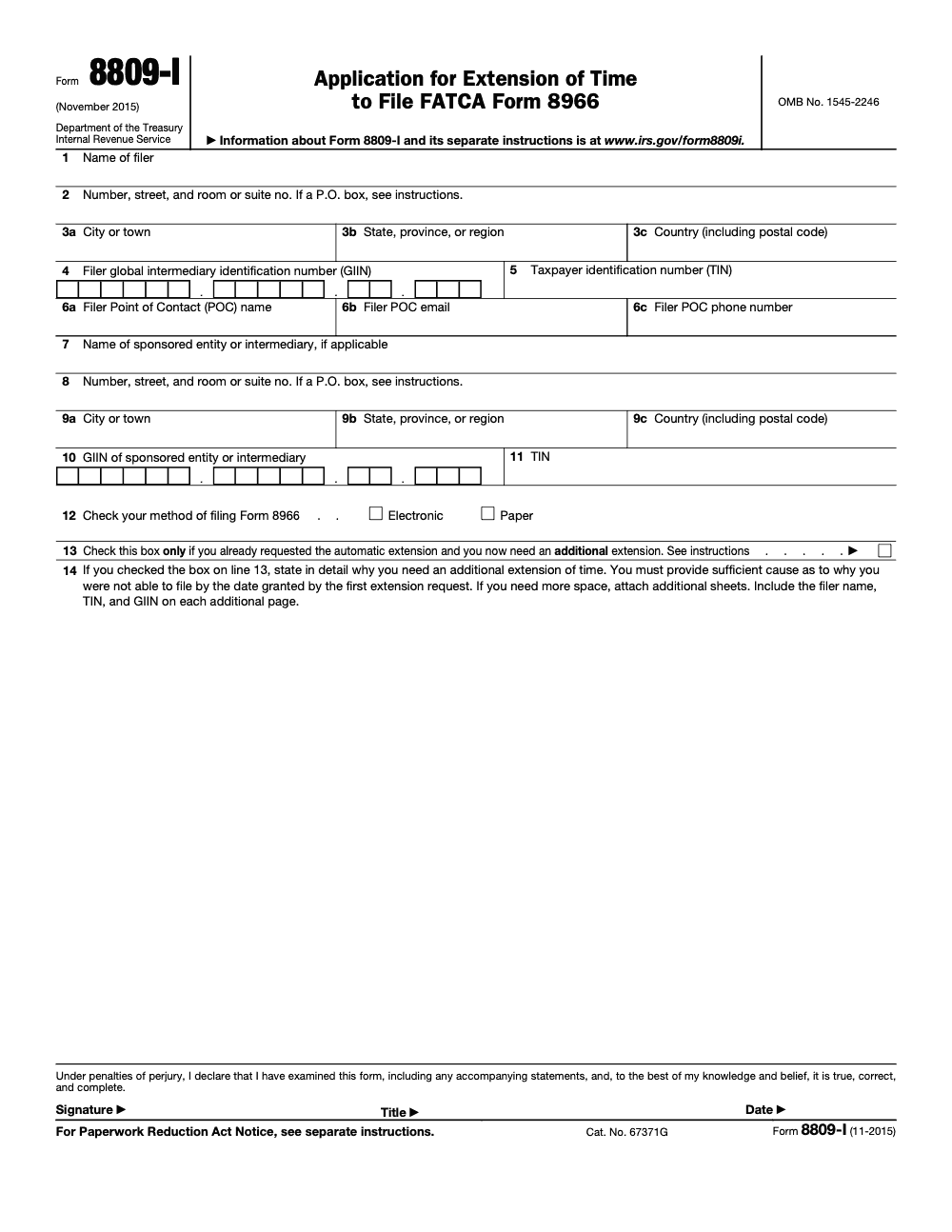
Form 8809-I is the paper application to extend the filing deadline for FATCA Form 8966 – the FATCA Report filed under chapter 4 of the Internal Revenue Code (per the IRS Form 8809-I instructions, Rev. November 2015). Filer GIIN goes on line 4, Form 8966 filing method (Electronic or Paper) on line 12, and line 13 stays blank for the first (automatic) extension – it is checked only on a subsequent additional extension request after the automatic extension has already been granted.
The Form 8809-I problem rarely shows up as a missed return. It shows up in late March, when a FATCA responsible officer notices the GIIN on their Form 8966 working file does not match the registration on record, and Form 8966 is due in days. Form 8809-I is the lever for that moment, but only if you know exactly which line does what.
Form 8809-I requests an automatic 90-day extension to file Form 8966, the FATCA Report. The filer GIIN goes on line 4, the filing method on line 12, and line 13 stays blank on the first request, getting checked only when you ask for an additional extension after the automatic one was already granted. It is a paper submission mailed to Ogden, UT, signed under penalties of perjury every time.
Key Takeaways
- Form 8809‑I lets you request an automatic 90‑day extension to file Form 8966. You must submit it by the original due date, which is generally March 31 for the prior calendar year.
- A second hardship extension of up to 90 more days is possible with a separate Form 8809‑I and a detailed explanation, filed before the first extension ends. Approval is not guaranteed.
- Form 8809‑I is a paper submission mailed to the IRS processing campus in Ogden, UT, and every Form 8809‑I must be signed under penalties of perjury (signature, title, and date), whether it is the automatic or the additional extension request. For a hardship extension, a signature is required.
- Each filer, and even each branch when applicable, submits its own extension request. Keep your approval or mailing proof in your records.
- Form 8966 is an electronic filing through IDES for most financial institutions, and you can request an electronic filing waiver on Form 8508‑I if needed (Form 8508‑I waives the electronic‑filing requirement only, it does not extend the time to file, so use Form 8809‑I for any time extension).
What Is Form 8809‑I and Who Actually Needs It
Think of Form 8809‑I as the IRS application that gives you more time to submit your FATCA Form 8966. It is not the same as domestic Form 8809 for 1099s and W‑2s, and it is not filed through FIRE. It is a FATCA‑specific extension request for entities that file Form 8966 with the IRS. The extension is automatic for 90 days when requested on time. A second extension requires hardship and a signed request.
You will use it if you are a foreign financial institution or another reporting entity responsible for Form 8966, and you know you will miss the original due date. If you operate branches, remember that each branch that needs more time files its own Form 8809‑I.
Important edge cases exist. Model 1 IGA filers generally report to their local tax authority and should not request an additional extension from the IRS. Reporting Model 2 FFIs have special rules for aggregate reporting on non‑consenting accounts. Check the instructions that apply to your status before you plan your timing.
Filing Deadlines You Must Track
The Form 8966 Due Date
For most filers, Form 8966 is due March 31 of the year after the calendar year you are reporting. That is the anchor date for your entire plan. If you expect delays, submit Form 8809‑I by that same date, and keep proof of timely mailing.
The 8809‑I Window
Your extension request must reach the IRS by the original Form 8966 due date. If the IRS grants your request, your new due date moves out by up to 90 days from the original date. If you later discover that you still cannot file, submit a second 8809‑I with a hardship explanation before the first extension ends.
Eligibility Rules and Practical Limits
Only the filer or an authorized person for that filer can request the extension. Every Form 8809‑I must be signed under penalties of perjury – signature, title, and date – by an authorized officer or representative, including the automatic extension request. For a hardship extension, the form must be signed by the filer or a duly authorized person, and the explanation must be specific and supported. None of this delays due diligence or withholding, and none of it waives penalties if you miss the extended deadline without reasonable cause.
Who Can Request
- The filer named on Form 8966 or a representative with proper authority.
- Separate requests for separate filers or branches, as applicable.
Time Limits You Cannot Bend
- File 8809‑I by the original Form 8966 due date for the automatic 90‑day extension.
- For a second 90‑day hardship extension, file a new 8809‑I before the first extension expires, include a signed statement, and provide facts.
What You Need Before You Complete Form 8809‑I
Gather filer identity information, confirm the Form 8966 year you are extending, and line up a contact who can answer IRS questions quickly.
Create a short checklist so nothing gets missed:
- Filer identity
- Legal name and complete mailing address.
- GIIN, if issued.
- TIN, if you have one, although a TIN is not required to request the automatic extension.
- A contact person’s name, phone, and email.
- What you are extending
- Identify Form 8966 as the return.
- Specify the reporting year you will file for.
- Indicate your method of filing for Form 8966, which is electronic in IDES for most financial institutions, unless you have an approved waiver on Form 8508‑I.
- Timing details
- Confirm the original due date.
- For hardship requests, prepare a signed narrative that explains why the first 90 days were not enough and exactly when you can file.
How To Submit Form 8809‑I
You submit Form 8809‑I on paper. Mail it to the IRS processing campus in Ogden, UT (Department of the Treasury, Internal Revenue Service, Ogden, UT 84201-0209) per the current Form 8809‑I separate instructions. Every Form 8809‑I must be signed under penalties of perjury – signature, title, and date – including the automatic extension request, so the signature block is never optional. For a hardship extension, sign the form and attach your explanation. Use a trackable mailing method and keep the receipt.
Where to mail Department of the Treasury, Internal Revenue Service, Ogden, UT 84201-0209 – the processing campus that receives paper Form 8809‑I filings per the current separate instructions.
After mailing, organize your records. Keep a copy of the completed form, your tracking proof or postmark, and any IRS response. If you are operating multiple branches, keep separate packets, one for each branch that requested an extension.
IRS‑Accepted Reasons And How To Write Them Well
You do not need to provide a reason for the automatic 90‑day window. You do need a solid reason if you request a second hardship extension. The IRS looks for circumstances that genuinely prevented filing within the first 90 days, and it expects your explanation to connect facts to dates.
Examples that typically support a hardship request
- A declared disaster or a major incident that halted operations at your location.
- A significant system failure or cybersecurity event that blocked access to necessary data.
- A late data dependency outside your control, documented through correspondence and logs.
How to strengthen your narrative
- State the exact dates when the problem began and ended.
- Describe the impact on the Form 8966 workpapers and IDES packaging.
- Provide the target date when you will file.
- Attach brief exhibits if they clarify the facts.
How Long The Extension Lasts And What It Covers
An approved automatic request gives you up to 90 days from the original due date. The period applies to the specified reporting year only. A second extension, if approved for hardship, can add up to another 90 days. The extension affects the filing of Form 8966 only. It does not extend FATCA due diligence, withholding, or any payment responsibilities. Plan your controls so those obligations stay on schedule.
Real‑World Planning Tips
- Build a March calendar that assumes you might need an extension, then plan backwards ten business days.
- If you support multiple branches, confirm early which ones require separate 8809‑I filings.
- Keep a one page “IDES readiness” sheet that lists your schema version, transmission certificate status, and the person on call during filing week.
Common Form 8809‑I Mistakes And How To Avoid Them
- Mixing up forms Do not confuse domestic Form 8809 with Form 8809‑I. The FATCA extension uses 8809‑I and is mailed to the Ogden, UT processing campus (Department of the Treasury, Internal Revenue Service, Ogden, UT 84201-0209) per the current separate instructions.
- Skipping the signature block Every Form 8809‑I must be signed under penalties of perjury – signature, title, and date – whether it is the automatic or the additional extension request, and any additional request must also include a clear written sufficient-cause explanation. An unsigned hardship request is treated as not filed under the penalties‑of‑perjury declaration and does not preserve a timely filing position.
- Filing late The IRS must receive your request by the original Form 8966 due date. Mail early and keep proof. A request received after the due date will be denied, and a late request does not preserve a timely filing position or shield you from failure‑to‑file exposure.
- Vague hardship narratives If you need a second extension, provide dates, systems, vendors, and the specific reason the first 90 days were not enough. General phrases like “resource constraints” invite questions.
- Missing branch logic Each branch that needs extra time should file its own 8809‑I. Do not assume one request covers an entire group.
What Happens After You File Form 8809‑I
The IRS acknowledges and processes your request. You may receive approval, a denial, or a request for more information. If approved, note your new due date immediately and align your IDES plan. If denied, the original due date remains in force, so you should file Form 8966 as soon as possible and evaluate reasonable cause if penalties apply. Keep every piece of correspondence in your retention file.
Post‑Filing Timeline
| Step | What you do | What to watch for |
| Acknowledgment | Confirm the IRS received your request | Keep mail tracking or any IRS notice |
| Information request | Respond quickly with facts and dates | Processing pauses until you answer |
| Decision | Log the new due date or plan to file right away | Update your filing calendar and owners list |
8809 vs 8809‑I, The Quick Comparison
| Topic | Form 8809 (domestic info returns) | Form 8809‑I (FATCA) |
| Purpose | Extend 1099, 1098, W‑2G, and similar returns | Extend FATCA Form 8966 |
| How filed | Online through FIRE or paper, rules vary by form type | Paper mail to IRS Ogden, UT processing campus per separate instructions |
| Automatic extension length | Often 30 days, rules vary by form type | Automatic 90 days from original due date |
| Additional extension | Sometimes 30 more days, limited and form dependent | Up to 90 more days for hardship with signed request |
| Filing system for the return | FIRE or other domestic systems | IDES for Form 8966 electronic filing |
| Common confusion | Thinking it applies to FATCA | Thinking it can be filed online like 8809 |
Notes in this table are drawn from current IRS instructions. Verify specifics that apply to your forms.
Step‑By‑Step Checklist You Can Use
- Two weeks before March 31, review your FATCA 8966 status, branch by branch.
- If any branch will miss the deadline, complete Form 8809‑I for that branch.
- Include GIIN. Include TIN if you have one. Add a clear contact.
- Mail to the Ogden, UT processing campus shown in the current Form 8809‑I separate instructions and keep tracking proof.
- Update your calendar with the new due date once approved.
- If a major event still prevents filing, prepare a signed hardship request and file a second 8809‑I before the first extension ends.
Where Disciplined Delivery Helps With FATCA Work
If your team spends March chasing workpapers and reviewer notes, the problem is usually delivery structure, not headcount. Accountably integrates trained offshore teams into your existing systems, then standardizes workpapers, review steps, and deadlines so you can file 8966 on time or, when needed, submit a clean 8809‑I early. The goal is simple, protect review time, improve file quality, and keep IDES weeks calm. Mention us only when it serves you, and only where the work requires it.
Sources And Dates
- IRS, Instructions for Form 8966, last reviewed for 2025, confirms the automatic 90‑day extension via Form 8809‑I and a possible second 90‑day hardship extension, and notes branch level requests and electronic filing through IDES.
- IRS, Instructions for Form 8809‑I, last revision published November 2015, remains the controlling instruction for mailing address, signature rules, and hardship narratives. Page last crawled recently, still current as of January 26, 2026.
- IRS, About Form 8809‑I page, reviewed January 23, 2026, confirms current product status.
Common Mistakes We See Every Season
Most Form 8809-I errors are not FATCA-reporting errors at all. They are paperwork errors that get the extension request denied, unsigned, or unfiled. Here are the six I see the most.
Reusable Checklists
Copy these straight into your firm's FATCA SOP. The data-checklist IDs let the page remember which boxes you have checked between sessions.
Form 8809-I pre-file packet
- Confirm filer legal name on line 1 matches the FATCA registration of record.
- Enter filer address on lines 2, 3a, 3b, and 3c; consult the separate instructions before entering a P.O. box.
- Enter filer GIIN on line 4 in the three-segment format separated by periods.
- Enter filer TIN on line 5; flag the file if no TIN exists yet so the team can resolve before mailing.
- Complete filer Point of Contact name, email, and phone on lines 6a, 6b, and 6c with a person reachable through the extension window.
- If a sponsored entity or intermediary is in scope, populate lines 7 through 11; otherwise leave them blank.
- Check exactly one box on line 12 (Electronic or Paper) for the Form 8966 filing method.
- Leave line 13 blank on the first request; check it only on a second, additional request.
- Complete signature, title, and date in the signature block.
Additional extension cause memo (lines 13 and 14)
- State the original Form 8966 due date and the extended date already granted under the automatic extension.
- Identify the specific event that delayed completion (sponsored entity onboarding, account-holder data lag, system migration, regulatory notice).
- Describe what has been done since the automatic extension to advance the return.
- Estimate the additional time needed and the planned filing date.
- Add filer name, TIN, and GIIN at the top of every attached page so the IRS can route them correctly.
- Have an authorized officer sign and date the cause memo before it is attached to the form.
Mailing and post-filing trail
- Mail Form 8809-I to the address shown in the current Form 8809-I separate instructions (Ogden, UT processing campus).
- Use certified mail with return receipt and retain the green card with the working file.
- Scan the signed Form 8809-I, mailing receipt, and any attached pages before sealing the envelope.
- Log the mailing date, IRS receipt date, and any IRS response in the FATCA tracker.
- Retain the Form 8809-I file with related Form 8966 workpapers for the 3-year retention period that applies to information returns generally (4 years where federal withholding is reported).
Keep 8809-I Season From Stalling
Form 8966 runs on a single, hard annual FATCA reporting cycle – the live page captures it as a late-March deadline – and that is exactly where Form 8809-I season starts and ends. Sponsored entities and direct reporting NFFEs roll onto FATCA registration in real time, which means the GIIN you verified in January may not match the structure that exists three days before the deadline. When the window narrows, Form 8809-I becomes the only protective lever left, and the request is only useful if every line is right the first time (per the IRS Form 8809-I instructions, Rev. November 2015).
The fix is not extra hours on the form. It is a repeatable workflow that pulls Form 8809-I out of the panic queue and into a normal pre-filing checkpoint. The Form 8809-I instructions and the underlying FATCA rules in Treasury Regulations §1.1471-4 and §1.1474-1 set the structure; the discipline below hardens the inputs.
- Build an early-March internal trigger that compares the GIIN on the working Form 8966 against the FATCA registration of record before any Form 8809-I is drafted.
- Standardize the line 12 selection (Electronic or Paper) by file convention, not by the preparer's guess in the moment.
- Treat line 13 as a controlled exception – a second-tier additional extension only an authorized reviewer can approve, with a line 14 cause memo attached and signed.
- Pre-stamp every attached page with filer name, TIN, and GIIN through a header template so attachments cannot get separated from the application.
- Run the signature block as a three-element checkpoint (signature, title, date) and refuse release until all three are filled.
That is the discipline we install for FATCA clients before each filing cycle, and it is the same delivery pattern we run across our U.S. tax outsourcing engagements: documented SOPs, multi-layer review, and a hard internal cutoff so Form 8809-I leaves the building well before Form 8966 is due.
FAQs
It is the IRS form you use to request more time to file FATCA Form 8966. File it by the original due date, generally March 31, to receive an automatic 90‑day extension.
Form 8809‑I is a paper-only application – the IRS Form 8809‑I separate instructions direct filers to mail it to the processing campus in Ogden, UT (Department of the Treasury, Internal Revenue Service, Ogden, UT 84201-0209). Every Form 8809‑I must be signed under penalties of perjury – signature, title, and date – including the automatic extension request. A hardship extension requires a signed request.
No. The extension covers only the filing of Form 8966. Your due diligence and withholding responsibilities continue on their normal schedule.
Yes. Each branch that needs more time files its own Form 8809‑I. Keep separate documentation for each filing.
Model 1 filers report to their local tax authority and generally should not request an additional extension from the IRS. Reporting Model 2 FFIs have special rules, and no extension applies for certain aggregate reporting. Review the instructions that match your status.
Other forms this guide names
- Form 8809: Information Return Extension Guide
- Form 8508-I: Waiver From Electronic Filing of Information Returns
- Form W‑2G: Gambling Winnings Reporting Guide
- Form 1098: How to Read It and Claim Mortgage Interest
About this guide
Accountably helps US CPA, EA, and accounting firms hire trained accountants and tax preparers in India.
About us Reviewed byJugal Thacker, CPAFounder and CEO at Accountably
A Washington-licensed CPA with 7+ years inside US firms – PwC, a real-estate tax practice, then a full-service firm, rising from reviewer to manager to advisory. This article was reviewed against current IRS guidance for the 2025 tax year and updated for filers preparing late returns, amendments, and 2026 estimates.
View profile →How we research, review, and update this guide
Every Accountably guide is researched against primary IRS sources, reviewed by a U.S. CPA, and refreshed as guidance evolves. Read our Editorial Guidelines to see how we source, fact-check, and update our content.