Summarize this article with AI
In Brief
Form 1098, the IRS Mortgage Interest Statement, is filed by any trade or business that receives $600 or more of mortgage interest from an individual on a single mortgage during the calendar year (per IRS Form 1098 Instructions, Rev. April 2025, and IRC §6050H). For tax year 2025 the recipient (borrower) copy is due January 31, 2026 (next-business-day rule shifts it to February 2, 2026) and the IRS electronic filing copy is due March 31, 2026. The borrower deducts Box 1 on Schedule A, subject to the §163(h) acquisition indebtedness cap ($750,000 for loans after December 15, 2017; $1,000,000 grandfathered). See our U.S. tax outsourcing services for Schedule A reconciliation and lender e-filing support.
The first thing most people do with a Form 1098 is check Box 1 against their own running total, and the first thing they say is that the two numbers don't match, even though usually nothing is wrong. A December payment that posted in early January lands on the next year's form, a mid-year refinance splits one mortgage across two servicers and two statements, and the lender is reporting what it actually received in the calendar year rather than what you think you paid.
Box 1 only earns you anything if you itemize on Schedule A and your loan clears the mortgage interest rules, including the $750,000 acquisition debt cap for loans taken after December 15, 2017, and the older $1,000,000 ceiling ($500,000 for married filing separately) for loans before that date. Box 5 mortgage insurance premiums sit blank on most forms now, which surprises people who deducted them a few years ago.

Key Takeaways
- Form 1098 reports $600 or more of mortgage interest you paid to a lender in a calendar year, along with loan details that help you itemize. Expect a copy for each qualifying mortgage by January 31.
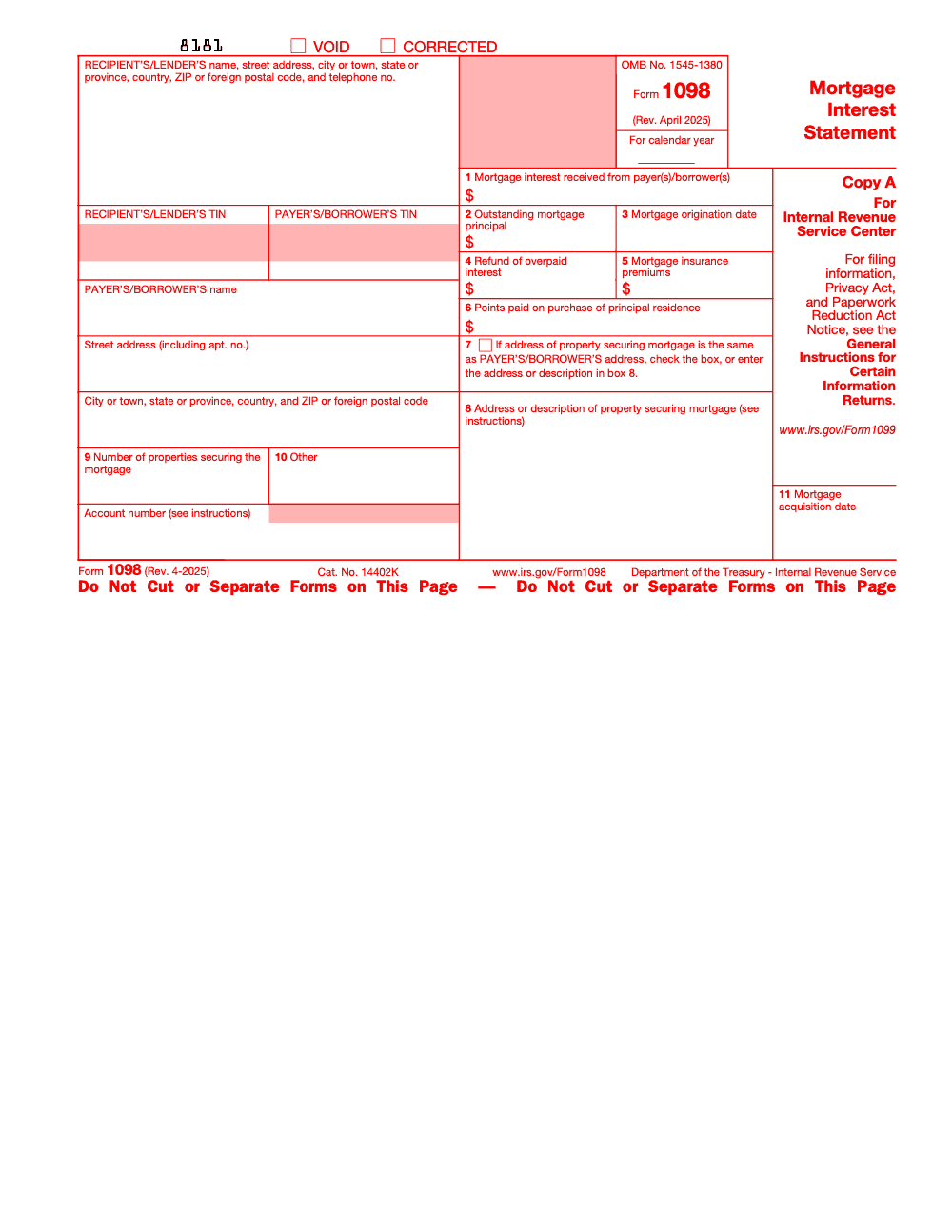
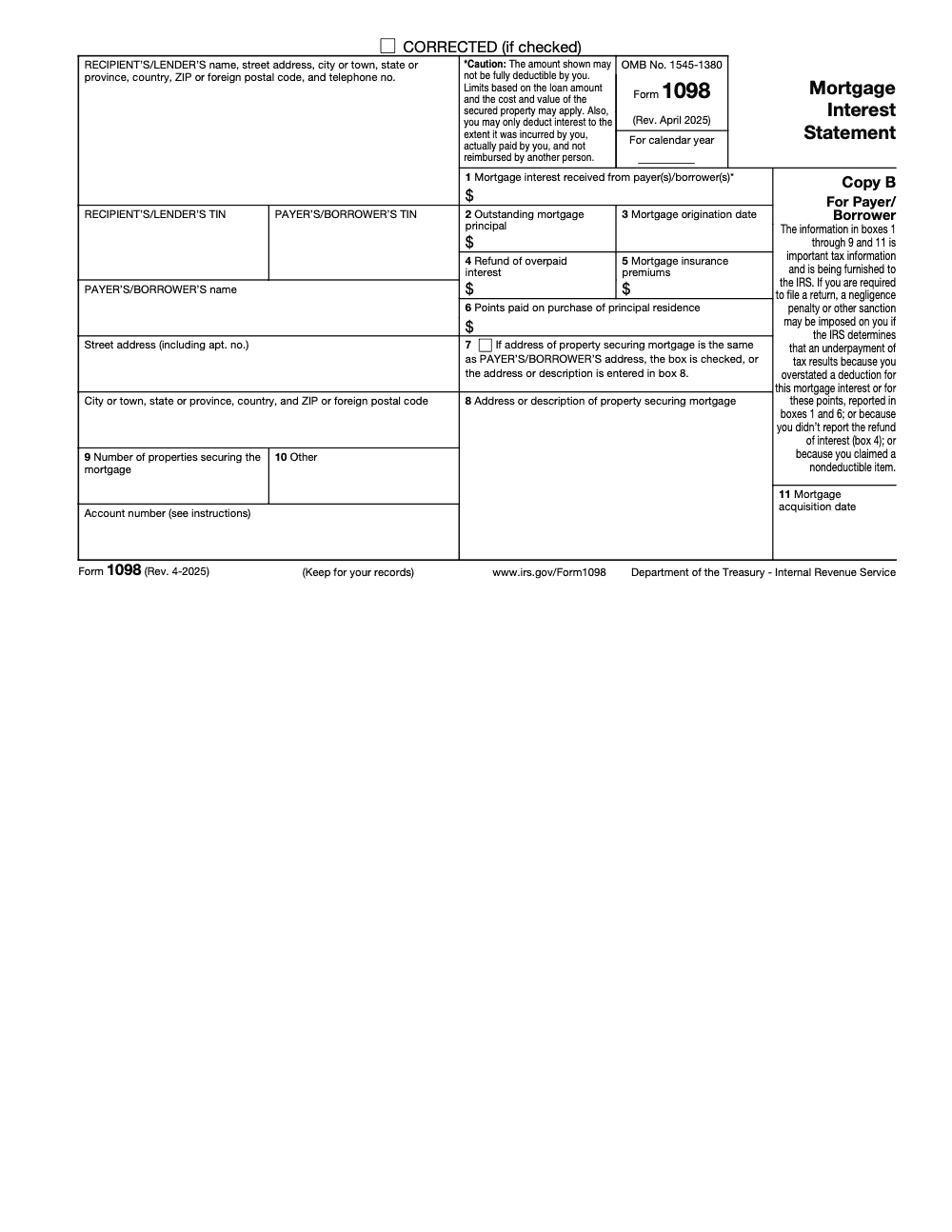
- The boxes changed in recent years. Today, key boxes are: Box 1 interest, Box 2 outstanding principal, Box 3 origination date, Box 4 refund of overpaid interest, Box 5 mortgage insurance premiums, and Box 6 points on a home purchase.
- You only benefit from Form 1098 if you itemize on Schedule A and your loan meets the mortgage interest rules, including the $750,000 acquisition debt cap for loans incurred after December 15, 2017, and the higher cap for older loans.
- Mortgage insurance premiums, shown in Box 5, are generally not deductible for tax years after 2021 unless Congress revives the provision. That is why many Box 5 entries are blank today.
- The $750,000 acquisition debt cap applies to loans incurred after December 15, 2017, while older loans keep the $1,000,000 ($500,000 MFS) ceiling. Confirm the current limit against the IRS instructions for your year before you refinance or buy.
What is Form 1098?
Form 1098, Mortgage Interest Statement, tells the IRS how much mortgage interest you paid and gives you the data you need to claim an itemized mortgage interest deduction. Lenders provide your borrower copy by January 31 and file the IRS copy separately by March 31 if filed electronically (the recipient-statement deadline and the IRS-filing deadline are not the same date). The $600 threshold applies per loan, so if you have two mortgages, you may see two forms.
The form is more than a receipt. It lists who you are and who the lender is, your loan’s outstanding principal as of January 1 of the year (or the origination date if the loan originated in the calendar year), the mortgage origination date, and whether there was any refund of overpaid interest. It can also show points you paid to buy your principal residence and any mortgage insurance premiums the lender received, even though those premiums are not deductible for post‑2021 tax years unless Congress extends the law.
Who receives Form 1098?
You receive Form 1098 if you are the lender’s payer of record on a mortgage and you paid at least $600 of reportable interest during the year. When there are multiple borrowers, the lender issues one form to the payer of record in its system. If your totals are under $600, the lender is not required to furnish a form, though some do. You will usually get a separate Form 1098 for each qualifying mortgage.
A few common edge cases:
- If you financed directly with a seller or paid interest to an entity that is not in the lending business, a Form 1098 may not be issued. Keep your own records, you can still claim eligible interest if you itemize and the loan is secured by a qualified home.
- If you are a co‑borrower but not listed as the payer of record, the statement may go to the other borrower. You can still allocate the deduction properly on your return based on who actually paid the interest and the IRS rules. Check the lender’s “payer of record” setting if you need the form reissued.
Why some boxes look different than you expect
A lot of older blog posts still say “Box 2 is points” or “Box 4 is mortgage insurance.” That was true years ago. Today’s instructions are clear, and they matter for how you read your form:
- Box 1, mortgage interest received
- Box 2, outstanding mortgage principal
- Box 3, mortgage origination date
- Box 4, refund of overpaid interest
- Box 5, mortgage insurance premiums (deductibility depends on whether Congress has extended the deduction for the year; see the Schedule A instructions and Pub. 936)
- Box 6, points paid on purchase of your principal residence
Always read the current instructions that ship with the form. They are updated and they control.
Tip, If Box 5 is blank even though you paid PMI or MIP each month, that is normal. The federal deduction expired after 2021, so many servicers do not populate Box 5 for current years. Keep your statements in case the law changes.
What the boxes mean for your return
Let’s translate the fields you will actually use when you prepare Schedule A.
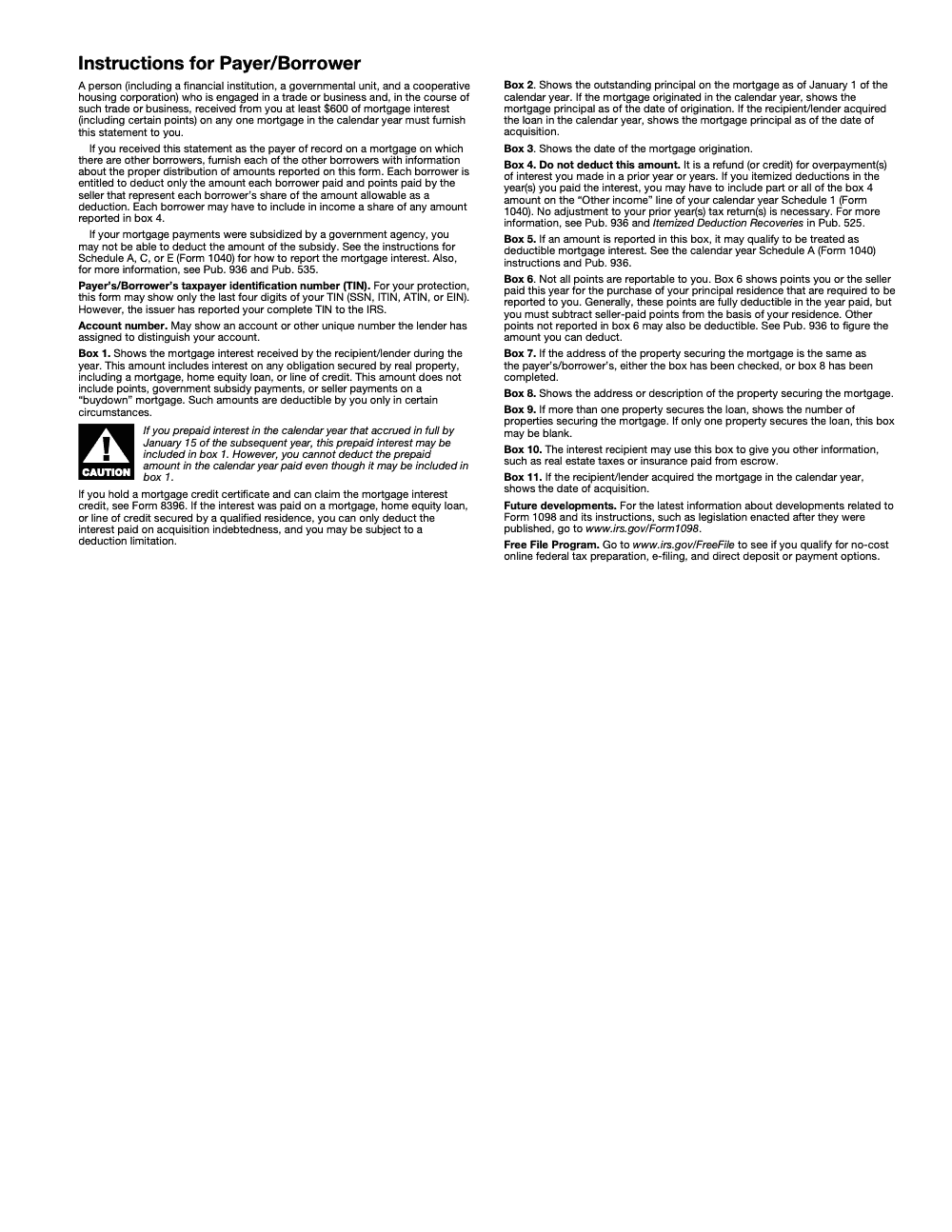
- Box 1, Mortgage interest received, This is the starting point for your itemized mortgage interest deduction. Reconcile it to your year‑end loan statement. If you prepaid December interest in late November, timing can cause small mismatches, so compare the accrual dates too.
- Box 2, Outstanding principal, This helps you monitor the size of your acquisition debt relative to the IRS limits. It does not go on your return, but it matters if you are near the cap.
- Box 3, Mortgage origination date, This date helps you determine which cap applies, $1,000,000 for older acquisition debt and $750,000 for post‑12/15/2017 debt, with a limited binding contract exception for closings by April 1, 2018.
- Box 4, Refund of overpaid interest, Do not deduct this amount. If you itemized in the prior year(s) you paid the interest, you may need to include part or all of Box 4 as Other income on Schedule 1 (Form 1040) for the current year; no prior-year amendment is required.
- Box 5, Mortgage insurance premiums, Only relevant if Congress extends the deduction. For now, premiums paid after December 31, 2021 are not deductible, which is why you may not see an amount here.
- Box 6, Points, If you bought a principal residence and paid qualifying points, you may deduct them in the year paid. For a refinance, you usually amortize points over the loan term. Keep your closing disclosure and match the label to the IRS definition of points.
Fast box‑by‑box check
- Names, addresses, and TINs match your records.
- Box 1 equals your interest paid for the year, based on accrual, not just payment date.
- Box 2 and Box 3 make sense for your loan history.
- Box 4, if any, is reflected in your deduction.
- Box 5 is blank for most current years, which is expected.
- Box 6 matches your closing disclosure if you bought a home.
When lenders must issue Form 1098
A lender must file Form 1098 with the IRS and furnish your borrower copy when its records show $600 or more of reportable mortgage interest for the year on a single mortgage. Your copy is due to you by January 31. If you have multiple mortgages, the $600 test applies to each loan separately, and you get one form per loan that meets the threshold.
Special reminders lenders follow include who must file, how to report points, how to handle multiple borrowers, and what counts as prepaid interest. These details explain why your form may look different if you refinanced, paid seller‑paid points, or moved mid‑year.
Situations when you might not receive a Form 1098
- Your total interest, points, and reportable items on one loan were under $600 for the year.
- The recipient of your payments is not in the lending business or is not required to file, for example, some seller‑financed notes.
- You are a co‑borrower but not the lender’s payer of record.
- Your servicer delivers statements electronically only, so the form is in your portal.
Good news, Even without a Form 1098, you can still deduct eligible mortgage interest if you itemize and your loan meets IRS rules. Keep statements, amortization schedules, and closing docs as proof.
What to do if the form is missing or wrong
- Check your online mortgage portal. Many servicers post by January 31.
- Compare Box 1 with your annual statement, then look for timing differences, like prepaid or late‑posted interest.
- Ask the servicer for a corrected Form 1098 if the lender name, your TIN, Box 1, Box 4, or Box 6 is wrong.
- Keep a written log of dates, contact names, and responses. If time is tight, file with your own records and attach detailed notes for your files.
How to claim the mortgage interest deduction on Schedule A
Here is a simple path I teach homeowners and new staff each year.
- Confirm you will itemize, Add up mortgage interest, state and local taxes (subject to the cap), charitable gifts, and other deductions. If itemized deductions do not exceed your standard deduction, you will not benefit from entering Form 1098.
- Gather all Forms 1098, one per qualifying mortgage.
- Enter Box 1 amounts, plus any deductible points in Box 6 for purchase loans, on Schedule A.
- If there is an interest refund in Box 4, do not deduct it. If you itemized in the year you originally paid the interest, include part or all of Box 4 as Other income on Schedule 1 (Form 1040) for the current year - do not amend the prior year's return.
- Apply the acquisition debt caps described below. Save every statement and your closing disclosure.
The IRS limits your deduction to interest on up to $750,000 ($375,000 MFS) of acquisition debt for loans incurred after December 15, 2017, and up to $1,000,000 ($500,000 MFS) for older acquisition debt, including a narrow binding‑contract exception for some 2017 purchases that closed by April 1, 2018.
Points and refinances, what to know
- If you bought a principal residence and your points meet the IRS tests, you can usually deduct them in the year paid.
- If you refinanced, you typically amortize points over the new loan’s term, unless part of the refinance paid for home improvements that may qualify for a different treatment.
- Match the description on your closing disclosure to the IRS definition of “points,” not just a generic “fee” label. Other points not reported in Box 6 (for example, refinance points) may also be deductible - see Publication 936 to figure the amount.
Mortgage insurance premiums today
Mortgage insurance premiums, often called PMI or MIP, appeared on Schedule A for years when Congress temporarily allowed the deduction. That deduction expired for premiums paid after December 31, 2021. For recent returns, you usually cannot deduct Box 5, which is why servicers often leave it blank. If Congress revives the deduction, the IRS will update instructions and servicers will resume reporting.
Publication 936 rules that actually affect you
Publication 936 is the IRS playbook for the home mortgage interest deduction. The biggest ideas are:
- Your loan must be a secured debt on a qualified home.
- Interest is deductible only on acquisition debt, money used to buy, build, or substantially improve the home that secures the loan.
- The cap is $750,000 ($375,000 MFS) for post‑12/15/2017 acquisition debt, $1,000,000 ($500,000 MFS) for older acquisition debt.
- If your average balances exceed those limits, you must prorate the deduction using the IRS worksheet.
Planning note, the $750,000 limit applies to acquisition debt incurred after December 15, 2017, and the $1,000,000 limit applies to older grandfathered debt. Confirm the cap that applies to your loan against the current IRS instructions before you purchase or refinance.
Real‑life example
You have two mortgages, both secured by qualified homes. Your Box 1 totals are 12,400 and 3,100. You itemize because your combined deductions beat the standard deduction. Your loans are post‑2017, and your average balances stayed under $750,000 combined. You can deduct the full 15,500 of interest. If the combined balances exceeded $750,000, you would apply the Publication 936 worksheet to limit the deduction proportionally.
Multiple mortgages and how to keep them straight
Treat each loan as its own packet first, then aggregate only the amounts that are actually deductible.
- Track each Form 1098 by loan number and property.
- Sum only the deductible amounts on Schedule A, mainly Box 1 interest and any current‑year deductible points.
- If one loan’s interest is under $600 and no form arrives, you can still claim eligible interest with bank records.
- Keep a simple spreadsheet, including property, lender, loan number, Box 1, Box 4, Box 6, and any notes.
Missing or incorrect Form 1098, quick fix plan
- Contact the servicer, verify your name, address, TIN, and the Box 1 amount, and request a PDF if the paper was lost.
- If the figures are wrong, ask for a “corrected Form 1098,” and confirm when they will also file the correction with the IRS.
- Document every call and message.
- If you must file before a correction arrives, use your statements to compute the deduction and keep your reconciliation in your records.
Form 1098 vs. 1098‑E, 1098‑T, 1098‑C, and 1098‑F
Here is a quick side‑by‑side so you do not mix up similarly named forms.
| Form | What it reports | Who sends it | Threshold | Your next step |
| 1098 | Mortgage interest, points, some loan details | Lender or servicer | $600 per mortgage | Use for Schedule A if you itemize and meet Pub 936 rules |
| 1098‑E | Student loan interest | Loan servicer | $600 | Claim up to $2,500 as an above‑the‑line deduction if you meet MAGI rules |
| 1098‑T | Tuition statement, payments and scholarships | School | Varies by instruction | Use for AOTC or LLC if eligible |
| 1098‑C | Vehicle donation acknowledgment | Charity | Over $500 sale proceeds | Use to substantiate charitable deduction |
| 1098‑F | Fines, penalties, restitution, compliance costs | Government agency | $50,000 aggregate, details vary | Informational for section 162(f) analysis, not a mortgage item |
The IRS sets the $600 threshold for the mortgage Form 1098 and the January 31 recipient due date. The student loan and tuition forms share the same January timeline for recipients.
A closer look at 1098‑F
Form 1098‑F is filed by a government or governmental entity when a suit, order, or agreement requires a payor to pay $50,000 or more in connection with a violation of law, including amounts for restitution or to come into compliance. Agencies also furnish a statement to the payor. In practice, if a dollar amount is not identified, agencies may enter $50,000 and add a code noting the unknown amount, which is why you might see that value even when the final settlement differs. Use 1098‑F as a notice, then analyze section 162(f) deductibility with a tax pro.
Student loan interest, the quick facts you asked about
- Maximum deduction, $2,500, claimed without itemizing.
- For 2024, the deduction phases out between $80,000 and $95,000 MAGI for single filers and $165,000 to $195,000 for joint filers. For 2025, check the latest IRS guidance when you prepare your return, since the IRS sets thresholds annually.
Keep your 1098‑E and your own interest records. If you paid less than $600, you might not receive a form, but you can still claim eligible interest.
For CPA, EA, and firm owners, keeping 1098 work clean at scale
Every January, our team reviews thousands of lender PDFs, and the same issues show up, mismatched Box 1 due to timing, missing corrected forms, and confusion over Box 5. The cure is a simple SOP, name files consistently, reconcile Box 1 to year‑end statements, flag Box 4 refunds, confirm origination dates for the cap rules, and note that Box 5 is usually not deductible after 2021. If your in‑house team is buried in season, a disciplined offshore delivery partner can plug in at the review level without changing your workflow or risking quality.
Accountably’s role here is limited and practical, we integrate trained offshore teams into your existing systems, with SOP‑driven workpapers and layered review that cut partner time in the review loop. That helps you meet the January 31 document checks, keep Schedule A clean, and protect client trust without adding overhead. If you want to compare engagement models or see sample workpapers, reach out when it makes sense.
Resources and current revision status
- Instructions for Form 1098, revised April 2025, with box‑by‑box definitions and important notes about points and mortgage insurance reporting.
- Publication 936, 2024 edition, the authoritative rules and worksheets for the mortgage interest deduction.
- Publication 530, 2024 edition, confirms no deduction for mortgage insurance premiums paid after 2021.
- General Instructions for Certain Information Returns, due dates table that shows Form 1098 must be furnished to recipients by January 31.
- Publication 970, 2024, for student loan interest MAGI thresholds and annual updates for 2025.
Updated, October 28, 2025. This guide is general information, not tax advice. For your situation, speak with a qualified tax professional and check the latest IRS instructions for any late‑year changes.
The bottom line
Use Form 1098 as your map, not the destination. Confirm that Box 1 matches your records, understand which cap applies to your loans, ignore Box 5 for now unless the law changes, and keep tidy documentation. If you operate a firm, put a lightweight SOP around January forms and reviews so your team glides into filing season. With a few smart checks, you will turn a pile of PDFs into a clean Schedule A and finish early with less stress.
Common Mistakes We See Every Season
The same handful of reading and filing errors show up every January. On the borrower side, most trace back to treating Box 1 as the deductible figure rather than the gross interest received. On the issuer side, the patterns cluster around the two deadlines, correction procedures, and the scannable Copy A trap. Here are the ones my team flags most often.
Reusable Checklists
These checklists are copy-paste ready for filing-season SOPs and pre-filing review packets. Each item points back to the IRS guidance behind it so a junior preparer can self-check before review.
Lender pre-file packet (Form 1098 issuer)
- Confirm each mortgage has $600 or more of reportable interest received from an individual in the calendar year, per IRC §6050H.
- Pull the latest April 2025 revision of Form 1098 and the General Instructions for Certain Information Returns (2025).
- Verify the payer/borrower TIN; mask all but the last four digits on the recipient copy.
- Populate Box 1 with gross interest received; exclude points (Box 6), government subsidy payments, and seller-paid buydown amounts.
- Confirm Box 3 origination date and Box 11 mortgage acquisition date if the recipient acquired the mortgage during the year.
- If aggregate information returns across form types are 10 or more, confirm e-file path through FIRE (or IRIS from filing season 2027) under Treasury Decision 9972.
- Schedule recipient statements for the January 31 furnish date; schedule IRS electronic filing for March 31.
- File Form 8809 by the IRS due date for an automatic 30-day extension if needed; file Form 15397 separately for any recipient-statement extension.
Borrower Schedule A intake
- Collect every Form 1098 the lender or lenders issued for the year, one per qualifying mortgage.
- Confirm the return will itemize: total Schedule A deductions must exceed the 2025 standard deduction ($15,750 single or MFS, $31,500 MFJ, $23,625 head of household after the OBBBA update).
- Reconcile Box 1 against the year-end loan statement; flag timing differences for prepaid or late-posted interest.
- Apply the IRC §163(h) acquisition indebtedness cap: $750,000 ($375,000 MFS) for post-12/15/2017 loans, $1,000,000 ($500,000 MFS) for grandfathered loans. Run the Publication 936 worksheet if balances approach the cap.
- If Box 4 has a refund of overpaid interest, do not deduct it; include the refund on Schedule 1 Other income only if the prior year was itemized.
- If Box 6 reports points, confirm purchase versus refinance; refinance points generally amortize over the loan term.
- If Box 10 reports real estate taxes paid from escrow, route them to the Schedule A taxes line, subject to the 2025 SALT cap of $40,000.
- Treat Box 5 mortgage insurance premiums as nondeductible unless the current-year Schedule A instructions confirm an extension.
Correction and reissue protocol
- Identify the error type: payer/borrower TIN, name, Box 1, Box 4, Box 6, or property address.
- If the original was filed electronically, file the correction electronically through the same system (FIRE for now; IRIS from filing season 2027).
- Use the CORRECTED checkbox; never check VOID on a return already submitted to the IRS.
- For one-transaction corrections, place Code G in field position 6 of the Payee ‘B’ Record per Publication 1220.
- Submit corrections within the three-calendar-year lookback window (four years if backup withholding under IRC §3406 was reported).
- Retain copies or the data needed to reconstruct them for at least three years from the reporting due date (four years if federal withholding was reported).
- If a corrected Form 1098 cannot be reissued before the borrower files, document the discrepancy and reconcile from the year-end statement and amortization schedule.
Keep 1098 Season From Stalling
Form 1098 season looks small from the outside, one statement per loan, mailed by January 31. Inside a firm that handles mortgage-interest filings or Schedule A returns at volume, the math changes fast. A mid-size servicer can issue tens of thousands of Forms 1098, and every miskeyed Box 1 or missed corrected return turns into a borrower call in February. Treasury Decision 9972 made e-filing mandatory at 10 aggregate information returns, which means even small lenders are now inside the FIRE (and soon IRIS) regime.
The fix is not more hours; it is structure around the two-deadline calendar (January 31 recipient copies, March 31 IRS electronic filings) and a layered review path that catches reading errors before they hit a Schedule A. The patterns that hold up across high-volume January work are predictable.
- Standardize Box 1 reconciliation against year-end loan statements so timing differences, like December interest posting in early January, get flagged before the recipient copy goes out.
- Build a Box 3 origination-date check into the SOP so the right acquisition indebtedness cap, $750,000 ($375,000 MFS) post-12/15/2017 or $1,000,000 ($500,000 MFS) grandfathered, applies automatically when the file moves to Schedule A.
- Route Box 4 refunds to Schedule 1 Other income only when the prior year was itemized; this is the single most common borrower mistake we see each January.
- Lock the corrections workflow to the original filing channel (electronic corrections for electronic originals per Publication 1220) and reserve the VOID checkbox strictly for paper Copy A that has not yet been mailed to the IRS.
- Submit a Transmitter Control Code (TCC) application by November 1 of the prior year so FIRE (or IRIS) access is approved well before the March 31 e-file deadline.
Accountably’s role here is operational, not promotional: we plug trained, U.S.-led offshore teams into the existing review path so the January-to-March 1098 cycle runs without partner-level rework. The U.S. tax outsourcing service covers Schedule A reconciliation, the corrections workflow, and FIRE/IRIS filing support inside SOC-2-aligned controls.
FAQs
No. You can claim eligible mortgage interest if you itemize and your loan meets the rules, even if your lender did not issue a Form 1098. Keep statements, amortization schedules, and your closing disclosure as proof.
The federal deduction for mortgage insurance premiums expired for premiums paid after December 31, 2021. Many servicers do not report Box 5 amounts for current years. If Congress extends the law, the IRS will update instructions and lenders will resume reporting.
Only acquisition debt, money used to buy, build, or substantially improve the home securing the loan. If your balances exceed the cap, use the IRS worksheet in Publication 936 to compute the deductible portion.
Purchase points that meet the IRS tests are usually deductible in the year paid. Refinance points are generally amortized over the new loan term, with a few exceptions. Match your closing disclosure to the IRS definition of “points.”
Expect a separate Form 1098 per loan that meets the $600 threshold. Aggregate only the deductible amounts on Schedule A.
If you ever receive a 1098‑F from a government agency, it is a heads‑up that section 6050X reporting has been triggered at the $50,000 level for fines, penalties, restitution, or compliance costs. It is informational. Review section 162(f) with your advisor to see what is deductible.
Other forms this guide names
- Form 1098-F: $50,000 Threshold, Reporting Rules, Deductibility
- Form 1040: Filing Guide for 2025 Returns (AGI, Deductions, Deadlines)
- Form 1098‑E: Student Loan Interest Deduction Guide
- Form 1098‑T: Guide: Read Boxes Correctly and Claim Credits
- Form 8809: Information Return Extension Guide
- Form 15397: 30-Day Recipient Copy Extension Guide (2025)
Summarize this article with AI
About this guide
Accountably helps US CPA, EA, and accounting firms hire trained accountants and tax preparers in India.
About us Reviewed byJugal Thacker, CPAFounder and CEO at Accountably
A Washington-licensed CPA with 7+ years inside US firms – PwC, a real-estate tax practice, then a full-service firm, rising from reviewer to manager to advisory. This article was reviewed against current IRS guidance for the 2025 tax year and updated for filers preparing late returns, amendments, and 2026 estimates.
View profile →How we research, review, and update this guide
Every Accountably guide is researched against primary IRS sources, reviewed by a U.S. CPA, and refreshed as guidance evolves. Read our Editorial Guidelines to see how we source, fact-check, and update our content.