Summarize this article with AI
In Brief
Form 8820 is the Orphan Drug Credit form under IRC § 45C – use it to claim 25% of qualified clinical testing expenses, or elect the reduced 19.75% rate under § 280C(b)(3) on line 2a to keep the full deduction. The current Rev. September 2018 version remains in use for tax year 2025 returns (per IRS.gov, About Form 8820); the net credit on line 4 carries to Form 3800, Part III, line 1h.
People assume the orphan drug credit is a flat number you drop on the return. It is not. On Form 8820 you choose between claiming 25% of your qualified clinical testing expenses or electing the reduced 19.75% rate on line 2a under §280C(b)(3) to keep your full deduction, and the choice has to be made on a timely original return, where it locks for the year.
Where the file usually breaks is upstream of that election. Costs have to fall after FDA orphan-drug designation and before approval, they cannot be funded by grants or governments, and they cannot double count with the research credit under §41. Get those right and line 4 carries cleanly to Form 3800, Part III, line 1h.
Key Takeaways
- The orphan drug credit equals 25% of qualified clinical testing expenses for FDA‑designated orphan drugs. You claim it on Form 8820 and carry it to Form 3800.
- You may elect a reduced credit under §280C so you keep your full deduction. With today’s corporate rate, that reduced rate equals 19.75%. The election must be on a timely original return and is irrevocable for the year.
- Costs must occur after FDA orphan‑drug designation and before approval or licensure, and they cannot be funded by grants, contracts, governments, or another taxpayer. 100% of contract research counts.
- Do not double count expenses with the research credit under §41. §45C has a coordination rule that prevents overlap.
- ProConnect users can enter carryovers and current‑year amounts so the credit flows to Form 3800. We include the exact menu path below.
What Form 8820 Covers, In Plain English
Form 8820 is the IRS form you use to figure and claim the orphan drug credit, and to make the §280C reduced‑credit election if that is better for you. You attach it to a timely filed original return, then the total feeds into Form 3800 with your other general business credits.
Who files and when
You file Form 8820 if you paid or incurred qualified clinical testing expenses for a drug or biologic that holds FDA orphan‑drug designation, and you want the credit. Corporations, individuals, partnerships, S corps, estates, and trusts can all have a filing position. One exception, if your only source of the credit is a K‑1 from a partnership, S corp, estate, or trust, you skip Form 8820 and report the credit directly on Form 3800. File it with your original return by the due date, including extensions, and keep it with your workpapers that prove timing and amounts.
What counts as qualified clinical testing expenses
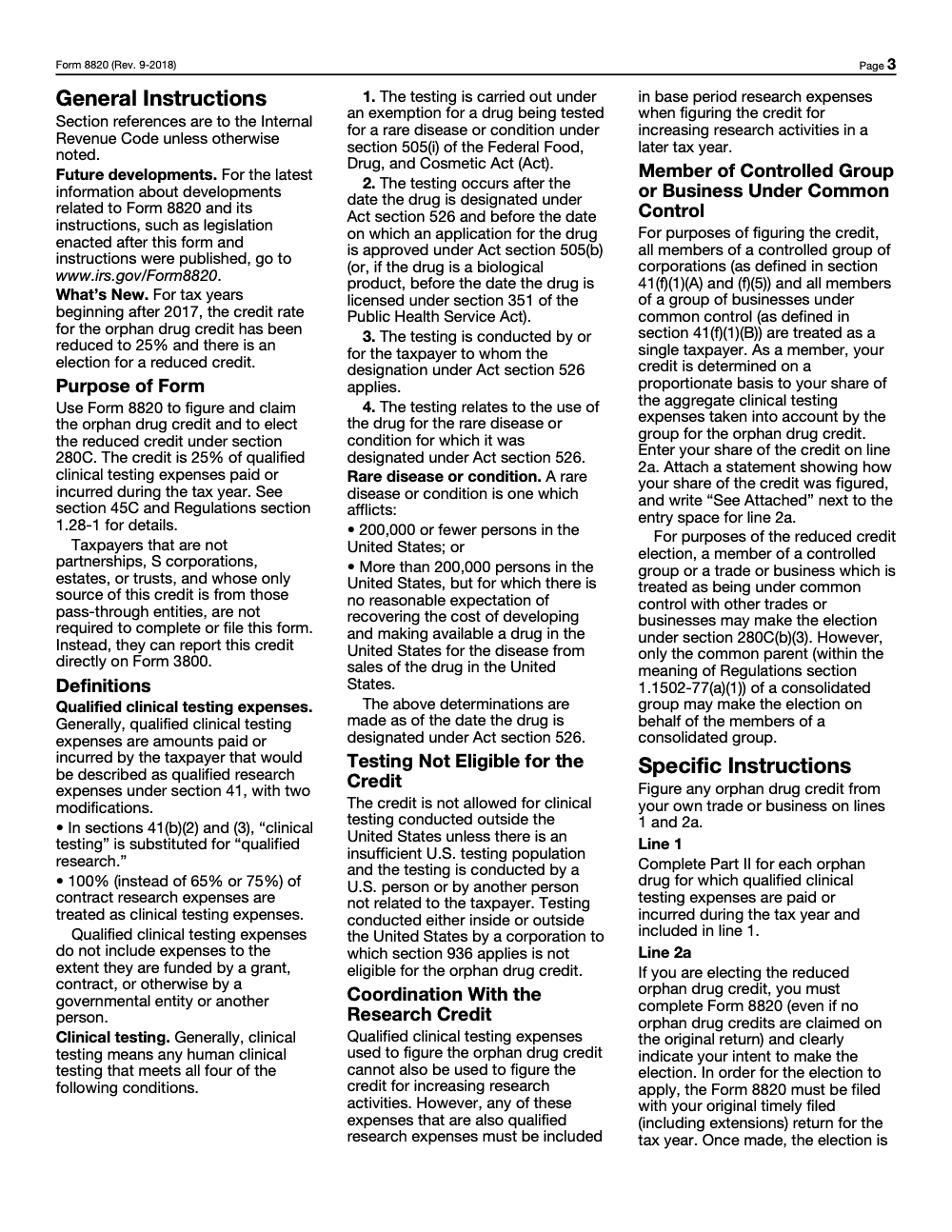
Start with the research credit rules, then apply the orphan‑drug modifications. Qualified clinical testing expenses are the amounts you paid or incurred for human clinical testing that, one, was conducted under FDA section 505(i) for drugs or section 351 for biologics, two, happened after your FDA orphan‑drug designation date, and three, finished before FDA approval or licensure. The law also lets you include 100% of contract research for these tests, instead of the §41 standard 65%, or 75% when the contract is with a qualified research consortium. Exclude any amounts funded by grants, government contracts, or another person.
The two rates you will actually use
- Standard credit, 25% of qualified clinical testing expenses.
- Reduced credit election under §280C, which equals the gross credit reduced by the maximum corporate rate under §11(b). With a 21% rate, that is 25% × 79% = 19.75%. The election must be made on a timely original return and, once made, cannot be changed for that year.
The Fast Path Through Form 8820
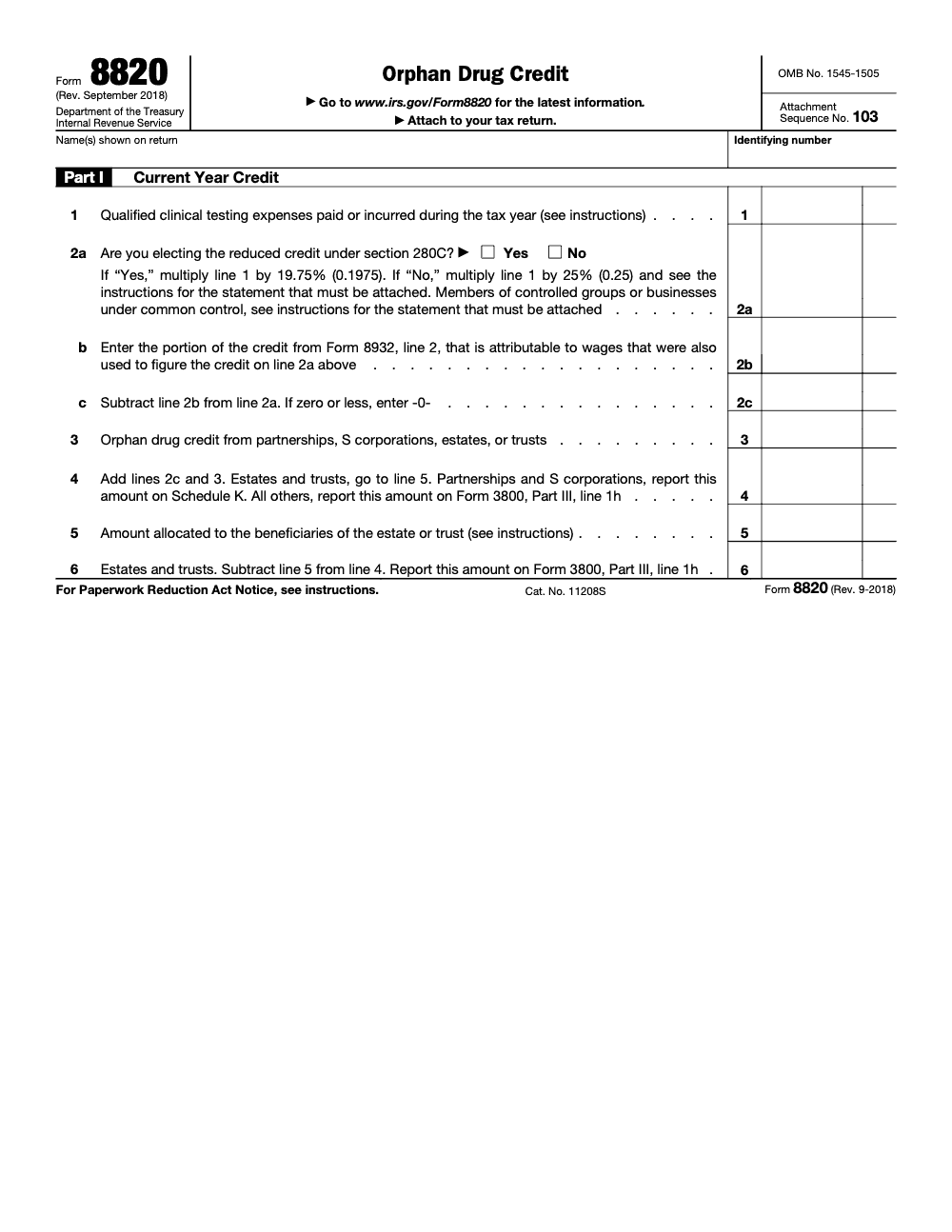
- Part I, enter your total qualified clinical testing expenses on Line 1, compute either 25% or 19.75% depending on your §280C choice, then add any pass‑through amounts and route the total to Form 3800.
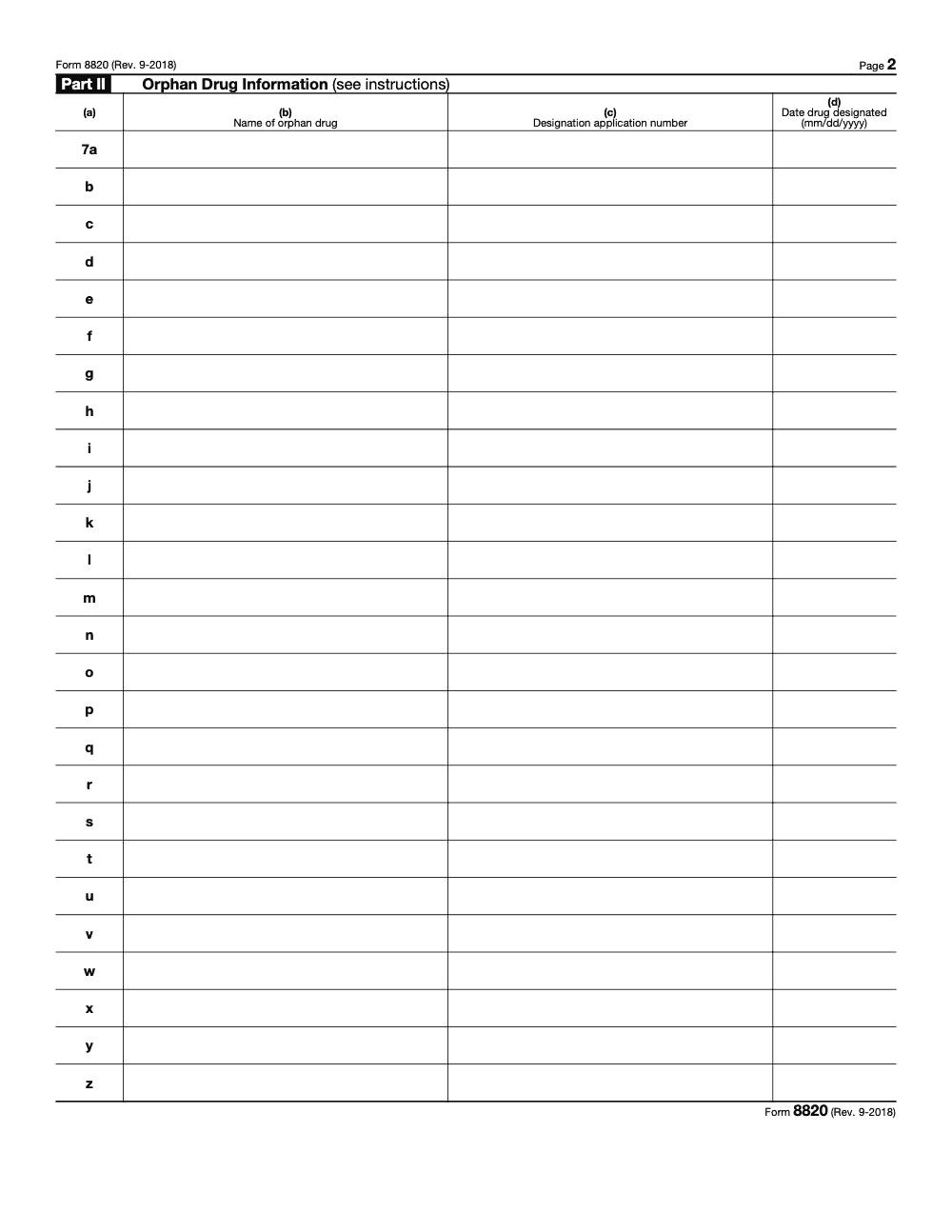
- Part II, list each drug with its generic or proper name, the FDA orphan‑drug designation application number, and the designation date. The list must support that your costs occurred after designation and before approval or licensure.
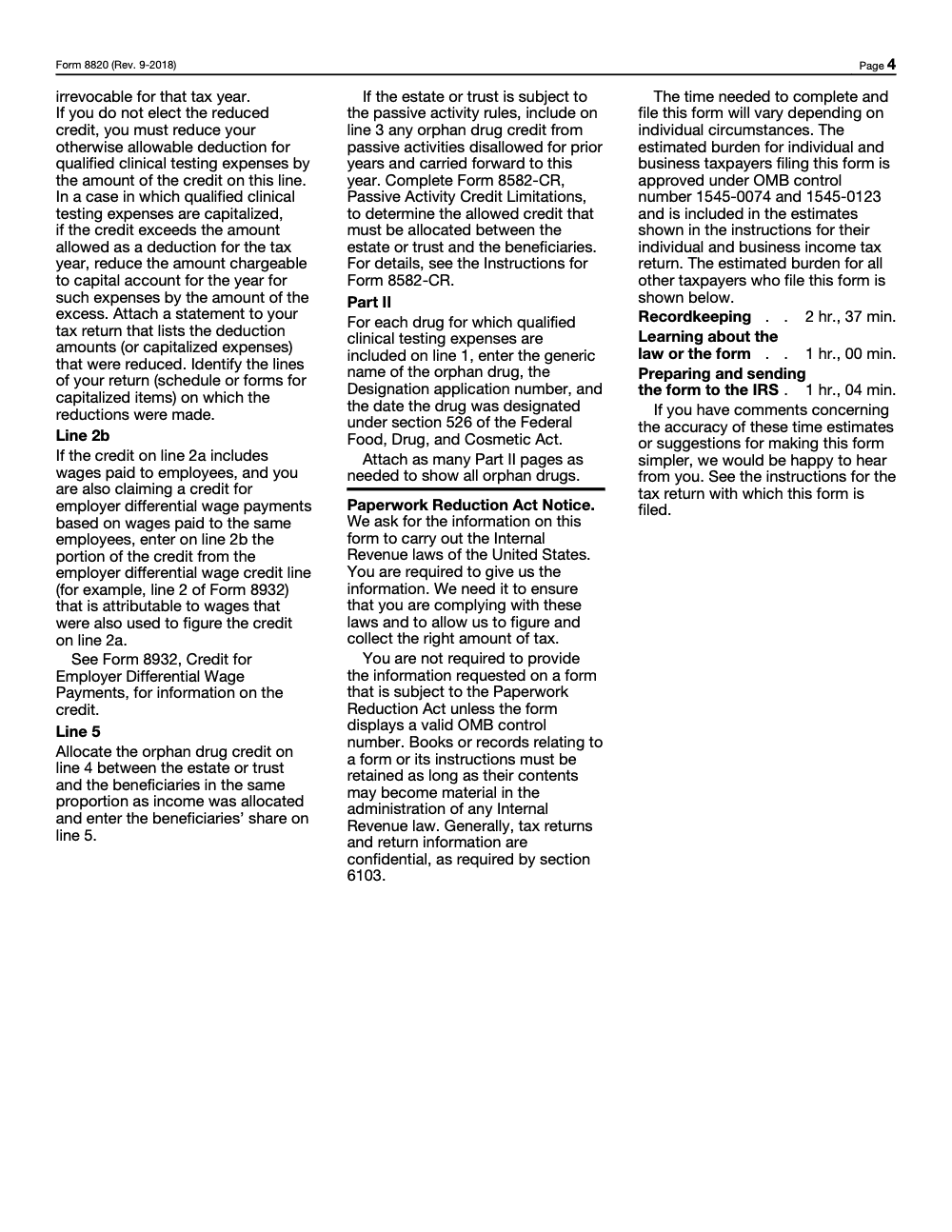
If you take the full 25% credit, reduce the related deductions or, if capitalized, reduce the capital account by any excess. If you elect §280C, you use the 19.75% rate and you do not reduce deductions. The statute controls both the disallowance and the reduced‑credit math.
What To Collect Before You Start
- FDA orphan‑drug designation letter that shows the exact indication and the designation date.
- Trial protocols and IND references that prove the testing was under section 505(i) or section 351.
- A ledger of clinical invoices, CRO bills, and internal allocations tied to the designated indication, with dates and cost centers.
- Evidence that no third party funded the claimed amounts, such as grant award letters or zero funding certification in your file.
- If you are part of a controlled group or have pass‑through entities, a clear allocation schedule for owners so the amounts flow correctly to Form 3800. Controlled‑group and common‑control members are treated as a single taxpayer under §41(f), so the group aggregates clinical testing expenses first, then each member takes a proportionate share and attaches a statement showing how that share was figured.
A quick example
Say you incurred 2,400,000 of qualified clinical testing expenses after designation and before approval.
- Standard method, credit is 25% × 2,400,000 = 600,000, and you must reduce the related deductions or capitalized amounts.
- §280C reduced method, credit is 19.75% × 2,400,000 = 474,000, and you keep your full deduction. Deciding between the two depends on your current and future tax position, including Form 3800 limits and net operating loss posture.
Software tip for ProConnect
In ProConnect, you can enter prior‑year unallowed amounts under Credits, General Business and Vehicle Credit, then choose Orphan drug, 8820. The software routes the amount to Form 3800 after passive limits, which keeps your carryovers intact. We walk through more entries later in this guide.
Note, do not claim the same dollar of expense for both the orphan drug credit and the §41 research credit. §45C has a coordination rule that blocks double benefit, and exam teams often ask for a side‑by‑side tie‑out.
25% vs 19.75%, How To Choose With Confidence
Your decision comes down to a trade, a larger credit today with a required deduction reduction, or a slightly smaller credit that preserves your deduction. Under §280C(b)(3), the reduced credit equals the gross credit minus the product of that credit and the maximum corporate rate under §11(b). With a 21% rate, that is 19.75% of your qualified clinical testing expenses. The election must be made on a timely original return and, once made, it is locked for the year.
Side‑by‑side comparison
| Choice | Credit rate | What you give up | When it helps |
| Standard credit | 25% | Reduce related deductions, or reduce capitalized amounts if deductions are not enough | Best when you need every dollar of current‑year credit and Form 3800 limits will not choke the benefit |
| §280C reduced credit | 19.75% | A smaller credit | Best when deductions are valuable this year, or when Form 3800 limits push you into carryovers anyway |
Rule of thumb, if your deduction is worth more at your expected tax rate than the extra 5.25 percentage points of credit, the §280C election often wins. Always test both paths in your model.
Preventing double counting with the research credit
Congress anticipated overlap between the orphan drug and research credits. The coordination rule in §45C blocks you from taking both credits on the same expense dollars. The expenses you used for the orphan drug credit must still be included in base period research expenses when you compute the §41 credit in a later year, they are excluded only from the current‑year qualified research expense pool. Build an internal worksheet that tags each expense line as 45C, 41, or neither, then reconcile totals to your return. If exam asks, you can show exactly how you avoided overlap.
Documentation That Survives Review
Auditors do not want a story, they want a timeline and evidence.
- Timeline, designation date, first human test date under section 505(i) or 351, and the approval or licensure date.
- Scope, match each trial and invoice to the designated indication.
- Funding, prove that no third party funded the claimed amounts.
- Math, tie every claimed dollar back to ledgers and statements, then forward to Lines 1 and 2 of Form 8820 and to Form 3800.
Keep a one‑page summary at the front of your file, dates, amounts, the rate you chose, and why.
Completing Part I, step by step
- Add up qualified clinical testing expenses paid or incurred this year that meet the timing window. Enter that total on Line 1.
- On Line 2, compute your credit, either 25% or 19.75% if you elected §280C.
- Add pass‑through amounts received, then carry the total to Form 3800 with any other general business credits. If you did not elect §280C, reflect the required deduction or capital account reduction in your return and keep a copy of the reduction statement in your file.
Completing Part II, the details that matter
List each designated drug or biologic with the exact name, the FDA orphan‑drug designation application number, and the designation date. Your list should make it obvious that every dollar on Line 1 falls between designation and approval or licensure. If you need more space, attach a continuation sheet with the same columns.
ProConnect entries that save time
For carryovers, go to Credits, General Business and Vehicle Credit, then use the Prior Year Unallowed Credits grid, choose Orphan drug, 8820, and enter the amount. The software flows it to Form 3800 after passive limits. For new‑year amounts, follow your module’s 8820 input screens and verify that totals reconcile to your workpaper summary.
Common Pitfalls We See
- Claiming pre‑designation or post‑approval costs, those are out.
- Missing or mismatched designation numbers, which breaks your Part II tie‑out.
- Claiming amounts funded by grants or contracts, the statute excludes them.
- Forgetting to model the §280C election on a timely original return, you cannot change it later for that year.
- Double counting with §41, fixable in planning, painful in audit.
A quick planning checklist
- Run a two‑column model, 25% vs 19.75%, include Form 3800 limits and any NOL interaction.
- Tag clinical spend by indication to protect against overlap with §41.
- Keep a clean copy of the FDA designation letter and the approval or licensure notice in your file.
- If you are a pass‑through, prepare owner allocations early, not during busy season.
A Simple, Audit‑Ready Workpaper Set
- Cover page, designation date, testing window, approval or licensure date, and the rate you chose.
- Expense schedule, vendor, date, description, amount, indication tag, and whether it is 45C, 41, or excluded.
- Funding check, proof that no third party funded the claimed dollars.
- Reconciliation, totals to Form 8820 Part I and to Form 3800.
- Part II detail, each drug matched to its designation information.
How firms keep Form 8820 work clean at scale
When the calendar turns and deadlines stack up, the weak points are always the same, naming, versions, reviews, and timing proof. If your team is buried, consider a more disciplined delivery setup, standard operating procedures for Part II, structured workpapers, and a layered review that protects partner time. This is where an offshore delivery system can help, not by throwing resumes at the problem, but by plugging trained people into a strict workflow inside your tools. That is the operating model we use at Accountably, U.S. led teams, SOP‑driven execution, structured workpapers, and a multi‑layer review so tax partners are not stuck in late‑night loops.
Final Checks Before You File
- Confirm your 25% vs 19.75% model and make the §280C election on a timely original return if you choose the reduced credit.
- Verify every dollar is within the designation‑to‑approval window and is not funded by another party.
- Reconcile Form 8820 to Form 3800 and to owner schedules if you are a pass‑through.
- Save FDA designation letters, IND references, approval or licensure notices, and your expense ledger behind a one‑page summary.
If you keep the timing tight, the math clean, and the file self‑explanatory, Form 8820 becomes a straight shot, not a scramble.
Common Mistakes We See Every Season
Same patterns repeat across orphan drug credit returns. Sometimes from staff new to §45C, sometimes from veterans whose memory of the rules predates TCJA. These are the ones we catch most often before a return ships.
Reusable Checklists
Pull these directly into your firm SOPs. The page persists check states locally, so a senior reviewer can pick up exactly where the preparer stopped.
QCTE eligibility scan
- Confirm each drug has an active FDA §526 orphan designation and the designation application number is on file.
- Pull the designation date and verify every clinical testing dollar falls AFTER it.
- Confirm an FDC Act §505(i) IND exemption is on file for each drug being tested.
- Confirm no testing extends past §505(b) approval or PHS Act §351 licensure for the designated indication.
- Exclude every dollar funded by grants, contracts, government, or another person to the extent funded.
- For contract research, confirm 100% of expense is captured on line 1, not the §41 standard 65% or 75%.
- Flag any testing performed by a §936 corporation. It is ineligible regardless of location.
- Confirm no QCTE is also being used to figure the §41 research credit on the same return.
§280C reduced credit decision
- Compute the gross credit at 25% of line 1 QCTE.
- Compute the reduced credit at 19.75% of line 1 (25% × (1 − 21%) under current §11(b)).
- Identify the §174 or capitalized R&D deduction tied to those expenses.
- Model the after-tax outcome: 25% credit minus lost deduction vs. 19.75% credit with full deduction retained.
- Document the §11(b) maximum corporate rate used in the calculation.
- Make the election on the timely filed original return (extensions count). Once made it is irrevocable for the year.
- For consolidated groups, route the election to the common parent only under Reg §1.1502-77(a)(1).
- If electing, complete Form 8820 even when no current-year credit is being claimed.
Part II documentation packet
- Enter the generic name of the orphan drug in column (b). Brand names are wrong.
- Enter the FDA orphan-drug designation application number in column (c).
- Enter the designation date in mm/dd/yyyy format in column (d).
- Attach additional Part II pages if more than 26 drugs (rows 7a through 7z).
- For controlled or common-control group filers, attach the share allocation statement and write "See Attached" next to line 2a.
- If no §280C election, attach a statement listing each reduced deduction amount and the return line where the reduction was made.
- Coordinate line 2b with Form 8932, line 2 when the same wages support both credits.
- Retain FDA designation letters, IND references, approval or licensure notices, and the QCTE ledger behind a one-page summary.
- Reconcile line 4 to Form 3800, Part III, line 1h before the engagement closes. Partnerships and S corps route the amount through Schedule K instead.
Keep 8820 Season From Stalling
Form 8820 stalls returns for a different reason than most tax forms. The work is not high volume, but every dollar on line 1 sits inside a narrow FDA timing window, a §41 coordination rule, and a one-shot §280C(b)(3) election that locks for the year on the original timely filed return (per Form 8820 instructions). When the documentation is loose, even a single drug program can hold the parent return until a reviewer can reconstruct the eligibility math from raw ledgers.
The fix is to treat each drug as its own workpaper tab with FDA timing fixed at the top, contract research grossed to 100% on a visible bridge, and the §280C election decision documented before the return ships – not after.
- Lock each drug's FDA §526 designation date as a hard line in the QCTE ledger. Everything before the date drops out; everything after §505(b) approval or PHS Act §351 licensure drops out.
- Maintain a parallel 100% contract research bridge from the §41 workpaper to Form 8820 line 1. The orphan drug rule overrides the §41 65% or 75% factor (per Form 8820 instructions).
- Decide §280C(b)(3) once per program per year and lock the math at 19.75% (or 25% with deduction reduction) before filing. The election is irrevocable for the tax year (per IRC §280C(b)(3)).
- Coordinate line 2b with Form 8932, line 2 whenever the same wages support both the orphan drug credit and the employer differential wage credit. Line 2c floors at zero.
- Reconcile line 4 to Form 3800, Part III, line 1h before the engagement closes. Partnerships and S corps route the amount through Schedule K to the partners or shareholders instead.
- For controlled or common-control groups, finalize the share-allocation statement before the return ships. The "See Attached" notation next to line 2a is mandatory for every member.
This is the kind of work where structured delivery beats raw capacity. Accountably's tax execution teams run §45C workpapers with FDA timing locked, contract research bridged at 100%, and the §280C election decision documented in a peer-reviewable format, so the parent return moves without waiting on credit cleanup.
FAQs
Amounts you paid or incurred for human clinical testing related to a designated rare disease or condition, conducted under FDA section 505(i) for drugs or section 351 for biologics, after the designation date and before approval or licensure. Include 100% of contract research. Exclude any amounts funded by grants, contracts, governments, or another taxpayer.
You may elect a reduced credit so you keep your full deduction. The reduced credit equals the gross §45C credit minus that credit times the maximum corporate rate under §11(b). With a 21% rate, the effective rate is 19.75%. You must make the election on a timely original return and it is irrevocable for that year.
Form 8820 computes the orphan drug credit and then feeds it to Form 3800, which aggregates your general business credits and applies the limits. Partnerships and S corps pass amounts to owners who report their share on Form 3800.
No. §45C has a coordination rule with §41 that prevents double counting. Decide which credit produces the better outcome, then tag each expense line to the chosen credit in your workpapers.
For each drug or biologic, show the name, the FDA orphan‑drug designation application number, and the designation date. Your Part II list should let an examiner verify that every cost in Part I happened after designation and before approval or licensure. If you need more space, attach a continuation sheet.
Go to Credits, General Business and Vehicle Credit, then Prior Year Unallowed Credits, choose Orphan drug, 8820, and enter the amount. ProConnect sends it to Form 3800 after passive limits.
Other forms this guide names
About this guide
Accountably helps US CPA, EA, and accounting firms hire trained accountants and tax preparers in India.
About us Reviewed byJugal Thacker, CPAFounder and CEO at Accountably
A Washington-licensed CPA with 7+ years inside US firms – PwC, a real-estate tax practice, then a full-service firm, rising from reviewer to manager to advisory. This article was reviewed against current IRS guidance for the 2025 tax year and updated for filers preparing late returns, amendments, and 2026 estimates.
View profile →How we research, review, and update this guide
Every Accountably guide is researched against primary IRS sources, reviewed by a U.S. CPA, and refreshed as guidance evolves. Read our Editorial Guidelines to see how we source, fact-check, and update our content.