Summarize this article with AI
In Brief
Form 8822-B updates a business’s mailing address, physical location, or responsible party for any entity that holds an EIN, and a responsible party change must be reported within 60 days under Regulations section 301.6109-1(d)(2)(ii) (per the Form 8822-B instructions, Rev. December 2019). Mail it by your OLD business-address state to the Kansas City, MO 64999 or Ogden, UT 84201-0023 service center, allow 4 to 6 weeks for processing, and remember business tax filings stay on the entity record only when that address is current.
The Form 8822-B problems almost never start with the form. They start months earlier, when a business moves offices or swaps out the responsible party on its EIN and nobody tells the IRS, so the first warning is a notice sent to an address no one checks or a former owner still listed as responsible party.
A responsible party change carries its own clock: report it within 60 days. Mail the form by your old business-address state to either Kansas City, MO 64999 or Ogden, UT 84201, complete Lines 1 through 10, and allow 4 to 6 weeks for processing. When an employment tax address moves, the IRS often sends CP148A and CP148B confirmations, so filing keeps those going to the right place. The current revision is December 2019.
Key Takeaways
- You use Form 8822‑B to update your business mailing address, physical business location, or your responsible party on IRS records. Responsible party changes must be reported within 60 days.
- Mail the form to the IRS service center that serves your old business address, either Kansas City, MO 64999 or Ogden, UT 84201, based on state.
- The IRS often sends CP148A and CP148B confirmation notices when employment tax addresses change. Filing the form keeps those going to the right place.
- Allow four to six weeks after receipt for the IRS to process an address change request. If you do not receive confirmation of a responsible party update within 60 days, send a second request.
- If an authorized representative signs for you, attach a Form 2848 Power of Attorney or the IRS will treat the submission as unauthorized.
What Is IRS Form 8822‑B
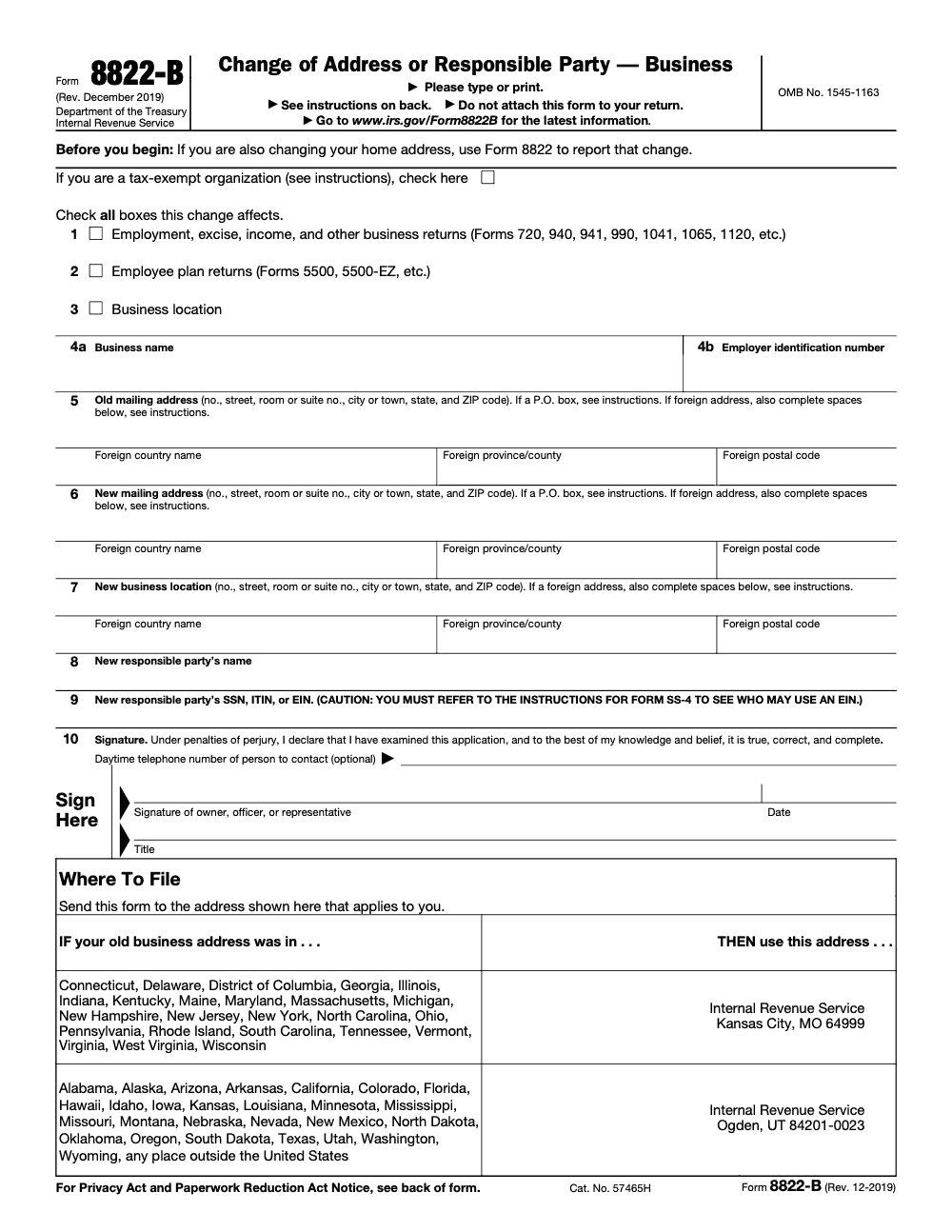
Form 8822‑B is the IRS form businesses use to tell the Service that something fundamental has changed, your mailing address, your physical location, or the identity of your responsible party. The form applies to any entity that has an EIN, including corporations, partnerships, LLCs, trusts, estates, and exempt organizations. The IRS explicitly reminds filers that a responsible party change must be reported within 60 days.
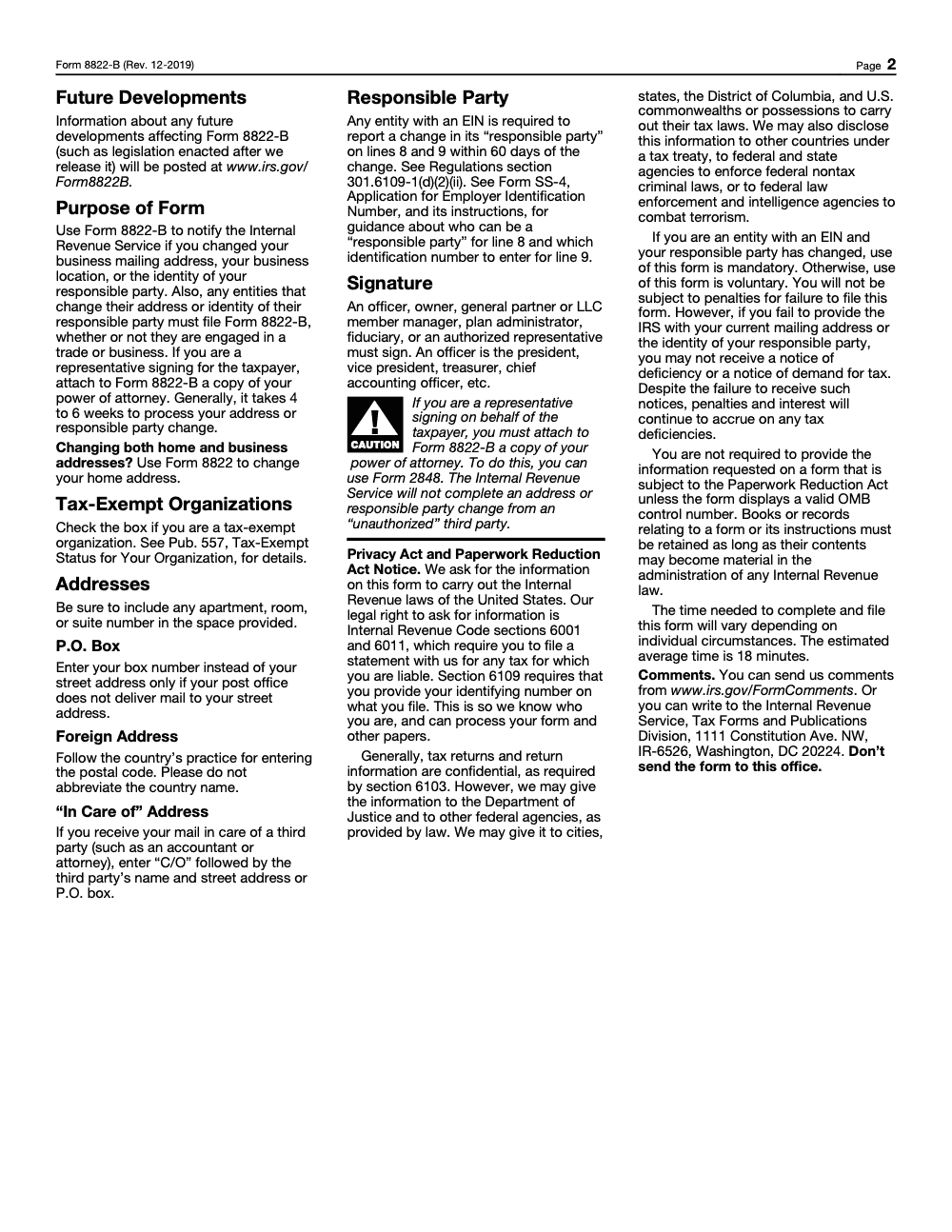
Why it matters comes down to contact and control. The IRS directs notices to the last known address and looks to the responsible party when it needs an accountable human who controls the entity’s funds and assets. Keeping this data current helps you receive time‑sensitive letters and reduces avoidable penalties. Be aware that a notice mailed to your last known address is legally sufficient, so penalties and interest can keep accruing on a deficiency even if you never see the letter. The Service issues CP148A and CP148B notices to confirm certain business address changes, which is another reason to keep your records tight.
What “Responsible Party” Means
The IRS defines the responsible party as the individual who controls, manages, or directs the entity and its assets. Per the Form SS-4 instructions, that means the person with ultimate ownership or effective control over the entity, not a CFO or controller named on the form for convenience. For most entities, this must be a person, not another business. If that person changes, you report it on Form 8822‑B within 60 days, separately from your regular tax returns. The 60-day deadline runs independently of your annual filing cycle, so reporting the change on a later return does not satisfy it. If you do not see a confirmation letter after 60 days, the IRS instructs you to mail a copy of your Form 8822‑B marked “Second Request.”
Who Must File Form 8822‑B
If your entity has an EIN, and you change your mailing address, physical location, or responsible party, you file Form 8822‑B, whether or not the entity is currently engaged in a trade or business. Dormant LLCs, shell corporations, and non-operating exempt organizations are not excused from this rule. This includes corporations, partnerships, LLCs, trusts, estates, and tax‑exempt organizations. For address changes tied to employment tax accounts, expect CP148A and CP148B confirmation letters at both the old and new addresses, which you should retain in your records.
A quick nuance for exempt organizations. If you are already filing a Form 990 and you check the address change box on a timely return, that usually updates the IRS file for the organization. If the address changes after the return is filed, use Form 8822‑B.
When in doubt, file. The form is short, and it prevents misdirected notices that cost you time, focus, and client goodwill.
When You Need To File
Timing is clear, you report a change to the responsible party within 60 days. File the address and location changes promptly as well, then allow several weeks for processing. The IRS says an address change can generally take four to six weeks after receipt to complete. If you have not received confirmation of a responsible party update by day 60, send a copy of your 8822‑B labeled “Second Request.”
You will mail the form to the service center that serves your old business address. Most eastern states route to Kansas City, MO 64999, and most western states route to Ogden, UT 84201. The full state list is below, and it is current as of October 28, 2025.
Form 8822 vs. Form 8822‑B
Think of it this way. Individuals and certain non‑EIN situations use Form 8822 to change a home mailing address. Businesses and entities with an EIN use Form 8822‑B to update a business mailing address, a physical business location, or the responsible party. If both your home and your business address are changing, the IRS keeps the two records separate, so file Form 8822 for the home address and Form 8822‑B for the business. The IRS page for Form 8822 confirms it is aimed at home address changes, and it cross‑references 8822‑B for business updates.
Which One You Need
- Use Form 8822 if you are changing an individual address that lives on the Individual Master File.
- Use Form 8822‑B if your entity has an EIN and you need to update the business mailing address, physical location, or responsible party, and remember the 60‑day rule for the responsible party.
Exempt organizations can check the address change box on a timely Form 990. If the change happens after filing, use Form 8822‑B.
Information You Need Before You Start
Gather everything the IRS will match against its records. Confirm the legal name exactly as shown on your most recent return, and your EIN. Pull the old mailing address the IRS currently has, your new mailing address, and, if it changed, your new physical business location. For a responsible party change, have the new party’s full legal name and SSN or ITIN ready. If someone else will sign for you, secure an executed Form 2848 Power of Attorney.
Required Identifiers
- Legal name, entered exactly as on the last filed return.
- EIN, verified against your original IRS notice or recent return.
- Old and new mailing addresses, complete and consistent, apartment or suite included.
- New physical business location, if different from mailing.
- New responsible party’s name and SSN or ITIN, when applicable.
| Field | What to enter | Why it matters |
| Legal name | Exact name from your latest return | Ensures a clean IRS match |
| EIN | Digits exactly as assigned | Ties the change to the right account |
| Old address | The address the IRS currently has | Links to the master file |
| New address | The address for future IRS mail | Prevents misdirected notices |
| Location | Street address if different | Clarifies the business situs |
| Responsible party | Full legal name and SSN or ITIN | Satisfies the 60‑day update rule |
Step‑By‑Step Completion Guide
Form 8822‑B is brief, but precision matters. Complete only the sections that apply, write clearly, and keep identifiers consistent across the page.
- Check the box in Section 1 if the change affects your employment, excise, income, or other business returns, then move to the entity information.
- Enter your legal name and EIN in Section 4, exactly as filed.
- Enter the old mailing address in Section 5, then the new mailing address in Section 6.
- Enter the new physical location in Section 7 if it differs from your mailing address.
- Complete Sections 8 and 9 only if the responsible party changed, include the SSN or ITIN.
- Sign and date. If a representative signs, attach Form 2848. Mail to the service center for your old address.
Use a trackable mailing method and keep the proof of delivery with your EIN records. The IRS notes that address changes can take four to six weeks to process after receipt.
Section 1, Business Tax Return Mail
Check the box if the change affects any of your business returns, for example Forms 940, 941, 1065, 1120, 990, or 1041. The form tells you to check every box the change affects, not to choose which return mail to redirect. Leave the box blank only if the change does not affect that return type. Verify your business name and EIN match IRS records to avoid misapplied changes. File promptly to keep notices moving to the new address.
Section 2, Employee Plan Mail
Check Section 2 only if your address change affects plan filings such as Forms 5500 or 5500‑EZ, so that plan notices route to the correct destination. Keep plan mail separate if a third‑party administrator receives it.
Section 3, New Business Location
Use Section 3 to signal a physical move. The IRS expects a complete street address, not a P.O. Box, and you should still complete Section 7 with the full location details. Updating the situs helps the IRS route field contacts and compliance notices when those occur.
Sections 4–7, Name, EIN, Old and New Addresses
Accuracy in these lines drives the match to your account.
- Section 4, enter the legal name exactly as shown on your most recent return and the correct EIN.
- Section 5, enter the old mailing address that the IRS currently has on file.
- Section 6, enter the new mailing address in full, apartment or suite included.
- Section 7, enter your new physical business location if it differs from the mailing address.
If the post office does not deliver to your street address, a P.O. Box is acceptable for the mailing address. Keep the physical location on Section 7 for clarity.
Sections 8–9, Responsible Party Details
Complete Sections 8 and 9 only when the responsible party changes. Enter the new responsible party’s full legal name and SSN or ITIN; Form 8822-B has no field for the old responsible party. The IRS emphasizes that responsible party changes must be reported within 60 days. If you have not received confirmation after 60 days, mail a copy labeled “Second Request.”
How To Sign And Authorize The Form
A person who can sign the entity’s tax return should sign Form 8822‑B, for example an officer, owner, partner, or trustee. A bookkeeper, office manager, or staff accountant without delegated authority cannot sign, and the IRS will reject a filing submitted by an unauthorized party. If someone signs for you, attach Form 2848 or another valid authorization to this form, even when a power of attorney is already on file with the IRS CAF unit. The instructions require the POA copy to be attached to Form 8822‑B itself. The IRS states that unauthorized third parties cannot change a taxpayer’s address without a power of attorney.
If you need a POA quickly, the IRS supports online submission of Forms 2848 and 8821. That does not change the mailing requirement for Form 8822‑B, it simply authorizes the signer.
Real‑World Quality Checks We Use
- Compare the legal name and EIN to the last return header.
- Pull a transcript or a recent IRS notice to confirm the old address before you fill Section 5.
- Confirm the responsible party is a person, not another entity, and capture the SSN or ITIN.
- Save the signed form and proof of mailing in your permanent entity file.
Accountably note, when our teams help firms with onboarding or leadership changes, we include 8822‑B in the workflow along with POA updates. That structure keeps mail, notices, and decision rights aligned without dragging partners into rework. Use a similar checklist even if you keep filing in house.
Where To Mail Your Form, By State
You mail Form 8822‑B to the center that serves your old business address, not the center closest to your new address. The routing key is the old-address state. Use the current state groupings below.
| States | Mail to |
| CT, DE, DC, GA, IL, IN, KY, ME, MD, MA, MI, NH, NJ, NY, NC, OH, PA, RI, SC, TN, VT, VA, WV, WI | Department of the Treasury, Internal Revenue Service Center, Kansas City, MO 64999 |
| AL, AK, AZ, AR, CA, CO, FL, HI, ID, IA, KS, LA, MN, MS, MO, MT, NE, NV, NM, ND, OK, OR, SD, TX, UT, WA, WY, Outside the United States | Department of the Treasury, Internal Revenue Service Center, Ogden, UT 84201 |
If you use a private delivery service, send to the IRS street address for the appropriate processing center. The Service lists those street addresses for Austin, Kansas City, and Ogden.
Processing Times And What To Expect
Address change requests generally take four to six weeks to process after the IRS receives them. Keep your proof of mailing with your EIN records. For responsible party changes, if you do not receive a confirmation letter within 60 days, the IRS instructs you to mail a copy of your Form 8822‑B and write “Second Request” on it.
- Use certified or other trackable mail and keep the receipt.
- Wait six to eight weeks before calling, since peak seasons can slow processing.
- Retain CP148A and CP148B letters that confirm business address changes for your files.
Common Mistakes To Avoid, With A Quick Checklist
The same handful of errors send Form 8822-B back or leave the IRS writing to an address nobody reads. Here are the ones my team catches most often.
Final Notes And Light CTA
You have one job here, keep the IRS master file aligned with your real world. Gather the right identifiers, fill the right boxes, sign with authority, mail to the correct center, and keep proof. If you run a team that is always on deadline, build 8822‑B into your onboarding, offboarding, and move checklists so it never becomes a fire drill again.
We help firms install that kind of discipline across compliance workflows. If you want structured support that keeps filings accurate and on time without adding partner review load, reach out to our team at Accountably. We can fold 8822‑B controls into your standard operating procedures so your mail and decision rights always match reality.
Reusable Checklists
These are copy-paste ready for your firm SOPs. Drop them into your onboarding, move, and entity-change procedures so Form 8822-B never turns into a deadline scramble.
Before You Mail Form 8822-B
- Confirm the change type: mailing address, business location, responsible party, or a combination.
- Enter the legal business name on Line 4a and the EIN on Line 4b exactly as they appear on the EIN record.
- Complete Line 5 (old address) and Line 6 (new mailing address), and add Line 7 if the physical location changed.
- Check every applicable box: Line 1, Line 2, and Line 3, plus the tax-exempt box if the entity is exempt.
- Use the physical street address, and a P.O. box only when USPS does not deliver to the street.
- Verify the Line 10 signer is an officer, owner, general partner, member-manager, fiduciary, or authorized representative.
- Type or print every entry so nothing is illegible.
Responsible Party Change, 60-Day Clock
- Identify the new responsible party using the Form SS-4 definition of ultimate control, not the CFO or controller by default.
- Record the date control changed, since the 60-day deadline runs from that date.
- Enter the new responsible party on Line 8 and the SSN, ITIN, or EIN on Line 9.
- File Form 8822-B as a standalone document rather than waiting for the next return.
- Calendar a 60-day follow-up to confirm the change posted to the EIN record.
Mail and Track
- Select the service center by the OLD business-address state: Kansas City, MO 64999 or Ogden, UT 84201-0023.
- Send any address outside the United States to the Ogden center.
- Do not staple the form to a return or mail it to the Washington, DC comments address.
- Use certified or trackable mail and keep the receipt with the EIN records.
- Allow 4 to 6 weeks for the change to post before following up.
- Keep any IRS confirmation letter with your records.
Keep 8822-B Season From Stalling
Form 8822-B is not a seasonal return, which is exactly why it slips. There is no April or quarterly trigger, so an office move, an entity sale, or a change in the responsible party gets logged everywhere except the IRS master file. The IRS estimates the form takes about 18 minutes to complete (per the Form 8822-B instructions, Rev. December 2019), yet the change itself posts in 4 to 6 weeks, and the 60-day responsible party deadline runs the whole time.
The fix is to treat 8822-B as a workflow event, not a one-off favor. When a client moves, restructures, or replaces a controlling owner, the filing should fire inside your onboarding, offboarding, and entity-change procedures so the 60-day clock never catches anyone by surprise.
- Tie a trigger to the responsible party rule: any change in ultimate control starts the 60-day clock for Lines 8 and 9, separate from the return calendar.
- Check every applicable box, Line 1 for income, employment, and excise returns, Line 2 for 5500-series plan returns, and Line 3 for a location change, since the form is not single-select.
- Route by the OLD business-address state to Kansas City, MO 64999 or Ogden, UT 84201-0023, and record which center received it.
- Confirm Line 10 signing authority before mailing, and attach a copy of Form 2848 whenever a representative signs.
- Calendar the 4 to 6 week processing window and confirm the responsible party update is on record before the 60-day deadline passes.
We build these controls into client SOPs so address and responsible party updates happen on time without adding partner review hours. If you want that discipline folded into your compliance workflow, see how our tax delivery teams keep the IRS record aligned with the real world.
FAQs
It updates a business’s mailing address, physical location, and the identity of the responsible party on IRS records. The responsible party update is time sensitive, report it within 60 days.
The IRS provides a PDF form and mailing addresses for Form 8822‑B, and it directs businesses to mail the form to the service center for the old address. There is no IRS e‑file system for 8822‑B at this time. If you need a representative to sign for you, you can submit Form 2848 online to authorize them, then mail the 8822‑B.
Use Form 8822 for an individual address change. Use Form 8822‑B for a business mailing address, physical location, or responsible party update for any entity with an EIN.
If an exempt organization checks the address change box on a timely Form 990, that generally updates the IRS record. If the change occurs after the return is filed, use Form 8822‑B.
Address change requests typically take four to six weeks after receipt. For responsible party changes, if you do not receive confirmation in 60 days, mail a copy as a “Second Request.”
Other forms this guide names
Summarize this article with AI
About this guide
Accountably helps US CPA, EA, and accounting firms hire trained accountants and tax preparers in India.
About us Reviewed byJugal Thacker, CPAFounder and CEO at Accountably
A Washington-licensed CPA with 7+ years inside US firms – PwC, a real-estate tax practice, then a full-service firm, rising from reviewer to manager to advisory. This article was reviewed against current IRS guidance for the 2025 tax year and updated for filers preparing late returns, amendments, and 2026 estimates.
View profile →How we research, review, and update this guide
Every Accountably guide is researched against primary IRS sources, reviewed by a U.S. CPA, and refreshed as guidance evolves. Read our Editorial Guidelines to see how we source, fact-check, and update our content.