Summarize this article with AI
In Brief
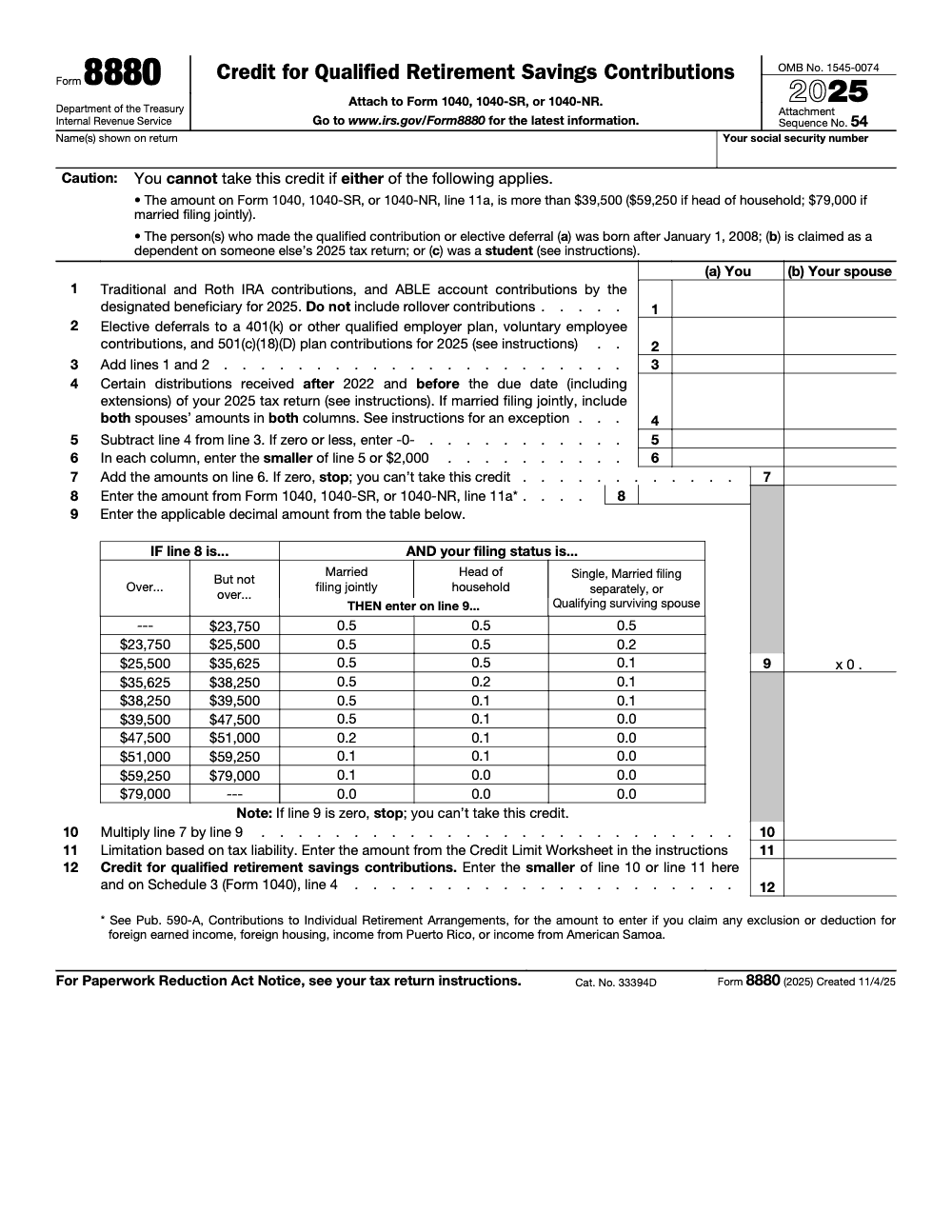
Form 8880 figures the Saver’s Credit – a nonrefundable credit of up to $1,000 ($2,000 if married filing jointly) on the first $2,000 of retirement contributions per person, carried from line 12 to Schedule 3, line 4 of Form 1040. For 2025, the credit is denied once AGI exceeds $39,500 (single, MFS, or QSS), $59,250 (head of household), or $79,000 (married filing jointly), according to the IRS Form 8880 instructions.
You do not have to earn much to get a tax break for saving, but you do have to stay under the income line. Form 8880 figures the Saver's Credit on the first $2,000 of retirement contributions per person, and your credit rate is 50%, 20%, or 10% depending on income and filing status. The result is worth up to $1,000 on your own, or $2,000 married filing jointly.
For 2025, the credit disappears entirely once AGI passes $39,500 for single, married filing separately, or qualifying surviving spouse, $59,250 for head of household, or $79,000 for married filing jointly. Contributions to plans like a 401(k), 403(b), governmental 457(b), SIMPLE, SEP, the federal TSP, and traditional or Roth IRAs can count, and the credit carries from line 12 to Schedule 3, line 4. Watch the testing period rules, recent distributions can shrink the contribution amount used to compute the credit.
Key Takeaways
- The Saver’s Credit is a nonrefundable credit for your retirement contributions. Use IRS Form 8880 and attach it to Form 1040 or 1040‑SR.
- For 2025, income ceilings for any credit are $39,500 single, $59,250 head of household, and $79,000 married filing jointly. Within those limits, your exact credit rate is 50%, 20%, or 10% of up to $2,000 per person.
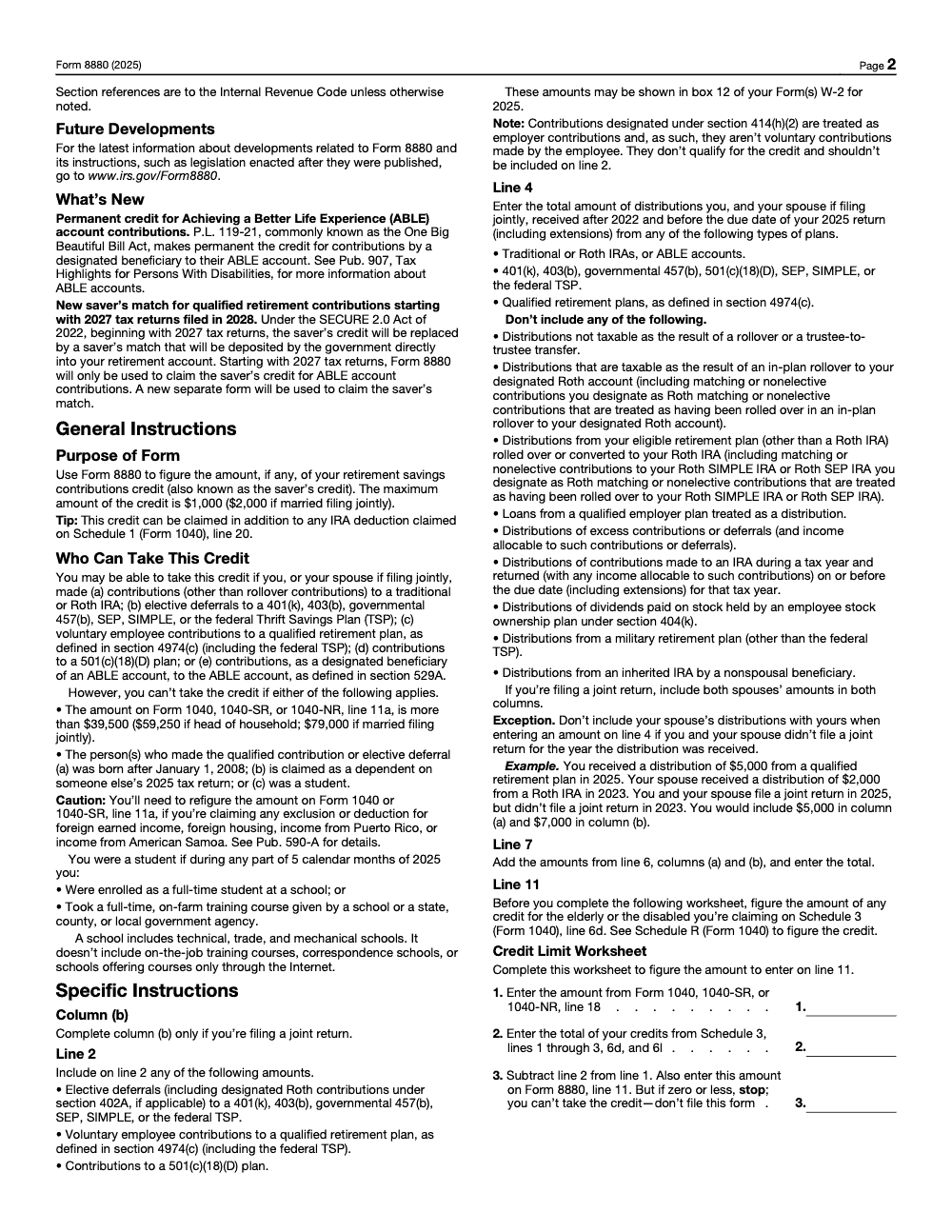
- Eligible contributions include 401(k), 403(b), governmental 457(b), SIMPLE, SEP, the federal TSP, and traditional or Roth IRAs. Certain ABLE account contributions by the designated beneficiary also qualify. Rollovers and employer contributions do not.
- You must be 18 or older (the precise IRS test is that you were born on or before January 1, 2008, not simply that you turned 18), not a full‑time student for any part of five calendar months, and not claimed as a dependent.
- Recent distributions can reduce the contribution amount used to compute the credit, so check the “testing period” rules before you calculate.
What Form 8880 Is
Form 8880 calculates the Saver’s Credit, a dollar‑for‑dollar reduction of your federal income tax that rewards contributions you make to retirement accounts. The credit is nonrefundable, which means it can reduce your tax to zero, but it will not create a refund by itself. You complete Form 8880, then report the final amount on Schedule 3 with your Form 1040.
Who qualifies
You qualify if all three are true.
- You are at least 18 (the precise IRS test is that you were born on or before January 1, 2008, not simply that you turned 18).
- You are not claimed as a dependent on another return.
- You were not a full‑time student during any part of five calendar months in 2025, based on IRS definitions (online-only and correspondence schools do not count toward student status, and part-time enrollment never triggers the rule).
In addition, your adjusted gross income must fall within the 2025 limits, and you must have made eligible contributions. If your income is above your filing status cutoff, the credit is zero.
Eligible Plans and Contributions
The IRS counts the following as “qualified retirement savings contributions” for this credit.
- Your elective deferrals to workplace plans, for example, 401(k), 403(b), governmental 457(b), SIMPLE, SEP, and the federal Thrift Savings Plan.
- Your traditional or Roth IRA contributions.
- Voluntary after‑tax contributions to a qualified plan and contributions to a 501(c)(18)(D) plan.
- Contributions to an ABLE account if you are the designated beneficiary.
What does not count
- Rollovers and trustee‑to‑trustee transfers.
- Employer contributions and certain mandatory employee contributions treated as employer payments under section 414(h)(2).
Quick tip: your eligible contributions are capped at $2,000 per person for credit purposes, even if you contributed more. For joint filers, you calculate each spouse’s amount, then add them.
Income Limits and Credit Rates for 2025
Your credit rate comes from a table on Form 8880 and depends on your AGI and filing status. Here is a simple view of the 2025 brackets. The precise brackets are determined on the form itself.
| Filing status | 50% credit up to | 20% credit up to | 10% credit up to | No credit above |
| Single, MFS, QSS | $23,750 | $25,500 | $39,500 | $39,500 |
| Head of household | $35,625 | $38,250 | $59,250 | $59,250 |
| Married filing jointly | $47,500 | $51,000 | $79,000 | $79,000 |
These figures come directly from the 2025 Form 8880 AGI table, which you will reference when you fill in line 9.
Note: Starting with 2027 tax returns filed in 2028, the Saver’s Credit for retirement contributions is scheduled to become a Saver’s Match paid into your plan. Form 8880 will still apply to ABLE account credits. We will update this page when the IRS finalizes forms and instructions.
How the Saver’s Credit Is Calculated, Step by Step
You only need a few numbers to get this right. Here is the clean, repeatable process I use with clients.
Step 1, total your eligible contributions
Gather your W‑2 and plan or IRA statements. Add up what you personally contributed in 2025 to qualifying plans, for example, 401(k), 403(b), governmental 457(b), SIMPLE, SEP, TSP, and traditional or Roth IRAs. Remember, employer matches do not count, and rollovers do not count.
Step 2, subtract any distributions in the testing period
If you took certain plan or IRA distributions during the testing period, you must reduce your contribution amount before applying the credit rate. The testing period generally looks back to the two years before the current tax year, plus the current year up to your filing deadline, including extensions, so distributions received through October 15, 2026 count if you extend your 2025 return. If you pulled funds, check the Form 8880 instructions and adjust your base. This rule trips up more people than any other.
Step 3, find your AGI on Form 1040
Use your adjusted gross income on Form 1040 or 1040‑SR, line 11a (line 11a is the modified AGI the saver's credit uses). If you exclude foreign earned income or certain income from U.S. territories, refigure AGI as required by the Form 8880 instructions. Your AGI determines whether your rate is 50%, 20%, 10%, or zero.
Step 4, find your rate on the Form 8880 table
Use the Form 8880 AGI table for your filing status. If your AGI is at or below the 50% band, that is your rate. If you fall in the 20% band, use 20%. If you land in the 10% band, use 10%. Above the top threshold, the credit is zero.
Step 5, apply the per person cap, then multiply
Cap your eligible contributions at $2,000 per person. Multiply the capped amount by your rate, 50%, 20%, or 10%. If you file jointly, compute the amount for each spouse, then add them together.
Step 6, apply the nonrefundable limit
Your Saver’s Credit cannot exceed your tax liability after other nonrefundable credits. If you have a low tax bill, your allowable credit may be smaller than the raw calculation. Coordinate with other credits on Schedule 3 and watch ordering on your software’s credit summary.
Two quick examples
- Example A, single filer You contributed $1,500 to a Roth IRA in 2025 and had no distributions. Your AGI is $22,800, which lands in the 50% band.
- Capped contribution base, $1,500
- Credit rate, 50%
- Preliminary credit, $750
- If your total tax is at least $750, you get the full $750. If your tax is $500, your allowable credit is capped at $500.
- Example B, married filing jointly You contributed $2,100 to a 401(k), your spouse contributed $800 to a traditional IRA, and there were no distributions. AGI is $50,200, which falls in the 20% band.
- Your capped base, $2,000
- Spouse capped base, $800
- Combined base, $2,800
- Credit at 20%, $560, subject to the nonrefundable limit.
Pro tip, if you are near a threshold, consider additional pre‑tax workplace contributions before year end, or an IRA contribution before your filing deadline, typically mid April 2026, to drop into a better rate band.
Filing Form 8880 With Your Return
You will fill out a short worksheet and one page. Keep your inputs organized so the review is quick and painless.
Line by line highlights
- Line 1, enter qualified retirement savings contributions.
- Line 2, enter elective deferrals (often the Box 12 amounts from your W-2). Line 3, add lines 1 and 2. Line 4, subtract qualifying distributions received during the testing period.
- Line 6, cap each column at $2,000 per spouse. Line 7, add the capped amounts from both columns.
- Line 9, use the AGI table to pick your rate based on filing status.
- Line 12, compute your final credit and carry it to Schedule 3, then to Form 1040.
What to keep in your file
- Your W‑2 showing Box 12 codes for elective deferrals.
- Year‑end statements or confirmations for IRA deposits, and any ABLE account contributions if applicable.
- Distribution forms, for example, 1099‑R, and notes showing how you applied the testing period adjustment.
- A copy of the Form 8880 worksheet and the completed form.
E‑file tips that save time
- Enter each spouse’s contributions separately for joint returns. Software often has a separate input field for the spouse.
- Flag plan distributions early, then confirm whether they reduce your base.
- Review your AGI after final adjustments, for example HSA deductions or self‑employed plan deductions, since these can move you into a better band.
Timing and deadlines you should know
- Workplace plan contributions must occur by December 31, 2025, to count for 2025.
- IRA contributions for 2025 can be made up to your filing deadline for 2025 returns, typically April 15, 2026, not including extensions.
- If you file an extension, you still must make IRA contributions for 2025 by your original due date to claim the 2025 Saver’s Credit.
Accuracy note, this article reflects 2025 limits and rules as of November 29, 2025. For unusual situations, for example disaster relief or special plan distributions, check the latest IRS guidance or work with a tax pro.
Common mistakes and how to avoid them
Every season I see the same handful of slips on Form 8880, and most of them either inflate or erase a credit that was sitting right there. We screen for these on every return we prepare; here are the ones worth checking before you file.
Simple strategies to maximize your 2025 Saver’s Credit
You do not need fancy planning to make this work. A few clean moves can help you qualify or boost your rate.
- Aim for the next rate band. If you are just above a band, a small pre‑tax deferral, HSA contribution, or deductible IRA deposit can pull you into a higher percentage.
- Use the full per person cap. For joint filers, each spouse has a $2,000 cap for the credit calculation. If one spouse already hit $2,000, see whether the other spouse can still add to an IRA.
- Coordinate Roth and traditional choices. Roth is great for long term tax‑free growth. If you are near a threshold and need AGI reduction, a deductible traditional IRA may create more value this year. You can claim the IRA deduction on Schedule 1 and the Saver’s Credit on the same contribution, so the two are not mutually exclusive.
- Avoid disqualifying distributions. If you plan to claim the credit, think twice before taking an IRA or plan withdrawal that would shrink your eligible base.
- Contribute early in the year. Early contributions grow longer, and you avoid year‑end cash crunch decisions.
Quick comparison, Roth vs traditional for threshold planning
| Goal | Roth IRA contribution | Traditional IRA deduction |
| Keep AGI low to reach a higher credit rate | No AGI reduction | AGI may drop, which can improve your credit rate |
| Tax profile in retirement | Withdrawals tax free if qualified | Withdrawals taxed as ordinary income |
| Coordinate with Saver’s Credit | Counts toward the $2,000 cap, but no AGI help | Counts toward the cap and can help AGI for a better rate |
FAQ
What is Form 8880 used for?
It calculates the Saver’s Credit for your own retirement contributions. You attach it to your Form 1040 or 1040‑SR and carry the credit to Schedule 3. Keep plan and IRA records that support your amounts.
Who qualifies for the Saver’s Credit?
You must be 18 or older (specifically, born on or before January 1, 2008), not a full‑time student, not a dependent, and within the 2025 AGI limits for your filing status. You also must have made eligible contributions to a qualifying plan or IRA.
Can I skip Form 8880 if my income is high?
Yes, if you are above your filing status limit, the credit is zero, so you can skip it. If you are close to a threshold, run the numbers. A small pre‑tax contribution or deductible IRA may bring you into a credit band.
Do 401(k) contributions qualify?
Yes, your elective deferrals to a 401(k) can qualify, subject to the credit’s income limits, per person cap, and distribution reduction rules. Employer matches do not qualify.
Can I claim the credit with a Roth IRA?
Yes. Roth IRA contributions count toward the $2,000 cap used to compute the credit. Roth does not reduce AGI, so if you are near a threshold, weigh a deductible traditional IRA before you file.
For firms, a quick process check
If you manage a CPA or EA firm, this is where delivery discipline shows up. The credit is small on paper, but missing it across a client base adds up and weakens trust. A tight workflow helps.
- Use SOP‑driven workpapers that flag Form 8880 whenever Box 12 elective deferrals or IRA deposits appear.
- Build a short checklist for testing period distributions, then document any reduction.
- Apply a layered review, preparer, senior, quality, final. This keeps small credits from slipping through.
If your in‑house team is stretched during peak season, a structured offshore delivery partner can keep the review queue clear. Accountably integrates trained offshore teams inside your systems with standard workpapers, clear SLAs, and review protection, so Form 8880 checks move fast without cutting corners. Mentioned here because it solves a delivery problem, not a sales problem.
Final checklist for you
- Confirm you meet the three status rules, age, student status, dependency.
- Add eligible contributions, subtract required distributions, cap at $2,000 per person.
- Use your AGI to pick 50%, 20%, or 10% on the 2025 table.
- Apply the nonrefundable limit, then attach Form 8880 to your Form 1040 or 1040‑SR.
- Keep W‑2s, IRA confirmations, plan statements, and any 1099‑R forms.
Bottom line, if you saved for retirement in 2025, even a modest amount, check Form 8880 before you file. It takes minutes and can put real money back in your pocket.
Reusable Checklists
These are copy-paste ready for your firm SOPs. Drop them into the workpaper and tick each box as you work the return.
Saver’s Credit eligibility screen
- Confirm the taxpayer was born on or before January 1, 2008.
- Confirm they were not a full-time student during any part of 5 calendar months in 2025.
- Confirm they are not claimed as a dependent on another 2025 return.
- Check 2025 AGI against the limit: $39,500 single, MFS, or QSS; $59,250 head of household; $79,000 married filing jointly.
- Verify at least one eligible contribution to an IRA, ABLE account, or workplace plan.
- For joint returns, apply each disqualifier to the spouse who actually made the contribution.
Line-by-line credit calculation
- Line 1: enter traditional and Roth IRA plus ABLE contributions, excluding rollovers.
- Line 2: enter elective deferrals, usually the Box 12 amounts from Form W-2, excluding section 414(h)(2) pickups.
- Line 4: subtract qualifying distributions received after 2022 through the return’s extended due date.
- Line 6: cap each column at $2,000 per spouse.
- Line 9: select the 50%, 20%, or 10% rate from the 2025 AGI table.
- Lines 11 and 12: apply the Credit Limit Worksheet, then carry the final credit to Schedule 3, line 4.
Firm review and workpaper pass
- Flag any return showing Box 12 elective deferrals or IRA and ABLE deposits.
- Document the line 4 distribution lookback back through 2023.
- Refigure modified AGI for any client with foreign earned income or possession exclusions.
- Confirm tax liability exists for the nonrefundable limit before keeping the form.
- Complete column (b) only for joint returns.
- Run a layered review: preparer, senior, quality, final.
Keep 8880 Season From Stalling
The Saver’s Credit is a small-dollar, high-volume line that hides inside W-2 Box 12 deferrals and IRA confirmations, and it surfaces right in the March and April individual filing crunch. The credit tops out at $1,000 for most filers and $2,000 on a joint return, so it is easy to wave off, but per the IRS Form 8880 instructions it disappears entirely above $39,500, $59,250, or $79,000 of AGI for 2025, and missing it across a client base chips away at trust.
The fix is not heroic effort during the busiest weeks of the year. It is a workflow that surfaces eligibility automatically and tests the reductions every time, so the credit gets caught on the first pass instead of a rushed final review.
- Trigger a Form 8880 check on any return with line 1 IRA or ABLE deposits or line 2 elective deferrals in Box 12.
- Run the line 4 distribution lookback back through 2023 so the eligible base is computed, not guessed.
- Apply the $2,000 per-column cap and the Credit Limit Worksheet before assuming a credit survives the nonrefundable limit.
- Track which savers age into or out of the credit, and flag the 2027 transition to the saver’s match under the SECURE 2.0 Act of 2022.
That discipline is exactly what a structured delivery partner brings to peak season. Accountably’s tax preparation teams work inside your systems with standard workpapers, documented SOPs, and turnaround SLAs, so Saver’s Credit checks clear the queue without slowing the rest of the return.
FAQs
It calculates the Saver’s Credit for your own retirement contributions. You attach it to your Form 1040 or 1040‑SR and carry the credit to Schedule 3. Keep plan and IRA records that support your amounts.
You must be 18 or older, not a full‑time student, not a dependent, and within the 2025 AGI limits for your filing status. You also must have made eligible contributions to a qualifying plan or IRA.
Yes, if you are above your filing status limit, the credit is zero, so you can skip it. If you are close to a threshold, run the numbers. A small pre‑tax contribution or deductible IRA may bring you into a credit band.
Yes, your elective deferrals to a 401(k) can qualify, subject to the credit’s income limits, per person cap, and distribution reduction rules. Employer matches do not qualify.
Yes. Roth IRA contributions count toward the $2,000 cap used to compute the credit. Roth does not reduce AGI, so if you are near a threshold, weigh a deductible traditional IRA before you file.
Other forms this guide names
- Form 1040: Filing Guide for 2025 Returns (AGI, Deductions, Deadlines)
- Form W‑2: Deadlines, E‑File Rules, Boxes, and W‑2c Corrections
- Form 1040-SR: Standard Deduction, Schedules, E-file Tips
- Form 1099‑R: Box 7 Codes, Rollovers, 2025 Filing Guide
Summarize this article with AI
About this guide
Accountably helps US CPA, EA, and accounting firms hire trained accountants and tax preparers in India.
About us Reviewed byJugal Thacker, CPAFounder and CEO at Accountably
A Washington-licensed CPA with 7+ years inside US firms – PwC, a real-estate tax practice, then a full-service firm, rising from reviewer to manager to advisory. This article was reviewed against current IRS guidance for the 2025 tax year and updated for filers preparing late returns, amendments, and 2026 estimates.
View profile →How we research, review, and update this guide
Every Accountably guide is researched against primary IRS sources, reviewed by a U.S. CPA, and refreshed as guidance evolves. Read our Editorial Guidelines to see how we source, fact-check, and update our content.