Summarize this article with AI
In Brief
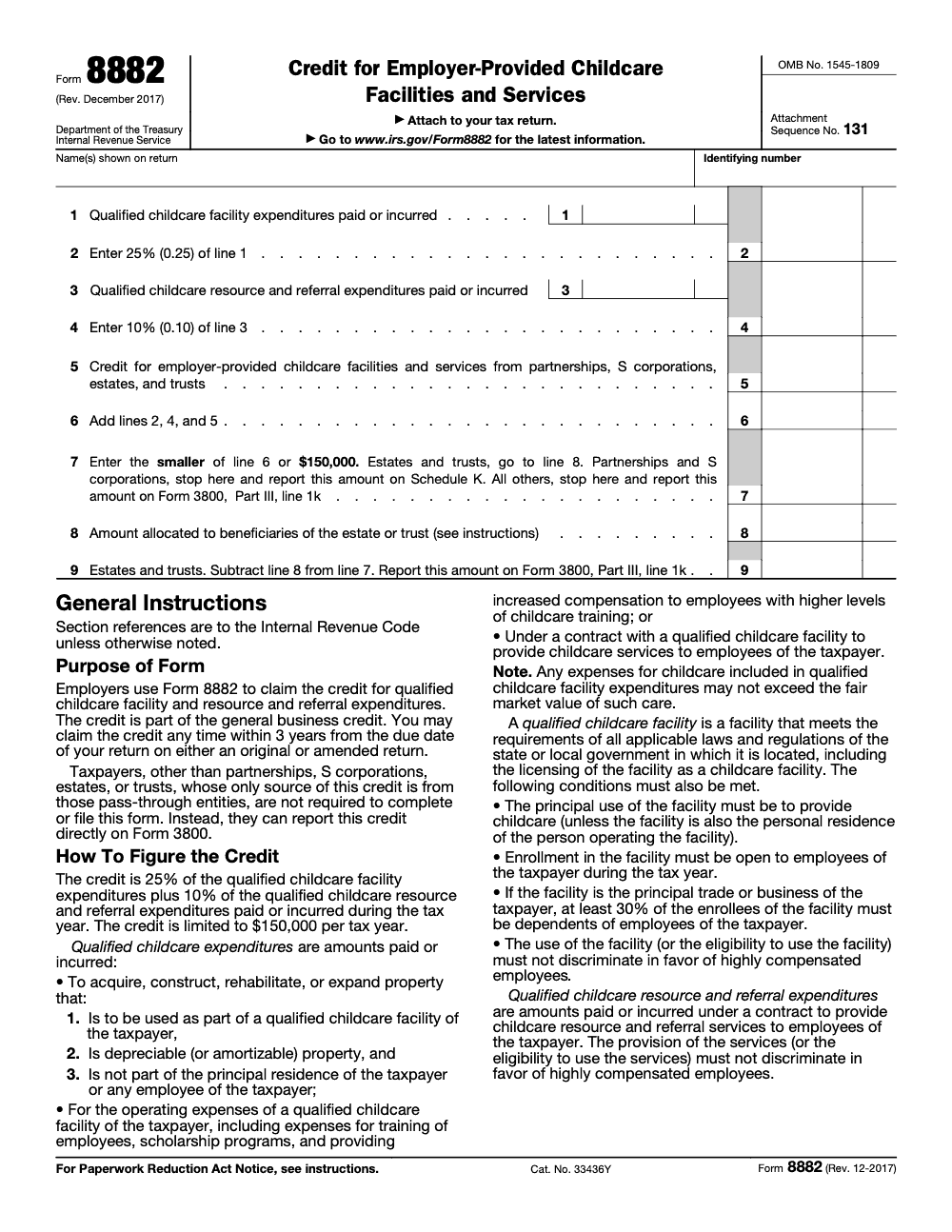
Form 8882 is how an employer claims the credit for employer-provided childcare facilities and services under Internal Revenue Code §45F – the business that provides the care files it, not employees claiming their own child care (that runs through Form 2441). On the current Rev. December 2017 form you take 25% of qualified facility expenditures on line 2 plus 10% of qualified resource and referral expenditures on line 4, capped at $150,000 on line 7 and carried to Form 3800, Part III, line 1k; for amounts paid or incurred after December 31, 2025, the One Big Beautiful Bill Act raises those rates to 40% (50% for eligible small businesses) and the cap to $500,000 ($600,000 for eligible small businesses), per the Form 8882 instructions.
The most common call about Form 8882 opens with a controller who just signed off on an on-site child care room asking how employees claim it on their own returns. That is the first thing to untangle. Form 8882 is an employer credit under Internal Revenue Code §45F, claimed by the business, its pass-through owners, or the estate or trust that earned it. Employees who pay for their own care use Form 2441 instead.
On the current Rev. December 2017 form you take 25% of qualified facility expenditures on line 2 plus 10% of qualified resource and referral expenditures on line 4, capped at $150,000 on line 7 and carried to Form 3800. The rules change for 2026, when the facility rate rises to 40%, or 50% for an eligible small business, with annual caps of $500,000 or $600,000. A qualified facility has to stay licensed and open to employees on a nondiscriminatory basis, and recapture can reach back up to 10 years if it stops qualifying.
Key Takeaways
- The employer‑provided child care credit is a non-refundable part of the general business credit, claimed on Form 8882 and included on Form 3800. Unused amounts typically carry back 1 year and forward 20 years.
- For 2026, the credit equals up to 40% of qualified child care facility expenditures, or 50% if you are an eligible small business, plus 10% for qualified resource and referral costs. Annual caps are $500,000 or $600,000 for eligible small businesses, with inflation indexing beginning after 2026.
- A qualified facility must be licensed, primarily used for child care, open to employees on a nondiscriminatory basis, and if child care is your principal trade or business, at least 30% of enrollees must be your employees’ dependents.
- Avoid double benefits. Reduce deductions and property basis by the credit amount. Set documentation rules up front.
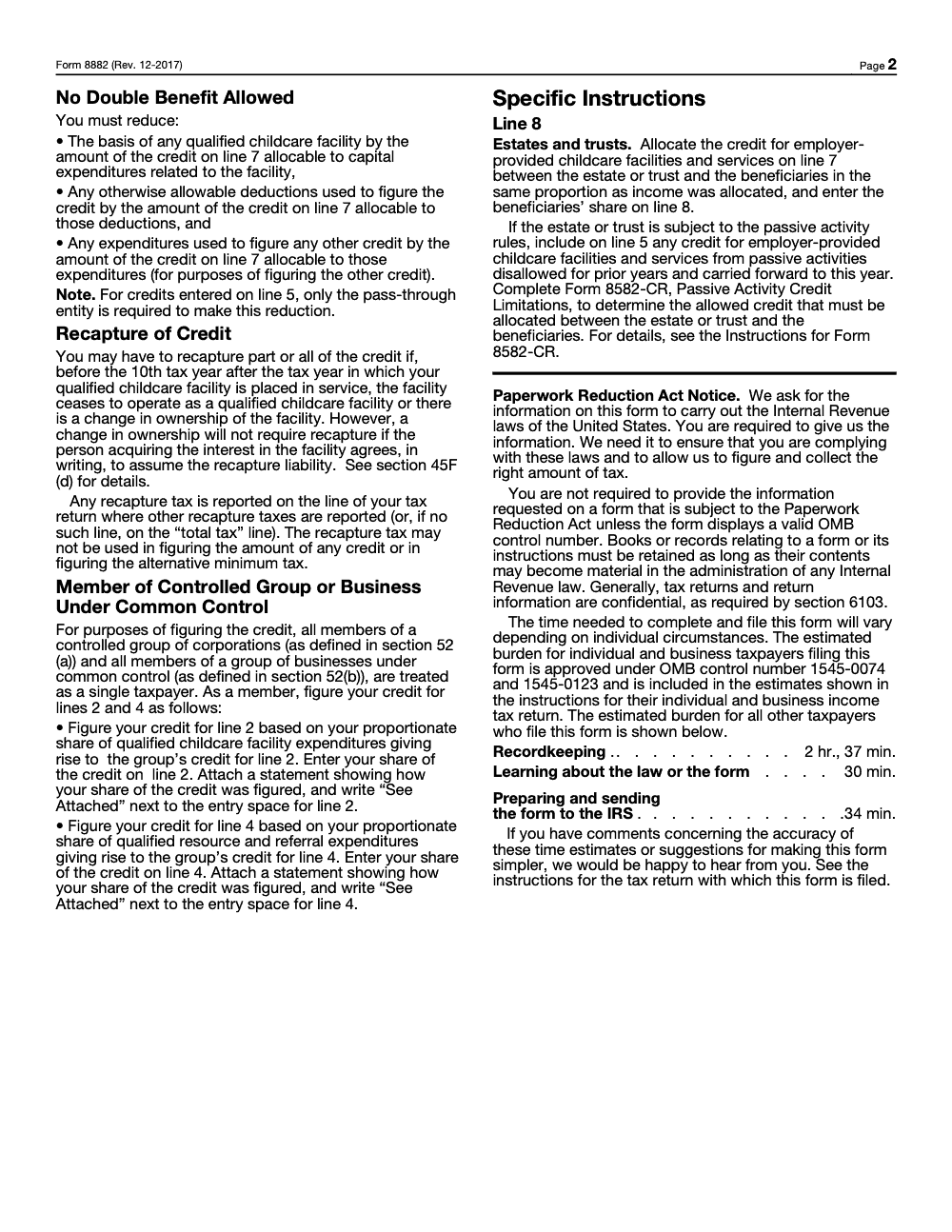
- Recapture applies for up to 10 years if the facility stops qualifying or certain ownership changes occur, with a declining percentage schedule (an ownership change does not trigger recapture if the buyer agrees in writing to assume the recapture liability).
What Form 8882 does, in plain terms
Form 8882 lets you claim a dollar‑for‑dollar business credit when you invest in child care for employees. This is strictly an employer credit, not a credit employees claim for their own out-of-pocket child care, which runs through Form 2441 and Section 129 instead. You can claim qualified facility expenditures, such as acquiring or expanding a licensed facility, plus certain operating costs, and you can also claim 10% on qualified resource and referral services that help employees find care. You file Form 8882 and then carry the amount to Form 3800 with your return.
Because this is a general business credit, the usual ordering and carry rules apply. If you cannot use the full amount this year due to the tax liability limit, you generally carry back 1 year and carry forward 20 years. Keep your schedules clean because FIFO ordering and carry statements matter during exams.
What changed for 2026, and why you should care
For amounts paid or incurred after December 31, 2025, Congress raised the ceiling and the core rate for facility expenditures and created an enhanced tier for eligible small businesses. If you are planning a buildout, co‑op arrangement, or long‑term contract, these changes can materially improve after‑tax economics compared with the 2025 rules.
- Facility expenditures credit rate, now up to 40% or 50% for eligible small businesses.
- Annual cap, now $500,000, or $600,000 for eligible small businesses, with indexing after 2026.
- Clarifications that make it easier to work with third‑party intermediaries or jointly owned facilities.
One important note if you are comparing years. Through 2025, the cap was $150,000 with a 25% facility rate. Many IRS pages still show those numbers, which were correct for 2025, but the law for 2026 forward is higher under H.R. 1 as enrolled. Always document the tax year covered by each figure in your files.
Who qualifies, at a glance
You are eligible if you pay or incur qualified expenditures to provide child care services to employees during the tax year. This may include building or expanding a facility, operating a qualified facility, or contracting for resource and referral services. The facility must be licensed under state or local law, primarily used for child care, open to all employees, and it cannot favor highly compensated employees. If child care is your principal trade or business, at least 30% of enrollees must be dependents of your employees.
Quick compliance check: licensing up to date, principal use test met, nondiscrimination confirmed, 30% rule tested if applicable, and costs tied to invoices and contracts. That is the core of audit‑ready files.
Aggregation and related‑party realities
If you are part of a controlled group or under common control, aggregation rules apply. All persons treated as a single employer under section 52 are treated as a single taxpayer for this credit. Plan caps and allocations accordingly to avoid surprises.
General business credit mechanics you cannot ignore
- Form 8882 computes the credit.
- Form 3800 aggregates it with your other general business credits, applies limits, and tracks carrybacks and carryforwards.
- Unused credit usually carries back 1 year and forward 20 years. Keep the required statements for each originating year and adjustment.
In our work with firms, the biggest pitfall is documentation that mixes deductible operating costs with amounts used to compute the credit. Build a simple tagging system in your GL and workpapers, then reconcile to Form 8882 categories before you close the year.
Credit rates, limits, and what counts as a qualified expense
Here is how the math works today for tax years beginning in 2026.
- Facility expenditures: 40%, or 50% for eligible small businesses.
- Resource and referral expenditures: 10%.
- Annual cap: $500,000, or $600,000 for eligible small businesses, indexed after 2026.
Quick comparison, 2025 vs 2026
| Item | 2025 rules | 2026 rules |
| Facility expenditures rate | 25% | 40% or 50% if eligible small business |
| Resource and referral rate | 10% | 10% |
| Annual cap | $150,000 | $500,000 or $600,000 if eligible small business, indexed after 2026 |
| Law reference | Prior law through 12/31/2025 | H.R. 1, Sec. 70401, effective for amounts paid or incurred after 12/31/2025 |
Source references: IRS overview page for prior‑year baseline and Congress.gov for the 2026 changes. Keep both in your file to show why the numbers differ year over year.
What is a qualified child care facility expenditure
Two buckets are common:
- Property costs to acquire, construct, rehabilitate, or expand a facility used as part of a qualified child care facility. The property must be depreciable or amortizable, and it cannot be part of your principal residence or an employee’s principal residence.
- Operating costs for a qualified facility, including training, scholarship programs, and higher compensation tied to credentials for child care workers. Costs cannot exceed fair market value.
What often trips teams up is separating build or expansion costs from ongoing operations. Create cost codes in your system at the start of a project and keep permits, licensing approvals, contracts, and progress billings in a single digital folder. That discipline shortens reviews.
What counts as qualified resource and referral expenditures
You can claim 10% of amounts paid under a contract to provide child care resource and referral services to employees. Access cannot discriminate in favor of highly compensated employees. Keep invoices, service descriptions, dates, and proof the benefit was available to all employees.
Tip for payroll and HR: publish a short how‑to for employees on using the referral benefit, then archive the communication. It helps show nondiscriminatory availability during an exam.
Facility criteria you must meet, every year
A facility is “qualified” only if it satisfies every condition below:
- Licensed under all applicable state and local law.
- Principal use is child care.
- Enrollment is open to employees.
- Cannot favor highly compensated employees.
- If child care is your principal trade or business, at least 30% of enrollees are your employees’ dependents.
Run these tests annually. If you outsource operations, write the tests into the operator’s SLA and require quarterly reporting on licensing status and enrollment mix. That way you see issues before they become recapture problems.
Recapture, the 10‑year risk map
If a facility stops qualifying, or certain ownership changes occur within 10 years of being placed in service, a portion of the credit is recaptured. The percentage declines from 100% in years 1–3 to 10% in years 9–10, then to 0% after year 11. If a buyer assumes the recapture liability in writing, an ownership change may avoid immediate recapture. Keep the assumption agreement with your permanent tax file.
Recapture does not apply if operations cease due to a casualty loss and you rebuild within a reasonable period. Document the loss, insurance, and reconstruction timeline.
Double benefits, basis adjustments, and audits
You cannot both deduct and claim a credit for the same dollar. Reduce otherwise allowable deductions by the portion used to compute the credit, and reduce the facility’s tax basis by the part of the credit tied to property. This is low‑hanging fruit for exam teams, so keep reconciliations with your return workpapers.
Coordinate this with Form 3800 ordering rules, carrybacks, and carryforwards. Label each originating credit year and track any recapture or adjustments that change carry amounts.
How to claim the credit, step by step
- Classify costs by bucket
- Facility property costs, facility operating costs, and resource and referral costs. Tie each item to a contract or invoice and confirm the facility meets licensing and principal use tests.
- Check eligibility tests
- Nondiscrimination, employee access, and the 30% rule if child care is your principal business. Keep enrollment reports and HCE testing support.
- Compute the credit on Form 8882
- Apply 40% or 50% to qualified facility expenditures, 10% to resource and referral, then apply the $500,000 or $600,000 cap for 2026.
- Carry to Form 3800
- Include on the general business credit and apply the liability limit. Consider carryback 1 year and carryforward 20 years if limited.
- Reconcile deductions and basis
- Reduce deductions and basis for any amounts used in the credit. Save a one‑page reconciliation and attach it to your fixed asset roll‑forward.
- Monitor recapture for 10 years
- Calendar a yearly compliance check and refresh the recapture schedule after any ownership changes. Include any assumption of liability in writing if interests change hands.
Example, 2026 rules
Assume you incur $700,000 in qualified facility expenditures and $40,000 in qualified resource and referral fees in 2026.
- Facility component, large employer: 40% × $700,000 = $280,000, but the cap applies.
- Referral component: 10% × $40,000 = $4,000.
- Combined total before cap = $284,000.
- Annual cap for 2026 = $500,000 for large employers, so the cap does not limit this example. Your allowed credit is $284,000.
- Reduce any related deductions and reduce property basis by the portion of the credit tied to property.
If you are an eligible small business, the facility component rate can be 50% and the cap $600,000, which can increase the allowed credit on the same spend.
Example, resource and referral only
You pay $100,000 to a third‑party agency for company‑wide child care resource and referral access in 2026. You may claim $10,000. Confirm the service is available to all employees and does not favor highly compensated employees.
Documentation checklist you can hand to your team
- Licensing, permits, and inspection results for the facility.
- Contracts, invoices, and proof of payment for build, rehab, expansion, or operations.
- HR communications showing nondiscriminatory access and availability.
- Quarterly enrollment counts and a rolling 30% test if child care is your principal trade or business.
- Basis reduction and deduction reconciliation tied to GL accounts and fixed asset schedules.
- Form 8882 computation, Form 3800, and carry schedules with required statements.
Pro move: store a one‑page “credit cover memo” in your permanent file each year that summarizes eligibility, amounts, cap application, carry status, and recapture tracking. It makes partner review and audits faster.
Where Accountably fits, lightly and only where helpful
If you are stretched on delivery, you can standardize workpapers, checklists, and review gates so Form 8882 files are clean on day one. That is our lane at Accountably, building disciplined offshore delivery that follows your SOPs, licensing checks, and documentation logic, without flooding partners with rework. Use us if the bottleneck is execution, not strategy. Otherwise, keep this checklist in‑house and you will be in good shape.
Common Mistakes We See Every Season
Most Form 8882 cleanups I run – and a fair number reach our tax desk as fix-it work – trace back to the same handful of misreads. Here are the ones worth printing for your review checklist.
Reusable Checklists
These checklists are copy-paste ready for your firm SOPs. Drop each block into your engagement workpapers and check items off as you clear them.
Eligibility and licensing review
- Confirm the claimant is the employer providing the care, not an employee seeking personal child care relief.
- Verify the facility meets all state and local licensing requirements as a child care facility.
- Confirm the principal use of the facility is child care, unless it is also the operator’s personal residence.
- Check that enrollment is open to employees and does not favor highly compensated employees.
- If child care is the taxpayer’s principal trade or business, confirm at least 30% of enrollees are dependents of employees.
- Cap any contracted child care cost at fair market value before it enters the credit base.
- Identify controlled-group or common-control members under §52(a) and §52(b) for single-taxpayer treatment.
Credit computation packet
- Total qualified facility expenditures on line 1, then take 25% on line 2 (2025 rate).
- Total qualified resource and referral expenditures on line 3, then take 10% on line 4.
- Add any pass-through credit on line 5 and sum lines 2, 4, and 5 on line 6.
- Apply the smaller of line 6 or the annual cap on line 7 ($150,000 for 2025).
- Reduce property basis and affected deductions by the line 7 amount allocable to them.
- Route the credit: Schedule K for partnerships and S corporations, Form 3800 Part III line 1k for all others.
- Attach the controlled-group allocation statement wherever the cap is shared.
Recapture and continuity tracker
- Record the placed-in-service date for every qualified facility.
- Build the 10-year recapture percentage table from that date.
- Monitor each year for closure, loss of qualified use, or change in ownership.
- On any ownership change, secure the buyer’s written assumption of the recapture liability or plan for recapture.
- Report any recapture tax on the recapture line of the return, or the total tax line if none exists.
- File a one-page credit cover memo each year covering eligibility, amounts, cap, carry status, and recapture.
Keep 8882 Season From Stalling
Form 8882 rarely fails on the math. It fails because the credit sits at the intersection of fixed assets, payroll, licensing, and legal, and the documentation has to come together while the underlying business return is already moving. The IRS pegs the form’s own paperwork burden at roughly 2 hours and 37 minutes of recordkeeping plus about 34 minutes to prepare and send it, per the Form 8882 instructions, and that estimate ignores the weeks of source-gathering that make line 1 defensible.
The teams that capture this credit cleanly treat it as a year-round file, not a return-season scramble. They settle eligibility when the facility is placed in service rather than when the return is due, which also protects the 3-year window to claim it on an amended return if a prior year slipped.
- Tag every qualified facility expenditure to line 1 as it is incurred, with the fair-market-value test applied before anything enters the credit base.
- Reconcile the line 7 cap across the whole controlled group under §52(a) and §52(b) before any member computes its share.
- Post the basis and deduction reductions to the fixed asset schedule in the same year the credit is claimed.
- Keep a placed-in-service date and a 10-year recapture percentage table in the permanent file.
- Confirm the credit routes correctly: Schedule K for partnerships and S corporations, Form 3800 Part III line 1k for everyone else.
That disciplined, documented delivery is what our tax outsourcing teams are built for: standardized workpapers, review gates, and a recapture tracker that survives staff turnover, so the credit still holds up years later when an examiner asks for support.
FAQs
No. It is part of the general business credit. If you cannot use it fully this year due to the liability limit, you can generally carry back 1 year and forward 20 years.
The 2026 law defines an eligible small business for this section and raises both the rate on facility expenditures and the annual cap for those businesses. Check the enrolled text of H.R. 1, Section 70401, and your gross receipts against the law’s threshold and indexing rules.
It applies when child care is your principal trade or business. In that case, at least 30% of enrollees at the facility must be dependents of your employees.
Yes, these provisions can interact. The employer may claim the credit on qualified expenditures and employees may have up to $5,000 in dependent care assistance excluded from wages, subject to Section 129 limits and plan rules. Coordinate payroll and plan documents to avoid confusion.
Members under common control are aggregated as a single employer for this credit. Plan projects and caps at the group level first, then allocate by entity.
If the facility stops qualifying or ownership changes without an assumption of liability, recapture applies on a declining schedule through year 10. Keep a schedule with the applicable percentage by year.
Other forms this guide names
About this guide
Accountably helps US CPA, EA, and accounting firms hire trained accountants and tax preparers in India.
About us Reviewed byJugal Thacker, CPAFounder and CEO at Accountably
A Washington-licensed CPA with 7+ years inside US firms – PwC, a real-estate tax practice, then a full-service firm, rising from reviewer to manager to advisory. This article was reviewed against current IRS guidance for the 2025 tax year and updated for filers preparing late returns, amendments, and 2026 estimates.
View profile →How we research, review, and update this guide
Every Accountably guide is researched against primary IRS sources, reviewed by a U.S. CPA, and refreshed as guidance evolves. Read our Editorial Guidelines to see how we source, fact-check, and update our content.