Summarize this article with AI
In Brief
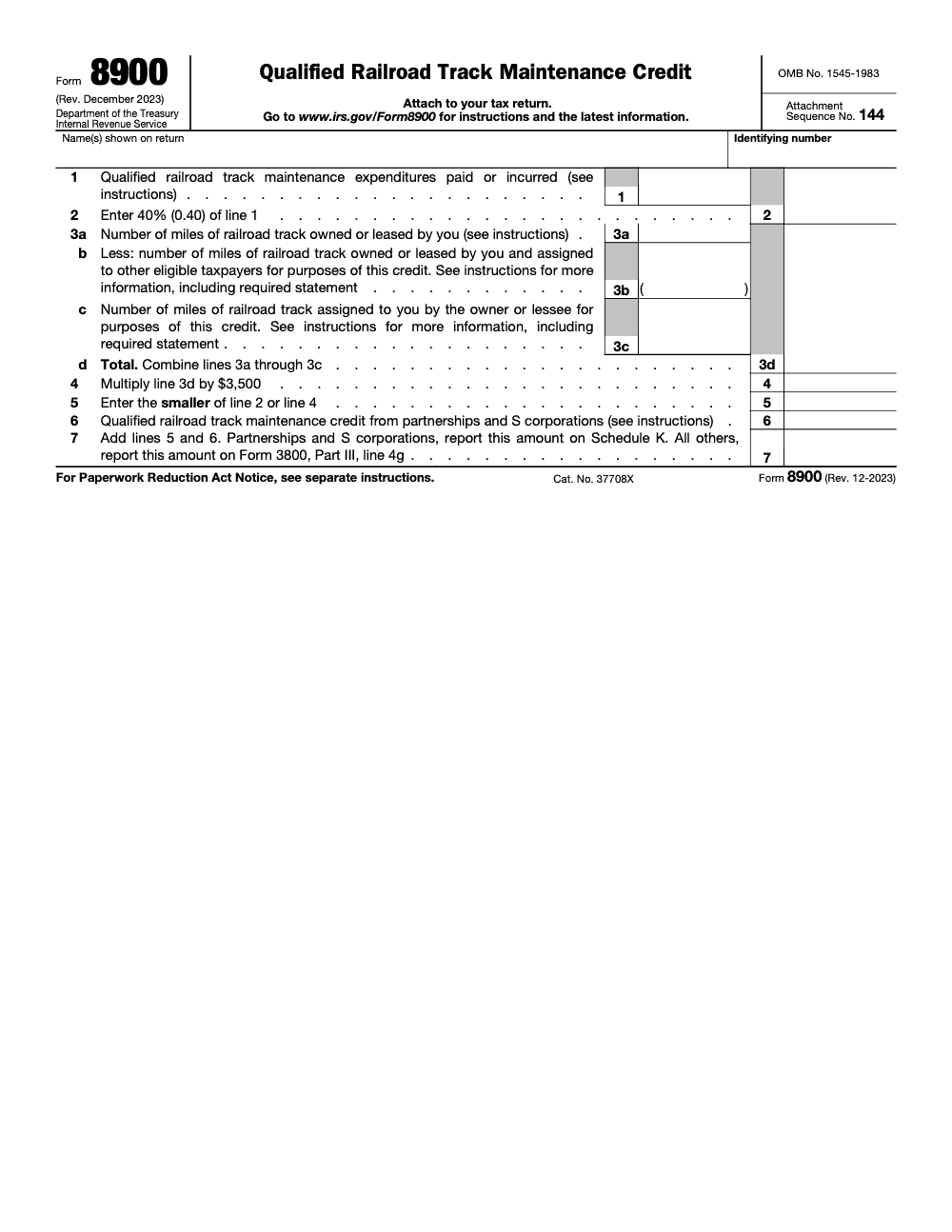
Form 8900 claims the Qualified Railroad Track Maintenance Credit. The credit equals the smaller of 40% of qualified railroad track maintenance expenditures (line 2) or $3,500 times your total eligible miles (line 4), with the lower amount landing on line 5, per Form 8900 (Rev. December 2023). The line 7 total carries to Form 3800, Part III, line 4g for direct filers, while partnerships and S corporations pass it through on Schedule K. Prefer to hand off the build? See our tax preparation services.
Form 8900 rarely fails on the math. It fails on the miles. The clean returns I have reviewed claimed every mile the railroad owned on line 3a without ever netting out the miles assigned to a shipper, which overstated the credit on line 5 and left the assignment statement behind line 3b missing from the file entirely.
The credit equals the smaller of 40% of qualified railroad track maintenance expenditures or $3,500 per eligible mile, and that per-mile cap is where overstatements get caught. You assign and receive miles, not credits, and a non-rail claimant can only count miles a Class II or III railroad assigns in writing. Partnerships and S corporations file at the entity level and pass the credit through on Schedule K, with most owners reporting it on Form 3800.
Key Takeaways
- The Qualified Railroad Track Maintenance Credit equals the smaller of 40% of qualified railroad track maintenance expenditures or $3,500 per eligible mile for the year. Use the December 2023 form, which shows the 40% rate on line 2.
- Eligible taxpayers include Class II and Class III railroads, and also shippers or service providers, but non‑rail claimants can only claim miles that a Class II or III assigns to them in writing.
- You assign and receive miles, not “credits.” The assignee’s payment to the railroad for those miles is treated as qualified expenditures to the assignee. Attach the required statements for lines 3b and 3c.
- Partnerships and S corporations file Form 8900 at the entity level and pass credits to owners, K‑1 code AJ, and most other owners report the credit on Form 3800, Part III, line 4g.
- The credit is permanent, the rate is 40% for tax years beginning after 2022, and the per‑mile cap remains $3,500 as of December 8, 2025. Proposals in 2025 would raise the cap to $6,100 and index it, but they were not enacted as of this date.
What Form 8900 is and who can claim it
Form 8900 is how you compute and claim the Qualified Railroad Track Maintenance Credit, sometimes called the short line railroad credit or section 45G credit. You attach the form to your federal return for the year you paid or incurred the costs. If your only source is a Schedule K‑1 from a partnership or S corporation, you generally claim it directly on Form 3800 instead, so you may not need to file Form 8900 yourself.
Eligible taxpayers
You can claim the credit if you are any of the following, subject to the assignment rules described below.
- A Class II or Class III railroad.
- A person or company that transports property using the rail facilities of a Class II or Class III railroad.
- A person or company that furnishes railroad‑related services or property to a Class II or Class III railroad.
Important guardrails for non‑rail claimants, if you are a shipper or a service provider, you are only eligible for miles a Class II or III railroad assigns to you for purposes of the credit. You cannot assign those miles again.
What track and costs count
- Eligible railroad track is track in the United States that a Class II or III owns or leases at year‑end. Double track counts as multiple miles, for example, one mile of double track counts as two.
- Qualified railroad track maintenance expenditures, QRTME, include amounts, whether expensed or capitalized, for maintaining, repairing, and improving a qualifying railroad structure, such as track, bridges, and tunnels, provided the track was owned or leased by a Class II or III as of January 1, 2015. If you are an assignee who pays a railroad to obtain an assignment of miles, that payment is treated as QRTME to you. Basis reduction rules apply when amounts are capitalized.
The rate and the limit, what changed
- For tax years beginning after 2022, the credit rate is 40%, and the per‑mile cap remains $3,500. The current one‑page form shows 40% on line 2 and multiplies eligible miles by $3,500 on line 4. You take the smaller of those two numbers on line 5.
- Congress made the credit permanent and reduced the rate to 40% in guidance reflected in the 12‑2023 instructions. As of December 8, 2025, the IRS Form 8900 page lists no additional developments.
A quick mental model
Think “What, How, Wow.”
- What, compute 40% of qualified costs, compare it to $3,500 times your total eligible miles, then take the smaller number.
- How, document miles owned or leased, subtract miles you assigned to others, add miles assigned to you, keep the required statements with your return.
- Wow, common wins come from getting the mileage math right, double track counts as multiple miles, and from treating assignment payments as QRTME to the assignee.
Who this helps inside your organization
- CFOs and controllers at Class II and III railroads who own or lease the track.
- Shippers that use short line facilities and receive mile assignments in exchange for funding work.
- Engineering and maintenance leaders, whose work tickets, invoices, and closeout reports become audit support for QRTME and mileage.
As you move forward, plan your 2025 filing decisions using today’s rules. A 2025 bill, H.R. 516, and a Senate companion, S. 1532, would raise the per‑mile cap to $6,100, index it for inflation starting with years after 2025, and update the eligible track ownership date to January 1, 2024. These proposals were introduced and had traction, however, they were not enacted as of December 8, 2025.
How to calculate the credit correctly in 2025
Here is a simple, line‑by‑line way to get the math right, using the December 2023 one‑page form.
A quick line‑by‑line
- Line 1, add up your qualified railroad track maintenance expenditures, QRTME, for the year. Include both expensed and capitalized amounts for maintaining, repairing, and improving a qualifying railroad structure on eligible track. If you paid a railroad for an assignment of eligible miles, that payment is QRTME to you.
- Line 2, multiply line 1 by 40%.
- Lines 3a to 3d, compute total eligible miles, miles you own or lease at year‑end, minus miles you assigned to others, plus miles assigned to you by a Class II or III.
- Line 4, multiply total eligible miles by $3,500.
- Line 5, take the smaller of line 2 or line 4.
- Line 6, add any credit passed through to you on K‑1s, code AJ.
- Line 7, partnerships and S corporations report the result on Schedule K, all other filers carry it to Form 3800, Part III, line 4g.
Calculation table you can reuse
| Step | What you enter | Where it lives | Source |
| 1 | Total QRTME for the year | Line 1 | Invoices, work orders, capitalization schedules |
| 2 | 40% of QRTME | Line 2 | IRS Form 8900, 12‑2023 revision |
| 3 | Miles owned or leased at year‑end | Line 3a | Engineering maps, FRA or STB records |
| 4 | Less miles you assigned | Line 3b | Assignment statement attached |
| 5 | Plus miles assigned to you | Line 3c | Assignment statement attached |
| 6 | Total eligible miles | Line 3d | Sum of lines 3a through 3c |
| 7 | $3,500 times total eligible miles | Line 4 | Per‑mile cap |
| 8 | Smaller of steps 2 or 7 | Line 5 | Allowed credit before K‑1 add‑ins |
| 9 | K‑1 credit, code AJ | Line 6 | Partner or shareholder statements |
| 10 | Total credit | Line 7 | To Form 3800 or Schedule K |
Form citations, lines 1 to 7 and the $3,500 multiplier appear on the December 2023 form.
What counts as QRTME, with practical examples
Eligible costs cover maintaining, repairing, and improving a qualifying railroad structure on eligible track owned or leased by a Class II or III as of January 1, 2015. That includes rails, ties, ballast, surfacing, switches, crossings, bridge timbers, culverts, and related labor and materials. If a shipper funds track work and receives an assignment of miles, the payment to the railroad is QRTME to the shipper. When you capitalize part of the work, the credit still applies, then you reduce basis by the credit amount tied to the capitalized portion.
Examples that usually qualify when tied to eligible miles:
- Installing new ties and surfacing to restore geometry on a Class III mainline.
- Replacing a timber deck on a qualifying bridge segment.
- Rail relay and ballast undercutting on track owned by a Class II that meets the 2015 ownership rule.
- A shipper’s payment to the short line under an agreement that assigns miles for the credit computation.
Costs that do not count
Avoid dropping routine operating costs into QRTME. Crew wages for train operations, fuel, dispatching, marketing, and most administrative overhead do not maintain, repair, or improve a qualifying railroad structure, so they are out. Buying land or acquiring rail property is not QRTME. Track that is not eligible under the rules, for example track that fails the ownership or lease test, is also out. See the definitions in the instructions and regulations for rail facilities, railroad‑related property and services, and qualifying structures.
Per‑mile cap and aggregation
The per‑mile cap is $3,500 multiplied by your total eligible miles for the year. The instructions also treat members of a controlled group or trades or businesses under common control as a single taxpayer for computing the credit, then each member takes a proportionate share. Keep a clear allocation workpaper if you file multiple returns in a group.
Double track counts as multiple miles. One mile of double track is two miles for the cap. This small detail often explains unexpected gaps between engineering mileage and the tax cap.
A quick scenario
Say you have 250 eligible miles at year‑end, and you assign 10 miles to a shipper and receive 5 miles from another short line. Your total eligible miles for the cap are 245. If your QRTME are 8,000,000, 40% is 3,200,000 on line 2. Your per‑mile cap is 245 x 3,500, 857,500 on line 4. Your allowed credit is 857,500 on line 5, the lower of the two numbers, before any K‑1 add‑ins.
If that shipper paid you 600,000 under the assignment agreement, that 600,000 is QRTME to the shipper, not you, and the shipper will need the required assignment statement to support its own Form 8900.
Assignments, documentation, and statements that keep you audit‑ready
You assign miles, not credits
This trips up many teams. A Class II or III railroad can assign miles of eligible track to another eligible taxpayer, for example a shipper that funded work. The assignee cannot reassign miles. The payment an assignee makes to the railroad to receive the assignment is treated as QRTME to the assignee. None of this requires a transfer of title or identifying a specific physical mile, but it does require precise statements attached to the returns of both parties.
Required statements for the assignor, line 3b
If you assign miles, attach a statement that lists each assignee’s name and TIN, your total eligible miles, the miles you assigned to each assignee, and the total miles you assigned to all assignees. If an assignor over‑assigns more miles than it has, each assignee’s allocation will be reduced proportionally.
Required statements for the assignee, line 3c
If you receive miles, your statement must show the total miles assigned to you for your tax year and include an attestation that you have, in writing and on file, the assignor’s name and TIN, the effective date of each assignment, and the miles assigned to you from each assignor. Keep this with your books and records.
Partnerships, S corporations, and owners
- Partnerships and S corporations file Form 8900 to compute the credit. Owners receive their share on Schedule K‑1, code AJ. Most other taxpayers with only pass‑through credit can report it directly on Form 3800, Part III, line 4g.
- The general business credit rules apply at the owner level, so you may face limitation, carryback, and carryforward under section 39 on your Form 3800. The IRS Form 8900 page confirms the routing to Form 3800.
Basis reduction
If you capitalized part of the work, you must reduce the basis of the qualifying railroad structure by the portion of the credit attributable to that capitalized amount. This basis adjustment is limited to the QRTME actually capitalized. Keep a tie‑out between your fixed asset module and the credit computation.
Controlled groups and common control
Members of a controlled group or trades or businesses under common control are treated as one taxpayer for computing the credit, then each member takes its proportionate share. Attach an allocation statement and keep the utilization and proportion math with your return workpapers.
Recordkeeping, checklists, and a light SOP you can adopt
Here is a practical checklist that has worked well for finance and engineering teams:
- Mileage file, maps, mileposts, and a summary showing miles owned or leased at year‑end, less miles assigned, plus miles received, and a note where any double track is present.
- Assignment agreements, with required statements for both assignors and assignees, signed and dated for the tax year.
- QRTME ledger with vendor invoices, labor reports, materials, work orders, and capitalization entries, showing which segments the work relates to and that the track satisfies the 2015 ownership or lease rule.
- Basis reduction tie‑out, a short schedule that connects the capitalized portion of QRTME to the credit and shows the basis reduction by asset.
- K‑1 tracking, owners’ allocations, and Form 3800 routing with line references and dates.
Where to find the form and which revision to use
Download the current one‑page Form 8900 and the December 2023 instructions from the IRS site. The instructions explicitly say to use the 12‑2023 revision for tax years beginning in 2023 or later until a newer revision appears. Check the IRS “About Form 8900” page for any new developments before you file.
Filing flow you can follow
- Confirm eligibility and track status using the definitions in the instructions.
- Build the QRTME ledger and compute line 1, then line 2 at 40%.
- Compute miles, lines 3a through 3d, and prepare the required statements if you assigned or received miles.
- Compute the $3,500 per‑mile cap on line 4 and pick the smaller amount on line 5.
- Add K‑1 amounts on line 6, report on line 7, then carry to Form 3800 or the Schedule K as indicated on the form.
Quick reminder, the Form 8900 page on IRS.gov, last reviewed January 28, 2025, shows no newer revision as of today, December 8, 2025. Always recheck that page the week you file.
A note on delivery discipline
If you are a CPA firm preparing multiple Form 8900 filings, build a small SOP, standard naming, a one‑page tie‑out for lines 1 to 7, and a single assignment statement template that legal reviews once. This prevents last‑minute rework and review bottlenecks. Where it is helpful, Accountably can slot trained offshore staff into that SOP inside your Karbon or TaxDome workflow, so your team stays out of the scramble and partners spend less time in review. Keep this light and focused on control, not headcount.
Legislative status in 2025, what to watch before filing
Two 2025 bills would modify the credit, H.R. 516 in the House and S. 1532 in the Senate. Both would raise the per‑mile cap to $6,100, index it for inflation for taxable years beginning after 2025, and update the eligible track ownership date from January 1, 2015 to January 1, 2024. These bills were introduced and tracked during 2025, however, as of December 8, 2025, they were not enacted. File under current rules until you see a signed law or an IRS update.
Action item, recheck Congress.gov or the IRS About Form 8900 page during year‑end close to see if a final bill changed the cap or the eligibility date.
Common mistakes we see, and how you can avoid them
Most Form 8900 corrections we make are not about the credit rate. They cluster around miles, statements, and where the credit lands. Here are the ones we see every cycle.
Practical next steps and a light CTA
- Build a simple mileage workbook with three tabs, owned or leased, assigned out, assigned in, and reconcile to engineering maps.
- Create an assignment statement template you can reuse for lines 3b and 3c support.
- Tie your fixed asset module to the QRTME ledger and basis reductions so the year‑end close matches the return.
If you are juggling multiple Form 8900 clients and want a repeatable delivery system, not more resumes, Accountably can provide trained offshore staff who work in your systems, follow your SOP, and prepare consistent workpapers that shorten partner review time. Use this where it truly helps your team’s throughput and control.
Compliance notes and sources
- IRS Form 8900, Rev. 12‑2023, shows the 40% rate and the $3,500 per‑mile calculation by line, and is one page.
- IRS Instructions for Form 8900, Rev. 12‑2023, define eligible taxpayers, QRTME, assignments, statements, basis reduction, controlled groups, and which revision to use.
- IRS About Form 8900 page, last reviewed January 28, 2025, lists the current revision and notes no additional developments as of that date.
- 2025 proposals, H.R. 516 and S. 1532, would raise the per‑mile cap to $6,100, index it, and update the eligible track ownership date to January 1, 2024. Monitor Congress.gov for changes.
Reusable Checklists
These checklists are copy-paste ready for your firm SOP. Keep the line references intact and adapt the item labels to each client.
Mileage reconciliation (lines 3a to 3d)
- Pull owned or leased track miles as of year-end for line 3a.
- Identify miles assigned to other eligible taxpayers and enter them as a negative on line 3b.
- Identify miles assigned to you by an owner or lessee and add them on line 3c.
- Combine to line 3d and reconcile the total to your engineering mileage maps.
- Resolve any disputed segments before the $3,500 per-mile cap is computed on line 4.
Credit computation tie-out (lines 1 to 7)
- Total qualified railroad track maintenance expenditures on line 1 from the QRTME ledger.
- Multiply line 1 by 40% for line 2.
- Multiply total eligible miles (line 3d) by $3,500 for line 4.
- Take the smaller of line 2 or line 4 on line 5.
- Add any pass-through credit on line 6 and total to line 7.
- Carry line 7 to Form 3800, Part III, line 4g, or to Schedule K for pass-throughs.
Assignment statement packet (lines 3b and 3c)
- Confirm whether the engagement assigns miles out (line 3b) or receives miles (line 3c).
- For assignors, list each assignee name, TIN, and the miles assigned.
- For assignees, document the assignor name, TIN, effective date, and miles received.
- Attach the supporting statement to the return, per the Instructions for Form 8900.
- File the signed assignment agreements with the workpapers for audit support.
Keep 8900 Season From Stalling
Form 8900 does not get its own deadline. The Qualified Railroad Track Maintenance Credit rides on the entity return it attaches to, which means the work lands in the same year-end close where engineering mileage, capitalization schedules, and the QRTME ledger are all still moving. With the credit set at the smaller of 40% of expenditures or $3,500 per eligible mile (Form 8900, Rev. December 2023), a single unreconciled mile changes the number on line 5.
The fix is not more reviewers at deadline. It is a standing workpaper set that closes the mileage and statement questions before return assembly starts, so the line 1 through line 7 build is mechanical by the time a partner looks at it.
- Lock the mileage roll-forward early: line 3a owned or leased miles, line 3b miles assigned out as a negative, line 3c miles assigned in, reconciled to line 3d.
- Template the line 3b and line 3c assignment statements once so every engagement reuses the same reviewed format.
- Tie the QRTME ledger to line 1, carry 40% cleanly to line 2, then confirm the line 5 lower-of test against the $3,500 cap on line 4.
- Route the line 7 total correctly: Form 3800, Part III, line 4g for direct filers, Schedule K for pass-throughs.
That is the structured, repeatable execution we build at Accountably. Trained offshore teams work inside your systems and SOPs to prepare the mileage roll-forward, the assignment statements, and the line 1 to line 7 tie-out, so your tax preparation capacity holds through close and partner review stays focused on judgment, not mileage cleanup.
FAQs
Yes. For tax years beginning after 2022, the rate is 40%, as reflected on the December 2023 form and instructions. You still apply the $3,500 per‑mile cap and take the smaller number.
Yes, but only for miles a Class II or III railroad assigns to the shipper for credit purposes. The shipper must attach the required statement and keep the assignor’s information on file.
The excess is corrected by proportionally reducing each assignee’s allocation. This is why you reconcile assigned miles to the railroad’s total eligible miles.
Improvements on qualifying railroad structures can be QRTME, even if capitalized. When capitalized, you must reduce basis by the credit amount tied to those capitalized costs.
Owners use Form 3800, Part III, line 4g, with K‑1 code AJ detail. The partnership or S corporation completes Form 8900 at the entity level.
Yes, one mile of double track is treated as two miles for the per‑mile multiplier.
Other forms this guide names
- Form 3800: How to Claim the General Business Credit in 2025
About this guide
Accountably helps US CPA, EA, and accounting firms hire trained accountants and tax preparers in India.
About us Reviewed byJugal Thacker, CPAFounder and CEO at Accountably
A Washington-licensed CPA with 7+ years inside US firms – PwC, a real-estate tax practice, then a full-service firm, rising from reviewer to manager to advisory. This article was reviewed against current IRS guidance for the 2025 tax year and updated for filers preparing late returns, amendments, and 2026 estimates.
View profile →How we research, review, and update this guide
Every Accountably guide is researched against primary IRS sources, reviewed by a U.S. CPA, and refreshed as guidance evolves. Read our Editorial Guidelines to see how we source, fact-check, and update our content.