Summarize this article with AI
In Brief
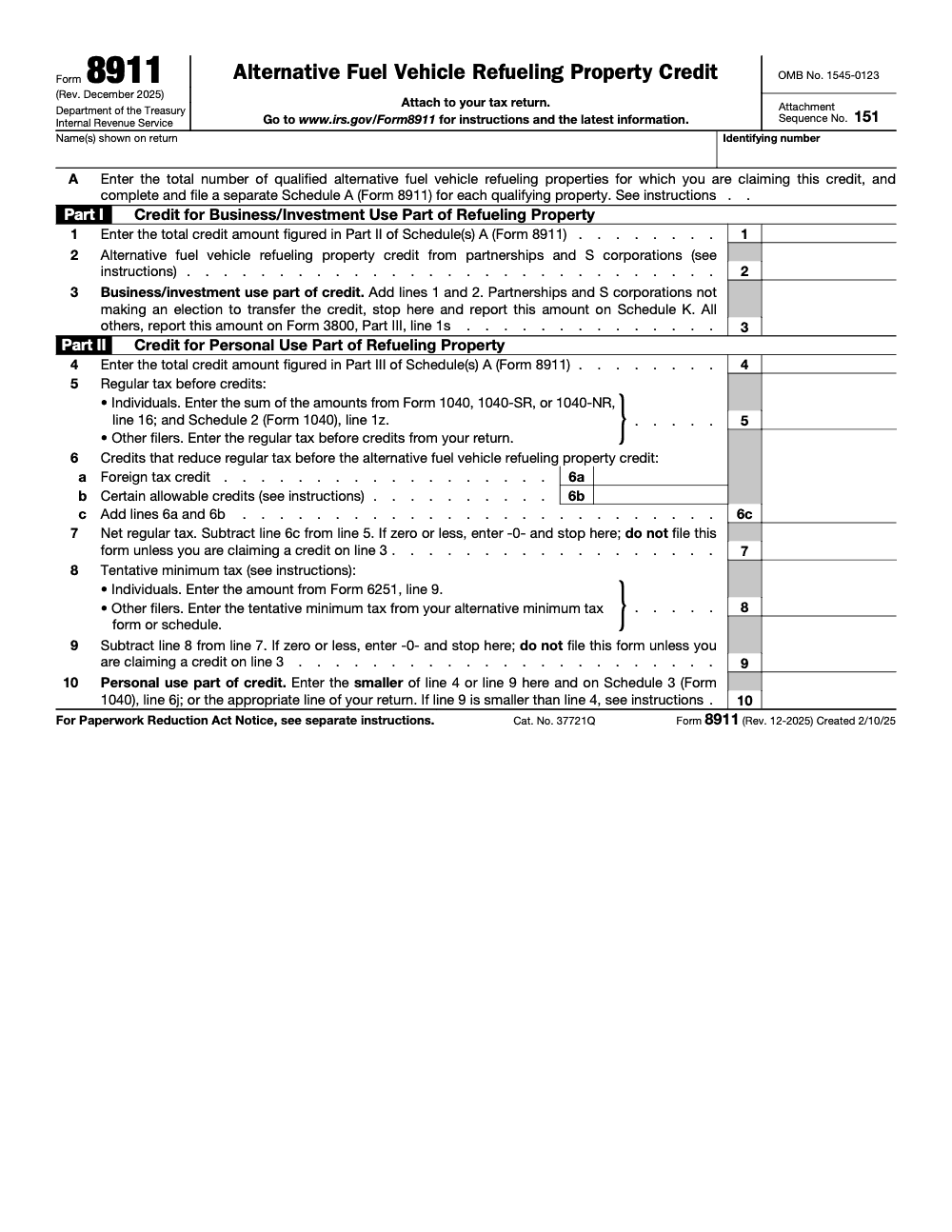
Form 8911 claims the Alternative Fuel Vehicle Refueling Property Credit under IRC §30C for qualified EV chargers and refueling equipment, and you file one Schedule A (Form 8911) per item placed in service. The business credit is 6 percent of basis (30 percent if prevailing wage and apprenticeship standards are met) capped at $100,000 per item on line 16, the personal-use credit is 30 percent capped at $1,000 per item on line 21, and per the IRS Form 8911 instructions (Rev. December 2025) post-2022 items must sit in an eligible census tract. Need this handled at scale? See our tax preparation services.
Form 8911 works item by item, so you complete a separate Schedule A (Form 8911) for every single item placed in service, and both the $100,000 business cap and the census-tract test apply to each item rather than to the project.
For items placed in service in 2023 and later, each one must sit in an eligible census tract, low-income or non-urban, verified at the time it is placed in service. Businesses claim 6 percent of basis up to $100,000 per item, or 30 percent up to $100,000 when prevailing wage and apprenticeship standards are met, and individuals generally claim 30 percent up to $1,000 per non-depreciable port at a principal residence.
Key Takeaways
- Use Form 8911 to claim the Alternative Fuel Vehicle Refueling Property Credit, and complete a separate Schedule A (Form 8911) for every single item you placed in service.
- For 2023 and later, every item must sit in an eligible census tract, low‑income or non‑urban, verified at the time the item is placed in service.
- Individuals, 30 percent up to $1,000 per non‑depreciable port at a principal residence, subject to eligible tract rules.
- Businesses, 6 percent up to $100,000 per depreciable item, or 30 percent up to $100,000 if you satisfy prevailing wage and apprenticeship.
- Keep tract proof, dates, invoices, and basis adjustments in a tidy packet, then mirror those details on Schedule A so Form 8911 and Form 3800 compute correctly.
What Form 8911 Actually Does
Form 8911 calculates the credit for qualified alternative fuel refueling property you placed in service during the tax year. It covers equipment that stores or dispenses electricity, hydrogen, natural gas, propane, E85, or qualifying biodiesel blends, plus the associated components that are directly attributable and traceable to each item. Buildings do not qualify. You must be the original user, you must use the property primarily in the United States, and for post‑2022 placements you must meet the eligible census tract rule.
Why the rules feel different after 2022
Two changes matter most. First, the law moved from a per‑location cap to a per‑item cap, so you calculate by port or dispenser, not by site. Second, the eligible census tract test now applies for property placed in service in 2023 through 2032 (though the One Big Beautiful Bill Act has since accelerated the Section 30C termination so that property placed in service after June 30, 2026 no longer qualifies, superseding the original 2032 sunset). Those two shifts are why documentation and per‑item organization matter so much in 2025.
A Quick Story From Review
On a recent multi‑store install, the numbers looked simple. Eight ports, about $14,500 of qualified cost per port. Without prevailing wage and apprenticeship, the credit came out to 6 percent per item. With compliance, it jumped to 30 percent per item. Same hardware, same addresses, totally different outcomes because the team decided early to meet labor standards, saved certified payrolls, and kept apprenticeship ratios. The review took minutes, not hours, because every port had its own packet.
Firms stall here when partner time gets trapped in review loops, when workpapers are rushed, and when no one owns documentation discipline. A clear SOP and consistent Schedule A packets fix that fast.
The What‑How‑Wow Summary
- What, Form 8911 pays you back for part of your qualified refueling property cost.
- How, verify the eligible census tract, build a per‑item packet, complete Schedule A for each item, then file Form 8911 and, if needed, Form 3800.
- Wow, with prevailing wage and apprenticeship, a business credit can jump from 6 percent to 30 percent, capped at $100,000 per item, which changes the payback math on multi‑port sites.
Educational only, not tax advice. Confirm details with the current IRS instructions and a qualified advisor.
Who Qualifies and What Counts as Refueling Property
You can claim the credit if you install new qualified property, original use begins with you, and the item is used mainly in the United States. For placements on or after January 1, 2023, the site must be in an eligible census tract. You can qualify as:
- An individual installing EV charging equipment at your principal residence, non‑depreciable property, usually 30 percent up to $1,000 per port (a charger installed at a vacation home, rental, or second residence does not qualify for this personal-use portion, only your main home does).
- A business, or other entity, installing depreciable equipment at a U.S. site that serves your fleet, employees, or customers, per‑item caps apply.
- An applicable entity that may use elective pay for the business credit, if you meet those rules and finish pre‑filing registration.
Qualified property includes the charger or dispenser and associated equipment that is directly attributable and traceable to that item, for example a pedestal, a dedicated panel, conduit, and wiring that serve that port. Structures and building improvements are out.
Common edge cases, answered quickly
- Bidirectional EV charging can still qualify when other requirements are met.
- Two or three wheel EV chargers may qualify if the vehicle is intended for on‑road use and other rules are met.
- Replacement parts can qualify if they are part of a new single item placed in service and original use begins with you.
Credit Amounts and Limits by Year Placed in Service
The placed‑in‑service year controls the math. Start there, then pick the right rules.
- Placed before 2023, 30 percent up to $30,000 per business location for depreciable property, and 30 percent up to $1,000 for personal, non‑depreciable property.
- Placed on or after 1‑1‑2023, business, 6 percent of depreciable cost per single item, up to $100,000. If you satisfy prevailing wage and apprenticeship, the rate increases to 30 percent, same $100,000 cap, and projects whose construction began before January 29, 2023 automatically qualify for the 30 percent rate without having to document prevailing wage or apprenticeship compliance.
- Placed on or after 1‑1‑2023, residential at a principal residence, 30 percent up to $1,000 per non‑depreciable item, and the home must be in an eligible census tract.
Important interactions:
- Reduce basis for any Section 179 deduction before computing the credit.
- After claiming the credit, reduce asset basis by the credit amount.
- For mixed‑use items, apply business or investment use percentage before the cap and before the rate.
Residential credit limits, fast math you can trust
- Per‑port limit, $1,000 for each non‑depreciable port.
- Per‑dwelling limit, $1,000 overall for the residence, unless you have multiple eligible ports that each qualify by the rules in place when installed.
- Calculation, lesser of 30 percent of eligible costs or $1,000, and the residence must be in an eligible census tract for post‑2022 placements.
Business credit mechanics, organized for reviewers
Here is the clean summary reviewers love.
| Topic | Key mechanics |
| Rate | 6 percent base, 30 percent with prevailing wage and apprenticeship |
| Cap | $100,000 per single item of depreciable property |
| Basis | Include equipment, directly attributable associated property, and installation labor, exclude buildings |
| Census tracts | Eligible low‑income or non‑urban tracts for 2023 through 2032 placements (the credit terminates for property placed in service after June 30, 2026 under the One Big Beautiful Bill Act) |
| Filing | One Schedule A per item, then Form 8911, then Form 3800 if a general business credit; only the business portion routes through Form 3800, the personal-use portion goes on Schedule 3 (Form 1040), line 6j instead |
| Documentation | Invoices, proof of payment, placed‑in‑service evidence, GEOID screenshot, Section 179 note, certified payrolls and apprenticeship records if claiming 30 percent |
Decide on prevailing wage and apprenticeship before you sign contracts. Waiting until year end to chase payroll records turns an easy 30 percent into a hard 6 percent.
Geographic Eligibility, How To Prove Your Site Qualifies
For property placed in service after 2022, each single item must be located in an eligible census tract. The rule is item by item, not by location, and it hinges on the tract status when you place the item in service.
- Low‑income community, a census tract that meets the income and poverty thresholds used for these credits.
- Non‑urban tract, a census tract that is not part of an urban area under the current definitions.
You do not need both. One category is enough. The key is accurate tract identification and a dated record that shows how you made the call.
The tract vintage rule, 2015 and 2020 GEOIDs
- If the item was placed in service before January 1, 2025, rely on the 2015 census tract identifier and the IRS eligibility list for that vintage.
- If the item is placed in service on or after January 1, 2025, use the 2020 census tract identifier and the current IRS eligibility list.
- If your rollout spans multiple years, match each item to the correct vintage. Do not mix GEOIDs across years in the same packet.
How to document eligibility in five clear steps
- Look up the address with the IRS endorsed tools or the Argonne 30C locator.
- Confirm whether the tract is low‑income or non‑urban based on the correct vintage.
- Save a screenshot or PDF that shows the address, the GEOID, the eligibility result, and the date you checked.
- Add the placed‑in‑service date to the screenshot file name.
- File that proof in the item’s folder and reference it on Schedule A.
What Costs Are In, What Costs Are Out
Include the single item and the associated property that is directly attributable and traceable to that item. Do not include building or structural costs.
- In, chargers, dispensers, pedestals, dedicated panels, conduit, wiring, mounting hardware, reasonable installation labor.
- Out, building shell work, parking lot resurfacing, unrelated electrical upgrades that are not dedicated to the item.
If you use Section 179, reduce the depreciable basis first. Then compute the credit and reduce the asset basis by the credit amount. Keep the math visible in your fixed asset subledger so reviewers can confirm it in seconds.
Real world examples you can model
- Homeowner, your all‑in cost is $3,200 for a Level 2 charger, dedicated panel, and conduit at your main home in an eligible tract. Thirty percent is $960, below the $1,000 cap, so your credit is $960. Save the tract proof, invoices, and a photo with the completion date.
- Retailer, eight ports across four eligible tracts, $14,500 of qualified cost per port. Without prevailing wage and apprenticeship, the credit is 6 percent, $870 per port. With compliance, the credit is 30 percent, $4,350 per port. Same hardware, different records, very different outcome.
- Warehouse, ten ports at $12,000 each. Without PWA, $720 per port. With PWA, $3,600 per port. All within the $100,000 cap per item.
Save tract proof and labor compliance as you build. Waiting until filing season turns simple wins into long email threads.
Schedule A, The Engine Behind Form 8911
Think of Schedule A as a per‑item dossier. You complete one Schedule A for every single item of property you placed in service during the year, then those totals flow to Form 8911. If you try to skip it, the software and the review will stall, because this is where the IRS asks for the details that determine your rate, your cap, and your eligibility.
What to enter on each Schedule A
- Property location, construction start date, and placed‑in‑service date.
- Total cost, business or investment use percentage, and any Section 179 deduction.
- Eligible census tract selection and the correct GEOID vintage.
- Whether you are using elective pay or a credit transfer, which later appears on Form 3800.
Pro tip, mirror your file names to Schedule A. If line 6b uses GEOID 2015‑XXXX, make the screenshot file name start with the same GEOID and date. Reviewers love this, and you avoid mystery attachments that slow the process.
Filing Steps and Where This Lives in Software
Here is a clean sequence that works for homeowners and for multi‑entity groups.
- Gather documents, invoices with equipment and labor, proof of payment, construction start, placed‑in‑service date, business or investment use percentage, Section 179 decisions, tract eligibility proof, and, if needed, prevailing wage and apprenticeship records.
- Complete a separate Schedule A for each single item.
- Enter Form 8911 in your software and confirm it carries to Form 3800 when it is a general business credit.
- If you are using elective pay or transferring credits, complete pre‑filing registration, then finish elections on Form 3800.
Elective pay and credit transfers, when to consider them
- Elective pay, for applicable entities that cannot normally use income tax credits, can turn the business credit into a payment and can produce a refund.
- Credit transfer, for eligible taxpayers, allows you to sell all or part of the credit to an unrelated buyer for cash.
- Both require pre‑filing registration and careful timing, so start early. Add the registration confirmation to each item’s folder.
Documentation, The Packet That Protects You
For every item, build a simple packet that a reviewer can scan in under two minutes.
- Itemized invoice that separates the charger, associated property, and installation labor.
- Proof of payment that ties to the invoice.
- Placed‑in‑service proof, for example a completion certificate or dated photo.
- Census‑tract proof, screenshot or PDF with the GEOID, the address, the eligibility result, and the date you checked.
- Section 179 summary, if taken.
- Prevailing wage and apprenticeship support if you claim the 30 percent business rate, certified payrolls and apprenticeship hours.
If your firm often scrambles here, you are not short on clients, you are missing structure. A standard naming convention and SOP‑driven workpapers remove the bottleneck and cut review time.
Preventable Errors I See Every Season
- No tract proof in the file. The credit hinges on location for post‑2022 items, save the GEOID and the date you checked.
- Treating a site as one item. The cap is per single item after 2022, tag each port separately.
- Basis math out of order. Reduce basis for Section 179 first, then compute the credit, then reduce asset basis by the credit.
- PWA records missing. If you want 30 percent for business, you need payroll and apprenticeship records that match the work window.
- Wrong tract vintage. Use 2015 GEOIDs for items placed before 1‑1‑2025, use 2020 GEOIDs for items placed on or after 1‑1‑2025.
Step‑By‑Step Templates You Can Copy
Here are two checklists you can lift into your process, one for homeowners, one for businesses.
Homeowner checklist
- Confirm your main home address is in an eligible census tract.
- Get a quote that lists the charger, the mount or pedestal, the dedicated panel, conduit, and labor.
- Save invoices, proof of payment, tract screenshot, and a photo on the day the charger went live.
- Complete Schedule A, then Form 8911 with your return.
- Keep the packet for at least the statute period in your records.
Business checklist
- Decide early whether you will meet prevailing wage and apprenticeship, it affects contracts, payroll, and training.
- Verify eligible tracts for every site and save the correct vintage GEOID.
- Split costs per single item, then add associated property and labor that belong to that item.
- Track Section 179 decisions and basis reductions.
- Build one packet per item with invoices, payments, tract proof, dates, PWA records, then complete one Schedule A per item.
- Enter Form 8911, confirm the flow to Form 3800, and finish elective pay or credit transfer if applicable.
Resources You Will Use Often
- IRS Form 8911 and Instructions, current form, instructions, and correction notices.
- IRS pages for individuals and businesses, examples for costs, tract guidance, and labor rules.
- Internal Revenue Bulletin materials that explain per‑item caps, basis interactions, and timing.
- Argonne National Laboratory 30C eligibility locator, a practical way to validate low‑income or non‑urban tract status and save a clean screenshot.
Compliance Notes For 2025 Filings
- Match the GEOID vintage to the placed‑in‑service date, 2015 tracts for items placed before 1‑1‑2025, 2020 tracts for items placed on or after 1‑1‑2025.
- Keep a dated tract screenshot with the GEOID in each item’s packet.
- Apply Section 179 before computing the credit, then reduce the asset basis by the credit.
- If you plan elective pay or a credit transfer, start pre‑filing registration while the project is underway, not at filing time.
- For business projects, decide on prevailing wage and apprenticeship up front and save payroll and apprenticeship records that match the project window.
Where Accountably Fits, Briefly
If your firm has strong demand but stalls in delivery, you are not alone. Many teams get trapped in review loops, inconsistent workpapers, and last‑minute document hunts. Accountably integrates trained offshore teams into your workflow with SOP‑driven execution, structured workpapers, and layered reviews, which is exactly what Form 8911 projects need at scale. We keep the packets consistent, protect reviewer time, and maintain clear turnaround windows. Mentioned here because process, not effort, is what keeps these credits on track.
Build the packet as you build the project. Treat each port as its own item from the first quote to the final entry. That single habit turns a stressful credit into a repeatable win.
Final Word
You now have a clear path. Confirm the eligible tract, tag each single item, decide early on prevailing wage and apprenticeship, and build a neat packet that mirrors Schedule A. That rhythm is simple enough for a one‑car garage and strong enough for a forty‑port rollout. If you want a one‑page checklist or a Schedule A template you can drop into your workflow, tell me what you are installing, and I will send over a version you can tailor to your team.
Common Mistakes We See Every Season
These are the slips I flag most often once the basic eligibility work is done. Each one is preventable with a line-level check before the return goes out.
Reusable Checklists
Lift these into your firm SOP so every Form 8911 engagement runs the same way. Each step is grounded in the IRS Form 8911 and Schedule A instructions (Rev. December 2025).
Census tract eligibility check
- Confirm the placed-in-service date for the item on Schedule A line 5.
- Pull the full 11-digit census tract GEOID (2-digit state, 3-digit county, 6-digit tract) for the install address.
- Match the GEOID vintage to the placed-in-service date, not to the filing date.
- Verify the tract is a low-income community or non-urban tract, then answer Schedule A line 6a Yes.
- Save a dated screenshot showing the GEOID, address, and eligibility result in the item packet.
Per-item Schedule A packet
- Open one Schedule A (Form 8911) for each item placed in service; do not aggregate ports.
- Enter total item cost on line 8 and the business-use percentage on line 9.
- Subtract any Section 179 expense on line 11 before computing the rate on line 14.
- Confirm the construction-begin date on line 4 to settle the 6 or 30 percent rate.
- Apply the $100,000 business cap on line 15 and the $1,000 personal cap on line 20.
- Enter latitude and longitude on line 3b with an explicit plus or minus sign.
Credit routing and review
- Total the line 16 amounts onto Form 8911 line 1 and the line 21 amounts onto line 4.
- Route the business portion on line 3 to Form 3800, Part III, line 1s.
- Route the personal portion on line 10 to Schedule 3 (Form 1040), line 6j.
- Confirm line 7 and line 9 are above zero before claiming the personal credit.
- For elective pay or transfer items, attach the Schedule A line 1 registration number.
Keep 8911 Season From Stalling
Form 8911 does not stall on a calendar deadline the way a quarterly return does. It stalls on volume and verification. A single multi-port rollout can mean a dozen separate Schedule A packets, each needing its own 11-digit census tract proof, construction-begin date, and basis math. Per the IRS Form 8911 instructions (Rev. December 2025), the credit now applies item by item, so an eight-port site is eight workpapers, not one.
The pressure is sharper in 2025 because the One Big Beautiful Bill Act accelerated the Section 30C termination, so property placed in service after June 30, 2026 no longer qualifies. When projects compress into that window, the bottleneck is rarely demand. It is the per-item documentation discipline that turns a clean credit into a slow one, and the fix is structure applied before the project closes.
- Standardize a per-item Schedule A packet so line 8 cost, line 9 business-use percentage, and the line 6b GEOID are captured the same way every time.
- Lock the construction-begin date on line 4 at intake so the 6 or 30 percent rate on line 14 is settled before review.
- Separate the routing in the workpaper, line 3 to Form 3800 and line 10 to Schedule 3 line 6j, so reviewers never untangle it twice.
- Flag elective pay and transfer items early so the Schedule A line 1 registration number is in hand before filing.
- Hold each site's eligibility screenshot and placed-in-service proof in one folder per item.
That is the kind of repeatable structure that keeps credit work moving when the calendar tightens. Our tax preparation and review teams build the per-item packet as the project is built, hold the documentation to a single naming standard, and protect reviewer time so every Schedule A computes the first time.
FAQs
It is the IRS form you use to claim the Alternative Fuel Vehicle Refueling Property Credit for qualified EV chargers and other refueling equipment you placed in service during the year. For post‑2022 items, you must complete one Schedule A per item and meet the eligible census tract rule.
Install the charger at your principal residence, confirm the address is in an eligible census tract, save invoices and placed‑in‑service proof, then file Form 8911 with your return. The residential credit is 30 percent up to $1,000 per eligible port.
Pay prevailing wages and meet apprenticeship ratios for the covered construction, alteration, or repair. Keep certified payrolls and apprenticeship records with your packet. Without those records, the default business rate is 6 percent.
For property placed after 2022, you need either a low‑income community tract or a non‑urban tract. If the site is not eligible as of the placed‑in‑service date, the credit is not available for that item.
Yes, certain applicable entities can use elective pay for the business credit, which treats the credit like a payment and can create a refund. Pre‑filing registration is required.
Yes, a charger that can both charge and discharge can still qualify, if all other requirements are met.
Form 8911 family
- Form 8911 Schedule A: GEOID, PWA, 30% Credit, $100,000 Cap
Other forms this guide names
Summarize this article with AI
About this guide
Accountably helps US CPA, EA, and accounting firms hire trained accountants and tax preparers in India.
About us Reviewed byJugal Thacker, CPAFounder and CEO at Accountably
A Washington-licensed CPA with 7+ years inside US firms – PwC, a real-estate tax practice, then a full-service firm, rising from reviewer to manager to advisory. This article was reviewed against current IRS guidance for the 2025 tax year and updated for filers preparing late returns, amendments, and 2026 estimates.
View profile →How we research, review, and update this guide
Every Accountably guide is researched against primary IRS sources, reviewed by a U.S. CPA, and refreshed as guidance evolves. Read our Editorial Guidelines to see how we source, fact-check, and update our content.