Summarize this article with AI
In Brief
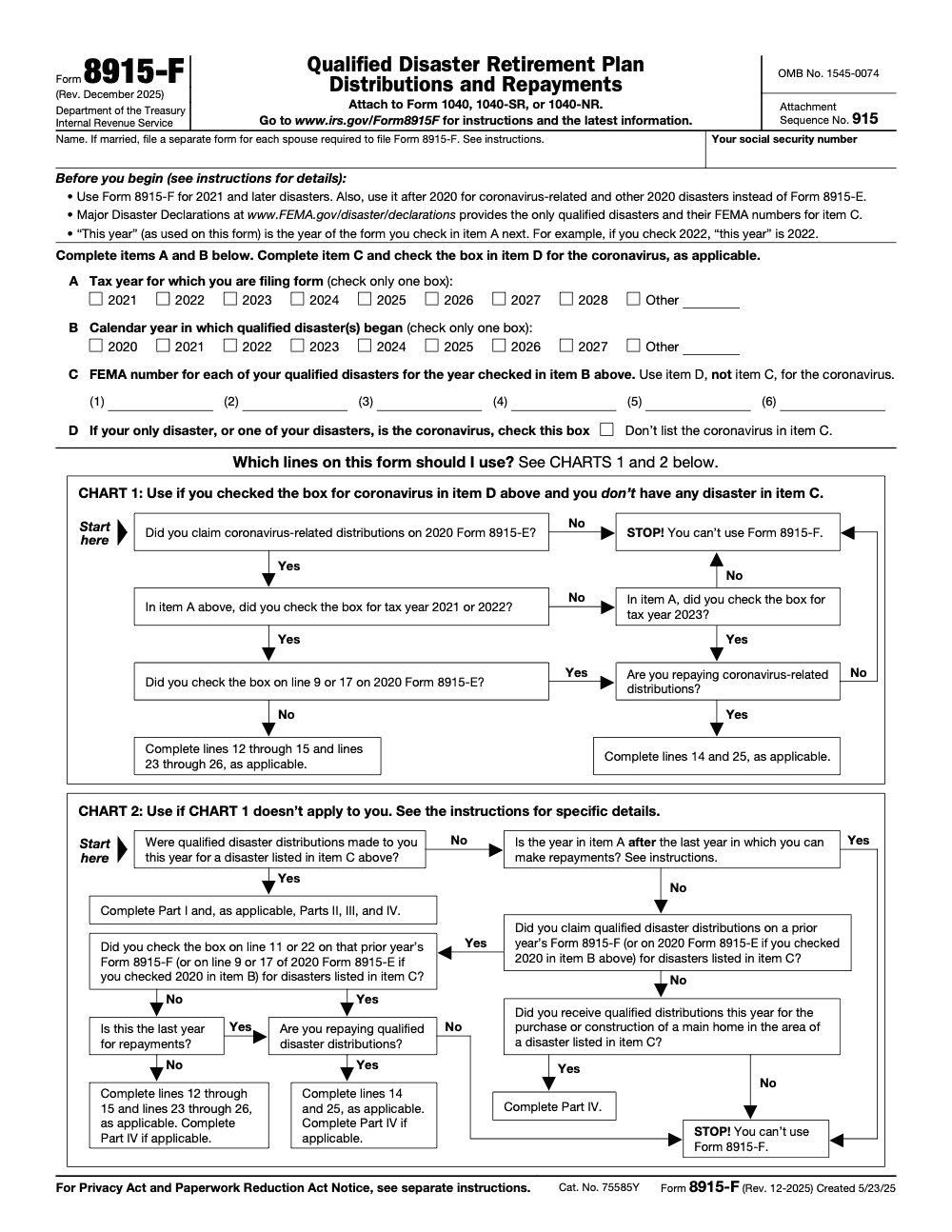
Form 8915-F is the IRS form for qualified disaster retirement plan distributions and repayments for 2021 and later FEMA-declared disasters, and for any post-2020 reporting on 2020 disasters that originally used Form 8915-E. Per the December 2025 Form 8915-F instructions, the per-disaster cap is $22,000 for 2021 and later disasters ($100,000 for 2020 disasters), the taxable amount defaults to a 3-year ratable spread unless the taxpayer checks the opt-out box on lines 11 and 22, line 15 flows to Form 1040 line 5b, and line 26 flows to Form 1040 line 4b.
The calls about Form 8915-F rarely come during the disaster itself. They land months later, when the client realizes the remaining two-thirds of that retirement distribution still have to be reported in later years and the original FEMA lookup is half-remembered. This is the forever form: used in the year of distribution and in each later year the income or a repayment shows up.
A qualified disaster distribution can avoid the 10% early withdrawal penalty, and the taxable amount defaults to a 3-year ratable spread unless you check the opt-out box on lines 11 and 22. The per-disaster cap is $22,000 for 2021 and later disasters, while the $100,000 cap applied only to 2020 disasters. Report 401(k) and similar plan distributions in Part II and IRA distributions in Part III, with each spouse filing a separate form.
Key Takeaways
- Use Form 8915-F to report qualified disaster retirement distributions and any repayments for disasters beginning in 2020 or later. The form is now a forever form, it is used in the year of distribution and in later years for the three year income spread and repayments.
- Qualified disaster distributions can avoid the 10% early withdrawal penalty, and you can include the income all at once or spread it over 3 years.
- Your distribution must fall within the disaster’s qualified disaster distribution period, which ends 179 days after the latest of the disaster beginning date, the declaration date, or December 29, 2022 for certain rules under SECURE 2.0.
- Report plan distributions from 401(k), 403(b), and similar plans in Part II, and IRA distributions in Part III. Each spouse on a joint return files a separate Form 8915-F if both have distributions.
- The per disaster limit for qualified 2021 and later disasters is generally $22,000 (the $100,000 cap applied only to 2020 disasters, including coronavirus-related distributions). Keep records and be ready to show your economic loss and your FEMA DR number.
Who Should File Form 8915-F
Start here if you took money from an IRA, 401(k), 403(b), or similar plan because a FEMA-declared major disaster affected you (state-only declarations and federal emergency declarations that are not major disaster declarations do not qualify). You should file Form 8915-F if any of the following apply for the year you are filing:
- You took a qualified disaster distribution.
- You are in year 2 or year 3 of a prior three year income spread.
- You repaid qualified disaster amounts this year and want the tax fixed.
You file one form for the spouse who had the distribution, so on a joint return you may send two forms when both spouses took disaster distributions. The dollar limits and the choice to spread income or include it all in one year are decided separately for each spouse.
What Counts As A Qualified Disaster Distribution
At its core, a qualified disaster distribution is a withdrawal tied to a federally declared disaster where your main home was in the disaster area and you had an economic loss. Your plan has to allow the withdrawal, and your timing has to fall inside the disaster’s distribution period.
Quick Qualification Table
| Criterion | Requirement | What to check |
| Disaster status | FEMA-declared major disaster | Confirm on FEMA and note the DR number for the form |
| Location | Your main home in the declared area | County and incident dates must match FEMA |
| Timing | Within the disaster’s period, ending 179 days after the latest trigger | Use IRS instructions for the specific dates |
| Purpose | You experienced an economic loss | Keep receipts, invoices, insurance letters |
| Limit | Generally up to 22,000 per disaster for 2021 and later | Track per disaster, per person |
| Documentation | Support for loss and dates | Maintain records with your return file |
The IRS instructions define the qualified disaster distribution period and the $22,000 limit for 2021 and later disasters. These rules come from SECURE 2.0 and they are baked into the current 8915-F instructions.
Why This Form Matters
- It removes the 10% penalty when the distribution fits the disaster rules.
- It lets you choose between one year inclusion or three equal years.
- It gives you a way to repay within three years, which can trigger refunds for taxes you already paid.
In plain terms, you get breathing room. Maybe you need the funds today for repairs. You can spread the income so your tax bracket stays reasonable, then repay when insurance finally pays or when cash flow returns. The form keeps those moving parts organized across tax years.
Tip, write down your FEMA DR number, the dates your area was declared, and the dates of your withdrawals. These details control the 179 day clock.
Tax Treatment And Repayment Options
Here is how the tax side plays out when your distribution qualifies:
- The 10% early distribution penalty does not apply to qualified disaster distributions, but the waiver only covers the qualifying amount within the per disaster cap (line 6); any excess above the cap is still subject to the 10% additional tax unless another exception applies.
- You may include the income in the year of distribution or spread it evenly over 3 years. Once you pass the tax return due date, that choice is locked for that distribution.
- You can repay within 3 years to an eligible plan. Repayments reduce the taxable amount, and if you already paid tax in a prior year, you may need to amend to get it back.
Mini Case Study
Say you took 18,000 from a traditional IRA in 2025 due to a federally declared flood. You elect the 3 year spread, so your income includes 6,000 in 2025, 6,000 in 2026, and 6,000 in 2027. If an insurance settlement arrives in mid 2027 and you repay the full 18,000 to an IRA within the three year window, the 2025 and 2026 income can be reversed through amended returns, and the 2027 piece is removed on your original 2027 return. The instructions explain how repayments reduce income and where to reflect them.
Qualified disaster distributions are special because you get time. Time to spread the income, and time to put the money back if your situation improves.
Completing Form 8915-F, Part By Part
The form separates plan types and uses a few key elections. Keep your 1099‑R forms handy and gather prior year 8915-F entries if you are in year 2 or 3 of a spread.
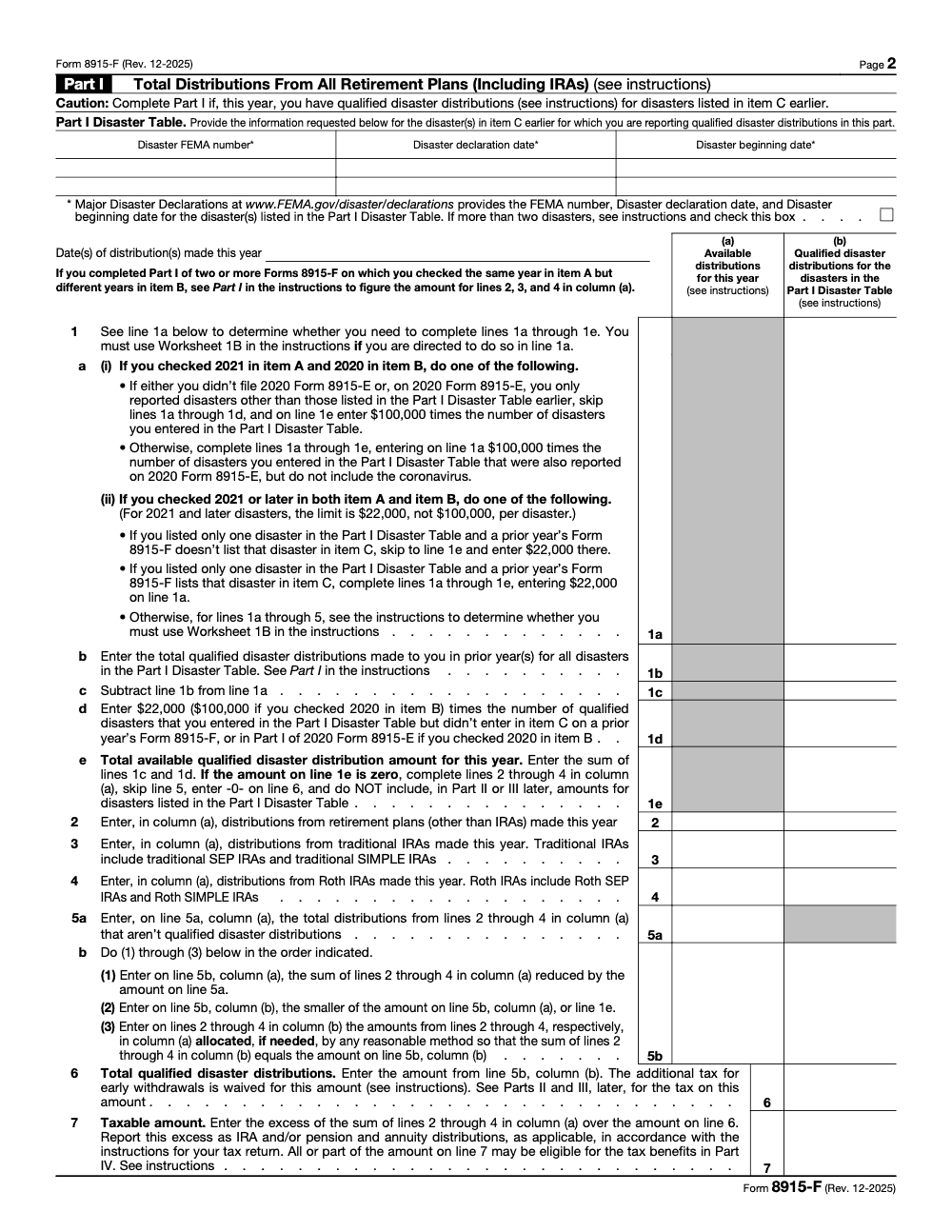
Part I, Disaster Details And Allocation
- Enter the year of the tax return you are filing and the year the disasters began (only one calendar year can be checked in item B; if you have qualified disaster distributions across multiple disaster years, file a separate Form 8915-F for each disaster year).
- List the FEMA DR number for each disaster you are using this year.
- The instructions include worksheets that help you allocate current year distributions across disasters and track the $22,000 per disaster cap.
Part II, Plans Other Than IRAs
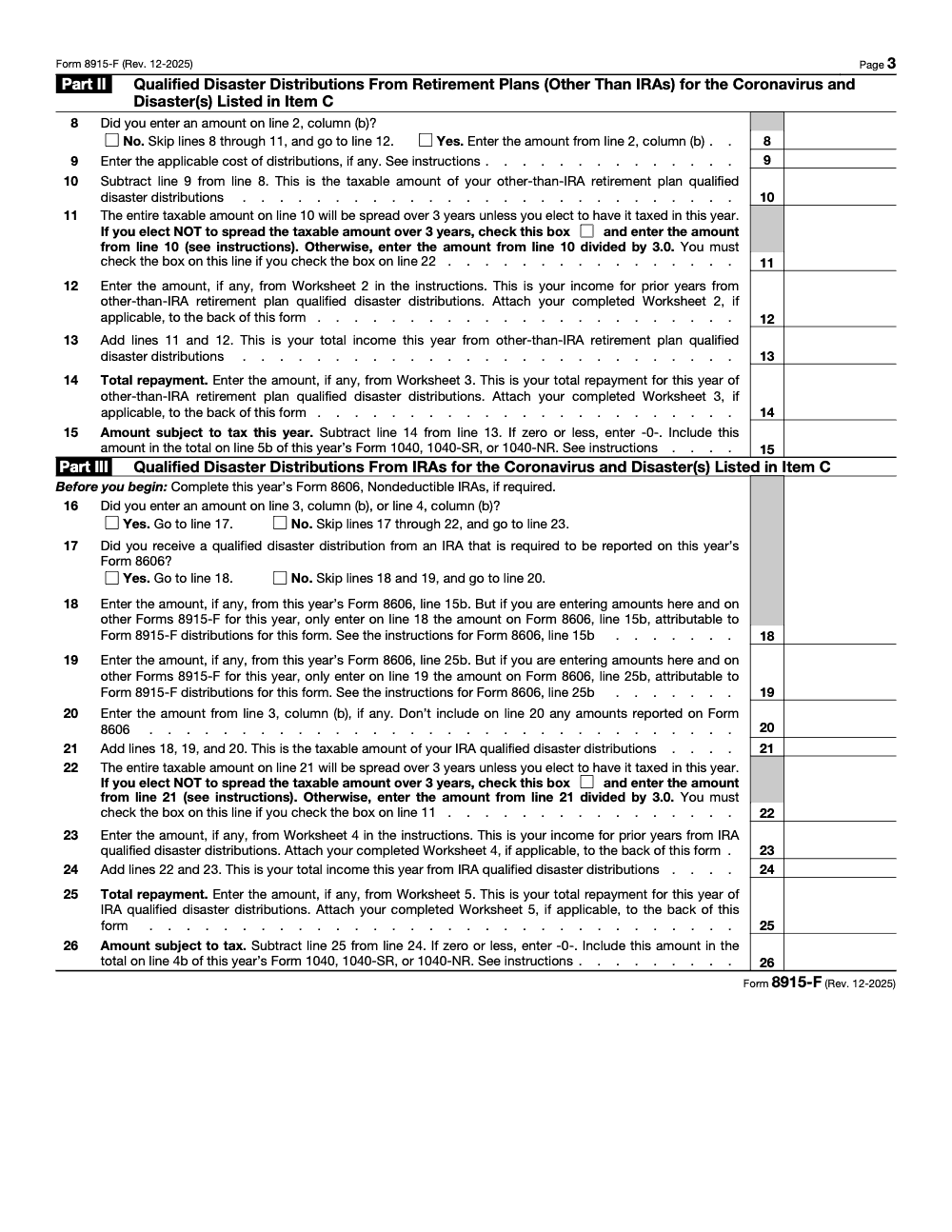
- Use Part II for 401(k), 403(b), governmental 457(b), and similar plan distributions.
- Figure the taxable portion and decide your income timing.
- The election to include all income now or spread over three years is on line 11. If you check the box, you choose one year inclusion. If you do not check it, the default is the 3 year spread.
Part III, IRAs
- Use Part III for traditional and Roth IRAs.
- Coordinate with Form 8606 if basis is involved: complete this year's Form 8606 first, then flow the disaster-related portion of Form 8606 lines 15b and 25b onto Form 8915-F lines 18 and 19. Skipping Form 8606 overstates the taxable amount.
- The one year versus three year decision for IRAs is on line 22, with the same rules as Part II (the line 11 and line 22 opt-out boxes must be consistent: if you check one, you must check the other).
Part IV, Repayments
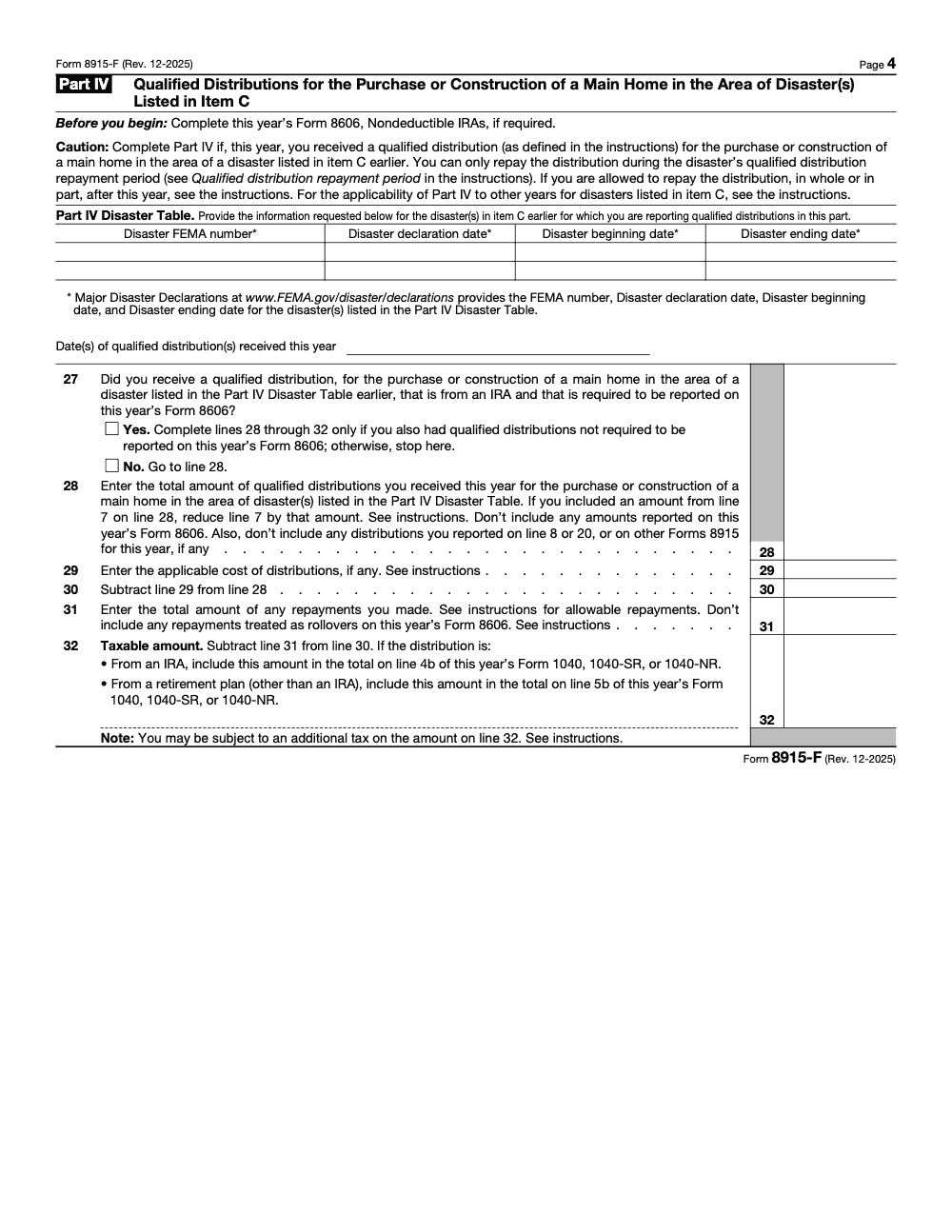
- Part IV repayments are governed by the disaster's qualified distribution repayment period defined in the Form 8915-F instructions (not the standard 60-day rollover window or a flat 3-year window). Report repayments made within that disaster-specific repayment period.
- The instructions provide worksheets that walk you from last year’s totals to this year’s deductible repayments and any carrybacks for amended returns.
Joint Returns
If both spouses have qualified disaster distributions, file a separate Form 8915-F for each spouse. Limits and elections apply per person, and the joint return will include two forms when needed. Enter only the name and SSN of the spouse reported on that form.
Eligibility, Timing, And The 179 Day Window
For disasters beginning after 2020, the qualified disaster distribution period starts on the disaster’s beginning date and ends 179 days after the latest of the disaster beginning date, the federal declaration date, or December 29, 2022 for certain SECURE 2.0 transitions. Your distribution has to land inside that window to qualify as a disaster distribution for that event.
Keep proof that your main home was in the area and that you had an economic loss. Examples include property damage, displacement costs, and income loss tied to the disaster. The instructions explain these points and where to list your FEMA details in Part I.
Filing Steps, Software Tips, And A Quick Checklist
Here is a clean workflow you can follow.
- Confirm your disaster info
- Look up the FEMA DR number, the disaster beginning date, and your county.
- Verify your distribution date fits the disaster’s 179 day period.
- Gather documents
- 1099‑R for each plan.
- Prior year Forms 8915‑F if you chose the three year spread.
- Proof of economic loss and insurance or grant paperwork.
- Choose your income timing
- Check the box on line 11 for plans, or line 22 for IRAs, only if you want all income in the distribution year. The line 11 and line 22 opt-out boxes must be consistent: if you check one, you must check the other. If you do nothing, the form spreads it over 3 years. The election closes after the return due date.
- Enter repayments
- Report rollovers or recontributions made by the due date and within 3 years. The instructions show which worksheet to use and how to amend if you repaid a prior year amount.
- E‑file and attach worksheets
- Many tax programs include the 8915‑F worksheets and carry them with your e‑file. If your software shows a validation message, attach the 8915‑F worksheets and re‑run diagnostics. Message codes vary by software.
Pro move, keep a one page summary in your file with the DR number, dates, amounts by plan, and your election choice. Future you, or your reviewer, will thank you.
Common Mistakes To Avoid
Form 8915-F errors cluster in the same spots every disaster season: the per-disaster cap, the spread election, and the worksheet trail. Catching these six before review saves the most rework.
A Short Word On Capacity And Control
If you run a CPA or EA firm, you already know disaster seasons can crush review queues. The work is detail heavy, and the three year tracking creates extra touches in later seasons. If your team needs extra hands without losing control of SOPs, documentation, or security, Accountably integrates trained offshore professionals into your firm’s workflow. Think consistent workpapers, clear review layers, and predictable turnaround, all inside your systems. Use it when delivery pressure, not sales, is the real barrier to scale. Only engage if you want accountable execution, not resumes.
Conclusion
You have real costs and a short timeline after a disaster. Form 8915‑F gives you rules that fit real life, the 10% penalty exception, the 3 year income spread, and a repayment window (Part IV qualified main-home distributions follow the disaster's qualified distribution repayment period defined in the instructions, not a flat 3-year window). Start by confirming your FEMA DR number and dates, map each distribution to the right part of the form, and make a clear election on income timing. Keep your receipts, update your worksheet each year, and amend if you repay later. That steady process keeps your tax bill fair and your records clean.
Reusable Checklists
These three checklists are copy-paste ready for firm SOPs and the 8915-F workpaper template. Drop them into your tax software notes or your engagement file so the next preparer follows the same steps every year of the 3-year spread.
Pre-file qualification packet
- Confirm the FEMA Major Disaster Declaration number, declaration date, and beginning date from FEMA.gov disaster declarations.
- Verify the distribution is from a qualified retirement plan, traditional IRA, Roth IRA, SEP, or SIMPLE that qualifies for disaster-distribution treatment under IRC §72(t)(2)(M).
- Identify whether the disaster year (item B) is 2020 ($100,000 per-disaster cap) or 2021 and later ($22,000 per-disaster cap).
- For joint returns, separate each spouse's distributions and prepare a distinct 8915-F per spouse.
- Confirm whether Form 8606 is required (IRA basis present); if yes, queue the 8606 before Part III of the 8915-F.
- Capture the taxpayer's income-timing election in writing: default 3-year spread or single-year inclusion via opt-out on lines 11 and 22.
Line-by-line completion review
- Item A: only one tax-year box checked (the year of the return being filed).
- Item B: only one calendar-year box checked. Separate 8915-F per disaster year.
- Item C: up to six non-coronavirus FEMA Major Disaster numbers; item D checked only for 2020 coronavirus-related distributions.
- Part I line 1e: total per-disaster cap loaded ($22,000 for 2021+, $100,000 for 2020).
- Part II line 11 and Part III line 22: opt-out boxes either both checked or both blank, never mixed.
- Part II line 15 carried to Form 1040 line 5b; Part III line 26 carried to Form 1040 line 4b.
- Part IV: disaster ending date populated alongside FEMA number, declaration date, and beginning date.
- Worksheets 2, 3, 4, and 5 (as applicable) attached to the back of the form.
Annual 3-year spread roll-forward
- Pull last year's filed 8915-F, Worksheet 2 (non-IRA), and Worksheet 4 (IRA) from the prior-year workpaper.
- Confirm the carryforward share entered on the current year's line 12 (non-IRA) and line 23 (IRA).
- Record any repayments made during the current tax year on Worksheet 3 (non-IRA) and Worksheet 5 (IRA); enter totals on lines 14 and 25.
- Determine whether a prior-year amendment is needed for a repayment carryback within the qualified distribution repayment period.
- Update the engagement file with the remaining unrecognized spread amount through the final year of the 3-year window.
- Close the file only after the spread is fully recognized or fully repaid, whichever comes first.
Keep 8915-F Season From Stalling
Form 8915-F is not a one-and-done filing. Once a qualified disaster distribution lands on a return, the same client file reopens for three more seasons: the year of the distribution and two carryforward years for the default 3-year spread, plus any repayment-driven amendments inside the qualified distribution repayment period. The December 2025 Form 8915-F instructions confirm the spread runs ratably across those three years on lines 11 and 22 unless the taxpayer opts out, and Worksheets 2 and 4 carry the unrecognized share forward each year.
The fix is not more hours, it is fewer surprises. The reviewer needs the prior-year worksheet, the original FEMA lookup, and the income-timing election visible at the moment the file is opened, not buried under quarter-old emails.
- Lock the FEMA Major Disaster number, declaration date, and beginning date in the engagement file the first year, then carry the same record forward without re-lookup.
- Save Worksheet 2 (non-IRA, feeds line 12) and Worksheet 4 (IRA, feeds line 23) carryforward amounts in a dedicated section of the prior-year workpaper, not as loose PDF attachments.
- Tag the file with the income-timing election (default spread or single-year opt-out on lines 11 and 22) so the reviewer does not re-derive it from the prior return.
- Track repayments on a single rolling schedule tied to Worksheet 3 line 14 and Worksheet 5 line 25, so prior-year amendments are obvious instead of reconstructed.
- Close the file only after the final year of the spread is recognized or the qualified distribution repayment period ends, whichever is later.
Accountably builds these multi-year workpaper trails into the standard tax preparation workflow so the carry-forward is part of the SOP, not a memory exercise each January.
FAQs
You use it to report qualified disaster distributions and repayments, choose whether to include income in one year or spread it over 3 years, and handle amendments when you repay later. It also applies the 10% penalty exception when the distribution qualifies.
No, repayment is optional. If you can repay within 3 years, it reduces taxable income and can create refunds for prior years you already filed. If you do not repay, the income timing rules still help you manage the tax.
Open the retirement income section, edit your 1099‑R answers about disasters, and delete the 8915‑F entries tied to that distribution. Each program labels steps differently, so follow your software’s guidance and re‑run diagnostics to clear any e‑file messages.
The latest Instructions for Form 8915‑F are on the IRS website. Your software should also provide the current year form and worksheets.
The general cap is $22,000 per disaster, per person, for qualified 2021 and later disasters. The instructions include allocation worksheets that help you keep track across multiple disasters.
Yes. You file a separate Form 8915‑F for each spouse. Limits and elections apply separately as well.
Other forms this guide names
- Form 8606: Nondeductible IRA Basis & Pro Rata Rule Guide
- Form 1040: Filing Guide for 2025 Returns (AGI, Deductions, Deadlines)
- Form 1099‑R: Box 7 Codes, Rollovers, 2025 Filing Guide
Summarize this article with AI
About this guide
Accountably helps US CPA, EA, and accounting firms hire trained accountants and tax preparers in India.
About us Reviewed byJugal Thacker, CPAFounder and CEO at Accountably
A Washington-licensed CPA with 7+ years inside US firms – PwC, a real-estate tax practice, then a full-service firm, rising from reviewer to manager to advisory. This article was reviewed against current IRS guidance for the 2025 tax year and updated for filers preparing late returns, amendments, and 2026 estimates.
View profile →How we research, review, and update this guide
Every Accountably guide is researched against primary IRS sources, reviewed by a U.S. CPA, and refreshed as guidance evolves. Read our Editorial Guidelines to see how we source, fact-check, and update our content.