Summarize this article with AI
In Brief
Form 8606 tracks after-tax (nondeductible) traditional IRA basis, reports Roth conversions, and prevents double taxation on later withdrawals – the IRS imposes a $50 penalty per missed filing under IRC §6693(b)(2). Taxable amounts from lines 15c, 18, and 25c flow to Form 1040 line 4b, per IRS Form 8606 instructions. The 2025 form attaches to your 1040 (or files standalone if no 1040 is required) and is due April 15, 2026.
Put a single after-tax dollar into a traditional IRA and skip Form 8606, and that dollar gets taxed twice: once when you earned it and again when it comes back out as a distribution. The form is how you record nondeductible basis so the IRS does not double-count it later. It is also where Roth conversions get reported.
File it in any year you make a nondeductible contribution, convert to a Roth, or take a traditional, SEP, or SIMPLE IRA distribution while basis exists. The pro rata rule looks across all your traditional, SEP, and SIMPLE IRAs using the December 31 balances, so you cannot isolate basis in one account. A missed filing can cost a $50 penalty, and the taxable amounts flow to Form 1040 line 4b.
Key Takeaways
- Form 8606 tracks your nondeductible traditional IRA contributions and the after‑tax basis so future distributions do not get taxed twice. Keep it for life.
- File it in any year you make nondeductible traditional IRA contributions, convert to a Roth, or take any traditional, SEP, or SIMPLE IRA distribution while basis exists.
- The pro rata rule applies across all your traditional, SEP, and SIMPLE IRAs, using the December 31 balances. You cannot isolate basis in one account.
- Missed filings can trigger a $50 penalty, and overstating basis can trigger a $100 penalty unless you show reasonable cause.
- For tax year 2025, the IRA contribution limit is $7,000, and the catch‑up for age 50+ is $1,000, total $8,000. Check the IRS inflation announcement for the next year’s limits before relying on them.
What Form 8606 Does And Why It Matters
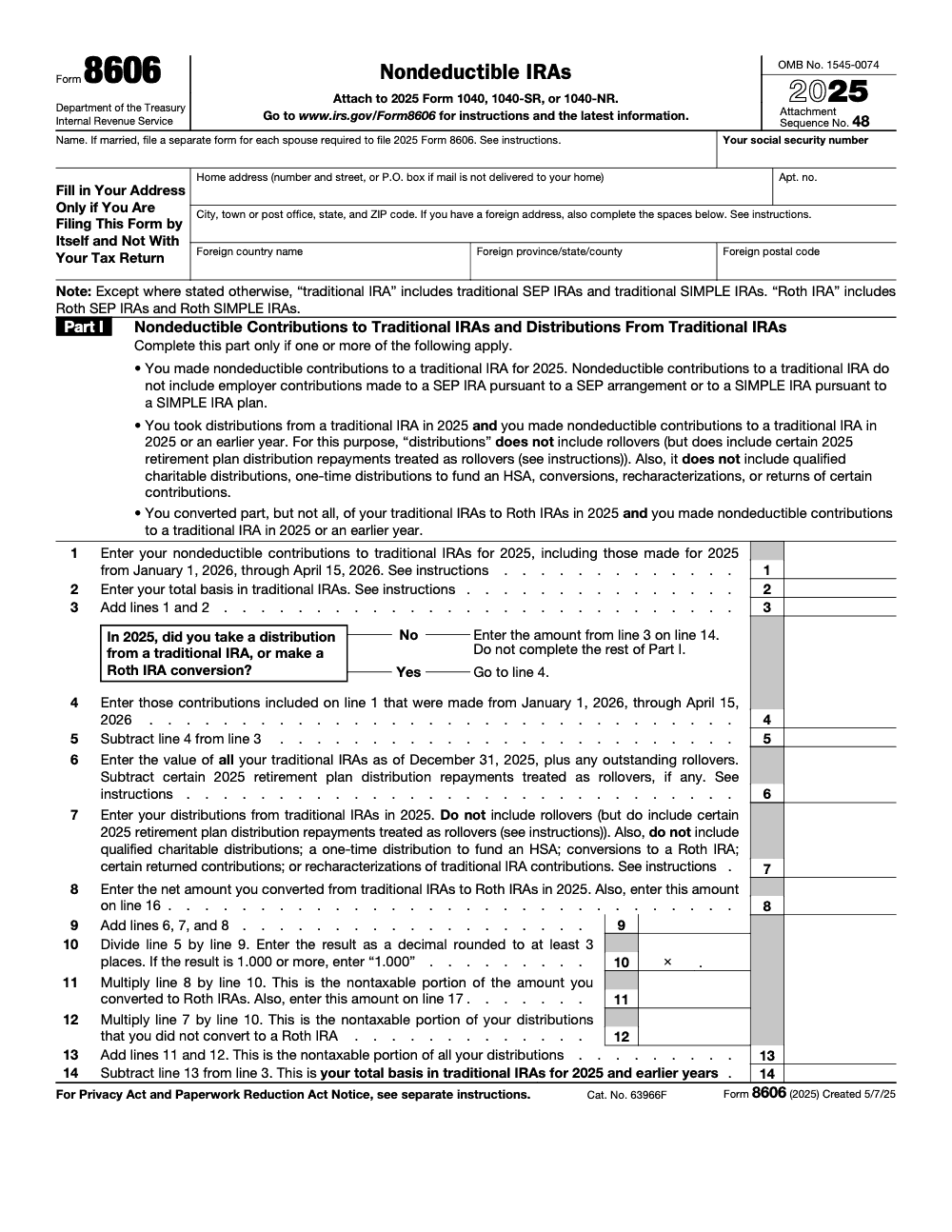
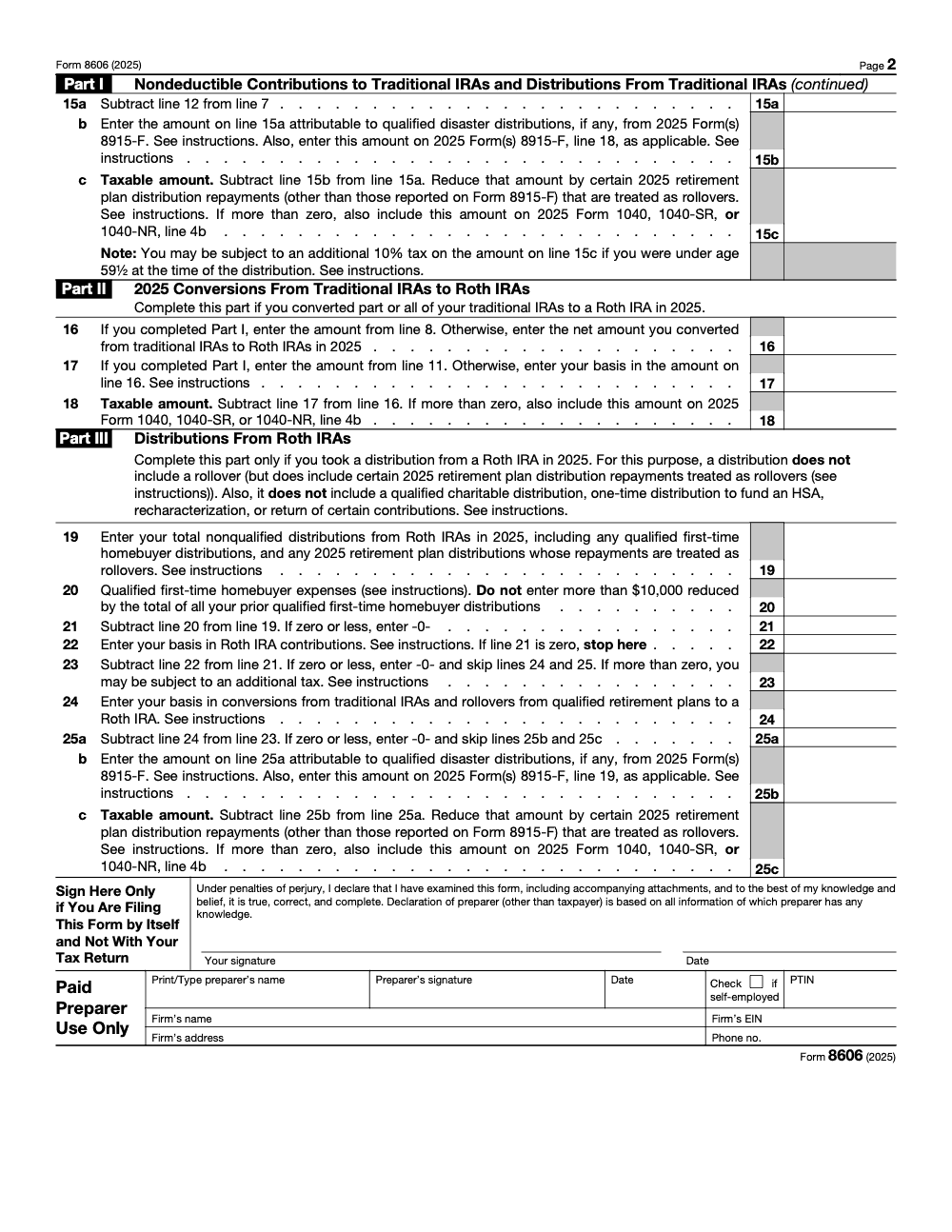
Form 8606 is the paper trail for your after‑tax IRA basis. Part I collects current and prior nondeductible amounts and applies the pro rata rule to any distributions from your traditional, SEP, or SIMPLE IRAs. That math decides how much of a withdrawal is nontaxable return of basis versus taxable income. Part II reports Roth conversions and computes the taxable portion of those conversions. Part III handles nonqualified Roth IRA distributions using the ordering rules, which pull contributions first, then conversions, then earnings.
If you skip the form when required, the IRS has no way to recognize your basis. That is how double taxation creeps in. File it, attach it to your Form 1040 for the year in question, and keep the records. The penalty for failing to file when required is $50, and exaggerating basis can trigger a $100 penalty. Reasonable cause can get penalties waived, but clean filing is better than fixing later.
When You Must File Form 8606
You must file Form 8606 in these common situations:
- You made a nondeductible contribution to a traditional IRA for the year, including contributions made by the April deadline that are designated for the prior year. This establishes and carries forward basis.
- You converted any amount from a traditional, SEP, or SIMPLE IRA to a Roth IRA. Part II is required even if you also contributed after‑tax dollars that year. Recharacterizing conversions is not permitted for conversions made in 2018 or later, so conversions are effectively permanent for tax reporting.
- You took a distribution from a traditional, SEP, or SIMPLE IRA while you still had basis. Part I applies the pro rata rule to find the taxable share across all IRAs, not just the one you withdrew from.
- You took a nonqualified distribution from a Roth IRA. Part III uses the Roth ordering rules and the separate five‑year clocks for conversions versus regular contributions to determine what, if anything, is taxable or subject to early distribution penalties.
Practical tip you can use today. Keep copies of every prior Form 8606, Forms 5498 showing IRA contributions and year‑end values, and Forms 1099‑R showing distributions. The IRS instructions explicitly tell you to keep these until all distributions are complete.
Understanding Nondeductible Traditional IRA Contributions
If your income or plan coverage makes a traditional IRA contribution non‑deductible, you can still contribute, then you must document it on Form 8606 to create basis. Basis is the running total of all nondeductible amounts you have ever put into any traditional, SEP, or SIMPLE IRA. That basis is what comes back nontaxable later, proportionally, when you take money out or convert to Roth.
For 2025, the limit is $7,000, with a $1,000 catch‑up for age 50+, due by April 15, 2026 (a Form 4868 extension on your 1040 does not extend the IRA contribution deadline, it stays at April 15). The IRS has indicated limits rise in 2026, which helps planning for multi‑year backdoor Roth strategies.
Two small but important habits protect you here. First, file Form 8606 for each year with nondeductible contributions, even if you did not take a distribution that year (and even if you are not required to file a Form 1040 at all, a standalone 8606 still has to be mailed in by the original April 15 due date or you lose the basis trail). Second, name and store your IRA workpapers consistently so you can reconcile year‑end values and basis without hunting through statements. If you ever amend, you will be grateful you did.
Quick checkpoint, especially for advisors and operations leads, treat 8606 basis like inventory. If you cannot count it, you cannot protect it.
Traditional, SEP, And SIMPLE IRA Distributions When Basis Exists
When you take money from any traditional, SEP, or SIMPLE IRA, the IRS does not let you cherry‑pick the after‑tax dollars. Instead, the pro rata rule forces you to blend basis across all accounts. You calculate the nontaxable percentage using your total basis divided by your total IRA value at December 31, plus distributions and certain rollovers for the year, then apply that percentage to what you withdrew. Form 8606, Part I formalizes this math so the right portion is nontaxable and the rest is taxable.
Pro Rata Rule, In Practice
Here is the idea in one line. Nontaxable percentage equals basis divided by total IRA value as of December 31, after adjusting for the year’s distributions and conversions. Multiply that percentage by your distribution to find the nontaxable share, and the remainder is taxable. The form and the IRS worksheets mirror this approach to keep things consistent across returns.
Example, simplified. You have $2,000 of basis and $8,000 of pre‑tax value, total $10,000 across all traditional IRAs. You withdraw $5,000. Your nontaxable portion is $1,000, your taxable portion is $4,000. You report this on Form 8606 and carry the taxable amount to Form 1040. That protects the $1,000 from being taxed again.
Aggregation Across All IRAs
The aggregation rule says you must treat all your traditional, SEP, and SIMPLE IRAs as one pool when basis exists. Even if the nondeductible dollars sit in a single IRA, your pretax balances in other IRAs dilute the nontaxable percentage. You cannot isolate basis by moving it or drawing from a specific account. Inherited IRAs are handled separately, so you do not mix an inherited IRA’s basis with your own.
One exception that trips people up. Inherited IRAs keep their own basis trail. Unless you are a spouse who elects to treat the account as your own, you cannot combine that inherited basis with yours.
Real‑World Workflow Tips
- Pull every December 31 IRA statement first. Your year‑end values drive the percentage.
- Confirm prior‑year basis from your last filed Form 8606, not from memory.
- Check for outstanding rollovers at year end, since they affect the denominator in the worksheet.
- Document the math in your workpapers and save a PDF of the completed form with your IRA statements.
If you prepare returns for clients, set a checklist item to ask for prior Forms 8606 and year‑end IRA values. You will catch missing basis early, and your Form 1040 lines will tie out cleanly to the form.
Reporting Roth IRA Conversions
Any time you convert dollars from a traditional, SEP, or SIMPLE IRA to a Roth IRA, you must file Part II of Form 8606 for that year. The conversion amount is reported in full, and the taxable portion is determined by the same pro rata formula, using total basis over total IRA value. Since the 2017 tax law changes, you cannot recharacterize a Roth conversion made in 2018 or later, so you cannot unwind it, and you must report it accurately for that tax year.
How The Taxable Amount Is Calculated
- Gather your cumulative basis from prior Form 8606, plus any current‑year nondeductible contribution.
- Add up your December 31 balances across all traditional, SEP, and SIMPLE IRAs, then add the year’s distributions and conversions per the worksheet.
- Divide basis by total IRA value to get the nontaxable percentage.
- Taxable conversion equals conversion amount multiplied by one minus that percentage.
This is exactly how the IRS worksheets and the Form 8606 lines walk you through the computation, so keep the math in your files.
Step‑By‑Step Reporting For Conversions
| Step | What you enter | Key data to have ready |
| 1 | Total conversion in Part II | All Forms 1099‑R showing conversions |
| 2 | Basis pulled into the form | Prior Form 8606 plus current nondeductible contribution |
| 3 | Pro rata computation | December 31 IRA balances, distributions, conversions |
Recharacterizations of conversions are not allowed for 2018 and later, so plan the timing before year end and review your December 31 balances if you want to influence the pro rata outcome.
Planning note. If your IRA balances are high and basis is small, the pro rata rule can make a conversion largely taxable. Some people reduce pretax IRA balances via qualified plan roll‑ins before doing a backdoor Roth to improve the percentage. Talk with a qualified advisor before moving assets.
Roth IRA Distributions And The Five‑Year Rules
Roth IRA withdrawals are simple if they are qualified, and they get more technical if they are not. A Roth distribution is qualified when it is made after your five‑taxable‑year holding period and after you reach age 59½, or due to death, disability, or a first‑time home purchase up to the $10,000 lifetime limit. Qualified Roth distributions are tax‑free and generally do not require Form 8606.
If the distribution is not qualified, you use Part III of Form 8606 and apply the ordering rules. Contributions come out first, then conversions on a first‑in, first‑out basis, then earnings last. A separate five‑year clock applies to each conversion for the early distribution penalty, which is different from the five‑year clock that determines whether a Roth distribution is qualified. The instructions and Publication 590‑B lay out these rules clearly.
Translation. Your contributions are always available tax‑ and penalty‑free, conversions can be subject to the 10 percent early withdrawal penalty within their own five‑year windows, and earnings are last and the most likely to be taxable if you do not meet the qualified rules.
Aligning 1099‑R With Your Return
If you receive a Form 1099‑R for a Roth distribution, make sure the taxable amount on your Form 1040 aligns with the taxable result you compute on Form 8606, lines 22 through 25c. Keep both the form and the worksheet you used to compute your outcome. It saves time if the IRS sends a notice later.
How To Complete And File Form 8606, Line By Line
Here is a practical flow that mirrors the IRS instructions.
- Part I, Nondeductible IRAs. Enter your current‑year nondeductible traditional IRA contributions, then bring forward your cumulative basis from previous years. Use year‑end balances across traditional, SEP, and SIMPLE IRAs to run the pro rata calculation for any distributions.
- Part II, Conversions to Roth. Report the full dollar amount you converted, then compute the taxable portion using the same percentage method. Keep the documented basis and conversion dates in your workpapers.
- Part III, Roth Distributions. If your Roth distribution is not qualified, apply the ordering rules, respect separate five‑year clocks for conversions, and finish the taxable amount on lines 25a through 25c.
Save copies of each year’s Form 8606, 1099‑R, and 5498. The IRS specifically instructs you to retain these until all IRA distributions are complete. Treat this like permanent records, because basis follows you for life.
2025 Contribution Limits, Verified
- Traditional and Roth IRA annual limit, $7,000
- Catch‑up amount for age 50+, $1,000
- Combined total for 50+, $8,000
These numbers apply to tax year 2025. Always check the IRS inflation announcement for the year you are filing, since the limits are adjusted periodically.
Common Errors, Penalties, And Fixes
- Missing Form 8606 after a nondeductible IRA contribution. File the missing form. The penalty is $50 unless you show reasonable cause.
- Overstating basis. This can trigger a $100 penalty if you cannot show reasonable cause. Rebuild your basis from old Forms 5498 and prior Forms 8606 if needed.
- Treating Roth conversions as reversible. Conversions made in 2018 or later cannot be recharacterized. Double‑check before year end.
- Ignoring inherited IRA rules. Do not blend an inherited IRA’s basis with your own unless you are a spouse who has treated the account as your own.
If you are late, file an amended return with the missing Form 8606 and include a short statement explaining the oversight. In practice, we have seen reasonable cause accepted when taxpayers showed good records and quick correction.
Short Compliance Note And Who This Helps
This article reflects IRS guidance available as of November 18, 2025. Tax rules change. Always verify current limits and instructions on IRS.gov or with a qualified tax professional before filing. Key sources for this page include IRS Instructions for Form 8606 and Publication 590‑B, which were reviewed or updated in 2025.
If you run an accounting or tax firm and Form 8606 season eats your team alive, structure and review protection matter as much as headcount. Accountably integrates trained offshore teams into your own workflow, with SOPs, layered reviews, and turnaround SLAs that reduce partner review time and keep filings on schedule. Use this when you need production stability during IRA season, without losing control of quality or security. Mentioned once here because it is relevant, not as a sales pitch.
Conclusion
You now have a clear plan. Use Form 8606 to log nondeductible contributions, protect your basis, and report conversions and Roth distributions correctly. Apply the pro rata rule across all IRAs, respect the Roth ordering rules and the five‑year clocks, and keep permanent records. If you missed a filing, fix it with an amended return and a short reasonable‑cause statement. Do this, and you will keep your after‑tax dollars from being taxed twice and your Roth strategy on track.
Common Mistakes We See Every Season
The same patterns return every IRA season on Form 8606. Most start with weak basis records and end with double-taxed dollars or a 10% surprise tax under IRC §72(t).
Reusable Checklists
These are copy-paste ready for firm SOPs. Adjust the prep-tracker labels and reviewer initials to match your shop.
Pre-file basis reconciliation (every 8606 client)
- Pull prior-year 8606 line 14 (total basis carried forward) for each spouse separately.
- Confirm cumulative basis from years before the client engaged the firm – request missing forms directly from the client.
- Reconcile prior basis to current-year nondeductible contributions on line 1.
- List every traditional, SEP, and SIMPLE IRA the client owns and capture 12/31 fair market value (the line 6 denominator).
- Recompute line 10 to three decimal places, cap at 1.000.
- Flag any year a prior 8606 appears to be missing and route to the partner review queue.
- Store the reconciled basis worksheet in the permanent file, not the year folder.
Backdoor Roth season packet
- Confirm the client has earned income at or above the contribution amount for tax year 2025 ($7,000 under 50, $8,000 age 50+).
- Pull 12/31 balances for every traditional, SEP, and SIMPLE IRA, including held-away accounts.
- Compute the pro rata fraction (line 10) before recommending the conversion strategy.
- Document the nondeductible contribution in Part I (lines 1, 2, 3, 14).
- Document the conversion in Part II (lines 16, 17, 18).
- Confirm taxable amount on line 18 flows to Form 1040 line 4b, not line 5b.
- Save the conversion confirmation, contribution confirmation, and 12/31 statement together in the client's permanent retirement file.
Standalone 8606 filing (no 1040 required)
- Confirm the client truly has no 1040 obligation for the year – do not skip the standalone 8606 because no return is owed.
- Have the client sign Form 8606 directly. The 1040 signature does not cover a standalone filing.
- Fill in the address block (only required on standalone filings).
- File by April 15 of the following year. No extension is available on a standalone 8606.
- Attach a short reasonable-cause statement if the form is being filed for a prior year, to support abatement of the $50 penalty under IRC §6693(b)(2).
- Mail to the IRS service center listed in the current Form 8606 instructions.
- Log the filing date and confirmation in the permanent basis worksheet so the next preparer sees it.
Keep 8606 Season From Stalling
The 8606 cycle does not look like 941 or 1040. It is a quiet, late-winter scramble that lands the moment basis-bearing clients walk in with prior-year statements and 12/31 balances. The 2025 IRA contribution deadline is April 15, 2026 with no extension available, per IR-2024-285, and the $7,000 (under 50) / $8,000 (50+) contribution limits force last-minute decisions before that hard date. Layer the pro rata rule across every traditional, SEP, and SIMPLE IRA the client owns and one engagement can eat half a senior's morning.
The fix is not more preparer hours in March. It is treating 8606 like a basis-tracking system, not a tax form, with its own permanent record and its own review path. The line items that cause rework – the line 6 December 31 valuation, the line 10 three-decimal fraction, the spouse-by-spouse separation – repeat every year and reward checklist discipline.
- Move every client's cumulative basis (prior-year line 14) into a permanent worksheet, not the year folder, so it survives staff turnover.
- Lock line 10 in the workpaper template at three decimal places with a hard cap at 1.000. Do not let it be hand-entered.
- Tag spouses independently in the prep tracker so each 8606 is generated, reviewed, and signed off separately.
- Run a 12/31 IRA-balance sweep in early February for any client who took a distribution, did a conversion, or made a nondeductible contribution – before the prep queue spikes.
- Route every standalone 8606 through a partner review with a reasonable-cause checklist, since the $50 penalty under IRC §6693(b)(2) is the most common post-season abatement request.
This is where structure beats headcount. Accountably integrates trained offshore preparers and reviewers into your existing IRA workflow with documented SOPs, a layered review path, and turnaround SLAs that hold even on April-13 contribution surges. See our tax outsourcing services for how the delivery model fits a basis-heavy season.
FAQs
It documents your after‑tax IRA basis, reports Roth conversions, and calculates the taxable and nontaxable share of IRA and Roth distributions so you do not pay tax twice.
Yes. You report the nondeductible traditional IRA contribution in Part I and the Roth conversion in Part II, then the pro rata rule decides how much, if any, is taxable. A backdoor Roth is only fully tax-free if you have zero pre-tax balance in any traditional, SEP, or SIMPLE IRA on December 31 of the conversion year, since speed of conversion does not bypass the aggregation rule. Keep prior Forms 8606 handy for your cumulative basis.
No. The IRS aggregates traditional, SEP, and SIMPLE IRAs for the pro rata rule, based on your December 31 balances. Inherited IRAs are tracked separately.
File the missing forms, often with an amended return if within the amendment window. You may face a $50 penalty per missed year, but reasonable cause can help. This also restores your basis so you do not overpay tax later.
There are two clocks. One five‑year clock determines whether a Roth distribution is qualified and tax‑free, and a separate five‑year clock applies to each conversion for the 10 percent early distribution penalty. Form 8606, Part III and Publication 590‑B guide the ordering and penalty rules.
No. For 2025, the IRA limit remains $7,000 with a $1,000 catch‑up for age 50+. Check the IRS inflation announcement for the next year’s limits before relying on them.
Other forms this guide names
- Form 1040: Filing Guide for 2025 Returns (AGI, Deductions, Deadlines)
- Form 1099‑R: Box 7 Codes, Rollovers, 2025 Filing Guide
- Form 5498: IRA Guide for Contributions, Rollovers, FMV, RMDs
- Form 4868: IRS Tax Extension 2025 Guide to Filing
Summarize this article with AI
About this guide
Accountably helps US CPA, EA, and accounting firms hire trained accountants and tax preparers in India.
About us Reviewed byJugal Thacker, CPAFounder and CEO at Accountably
A Washington-licensed CPA with 7+ years inside US firms – PwC, a real-estate tax practice, then a full-service firm, rising from reviewer to manager to advisory. This article was reviewed against current IRS guidance for the 2025 tax year and updated for filers preparing late returns, amendments, and 2026 estimates.
View profile →How we research, review, and update this guide
Every Accountably guide is researched against primary IRS sources, reviewed by a U.S. CPA, and refreshed as guidance evolves. Read our Editorial Guidelines to see how we source, fact-check, and update our content.