Summarize this article with AI
In Brief
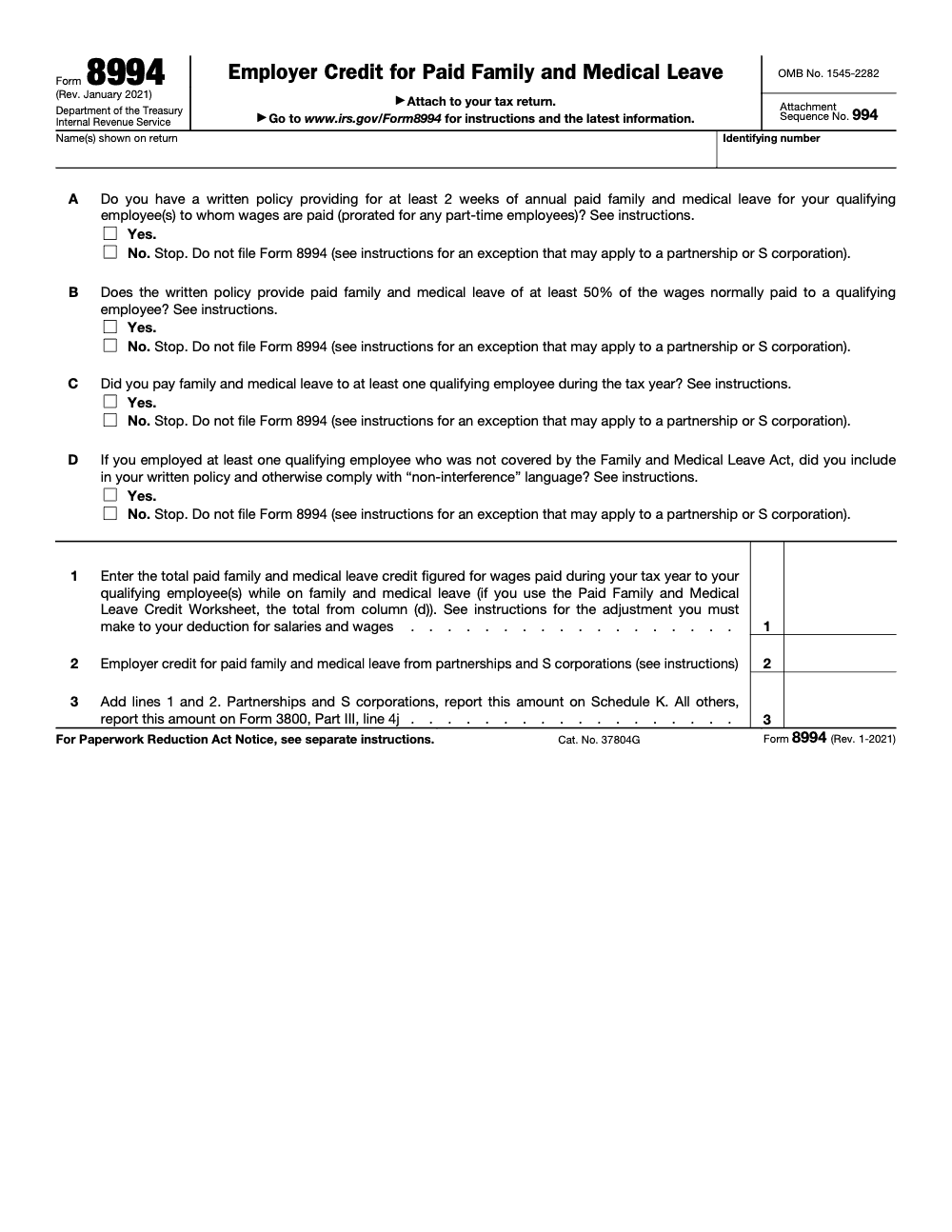
Form 8994 calculates the §45S Employer Credit for Paid Family and Medical Leave for employers with a qualifying written paid-leave policy. The credit runs from 12.5% of qualifying leave wages at the 50% wage-replacement floor up to 25% at 100% replacement (in 0.25-point steps), capped at 12 weeks per qualifying employee per year per IRC §45S. Line 3 of Form 8994 carries to Form 3800, Part III, line 4j (or Schedule K for partnerships and S corps). The One Big Beautiful Bill Act, enacted July 2025, made §45S permanent for tax years beginning after December 31, 2025.
A manufacturing client offered paid leave below the required floor last year and assumed the credit applied. It did not. The §45S written policy has to pay at least 50% of normal wages, and a policy paying below that floor earns zero credit, not a smaller one. That is the gate clients miss most often when they read about Form 8994 loosely and only later see how specific the rules are.
Form 8994 figures the §45S Employer Credit for Paid Family and Medical Leave. The rate runs from 12.5% at the 50% wage-replacement floor up to 25% at 100% replacement, in 0.25-point steps, capped at 12 weeks per qualifying employee each year. Line 3 carries to Form 3800, Part III, line 4j, with pass-throughs reporting on Schedule K instead. The One Big Beautiful Bill Act, enacted July 2025, repealed the post-2025 sunset, so verify which years a given engagement actually covers.
Key Takeaways
- Use Form 8994 to claim the Employer Credit for Paid Family and Medical Leave for eligible wages in tax years 2018–2025; the One Big Beautiful Bill Act, enacted July 2025, repealed the post-2025 sunset and made §45S permanent, so the credit continues for tax years beginning after December 31, 2025 under updated rules.
- You must have a written, non‑discriminatory policy that grants at least two weeks of FMLA‑qualifying paid leave, pro rata for part‑time staff, and pays 50%+ of normal wages.
- The credit rate ranges from 12.5% (at exactly 50% wage replacement) to 25% (at 100% wage replacement), limited to 12 weeks per employee each year; policies paying below 50% of normal wages earn zero credit, not a smaller one.
- Report the total through the general business credit on Form 3800. Partnerships and S corporations pass it through to owners via Schedule K/K‑1, Code P.
- Exclude generic PTO and any wages used for other credits, and reduce your wage deduction by the credit amount.
- Keep a clean audit trail, written policy, payroll proofs, your worksheet, and the deduction reduction entry.
What Form 8994 Does, And Why It Matters
Form 8994 calculates your section 45S credit on wages paid to qualifying employees during FMLA‑qualifying leave, under a compliant written policy. The credit is part of the general business credit, so it ultimately flows to Form 3800 with carryforward rules (the credit is nonrefundable and subject to the §38(c) general business credit limitation, with a 1-year carryback and 20-year carryforward – not a refundable cash credit). For firms that already support paid leave, this turns a people‑first benefit into a predictable savings, as long as your policy and records are tight.
The Quick Math
- Pay exactly 50% during qualifying leave, your credit rate is 12.5%.
- For each one percentage point above 50% that you pay, add 0.25 to the credit rate.
- Pay 100%, your credit rate is 25%.
- Apply the rate to eligible wages for up to 12 weeks per employee each year, and never above the employee’s normal wage rate times the leave hours.
A Simple Example
Your client pays an employee 75% of normal wages for 4 weeks of qualifying leave. Normal pay is 1,000 per week, so 3,000 of paid leave wages. The applicable percentage is 18.75%, so the credit is 562.50, and the wage deduction is reduced by 562.50. Reviewers expect to see the written policy, payroll detail showing 4 weeks at 75%, and the worksheet rolling to Form 8994.
Who Can Claim The Employer Credit
You can claim the credit for tax years beginning 2018–2025 if your written policy meets the leave and pay standards and at least one qualifying employee actually took paid family and medical leave during the year (the One Big Beautiful Bill Act, enacted July 2025, made §45S permanent for tax years beginning after December 31, 2025, so the credit does not actually sunset after 2025). Only wages under that policy qualify. If a third‑party payer, such as an insurer or PEO/CPEO, pays the leave, you cannot claim the credit on those amounts, and for 2025 returns you must also exclude any leave paid by a state or local government or required by state or local law (for example, California, New York, or New Jersey PFL wages) per IRC §45S(c)(4). Partnerships and S corporations pass the credit to owners on Schedule K‑1, Code P, and you must reduce your wage deduction by the credit.
Qualifying Employees And Key Definitions
You need to identify which workers count as qualifying employees, then confirm the leave itself is for FMLA purposes.
Who Counts As A Qualifying Employee
- The employee has been employed for at least one year when paid FML begins. You may use any reasonable 12‑month method, applied consistently.
- Prior‑year compensation is at or below 60% of the highly compensated employee threshold for that prior year. If it exceeds that amount, the worker is not a qualifying employee.
- Part‑time generally means fewer than 30 hours per week, with proportional leave.
- The FMLA 1,250‑hour rule does not apply to this credit.
- Status is tested when leave is taken. Wages for earlier leave do not qualify.
Compensation Limit Thresholds
Screen qualifying employees against 60% of the HCE threshold for the preceding year. For planning and examples, you can use these guideposts: $93,000 for 2025 returns (60% of the 2024 §414(q)(1)(B)(i) HCE threshold of $155,000) and $96,000 for 2026 returns (60% of the 2025 HCE threshold of $160,000). Apply controlled‑group rules across related entities. For mid‑year hires and part‑time staff, use a reasonable method to annualize prior‑year compensation. For 2026 tax years, statutory annualization applies and may align with a six‑month employment election.
The One‑Year Employment Rule
Treat an employee as a qualifying employee only if they have at least one year of service when paid FML starts. You can measure that period by 12 calendar months or 52 consecutive weeks, as long as you use a consistent method across employees. Months need not be consecutive. Wages for leave taken before the one‑year mark are not eligible. Non‑calendar‑year filers may apply a reasonable method aligned to their fiscal year. A six‑month alternative may be available for 2026 tax years.
Written Policy Requirements
Your policy is the eligibility key, so adopt it before any covered leave occurs. It must name FMLA‑qualifying purposes only, not generic PTO, and promise at least two weeks of paid family and medical leave per 12‑month period for full‑time employees, pro rata for part‑time, paid at 50% or more of normal wages. If any employee is not covered by Title I of the FMLA, include the required non‑interference language.
Adopt a written, FMLA‑designated leave policy before any covered leave to claim section 45S.
Policy Checklist You Can Paste Into Your Template
- Names qualifying employees and lists only FMLA‑qualifying reasons
- Promises at least two weeks per year, pro rata for part‑time
- Pays 50%+ of normal wages during qualifying leave
- Includes non‑interference language for non‑FMLA‑covered staff
- Applies consistently, without favoritism to highly compensated employees
- Clarifies documentation and timing, so reviewers can follow your file
Minimum Leave And Pay Rate Standards
Two floors control eligibility. First, grant at least two weeks of paid family and medical leave per year, pro rata for part‑time. Second, pay at least 50% of normal wages during that leave. These floors anchor the applicable percentage you will apply to eligible leave wages for up to 12 weeks per employee.
The Two‑Week Leave Minimum
Define paid family and medical leave as FMLA‑qualifying only, such as birth or placement of a child, care for a spouse, parent, or child with a serious health condition, the employee’s own serious health condition, qualifying military exigency, or military caregiver leave. Grant at least two weeks to full‑time qualifying employees and a proportional amount for part‑time. Track with a dedicated earnings code so your worksheet pull is clean.
The Minimum 50% Wage Pay
If your policy pays below 50%, no credit applies. At 50%, your applicable percentage is 12.5%. Add 0.25 for each point above 50%, up to 25% when you pay 100%. Cap eligible wages at the employee’s normal rate times leave hours. Post the journal entry that reduces your wage deduction by the credit.
Eligibility Questions To Clear Before You Compute
- Do you have a written policy with at least two weeks of paid FML, pro rata for part‑time, for FMLA purposes only?
- Does it pay 50%+ of normal wages during leave?
- Did at least one qualifying employee take paid FML during the tax year?
- If any employee is not covered by the FMLA, does the policy include non‑interference language?
- Did each worker meet the one‑year service rule and the 60% HCE pay screen?
If any answer is “No,” you generally cannot claim your own credit, though you can still include a pass‑through credit on Line 2 if you received one via Schedule K‑1, Code P.
Completing The Header And Taxpayer Fields
- Enter the taxpayer name exactly as shown on the federal return.
- Partnerships and S corporations use the entity name. Schedule C filers use the owner’s name.
- Enter the EIN. Do not substitute a Social Security Number.
- Attach a worksheet that lists each qualifying employee, paid FML wages, and the applicable percentage. Ensure names or IDs match payroll.
Calculating The Credit Step By Step
Build The Worksheet
- List each employee who took FMLA‑qualifying paid leave.
- In column (b), enter eligible paid FML wages only. Exclude wages used for other credits.
- In column (c), compute the applicable percentage from 12.5%–25% based on your wage replacement rate.
- In column (d), multiply column (b) × column (c).
- Sum column (d) for Form 8994, Line 1.
- Add any pass‑through credit from Schedule K‑1, Code P on Line 2.
- Combine Lines 1–2 on Line 3 and carry to Form 3800.
Applicable Percentage And Rate Increases
Base Percentage At 50%
When your policy pays exactly 50% of normal wages during qualifying leave, the applicable percentage is 12.5%. Below 50% yields no credit.
Incremental Increase Formula
For each one percentage point above 50%, add 0.25 to the credit rate, up to the cap. Keep your policy tiers simple so your team can compute the rate without confusion.
Maximum Credit Cap
The applicable percentage cannot exceed 25%, which applies when you pay 100% of normal wages. Always apply the 12‑week per‑employee limit and the cap that ties eligible wages to normal wage rate × leave hours.
| Wage replacement rate | Applicable percentage |
| 50% | 12.5% |
| 60% | 15.0% |
| 75% | 18.75% |
| 90% | 22.5% |
| 100% | 25.0% |
Reporting The Credit On Your Return
- Enter your computed credit on Form 8994, Line 1.
- Add any pass‑through amount from Schedule K‑1, Code P on Line 2.
- Enter the total on Line 3 and report it on Form 3800, Part III, Line 4j.
- Partnerships and S corporations also reflect the credit on Schedule K, flowing it to owners via K‑1 Code P.
Coordination With Other Credits And Reductions
- Do not double count. Exclude wages already used for other credits.
- Reduce your salaries‑and‑wages deduction by the credit amount, and reduce any capitalized costs by the related portion.
- For third‑party payers, only the employer claims the credit. Keep payer reports showing which wages relate to leave.
Resources, Downloads, And A Clean Workflow
| Resource | Purpose | Action |
| IRS Form 8994 | Official filing | Download and complete for the filing year |
| IRS Instructions | Rules and examples | Follow line by line, note any year‑specific changes |
| Credit Worksheet | Calculations | Enter leave wages, apply percentage, total to Line 1 |
| Practitioner Walkthroughs | Training | Use examples to coach staff and speed review |
Retain in your file, the written policy, payroll detail, the worksheet, any Schedule K‑1 (Code P) items, and the deduction reduction entry.
Worked Examples You Can Reuse
Hourly Employee With Varying Schedules
- Normal rate 28.00 per hour, policy pays 70%.
- Leave taken 120 hours.
- Eligible wages, 120 × 28.00 × 70% equals 2,352.00.
- Applicable percentage, 12.5% + 0.25 × 20 equals 17.5%.
- Credit, 2,352.00 × 17.5% equals 411.60.
- Deduction reduction, 411.60.
Salaried Employee With Partial‑Week Leave
- Weekly salary 1,500, policy pays 100%.
- Leave taken 6 weeks.
- Eligible wages 9,000.
- Applicable percentage 25%.
- Credit 2,250.
- Deduction reduction 2,250.
Practical Delivery Tips That Cut Rework
- Create a dedicated payroll earnings code for paid FML.
- Keep a one‑page chart that maps each policy pay tier to its applicable percentage.
- Standardize file names and include a top‑sheet that ties the worksheet to Form 8994 and Form 3800.
- Add the deduction reduction to your month‑end checklist.
Where Accountably Fits, Briefly
When your internal team is buried, structure beats heroics. Accountably integrates trained offshore teams into your workflow with SOP‑driven execution, structured workpapers, and multi‑layer review, so partners spend less time in the weeds and more time advising clients. Apply that same discipline to Form 8994, from policy proof to the final journal entry, and reviews move faster with fewer revisions.
Conclusion
Form 8994 is straightforward once you set the foundation, a written policy, the service and pay screens, and a tidy worksheet. Do that, and the credit becomes a routine part of close, not a last‑minute scramble. Your clients keep a strong leave benefit, your team keeps its sanity, and your file stands up to review.
Common Mistakes We See Every Season
We see the same §45S errors repeat every year, mostly around the 50% wage-replacement floor, the written-policy timing rule, and the §280C deduction reduction. Here are the recurring traps and the fixes we keep in our SOP.
Reusable Checklists
The following checklists are copy-paste ready for firm SOPs. Each one addresses a single phase of §45S work we run for clients.
Written-policy review checklist
- Confirm the written policy is signed and dated before any leave for which credit is claimed (per Notice 2018-71).
- Verify the policy provides at least 2 weeks of annual paid family and medical leave, prorated for part-time, per Question A on Form 8994.
- Verify the wage-replacement rate is at least 50% of normal wages per Question B; below 50% no credit is available.
- Check that a non-interference clause is included if any qualifying employee is not federally FMLA-covered (Question D).
- Confirm the policy covers FMLA-qualifying reasons only, not generic PTO or vacation.
- Store the signed copy with the payroll records before close of tax year.
Form 8994 computation packet
- Pull a payroll report of FMLA-tagged paid leave hours by employee for the tax year.
- Filter out any employee with preceding-year compensation above the 60% HCE cap ($93,000 for 2025 returns).
- Cap each employee's qualifying leave at 12 weeks per IRC §45S(b)(3).
- Strip state-mandated PFL wages from the base (CA, NY, NJ, MA, CT, RI, OR, WA, and similar).
- Compute the applicable credit rate: 12.5% at 50% replacement, plus 0.25 points per percentage point above 50%, capped at 25%.
- Enter the result on Form 8994 Line 1; add any passthrough credit on Line 2; sum to Line 3.
- Carry Line 3 to Form 3800, Part III, line 4j (or to Schedule K for partnerships and S corps).
§280C deduction reconciliation
- Pull the Form 8994 Line 1 figure for the year.
- Reduce the salaries-and-wages deduction on the income-tax return by the same amount, per IRC §280C(a).
- Document the adjustment in the workpapers so the reviewer can tie credit to deduction.
- If the §38 General Business Credit limit prevents current-year use, schedule the 1-year carryback and 20-year carryforward through Form 3800 per IRC §39.
- Reconcile to the General Business Credit total before the return is signed.
Keep 8994 Season From Stalling
Form 8994 is a low-volume but high-precision deliverable. The credit looks simple on the surface (12.5% to 25% of qualifying leave wages) but the §45S written-policy rule, the $93,000 preceding-year compensation cap for qualifying employees, the §280C wage-deduction reduction, and the state-PFL exclusion all create reconciliation work that slips when teams rush through busy season. With the One Big Beautiful Bill Act making §45S permanent for tax years beginning after December 31, 2025 (per Public Law 119, July 2025), clients now expect this credit to be a recurring deliverable instead of a one-off.
Most of the trouble is structural, not technical. When the §45S file lives only in a preparer's memory, the policy effective date never gets tied out to payroll and the §280C deduction adjustment gets dropped at the last minute. The fix is to codify each phase of the §45S workflow as a checklist tied to specific lines on Form 8994.
- Lock the written-policy signature and effective date in a single shared workpaper, dated before any FMLA-qualifying leave is taken (per Notice 2018-71).
- Filter the payroll FMLA tag against the preceding-year compensation cap ($93,000 for 2025 returns) before any hours hit Line 1.
- Cap each employee's qualifying leave at 12 weeks per year per IRC §45S(b)(3); flag anything over for reviewer signoff.
- Carry Form 8994 Line 3 to Form 3800 Part III line 4j on the same return cycle, not as a downstream adjustment.
- Book the §280C wage-deduction reduction as part of the credit calculation, not as an afterthought during signoff.
This is the operational discipline we layer into our tax outsourcing engagements. We run §45S the same way every year, document the policy review, cap and reconcile Line 1, and tie the credit to the General Business Credit before the return is signed.
FAQs
It is the calculation form for the Employer Credit for Paid Family and Medical Leave. You confirm eligibility, compute the 12.5%–25% rate on eligible wages, cap at 12 weeks per employee, then carry the total to Form 3800. Partnerships and S corporations pass the credit through with K‑1 Code P.
You need a written policy providing at least 2 weeks of annual paid family and medical leave (prorated for part-time staff), paying at least 50% of the employee's normal wages, and you must have actually paid that leave to at least one qualifying employee during the year. If any qualifying employee is not covered by FMLA, the policy must also include non-interference language. These are Questions A through D on the form, and a "No" generally stops the credit.
No, not in full. Under §280C(a), you must reduce your salaries-and-wages deduction by the amount of the credit on Line 1. The same wages cannot fund both a deduction and a credit, so the real benefit is the credit minus the tax value of the deduction you give up.
A qualifying employee must have been employed for one year or more and must have had prior-year compensation no greater than 60% of the §414(q)(1)(B)(i) highly compensated employee threshold. Testing 2025 status against the 2024 threshold of $155,000, that ceiling is $93,000. Only the first 12 weeks of FMLA-qualified paid leave per employee per year count toward the credit.
Other forms this guide names
- Form 3800: How to Claim the General Business Credit in 2025
About this guide
Accountably helps US CPA, EA, and accounting firms hire trained accountants and tax preparers in India.
About us Reviewed byJugal Thacker, CPAFounder and CEO at Accountably
A Washington-licensed CPA with 7+ years inside US firms – PwC, a real-estate tax practice, then a full-service firm, rising from reviewer to manager to advisory. This article was reviewed against current IRS guidance for the 2025 tax year and updated for filers preparing late returns, amendments, and 2026 estimates.
View profile →How we research, review, and update this guide
Every Accountably guide is researched against primary IRS sources, reviewed by a U.S. CPA, and refreshed as guidance evolves. Read our Editorial Guidelines to see how we source, fact-check, and update our content.