Summarize this article with AI
In Brief
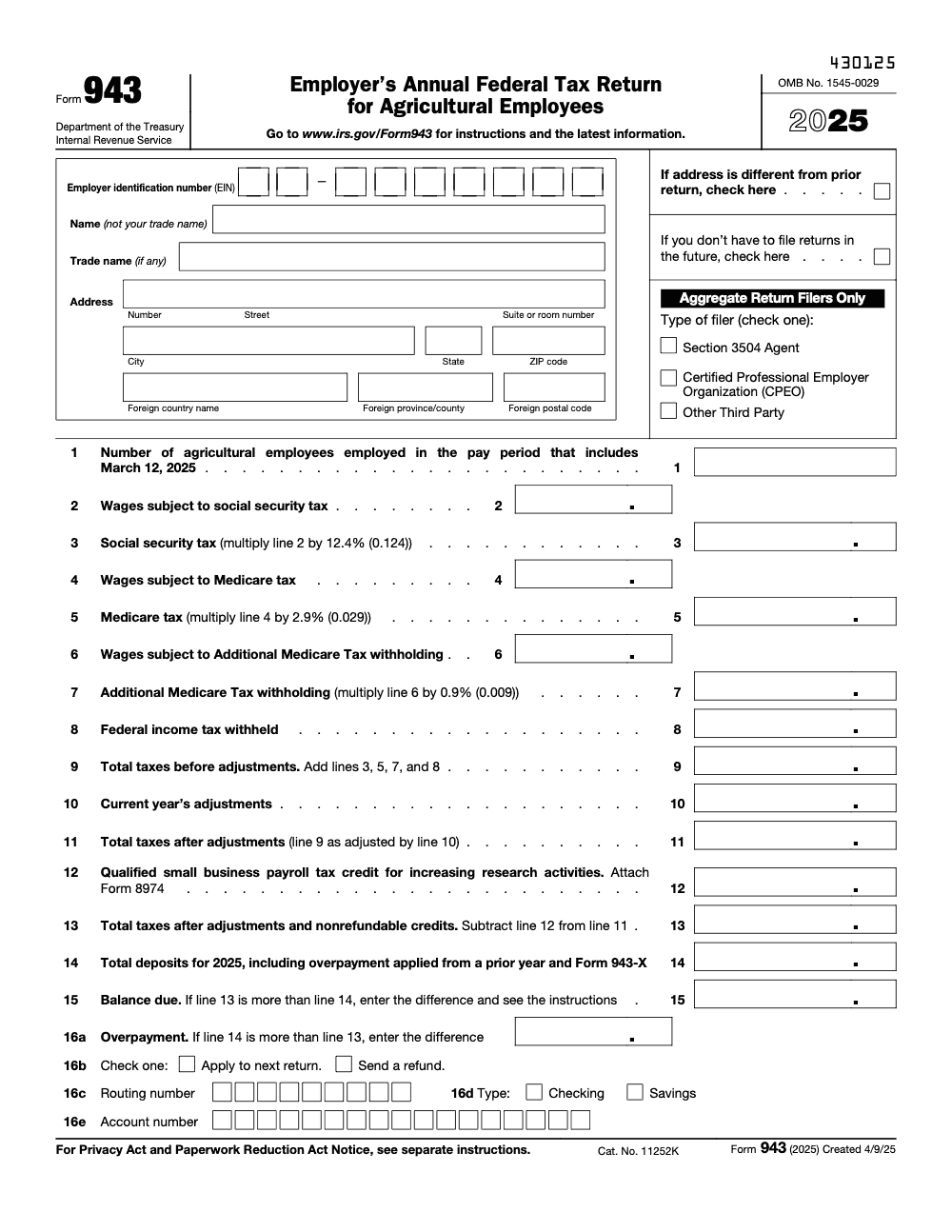
Form 943 is the annual federal employment tax return for agricultural employees. You must file it if you pay any one farmworker $150 or more in cash wages, or pay $2,500 or more in total farm wages, in the year (per the IRS Form 943 instructions). Social security tax sits on line 3 (line 2 × 12.4%), Medicare on line 5 (line 4 × 2.9%), and the 2025 return is due February 2, 2026, or February 10, 2026 if every deposit was made on time.
A dairy operation looks at a small total payroll and decides it is too small to file. Then you count the cash: one herdsman's cash wages alone reach $150 for the year, and that single test puts the operation on the hook for Form 943, the annual federal employment tax return for agricultural employees.
You file once either test is met: any one farmworker reaching $150 in cash wages, or total farm wages, cash and noncash, reaching $2,500 for the year, and once you start filing, you keep filing every year until you submit a final return. Social security tax sits on line 3 (line 2 times 12.4%) and Medicare on line 5 (line 4 times 2.9%), and the 2025 return is due February 2, 2026, or February 10, 2026 if every deposit was made on time.
Key Takeaways
- Form 943 is the annual IRS employment tax return for agricultural employers. It reports federal income tax withheld, Social Security, Medicare, and Additional Medicare Tax on farmworker wages, then reconciles deposits for the year.
- You must file when either test is met, any one farmworker gets at least $150 in cash wages in the year, or total farm wages, cash and noncash, reach $2,500 for the year. Once you start filing, keep filing every year until you submit a final return.
- The annual due date is normally January 31, but because January 31, 2026 falls on a weekend, the 2025 return is due Monday, February 2, 2026, or February 10, 2026 if you made all required deposits on time.
- Social Security tax applies up to the taxable maximum, $176,100 for 2025 and $184,500 for 2026, while Medicare applies to all wages. Withhold Additional Medicare Tax on wages over $200,000 for an employee.
- E‑file is encouraged for speed and fewer errors, and you must keep employment tax records for at least four years.
What is Form 943?
Form 943 is the annual employment tax return for farm payroll. You use it to report federal income tax you withheld, Social Security and Medicare taxes on covered farm wages, and Additional Medicare Tax withheld from any employee who crossed $200,000 in wages. Then you reconcile what you already deposited to determine any balance due or overpayment.
In practice, that means you will total up Social Security wages and tax, Medicare wages and tax, Additional Medicare withholding, and federal income tax withholding. You will also reflect adjustments and any credits, such as the qualified small business R&D payroll credit if you elected it and attach Form 8974.
How Form 943 connects to deposits and W‑2s
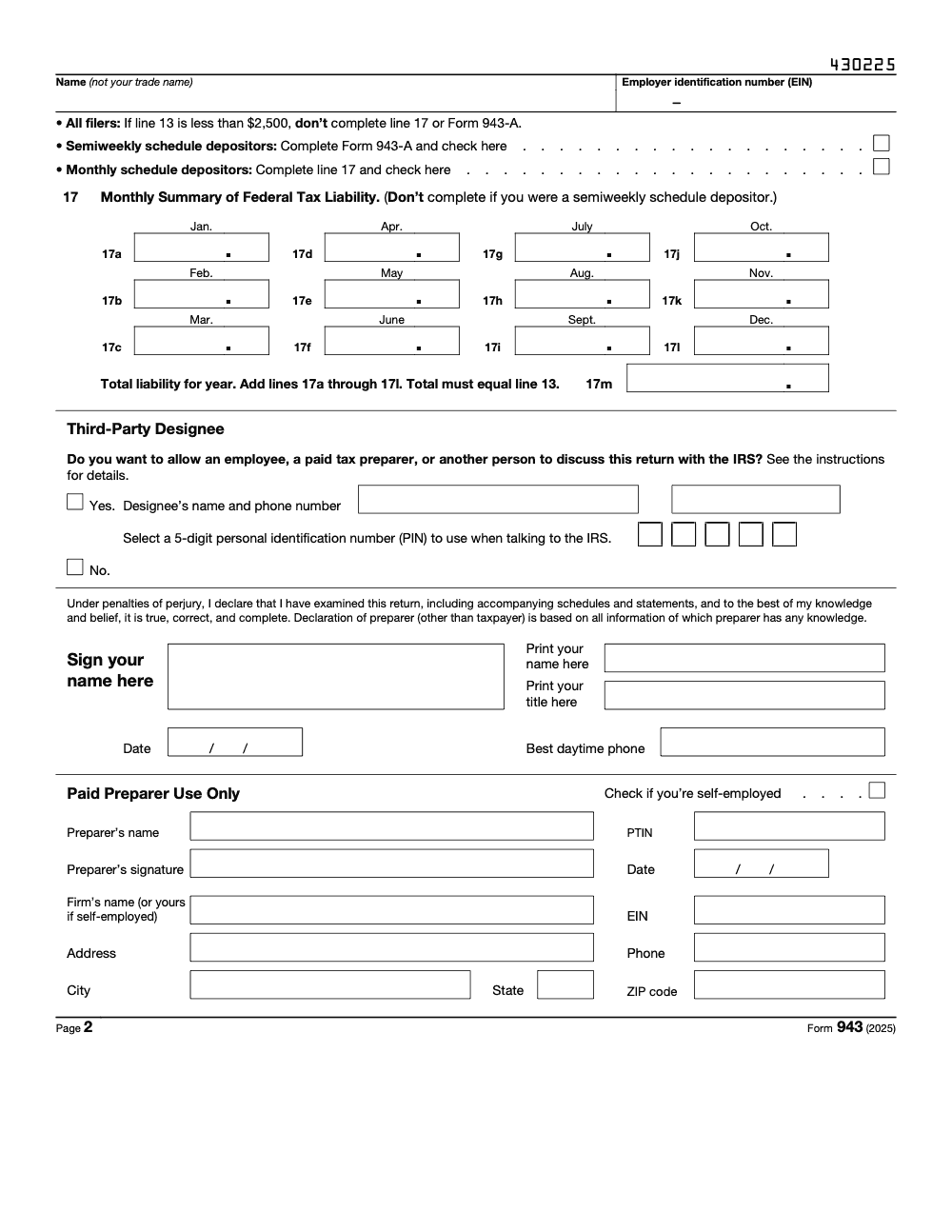
Your deposit schedule, monthly or semiweekly, does not change the content of Form 943, but it changes how you document liability. Monthly depositors complete the monthly liability summary on the form, while semiweekly depositors attach Form 943‑A. Either way, your yearly liability must match the total tax after adjustments and credits on the return. When line 13 is 2,500 or more, a line 17 monthly summary that does not tie to line 13 can draw an averaged failure-to-deposit penalty of 2% to 10%, so reconcile the two before you file. Also, remember that Forms W‑2 must be furnished to employees and filed with the SSA by January 31.
Small operational habits, consistent workpapers, named files, and timely deposits, make Form 943 feel manageable instead of frantic.
Who must file Form 943, the practical tests
You are in Form 943 territory if you pay agricultural wages that are subject to withholding or FICA, and you meet either of the classic tests. If any one farmworker receives $150 or more in cash wages during the year, you must file. If your total farm wages, cash and noncash together, reach $2,500 or more for the year, you must also file, even if no single worker hits $150. Once you file the first time, you continue every year until you file a final return.
There is a special carve‑out for certain hand‑harvest laborers who receive less than $150 in annual cash wages. These seasonal workers can be exempt from Social Security, Medicare, and federal income tax withholding, even when your overall payroll crosses $2,500. Those seasonal wages still count toward the $2,500 test that decides whether your other farmworkers’ wages are subject to Social Security and Medicare, so the exemption covers the seasonal worker only, not the trigger for everyone else. Read the exceptions carefully before you assume the rule applies.
H‑2A agricultural workers are another common question. Compensation to H‑2A workers is not subject to Social Security and Medicare taxes, and this difference often alters your totals on the form and your deposits. Federal income tax withholding is not required on H‑2A pay either, though you may withhold if the worker asks for it on Form W‑4 and you agree.
Key dates, e‑file tips, and deposit rhythm
- The annual due date is normally January 31, but for the 2025 tax year it shifts to Monday, February 2, 2026 because January 31, 2026 falls on a weekend. If you made all deposits on time and in full, you may file by February 10, 2026.
- E‑file is encouraged by the IRS. It is faster, reduces common math and transcription mistakes, and gives you an electronic acknowledgment.
- Your deposit method depends on your status. Monthly depositors complete the monthly liability section on the form, line 17, when total tax after adjustments and nonrefundable credits is $2,500 or more. Semiweekly depositors attach Form 943‑A to report daily liabilities. If you ever hit the $100,000 next‑day rule, you become semiweekly for at least the rest of that year and the next year.
- Forms W‑2 must be furnished to employees and filed with SSA by January 31, even though Form 943 is annual. Keep your W‑2 totals aligned with the Social Security and Medicare wage totals on the return.
2025 and 2026 wage bases, a quick reference
- Social Security wage base, $176,100 for 2025. Medicare has no wage cap.
- Social Security wage base, $184,500 for 2026. Medicare still has no cap.
- Additional Medicare Tax withholding starts for an employee when their wages exceed $200,000 in a calendar year. Employers withhold the extra 0.9 percent, there is no employer match.
Tip, set calendar reminders in December to validate your depositor status for the new year, monthly versus semiweekly, so you file the correct liability schedule with your 943.
What to gather before you start
Before you touch the form, confirm your legal name, address, and EIN. Pull a current headcount for the pay period that includes March 12, since that is the employee count you report on line 1. Then assemble your year‑end totals for Social Security wages, Medicare wages, federal income tax withheld, Additional Medicare withheld, and your deposit history.
Deadlines only help when your records are clean, double check the name, address, phone, and EIN before you begin.
Include documentation for adjustments, for example fractions of cents, third‑party sick pay, or group‑term life. If you elected the qualified small business R&D payroll credit on your income tax return, attach Form 8974 to determine the credit you can claim on Form 943.
Step‑by‑step, from top to signature
- Confirm that you meet a filing trigger, the $150 cash wages test for a worker or the $2,500 total wages test. Enter your EIN and legal name at the top.
- Complete the employee count for the pay period that includes March 12.
- Report Social Security wages and Social Security tax, Medicare wages and Medicare tax, then any Additional Medicare Tax withheld for employees who exceeded $200,000.
- Enter federal income tax withheld, apply permitted adjustments, and reflect any qualified small business R&D payroll credit from Form 8974.
- Reconcile total deposits for the year, compute any balance due or overpayment, and choose refund or apply to next year. Monthly depositors complete line 17, semiweekly depositors attach Form 943‑A.
- Sign, date, and e‑file. Keep a full copy with proof of transmission.
Form 943 vs Form 941, which one for which wages
If you pay farm wages that meet the $150 or $2,500 tests, those go on Form 943, annually. Nonfarm wages generally go on Form 941, quarterly. If you have both payrolls, you often file both forms, and you keep farm and nonfarm deposits and liability schedules separate.
Comparison at a glance
| Topic | Form 943, agricultural employees | Form 941, most nonfarm employees |
| Filing cadence | Annual, due Feb 2, 2026 for 2025 (Jan 31 falls on a weekend), or Feb 10 if all deposits on time | Quarterly, due last day of month after quarter end |
| Filing triggers | Any worker paid ≥ $150 cash wages, or total farm wages ≥ $2,500 | Pay wages subject to withholding or FICA to nonfarm employees |
| Liability schedule | Line 17 for monthly depositors, Form 943‑A for semiweekly | Schedule B for semiweekly depositors |
| Wage bases | Social Security to taxable maximum, Medicare on all wages, Additional Medicare over $200,000 | Same wage bases and rules |
| Mixed payrolls | Keep records and deposits separate, file both when applicable | Keep separate from farm payrolls |
Citations for rules and wage bases appear throughout this article in the relevant sections.
Final return rules and the records you should keep
If you stop paying agricultural wages, check the Final return box above line 1 for that year. This only applies once wages have truly stopped. If you keep paying taxable wages after the farm closes, you must keep filing Form 943 for those periods. Attach a statement naming the person who will keep your payroll records and where those records will be kept. If you sold or transferred the business, include the new owner’s name, address, and date of transfer. This prevents IRS notices that assume you still have farm payroll.
Keep employment tax records for at least four years after the due date of the return, including wage totals, withholding, Social Security and Medicare wages, Additional Medicare withholding, deposits, adjustments, and any credits such as Form 8974. Keep deposit acknowledgments from EFTPS, copies of filed forms, and documentation for any carryforwards.
FAQs
What is a 943 used for, in plain terms?
It is the annual employment tax return for farm payroll. You report federal income tax withheld, Social Security and Medicare taxes on covered farm wages, Additional Medicare Tax withheld when an employee exceeds $200,000, and you reconcile your deposits for the year.
How often do you file Form 943?
Once a year. The statutory due date is normally January 31, but it shifts to the next business day when January 31 falls on a weekend, with a February 10 filing option only if all required deposits were made on time and in full. For the 2025 tax year, that is Monday, February 2, 2026, or February 10, 2026 with timely deposits.
What kind of employer uses a 943?
Agricultural employers who meet the filing tests, the $150 cash wage test for any worker or the $2,500 total farm wages test, use Form 943. If you also have nonfarm payroll, you may file both 943 and 941, with separate records and deposits.
Why would I file 943 instead of 941?
Because farm wages that meet the tests belong on Form 943, and nonfarm wages belong on Form 941. The tax types are the same, but the cadence, liability schedules, and how you attach schedules differ. If you run both kinds of payroll, keep them separate and follow each form’s rules.
Do H‑2A workers change how I fill out the form?
Yes. H‑2A wages are not subject to Social Security and Medicare taxes, so they are excluded from your FICA wage totals and deposits. Make sure your W‑2 and 943 totals reflect that difference.
When a little operational help makes a big difference
During peak filing, firms do not fall behind because clients disappear, they fall behind because delivery breaks. If your internal team is stuck in review loops or rushing workpapers, the risk is missed deposits, late 943 filings, and rework. This is where a disciplined partner helps. Accountably integrates trained offshore teams into your workflow, inside your systems, with SOPs, structured workpapers, multi‑layer reviews, SLAs, and continuity plans that keep your deadlines intact without sacrificing quality or security. Use that kind of structure when you need extra hands, and keep ownership of your process.
Wrap up and next step
You can file Form 943 with confidence when you confirm the filing tests, align deposits to your liability schedule, and reconcile your year‑end totals. Use the correct wage bases for the year you are filing, use e‑file, and attach schedules and credits where they belong. If this is your final year with farm payroll, check the box and include the recordkeeper statement, then keep records for four years. When in doubt, compare your totals to your W‑2s and the IRS instructions for the current year before you submit.
Common Mistakes We See Every Season
After enough farm-payroll seasons, the same handful of errors keep resurfacing, and almost all of them are avoidable with a tighter template. Here are the ones my team flags most often on Form 943.
Reusable Checklists
These checklists are copy-paste ready for your firm SOPs, so the same review runs every farm-payroll season. Adapt the line references to the year you are filing and confirm against the current IRS Form 943 instructions.
Form 943 filing-test scan
- Confirm whether any single farmworker received $150 or more in cash wages this year.
- Total all farm wages, cash and noncash, and check against the $2,500 filing threshold.
- Separate seasonal hand-harvest workers under $150, and confirm their wages still count toward the $2,500 trigger for everyone else.
- Identify H-2A workers and exclude their pay from social security and Medicare tax.
- Flag any child under 18 working a parent's sole proprietorship or all-parent partnership farm as FICA-exempt, but count those wages toward the $2,500 test.
- Confirm whether this is a final return, and if so plan the recordkeeper statement.
Line-by-line year-end close
- Total social security wages on line 2 and compute line 3 as line 2 × 12.4%.
- Total Medicare wages on line 4 and compute line 5 as line 4 × 2.9%, with no wage base cap.
- Withhold Additional Medicare Tax on line 7 for any employee over $200,000, at 0.9%, with no employer match.
- Enter federal income tax withheld on line 8, then sum lines 3, 5, 7, and 8 into line 9.
- Apply current-year adjustments on line 10 and any Form 8974 R&D credit on line 12.
- Reconcile line 13 total tax against total deposits on line 14 to land a balance due or overpayment.
- Confirm Form 943 line 3 and line 5 are roughly twice the matching employee-share totals on Form W-3.
Deposit and deadline review
- Pull the lookback year, the calendar year two years back, and set monthly versus semiweekly using the $50,000 line 13 threshold.
- Monthly depositors complete line 17 and confirm line 17m equals line 13 exactly.
- Semiweekly depositors complete and attach Form 943-A instead of using line 17.
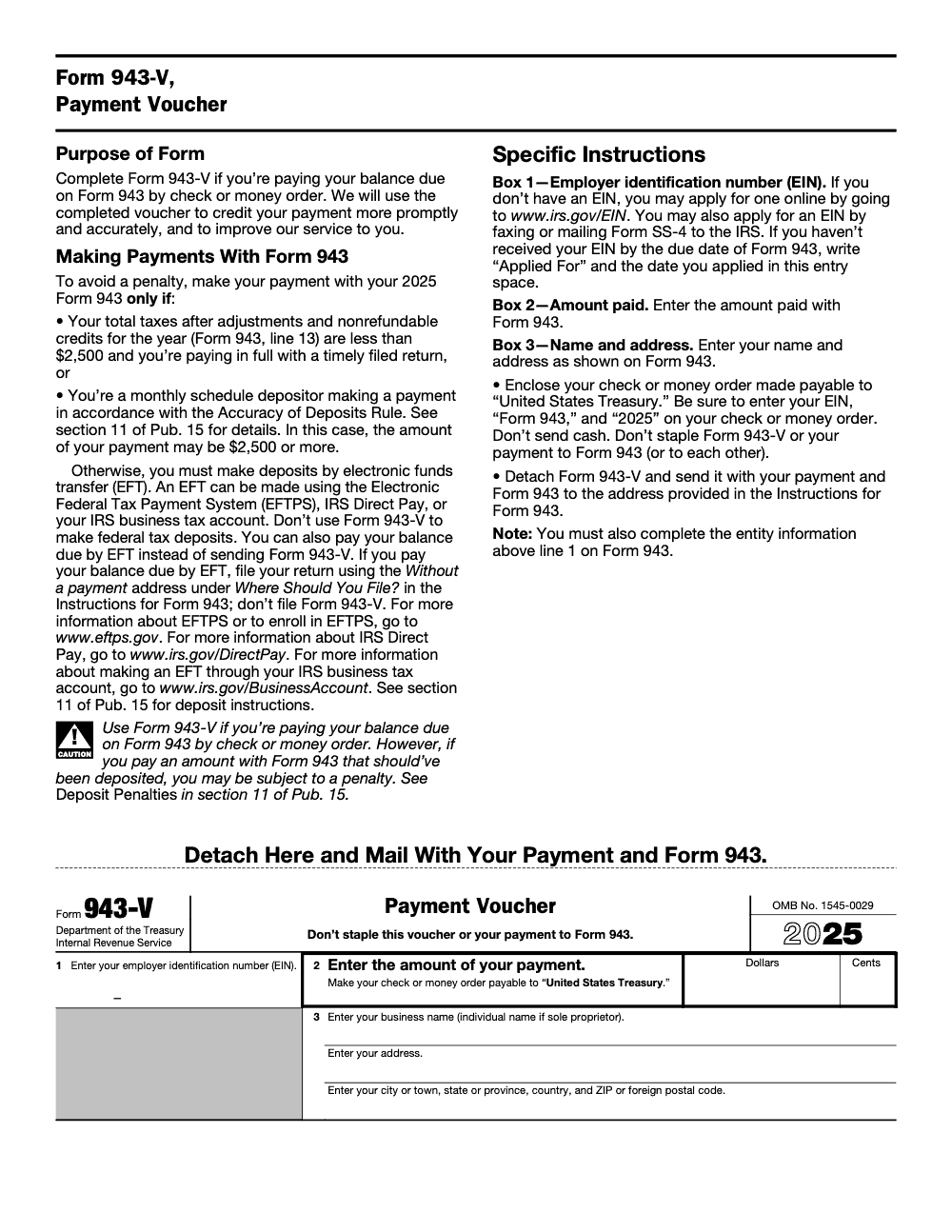
- Make every federal tax deposit by EFT through EFTPS, never with Form 943-V.
- Watch the $100,000 next-day deposit rule, which also forces a monthly depositor to semiweekly for the rest of the year and the following year.
- File the 2025 return by February 2, 2026, or by February 10, 2026 if all deposits were timely and paid in full.
- Furnish and file Forms W-2 with the SSA by January 31, 2026.
Keep 943 Season From Stalling
Form 943 only comes around once a year, and that is exactly what makes it risky. A monthly liability summary on line 17 that does not tie to line 13 can draw an averaged failure-to-deposit penalty of 2% to 10% (per the IRS Form 943 instructions), and unpaid trust fund amounts expose any responsible person to a 100% Trust Fund Recovery Penalty. When a team only touches farm payroll in January, the reconciliation gets rushed and those penalties turn into live exposure.
The fix is not more hours in January, it is a repeatable close that runs the same way every year. When the wage tests, the line math, and the deposit schedule are codified in a workpaper, the year-end filing becomes a review step instead of a scramble.
- Reconcile line 17m to line 13 before anyone signs, so the monthly summary never triggers an averaged deposit penalty.
- Set the deposit schedule from the correct calendar-year lookback and the $50,000 threshold, not Form 941's quarterly rule.
- Keep Form 943 deposits in their own EFTPS stream, separate from any Form 941 payroll.
- Tie line 2, line 4, and line 7 totals back to the W-2s and Form W-3 before filing to head off SSA reconciliation notices.
That is the kind of structure we build into a firm's staffing. Accountably places trained offshore preparers inside your workflow with documented SOPs, multi-layer review, and turnaround SLAs, so agricultural payroll stays on schedule without adding headcount. The review stands between their work and your signature, so you hand off because the work earned it. See how our tax services keep the close predictable.
FAQs
Form 943, the Employer's Annual Federal Tax Return for Agricultural Employees, is how a farm employer reports social security tax, Medicare tax, and federal income tax withheld on farmworker wages for the year. Social security tax is figured on line 3 at 12.4% of line 2 wages, Medicare on line 5 at 2.9% of line 4 wages, and federal income tax withheld lands on line 8. Lines 9 through 13 carry the totals down to the tax after adjustments and credits.
You file Form 943 if you paid an agricultural employee cash wages that meet either of two tests: $150 or more to a single worker for the year (the $150 test), or $2,500 or more in total farmwork payments to all workers (the $2,500 test). Once either test is met, the wages become subject to social security and Medicare tax and you file Form 943 for that calendar year. Children under 18 working on a parent's sole proprietorship or partnership farm are generally exempt from FICA.
No. Form 941 is the quarterly return for most nonfarm employers, while Form 943 is filed once a year for agricultural wages only. The deposit rules differ too: Form 943 uses a calendar-year lookback (the second preceding calendar year) and the $50,000 threshold to set monthly versus semiweekly, rather than Form 941's quarterly lookback. Keep Form 943 deposits in their own EFTPS stream, separate from any Form 941 payroll.
The 2025 Form 943 is due February 2, 2026 (January 31 falls on a weekend). If every required deposit for the year was made on time and in full, you get until February 10, 2026 to file. File Forms W-2 with the SSA by January 31, 2026 regardless of which filing date applies to the return.
Download the current Form 943 and its instructions from IRS.gov. The instructions include the line-by-line walkthrough, the deposit schedule rules, and the mailing addresses if you file on paper. Most payroll software also embeds the current form for e-filers.
File Form 943-X, the Adjusted Employer's Annual Federal Tax Return for Agricultural Employees or Claim for Refund, to correct wages, tax, or withholding reported on a prior Form 943. Keep your employment-tax records for at least 4 years in case the IRS reviews the original return or the correction.
Late deposits draw a failure-to-deposit penalty that scales with how late they are: 2% for 1 to 5 days, 5% for 6 to 15 days, and 10% for 16 or more days. If your monthly liability summary on line 17 does not tie to line 13, the IRS can assess an averaged penalty of 2% to 10%. Unpaid trust fund taxes also expose any responsible person to the 100% Trust Fund Recovery Penalty, so reconcile line 17m to line 13 before anyone signs.
Form 943 family
- Form 943 Schedule R: Guide for Agents, CPEOs, Payers
- Form 943-X: Correct Agricultural Payroll Tax Returns
Other forms this guide names
- Form 941: Employer's Quarterly Tax Return Guide 2025
- Form W‑2: Deadlines, E‑File Rules, Boxes, and W‑2c Corrections
- Form 943-A: IRS Daily Tax Liability Guide for Farms
- Form 8974: Guide to the Payroll R&D Credit for QSBs
- Form W-3: What It Is, Filing Deadline, W-3c Corrections
Summarize this article with AI
About this guide
Accountably helps US CPA, EA, and accounting firms hire trained accountants and tax preparers in India.
About us Reviewed byJugal Thacker, CPAFounder and CEO at Accountably
A Washington-licensed CPA with 7+ years inside US firms – PwC, a real-estate tax practice, then a full-service firm, rising from reviewer to manager to advisory. This article was reviewed against current IRS guidance for the 2025 tax year and updated for filers preparing late returns, amendments, and 2026 estimates.
View profile →How we research, review, and update this guide
Every Accountably guide is researched against primary IRS sources, reviewed by a U.S. CPA, and refreshed as guidance evolves. Read our Editorial Guidelines to see how we source, fact-check, and update our content.