Summarize this article with AI
In Brief
Form 1023-EZ is the streamlined 501(c)(3) exemption application for small nonprofits projecting $50,000 or less in annual gross receipts and holding $250,000 or less in total assets. It is filed electronically only through Pay.gov for a $275 user fee (per the Instructions for Form 1023-EZ and Rev. Proc. 2025-5), and filing within 27 months of the end of the formation month secures recognition retroactive to the date of formation.
A board running an animal rescue came to us eight months in, after they had already accepted donations, written receipts, and opened a bank account, none of it backed by an IRS determination letter. Form 1023-EZ could get them recognized in a few weeks rather than the months the full Form 1023 can take, which was a relief in the room.
The catch is the eligibility worksheet, and it has to come first. The streamlined path is only open to small organizations projecting $50,000 or less in annual gross receipts and holding $250,000 or less in total assets. Filing 1023-EZ when the organization does not actually qualify creates a bigger problem than the slower full application would have.
Key Takeaways
- Form 1023-EZ is the streamlined path to 501(c)(3) recognition for small organizations that meet the eligibility requirements. It replaced the lengthy full Form 1023 process for qualifying organizations and is filed electronically through Pay.gov.
- Eligibility is the first gate. The organization must complete the eligibility worksheet in the instructions. Total assets must not exceed $250,000, projected annual gross receipts for the next 3 years must not exceed $50,000, and certain organization types are categorically ineligible regardless of size.
- The user fee is $275 (per Rev. Proc. 2025-5), paid at the time of filing on Pay.gov. There are no installment options. The fee is nonrefundable, even if the application is denied. It is, however, refunded if the application is returned as incomplete or withdrawn before substantive review begins.
- Approval timelines are significantly faster than the full Form 1023. Most 1023-EZ applications are processed in two to four weeks. The IRS does not issue advance rulings; the determination letter is the authorization to operate as a 501(c)(3).
- Retroactive recognition is available if filed within 27 months from the end of the month in which the organization was formed (the 27-month count starts at the end of the formation month, not the exact date of organization, which gives slightly more time than a literal 27 months from formation). Beyond 27 months, recognition is effective from the date of filing, not the date of formation.
- Quick SOP tip: Run the eligibility worksheet before any client conversation about 1023-EZ. If they fail any one of the worksheet questions, they must use Form 1023 or Form 1023 Schedule E if operating as a church. Assuming eligibility without checking is the most common early mistake.
What Form 1023-EZ Is and When to Use It
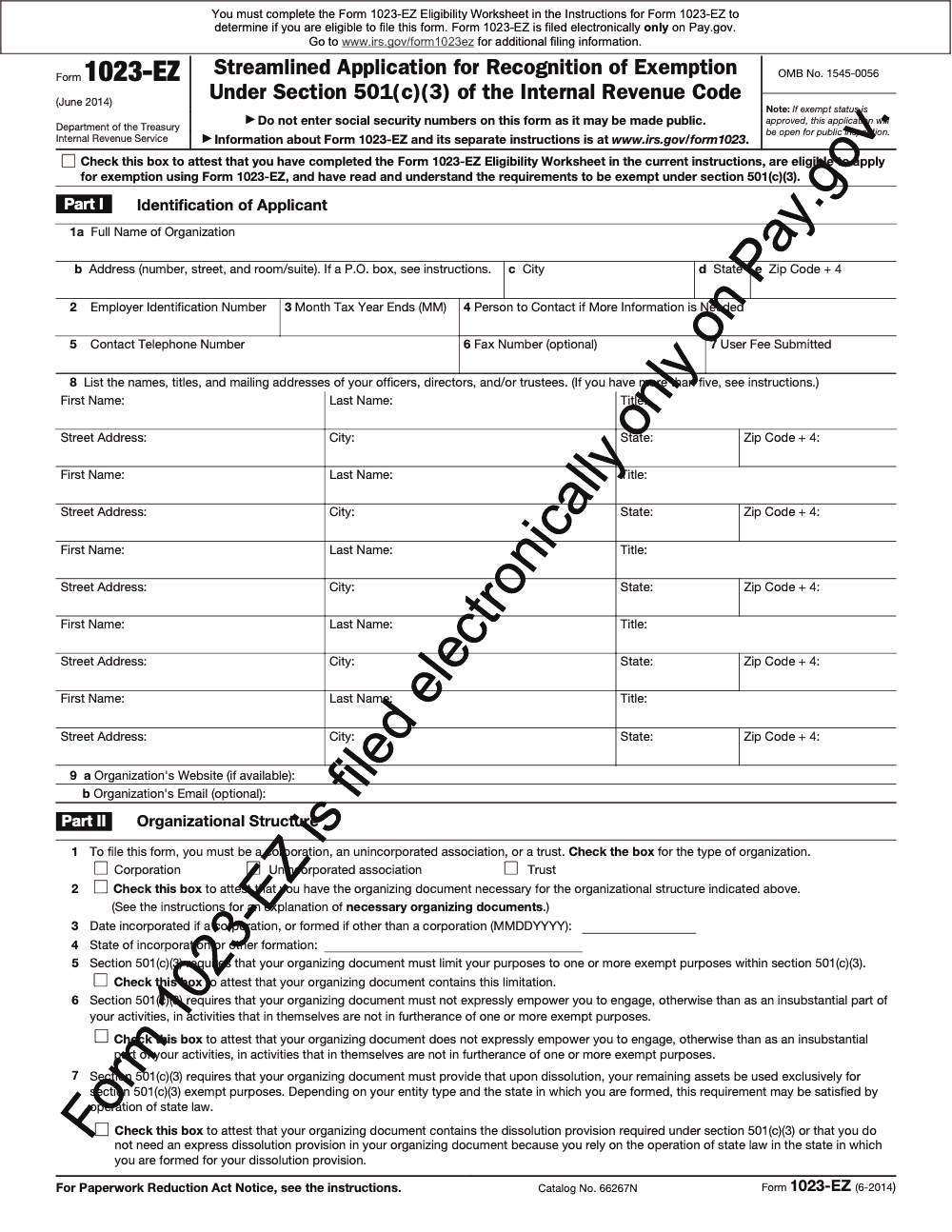
Form 1023-EZ is the IRS’s streamlined application for recognition of tax-exempt status under §501(c)(3) of the Internal Revenue Code. It was introduced in 2014 to reduce the processing burden for small organizations that would otherwise have to navigate the full Form 1023, a document that can run 12 or more pages with extensive schedules. The 1023-EZ accomplishes the same legal result – an IRS determination letter recognizing the organization as a public charity exempt from federal income tax – in a fraction of the time and paperwork.
The form is filed exclusively through Pay.gov, the U.S. government’s secure online payment portal. There is no paper version. The application is short – three pages – and asks the organization to attest to its eligibility, structure, purposes, and activities rather than provide detailed documentation. The IRS relies heavily on these attestations, which creates a corresponding responsibility to ensure they are accurate. Inaccurate attestations are a basis for revocation and can expose officers to penalties under §6701.
Organizations that should use Form 1023-EZ are those that: have been in existence for less than or equal to 27 months (for retroactive recognition), project gross receipts of $50,000 or less for each of the next 3 years, have total assets of $250,000 or less at the time of filing, and are not on the list of categorically ineligible types (churches, schools, hospitals, supporting organizations, and others listed in the eligibility worksheet).
When to Use Form 1023 Instead
Form 1023 is required when the organization fails any eligibility question on the 1023-EZ worksheet. This includes situations where the organization expects significant grants from private foundations (the grantor may require a full determination letter), where the organization has complex activities that need explanation, or where the organization has been denied exemption previously. From my side of the desk, I also recommend Form 1023 for any organization with a budget trajectory that will clearly exceed $50,000 within a year or two – growing into ineligibility after receiving the determination via 1023-EZ can complicate donor relations if anyone questions whether the original application was accurate.
How to Complete Form 1023-EZ
The form is completed entirely online at Pay.gov. There is no PDF filing option. Here is a section-by-section breakdown of what you will encounter:
| Section | What It Covers | Practitioner Notes |
|---|---|---|
| Part I – Identification of Applicant | Legal name, EIN, address, formation date, state of organization, type of entity (corporation, unincorporated association, or trust). | The organization must have an EIN before filing. If the client does not have one, apply via Form SS-4 or the IRS online EIN application first. Do not use the founder’s personal SSN. |
| Part II – Organizational Structure | Confirms the organization has organizing documents (articles of incorporation or trust agreement) that include the required purpose clause and dissolution clause. | Both clauses must appear verbatim or substantially similar to the IRS model language. Many state-formed nonprofit corporations include them by default; verify before attesting – a generic ‘any lawful purpose’ clause from a standard state template does not satisfy the organizational test, because the purpose clause must specifically limit the organization to one or more exempt purposes described in §501(c)(3). Missing clauses are the top reason for follow-up requests from the IRS. |
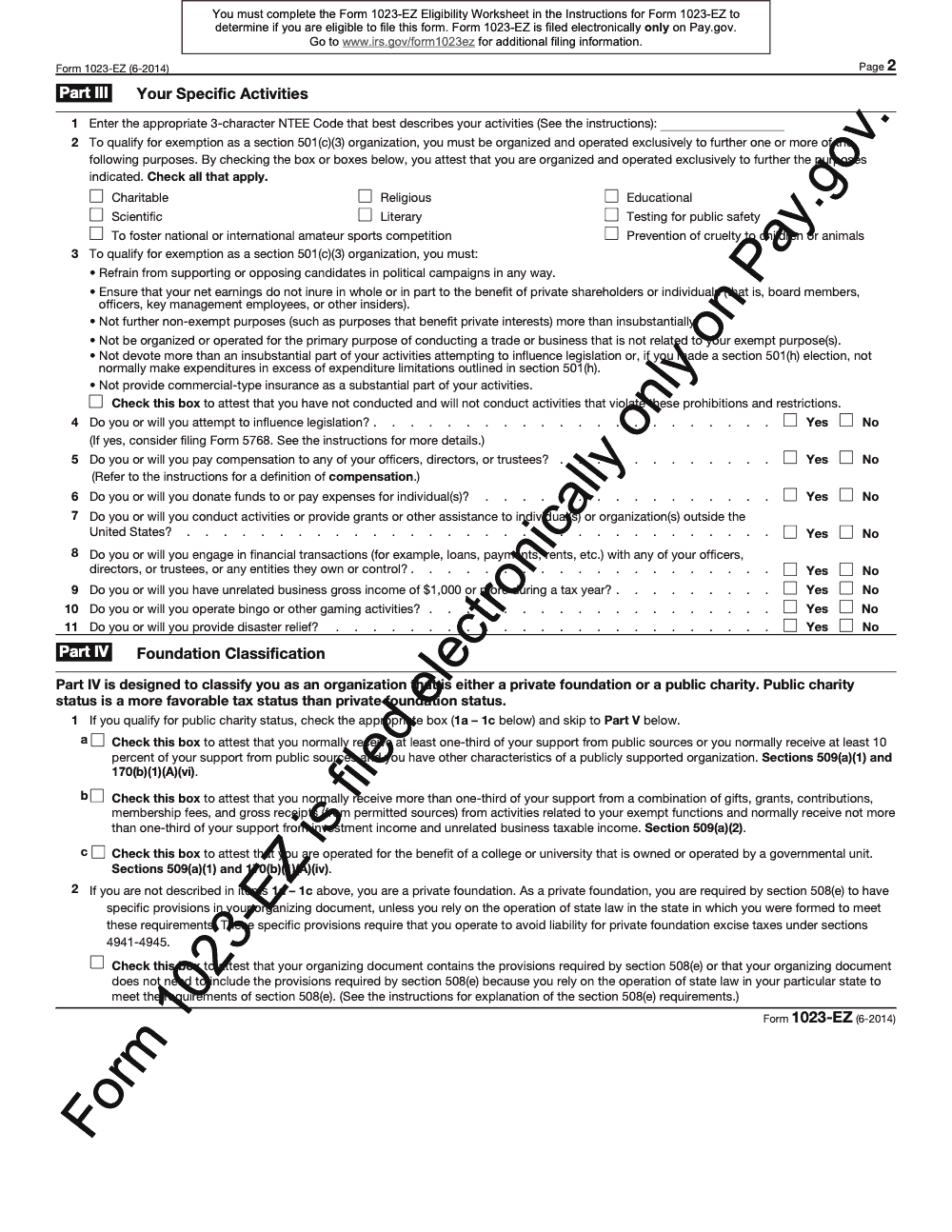
| Part III – Your Specific Activities | A brief description of the organization’s mission and activities (limited to 255 characters on the form). The applicant selects an NTEE Code (National Taxonomy of Exempt Entities) that best describes the organization. | The 255-character limit is tight. Use the description to state the primary charitable purpose clearly: “Provides after-school tutoring and college prep services to underserved students in [city], [state].” Avoid vague language like “educational activities” with no context. |
| Part IV – Foundation Classification | Identifies the organization’s public charity basis. Form 1023-EZ Part IV offers only three options – §509(a)(1) and §170(b)(1)(A)(vi), §509(a)(2), or §509(a)(1) and §170(b)(1)(A) other. It offers no §509(a)(3) supporting-organization option, and school, hospital, and church are not selectable classifications here. | Most small nonprofits select §509(a)(1) or (2) – they intend to be publicly supported charities. Selecting the wrong classification can affect donor deductibility calculations down the road. Confirm the applicable subsection before attesting. Public charity status is not permanent either – the organization must keep meeting the public support test each year on Schedule A of its Form 990 or 990-EZ, or it can be reclassified as a private foundation. |
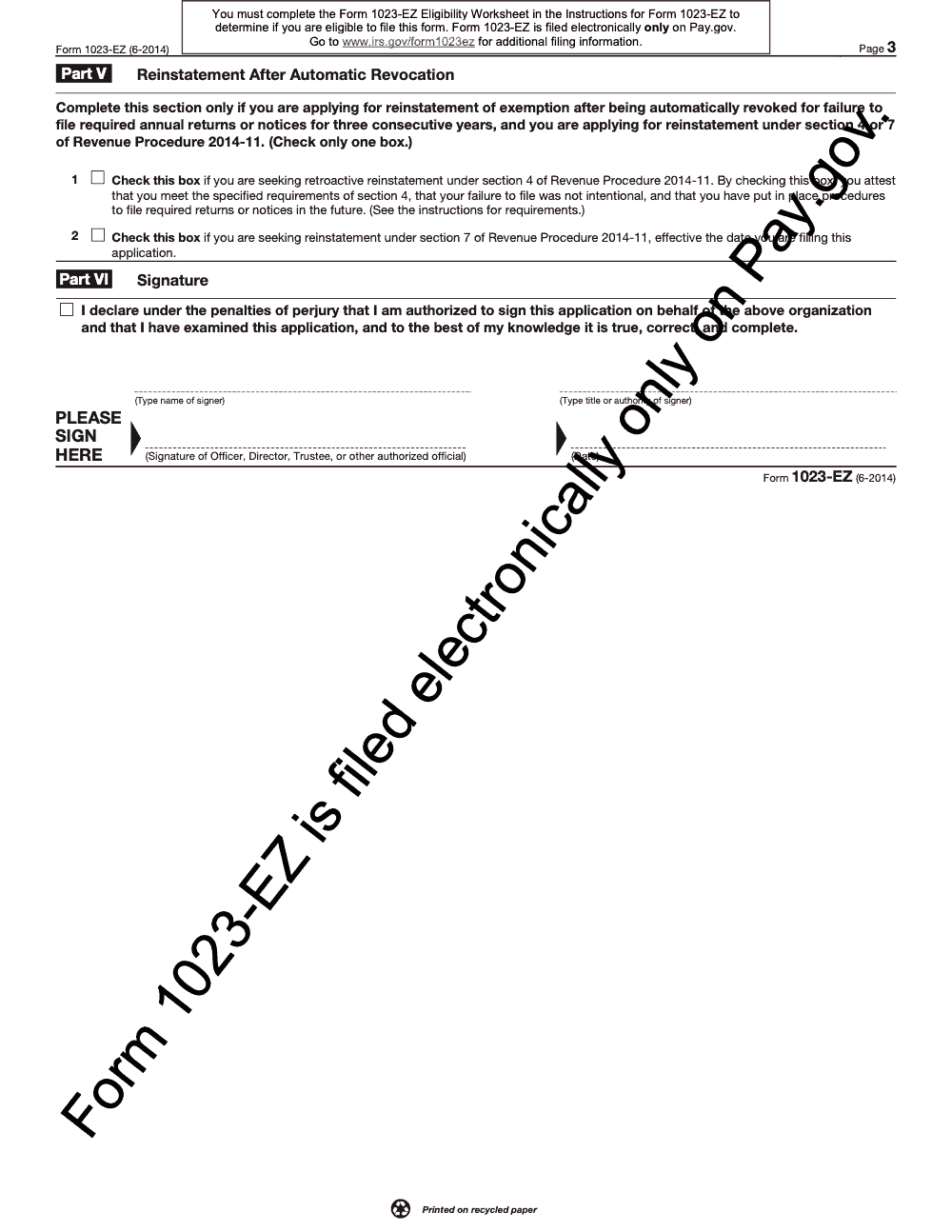
| Part V – Reinstatement After Automatic Revocation | Applies only to organizations reinstating after losing status for failing to file for 3 consecutive years. | A reinstatement filing carries the same flat $275 user fee as any other Form 1023-EZ; there is no gross-receipts-based reduced fee. Review Rev. Proc. 2014-11 for the streamlined reinstatement procedures available under 1023-EZ. Note that the Section 4 streamlined process is available only if you file within 15 months of the later of the revocation date or the date on the IRS revocation letter – miss that window and reinstatement requires the reasonable-cause procedures of Section 6 or 7. |
| Part VI – Signature | Electronic signature by an authorized officer of the organization. | The signer must be listed as an officer in the organizing documents or bylaws. A preparer cannot sign on behalf of the organization. |
After submission, Pay.gov generates a confirmation number and confirmation email. Save both. The IRS processes the application and issues a determination letter electronically; watch the email address associated with the Pay.gov account.
Deadlines, Penalties, and Filing Requirements
Form 1023-EZ does not have a fixed annual filing deadline like a tax return, but timing matters significantly for the effective date of exempt status and for retroactive recognition.
| Requirement | Deadline / Threshold | Consequence / Notes |
|---|---|---|
| Retroactive recognition | File within 27 months of the end of the month in which the organization was formed | If filed within 27 months, exempt status is recognized back to the formation date. Donors can deduct gifts made during the intervening period once the letter issues. |
| Recognition effective from filing date | Filed after 27 months from formation | Exempt status recognized only from the date of application, not from formation. An organization that misses the 27-month window and wants a discretionary extension under Reg. §301.9100-1 must file the regular Form 1023 – a late Form 1023-EZ cannot be used to request that extension. Gifts before the filing date are not deductible as charitable contributions, which can affect donor relations and prior-year reporting. |
| User fee | $275 at time of Pay.gov submission | Paid by credit/debit card or ACH. Nonrefundable. No reduced fee option for Form 1023-EZ; the regular Form 1023 carries a higher $600 user fee. |
| Annual information return | Form 990-N (e-Postcard) by 15th day of 5th month after fiscal year end, or Form 990/990-EZ if gross receipts exceed thresholds | Organizations with gross receipts normally not exceeding $50,000 file Form 990-N. Those between $50,000 and $200,000 file Form 990-EZ. Annual filing must begin for the first year of existence regardless of activity level. |
| Automatic revocation for non-filing | Three consecutive years of failing to file the required annual return (990-N, 990-EZ, or 990) | Status is automatically revoked. Reinstatement requires a new application. Organizations revoked must disclose the revocation to donors; gifts during revocation are not deductible. |
| State-level requirements | Varies by state – typically within 30–90 days of formation or of receiving IRS determination letter | State charitable registration, state franchise tax exemption, and state sales tax exemption are separate from the IRS process. Many organizations miss these, creating state-level compliance gaps. |
The Eligibility Worksheet – Work Through It Before Anything Else
The 1023-EZ eligibility worksheet is not optional guidance – it is a required gatekeeping step. The IRS instructions include a multi-question worksheet that eliminates ineligible organizations before they apply. Filing 1023-EZ when the organization fails the worksheet exposes the officers to inaccurate attestation claims and may result in revocation of any determination letter issued.
Size-Based Eligibility Tests
The organization must meet all three size-based tests:
- Annual gross receipts must not be expected to exceed $50,000 in any of the next 3 years
- Total assets must not exceed $250,000 at the time of filing
- Prior-year gross receipts (if in existence 1–3 years) must not have exceeded $50,000 in any year
These are not averages – they are per-year tests. An organization that received $45,000 in year one but expects $60,000 in year two fails the forward-looking test and must use Form 1023.
Categorically Ineligible Organizations
The following types cannot use Form 1023-EZ regardless of size:
- Churches, associations of churches, and integrated auxiliaries of churches
- Schools, colleges, and universities
- Hospitals and medical research organizations
- Successors to an organization whose tax-exempt status was automatically revoked for three consecutive years of non-filing and has not yet been reinstated (a previously revoked organization can itself seek reinstatement through Part V of Form 1023-EZ rather than being barred outright)
- Organizations formed in a foreign country
- Limited liability companies (LLCs) that are not classified as corporations for federal tax purposes (an LLC that has elected to be taxed as a corporation can file)
- §509(a)(3) supporting organizations
- Organizations electing non-private foundation status as a §509(a)(3) supporting organization
- Successors to for-profit organizations
- Organizations that have undergone a significant change in activities, structure, or purpose
Quick rule you can copy into your SOP: print the eligibility worksheet from the 1023-EZ instructions and walk the client through it in the initial consultation. If they answer “yes” to any disqualifying question, pivot to Form 1023. Do not try to fit a square peg into a round hole because 1023-EZ is faster.
What Happens After You File – Approval, Follow-Up, and State Steps
Once the form is submitted via Pay.gov, the IRS processes the application and in most cases issues a determination letter within two to four weeks. The IRS does not typically request additional information for 1023-EZ applications; if the attestations are complete and the organization is eligible, approval is largely administrative. The determination letter is sent electronically to the email address associated with the Pay.gov account.
Using the Determination Letter
The determination letter is the organization’s legal authorization to represent itself as a 501(c)(3) public charity. It should be stored permanently and provided to:
- Donors requesting confirmation of deductibility (many major donors and foundations will request a copy before making a contribution)
- Grant applications that require IRS determination letter documentation
- Banks and financial institutions opening organizational accounts
- State agencies for charitable registration and sales tax exemption applications
State-Level Steps That Follow Federal Recognition
Federal 501(c)(3) recognition does not automatically confer state tax exemption. After receiving the IRS determination letter, the organization typically needs to:
- Apply for state corporate income tax exemption (usually requires a copy of the IRS letter and state-specific form)
- Register with the state charitable solicitation authority if the organization will solicit donations (required in most states)
- Apply for state sales tax exemption (varies by state; some exempt 501(c)(3)s automatically, others require a separate application)
- Obtain any required local business licenses or permits even though the organization is nonprofit
Many organizations that handle the IRS process well drop the ball on state compliance. I always include a state compliance checklist in the engagement letter so the client understands that federal recognition is step one, not step done.
Common Mistakes That Slow Things Down
The 1023-EZ looks deceptively simple, and that is exactly where the trouble starts. The same handful of errors come back every season, and most of them surface long before a determination letter is ever at risk.
Practical Checklists You Can Reuse
These checklists are copy-paste ready for a firm SOP or a client engagement file. Run them in order and most 1023-EZ surprises disappear before submission.
Eligibility pre-screen
- Confirm projected annual gross receipts will not exceed $50,000 in any of the next 3 years.
- Confirm prior-year gross receipts did not exceed $50,000 in any year the organization has existed.
- Confirm total assets do not exceed $250,000 at the time of filing.
- Walk all 30 questions on the Eligibility Worksheet in the Instructions for Form 1023-EZ and record a No for each.
- Rule out categorically excluded types: church, school, hospital, §509(a)(3) supporting organization, foreign entity, or non-corporate LLC.
- Confirm the organization is not a successor to a for-profit or a previously revoked entity.
Pre-submission packet
- Obtain the EIN on Form SS-4 before starting; never enter an SSN.
- Verify the articles include a 501(c)(3) purpose clause and a dissolution clause, or confirm state law supplies the dissolution provision.
- Select the correct NTEE code (3 characters) for Part III.
- Choose the public-charity basis for Part IV: §509(a)(1) or §509(a)(2).
- Draft the 255-character activity description in plain, specific language.
- Confirm the signer is an authorized officer, director, or trustee.
- Have the $275 user fee ready to pay by card or ACH on Pay.gov.
Post-determination handoff
- Save the determination letter and the Pay.gov confirmation number to the permanent file.
- Calendar the annual return from year one: Form 990-EZ if gross receipts are between $50,000 and $200,000, otherwise Form 990-N when receipts are normally $50,000 or less.
- Set a 3-consecutive-year non-filing alert to head off automatic revocation.
- File state corporate income tax exemption, charitable-solicitation registration, and sales tax exemption as applicable.
- Provide the determination letter to banks, grantmakers, and major donors on request.
Keep 1023-EZ Season From Stalling
Form 1023-EZ has no tax-season rhythm, but it runs on a clock all the same. The 27-month retroactive window starts ticking at the end of the month an organization is formed, and the eligibility gate is a 30-question worksheet in the Instructions for Form 1023-EZ where a single Yes pushes the client onto the regular Form 1023 with its $600 user fee instead of the $275 EZ fee (per Rev. Proc. 2025-5). When that intake is rushed, applications stall before they ever reach Pay.gov.
The fix is to treat the front end as a controlled intake rather than a fill-in-the-blanks exercise. Most of the delay sits in three places: eligibility screening, organizing-document review, and the post-recognition annual-return calendar that keeps a hard-won determination from being quietly revoked three years later.
- Lock the 27-month date the day the entity is formed, since recognition only reaches back to formation when you file inside that window.
- Clear the 30-question Eligibility Worksheet and rule out churches, schools, hospitals, and §509(a)(3) supporting organizations before any Pay.gov work begins.
- Confirm the Part II purpose and dissolution clauses and the Part IV public-charity basis (§509(a)(1) or (2)) before the officer signs under penalty of perjury.
- Schedule the annual 990-series return from year one to head off the 3-consecutive-year automatic revocation under §6033(j).
That is the kind of structured, repeatable intake we build into our tax and exempt-organization delivery: documented screening steps, layered review of the organizing documents, and a recognition-to-annual-return handoff that does not drop once the determination letter lands.
FAQs
Yes – it must be filed electronically. Form 1023-EZ is only available through Pay.gov, the U.S. government’s secure online payment portal. There is no paper version. The filer creates a Pay.gov account, completes the form online, pays the $275 user fee, and submits. The IRS determination letter is issued electronically to the email address associated with the account.
Most Form 1023-EZ applications are processed and approved within two to four weeks of submission. This is significantly faster than the full Form 1023, which can take three to six months or longer. Approval timelines can vary based on IRS processing volumes, but the streamlined nature of the 1023-EZ means that most applications do not require additional information requests and move through quickly.
The user fee for Form 1023-EZ is $275 (per Rev. Proc. 2025-5), paid at the time of filing on Pay.gov. The fee is generally nonrefundable once the IRS begins substantive review, though it is refunded if the application is returned as incomplete or withdrawn before that review begins. There is no reduced-fee option for Form 1023-EZ; the regular Form 1023 carries a higher user fee of $600.
The main eligibility requirements are: projected annual gross receipts not exceeding $50,000 for any of the next 3 years, total assets not exceeding $250,000, and the organization is not a church, school, hospital, supporting organization, or other categorically ineligible type (an LLC qualifies only if it is classified as a corporation for federal tax purposes). The applicant must complete the eligibility worksheet in the IRS instructions to confirm eligibility before filing. If the organization fails any question, Form 1023 must be used instead.
The $50,000 threshold applies to projected gross receipts at the time of filing – it is a forward-looking eligibility test, not an ongoing cap. However, eligibility is tested in both directions: the organization must also confirm its actual annual gross receipts did not exceed $50,000 in any of the prior 3 years it has existed, not only that projected future receipts stay under the limit. Once the organization receives its determination letter, growing beyond $50,000 does not invalidate the exempt status. However, the organization’s annual information return requirement will change: once gross receipts exceed $50,000, Form 990-N is no longer sufficient and Form 990-EZ or Form 990 will be required. The organization should also ensure that its activities remain consistent with its stated exempt purpose as it grows.
A denial of Form 1023-EZ typically occurs when the IRS determines the organization does not qualify for exemption under §501(c)(3), the organizing documents do not meet the required language standards, or there is a disqualifying characteristic. The organization may appeal the denial through the IRS Office of Appeals. It may also be possible to file a new application with the deficiencies corrected. An organization denied 1023-EZ status cannot file a new 1023-EZ and must use Form 1023 for any subsequent application.
Other forms this guide names
- Form 990‑EZ: Eligibility, Deadlines, E‑File, Schedules
- Form 990: Nonprofit Tax Return Filing Guide 2025
About this guide
Accountably helps US CPA, EA, and accounting firms hire trained accountants and tax preparers in India.
About us Reviewed byJugal Thacker, CPAFounder and CEO at Accountably
A Washington-licensed CPA with 7+ years inside US firms – PwC, a real-estate tax practice, then a full-service firm, rising from reviewer to manager to advisory. This article was reviewed against current IRS guidance for the 2025 tax year and updated for filers preparing late returns, amendments, and 2026 estimates.
View profile →How we research, review, and update this guide
Every Accountably guide is researched against primary IRS sources, reviewed by a U.S. CPA, and refreshed as guidance evolves. Read our Editorial Guidelines to see how we source, fact-check, and update our content.