Summarize this article with AI
In Brief
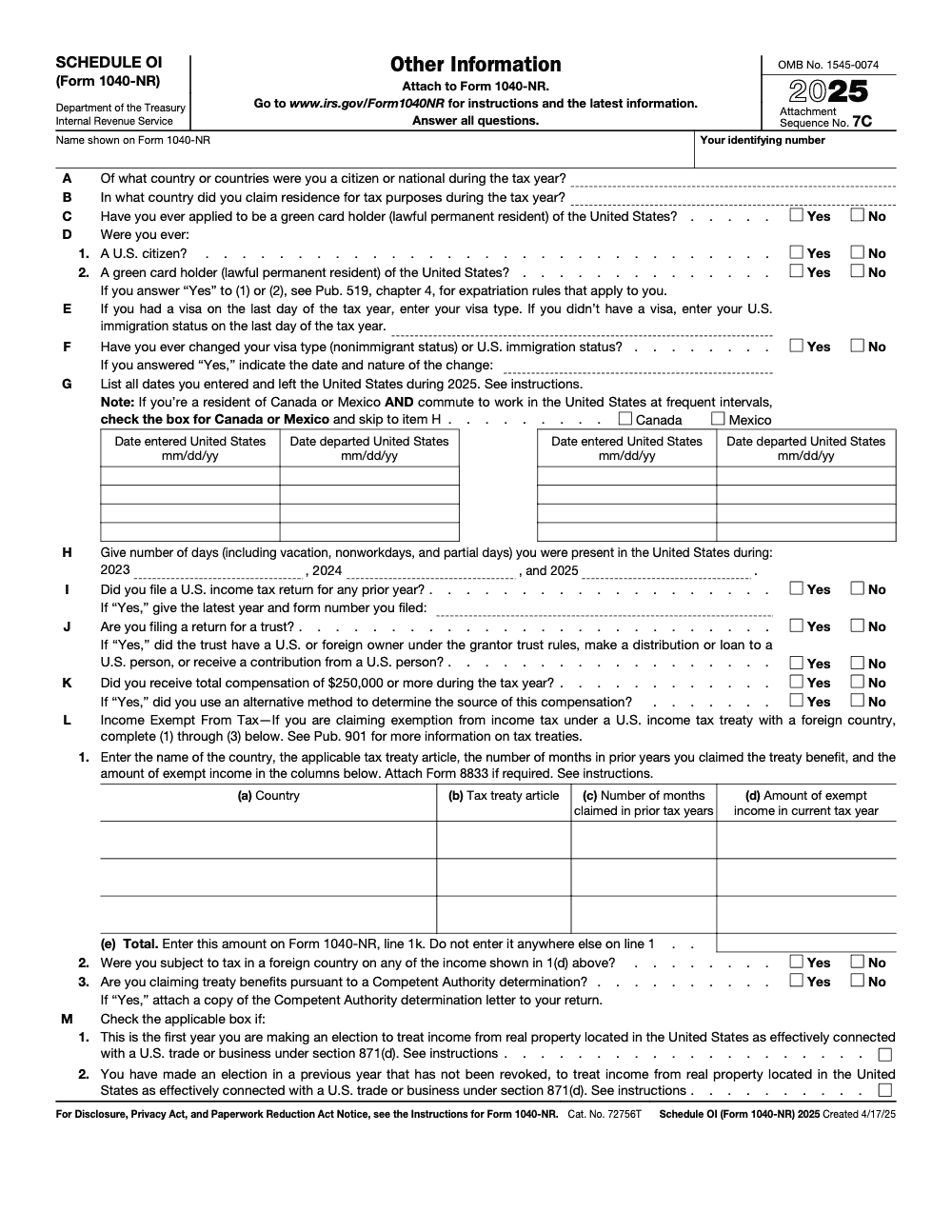
Schedule OI (Other Information) is a required attachment to Form 1040-NR, the U.S. nonresident return. It runs 13 lettered items, A through M, covering country of residence, visa status, U.S. days of presence, and any tax treaty claim (per the IRS Instructions for Form 1040-NR). Treaty-exempt income from item L(1) column (e) carries to Form 1040-NR line 1k, and tax year 2025 returns are due April 15, 2026 if you had wages subject to U.S. withholding, or June 15, 2026 if you did not. Form 4868 grants a 6-month extension to file, not to pay.
Almost everything on a 1040-NR can be clean and the return still comes back for rework if Schedule OI was treated as an afterthought. One spring a J-1 researcher gave us a tidy wage summary and a treaty letter, yet item L sat half finished, item H was missing the earlier years' days, and the treaty wages had been parked on line 1a instead of line 1k. None of it was hard, and all of it would have drawn a notice.
The math on Schedule OI is light; the work is in the disclosures. The 13 lettered items, A through M, are where visa status, days of presence, and treaty claims line up, with Form 8833 attached only when section 6114 or 7701(b) requires it.
Key Takeaways
- Schedule OI is required with every Form 1040‑NR. You answer all questions to document visa status, U.S. days of presence, closer‑connection factors, green card steps, and any treaty claim.
- Deadlines depend on whether you had wages subject to U.S. withholding, generally April 15 if you had wages, June 15 or the next business day if not, for 2025 returns that means April 15, 2026 with wages and June 15, 2026 without. Extensions give more time to file, not to pay.
- If you claim treaty benefits, you identify the treaty country, article, and the exempt amount on Schedule OI, and attach Form 8833 only when disclosure is required by section 6114 or 7701(b).
- Gather proof before you start, passport and visa pages, I‑94 travel history, W‑2 and 1042‑S, and your day counts for the Substantial Presence Test or any closer‑connection claim.
- File on time. Failure‑to‑file penalties can reach 5% per month, up to 25%, and failure‑to‑pay adds 0.5% per month. Minimum late‑filing penalties also apply for recent years.
What Schedule OI Is And Why It Matters
Schedule OI stands for Other Information. Think of it as the IRS snapshot of your nonresident facts. You confirm your country of residency for treaty purposes, your visa classification, your physical presence in the United States this year and the prior two years, and whether you took any green card steps. The IRS uses these answers to verify your tax residency, to check your Substantial Presence Test math, and to validate any treaty line you claim elsewhere on 1040‑NR. The instructions put it plainly, include Schedule OI with your 1040‑NR and answer all questions.
If you claim a treaty benefit, Schedule OI is where you state the treaty country, article, prior months you claimed it, and how much income is exempt this year. Those numbers must tie to Form 1040‑NR line 1k and, when required, to Form 8833. The IRS even gives an example for a teacher claiming a treaty exemption, show the country, the article, prior months used, and the current exempt wages.
Who Must File Schedule OI With Form 1040‑NR
If you file Form 1040‑NR, you file Schedule OI. There is no income threshold or carve‑out. The 2025 instructions state you will need to complete the applicable items on Schedule OI and include it with your 1040‑NR. Later in the same guidance, the IRS says you must answer all questions on Schedule OI. That combination means you attach Schedule OI every time you file a 1040‑NR, then complete all questions that apply to your situation.
A quick note on deadlines. For a calendar‑year filer, if you had wages subject to U.S. withholding, your 2025 1040‑NR is due April 15, 2026. If you had no wages subject to withholding, it is due June 15, 2026. These are the same timing rules the IRS lists for nonresident aliens, count four months if you had wages, six months if you did not. You can request an automatic extension with Form 4868 by the original due date, but that extends filing only, not payment.
Why the IRS Cares About Days And Visas
Days of presence feed the Substantial Presence Test, which looks at your days this year plus weighted days in the two prior years. Certain days do not count, like commuter days from Canada or Mexico, or days as an exempt individual under F, J, M, or Q in specific circumstances. Schedule OI captures your dates and visa type so the IRS can reconcile those day counts. If you qualify for the closer‑connection exception, that is a separate filing, Form 8840, but Schedule OI still records the facts that support your status.
When A Treaty Claim Belongs On Schedule OI
If a treaty exempts part of your income, for example student wages, teaching income, scholarship amounts, or interest, Schedule OI item L is where you identify the treaty country, the article, prior months used, and the current year exempt amount. You then show the exempt amount on line 1k of Form 1040‑NR, and attach Form 8833 only when the disclosure rules require it. The instructions give concrete examples of how this appears on the return.
Pro tip: If your payor already reported a treaty exemption correctly on a 1042‑S, include that 1042‑S with your return. It helps the IRS match your treaty claim to information returns.
Documents To Gather Before You Start Schedule OI
Start with identity and status. You need your passport biographic page and current visa, plus your SSN or ITIN. If you are claiming a treaty position, pull the 1042‑S reporting the exempt income. If your employer withheld on treaty‑exempt wages because they could not determine eligibility, you will still disclose the treaty and reconcile on the return.
- Travel history and day counts, retrieve your I‑94 record and five‑year arrival or departure history from the CBP site, then line up entry and exit dates with your day‑count worksheet.
- Income forms, W‑2 for wages and 1042‑S for U.S. source income subject to withholding or treaty exemption, plus any 1099s tied to U.S. income.
- Residency support, if you rely on closer connection, you will file Form 8840, and if you are a student relying on the student exception, you will file Form 8843. Your Schedule OI answers still need to match these filings.
Keep digital copies of everything, and save signed PDFs of your return, Schedule OI, and attachments for at least three years. If you filed with treaty‑exempt income, keep the 1042‑S, employer letters, and scholarship statements alongside your passport and I‑94 printouts.
Step‑By‑Step, Completing Schedule OI Accurately
Below is a field‑by‑field guide using the language the IRS relies on. You will see references to specific items in the current instructions.
Items A and B, Nationality and Country Of Residence
You list the country or countries where you were a citizen or national during the tax year in item A, and state your country of residence in item B. For status and treaty claims, your country of residence is a treaty concept, not simply where you live, so it must align with the specific treaty article you cite. The instructions direct you to enter your country of residency on Schedule OI and, if applicable, that you are a U.S. national.
Visa Classification, Entry And Exit Dates, And Days Of Presence
Schedule OI asks for your visa type and your dates of arrival and departure (list every entry and departure for the year, not just your first entry or longest stay). When you total days present for the year and the two prior years, use the Substantial Presence Test rules, do not count commuter days, certain short transits, exempt individual days, or qualifying medical condition days, but do count every other day you were physically present for any part of the day, including vacation days, weekends, nonworkdays, and partial arrival or departure days. Match what you report on Schedule OI to your own day‑count sheet and to your I‑94 history.
Green Card Steps And Closer‑Connection Facts
If you have ever held a green card, or took steps such as filing I‑485 or being the subject of an I‑130 or I‑140, that can affect whether you can claim closer connection. Schedule OI surfaces these facts for the IRS. If you claim the closer‑connection exception, you must file Form 8840 on time, and your Schedule OI answers should support the claim. Students who do not qualify for the general closer‑connection exception may use the student exception with Form 8843.
Item K, High‑Compensation Sourcing Disclosure
If your total compensation, including fringe benefits, is at least $250,000 (the item K test uses your worldwide total compensation, not just your U.S.-source wages) and you use an alternative method to source compensation between U.S. and foreign workdays, you check the two Yes boxes in item K and attach a statement with the detail the IRS lists. This is a common miss that slows reviews.
Item L, Treaty Claims That Affect Income On Your 1040‑NR
Item L is the treaty grid. The IRS wants four things, your treaty country, the exact article, the number of months previously claimed under that article, and your current year exempt amount. The grid is only subpart L(1), though, so when you claim any treaty exemption you must also complete L(2), whether you were subject to tax in a foreign country on that same income, and L(3), whether you are claiming benefits under a Competent Authority determination. The instructions include an example that shows how those entries flow to Form 1040‑NR line 1k. If you reduced withholding with Form 8233, attach the 1042‑S and complete item L. If your employer did not accept Form 8233 and withheld anyway, you still use item L to claim the treaty on the return.
Practitioner note: Wages exempt by treaty are not reported on 1040‑NR line 1a, they are entered on line 1k with the item L detail, which is why reviewers look for that tie‑out first.
Cross‑Checking Your Return
- Line 1k must equal the total of item L, column d.
- Days of presence should reconcile to your SPT worksheet.
- If you filed 8840 or 8843, the facts on Schedule OI should align.
Claiming Tax Treaty Benefits On Schedule OI, Without The Guesswork
Treaty claims live in two places on your return, the Schedule OI item L grid and, when disclosure is required, Form 8833. The IRS summarizes when to disclose, you file Form 8833 with your return if your treaty position reduces or modifies how the Internal Revenue Code would otherwise tax you, for example a disposition of U.S. real property under a treaty, a change to the source of income, or a credit that would not otherwise be allowed. If an exception applies, like dependent personal services, scholarships and fellowships, many student or teacher provisions, pensions and annuities, or certain interest or dividend withholding rate reductions, you often do not file 8833, you still complete item L.
A Practical Treaty Workflow
- Identify the treaty article and paragraph that applies to your facts, for example wages, teaching income, scholarship, interest, or dividends.
- Confirm the conditions, for example time limits, residence tie‑breaker rules, beneficial ownership, and days present.
- Complete Schedule OI item L with country, article, prior months used, and current exempt amount, then flow the amount to line 1k.
- Attach Form 8833 when a disclosure is required. The IRS penalties for not filing when required are separate from late‑filing penalties and can be $1,000 for individuals.
Examples You Can Model
- F‑1 student with taxable scholarship for room and board, many treaties exempt scholarship income or set conditions, so the student shows the treaty on item L, includes the exempt amount, and keeps the 1042‑S as proof. If required by the situation, 8833 is attached, but in many scholarship cases, an exception applies.
- J‑1 teacher claiming a teacher article for wages, item L lists the treaty country, the specific article, the prior months used in earlier years, and this year’s exempt salary. The IRS instructions include a similar teacher example.
- H‑1B professional with a general wages article, some treaties reduce tax on dependent personal services for limited periods or limited amounts. If your article requires disclosure under 6114, add Form 8833, otherwise complete item L only.
Common Treaty Pitfalls
- Vague citations, “UK treaty applies” is not enough, you need the country and the exact article or paragraph.
- Not tracking months used in prior years, most articles are time bound. Item L asks for months claimed before this year.
- Missing Form 8833 when disclosure is required, the penalty is separate and can apply even if your treaty claim is otherwise valid.
Deadlines, Extensions, And Late Submission Consequences
Mark two calendars. If you had wages subject to U.S. withholding, a calendar‑year 1040‑NR is due on April 15 following the tax year. If you did not have wages subject to U.S. withholding, your due date is June 15, or the next business day when it falls on a weekend, for 2025 returns this is Wednesday, April 15, 2026 with wages and Monday, June 15, 2026 without. File Form 4868 by the original due date if you need more time to file. Remember, an extension does not extend time to pay.
If you miss the deadline, two penalties can apply. Failure to file is generally 5% of unpaid tax per month, up to 25%, with a minimum set amount for late individual returns in recent years. Failure to pay is generally 0.5% per month, up to 25%. If both apply in the same month, the failure‑to‑file percentage drops by the failure‑to‑pay percentage. Interest also accrues on unpaid tax. Filing, even if you cannot pay in full, usually reduces total penalties.
Practical tip: If you expect a refund, file electronically and choose direct deposit. The IRS says most e‑filed refunds are issued in less than 21 days, though some returns require more review. Use Where’s My Refund to track status. Paper refunds take longer.
Common Mistakes On Schedule OI And How To Fix Them
Schedule OI is light on math and heavy on disclosure, so the errors I see cluster around skipped subparts and mismatched dates, not arithmetic. These five surface every season.
Filing Options, Processing, And Recordkeeping
E‑file when your software or preparer supports it, it is faster, and avoids mailing delays. The IRS confirms you can e‑file Form 1040‑NR, and if you later discover a mistake, 1040‑X can be e‑filed for many returns. Paper still works if you must, but expect additional time. Track refunds with Where’s My Refund, which updates once per day and shows return received, refund approved, and refund sent.
Keep a tight file for at least three years, your completed return and Schedule OI, passport and visa pages, I‑94 records, W‑2 and 1042‑S, treaty notes, and any Form 8833, 8840, or 8843. If you used the high‑compensation sourcing disclosure in item K, keep your workday allocation and the required statement in the same folder.
Quick Reference Table
| Field on Schedule OI | What to enter | Where it ties out on 1040‑NR | Proof to keep |
| Item A or B | U.S. national or treaty residence country | Filing status context, treaty eligibility | Passport, residency certificate if needed |
| Visa type, entry and exit dates | Your actual status and dates for the year | SPT and closer‑connection support | Visa, I‑94 travel history printout |
| Item K, compensation over 250,000 | Yes or No, and alternative sourcing statement if used | Explains your wage sourcing method | Allocation workpapers and statement |
| Item L, treaty grid | Country, article, prior months, current exempt amount | Line 1k must match total | 1042‑S, Form 8233 if used, 8833 if required |
Closing Thoughts And Next Steps
You have everything you need to complete Schedule OI with confidence. Get your travel history first, verify day counts, and line up any treaty citations with the right article and amount. If you need more time, file an extension on time and pay what you owe to limit penalties. File electronically when possible, then track your refund with the IRS tool.
Disclosure: This guide was compiled with the help of automation and checked against current IRS instructions and pages reviewed through November 2025. Always confirm details that are unique to your facts.
If you run an accounting firm and want help building disciplined offshore capacity for 1040‑NR season, our view is simple, capacity without structure creates rework. Accountably partners with firms that need controlled offshore delivery, SOP‑driven workpapers, and review protection to keep Schedule OI clean, treaty‑ready, and on time. Use it only if it strengthens your workflow and client experience.
Reusable Checklists
These are copy-paste ready for a firm SOP or a self-filer’s working file. Work them top to bottom before you sign and attach Schedule OI to Form 1040-NR.
Residency and day-count packet
- Retrieve the passport biographic page, current visa, and SSN or ITIN.
- Pull the I-94 travel history and list every U.S. entry and departure date for 2025.
- Count days present for 2023, 2024, and 2025, including weekends, vacation, and partial days.
- Apply the Substantial Presence Test weighting and confirm you are under the 183-day threshold.
- Record the visa type held on the last day of the tax year for item E.
- Note any visa or immigration status change and its date for item F.
Treaty claim tie-out
- Identify the treaty country and the exact article and paragraph you rely on.
- Enter country, article, prior months claimed, and current exempt amount in item L(1).
- Answer the L(2) foreign-tax question and the L(3) Competent Authority question.
- Carry the item L(1) column (e) total to Form 1040-NR line 1k, and keep it off line 1a.
- Attach Form 8833 if the position requires disclosure under section 6114, along with the 1042-S supporting the exemption.
- Attach the Competent Authority determination letter if you answered Yes to L(3).
File and retain
- Confirm the deadline, April 15, 2026 with withholding wages or June 15, 2026 without.
- File Form 4868 by the original due date if you need more time, and pay the estimated balance to limit penalties.
- Answer every lettered item, A through M, using No where an item does not apply.
- Match the name and identifying number on Schedule OI to the attached Form 1040-NR.
- Save the return, Schedule OI, I-94 printout, W-2, 1042-S, and any Form 8833, 8840, or 8843 for at least three years.
Keep 1040-NR Schedule OI Season From Stalling
Nonresident season does not spike the way 1040 season does, it stretches. Returns cluster around two dates, April 15, 2026 for filers with U.S. withholding wages and June 15, 2026 for those without, and every one carries a Schedule OI that has to be answered item by item, A through M. The pressure is not volume, it is disclosure exposure. A missed treaty disclosure can draw a $1,000 penalty per failure under section 6114, and a late Form 1040-NR runs 5% of unpaid tax per month up to 25%, with a $510 minimum on 2025 returns filed more than 60 days late (per IRS penalty guidance under section 6651).
The fix is structure, not heroics. Schedule OI rewards a fixed sequence, gather the travel and income documents, settle residency before anyone touches a treaty line, then tie every exempt dollar back to a single line on the return. When that sequence is documented, reviewers stop re-deriving day counts and treaty math under deadline pressure.
- Standardize an I-94 and day-count workpaper that totals 2023, 2024, and 2025 before residency is decided.
- Lock item L so country, article, prior months, and the column (e) total flow to line 1k and never to line 1a.
- Set an item M rule so the section 871(d) election is checked as M(1) once and M(2) in every later year.
- Flag item K whenever total compensation reaches $250,000, with the alternative-sourcing statement attached.
- Track the dual April 15 and June 15 deadlines per client so wage and non-wage filers are not calendared alike.
This is the kind of repeatable, review-protected execution our teams build. Accountably structures offshore tax delivery around documented SOPs and multi-layer review, so Schedule OI files stay treaty-ready and on time without burning senior reviewer hours.
FAQs
It is a required questionnaire that documents your visa, days in the United States, residency factors, and any treaty claim. The IRS uses it to check your tax residency and to validate treaty entries on your return. You must include it with every 1040‑NR you file.
Attach 8833 when a treaty position modifies how the Code would tax you, for example source changes, certain capital gains, or credits that would not otherwise apply. Many common nonresident items do not require 8833, like reduced withholding on interest or dividends, or many teacher, student, or pension articles. You still disclose the treaty on Schedule OI item L.
Calendar‑year filers with wages subject to U.S. withholding generally file by April 15. If you had no wages subject to withholding, you generally file by June 15, or the next business day. You can request an extension with Form 4868 by the original due date, but it does not extend time to pay.
Use the Substantial Presence Test, count all days physically present, then remove exceptions like commuter days, short transits, exempt individual days, and qualifying medical condition days. Keep your I‑94 history as backup for your dates.
Other forms this guide names
- Form 1040‑NR: Filing 2025, Nonresident Taxes Made Simple
- Form 8833: Filing Requirements, Exceptions, and Penalties
- Form 8840: Closer Connection Exception Guide
- Form 4868: IRS Tax Extension 2025 Guide to Filing
- Form W‑2: Deadlines, E‑File Rules, Boxes, and W‑2c Corrections
- Form 8233: How to Reduce 30% U.S. Withholding With a Tax Treaty
Summarize this article with AI
About this guide
Accountably helps US CPA, EA, and accounting firms hire trained accountants and tax preparers in India.
About us Reviewed byJugal Thacker, CPAFounder and CEO at Accountably
A Washington-licensed CPA with 7+ years inside US firms – PwC, a real-estate tax practice, then a full-service firm, rising from reviewer to manager to advisory. This article was reviewed against current IRS guidance for the 2025 tax year and updated for filers preparing late returns, amendments, and 2026 estimates.
View profile →How we research, review, and update this guide
Every Accountably guide is researched against primary IRS sources, reviewed by a U.S. CPA, and refreshed as guidance evolves. Read our Editorial Guidelines to see how we source, fact-check, and update our content.