Summarize this article with AI
In Brief
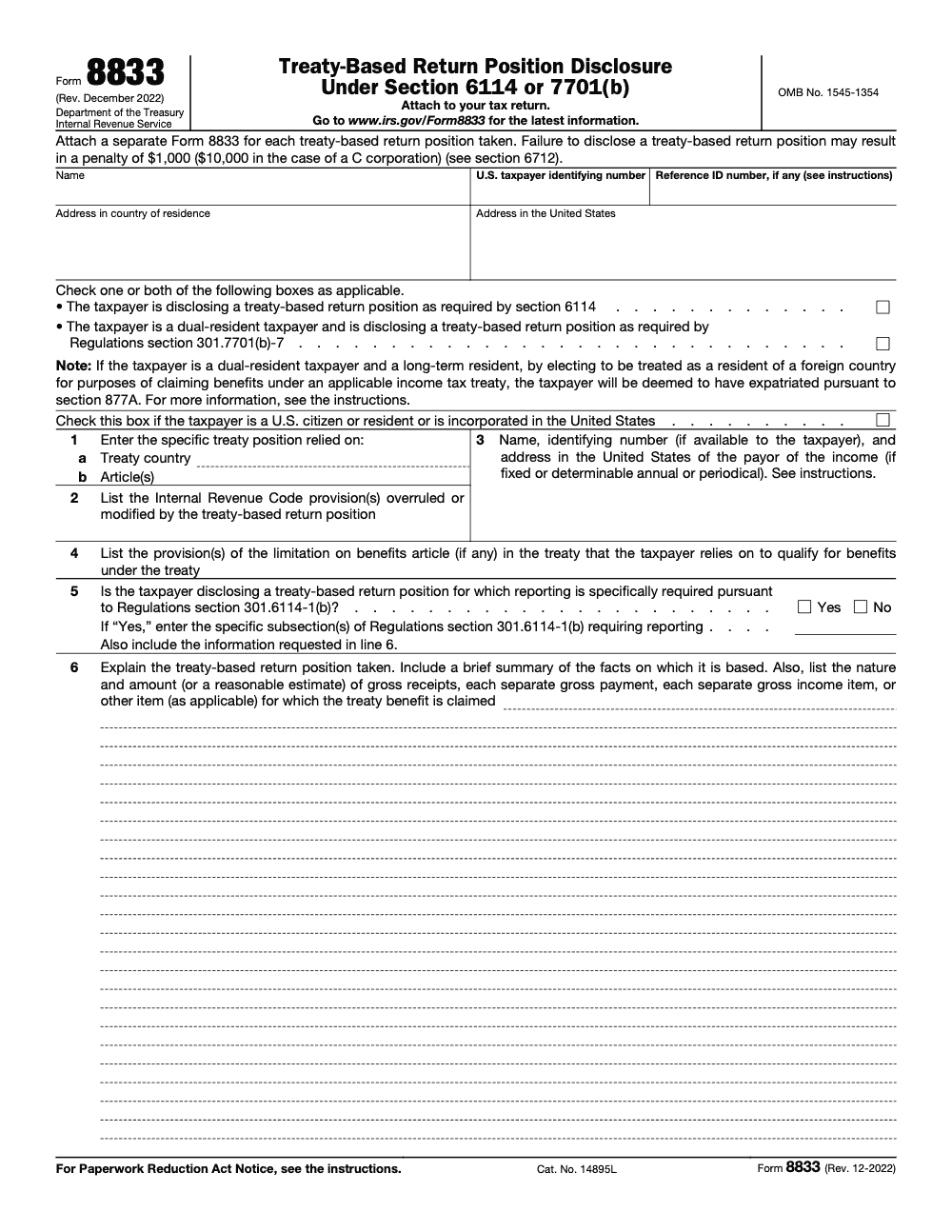
Form 8833 is the treaty-based return position disclosure required by Internal Revenue Code Section 6114 and Regulations section 301.6114-1, attached to a U.S. return such as Form 1040-NR or Form 1120-F. Per the Form 8833 Instructions (Rev. December 2022), Section 6712 penalizes failure to disclose at $1,000 per failure for most filers and $10,000 per failure for a C corporation, and a separate Form 8833 is required for each distinct treaty position taken.
A long-term resident triggers a treaty tie-breaker on one return, claims a re-sourced royalty on another position, and suddenly two distinct treaty positions each need their own Form 8833. That is the part that catches teams: the form attaches to a return such as Form 1040-NR or Form 1120-F, but a separate disclosure is required for every distinct position under IRC Section 6114 and Regulations section 301.6114-1.
Skip a required disclosure and Section 6712 sets the penalty at $1,000 per failure for most filers and $10,000 per failure for a C corporation. There are exceptions, including a small-amounts rule and certain pensions and reduced-withholding claims, so the workflow that earns its keep is the one that catches the trigger before the file reaches a senior reviewer.


Key Takeaways
- Form 8833 discloses a treaty‑based return position that overrides or modifies the Internal Revenue Code and reduces, or could reduce, U.S. tax. Filing satisfies Section 6114 and, for dual‑resident individuals, Reg. §301.7701(b)‑7.
- File a separate Form 8833 for each position and year, attach it to the timely return, or file it stand‑alone if no return is otherwise required.
- Common triggers include treaty tie‑breaker residency, exemptions or re‑sourcing for wages, dividends, interest, royalties, capital gains, and certain treaty‑based foreign tax credits.
- Exceptions apply, including reduced withholding claims, certain pensions and Social Security, students and teachers, entity‑level reporting, and a small amounts rule set at $10,000. Always confirm the current instructions.
- The penalty for missing a required Form 8833 is generally $1,000 per failure for individuals, and $10,000 for C corporations. Reasonable cause may waive it.
What Form 8833 Is and How It Works
Form 8833 is your disclosure to the IRS that a U.S. treaty (most commonly an income tax treaty, but also an estate-and-gift treaty or a friendship, commerce, and navigation treaty when it reduces U.S. tax) changes the default Code outcome for this taxpayer. On the form, you state the treaty country, the exact article, the Internal Revenue Code section affected, the income type and amount, and a short factual explanation. That single page connects the dots for an examiner and proves you took a transparent, well‑supported position.
For dual‑resident individuals who claim nonresident status under a treaty tie‑breaker, Reg. §301.7701(b)‑7 requires a fully completed Form 8833. In many cases, that person files Form 1040‑NR and attaches 8833 for the year they rely on treaty residence.
If the taxpayer would not otherwise file a U.S. return, the regulations still require filing to make the disclosure. In practice, you file Form 8833 at the IRS campus where the return would have been filed for that year. This keeps the statute and the file in order.
Why Some U.S. Expats and Cross‑Border Clients Must File Form 8833
Any time your position says, the treaty changes what the Code would do, and that change reduces current or potential U.S. tax, Form 8833 is likely required. Typical facts include asserting nonresident status as a dual‑resident, exempting specific income under article provisions, re‑sourcing income so it is foreign, or taking a treaty‑based foreign tax credit that would otherwise fail under the Code.
Remember, reportability is broad. A position can be reportable even if the current year tax is unchanged, for example when a treaty position generates an NOL that affects other years. The reporting obligation looks at any tax reduction at any time, not only the current year.
How Treaties Reduce Double Taxation, In Practice
You apply treaty articles that allocate taxing rights by income type, for example dividends, interest, royalties, business profits, employment, and pensions. Some benefits apply at source through withholding certificates, while others change residency or sourcing and must be disclosed on Form 8833. When an article overrides the Code, you disclose. If it only changes withholding and falls within an exception, you usually do not. Publication 519 lists the key exceptions, including the 10,000 small amounts rule.
Reader Snapshot
- You advise expats, founders, or remote employees with multi‑country facts.
- You manage returns where treaty residence flips filing status.
- You want a short, reliable playbook to keep penalties out of the file and partner time out of review loops.
From experience, the fastest reviews come from tight workpapers, clear treaty citations, and a one‑paragraph narrative that reads like it was written for a smart non‑specialist. That is what Form 8833 was built for.
Do You Need Form 8833 If You Live In A Treaty Country?
Living in a treaty country does not trigger Form 8833 by itself. The trigger is your treaty‑based return position. If you claim treaty residence as a dual‑resident under a tie‑breaker, you disclose. If you claim an article that exempts or re‑sources income and reduces U.S. tax, you disclose. If your fact pattern fits a listed exception, you may not file Form 8833. Always check the current instructions and Pub. 519 language before you decide.
Treaty Residence vs Filing Mechanics
When a dual‑resident individual claims treaty residence in the other country, Reg. §301.7701(b)‑7 generally treats them as a nonresident for computing U.S. income tax, and they file Form 1040‑NR with a fully completed Form 8833 attached. The tiebreaker election only affects the income-tax computation: the individual remains a U.S. resident for FBAR, information-return, and other non-income-tax federal obligations. That is the clean way to memorialize the position and prevent mismatches.
When Form 8833 Is Required
Here are common scenarios that usually require disclosure under §6114, beyond the obvious tie‑breaker claim:
- You exempt or re‑source income under a treaty article, for example business profits without a U.S. PE, or certain gains tied to real property or permanent establishment rules.
- You rely on a treaty‑based foreign tax credit that would not be creditable under sections 901 or 903 without the treaty.
- You claim a nondiscrimination article to preclude an otherwise applicable Code rule.
If a return would not otherwise be required, you still file to make the disclosure.
Exceptions That Waive Filing
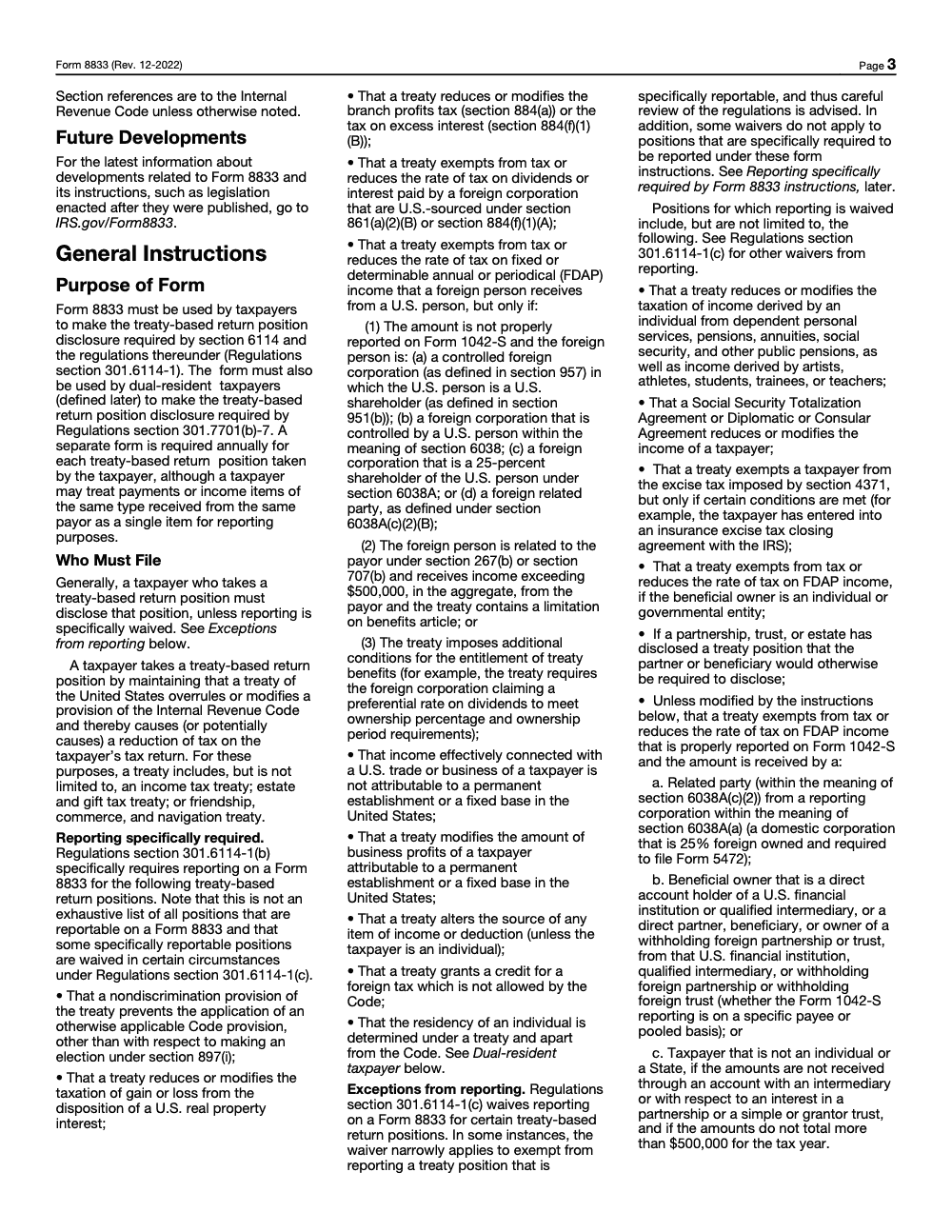
Publication 519 lists situations where you usually skip Form 8833, including:
- Reduced or exempt withholding on interest, dividends, rents, or royalties.
- Employment income of teachers, students, and trainees, and routine treatment of pensions, annuities, and Social Security.
- Positions reported by a partnership, trust, or estate at the entity level.
- Aggregated payments or income items that total no more than 10,000 for the year.
Note, exceptions are precise. Some items are still specifically reportable by regulation, and the Form 8833 instructions can carve out special cases. When in doubt, read the current Pub. 519 text and the regs before you check the box.
Exceptions, At A Glance
| Exception | What It Means In Practice |
| Withholding‑only benefits | Claimed to the payor with W‑8BEN, W‑8BEN‑E, or Form 8233. No Form 8833 if you do not override the Code on the return. |
| Routine categories | Teachers, students, trainees, certain pensions and Social Security, and some artists or athletes. Confirm the article and any savings clause detail. |
| Entity‑level reporting | Partnership, estate, or trust makes the disclosure on its return, so owners typically do not file their own 8833. |
| Small amounts rule | Total payments or income items otherwise subject to disclosure do not exceed 10,000 for the year. Keep proof. |
Who Must File and Typical Scenarios
You file Form 8833 with the federal return any time a treaty position overrides the Code and cuts U.S. tax now or later. That includes a dual‑resident tie‑breaker, treaty article exemptions, re‑sourcing income that would otherwise be effectively connected, or taking a treaty‑based credit. File a separate form for each position and each year.
- Selling a U.S. real property interest where the treaty assigns taxing rights differently than the Code.
- Claiming nonresident status under a tie‑breaker. You typically file 1040‑NR with Form 8833 attached.
- Using a treaty article to make a foreign tax credit valid when it would not be under sections 901 or 903, per the regs’ examples.
Clean disclosure buys peace of mind. A complete Form 8833 with tight facts and citations is often the difference between a quick pass and a drawn‑out IDR.
Documents And Details To Gather
Think like a reviewer. Pull together what proves eligibility and makes your narrative obvious:
- Identity and period. Name, SSN or ITIN, address, treaty residence country, and the tax year you are disclosing.
- Authority. Exact treaty citation, by article and paragraph, and the Internal Revenue Code section overridden, for example 871, 881, 7701(b), 862, or 884.
- Narrative. Who earned the income, where services were performed, dates, amounts, why the article applies, and how the savings clause and limitation on benefits are satisfied.
- Evidence. W‑2, 1042‑S, 1099s, contracts, residency certificate where relevant, foreign return or tax‑paid proof, and any LOB analysis. Keep your substantial presence computation in the file for tie‑breaker cases.
- Entity coordination. If a partnership or trust will disclose at the entity level, confirm that and keep copies.
Step‑By‑Step Filing Instructions
- Identify the precise treaty position and the Code section affected. Confirm that it really changes the default U.S. result.
- Draft a concise explanation. In 5 to 10 sentences, state the facts, the article, how it applies, and the income affected.
- Complete Form 8833. Include the treaty country, article and paragraph, overridden Code section, income type and amount, and your statement of facts.
- Attach proof. Include residency certificates, pay statements, Forms W‑8BEN or 8233 as relevant, and any LOB or savings‑clause analysis.
- File a separate Form 8833 for each position, every year you rely on it.
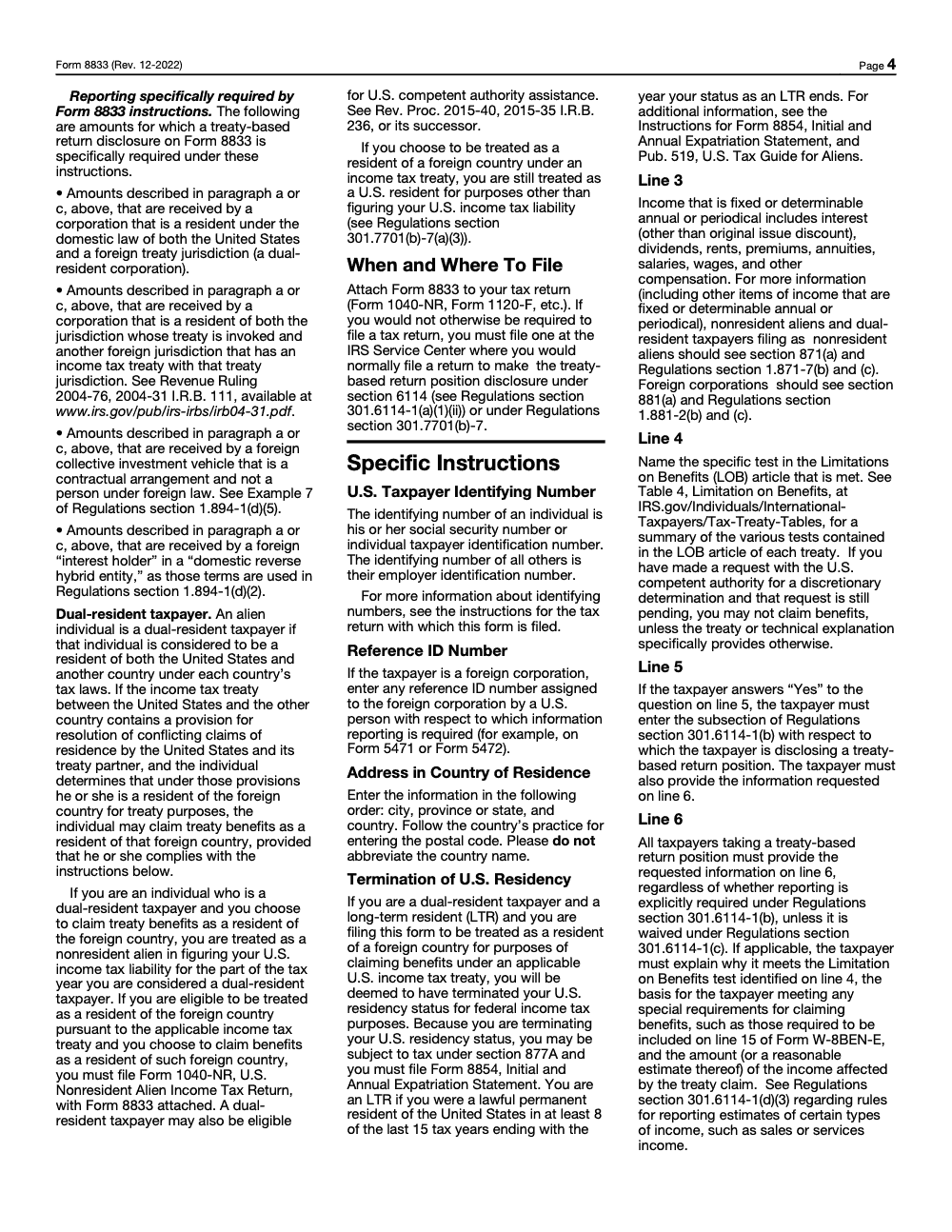
For dual‑resident individuals, file Form 1040‑NR and attach Form 8833 for the year you claim treaty residence under the tie‑breaker. That step aligns your status, income reporting, and disclosure. One warning: if the individual is also a long-term resident (a lawful permanent resident in at least 8 of the last 15 tax years), making this election is deemed expatriation under section 877A and triggers a Form 8854 filing requirement, plus potential mark-to-market exit tax.
Deadlines, Extensions, And E‑Filing
Treat the Form 8833 deadline as the same as the return it accompanies. If you are abroad and qualify for the June 15 automatic extension, or you extend to October 15 using Form 4868, Form 8833 follows that extended due date. If no return is otherwise required, the regulations still require you to file a Form 8833 by the date a return would have been due.
E‑filing is possible only if your software or provider can transmit the attachment. IRS Free File Fillable Forms, for example, does not allow attaching supplemental PDFs, so you would need to paper‑file in that channel. Professional suites vary, so verify attachment support early in the season.
As of December 3, 2025, the IRS Form 8833 page notes no special developments, and the form remains the vehicle for §6114 and §301.7701(b)‑7 disclosures. Always work off the current IRS page for the year you are filing.
Standard Filing Reminders
- Attach Form 8833 to the original return for the year the treaty position applies, or attach it to an amended return if you are correcting prior filings.
- Keep the workpapers that support your position, not just the form.
- If an e‑file path cannot carry Form 8833, plan ahead to mail a paper return on time.
Compliance note, time‑sensitive: These rules are current through December 24, 2025. For changes after that date, confirm the latest IRS pages, Publication 519, and the regulations before you file.
Common Mistakes And How To Avoid Them
Across the 8833 filings my team reviews each season, the same handful of errors show up – and most of them get caught only because someone slowed the review down to read the treaty article in full. Train the desk to spot these patterns before the file leaves preparer hands.
Penalties And How To Request A Waiver
If you miss a required Form 8833, the penalty is generally $1,000 per failure for individuals and $10,000 for C corporations, and the IRS can assert it even if there is no underpayment. Reasonable cause can waive all or part of the penalty. Cite the facts, show ordinary business care and prudence, and document how you corrected the issue promptly.
Waiver Steps That Work
- Prepare complete Forms 8833 for each year missed, assemble residency certificates, treaty excerpts, and a clear timeline of discovery and correction.
- Submit a dated reasonable cause statement with corroboration, for example engagement letters, correspondence, and medical or travel records if relevant.
- Respond by the notice deadline or include the statement with your amended filing.
- If denied, request Appeals. Keep copies of everything. The Internal Revenue Manual recognizes §6712 penalties and references the §6114 disclosure requirements that 8833 satisfies.
Practical Wrap‑Up
If your treaty position changes the default Code result, disclose it with a crisp Form 8833, attach your proof, and file on time. If an exception fits, document why and keep the citation in your workpapers. If you discover a miss, act quickly and present a reasoned waiver request with dates and support. That is how you keep notices away and reviews short.
Reusable Checklists
These are copy-paste ready for a firm SOP folder. Drop them into the workpaper template, keep the data-checklist ids as written or swap them for your engagement code, and the localStorage state will persist for the preparer through review.
Treaty Position Intake Packet
- Confirm the client's residency status under U.S. law and under the treaty partner's law (dual-resident or single-resident).
- Collect the treaty country name and the specific treaty article(s) the position relies on for Line 1a and Line 1b.
- List every Internal Revenue Code provision the treaty position overrules or modifies for Line 2.
- For FDAP positions, identify the payor (name, identifying number, U.S. address) for Line 3 and confirm whether a Form 1042-S was issued.
- If the treaty contains a limitation-on-benefits article, identify the specific LOB test the client meets for Line 4 (cross-reference IRS Tax Treaty Table 4).
- Run the green-card history check – flag any client with 8+ years of lawful permanent resident status in the last 15 tax years for the Section 877A and Form 8854 conversation.
- Confirm the position is not on the Regulations section 301.6114-1(c) waiver list before drafting Form 8833.
Form 8833 Lines 1 to 6 Reviewer Sweep
- Line 1a names the treaty country in full, with the country name spelled out and not abbreviated.
- Line 1b cites the specific treaty article(s) relied on, not a general treaty reference.
- Line 2 lists each Code section the treaty position overrides or modifies.
- Line 3 is populated for every FDAP position (payor name, identifying number, U.S. address); blank when the position is not FDAP.
- Line 4 names the limitation-on-benefits test met if the treaty has an LOB article.
- Line 5 cites the specific Regulations section 301.6114-1(b) subsection if answered Yes.
- Line 6 carries the position explanation, the factual summary, and the nature and amount (or reasonable estimate) of income claimed – required even when Line 5 is No.
- Foreign address block lists city, province or state, country in that order, with the country name spelled out per the form instructions.
Section 6712 Penalty Exposure Scan
- Confirm the entity type – $1,000 per failure for individuals and most filers, $10,000 per failure for C corporations.
- Count the distinct treaty-based positions taken on the return; each unfiled position is a separate failure under Section 6712.
- Check whether the position is on the specifically-required list at Regulations section 301.6114-1(b) or covered by a waiver at Regulations section 301.6114-1(c).
- For prior-year misses, prepare complete Forms 8833 for each missed year alongside a dated reasonable-cause statement.
- Document the timeline of discovery and correction – ordinary business care and prudence is the standard the IRS applies under the Internal Revenue Manual.
Keep 8833 Season From Stalling
Treaty-based return positions live on top of an already-heavy international return – a Form 1040-NR, a Form 1120-F, or a return filed solely to attach Form 8833 because no other U.S. filing obligation exists. Each position needs its own form, its own line-by-line completeness check, and its own reviewer pass against Regulations section 301.6114-1(b) and (c). When the cross-border queue grows, 8833 work is what gets rushed, and Section 6712 penalties of $1,000 per individual failure or $10,000 per C-corporation failure show up in IRS notices months later (per the December 2022 Form 8833 instructions and Section 6712 of the Internal Revenue Code).
The fix is structural, not more hours. Cross-border returns reward a desk that knows where to slow down (treaty article lookups, LOB tests, FDAP carve-outs) and where to keep moving (waiver-list checks, address formatting, schedule attachment). A documented intake plus a Lines 1 to 6 reviewer sweep takes the variability out of the work.
- Maintain a treaty-article reference library mapped to the client's residency country, with citations pulled from IRS Publication 901 and the relevant treaty technical explanations.
- Run a separate Form 8833 per position – only aggregate same-type income items from the same payor on a single form.
- Build Line 6 into the workpaper template as a required field, regardless of how Line 5 reads.
- Flag any green-card client with 8 or more years of lawful permanent resident status in the last 15 tax years for the Section 877A and Form 8854 review before a tiebreaker election is filed.
- Track FDAP positions through a Form 1042-S override checklist (dual-resident corporations, triangle-treaty corporations, contractual-arrangement foreign collective investment vehicles, domestic reverse hybrid interest holders) so the instructions never get missed.
Accountably's trained offshore desks slot into that structure with U.S.-led review and documented SOPs. Our taxation service handles the 8833 prep, the Lines 1 to 6 sweep, and the Section 6712 exposure scan inside your workflow, so senior reviewers see clean files instead of draft cleanup.
FAQs
To disclose a treaty‑based return position that overrides or modifies the Code and reduces, or could reduce, U.S. tax. It is the mechanism Section 6114 and Reg. §301.7701(b)‑7 tell you to use.
Form 8233 is given to the payor to claim a treaty withholding exemption as a nonresident beneficial owner of dependent personal services income. It affects withholding at source. It does not replace Form 8833 if a return‑level disclosure is required.
Identify the treaty country, article, and overridden Code section, list the income type and amounts, and write a concise explanation of facts and rationale. Attach proof and file one 8833 per position per year with a timely return, or file it stand‑alone if no return is otherwise required.
Common exceptions include reduced withholding claims, certain pensions and Social Security, teachers and students, entity‑level reporting, and the 10,000 small amounts rule. Review Pub. 519 for the full list before you decide.
Other forms this guide names
- Form 1040‑NR: Filing 2025, Nonresident Taxes Made Simple
- Form 8854: Guide to Expatriation and Exit Tax
- Form 8233: How to Reduce 30% U.S. Withholding With a Tax Treaty
- Form W-8BEN: Foreign Status Certificate Guide 2025
Summarize this article with AI
About this guide
Accountably helps US CPA, EA, and accounting firms hire trained accountants and tax preparers in India.
About us Reviewed byJugal Thacker, CPAFounder and CEO at Accountably
A Washington-licensed CPA with 7+ years inside US firms – PwC, a real-estate tax practice, then a full-service firm, rising from reviewer to manager to advisory. This article was reviewed against current IRS guidance for the 2025 tax year and updated for filers preparing late returns, amendments, and 2026 estimates.
View profile →How we research, review, and update this guide
Every Accountably guide is researched against primary IRS sources, reviewed by a U.S. CPA, and refreshed as guidance evolves. Read our Editorial Guidelines to see how we source, fact-check, and update our content.