Summarize this article with AI
In Brief
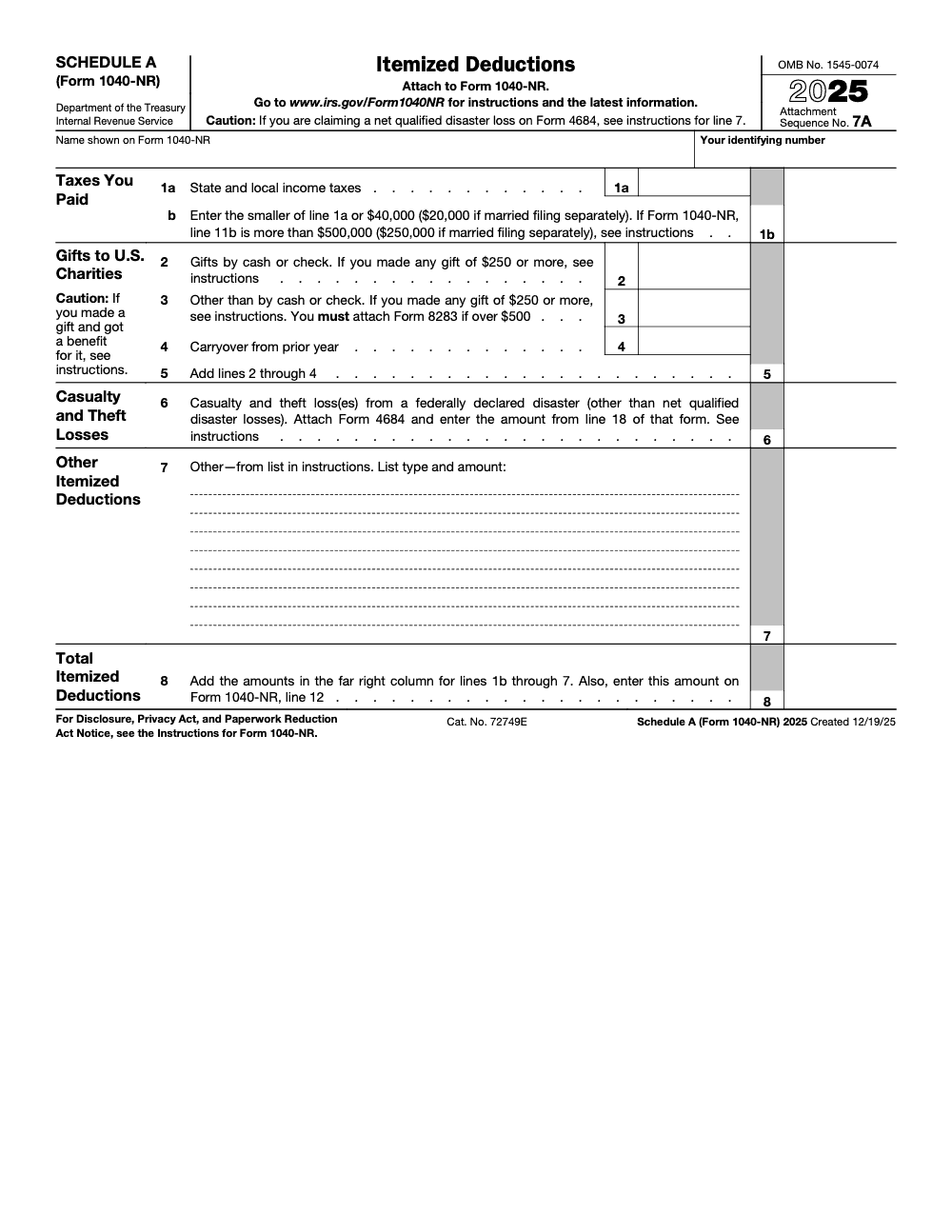
Schedule A (Form 1040-NR) is the itemized-deduction schedule for nonresident aliens – a narrower schedule than the resident Schedule A (Form 1040), with no medical, mortgage-interest, or property-tax lines (per the IRS Instructions for Schedule A (Form 1040-NR)). State and local income taxes go on line 1a under the 2025 SALT cap of $40,000 ($20,000 if married filing separately), gifts to U.S. charities run on lines 2 through 7, and the line 10 total carries to Form 1040-NR line 12. The return is due April 15, 2026 for nonresidents with wages subject to U.S. withholding and June 15, 2026 for those without, with Form 4868 extending the filing deadline to October 15, 2026.
New nonresident alien clients usually assume Schedule A works the way it does for their U.S. colleagues, but the nonresident version is a much narrower schedule. The standard deduction is generally off the table, with a narrow exception for certain residents of India under the U.S.-India treaty, and the resident lines for medical, mortgage interest, and property tax are gone entirely.
What is left is a short, focused list: state and local income taxes on line 1a under the 2025 SALT cap of $40,000, or $20,000 for married filing separately, and gifts to qualifying U.S. charities on lines 2 through 7. The line 10 total carries to Form 1040-NR line 12.
Key Takeaways
- Form 1040-NR Schedule A is the itemized deduction schedule used exclusively by nonresident alien individuals filing Form 1040-NR – it is not the same as the Schedule A used by U.S. citizens and resident aliens.
- Nonresident aliens cannot claim the standard deduction (with a narrow exception for certain residents of India covered by the U.S.-India tax treaty), so Schedule A itemization is the only path to reducing taxable income through personal deductions.
- The list of allowable deductions for nonresidents is significantly narrower than the resident Schedule A: primarily state and local income taxes, charitable contributions to qualifying U.S. organizations, and certain casualty and theft losses on ECI property.
- The SALT deduction limit ($40,000 cap, or $20,000 for married filing separately filers) applies to nonresidents on the same basis as residents, limiting the state income tax deduction for clients in high-tax states.
- Charitable contributions are only deductible if made to qualifying U.S. organizations – donations to foreign charities, even treaty-country organizations, do not qualify unless a specific treaty article provides otherwise.
- Quick SOP tip: always confirm the client’s country of residence and applicable treaty before determining deduction eligibility – treaty provisions can expand or modify the default nonresident rules in ways that significantly change the Schedule A outcome.
What Form 1040-NR (Schedule A) Is and When to Use It
Form 1040-NR Schedule A is attached to the main 1040-NR return when a nonresident alien individual elects to itemize deductions rather than take any available alternative. Because most nonresident aliens cannot claim the standard deduction (the standard deduction is reserved for U.S. citizens, resident aliens, and certain U.S. national filers), Schedule A itemization is typically the only mechanism available to reduce taxable effectively connected income (ECI) through personal deductions.
This form is not optional in the sense that a nonresident always gets a choice between standard and itemized. Rather: if the taxpayer has allowable itemized deductions that exceed what would otherwise be available (which for most nonresidents is zero, since no standard deduction applies), Schedule A reduces taxable ECI. If the taxpayer has no qualifying deductions – no U.S. state income tax paid, no U.S. charitable contributions, no ECI-related casualty losses – they file with zero deductions and compute tax on gross ECI.
The form is used only for effectively connected income. Nonresident alien income that is not ECI – fixed or determinable annual or periodic income (FDAP) such as dividends, interest, and royalties taxed at flat Chapter 3 rates – is not subject to the itemized deduction calculation. That income is taxed on the gross amount at the applicable withholding rate (often 30%, reduced by treaty), and no deductions apply against it.
Who needs to think about Schedule A: nonresident aliens who work in the U.S. and pay state income tax, nonresident alien sole proprietors or partners with ECI who have donated to U.S. charities, nonresidents who suffered a casualty loss on U.S. property used in a trade or business, and clients from treaty countries whose treaties permit deductions not otherwise available.
The Standard Deduction Exception for India Residents
Article 21(2) of the U.S.-India income tax treaty provides that residents of India who are students or business apprentices in the U.S. may claim the standard deduction under the same conditions as a U.S. resident. This is one of the very few treaty provisions that expands a deduction right for nonresidents. In practice, this means an F-1 or J-1 student from India may elect the standard deduction on their 1040-NR if it is more favorable than their itemized deductions, so long as the student is not married filing separately with a spouse who itemizes (in which case the standard deduction is unavailable). This election must be disclosed by attaching a statement to the return referencing the treaty article. Failing to disclose a treaty position on Form 8833 when required can result in a $1,000 penalty.
How to Complete Form 1040-NR (Schedule A)
Schedule A for nonresidents is structured differently from the resident version. It is organized into deduction categories, and each category has specific sourcing and eligibility rules that differ from what a resident filer would encounter. I walk through each part below with the practitioner notes I use in our workpapers.
Part I – Deductions Connected with Income Effectively Connected with a U.S. Trade or Business
These are the deductions that reduce ECI – the income taxed at graduated rates on the 1040-NR. The categories allowed are:
| Deduction Category | Allowable for Nonresidents? | Key Limitation |
|---|---|---|
| State and local income taxes only (nonresident aliens cannot elect general sales taxes in lieu of income tax, unlike Schedule A (Form 1040)) | Yes – if connected to ECI-generating activity | Subject to the 2025 SALT cap of $40,000 ($20,000 for married filing separately) |
| Real property taxes | No – not deductible on Schedule A (Form 1040-NR) | Schedule A (Form 1040-NR) line 1a allows only state and local income taxes; property taxes on ECI-generating rental property are deducted on Schedule E, not Schedule A |
| Home mortgage interest | No | Schedule A (Form 1040-NR) has no home-mortgage-interest line; interest on a U.S. rental property that produces effectively connected income is deducted on Schedule E, not Schedule A |
| Investment interest expense | Yes – on U.S.-source investment income | Limited to net investment income (same limitation as residents); Form 4952 applies |
| Charitable contributions | Yes – to U.S. qualifying organizations only | Contributions to foreign charities do not qualify; noncash contribution rules apply |
| Casualty and theft losses | Yes – on property used in U.S. trade or business | Personal casualty losses (on non-ECI property) are not deductible; federally declared disaster area losses may qualify |
| Medical expenses | No | Not available to nonresident aliens |
| Student loan interest | No | Not available to nonresident aliens (above-the-line deduction, not on Schedule A, but also excluded) |
| Miscellaneous itemized deductions subject to 2% floor | No | Suspended through 2025 under TCJA and not available to nonresidents even pre-suspension |
State and Local Tax (SALT) Deduction
The most common deduction on the nonresident Schedule A is state and local income tax paid on ECI. A nonresident alien working in a state with an income tax – New York, California, Massachusetts, New Jersey – typically pays state income tax on the portion of compensation attributable to work performed in that state. That state tax payment is deductible on Schedule A, subject to the 2025 SALT cap of $40,000 ($20,000 for married filing separately) for single nonresident filers (nonresident aliens who are married may not file jointly and are treated as single or married filing separately for SALT cap purposes).
The allocation question matters here. If a nonresident worked in multiple states during the year or performed some work outside the U.S., the state taxes paid must be allocated to the portion of income that qualifies as ECI. Only the state taxes attributable to ECI-generating activity are deductible on Schedule A. State taxes attributable to foreign-source income are not deductible because foreign-source income is not included in ECI on the 1040-NR.
Charitable Contributions
Nonresident aliens may deduct charitable contributions made to U.S. qualifying organizations under IRC §170. The same percentage-of-AGI limitations that apply to residents apply here, calculated as a percentage of the nonresident’s ECI-based adjusted gross income. Contributions must be: (a) in cash or qualifying property, (b) made to organizations described in IRC §170(c) (U.S. entities), and (c) properly substantiated with written acknowledgment for contributions of $250 or more.
The treaty exception: some treaties – notably the U.S.-Canada treaty – allow deductions for contributions to Canadian charities to the extent the taxpayer has Canadian-source income included in U.S. gross income. A client with both Canadian and U.S. income may be able to deduct Canadian charitable contributions up to 75% of their Canadian-source ECI. These treaty-based deductions require a Form 8833 disclosure.
Casualty and Theft Losses
A nonresident alien may deduct casualty and theft losses on property used in a U.S. trade or business that generates ECI. The loss must be sudden, unexpected, or unusual – the standard casualty loss definition under IRC §165. Personal casualty losses (on a residence or personal-use property) are generally not deductible for nonresidents unless the loss occurs in a federally declared disaster area and the property is located in the U.S. The Form 4684 calculation applies: total loss minus any insurance reimbursement, minus the $100 floor per event, limited to 10% of AGI for personal casualty losses in disaster areas.
Deadlines, Penalties, and Filing Requirements
Schedule A is part of the Form 1040-NR return and shares the same due date. There is no separate filing deadline for the schedule itself. The 1040-NR return – and therefore Schedule A – is due based on whether the nonresident alien has U.S.-source wage income subject to withholding or not.
Form 1040-NR Filing Deadlines
| Situation | Due Date | Extension Available? |
|---|---|---|
| Wages subject to U.S. withholding (W-2 recipient) | April 15 (calendar-year filers) | Yes – Form 4868 extends to October 15; extension is automatic for 6 months |
| No wages subject to withholding (self-employed, ECI from business) | June 15 (calendar-year filers) | Yes – Form 4868 extends to October 15 |
| Out of the country on April 15 | June 15 automatic extension (no form required for wage earners outside the U.S.) | Additional extension available; attach statement claiming the automatic 2-month extension |
| Fiscal-year nonresident alien | 15th day of 4th month after tax year end | Form 4868 extends 6 months |
Penalty for Late Filing vs. Late Payment
The failure-to-file penalty is 5% per month (or partial month) of unpaid tax, maximum 25%. The failure-to-pay penalty is 0.5% per month, maximum 25%. When both apply, the failure-to-file penalty is reduced by the failure-to-pay rate so the combined maximum does not exceed 5% per month. An extension to file does not extend the time to pay – the client must estimate the tax liability and pay by the original due date to avoid the failure-to-pay penalty accruing during the extension period.
Late Election to Itemize
A nonresident who filed a 1040-NR without attaching Schedule A and wishes to amend to add itemized deductions must file Form 1040-X (or a superseding return if still within the filing period). The three-year statute of limitations on refund claims applies. I have seen clients leave significant state income tax deductions on the table by not realizing Schedule A was available in their original year. The amendment process is straightforward but time-sensitive – document the deductions carefully and file before the three-year window closes.
Treaty Modifications to Schedule A Deductions
Tax treaties do not simply reduce withholding rates – several treaties modify the deduction rules that would otherwise apply to nonresident aliens in ways that are material to the Schedule A analysis. The most significant treaty provisions I encounter regularly:
U.S.-Canada Treaty
Article XXI of the U.S.-Canada treaty allows Canadian residents with ECI to deduct charitable contributions to Canadian charitable organizations, limited to 75% of their Canadian-source income included in U.S. gross income. It also allows deductions for state and local taxes on a basis more comparable to a U.S. resident. Canadian treaty clients frequently have more deductions available than a straightforward reading of the 1040-NR instructions would suggest.
U.S.-India Treaty
As noted earlier, Article 21(2) permits Indian students and business apprentices to claim the U.S. standard deduction instead of itemizing. This is particularly valuable for F-1 students from India who have minimal itemized deductions – the 2025 standard deduction of $15,750 for single filers is almost always larger than whatever state taxes and charitable contributions such a client might have. The Form 8833 disclosure and Schedule OI (Form 1040-NR), citing U.S.-India treaty Article 21(2), are both mandatory when claiming this benefit.
Other Treaty Provisions
Several other treaties (notably those with Germany, France, and the Netherlands) contain nondiscrimination clauses that arguably require the U.S. to allow treaty-country nationals to deduct items on the same basis as U.S. citizens in comparable situations. These nondiscrimination arguments are complex, not uniformly accepted by the IRS, and require careful technical analysis before claiming. When a client asks whether a specific deduction should be available based on their treaty country, my default is to research the specific treaty article, not to assume the default nonresident rules govern.
Effectively Connected Income – The Deduction Connection
The concept of effectively connected income drives almost every aspect of Form 1040-NR, including Schedule A. Only deductions that are “connected” to ECI are deductible on Schedule A. The IRS uses two tests to determine whether income is effectively connected: the asset-use test and the business-activities test.
For practitioners, the practical consequence is that a nonresident alien with both ECI and FDAP income must allocate deductions between the two categories. Only the portion of state taxes, investment interest, and other deductions attributable to ECI generation is deductible on Schedule A. Deductions allocated against FDAP income produce no benefit because FDAP is taxed on the gross amount at a flat rate – there are no deductions against it.
Deduction Allocation When Income Is Mixed
The allocation rules come from Treas. Reg. §1.861-8 and related regulations. For practitioners who do not specialize in international tax, the simplified approach I use: allocate state income taxes based on the ratio of ECI to total income; allocate investment interest based on assets generating ECI versus assets generating non-ECI income; and document the allocation methodology in the workpapers. If the allocation methodology is challenged on audit, a well-documented workpaper showing the rationale and calculation is far more defensible than an undocumented estimate.
The Net Rental Income Election and Schedule A
One of the more interesting intersections between ECI and Schedule A involves U.S. rental income. By default, rental income received by a nonresident alien from U.S. real property is treated as FDAP and taxed at 30% on the gross amount – no deductions allowed. However, the nonresident can make an election under IRC §871(d) to treat all income from U.S. real property as ECI. Once that election is made, the rental income is taxed at graduated rates after deductions, and state property taxes, mortgage interest (if the property is the business property), and maintenance costs become deductible. This election is irrevocable once made and applies to all U.S. real property. The first year the election is made, the client deducts the now-available property taxes and other rental expenses on Schedule E, not Schedule A, because Schedule A (Form 1040-NR) line 1a allows only state and local income taxes.
Common Mistakes That Slow Things Down
From my side of the desk, the errors that cost nonresident clients the most come from treating Schedule A (Form 1040-NR) like the resident version and from carrying stale numbers into the current year. Here are the ones my team flags most often.
Practical Checklists You Can Reuse
These are copy-paste ready for your firm SOPs. Drop them into your workpaper template and check items off as you clear them.
Schedule A (Form 1040-NR) intake packet
- Confirm the client files Form 1040-NR, not Form 1040, for the year.
- Record the country of residence and whether a U.S. income tax treaty applies.
- Collect W-2s and state statements showing 2025 state income tax withheld.
- Gather 2025 state estimated payments and any 2024 state balance paid in 2025.
- Collect written acknowledgments for cash gifts of $250 or more to U.S. charities.
- Gather Form 8283 support for noncash gifts over $500 to U.S. charities.
- Note any federally declared disaster loss on income-producing U.S. property.
Line-by-line deduction review
- Line 1a: enter only state and local income taxes tied to effectively connected income.
- Line 1b: apply the 2025 SALT cap of $40,000, or $20,000 for married filing separately.
- Lines 2 through 4: enter cash gifts, noncash gifts, and prior-year charitable carryover.
- Line 7: hold cash gifts to 60% of AGI and capital-gain property to 30% of AGI.
- Line 8: report federally declared disaster losses on Form 4684, after the $100 floor and 10% of AGI.
- Line 9: limit gambling losses to gambling winnings and exclude suspended 2%-floor items.
- Line 10: tie the total to Form 1040-NR line 12.
Treaty and deadline check
- Identify the specific treaty article before claiming any treaty-based deduction.
- For India students or business apprentices, compare the $15,750 standard deduction against the itemized total.
- Attach Schedule OI (Form 1040-NR) for every treaty position taken.
- Confirm the deadline: April 15, 2026 with U.S. wage withholding, June 15, 2026 without.
- If extending, file Form 4868 and pay the estimated balance by the original due date.
Keep Schedule A (Form 1040-NR) Season From Stalling
Schedule A (Form 1040-NR) work clusters around two pressure points the resident calendar does not share. The return carries a split due date – April 15, 2026 for nonresidents with U.S. wage withholding and June 15, 2026 for those without, per the IRS Instructions for Schedule A (Form 1040-NR) – so a firm can still be closing nonresident returns two months after the rest of its individual book is done. On top of that, the One Big Beautiful Bill Act reset the 2025 SALT cap to $40,000 (as published in IRS Publication 17), so any line 1a deduction built against the old $10,000 figure has to be reworked.
The answer is not more hours in April. It is a standardized intake and review path that treats the nonresident return as its own workflow, with treaty research and effectively connected income allocation handled before the deadline crunch rather than during it.
- Route every return through a country-of-residence and treaty check before any deduction hits line 1a, so India Article 21(2) and Canada charitable provisions are caught early.
- Standardize the line 1a SALT workpaper to the current $40,000 cap and document which state payments trace to effectively connected income.
- Build a Schedule OI (Form 1040-NR) trigger into review so no treaty position ships without its required disclosure.
- Run April 15 and June 15 filers on separate work queues so wage and non-wage returns are not managed on one calendar.
- Reconcile the line 10 total to Form 1040-NR line 12 as a final-review gate before sign-off.
This is the structured, reviewable execution we build at Accountably. Our U.S.-led tax preparation teams run nonresident returns through documented SOPs and multi-layer review, so the treaty analysis and SALT rework stay inside a defined process instead of landing on your senior reviewers during peak weeks.
FAQs
Generally no. The standard deduction is not available to nonresident alien individuals filing Form 1040-NR. The one exception applies to residents of India who qualify as students or business apprentices under Article 21(2) of the U.S.-India tax treaty – those individuals may elect to claim the standard deduction if it is larger than their itemized deductions. This treaty position must be disclosed by attaching Schedule OI (Form 1040-NR) citing U.S.-India treaty Article 21(2). Omitting Schedule OI invalidates the treaty claim.
Nonresident aliens may deduct: (1) state and local income taxes paid on effectively connected income, subject to the 2025 SALT cap of $40,000 ($20,000 for married filing separately); (2) charitable contributions to qualifying U.S. organizations under IRC §170(c); (3) investment interest expense on U.S.-source investments (limited to net investment income); (4) casualty and theft losses on property connected to a U.S. trade or business; and certain treaty-expanded deductions depending on the client’s country of residence. Medical expenses, mortgage interest on personal residences, and most other Schedule A categories available to residents are not available to nonresidents.
No, not under general U.S. tax law. Charitable contributions must be made to U.S. qualifying organizations described in IRC §170(c) to be deductible. However, certain tax treaties – particularly the U.S.-Canada treaty – allow deductions for contributions to treaty-country charities up to a specified percentage of treaty-country-source income included in U.S. gross income. If the client’s treaty country has such a provision, document it and disclose it on Form 8833.
Yes. For 2025 the One Big Beautiful Bill Act sets the state and local income tax (SALT) cap at $40,000 ($20,000 for married filing separately), and this limit applies to nonresident alien filers on the same basis as it applies to resident filers who are single or married filing separately. Since nonresident aliens cannot file jointly, the $40,000 cap ($20,000 if married filing separately) is the effective maximum regardless of the actual state taxes paid. For clients in New York or California with significant ECI, this limitation is often the binding constraint on the total Schedule A deduction.
The client can file an amended return using Form 1040-X to add Schedule A and claim the missed deductions. The statute of limitations for a refund claim is three years from the original due date of the return (including extensions) or two years from the date the tax was paid, whichever is later. After that window closes, the deductions are permanently lost. I recommend reviewing prior-year returns for any new nonresident alien client specifically looking for unclaimed state tax or charitable deductions.
Only in limited circumstances. Residential mortgage interest on a personal residence is generally not deductible for nonresident aliens. Schedule A (Form 1040-NR) has no home-mortgage-interest line, so mortgage interest is never claimed there. A nonresident who owns a U.S. rental property and has made the IRC §871(d) election to treat rental income as ECI deducts the mortgage interest on that property on Schedule E, not Schedule A. The personal home mortgage interest deduction that resident Schedule A filers commonly claim is not available to nonresidents.
Other forms this guide names
- Form 1040‑NR: Filing 2025, Nonresident Taxes Made Simple
- Form 4868: IRS Tax Extension 2025 Guide to Filing
- Form 8833: Filing Requirements, Exceptions, and Penalties
- Form 1040: Filing Guide for 2025 Returns (AGI, Deductions, Deadlines)
- Form W‑2: Deadlines, E‑File Rules, Boxes, and W‑2c Corrections
- Form 1040‑X: How to Amend Your Tax Return in 2025
Summarize this article with AI
About this guide
Accountably helps US CPA, EA, and accounting firms hire trained accountants and tax preparers in India.
About us Reviewed byJugal Thacker, CPAFounder and CEO at Accountably
A Washington-licensed CPA with 7+ years inside US firms – PwC, a real-estate tax practice, then a full-service firm, rising from reviewer to manager to advisory. This article was reviewed against current IRS guidance for the 2025 tax year and updated for filers preparing late returns, amendments, and 2026 estimates.
View profile →How we research, review, and update this guide
Every Accountably guide is researched against primary IRS sources, reviewed by a U.S. CPA, and refreshed as guidance evolves. Read our Editorial Guidelines to see how we source, fact-check, and update our content.