Due dates
Summarize this article with AI
In Brief
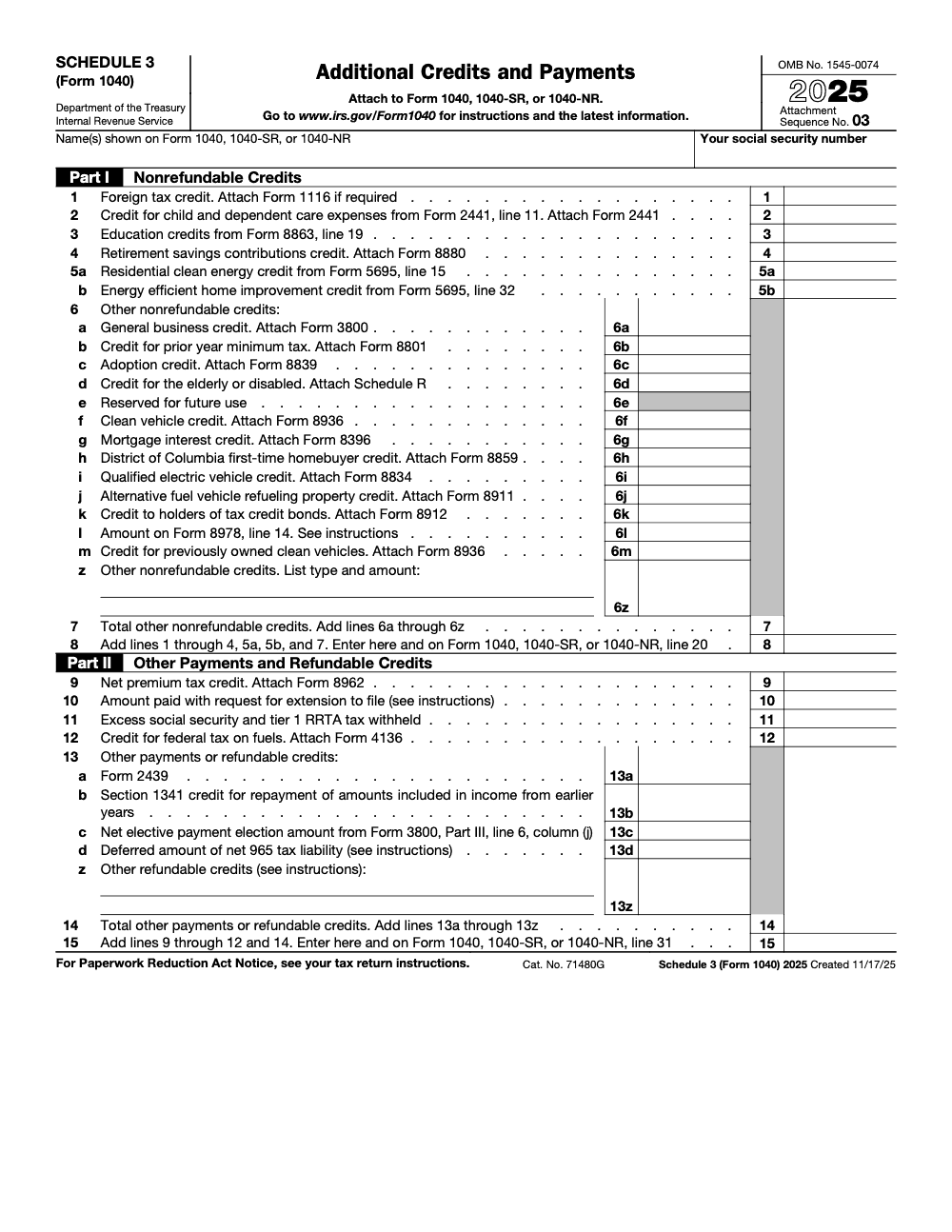
Schedule 3 (Form 1040) reports additional credits and payments that do not appear on the face of the return. Part I nonrefundable credits total on Line 8 and flow to Form 1040 line 20; Part II refundable credits and other payments total on Line 15 and flow to Form 1040 line 31 (per the 2025 Schedule 3 instructions). For 2025 returns it is filed with Form 1040 by April 15, 2026, and Form 4868 extends the filing deadline to October 15, 2026.
A client worked for more than one employer in the first half of the year, each employer withheld the full Social Security tax, and nobody compared the combined wages against the annual wage base. That excess is a credit on line 11 of Schedule 3, and it is missed in dual-employer situations.
Not everyone needs Schedule 3; it is only required if the taxpayer claims one or more of the credits or payments on it. Part I nonrefundable credits total on line 8 and flow to Form 1040 line 20, and Part II refundable credits and other payments total on line 15 and flow to line 31; for 2025 returns it goes with Form 1040 by April 15, 2026, or October 15, 2026 with Form 4868.
Key Takeaways
- Schedule 3 is a supplemental schedule attached to Form 1040 that captures additional tax credits and other payments not included on the main 1040 form itself.
- Not everyone needs Schedule 3 – it is only required if the taxpayer claims one or more of the credits or payments listed on the form. If none apply, the schedule is not filed.
- Part I (Lines 1–8) captures nonrefundable credits including the foreign tax credit, education credits, child and dependent care credit (from Form 2441), retirement savings credit, residential clean energy credit, and the general business credit.
- Part II (Lines 9–15) captures other payments and refundable credits including net premium tax credit, amount paid with extension, excess Social Security tax withheld, credit from Form 2439, and other payments.
- Key pitfall: Excess Social Security tax withheld (Line 11) is missed in dual-employer situations. Verify the aggregate Social Security wages on all W-2s against the annual wage base.
- SOP tip: Build a Schedule 3 checklist into your 1040 intake questionnaire, specifically asking about multiple employers (excess SS), ACA marketplace insurance (premium tax credit), and any estimated tax payments – these three items account for the majority of Schedule 3 entries.
What Schedule 3 Is and When to Use It
Schedule 3 is titled “Additional Credits and Payments.” It was created as part of the 2018 Form 1040 redesign that separated various credits and payments from the main return into supplemental schedules. The result is that the core Form 1040 is shorter, but the full picture of a taxpayer’s credits and payments is distributed across Schedules 1, 2, 3, and additional supporting forms.
Schedule 3 serves as the funnel for credits and payments that, after computation on their own supporting forms, flow into a single line on the main 1040. Line 20 of Form 1040 captures the total from Schedule 3, Part I (nonrefundable credits). Line 31 captures the total from Part II (other payments and refundable credits). This aggregation means that errors or omissions on Schedule 3 affect two separate lines on the 1040.
Who Files Schedule 3
A taxpayer files Schedule 3 whenever they claim any of the credits listed in Part I or have any of the payments or credits listed in Part II. If none apply, the schedule is simply not attached. Common taxpayers who file Schedule 3 include those who paid foreign taxes and claim the foreign tax credit, students or parents claiming education credits, contributors to retirement accounts who claim the Saver’s Credit, ACA marketplace enrollees who paid subsidized premiums, taxpayers with multiple employers who over-withheld Social Security tax, and those who purchased qualifying electric vehicles.
Relationship to Supporting Forms
Most entries on Schedule 3 are derived from a separate form. The foreign tax credit comes from Form 1116. Education credits come from Form 8863. Child and dependent care credit comes from Form 2441. The residential clean energy credit comes from Form 5695. The general business credit comes from Form 3800. Understanding which supporting form populates each Schedule 3 line is the key to efficient preparation – you complete the supporting form, then the result flows to Schedule 3.
How to Complete Schedule 3, Line by Line
Part I – Nonrefundable Credits
| Line | Credit | Supporting Form | Key Note |
|---|---|---|---|
| 1 | Foreign tax credit | Form 1116 (or claimed directly if ≤ $300/$600) | Taxes paid to foreign governments on foreign income; nonrefundable |
| 2 | Child and dependent care expenses | Form 2441 | Credit for care expenses enabling the taxpayer to work or look for work |
| 3 | Education credits | Form 8863 | American Opportunity Credit (only the nonrefundable portion flows to Line 3; the refundable 40%, up to $1,000, is claimed on Form 1040 line 29, not Schedule 3) and Lifetime Learning Credit |
| 4 | Retirement savings contributions credit | Form 8880 | Saver’s Credit; available to lower-income taxpayers contributing to retirement accounts, but denied to full-time students, anyone claimed as a dependent, and filers under age 18 |
| 5a | Residential clean energy credit | Form 5695, Part I | Solar panels, wind, geothermal – 30% of qualified property costs |
| 5b | Energy efficient home improvement credit | Form 5695, Part II | Windows, insulation, HVAC, heat pumps – up to $1,200 per year for most items; nonrefundable with no carryforward of any unused amount, unlike the Line 5a residential clean energy credit, which does carry forward |
| 6a | General business credit | Form 3800 | Aggregates business credits such as R&D, work opportunity, and low-income housing |
| 6b | Credit for prior year minimum tax | Form 8801 | Minimum tax credit for AMT paid in a prior year, attributable to deferral items |
| 6j | Alternative fuel vehicle refueling property credit | Form 8911 | Home or business EV charging infrastructure |
| 7 | Total other nonrefundable credits | Subtotal | Add lines 6a through 6z |
| 8 | Total nonrefundable credits | Total | Add lines 1 through 4, 5a, 5b, and 7; flows to Form 1040 line 20 |
Part II – Other Payments and Refundable Credits
| Line | Item | Note |
|---|---|---|
| 9 | Net premium tax credit | Form 8962; ACA marketplace subsidy reconciliation; Line 9 reports only the net premium tax credit (when the allowed PTC exceeds advance PTC). Excess advance PTC that must be repaid is not entered here as a negative; it goes on Schedule 2 line 1a as additional tax |
| 10 | Amount paid with extension request | Tax paid with Form 4868; reduces balance due on the return |
| 11 | Excess Social Security tax withheld | Amount withheld over the annual SS wage base by multiple employers; fully refundable |
| 12 | Credit for federal tax on fuels | Form 4136; covers specific nontaxable business uses of fuel such as off-highway business use, farming, and certain buses. Form 2439 amounts belong on Line 13a, not here |
| 13a–13z | Other payments and refundable credits | Form 2439 undistributed capital gains (13a), Section 1341 claim-of-right credit (13b), net elective payment election (13c), deferred net 965 tax liability (13d), and other refundable credits (13z) |
| 15 | Total other payments and refundable credits | Sum of lines 9–14; carries to Form 1040 line 31 |
Deadlines, Penalties, and Filing Requirements
Schedule 3 is filed with Form 1040 and has no separate deadline. It is due when the 1040 is due.
| Event | Due Date | Notes |
|---|---|---|
| Form 1040 with Schedule 3 | April 15 | Extension to October 15 via Form 4868 (extension to file, not to pay; interest and a 0.5% per month failure-to-pay penalty still accrue on any unpaid balance from April 15) |
| Net premium tax credit repayment | Due with the return | If PTC was overpaid (too high subsidy during the year), the excess advance PTC is repaid on Schedule 2 line 1a as additional tax, not as a negative amount on Schedule 3 Line 9 |
Premium Tax Credit Reconciliation
The ACA premium tax credit is unique in that it is typically paid in advance to the insurance marketplace throughout the year (advance PTC). At tax time, the actual credit based on income is reconciled against the advance PTC paid. If actual income was higher than estimated, the taxpayer may owe back some or all of the advance PTC. This repayment is computed on Form 8962 and reported directly on Schedule 2 line 1a (as an additional tax) rather than as a credit on Schedule 3 Line 9. Getting this reconciliation wrong is one of the most common ACA-related errors on individual returns.
Excess Social Security Withholding
If a taxpayer worked for two or more employers and their combined wages exceeded the Social Security wage base ($176,100 for 2025), each employer may have independently withheld the full 6.2% on the employee’s wages at that employer – resulting in over-withholding in total. The excess is refundable through Schedule 3 line 11, but only when the over-withholding comes from two or more employers; if a single employer withheld too much Social Security tax, the taxpayer cannot use Line 11 and must request the refund (and a corrected W-2) from that employer directly. The employer overpaid their share separately and cannot claim it back; each employee is responsible for claiming only their own excess employee withholding.
The Foreign Tax Credit – Line 1 Deep Dive
The foreign tax credit is the most complex item on Schedule 3 for many taxpayers. It allows a credit for income taxes paid to foreign governments on income that is also subject to U.S. tax – preventing double taxation of foreign-source income. Taxpayers with foreign taxes paid of $300 or less (single) or $600 or less (MFJ) can claim the credit directly without Form 1116, but only if all of that foreign income is passive category income reported on a qualified payee statement such as a 1099-DIV; if any of the foreign income is non-passive, Form 1116 is required even below those amounts. Above those amounts, Form 1116 must be completed – separately for each category of foreign income (passive, general, Section 901(j), etc.).
Who Needs Form 1116
Taxpayers with foreign taxes paid above the de minimis threshold, or with income from multiple foreign income categories, need Form 1116. Common situations include: expatriates earning foreign salaries subject to both U.S. and host-country tax, investors with foreign dividend income on which foreign withholding taxes were paid (reported in Box 7 of 1099-DIV), and employees with stock compensation vesting while working in foreign countries. Each category requires separate computation on a separate Form 1116.
Carryback and Carryforward
The foreign tax credit is nonrefundable – it cannot exceed the U.S. tax on the foreign income. If the credit exceeds this limitation in a given year, the excess can be carried back 1 year and forward 10 years. Tracking foreign tax credit carryforwards is an often-missed item in return preparation – review the prior year’s Form 1116 for any carryforward before completing the current-year form.
General Business Credit – Line 7 and Form 3800
Line 6a of Schedule 3 captures the General Business Credit (GBC) from Form 3800; that amount then feeds the Line 7 subtotal of other nonrefundable credits. The GBC is itself an aggregation of over 30 separate business credits, including the R&D credit (Form 6765), Work Opportunity Credit (Form 5884), Low-Income Housing Credit (Form 8586), Energy Credits, and many others. Form 3800 computes the allowed GBC after applying the nonrefundable limitation and tracks any carryback or carryforward amounts.
Ordering Rules and Carryforwards
The GBC has specific ordering rules – the current-year credit is applied after carryback credits from future years, which are applied after carryforward credits from prior years. The nonrefundable GBC cannot reduce tax below the greater of the tentative minimum tax or 25% of regular tax liability above $25,000. Any excess is carried back 1 year and forward 20 years. For businesses claiming the R&D or other business credits for the first time, reviewing whether prior-year carryforwards exist is essential before completing Form 3800.
Common Mistakes That Slow Things Down
Most Schedule 3 errors are not arithmetic. They come from putting the right credit on the wrong line, or assuming a credit behaves like one sitting a few lines above it. Here are the patterns my team flags most often when reviewing returns with Schedule 3 attached.
Practical Checklists You Can Reuse
These are copy-paste ready for a firm SOP or a solo preparer's intake file. Tick each item as you work a return with Schedule 3 attached.
Schedule 3 intake screen
- Ask whether the client had two or more employers in 2025 (excess Social Security on Line 11).
- Confirm any ACA marketplace coverage and collect Form 1095-A for the Line 9 net premium tax credit.
- Identify foreign taxes paid and whether they stay at or under $300 single or $600 MFJ for the Line 1 de minimis election.
- Flag college tuition payments for education credits on Line 3 (Form 8863).
- Note retirement contributions for the Saver's Credit on Line 4 (Form 8880), then confirm the client is 18 or older, not a full-time student, and not claimed as a dependent.
- Ask about a clean vehicle purchase for the Line 6f (new) or Line 6m (previously owned) credit on Form 8936.
- Capture any amount paid with a Form 4868 extension for Line 10.
Part I nonrefundable credit review
- Confirm the Line 1 foreign tax credit either meets the de minimis test or has a completed Form 1116.
- Verify Line 3 carries only the nonrefundable education amount; route the refundable AOTC portion (up to $1,000) to Form 1040 line 29.
- Separate the Line 5a residential clean energy credit (30%, carries forward) from the Line 5b efficiency credit (no carryforward, $1,200 annual cap).
- Pull the General Business Credit total from Form 3800 onto Line 6a, then include it in the Line 7 subtotal; do not list component credits individually.
- Leave Line 6e blank; it is reserved for 2025.
- Total the Part I credits (Lines 1-4, 5a, 5b, and 7) onto Line 8 and confirm it flows to Form 1040 line 20.
Part II payments and refundable credit review
- Confirm Line 9 holds only a net premium tax credit; send any excess advance PTC to Schedule 2 line 1a.
- Record the Form 4868 extension payment on Line 10.
- Recompute Line 11 excess Social Security against the 2025 cap of $10,918.20 across all employers.
- Enter Form 2439 undistributed long-term capital gains tax as a payment on Line 13a and record the related basis increase.
- Total Lines 9 through 14 onto Line 15 and confirm it flows to Form 1040 line 31.
Keep 1040 Schedule 3 Season From Stalling
Schedule 3 looks like a short attachment, but it pulls totals from more than a dozen supporting forms, from Form 1116 for the foreign tax credit on Line 1 to Form 8962 for the net premium tax credit on Line 9. During the March to April crunch, that is exactly where credits get dropped: a second W-2 that pushes a client past the 2025 Social Security cap of $10,918.20 (per the IRS Schedule 3 instructions), or a Form 1095-A that never made it into the file.
The fix is not more hours in April. It is a repeatable intake and review routine that surfaces every Schedule 3 item before the return reaches a reviewer, so senior time goes to judgment calls rather than chasing a missing 1099-DIV or 1095-A.
- A standard intake question for two-or-more-employer years, so excess Social Security on Line 11 is caught at the source instead of at review.
- A credit-routing rule that sends only the nonrefundable education amount to Line 3 and the refundable American Opportunity portion to Form 1040 line 29.
- A foreign tax credit screen that confirms the Line 1 de minimis test ($300 single, $600 MFJ) before anyone starts a Form 1116.
- A premium tax credit step that reconciles Form 8962 first, then splits a net credit to Line 9 from an excess advance repayment on Schedule 2 line 1a.
- A Part I and Part II tie-out that confirms Line 8 reaches Form 1040 line 20 and Line 15 reaches line 31.
That structure is what we build into every engagement. Accountably runs trained, U.S.-led offshore teams through documented SOPs and a multi-layer review, so Schedule 3 credits are captured and tied out on time. See how our tax preparation services fit into your existing workflow.
FAQs
No. Schedule 3 is only filed if the taxpayer claims one or more of the credits or payments listed on the form. Taxpayers with no foreign taxes, no education expenses, no ACA marketplace insurance, no energy credits, and no excess Social Security withholding typically do not file Schedule 3. It is only attached when at least one item applies.
Part I of Schedule 3 includes: foreign tax credit (Line 1), child and dependent care credit (Line 2), education credits (Line 3), retirement savings credit (Line 4), residential clean energy credit (Line 5a), energy efficient home improvement credit (Line 5b), general business credit (Line 6a), credit for prior year minimum tax (Line 6b), adoption credit (Line 6c), and the clean vehicle credit (Line 6f); the Line 6 credits subtotal on Line 7, and Line 8 totals all Part I nonrefundable credits. Part II includes the net premium tax credit, excess Social Security withholding, and other payments.
Schedule 3 is a supplemental form attached to Form 1040 that reports additional tax credits and other payments not captured on the main return. It was introduced in 2018 as part of the Form 1040 redesign that split various items onto separate schedules. The totals from Schedule 3 flow to two lines on the core 1040 – reducing tax owed or increasing refunds.
If a taxpayer worked for two or more employers during the year and the combined Social Security wages exceeded the annual wage base, each employer may have withheld more total Social Security tax than the maximum allowed for the employee. The excess employee withholding is refundable through Schedule 3 Line 11. The employer cannot claim this back; it is the employee’s credit only.
Schedule 3 captures tax credits and other payments that reduce total tax or increase the refund. Schedule 2 captures additional taxes that increase total tax liability, such as self-employment tax, alternative minimum tax, and net investment income tax. Schedule 1 captures additional income and adjustments. Together these three schedules supplement the core Form 1040.
Other forms this guide names
- Form 1040: Filing Guide for 2025 Returns (AGI, Deductions, Deadlines)
- Form 1116: Foreign Tax Credit Guide 2025, How to Claim
- Form 3800: How to Claim the General Business Credit in 2025
- Form 4868: IRS Tax Extension 2025 Guide to Filing
- Form 8962: Premium Tax Credit Reconciliation Guide
- Form 5695: Energy Credits, Caps, Eligibility & Filing
Summarize this article with AI
About this guide
Accountably helps US CPA, EA, and accounting firms hire trained accountants and tax preparers in India.
About us Reviewed byJugal Thacker, CPAFounder and CEO at Accountably
A Washington-licensed CPA with 7+ years inside US firms – PwC, a real-estate tax practice, then a full-service firm, rising from reviewer to manager to advisory. This article was reviewed against current IRS guidance for the 2025 tax year and updated for filers preparing late returns, amendments, and 2026 estimates.
View profile →How we research, review, and update this guide
Every Accountably guide is researched against primary IRS sources, reviewed by a U.S. CPA, and refreshed as guidance evolves. Read our Editorial Guidelines to see how we source, fact-check, and update our content.