Summarize this article with AI
In Brief
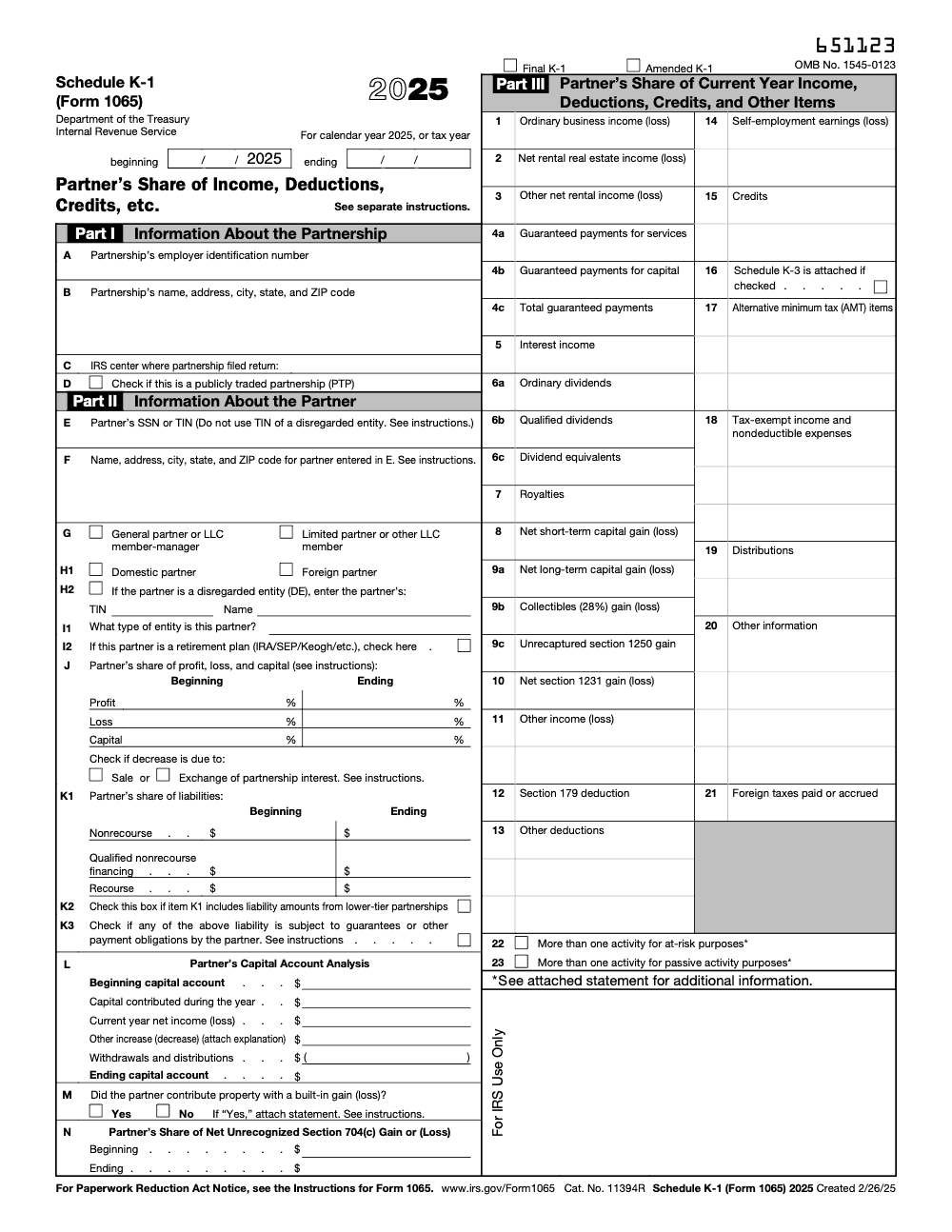
Schedule K-1 (Form 1065) reports each partner's distributive share of partnership income, deductions, credits, and other items for tax year 2025 (per the IRS 2025 Schedule K-1, catalog no. 11394R). Calendar-year partnerships must furnish each K-1 alongside the parent Form 1065 by March 16, 2026, or face a §6722 payee-statement penalty of $340 per K-1 stacked on top of the §6698 failure-to-file penalty of $255 per partner per month (up to 12 months).
Every March a partner calls saying the K-1 just showed up and half the boxes make no sense. Fair enough; Schedule K-1 (Form 1065) is dense by design. It reports each partner's distributive share of income, deductions, credits, and other items, and the partner cannot file their own return until those amounts are read correctly into Schedule E, Schedule SE, and the rest.
The line people misread is the capital account in Part II, Line L. It shows tax-basis capital, but that figure still leaves out the partner's share of partnership liabilities under section 752, so it is not the partner's outside basis and should never be used as one. Furnishing matters too: for tax year 2025 the K-1s are due March 16, 2026, and a late or wrong one carries a section 6722 penalty of $340 per K-1 on top of the section 6698 filing penalty.
Key Takeaways
- Schedule K-1 (Form 1065) is the document a partnership provides to each partner each year, showing that partner’s share of income, deductions, credits, and other tax attributes. It is a pass-through reporting document, not a tax payment form.
- Partners use K-1 data to complete their own tax returns – the amounts from various boxes flow to Schedule E, Schedule SE, Form 8582, and other forms depending on the type of item.
- The K-1 is not a standalone document – it cannot be filed on its own. It is issued by the partnership (with a copy to the IRS via Form 1065) and used by each partner to report their share of partnership activity.
- Outside basis must be tracked separately – the K-1’s capital account section (Part II, Line L) shows tax-basis capital, which still excludes the partner’s share of partnership liabilities under §752 and is therefore not the same as outside basis. Partners who ignore basis tracking risk deducting losses they are not entitled to take.
- Deadline: Partnerships must furnish K-1s by March 15 (March 16, 2026 for tax year 2025 because March 15, 2026 falls on a Sunday), or by the extended due date of September 15 if an extension is filed. Partners dependent on K-1 data for their own returns often need to file their own extensions.
- Quick SOP rule: Build the K-1 preparation workflow into the partnership return timeline with a hard internal deadline of February 28 for the partnership’s key numbers to be finalized – so K-1s can be reviewed and issued ahead of the March 15 deadline.
What Schedule K-1 (Form 1065) Is and Why It Matters
Schedule K-1 is the mechanism through which a partnership’s tax attributes flow to its partners. Partnerships are pass-through entities: the partnership itself generally pays no federal income tax, with narrow exceptions (BBA imputed underpayments, §1446 withholding on foreign partners, and certain state composite taxes). Instead, each partner picks up their share of the partnership’s income, deductions, losses, and credits on their own return – regardless of whether any cash was actually distributed. The K-1 is the document that tells the partner (and the IRS) what those amounts are.
There are three types of K-1 depending on the entity: Form 1065 Schedule K-1 for partnerships and LLCs taxed as partnerships, Form 1120-S Schedule K-1 for S corporations, and Schedule K-1 for trusts and estates (Form 1041). This guide covers only the Form 1065 version. The boxes, items, and rules differ significantly between entity types.
Every year, the partnership prepares one K-1 for each partner who was a partner at any point during the year. Even a partner who joined on December 1 and held a 0.01% interest receives a K-1. The K-1 is filed with Form 1065 (a copy goes to the IRS) and furnished to each partner by the due date of the partnership return.
Part I – Information About the Partnership
Part I of Schedule K-1 provides identifying information about the partnership itself, not the partner. This section is completed by the partnership for every K-1 issued.
| Line | Description | Notes |
|---|---|---|
| A | Partnership’s employer identification number (EIN) | Must match Form 1065 header; partners use this when reporting on their returns |
| B | Partnership’s name, address, and city/state/ZIP | As registered with the IRS |
| C | IRS center where partnership files | Partners may need this for amended return coordination |
| D | Check if publicly traded partnership (PTP) | PTP status affects passive activity rules significantly – PTP losses can only offset income from the SAME PTP, not other passive income, so missing the PTP checkbox lets partner-level software wrongly aggregate the losses |
Part II – Information About the Partner
Part II identifies the specific partner receiving the K-1 and describes their type and status within the partnership. This section drives many of the downstream tax consequences for the partner.
| Line | Description | Why It Matters |
|---|---|---|
| E | Partner’s SSN or TIN | Used for IRS matching; errors here create CP2000 notices for partners |
| F | Partner’s name and address | Must be current; stale addresses cause K-1 delivery failures |
| G | General partner or LLC member-manager / Limited partner or other | Determines self-employment tax exposure on Box 1 income |
| H | Domestic / Foreign partner | Foreign partners trigger §1446 withholding on effectively connected income and reporting requirements |
| I1 | What type of entity is the partner | Individual, C corp, S corp, partnership, trust, estate, exempt org |
| J | Partner’s share of profit, loss, capital – beginning and ending year percentages | Allocations may change mid-year; tiered allocations complicate this |
| K | Partner’s share of liabilities: nonrecourse, qualified nonrecourse, recourse | Liability share affects outside basis; critical for loss limitation analysis |
| L | Partner’s capital account analysis: beginning, contributions, current year income, withdrawals, ending | Tax basis vs. GAAP vs. 704(b) – reporting method matters; see below |
| M | Did the partner contribute property with a built-in gain or loss? | Triggers Section 704(c) allocation tracking requirements |
| N | Partner’s share of net unrecognized Section 704(c) gain or loss | Relevant for contributed property with FMV ≠ basis at contribution |
Capital Account Reporting Method (Line L)
Beginning in 2020, partnerships must report capital accounts on Schedule K-1 using the tax-basis method only; the GAAP, §704(b) book, and 'Other' methods are no longer permitted. This was a significant change from prior years when many partnerships reported GAAP or Section 704(b) book capital. If your K-1 shows a negative ending capital account balance on a tax-basis K-1, the partner has a deficit capital account – a situation with significant tax implications that the partner’s own advisor must address.
Part III – Partner’s Share of Income, Deductions, Credits
Part III is the core of the K-1 – it is where the partnership’s allocations are communicated to each partner. There are over 20 numbered boxes plus supplemental codes in Box 20 that carry additional items. Here is how to navigate the most significant ones.
Income Items (Boxes 1–11)
Box 1 (Ordinary business income/loss) is the most common and most impactful line. This is the partner’s share of the partnership’s net income from trade or business activities. For general partners, it is subject to self-employment tax. For limited partners, it generally is not – though the rules are more nuanced for LLC members, because the IRS (Renkemeyer, Castigliola, Soroban) treats LLC member-managers and actively participating members as general partners for §1402(a)(13) purposes regardless of the state-law ‘limited’ label.
Box 2 (Net rental real estate income/loss) applies to rental activities and flows to Form 8582 (passive activity limitations) for most partners. Box 3 (Other net rental income/loss) covers non-real estate rental activities. Boxes 4a and 4b cover guaranteed payments – for services (Box 4a) and for capital (Box 4b). Guaranteed payments for services are always ordinary income to the recipient partner and always subject to self-employment tax.
Portfolio Income (Boxes 5–9)
Portfolio income items – interest (Box 5), dividends (Boxes 6a and 6b), royalties (Box 7), net short-term capital gain/loss (Box 8), and net long-term capital gain/loss (Box 9a) – retain their character as they pass through the partnership to the partner. A partner receiving Box 9a long-term capital gain reports it on Schedule D as long-term. The partnership’s holding period determines the character, not the partner’s.
Net Section 1231 Gain/Loss (Box 10)
Section 1231 gains and losses arise from the sale of trade or business property held more than one year. Net 1231 gain is taxed at capital gain rates; net 1231 loss is deductible as ordinary. The look-back rule under IRC Section 1231(c) can recharacterize 1231 gains as ordinary if the taxpayer had unrecaptured 1231 losses in the prior five years. This is an area where practitioner attention to multi-year history is essential.
Deductions (Boxes 12–13)
Box 12 covers Section 179 deductions. The §179 cap ($1,250,000 for 2025) applies first at the partnership level and AGAIN at the partner level under §179(d)(8) – a partner with §179 from multiple K-1s must test the aggregate against the same partner-level cap, not simply add them together. Box 13 includes various deductions with codes (e.g., Code A for cash contributions, Code C for noncash contributions, Code W for other deductions). Each coded item in Box 13 requires reference to the K-1 instructions for the proper treatment on the partner’s return. Do not assume all Box 13 items are deductible outright – some are subject to limitations at the partner level.
Credits (Box 15)
Box 15 reports the partner’s share of tax credits using letter codes. Each credit type has its own form at the partner level (e.g., Code B = work opportunity credit, Code P = credit for employer Social Security tax paid on tips). Missing a Box 15 item on the partner’s return means leaving money on the table.
Other Information (Boxes 16–20)
Box 16 is the Schedule K-3 attached indicator – check it when an international Schedule K-3 is being attached to the K-1; foreign taxes paid or accrued now sit on Box 21 of the 2025 K-1 and feed Form 1116 or 1118 for the foreign tax credit. Box 17 covers alternative minimum tax (AMT) items. Box 18 covers tax-exempt income and nondeductible expenses. Box 20 is the catch-all “other information” box with codes A through Z and beyond, covering items ranging from excess business interest expense (Code AE) to Section 199A qualified business income information (Code Z), which feeds the partner’s QBI deduction on Form 8995 or 8995-A.
Box-by-Box Reference: Key Lines Explained
| Box | Item | Where It Goes on Partner’s Return |
|---|---|---|
| 1 | Ordinary business income (loss) | Schedule E, Part II; Schedule SE if general partner |
| 2 | Net rental real estate income (loss) | Schedule E, Part II; Form 8582 passive activity rules apply |
| 4a | Guaranteed payments for services | Schedule E (ordinary income); Schedule SE for SE tax |
| 5 | Interest income | Schedule B |
| 6a | Ordinary dividends | Schedule B |
| 6b | Qualified dividends | Schedule B; lower tax rate applies |
| 8 | Net short-term capital gain (loss) | Schedule D, Part I |
| 9a | Net long-term capital gain (loss) | Schedule D, Part II |
| 10 | Net Section 1231 gain (loss) | Form 4797 |
| 11 | Other income (loss) – coded | Various; see K-1 instructions for each code |
| 12 | Section 179 deduction | Form 4562; subject to partner-level limitations |
| 13 | Other deductions – coded | Various per code; some flow to Schedule A, others are direct deductions |
| 15 | Credits – coded | Various credit forms (e.g., 3800, 5884); see instructions per code |
| 17 | AMT items – coded | Form 6251 |
| 20Z | Section 199A QBI information | Form 8995 or 8995-A for the 20% pass-through deduction |
| 20AE | Excess business interest expense | Form 8990; limited at partner level under Section 163(j) |
Outside Basis Tracking and the At-Risk Rules
This is the section of K-1 planning that separates thorough practitioners from careless ones. A partner’s ability to deduct their share of partnership losses is limited to their outside basis in the partnership interest. Outside basis is not the same as the capital account shown on Line L of the K-1.
Outside basis starts with the partner’s original investment, then increases with additional contributions and the partner’s share of partnership liabilities (both recourse and nonrecourse, per Box K of the K-1), and decreases with distributions and the partner’s share of losses. Guaranteed payments do not affect basis directly, but ordinary income items do increase it before losses are deducted.
The Three-Hurdle Test for Partnership Losses
Before a partner can deduct a loss from the K-1, it must clear three hurdles:
- Basis limitation (IRC §704(d)): The partner’s share of losses cannot exceed their outside basis.
- At-risk limitation (IRC §465): Losses are further limited to amounts the partner is personally at risk for. Generally, this means recourse debt and contributed cash; nonrecourse financing (other than qualified nonrecourse financing in real estate activities) does not increase at-risk amounts.
- Passive activity limitation (IRC §469): If the partner does not materially participate in the partnership’s activities, the losses are passive and can only offset passive income from other sources.
Suspended losses carry forward and are freed up when the partner has sufficient basis in a future year, at-risk amounts increase, the activity generates passive income, or the interest is disposed of in a taxable transaction. Tracking suspended losses year over year is an SOP item that many firms handle inconsistently. Quick rule: build a partner basis schedule into every K-1 workpaper, updated annually.
Self-Employment Tax and the K-1
Whether a partner owes self-employment (SE) tax on their K-1 income is one of the most frequently litigated and misunderstood questions in partnership taxation. Here is the framework:
| Partner Type | Box 1 (Ordinary Income) | Box 4a (Guaranteed Payments) |
|---|---|---|
| General partner | Subject to SE tax | Subject to SE tax |
| Limited partner | Not subject to SE tax (generally) | Subject to SE tax if for services |
| LLC member-manager | Treated like general partner; SE tax applies | Subject to SE tax |
| LLC non-managing member | Similar to limited partner; generally no SE tax | Subject to SE tax if for services |
| S corp or other entity partner | No SE tax at partnership level | No SE tax at partnership level |
The LLC member-manager rule is an area of ongoing IRS scrutiny. Some taxpayers structure their LLC ownership to claim limited partner status and avoid SE tax on large distributive shares. The IRS has issued proposed regulations that would tighten these rules. Until final regulations are issued, practitioners must apply the current law while staying current on regulatory developments. From my side of the desk, I document the material participation analysis for every LLC partner in my workpapers.
Passive Activity Rules and K-1 Losses
The passive activity rules under IRC Section 469 apply to most partnership interests held by individual partners, estates, trusts, and closely held corporations. The default rule is that a limited partner’s interest is passive – meaning losses from the K-1 can only offset passive income, not ordinary income from other sources.
A partner who materially participates in the partnership’s activities avoids passive characterization for that activity. The IRS defines material participation using seven tests, the most common of which is participation for more than 500 hours during the year. Documenting material participation requires more than a subjective assertion – time logs, calendar records, or activity-based documentation are the standard of proof in an audit.
Real Estate Professionals and Rental K-1 Losses
Box 2 rental real estate income/loss is automatically passive for most taxpayers. However, real estate professionals (as defined under IRC Section 469(c)(7)) who materially participate in their rental activities can deduct rental losses without passive limitation. If your client is a real estate professional claiming to deduct Box 2 losses on their K-1, verify that the professional status election and material participation documentation are in place. This is one of the highest-audit-risk positions in individual partnership taxation.
Deadlines, Penalties, and Filing Requirements
| Item | Detail |
|---|---|
| Form 1065 (partnership return) due date | March 15 for calendar-year partnerships (15th day of 3rd month after year-end), with weekend/holiday rollover – for tax year 2025, March 15, 2026 falls on a Sunday, so the deadline shifts to Monday, March 16, 2026 |
| Schedule K-1 must be furnished to partners by | Same date as the Form 1065 due date (or extended due date if extension filed) |
| Extension available | Form 7004 – automatic 6-month extension; extended due date September 15. Note: Form 7004 extends time to file only, not time to pay – any BBA imputed underpayment, look-back interest, or entity-level tax is still due on the original March 15 deadline. |
| Late K-1 furnished to partners | Penalties under IRC §6722 for each K-1 not furnished timely: up to $340 per K-1 for statements due in 2026 (tax year 2025). This is separate from and stacks on top of the §6698 partnership failure-to-file penalty ($255 per partner per month, up to 12 months). |
| Incorrect K-1 | Same penalty schedule; correct promptly with an amended K-1 |
| Partner’s return due date | April 15 for individuals; partner often must file an extension if K-1 is received late |
| IRS copy of K-1 | Filed with Form 1065; partner’s copy is separate from the IRS copy |
| Amended K-1 | Issue a corrected K-1 marked “Amended” if errors are discovered after filing |
The timing mismatch between the K-1 due date (March 15) and the partner’s return due date (April 15) is operationally tight. Partners who receive their K-1 right at the March 15 partnership deadline have roughly 31 days before their own April 15 return is due. For complex K-1s with significant QBI, passive activity, or basis computations, that is not enough time. Advise partnership clients to target K-1 delivery by March 1 so partners have a full six weeks before the individual return deadline.
Common Mistakes That Slow Things Down
The recurring pattern with Schedule K-1 is that small administrative slips at the partnership level cascade into stacked penalties and partner-level reporting errors. Below are the six mistakes I see most often during 1065 review.
Reusable Checklists
These three checklists drop straight into a partnership-engagement SOP. Each item maps to a specific K-1 part or supporting workpaper so reviewers know what to verify before signing off.
Pre-K-1 partner data refresh
- Confirm each partner's legal name, current address, and TIN against the prior-year roster.
- For any disregarded-entity partner, record both the beneficial owner's TIN (Item E) and the DE's TIN (Item H2).
- Update Item G classification for any LLC member whose role shifted during the year.
- Document any mid-year admissions, redemptions, or transfers and the effective date for each.
- Pull prior-year Item L tax-basis ending balance and prior-year Item N §704(c) ending balance into the current workpaper.
- Refresh the partnership liability schedule split by recourse, qualified nonrecourse, and nonrecourse for Item K1.
- Check Item K2 if any liability amounts come from a lower-tier partnership and Item K3 for partner guarantees.
K-1 pre-issue QA review
- Verify Item D PTP checkbox matches the partnership's §469(k)(2) status.
- Confirm Item J profit, loss, and capital percentages tie to the partner agreement and any sale or exchange decrease is flagged with the correct checkbox.
- Reconcile Item L beginning balance to the prior-year ending balance for every partner.
- Verify Item M and Item N are populated for any partner with §704(c) layers, even when no new property was contributed this year.
- Cross-check Line 1 ordinary business income to Form 1065 Line 23 and Schedule K Line 1 totals.
- Confirm Line 14a SE earnings include General-partner and LLC-manager partners only, with Line 4a guaranteed payments flowing through.
- Tick Line 16 if Schedule K-3 is being attached for international items.
- Mark "Final K-1" for any exited partner before generating the partner PDF.
Partner-level basis and SE handoff packet
- Outside basis roll-forward worksheet showing beginning basis, contributions, Item K1 liability changes, income items, distributions, and ending basis.
- §465 at-risk calculation separating qualified nonrecourse real-estate financing from other nonrecourse debt.
- §469 passive activity summary noting material participation status for each activity reported on the K-1.
- Schedule SE inputs combining Line 14a SE earnings with Line 4a guaranteed payments for services.
- QBI statement reference for Box 20 codes Z/AA so the partner's §199A worksheet ties out at the 20% deduction rate.
- §461(l) excess business loss check using the 2025 thresholds of $313,000 (single) and $626,000 (MFJ).
- Cover memo flagging any K-1 items that require a partner-level election before April 15.
Keep 1065 Schedule K-1 Season From Stalling
The Schedule K-1 cycle compresses a year of partnership accounting into a six-week window between February close and the March 16, 2026 furnishing deadline. Every exited partner, every §704(c) layer, every shift in Item K1 liability classification has to be reconciled before a single K-1 leaves the firm. When something slips, the penalty stack lands in two layers: $255 per partner per month under §6698 for the late 1065, and $340 per K-1 under §6722 for the late statements (per the IRS 2025 inflation-adjusted penalty schedule, up to a $4,098,500 calendar-year cap on the §6722 side for large filers).
The fix is rarely "more hours in March." It is a partnership-cycle SOP that fronts the work into January and uses the same partner roster, basis worksheet, and liability schedule across every engagement.
- Lock the partner-data refresh in January so Items E through I2 are signed off before workpaper assembly begins.
- Roll Item L tax-basis capital and Item N §704(c) balances forward from the prior year inside the workpaper template, not by hand.
- Run the Item K1 liability classification split (recourse, qualified nonrecourse, nonrecourse) at month-end February so basis schedules close before final K-1 review.
- Build a Line 14a self-employment gate that pulls only General-partner and LLC-manager partners and flags any "Limited" classification for partner-level review under the Renkemeyer line of cases.
- Target internal K-1 delivery by March 1 so each partner has six weeks before the April 15 individual deadline, and budget a September 1 milestone for any return on a Form 7004 extension.
This is the delivery architecture Accountably's tax outsourcing teams build into partnership engagements: SOP-driven intake, layered review, and reconciled basis schedules that hold up under partner scrutiny without burning senior-reviewer hours.
FAQs
Schedule K-1 (Form 1065) reports each partner’s share of the partnership’s income, deductions, credits, and other tax items for the year. Partners use it to complete their own tax returns. The partnership does not pay tax at the entity level – tax flows through to partners based on their K-1 allocations.
Box 1 reports the partner’s share of ordinary business income or loss from the partnership’s trade or business activities. For general partners and managing LLC members, this amount is subject to self-employment tax. It flows to Schedule E of the partner’s Form 1040. It does not include rental income, portfolio income, or guaranteed payments, which are reported separately.
General partners and managing LLC members generally owe self-employment tax on Box 1 ordinary income and Box 4a guaranteed payments for services. Limited partners generally do not owe SE tax on their distributive share, though guaranteed payments for services remain subject to SE tax regardless of partner type. The LLC member classification question is an area of ongoing IRS scrutiny.
Outside basis is tracked in a separate basis schedule, not read directly from the K-1. You start with your original investment, add contributions and your share of partnership liabilities (per Box K), add income items allocated to you, and subtract distributions and loss allocations. The capital account on Line L shows tax-basis capital, which still excludes the partner’s share of partnership liabilities under §752 and is therefore not the same as outside basis.
Partnerships must furnish K-1s to partners by the Form 1065 due date – March 15 for calendar-year partnerships (March 16, 2026 for tax year 2025 because March 15, 2026 falls on a Sunday). If a 6-month extension is filed, K-1s can be issued by September 15. Partners who need the K-1 to complete their own returns by April 15 may need to file their own extension if the partnership is on extension.
Guaranteed payments (Box 4a) are payments to a partner made without regard to partnership income, analogous to a salary. They are always ordinary income and always subject to self-employment tax. The distributive share (Boxes 1–13) represents the partner’s allocated portion of partnership items, and the tax treatment of each item depends on its character at the partnership level.
Other forms this guide names
- Form 1065: Guide, Deadlines, K‑1, K‑2/K‑3, E‑File
- Form 1065: Schedule K-2 and K-3 Guide 2025, one month date rules
- Form 7004: Business Tax Extension Guide, Deadlines & E‑File
- Form 1040: Filing Guide for 2025 Returns (AGI, Deductions, Deadlines)
- Form 8582: Guide to Passive Activity Loss Limits
- Form 8995-A: QBI Deduction Thresholds and Phaseouts
Summarize this article with AI
About this guide
Accountably helps US CPA, EA, and accounting firms hire trained accountants and tax preparers in India.
About us Reviewed byJugal Thacker, CPAFounder and CEO at Accountably
A Washington-licensed CPA with 7+ years inside US firms – PwC, a real-estate tax practice, then a full-service firm, rising from reviewer to manager to advisory. This article was reviewed against current IRS guidance for the 2025 tax year and updated for filers preparing late returns, amendments, and 2026 estimates.
View profile →How we research, review, and update this guide
Every Accountably guide is researched against primary IRS sources, reviewed by a U.S. CPA, and refreshed as guidance evolves. Read our Editorial Guidelines to see how we source, fact-check, and update our content.