Summarize this article with AI
In Brief
Form 1099-DIV reports dividends and distributions from a payer to a recipient once payments reach $10 in a calendar year (or any amount of backup withholding), per the Instructions for Form 1099-DIV (Rev. January 2024). For tax year 2025, furnish Copy B to recipients by January 31, 2026; paper-file Copy A by February 28, 2026 and e-file by March 31, 2026 – with box 1a as total ordinary dividends, box 1b as the qualified subset, box 2a as capital gain distributions, and box 5 as the section 199A amount eligible for the 20% QBI deduction. Need this work handled outside your team? See U.S. tax outsourcing.
A client forwards a brokerage statement, sees the same dividend totals as last year, and asks why the refund came out smaller. The answer almost never lives in the headline figure. It lives in how the boxes nest, because Box 1b is a subset of Box 1a, and Box 2a can carry amounts from boxes 2b through 2d and 2f that change the rate before the math ever reaches Schedule B.
A payer owes you this form once dividends or distributions reach $10 in a calendar year, or the moment any tax gets withheld, whichever comes first. For tax year 2025, recipient Copy B is due January 31, 2026, paper Copy A by February 28, 2026, and e-filed Copy A by March 31, 2026, with a 24% backup withholding rate sitting behind any missing taxpayer information.
Key Takeaways
- You receive Form 1099‑DIV when dividends or certain distributions are at least 10, or when any tax is withheld. Payers must also file with the IRS.
- Box 1a shows total ordinary dividends, and Box 1b shows the qualified portion that may receive long‑term capital gains rates if holding period rules are met.
- Box 2a reports capital gain distributions, generally treated as long‑term, and it can include amounts from boxes 2b through 2d and 2f.
- Box numbers matter, Box 5 is section 199A dividends, Box 6 is investment expenses, Box 7 is foreign tax paid, and Box 12 is exempt‑interest dividends.
- Most recipient statements are due to payees by January 31, 2026 for tax year 2025, and most information returns are due to the IRS by February 28, 2026 on paper or March 31, 2026 if e‑filed.
What is Form 1099‑DIV
Form 1099‑DIV is an IRS information return that reports the dividends and distributions you received for the calendar year. Your brokerage or fund uses it to show your ordinary dividends, any qualified portion, capital gain distributions, and other items that affect your tax. You use those figures to complete your Form 1040 and the related schedules.
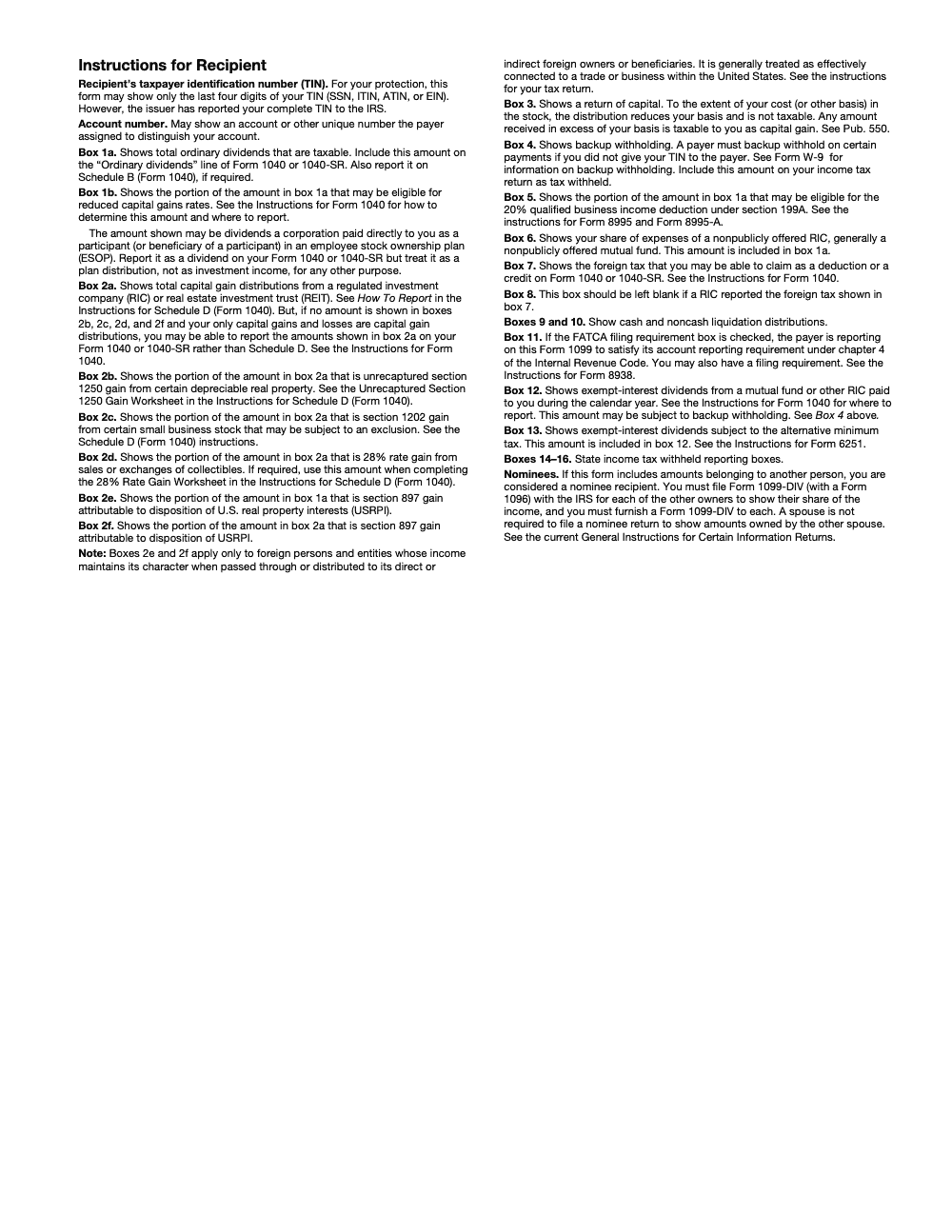
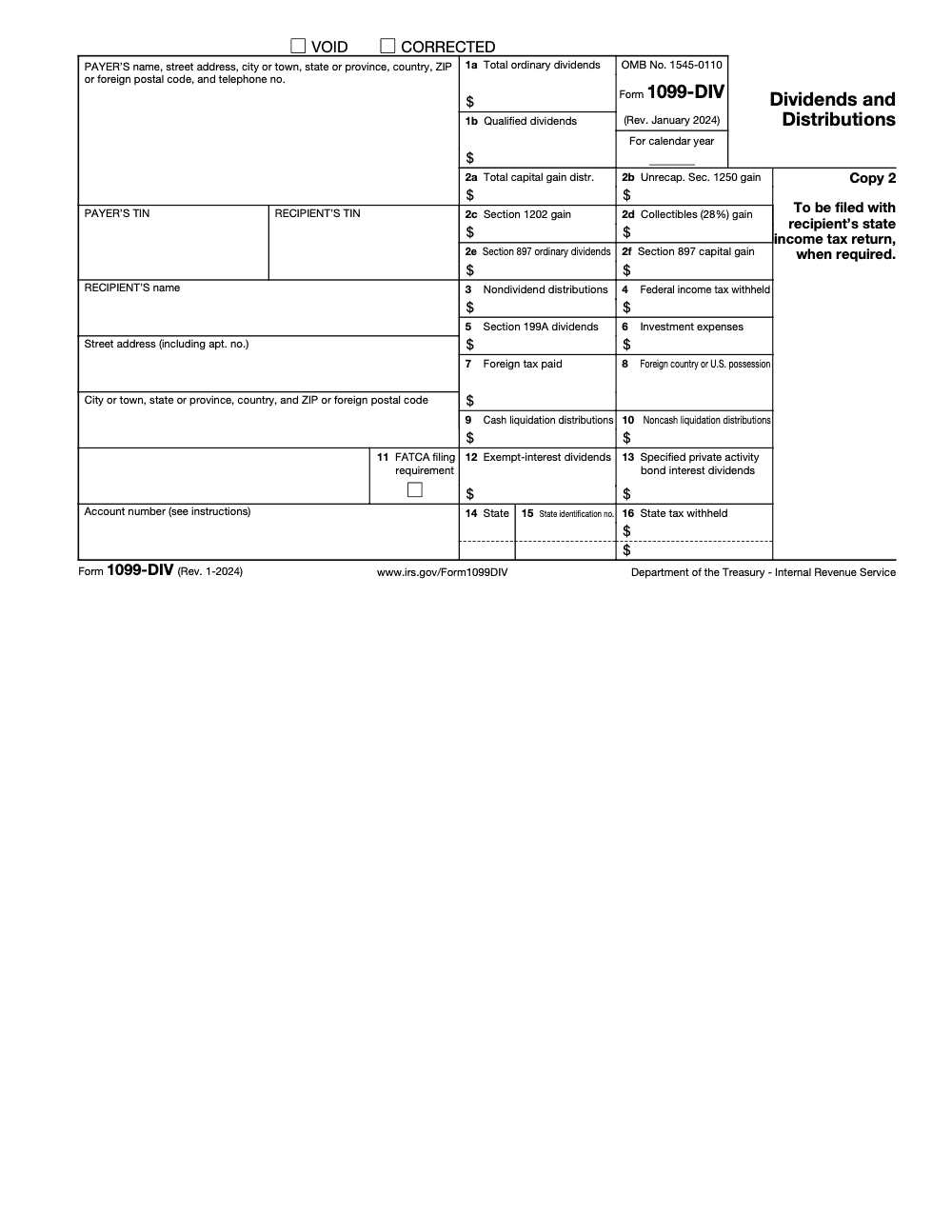
What each core box means
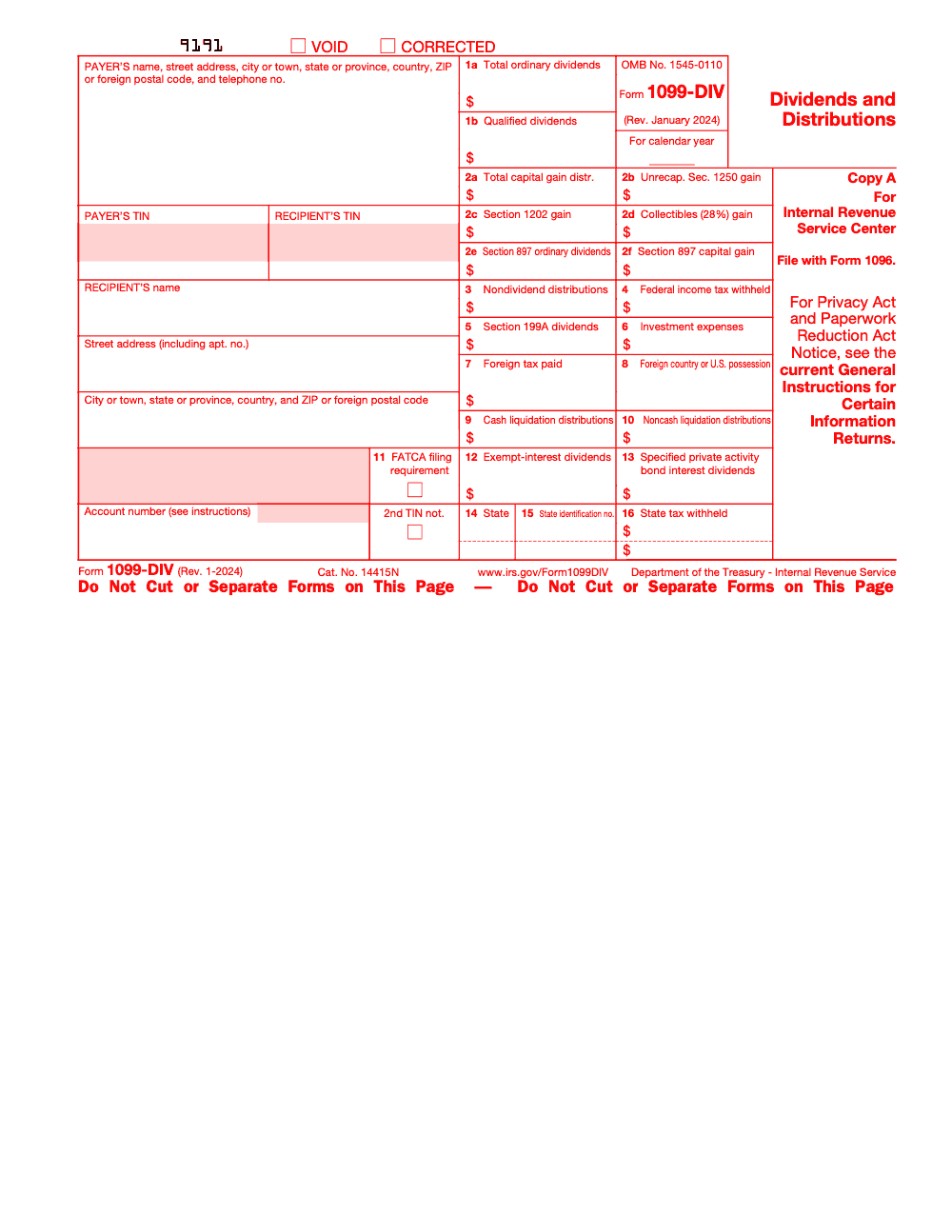
- Box 1a, total ordinary dividends, includes reinvested dividends and certain items your fund reports as dividends.
- Box 1b, qualified dividends, is a subset of 1a with potential long‑term capital gains rates if issuer and holding period rules are satisfied.
- Box 2a, total capital gain distributions, is generally treated as long‑term, and it includes amounts that may also be shown in 2b through 2d and 2f.
- Box 4, federal income tax withheld, is where backup withholding shows up if your TIN was missing or you were notified about underreporting.
- Box 5, section 199A dividends, captures amounts from REITs and RICs that may feed the 20 percent 199A deduction rules (the amount is already included in Box 1a, not in addition to it).
- Box 6, investment expenses, applies in limited RIC situations and is included in 1a.
- Box 7, foreign tax paid, is the number you may claim as a credit or, less commonly, as an itemized deduction, but not both for the same foreign tax in the same year.
- Boxes 12 and 13 show exempt‑interest dividends and specified private activity bond interest dividends from RICs (Box 13 is included in Box 12, not in addition, and must be added back on Form 6251 as an AMT preference item; Box 12 itself can still be subject to backup withholding even though it is exempt from regular federal income tax).
When the issuer must send it
Payers furnish recipient copies by January 31. For 2025 amounts reported in early 2026, the IRS filing due dates are February 28, 2026 for paper or March 31, 2026 if filing electronically. The IRS now requires e‑filing if, in total, you must file at least 10 information returns, and that 10 is calculated in the aggregate across all 1099 series and similar forms.
Quick compliance note for firms
Form 1099‑DIV and its instructions are “continuous‑use,” which means the IRS updates the online instructions instead of releasing a new PDF every single year. Always pull the latest version before you finalize your processes.
A fast story that may sound familiar
You complete a return with multiple funds. One fund shows small foreign tax paid, another shows section 199A dividends, and a third reports section 897 amounts from a REIT sale of U.S. real property. You can file a clean return if you map each box, pass the right amounts to Schedule B, Schedule D, and possibly Form 1116, and you document holding periods for qualified dividends. Miss any one of those, and you invite IRS notices or painful corrections. The good news, you can avoid that with a simple box‑by‑box checklist and a few guardrails, which I will give you next.
If you cannot determine by filing time whether a payment is a dividend, report the full amount as a dividend and correct later if needed, per section 6042 regulations cited in the IRS instructions.
Who files, who receives, and the threshold rules
If you issue dividends or capital gain distributions, and the amount is at least 10, or if you withhold any tax, you must furnish Form 1099‑DIV and file with the IRS. That includes brokers, mutual funds, banks, RICs, and REITs. You must also file if you pay 600 or more as part of a corporate liquidation. Most individuals with taxable brokerage accounts receive 1099‑DIV, while exempt payees, such as corporations and certain tax‑exempt entities, generally do not.
Payers required to file
- You paid dividends or other distributions of 10 or more.
- You withheld foreign tax on dividends or distributions.
- You withheld any federal income tax under backup withholding.
- You paid 600 or more in liquidation distributions.
Who receives it
- Individuals with taxable accounts who received at least 10 in dividends or distributions.
- Anyone subject to backup withholding or foreign tax withholding, regardless of amount.
- Not typically issued for IRAs or 401(k)s, and many corporate or governmental recipients are exempt.
Filing triggers, exemptions, and special cases
Below is a quick reference you can paste into your firm’s SOP.
| Trigger | Filing action |
| 10 or more in dividends or other distributions | File Form 1099‑DIV |
| Foreign tax withheld | File and report amounts in Box 7 |
| Backup withholding taken | File, report in Box 4 |
| 600 or more liquidation distributions | File regardless of other thresholds |
These rules come straight from the IRS instructions. They also note a practical point, if you cannot determine by the deadline whether a payment is a dividend, report it as a dividend and correct later if needed.
Common exemptions
You generally do not file 1099‑DIV for corporations, certain tax‑exempt organizations, IRAs, HSAs, Archer MSAs, U.S. government agencies, and registered securities or commodities dealers. That said, backup withholding or liquidation distribution rules override those exemptions, so if you withhold or you make liquidation payments over the threshold, you still file.
Backup withholding, the 24 percent rule
Backup withholding applies when a payee fails to give a correct TIN, when the IRS has notified you about underreported interest or dividends, or when the payee fails to certify they are not subject to backup withholding. The current backup withholding rate is 24 percent, and withheld amounts must be reported on Form 945 and in Box 4 of the recipient’s 1099‑DIV.
Deadlines, e‑file threshold, and giving clients a smooth experience
- Furnish recipient statements by January 31, 2026 for 2025 payments.
- File with the IRS by February 28, 2026 if paper, or March 31, 2026 if electronic.
- E‑file is required when you file 10 or more total information returns, aggregated across series, for returns due on or after January 1, 2024. Use FIRE or IRIS to e‑file.
Small but important calendar tip
Because the IRS due dates shift when the date falls on a weekend or holiday, always confirm the specific year’s dates in the current General Instructions for Certain Information Returns. For 2026 filing of 2025 1099‑DIV forms, the paper due date is February 28 and the e‑file due date is March 31.
Pro tip, lock your 1099‑DIV calendar on January 15 for internal quality review, January 25 for client communications, January 31 for furnishing to recipients, and early March for filing to the IRS. This simple cadence avoids rush corrections and keeps penalty risk low.
Ordinary vs qualified dividends, how to tell them apart
Ordinary dividends, Box 1a, are taxed at your regular rates. Qualified dividends, Box 1b, are a subset of Box 1a that may receive long‑term capital gains rates, but only if you meet issuer and holding period rules. In practice, your broker flags the amounts for you on the form, your job is to confirm the holding period and the issuer type when something looks unusual.
The holding period test in plain English
- For most common stock, you must hold the shares for more than 60 days during the 121‑day window that starts 60 days before the ex‑dividend date.
- Certain preferred stock requires a longer holding window.
- Short sales, substantial hedges, and similar positions can disqualify otherwise qualified dividends.
If you want a quick investor‑friendly explainer to share with clients, this overview of qualified vs ordinary dividends is concise and consistent with IRS rules, and it underscores the 0, 15, or 20 percent rate structure.
Capital gain distributions and the 2‑series boxes
Your 1099‑DIV tells you more than just dividends. It also reports capital gain distributions that flow from mutual funds, ETFs, and RICs.
- Box 2a, total capital gain distributions, generally long‑term regardless of how long you owned the fund.
- Box 2b, unrecaptured section 1250 gain, real estate depreciation recapture at up to 25 percent.
- Box 2c, section 1202 gain, potential QSBS exclusion details provided by the payer.
- Box 2d, collectibles 28 percent rate gain, applies to collectibles.
- Boxes 2e and 2f, section 897 ordinary and capital gain amounts that look through RICs and REITs to U.S. real property interests. These are completed by RICs and REITs, and they matter for character and withholding.
Box 2a includes the amounts that also appear in 2b, 2c, 2d, and 2f, so it is your starting point for Schedule D.
Where these go on your return
- Ordinary dividends go to the ordinary dividends line on Form 1040, and you attach Schedule B if your interest exceeds $1,500 or your ordinary dividends exceed $1,500, or if any of the other Schedule B triggers apply.
- Qualified dividends flow to the qualified dividends line so the software applies preferential rates.
- Capital gain distributions from Box 2a go to Schedule D, and you may need Form 8949 only if instructions say so. One exception, if boxes 2b, 2c, 2d, and 2f are all blank and your only capital gains and losses are these capital gain distributions, you may report Box 2a directly on Form 1040 or 1040-SR without filing Schedule D.
- If backup withholding was taken, claim it as a payment on the tax return, and reconcile to Form 945 at the payer level.
A quick checklist for reviewers
- Confirm Box 1a plus Box 6 mechanics, Box 6 is included in 1a.
- Tie Box 7 to a foreign tax credit or deduction, see next section.
- For any 2e or 2f entries, note that only RICs and REITs complete them, and keep your workpapers for FIRPTA and sourcing.
If you received a corrected 1099‑DIV after you filed, consider whether an amended return is needed to fix your dividend classifications or capital gain distributions. Keep copies of the original and corrected statements with your notes.
Foreign tax paid, how to claim it the right way
If Box 7 shows foreign tax paid, you often have two choices, claim a foreign tax credit or take an itemized deduction. Most taxpayers prefer the credit, and many can claim it without filing Form 1116 if all the income is passive category, the tax was reported on a qualified payee statement such as a 1099‑DIV, and total creditable foreign taxes are not more than 300, or 600 if married filing jointly. If you make that election, you simply enter the smaller of your foreign tax or regular tax on the foreign tax credit line of Schedule 3.
- If your foreign taxes exceed the 300 or 600 threshold, or if you have non‑passive categories, attach Form 1116 and follow its limitation rules.
- Box 7 amounts reported in U.S. dollars on a 1099 do not need reconversion for the form.
- If you choose a deduction instead of the credit, use Schedule A.
Remember, Box 7 is foreign tax paid. Box 6 is investment expenses, and Box 8 is the foreign country or U.S. possession, which RICs usually do not complete under the section 853 rules.
Special rules for RICs, REITs, and section 199A dividends
Two frequent pain points are section 199A dividends and section 897 look‑through amounts.
Section 199A dividends
- Box 5 shows section 199A dividends. These generally capture qualified REIT dividends paid by a REIT, and section 199A dividends paid by a RIC to the extent permitted by the regulations.
- The amount in Box 5 is included in Box 1a, it is ordinary for rate purposes, but it may support the separate 20 percent deduction calculation under section 199A, subject to holding period and related‑payment rules.
Section 897 look‑through
When a RIC or REIT recognizes gain from a U.S. real property interest, section 897 can look through to you. Boxes 2e and 2f report the ordinary and capital components of those USRPI gains. Only RICs and REITs complete these boxes, and the amounts apply only to foreign persons and entities whose income keeps its character when passed through to foreign owners or beneficiaries; domestic U.S. shareholders generally include the underlying Box 1a and 2a amounts normally and ignore the 2e and 2f labeling.
January payment, December 31 treatment
For dividends declared in October through December and paid in January, funds treat them as paid on December 31 of the prior year. That is why they belong on the prior year’s 1099‑DIV and on that return. This rule prevents timing mismatches between funds and investors.
Backup withholding and corrections without the panic
Backup withholding sits at a flat 24 percent. If you are the payer, you report it in Box 4 on 1099‑DIV and on Form 945, and you deposit it under the Form 945 deposit rules. If you are the recipient, you claim Box 4 as a payment on your individual return, and you keep the notice history that triggered the withholding in your records.
- Late dividend designation issues happen, especially with funds. If a January payment is treated as December income, you still withhold when you actually pay it and report the withholding on the Form 945 for the year withheld, but you show the withholding on the prior year’s 1099‑DIV. Keep tight controls to reconcile Box 4 totals to Form 945 and fix errors with corrected statements as soon as you catch them.
Quick sanity check, if you backup withhold on a payment, you must file a 1099 and furnish a statement even if the gross payment would have been under the usual 10 threshold.
Using 1099‑DIV numbers on your return, step by step
- Map Box 1a to the ordinary dividends line on Form 1040.
- Ensure Box 1b is entered so the software applies preferential rates.
- Enter Box 2a on Schedule D, then follow your software prompts for Form 8949 if needed.
- File Schedule B if your interest exceeds $1,500 or your ordinary dividends exceed $1,500, or if any Schedule B triggers apply, such as nominee distributions or foreign accounts.
If your 1099‑DIV is wrong, request a corrected form. If you already filed, amend with Form 1040‑X. Keep the original and corrected statements with notes explaining the change.
Common reviewer pitfalls
- Treating Box 6 as foreign tax, it is not, Box 7 is foreign tax, and Box 6 is investment expenses.
- Ignoring Box 5 for section 199A analysis.
- Missing the October‑to‑January declared‑then‑paid rule for funds.
- Forgetting that Boxes 2e and 2f are for RICs and REITs only.
Key dates and quick reference for 2025 amounts
- Furnish recipient statements by January 31, 2026.
- File with the IRS by February 28, 2026 on paper or March 31, 2026 if e‑filed.
- E‑file is required when your aggregate information returns reach 10 or more, and that aggregation spans all 1099 series covered by the rules.
FAQs
What is a Form 1099‑DIV, and why did I receive it?
It is the annual statement your broker or fund sends when you received at least 10 in dividends or certain distributions, or when any tax was withheld. It reports ordinary dividends, qualified dividends, capital gain distributions, nondividend distributions, foreign tax, and other items you need for your return.
Do I have to report Form 1099‑DIV on my taxes?
Yes. Report ordinary dividends on Form 1040, include qualified dividends so the lower rates apply, and carry capital gain distributions to Schedule D. File Schedule B if your interest exceeds $1,500 or your ordinary dividends exceed $1,500, or if other triggers apply.
What is the difference between a 1099‑DIV and “a 1099”?
1099‑DIV is a specific information return for dividends and distributions. “1099” is a family of forms for different non‑wage payments, such as 1099‑INT for interest, 1099‑NEC for nonemployee pay, and 1099‑B for broker proceeds. The general filing rules for due dates and e‑file thresholds come from the General Instructions for Certain Information Returns.
How do I handle foreign tax in Box 7?
If your total qualified foreign taxes are not more than 300, or 600 if married filing jointly, and your income is passive category reported on a qualified payee statement, you may claim the credit without Form 1116. Otherwise, attach Form 1116 and apply the limitation.
For accounting firm leaders
If your team dreads 1099‑DIV season because files arrive late, box mapping is inconsistent, or reviewers are drowning in corrections, structure beats heroics. In our work with U.S. firms, we standardize workpapers, add box‑to‑return mapping checklists, and set calendar gates, which shortens reviews and cuts correction rates. If you are considering disciplined offshore delivery for seasonal volume, introduce SOPs, version control, and review layers first, then add capacity.
Accountably can integrate trained offshore teams into your workflow for 1099‑DIV and broader compliance cycles, using SOP‑driven execution, structured workpapers, and layered QA so partners spend more time on clients and less time in review. When it is helpful, we will map boxes 1a through 13 into your templates and enforce turnaround SLAs during the January to March crunch.
Final notes and compliance reminder
- Always pull the latest “continuous‑use” instructions for Form 1099‑DIV, since the IRS updates them online.
- Confirm the e‑file aggregation threshold and due dates each year, especially when holidays shift the calendar.
- Keep explanatory statements for unusual items, such as section 1202 amounts or section 897 look‑through.
Common Mistakes We See Every Season
Most 1099-DIV cleanup work in my practice traces back to the same handful of mistakes – the boxes nest in ways recipients and even some preparers do not expect, and the timing rules differ from the rest of the 1099 family.
Reusable Checklists
Three checklists my team pastes into every 1099-DIV engagement SOP – pre-issuance for the payer side, recipient reconciliation for prep work, and the correction protocol for late catches.
Payer pre-issuance verification
- Confirm payer EIN, name, and address match IRS records on file.
- Pull a recipient list with TINs from W-9 on file; flag any missing or expired TINs and request a new W-9.
- For payees flagged twice in three years for incorrect TIN, check the "2nd TIN not." box on Copy A.
- Aggregate all information returns (1099 family, W-2, 1098, 5498) for the payer; if 10 or more, route the entire batch through FIRE or IRIS.
- For each recipient with dividends of $10 or more, or any backup withholding, generate a 1099-DIV.
- For each recipient with liquidation distributions of $600 or more, populate box 9 (cash) or box 10 (noncash).
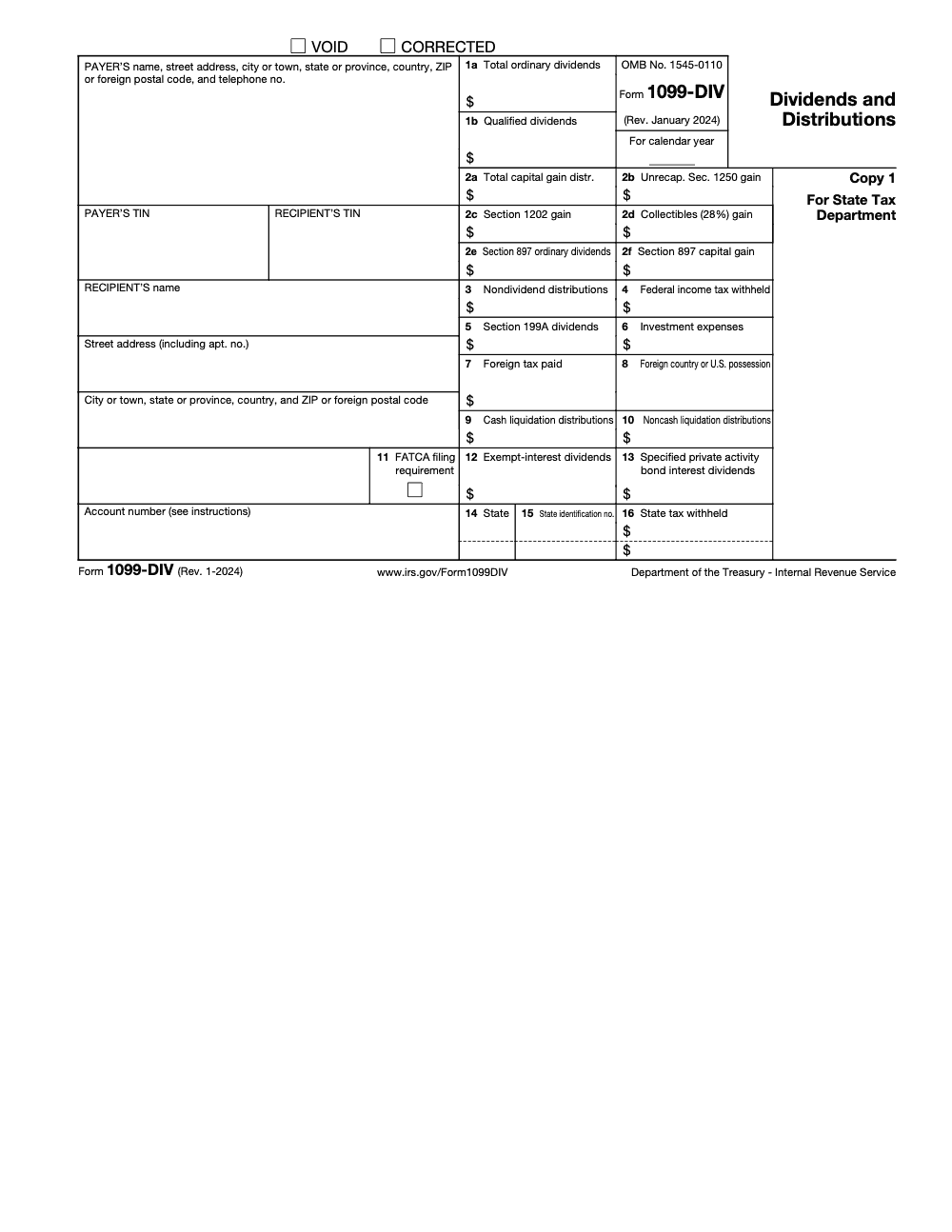
- If state withholding applies, complete boxes 14, 15, and 16 and prepare Copy 1 for the state tax department.
- Order official red-ink Copy A and Form 1096 transmittal if paper-filing; do not mail the IRS website PDF.
- Furnish Copy B to recipients by January 31, 2026 for tax year 2025 distributions.
Recipient return reconciliation
- Map box 1a to the ordinary dividends line on Form 1040; do not add box 1b.
- Map box 1b to the qualified dividends line on Form 1040.
- If boxes 2b, 2c, 2d, and 2f are blank AND no other capital transactions exist, report box 2a directly on Form 1040 without Schedule D.
- If any 2-series subcategory is populated, build Schedule D plus the Unrecaptured Section 1250 Gain and 28% Rate Gain worksheets.
- Reduce basis records by the box 3 amount; recognize capital gain only on excess above remaining basis.
- Claim box 4 backup withholding on the federal income tax withheld line of Form 1040.
- Compute the section 199A QBI deduction on Form 8995, or Form 8995-A above the $394,600 MFJ / $197,300 other-returns threshold, using the box 5 amount.
- Pick foreign tax credit OR Schedule A deduction for box 7; document the choice in the workpaper.
- If box 11 (FATCA) is checked, evaluate Form 8938 thresholds and file if applicable.
- If box 13 has an amount, add it back as an AMT preference on Form 6251.
- For ordinary dividends above $1,500, attach Schedule B (Form 1040).
Correction (CORRECTED box) filing
- Confirm the original was actually filed with the IRS; if it was VOID before filing, do not file a corrected version.
- Prepare a new 1099-DIV with corrected amounts and check the CORRECTED box on Copy A.
- Do not strike through or line-edit prior values on the old copy.
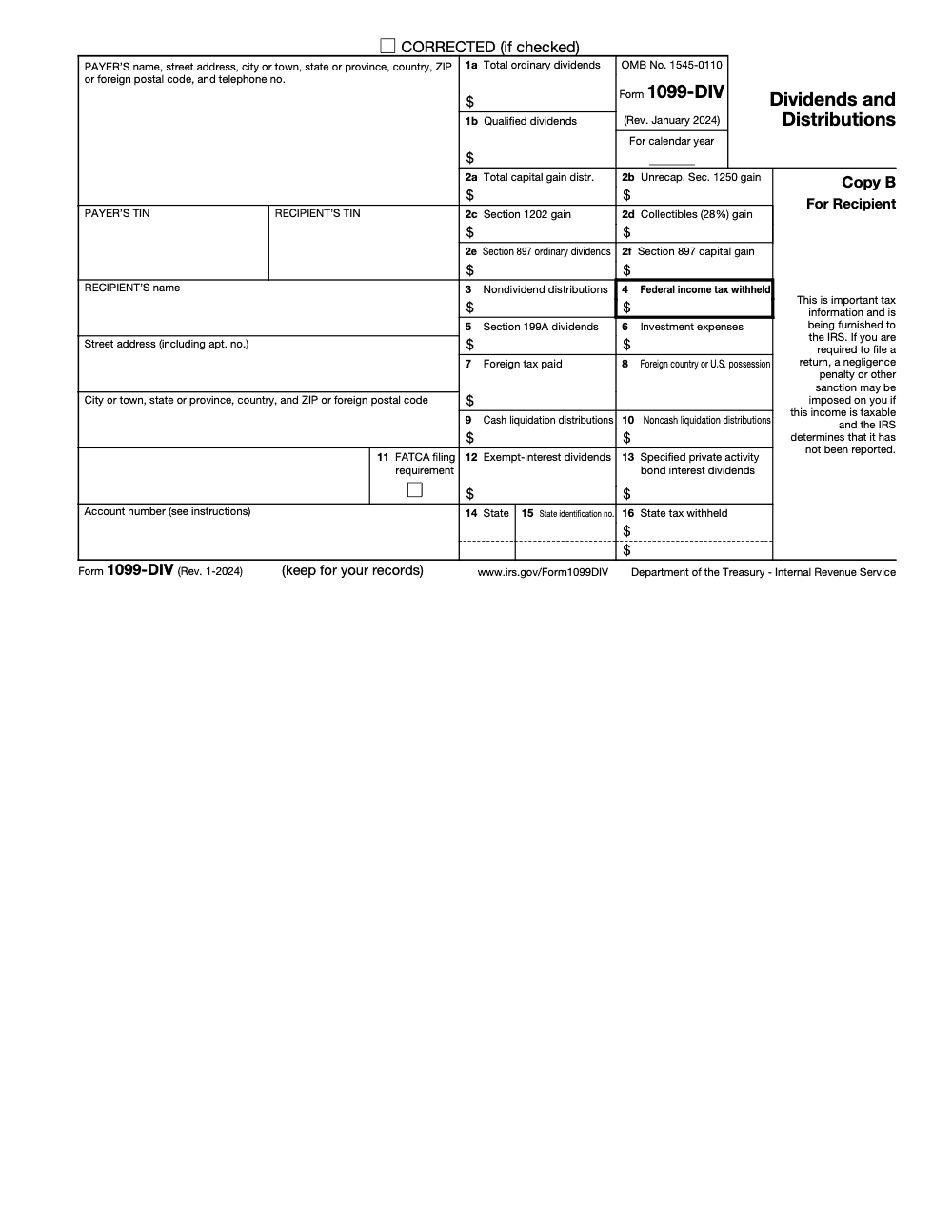
- Furnish a corrected Copy B to the recipient with the CORRECTED box checked.
- File a new Form 1096 transmittal for the corrected paper return, or transmit the corrected record through FIRE or IRIS.
- Update the recipient's basis worksheet (if box 3 changed) and any AMT preference tracking (if box 13 changed).
- Notify the recipient in writing that an amended Form 1040 may be required.
Keep 1099-DIV Season From Stalling
The 1099-DIV cycle does not stall on a single deadline. It stalls on three deadlines stacked one month apart – January 31, 2026 for recipient copies, February 28, 2026 for paper Copy A, and March 31, 2026 for e-filed Copy A. The General Instructions for Certain Information Returns build that gap deliberately to push filers onto FIRE or IRIS, and the 10-return aggregation rule (counted across all information return types, not per form) makes electronic filing mandatory for most payers running a mixed-return book.
The fix is rarely more staff. It is a tighter pre-season process: TIN verification before issuance, aggregate counting across all information return types, and basis tracking for box 3 amounts that carries forward year over year. The bottleneck is the workpaper structure, not the headcount.
- Run TIN matching for every payee with a W-9 on file before December 31, and flag any payee that triggered the "2nd TIN not." rule so backup withholding under box 4 starts on schedule.
- Maintain a single roll-up of all information returns per payer (1099-DIV, 1099-INT, 1099-MISC, 1099-NEC, W-2, 1098, 5498); the moment the aggregate hits 10, route the entire batch through FIRE or IRIS.
- For RIC and REIT payers, document the box 2a build-up (box 2b unrecaptured 1250, box 2c section 1202, box 2d collectibles, box 2f section 897) in a single worksheet so reviewers can audit the nesting without recomputing.
- Track box 3 nondividend distributions in a basis worksheet that carries forward across years; capital gain recognition lags receipt, and a missed basis adjustment compounds.
- For payers issuing exempt-interest dividends in box 12, flag the box 13 specified private activity bond interest portion as an AMT preference for the recipient's Form 6251 in the same year.
This is the work our delivery teams handle inside payer workflows – TIN verification, aggregate counting, basis tracking, and the corrected-return protocol – without adding seats on the production side. Walk through what a structured engagement looks like at U.S. tax outsourcing.
FAQs
A payer must file Form 1099-DIV for each person paid dividends and other distributions of $10 or more, or $600 or more as part of a liquidation. Any backup withholding triggers the form regardless of amount. Below those thresholds, the payer is not required to issue the form, but the income is still reportable on your return.
Box 1a shows total ordinary dividends that are taxable. Box 1b shows the portion of box 1a that may be eligible for reduced capital gains rates, the qualified dividends. Box 1b sits inside box 1a, so never add the two together. Report box 1a on the ordinary dividends line of Form 1040 and box 1b on the qualified dividends line.
Box 3 reports a return of capital. It reduces your basis in the stock rather than counting as current income. It only becomes a capital gain once cumulative distributions exceed your remaining basis. Keep a basis worksheet so you track the reduction year over year, as IRS Publication 550 explains.
Report box 1a on Form 1040, and also on Schedule B (Form 1040) if required, generally when your taxable interest exceeds $1,500 or your ordinary dividends exceed $1,500, or when other Schedule B triggers apply. Below that, you can usually report dividends directly on Form 1040 without attaching Schedule B.
Box 4 shows federal income tax withheld under the backup withholding rules, applied at 24% for 2025 when a payee fails to certify a correct TIN. Claim it on the federal income tax withheld line of your Form 1040, the same way you would treat wage withholding from a W-2.
Ask the payer for a corrected 1099-DIV with the CORRECTED box checked, rather than line-editing the original. If you already filed using the wrong figures, file Form 1040-X once the corrected statement arrives. Keep your own records of distributions and basis so you can reconcile the corrected amounts.
For tax year 2025, payers must furnish Copy B to recipients by January 31, 2026, file Copy A on paper with the IRS by February 28, 2026, and file electronically by March 31, 2026. Filers with 10 or more information returns in the aggregate must e-file.
Other forms this guide names
- Form 1040: Filing Guide for 2025 Returns (AGI, Deductions, Deadlines)
- Form 1116: Foreign Tax Credit Guide 2025, How to Claim
- Form 945: Backup Withholding, Deadlines, and Deposits
- Form W‑2: Deadlines, E‑File Rules, Boxes, and W‑2c Corrections
- Form 1099-NEC: Rules, Who Gets One, How to File
- Form W-9: Guide & Instructions
Summarize this article with AI
About this guide
Accountably helps US CPA, EA, and accounting firms hire trained accountants and tax preparers in India.
About us Reviewed byJugal Thacker, CPAFounder and CEO at Accountably
A Washington-licensed CPA with 7+ years inside US firms – PwC, a real-estate tax practice, then a full-service firm, rising from reviewer to manager to advisory. This article was reviewed against current IRS guidance for the 2025 tax year and updated for filers preparing late returns, amendments, and 2026 estimates.
View profile →How we research, review, and update this guide
Every Accountably guide is researched against primary IRS sources, reviewed by a U.S. CPA, and refreshed as guidance evolves. Read our Editorial Guidelines to see how we source, fact-check, and update our content.