Summarize this article with AI
In Brief
Form 1099-Q reports distributions from 529 plans and Coverdell ESAs – Box 1 (gross) always equals Box 2 (earnings) plus Box 3 (basis), and only the Box 2 earnings can be taxable. For tax year 2025, trustees furnish Copy B to recipients by February 2, 2026 (January 31 falls on a Saturday), file paper with the IRS by February 28, 2026, and file electronically by March 31, 2026 (per the General Instructions for Certain Information Returns). Non-qualified distributions trigger a 10% additional tax on Form 5329 in addition to ordinary income tax on the earnings.
A client pays a tuition bill from a 529 account, sees the money leave and the receipt come in, and assumes the matter is closed. Then a 1099-Q shows up in the January stack and the worry starts: did that withdrawal create taxable income? Usually it did not, but you cannot tell from the form alone. Box 1 reports the gross distribution, Box 2 the earnings inside it, and Box 3 the basis, and only the Box 2 earnings can ever be taxed.
The piece people skip is the netting. Before you decide how much of those earnings is tax-free, you have to reduce qualified expenses by any tax-free scholarship, the American Opportunity Credit, or the Lifetime Learning Credit the same student claimed. Pull the tuition billing statement alongside the 1099-Q every year, because a non-qualified slice carries ordinary income tax plus a 10% additional tax on the earnings.
Key Takeaways
- Form 1099-Q is issued by 529 qualified tuition plan administrators and Coverdell ESA trustees to report distributions from education savings accounts – the recipient uses it to determine whether distributions are taxable.
- The program administrator, not the taxpayer, files Form 1099-Q with the IRS; the account owner or beneficiary receives Copy B.
- Distributions used for qualified education expenses are completely tax-free – the earnings portion of a non-qualified distribution is subject to ordinary income tax plus a 10% additional tax.
- Administrators must furnish Copy B to recipients by January 31 (for tax year 2025 the deadline shifts to February 2, 2026 because January 31, 2026 falls on a Saturday) and file with the IRS by February 28 (paper) or March 31 (electronic).
- The most common mistake: forgetting to reduce qualified expenses by tax-free scholarships, the American Opportunity Credit, or the Lifetime Learning Credit before calculating the tax-free portion of the distribution.
- Quick rule you can copy into your SOP: request the client’s tuition billing statement alongside the 1099-Q every year – you cannot determine taxability from the 1099-Q alone.
What Form 1099-Q Is and When to Use It
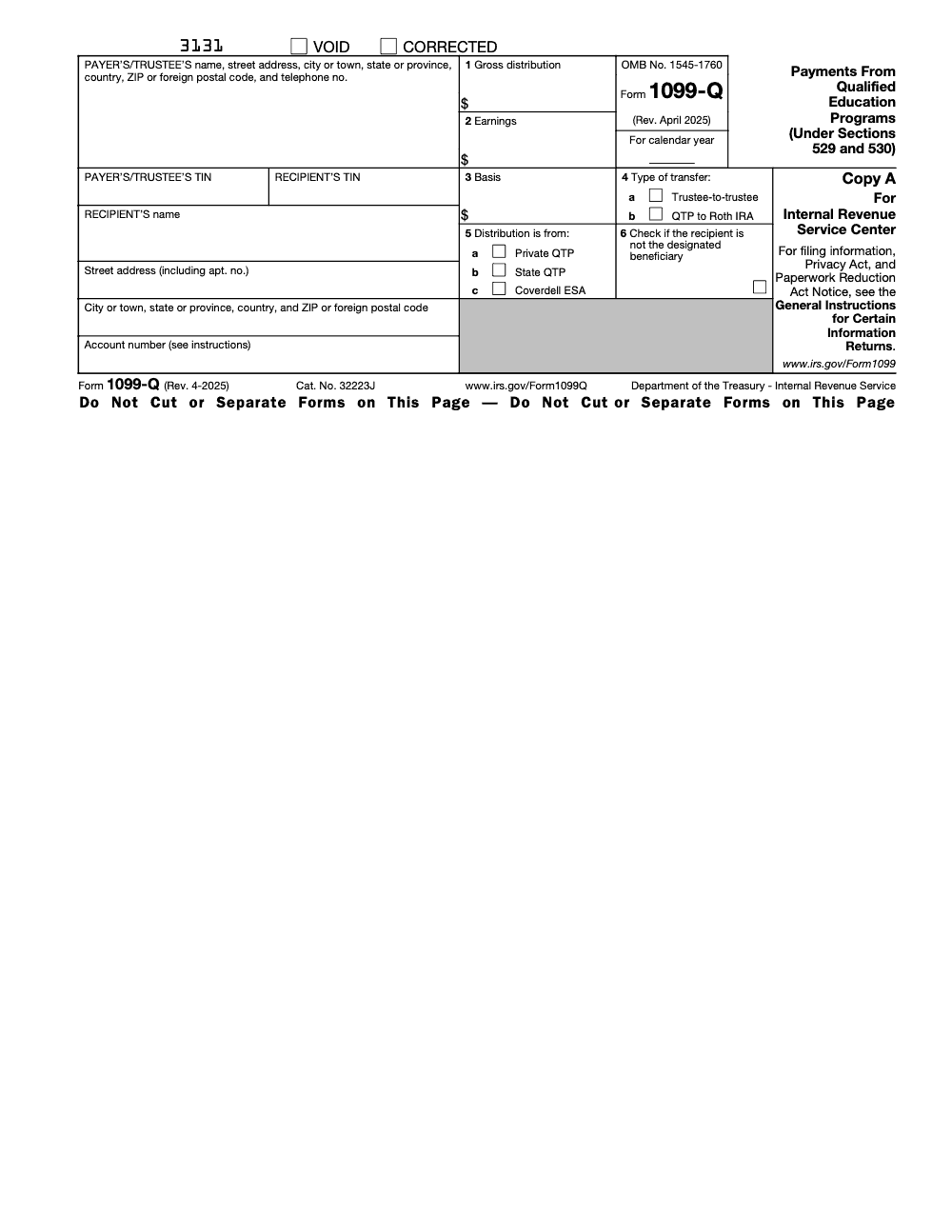
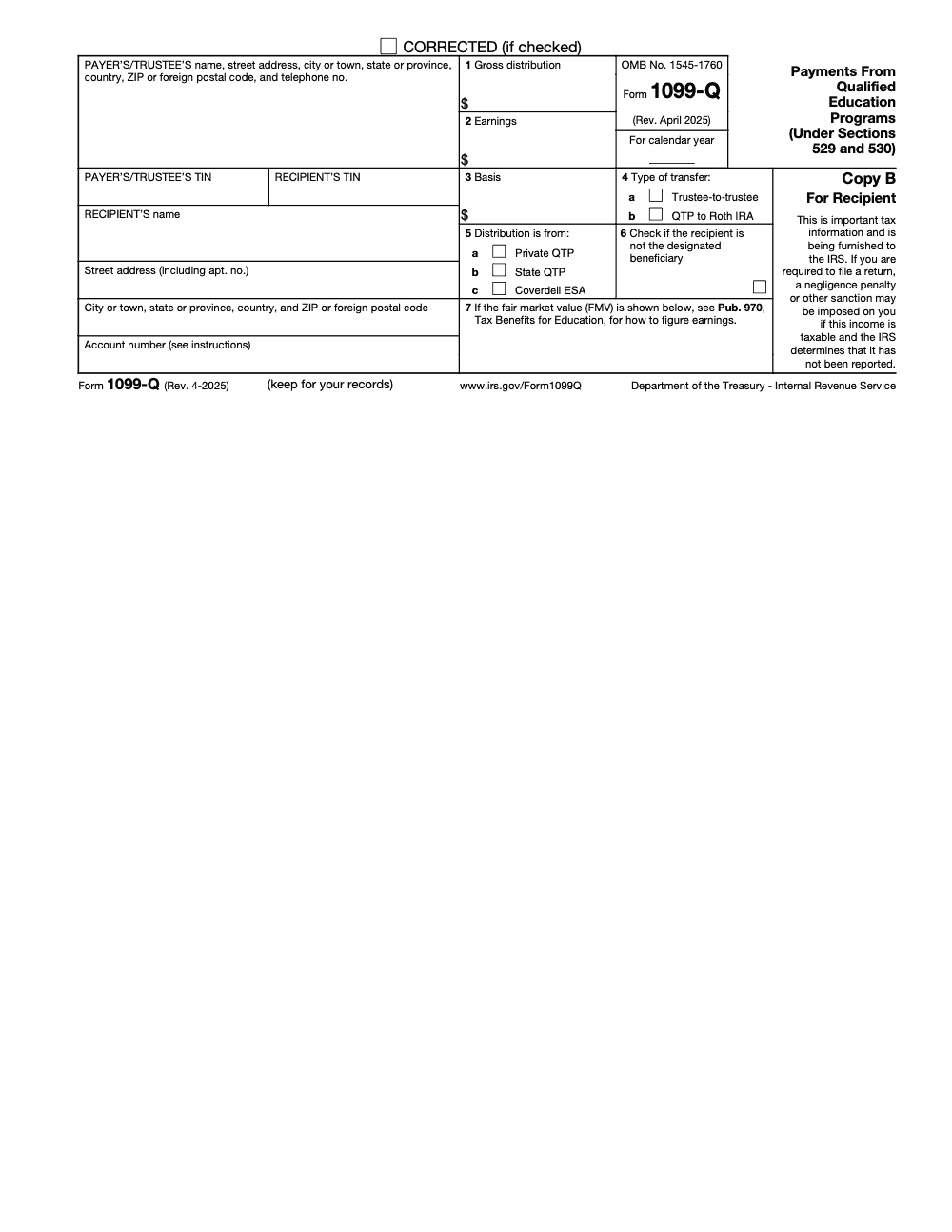
Form 1099-Q, Payments from Qualified Education Programs (Under Sections 529 and 530), is an information return filed by administrators of qualified tuition programs (QTPs, commonly called 529 plans) and Coverdell Education Savings Accounts (ESAs). The form reports the total distribution amount, the earnings portion, and the basis (return of contributions) portion of each distribution made during the calendar year.
The form is issued to the distributee – which is either the beneficiary (the student) or the account owner (often a parent), depending on where the funds were sent. If the 529 plan paid the educational institution directly, the 1099-Q goes to the beneficiary. If the funds went to the account owner, the 1099-Q goes to the account owner. This distinction matters for whose tax return picks up any taxable income from a non-qualified distribution.
What Qualifies as a 529 Plan
A 529 qualified tuition program includes prepaid tuition plans and education savings plans established and maintained by a state or educational institution under IRC §529. Starting with tax years after December 31, 2017, 529 plans were expanded to cover up to $10,000 per year in K–12 tuition. The SECURE Act further expanded qualifying uses to include certain apprenticeship programs and up to $10,000 in student loan repayments (lifetime). These expansions mean that the universe of distributions requiring 1099-Q review has grown considerably.
Coverdell ESA vs. 529 Plan – Same Form, Different Rules
Both Coverdell ESAs (Section 530) and 529 plans use Form 1099-Q, but there are important differences. Coverdell ESAs allow a broader range of qualified education expenses (including elementary and secondary school costs) and carry contribution limits ($2,000 per year per beneficiary). Box 5c on the 1099-Q is checked when the distribution is from a Coverdell ESA rather than a 529 plan (Box 5a is checked for a private QTP and Box 5b for a state QTP). The taxability analysis runs similarly, but the contribution limits and expense categories differ, so always confirm which account type you are working with before applying rules.
How to Complete Form 1099-Q
The filing obligation belongs to the program trustee or administrator, not the taxpayer. For CPA firms, the practical work is on the recipient side – interpreting the 1099-Q and determining whether any earnings are taxable. Here is how each box functions:
| Box | What It Contains | How It’s Used on the Return |
|---|---|---|
| Box 1 – Gross distribution | Total amount distributed from the account during the year, including in-kind distributions paid directly from the plan to the school – not just cash sent to the recipient | Compare to qualified education expenses; not automatically taxable |
| Box 2 – Earnings | The earnings (growth) portion of the distribution | Only the earnings portion of a non-qualified distribution is taxable – not the basis |
| Box 3 – Basis | The original contribution (basis) portion of the distribution | Always tax-free return of after-tax contributions; Box 1 = Box 2 + Box 3 |
| Box 4 – Trustee-to-trustee transfer | Box 4a is checked for trustee-to-trustee transfers (QTP-to-QTP, CESA-to-CESA, CESA-to-QTP, or QTP-to-ABLE); Box 4b is checked for QTP-to-Roth IRA rollovers under SECURE 2.0 | Rollovers are not taxable; no further action needed on the return if checked |
| Box 5 – Distribution source checkbox | Box 5a (Private QTP), Box 5b (State QTP), or Box 5c (Coverdell ESA) is checked to identify the account type the distribution came from | Identifies the plan type so the correct qualified-expense and contribution rules apply on the recipient’s return |
| Box 6 – Recipient is not the designated beneficiary | Checked when the recipient of the distribution is someone other than the designated beneficiary (e.g., a parent recipient paying a student-beneficiary’s tuition) | Taxability and the 10% additional tax are computed at the recipient’s return level, not the beneficiary’s |
| Box 7 – Fair market value (Copy B) / optional distribution code | For CESA distributions, the payer/trustee may report the December 31 FMV here in lieu of Boxes 2 and 3; also the optional location for distribution codes 1–6 | If Box 7 shows an FMV with Box 2 blank, use the Pub 970 Coverdell worksheet to compute taxable earnings; codes 1–6 identify the distribution type |
Calculating the Taxable Portion of a Non-Qualified Distribution
When total distributions exceed qualified education expenses, a portion of the earnings is taxable. The calculation is straightforward once you have the right numbers. First, determine the adjusted qualified education expenses (AQEE) by reducing the gross qualified expenses by any tax-free amounts: scholarships, employer-provided education assistance, and the portion of expenses used to claim an education credit (American Opportunity or Lifetime Learning). Then use the ratio of AQEE to gross distribution to determine what fraction of the earnings is excludable. The remainder is ordinary income plus the 10% additional tax under IRC §529(c)(3)(A).
From my side of the desk, the credit coordination step is the most frequently botched. A family that claimed the full American Opportunity Credit on $4,000 of expenses cannot also use that same $4,000 to justify a tax-free 529 distribution. Doubling up the same expenses for two tax benefits is not allowed under the anti-double-benefit rules. I build a simple spreadsheet that reconciles total qualified expenses, allocations to each benefit, and what remains to justify the 529 distribution – it takes 10 minutes and catches errors before they cause problems.
Deadlines, Penalties, and Filing Requirements
| Requirement | Date | Notes |
|---|---|---|
| Furnish Copy B to recipient | January 31 (February 2, 2026 for tax year 2025 – weekend shift) | Sent to account owner or beneficiary, depending on who received funds |
| Paper filing with IRS (Copy A + Form 1096) | February 28 | Manual filers use Form 1096 as a transmittal |
| Electronic filing via FIRE system | March 31 | Required for filers submitting 10 or more information returns in aggregate |
| E-file threshold (mandatory) | 10+ returns aggregate | Applies in aggregate across ALL information return types (1099-series, W-2, 1098, 3921, 3922, 5498, W-2G) filed by the same entity – not just 1099-series alone |
Penalties for Late or Incorrect Filing
Penalties follow the standard information return penalty structure: $60 per return if corrected within 30 days, $130 per return if corrected after 30 days but by August 1, and $340 per return if filed after August 1 or not at all. Intentional disregard carries a minimum of $680 per return with no annual cap. For plan administrators filing high volumes of 1099-Qs, the aggregate exposure can be significant – get corrections in early.
No Separate Form for the Recipient
Unlike some other information returns, there is no separate IRS form the recipient files to report 1099-Q income. If the distribution is fully qualified, nothing appears on the return. If there is a taxable portion, the earnings are reported on Schedule 1, line 8z (other income), and the 10% additional tax is computed on Form 5329, Part II. The 1099-Q is not attached to the return.
Qualified Education Expenses – What Counts and What Doesn’t
Knowing what qualifies is the core of every 1099-Q analysis. For higher education (529 plans used for college), qualified expenses include tuition, fees required for enrollment, books, supplies, and equipment required for courses, as well as room and board up to the school’s published cost of attendance allowance. Special needs services also qualify. What does not qualify: transportation, health insurance, optional equipment not required for courses, and extracurricular activity fees.
K–12 Tuition Expansion
Under the Tax Cuts and Jobs Act of 2017, 529 plan funds can be used for up to $10,000 per year in tuition at elementary or secondary schools (public, private, or religious). Note that this $10,000 limit is per beneficiary, not per account – if a family has multiple 529 accounts for one child, the combined K–12 limit is still $10,000. State conformity varies; some states do not conform to the K–12 expansion and may tax those distributions at the state level even if they are federal-free.
Student Loan Repayment Distributions
The SECURE Act of 2019 added student loan repayment as a qualified expense, with a lifetime limit of $10,000 per beneficiary (and an additional $10,000 for siblings of the designated beneficiary). This is a relatively new use case, and I’ve seen preparers miss it because the clients don’t volunteer that they used 529 funds for loan repayment. Always ask specifically whether any 529 distributions were used to pay student loans – it is a legitimate qualified use that protects the distribution from tax.
Apprenticeship Programs
Also added by the SECURE Act: registered apprenticeship programs are now qualified education expenses for 529 purposes. The apprenticeship program must be registered with the Secretary of Labor. This is an emerging planning opportunity for clients whose children are entering skilled trades rather than four-year colleges.
Rollovers and Beneficiary Changes
A trustee-to-trustee rollover from one 529 plan to another for the same beneficiary, to a family member’s plan, or to an ABLE account (Section 529A) within 60 days, is not a taxable distribution. Box 4 on the 1099-Q will be checked when a direct rollover occurs. Indirect rollovers (funds go to the account owner first, then to the new plan) must be completed within 60 days and are limited to one per 12-month period per beneficiary.
Starting with the SECURE 2.0 Act of 2022, a 529 plan can roll over up to $35,000 (lifetime, per beneficiary) to a Roth IRA for the same beneficiary, subject to conditions: the 529 account must have been open for at least 15 years, contributions and earnings from the last five years are excluded from rollover eligibility, any single year’s rollover cannot exceed the annual IRA contribution limit (so the $35,000 lifetime cap is typically spread over several years), and the Roth IRA owner must be the designated beneficiary of the 529. This is a significant new planning tool, and understanding when a 1099-Q reflects a Roth rollover versus a taxable non-qualified distribution will be increasingly important.
Common Mistakes That Slow Things Down
Most 1099-Q errors come from treating the recipient copy like a 1099-INT or 1099-DIV and assuming the whole box reports taxable income. That assumption costs clients real money during a non-qualified year, and it creates avoidable basis disputes in audit prep. The patterns below show up across both 529 plan and Coverdell ESA engagements every season.
Practical Checklists You Can Reuse
These checklists are copy-paste ready for firm SOPs and trustee year-end binders. The structure mirrors the workflow most teams already use, with the 1099-Q edge cases baked in so nothing slips through review.
Qualified-Expense Reconciliation Packet
- Pull the 1099-Q and confirm Box 1 equals Box 2 plus Box 3.
- Identify the recipient (note Box 6) and route any taxability to the correct return.
- Collect the 1098-T, room and board statements, books receipts, and required fees.
- Subtract tax-free scholarships and any expenses already used for the American Opportunity or Lifetime Learning Credit (anti-double-benefit rule under IRC Section 529(c)(3)(B)).
- Compute the qualified-expense ratio and apply it to Box 2 earnings per IRS Publication 970.
- Document any non-qualified portion and compute the 10% additional tax on Form 5329.
- Archive the worksheet and supporting receipts in the client folder.
Trustee Year-End 1099-Q Filing Packet
- Confirm the calendar-year distribution log against the plan's general ledger.
- Map each distribution to the right account, recipient TIN (full TIN to IRS, last four on Copy B), and designated beneficiary.
- Check Box 6 on every record where the recipient differs from the designated beneficiary.
- Apply the right Section 529 (Box 5b state QTP or 5a private QTP) or Section 530 (Box 5c CESA) checkbox per account type.
- Code each distribution 1 through 6 in Box 7 where the trustee elects optional reporting.
- Run the aggregate information-return count and confirm e-file mandate compliance (10-return aggregate threshold per T.D. 9972).
- Furnish Copy B to recipients by February 2, 2026.
- File paper with the IRS by February 28, 2026, or electronic by March 31, 2026.
- Archive the transmittal confirmation; do not cut or separate Copy A pages filed on paper.
Rollover Documentation Packet
- Capture the distribution date and the 60-day rollover deadline on the engagement calendar.
- Pull the prior 12 months of 1099-Q history to confirm no other QTP rollover for this beneficiary.
- For Box 4b (529 to Roth IRA): verify the 15-year account age, the $35,000 lifetime cap, the annual IRA contribution limit, and that the Roth owner is the designated 529 beneficiary.
- For CESA-to-CESA or CESA-to-QTP transfers: confirm the new beneficiary is a family member under age 30 (or a special-needs beneficiary).
- Capture the receiving account confirmation letter and account number.
- File the rollover documentation alongside the original 1099-Q workpaper for the audit binder.
Keep 1099-Q Season From Stalling
The 1099-Q workload hits firms in two distinct waves. The first is the late-January trustee scramble: 529 administrators and Coverdell ESA custodians have to furnish Copy B by February 2, 2026, file paper with the IRS by February 28, 2026, and file electronically by March 31, 2026 (per the General Instructions for Certain Information Returns). The second wave hits in March and April when individual returns force a qualified-expense reconciliation against every 1099-Q that came in.
Both waves break for the same three reasons: the recipient and designated beneficiary often differ, the basis-versus-earnings math gets skipped, and Box 4b SECURE 2.0 rollovers introduce a new edge case most preparers see only once or twice a year. The fix is documentation discipline, not extra hours.
- Lock a Box 1 equals Box 2 plus Box 3 reconciliation step into every 1099-Q workpaper, with the qualified-expense allocation captured before the return is keyed.
- Pre-build a recipient versus designated beneficiary screen so Box 6 is never an afterthought during parent-funded tuition payments.
- Calendar the 60-day rollover window the day the distribution clears, and require the receiving-account confirmation before the file closes.
- For Box 4b rollovers, run a four-point check on every record: 15-year account age, $35,000 lifetime cap, annual IRA contribution limit, and Roth owner equals the 529 designated beneficiary.
- Track state-level conformity with the federal K-12 529 carve-out so the federal treatment does not flow through unchecked at the state return.
Accountably builds the same discipline into delivery: documented SOPs, multi-layer review, and turnaround SLAs that hold across the January trustee filings and the March-April individual reconciliation crunch. See our tax outsourcing services for how the workflow fits inside your existing tools.
FAQs
Not necessarily. If the total distributions shown on Form 1099-Q were used entirely for qualified education expenses – after reducing for scholarships and any expenses used to claim education credits – the distribution is completely tax-free and nothing appears on your return. The IRS receives a copy from the program administrator, so it knows the distribution occurred, but a matching return entry is only required if there is a taxable portion.
The earnings portion of a non-qualified distribution is includable in gross income as ordinary income and is also subject to a 10% additional tax, similar to an early IRA withdrawal penalty. The basis portion (original after-tax contributions) is always returned tax-free. Certain exceptions waive the 10% penalty: death or disability of the beneficiary, a tax-free scholarship received, attendance at a U.S. military academy, or receipt of employer-provided educational assistance.
Federal law allows up to $10,000 per year per beneficiary in 529 plan funds to be used for tuition at an elementary or secondary school (public, private, or religious) on a tax-free basis. However, many states do not conform to this federal expansion and will tax K–12 529 distributions at the state level, and some will recapture any prior-year state deduction taken for the contribution. Always confirm your state’s treatment before advising on K–12 withdrawals.
It depends on who received the funds. If the 529 plan paid the educational institution directly, the 1099-Q goes to the beneficiary (the student). If the funds were distributed to the account owner (typically a parent), the 1099-Q goes to the account owner. Any taxable income from a non-qualified distribution is reported on the return of whoever received the 1099-Q, not necessarily whoever set up the account. When the recipient and the designated beneficiary are different people (a parent recipient paying a student-beneficiary’s tuition is the classic case), Box 6 on the 1099-Q must be checked and taxability plus the 10% additional tax are computed at the recipient’s tax-return level.
No. The anti-double-benefit rule under IRC §529(c)(3)(B) prevents you from using the same expenses to justify both a tax-free 529 distribution and an education credit. In practice, you can split expenses: allocate some tuition to the education credit and use the 529 distribution for the remaining expenses (or for room and board, which the credits don’t cover). The key is that the same dollar of expense can only support one tax benefit.
Yes. Under SECURE 2.0, up to $35,000 lifetime can be rolled from a 529 to a Roth IRA for the same beneficiary, subject to conditions including the 529 being open at least 15 years. The 529 administrator would issue a 1099-Q showing the rollover distribution – the recipient should treat it as a Roth IRA contribution on their return (subject to annual IRA contribution limits), not as a taxable withdrawal. The tax software handling is still evolving, so verify current IRS guidance for the specific tax year.
Other forms this guide names
Summarize this article with AI
About this guide
Accountably helps US CPA, EA, and accounting firms hire trained accountants and tax preparers in India.
About us Reviewed byJugal Thacker, CPAFounder and CEO at Accountably
A Washington-licensed CPA with 7+ years inside US firms – PwC, a real-estate tax practice, then a full-service firm, rising from reviewer to manager to advisory. This article was reviewed against current IRS guidance for the 2025 tax year and updated for filers preparing late returns, amendments, and 2026 estimates.
View profile →How we research, review, and update this guide
Every Accountably guide is researched against primary IRS sources, reviewed by a U.S. CPA, and refreshed as guidance evolves. Read our Editorial Guidelines to see how we source, fact-check, and update our content.