Summarize this article with AI
In Brief
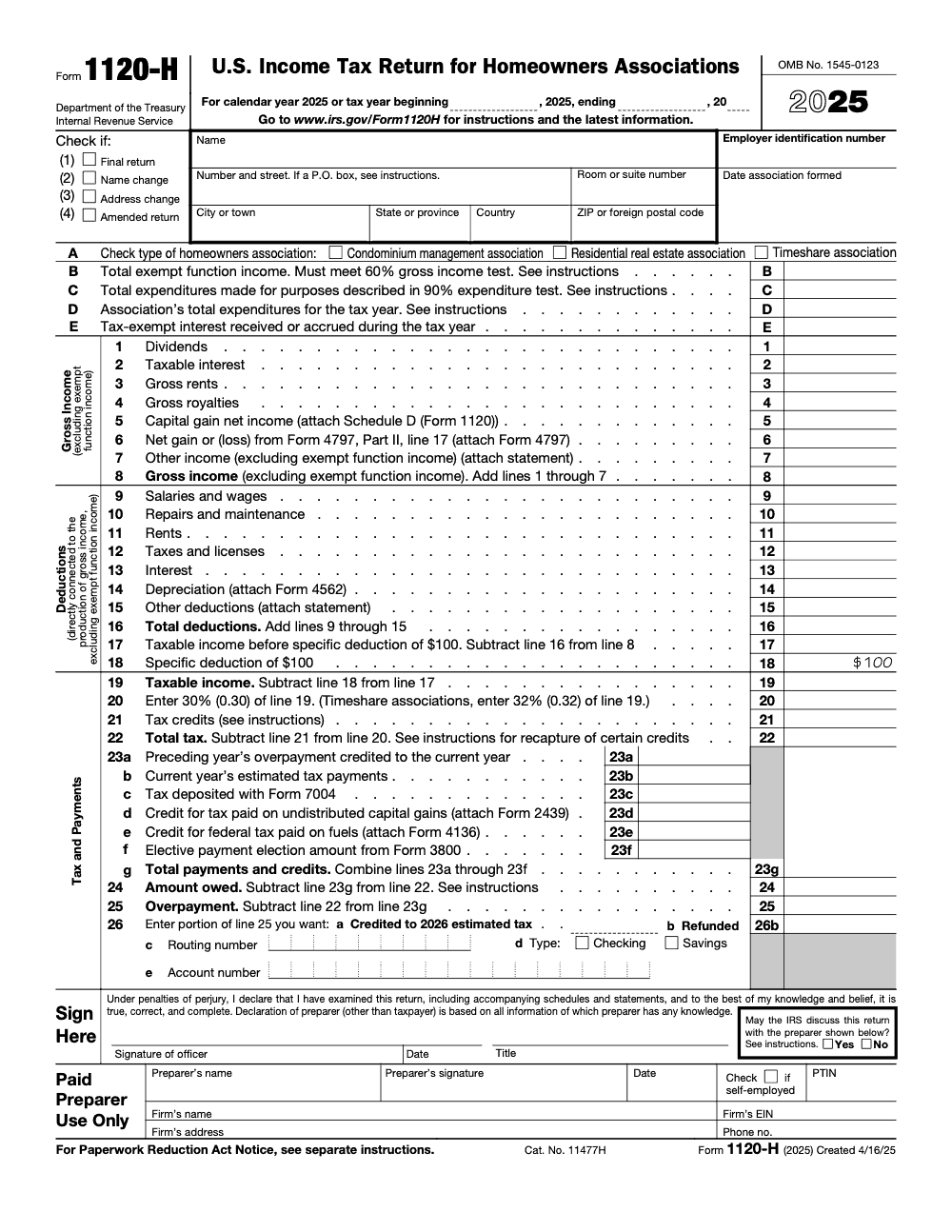
Form 1120-H is the U.S. Income Tax Return for Homeowners Associations – an annual Section 528 election that lets a qualifying condominium, residential real estate, or timeshare association exclude exempt function income (member dues, fees, and assessments) from gross income and tax only non-exempt income (per the 2025 Form 1120-H instructions on IRS.gov, OMB 1545-0123). The association must pass the 60% gross income test on Box B and the 90% expenditure test on Box C, then pay a flat 30% on line 20 (32% for timeshare associations) after the $100 specific deduction on line 18. See our tax services for filing support, or compare to other corporate returns on the IRS Forms hub.
A board treasurer finds that last year's preparer never made the Section 528 election, or that interest on the association's money-market sweep was treated as dues, when interest is generally non-exempt income. Form 1120-H is the annual Section 528 election that lets a qualifying homeowners association exclude exempt function income, member dues, fees, and assessments, and tax only non-exempt income.
To qualify, the association must pass the 60% gross income test on Box B and the 90% expenditure test on Box C every tax year, then pay a flat 30% on line 20, or 32% for a timeshare association, after the $100 specific deduction on line 18. If it does not qualify or does not elect, it files Form 1120, and the total tax is worth comparing both ways each year.
Key Takeaways
- Form 1120‑H is an annual election under Section 528 that lets qualifying associations exclude exempt‑function income and tax only net non‑exempt income.
- To qualify, you must meet the 60% gross income and 90% expenditure tests and avoid private inurement, every tax year.
- The federal tax is a flat 30%, or 32% for timeshare associations, applied to net non‑exempt income after allowable allocations and a $100 specific deduction.
- The due date is the 15th day of the 4th month after year end, with a June 30 fiscal year exception. File Form 7004 for time to file, not to pay.
- If you do not elect or do not qualify, file Form 1120 and compare the total tax both ways each year.
What Form 1120‑H Actually Does
Although it looks like a corporate return, Form 1120‑H is a special election for homeowners associations, condominium associations, residential real estate management associations, and timeshare associations (commercial property associations are not eligible under section 528 even if they appear similar in structure). When you qualify and elect, you exclude exempt‑function income from owners, and you only tax the net from non‑exempt items, after direct and properly allocated expenses plus the $100 deduction. That simplicity is the point, but it only works if your books are classified and documented correctly.
Who Qualifies Under Section 528
Section 528 sets four guardrails you have to clear each year.
- Organizational purpose, you operate primarily to acquire, build, manage, maintain, or care for association property for owners.
- Residential use, substantially all units are homes for individuals.
- Income ratio, at least 60% of gross income is exempt‑function income.
- Expenditure ratio, at least 90% of expenses relate to acquiring, building, managing, maintaining, or caring for association property.
- No private inurement, no person benefits from net earnings except by caring for association property or by a rebate of excess dues.
Organizational Purpose Test
Your governing documents and operations should point to one thing, caring for common property for the owners. Spell it out in articles, bylaws, covenants, and board minutes, and keep your activities aligned with that purpose. If your documents read like a commercial landlord, that undercuts Section 528 status.
- Put common‑area care front and center in governing documents.
- Show assessments fund maintenance and management.
- Avoid commercial language and non‑owner uses that look like a for‑profit business.
Residential Use Threshold
Practically, HOAs usually satisfy the “substantially all” residential‑use expectation with about 85% used as residences. Count units or membership interests, not owners. Timeshares are a defined association type under 528, they use a higher tax rate. Keep yearly evidence, deeds, occupancy, usage logs, and leases.
| Unit Type | Counts Toward Residential Use? | Typical Evidence |
| Condominium | Yes | Deed, occupancy records |
| Cooperative | Yes | Share and occupancy records |
| Timeshare | Yes | Usage logs |
| Short‑term rental where owner’s primary use is residential | Often yes | Owner occupancy proof |
| Predominant commercial rental to nonowners | No | Third‑party leases |
Income And Expenditure Ratios
You must hit both ratios every year.
- Income test, at least 60% of gross income is exempt‑function income from owners paying assessments as owners.
- Expenditure test, at least 90% of total expenses are for association property, including maintenance, management, repair, acquisition, construction, and similar.
- Private inurement is not allowed.
Practical tips:
- Classify every revenue line, owner assessments versus member‑customer charges and nonmember receipts.
- Reconcile exempt‑function income to total gross income.
- Tag expenses to property functions, and document allocations for mixed costs like insurance and management.
Exempt‑Function Income, What Counts And What Does Not
“Exempt‑function income” is money from owner‑members in their capacity as owners to fund the association’s management, maintenance, construction, acquisition, or care of association property. Think regular dues, special assessments for roof replacement, reserve contributions, snow removal, and landscaping. These amounts drive the 60% test and get excluded from gross income on Form 1120‑H.
Keep this bright line in mind, when owners act like customers, the income is not exempt. A pool day pass, a private clubhouse party rental, vending, laundry, paid parking, guest fees, even third‑party cell tower rent, all land in the non‑exempt bucket. Interest, dividends, and capital gains are generally non‑exempt too.
Rule of thumb, dues and assessments for common property are exempt, sales‑like charges and investment returns are not. When in doubt, document the purpose and the user.
Non‑Exempt Income And How Tax Applies
Even when you qualify to file 1120‑H, you must isolate non‑exempt items because only those are taxed. Start with a clean P&L segmentation:
- Member‑customer income, pool and amenity day passes, clubhouse rentals, event fees.
- Nonmember income, outside rentals, cell towers, third‑party events.
- Investment items, interest, dividends, capital gains.
From there:
- Subtract expenses directly tied to those revenue lines, such as cleaning, security, rental advertising, and staffing.
- Allocate a reasonable share of mixed expenses, management, insurance, utilities, accounting, to the taxable activities.
- After those deductions, apply the $100 specific deduction to arrive at taxable income.
- Multiply by 30%, or 32% for timeshares.
Deductions And Allocations You Can Actually Support
Documentation wins audits. Create a standard allocation memo that explains your method and keep backup every year.
Deductible Operating Costs
- Deduct ordinary and necessary costs directly tied to non‑exempt income, for example, clubhouse repairs used for paid rentals, rental advertising, extra cleaning, or event security.
- Allocate a reasonable slice of mixed costs, management fees, utilities, insurance, legal, and accounting, using time, usage, or revenue methods, then apply the share to non‑exempt income.
- Capital items are not currently deductible, capitalize or depreciate as appropriate under corporate rules.
- Always apply the $100 specific deduction after other allowable deductions (the $100 amount is fixed by section 528 and is not indexed for inflation, so it does not grow year over year).
Reserve Fund Expenses
Reserve contributions collected from owners are exempt‑function income. When you spend reserves for common‑area repairs and replacements, those are property expenses that help your 90% expenditure test. Reserve fund interest is typically non‑exempt, track it separately. Keep board approvals, the reserve study, vendor contracts, and invoices in one workpaper set so reviewers can follow the story in minutes, not hours.
Common Misclassifications That Cause Rework
- Treating guest and amenity fees as exempt. They are not.
- Dumping investment income into “assessments.” Keep a specific account for interest and dividends.
- Skipping expense allocations, which overstates taxable income.
- Mixing reserve activity with operating activity, which makes both tests harder to prove.
Micro‑anecdote, a condo client taxed all vending proceeds without deducting the cleaning and restocking charges the onsite vendor billed quarterly. Once we carved out those direct costs and an allocation of utilities and management time, taxable income dropped by more than half, and they still cleared the 60% and 90% tests with room to spare.
Election, Due Dates, And E‑File Notes
Electing is simple. You elect 1120‑H by filing it, and you do that every year. If you miss the election, regulations allow an automatic 12‑month window to correct the election if you act within 12 months of the original due date including extensions. Keep that in your back pocket for late‑season fixes.
- Due date, 15th day of the 4th month after your tax year ends, except June 30 fiscal years, which are due the 15th day of the 3rd month.
- If the date falls on a weekend or legal holiday, you file the next business day.
- Form 7004 extends time to file, not to pay.
- Associations filing 10 or more returns during the calendar year are required to e‑file 1120‑H unless a waiver applies.
Always pay any expected tax by the original due date to stop penalties and interest, even if you extend.
Form 1120‑H vs Form 1120, How To Choose Each Year
You should compare total tax under both paths. Form 1120‑H taxes only net non‑exempt income at a flat 30% or 32% for timeshares. Form 1120 uses the corporate framework with a 21% corporate rate and broader deductions, but it can tax more of your activity depending on how income and expenses classify under corporate rules. Run both returns in your software and pick the lower tax that is fully supportable.
Eligibility And Qualifications
You can only file 1120‑H if you qualify under Section 528, organizational purpose, residential use, 60% income, 90% expenditures, and no private inurement. If you fail any test, you must file Form 1120 for that year. Qualification is not optional.
Tax Rate Differences
- 1120‑H, 30% flat rate, or 32% for timeshares, applied to net non‑exempt income after the $100 deduction.
- 1120, 21% corporate rate, applied to taxable income under corporate rules.
| Scenario | Often Lower |
| Very low non‑exempt income with clean allocations | 1120‑H |
| Modest non‑exempt income with large allocable expenses | 1120‑H |
| Significant non‑exempt income or unusual deductions | 1120 |
| Timeshares with meaningful non‑exempt income | Often 1120 |
Pros, Cons, And Risk
- 1120‑H is specialized and simpler, which often means lower audit friction, provided your classifications are correct.
- The flat rate can be more expensive when non‑exempt income is high.
- 1120 may reduce rate to 21%, but brings corporate rules, different deductions, and more complexity.
- Misclassification risks penalties either way. Keep segregation and documentation tight.
Are There 2025 Changes You Should Know About
As of the IRS page review dates in January 2025, the IRS lists “Recent developments, None at this time” for About Form 1120‑H, and the 1120‑H instructions continue to show the 30% and 32% rates, the 60% and 90% tests, and the 4th‑month due date framework. Always check the current IRS page before filing, but there were no substantive changes posted as of those reviews.
How To Compute Taxable Income Under 1120‑H
Here is a simple, realistic walkthrough you can adapt to your association.
- Identify non‑exempt income, clubhouse rentals 5,200, guest passes 1,100, parking fees 2,400, interest 850, total 9,550.
- Direct costs, cleaning and supplies 1,300, rental ads 250, event security 200, total 1,750.
- Allocate shared costs, management 1,100, insurance 400, utilities 300, accounting 200, total 2,000.
- Net before specific deduction, 9,550 minus 1,750 minus 2,000 equals 5,800.
- Specific deduction, $100.
- Taxable income, 5,700.
- Tax, 5,700 times 30% equals 1,710. Timeshares use 32%.
Document the allocation method in a one‑page memo, then attach the workpapers that tie to your G/L. Reviewers and auditors will thank you.
Filing Steps In Software, Without Getting Lost
You can prepare 1120‑H in most business tax suites. The essentials are the same:
- Start a corporate return, then enable the Homeowners Association election, which generates Form 1120‑H.
- Enter exempt‑function income and exempt expenses in their designated fields for ratio tests and internal checks.
- Put non‑exempt income lines on the 1120‑H income screen, then allocate direct and shared expenses to those lines.
- Confirm the $100 specific deduction and the flat rate calculation.
- If you amend, file a new Form 1120‑H for that tax year with the amended flag set (do not use Form 1120‑X, which is for amending Form 1120, not 1120‑H) and follow your software’s print or e‑file rules. Many platforms now support e‑file for 1120‑H, and e‑file is required once you file 10 or more total federal returns in a calendar year unless you have an approved waiver.
Common Preparation Mistakes
- Entering all assessments as one lump sum, then forgetting to tag member‑customer items separately.
- Skipping the allocation of shared costs to taxable activities.
- Forgetting the $100 deduction.
- Missing the due date math for non‑calendar fiscal years.
How Disciplined Delivery Improves 1120‑H Accuracy
This return rewards structure. Standard operating procedures, consistent workpaper naming, live status tracking, and layered review save partner time and cut rework. If your firm is scaling HOA work and peak‑season reviews bog down, consider a delivery model that puts documentation, allocation memos, and reviewer‑ready 1120‑H packages on rails. A U.S.‑led offshore partner that embeds teams into your workflow, with SOPs, SLAs, and quality checks, can create stable capacity without chaos. That is the kind of controlled model Accountably builds for firms that need predictable turnaround and review protection, while working in your systems and templates. Use it where it genuinely helps your workflow, not as a shortcut.
Capacity is not enough. Structure plus accountability is what keeps 1120‑H filings on time and on standard.
State Spotlight, Illinois, How 1120‑H Flows To IL‑1120
If your association operates in Illinois, your federal election drives the state return. Illinois requires corporations, including political organizations and homeowners’ associations that report federal taxable income on Form 1120‑H, to file Form IL‑1120. Illinois starts with your federal taxable income, then applies state additions, subtractions, and apportionment as needed.
Two key points from Illinois instructions:
- “Political organizations and homeowners’ associations” that file 1120‑H federally are subject to Illinois income and replacement taxes and “must file Form IL‑1120.”
- On IL‑1120, Step 2, Line 1 asks for federal taxable income from Form 1120, Line 30, or equivalent, with a copy of your federal return attached. For filers on 1120‑H, the “equivalent” is the federal taxable income on Form 1120‑H, Line 19, which is the line IRS instructions use to compute the 30% or 32% tax. Attach the federal return copy so the state can see the line reference.
Illinois Due Dates And Extensions
Illinois ties your state due date to your federal due date. For most filers, that is the 15th day of the 4th month after year end, or the 15th day of the 3rd month after year end for June 30 fiscal years. Illinois grants an automatic extension, seven months for most year ends and eight months for June 30 year ends. Pay any tax by the original due date to stop penalties and interest.
Illinois Reciprocity And Nonresident Wage Withholding, Quick Guide
Illinois has reciprocity with Iowa, Kentucky, Michigan, and Wisconsin. If a resident of one of those states works in Illinois, wages are generally exempt from Illinois income tax withholding when the employee gives the employer Form IL‑W‑5‑NR. If Illinois tax is withheld in error, the employee files IL‑1040 with Schedule NR and attaches a W‑2c or an employer letter to claim a refund. These rules apply to individual wages, they are separate from your HOA’s corporate filing, but many boards ask about them for staff or management company payroll.
Practical steps:
- Confirm the employee’s residency in IA, KY, MI, or WI.
- Collect IL‑W‑5‑NR to stop Illinois withholding.
- If withholding happened in error, file IL‑1040 and Schedule NR with required attachments to reclaim the over‑withheld amount.
For your corporate state return, keep the federal‑to‑state tie‑out, your IL‑1120 Step 2 worksheet, and apportionment schedules together. That single packet prevents most state notices.
A Simple 1120‑H Checklist
- Confirm organizational purpose and residential use.
- Test 60% exempt‑function income and 90% expenditures.
- Segregate exempt assessments from member‑customer and nonmember receipts.
- Allocate direct and shared costs to taxable lines, then apply the $100 deduction.
- Compute tax at 30%, or 32% for timeshares.
- File by the due date, extend with Form 7004 if needed, and e‑file if you cross the IRS threshold.
- For Illinois, complete IL‑1120, start with federal taxable income from your signed federal return, and keep all tie‑outs.
Closing Thoughts
If you felt a little stress reading this, that is normal. The trick is not to memorize every rule. It is to set up your books so the return almost fills itself. Classify income at the source, map non‑exempt activities to their costs, and write a short allocation memo every year. If your firm is handling dozens of associations and delivery keeps slipping, invest in structure, not heroics. That is how you protect review time, meet deadlines, and keep board questions easy to answer.
This article reflects IRS pages last reviewed in January 2025 and Illinois instructions updated through July 2025. Always confirm the latest IRS “About Form 1120‑H” page and the current state instruction set before filing.
Common Mistakes We See Every Season
These show up on nearly every HOA file we touch. Each one is preventable with a short qualification scan at intake and one disciplined review pass before the officer signs.
Reusable Checklists
Copy these into the firm SOP or the engagement file. They cover the qualification pass at intake, the non-exempt income build, and the annual signoff before the return is transmitted.
Section 528 qualification scan (at intake)
- Confirm the association is one of the three eligible types: condominium management, residential real estate, or timeshare.
- Compute gross income for the tax year, excluding exempt function income from lines 1 through 7.
- Calculate Box B as exempt function income divided by gross income, then verify the result is at least 60%.
- Calculate Box C as exempt-purpose expenditures divided by total expenditures (Box D), then verify the result is at least 90%.
- Confirm the association's EIN is on file and not an officer's Social Security Number.
- Note the officer who will sign and record their title (president, treasurer, or other authorized officer) in the engagement memo.
- Flag any prior year filed on Form 1120 so the workpaper documents this year's annual election decision.
Non-exempt income and allocation workpaper
- Pull taxable interest to line 2 separately from tax-exempt interest, which goes on Box E.
- Reconcile dividends (line 1), gross rents (line 3), and gross royalties (line 4) to the trial balance.
- Attach Schedule D (Form 1120) for any capital gain net income on line 5 – not Schedule D (Form 1040).
- Attach Form 4797 for Part II gain or loss on line 6, and a supporting statement for any line 7 other income.
- Allocate salaries, repairs, rents, taxes, interest, and depreciation only to the extent directly connected to non-exempt gross income (lines 9 through 15).
- Attach Form 4562 for depreciation on line 14 and a supporting statement for line 15 other deductions.
- Subtract total deductions (line 16) from gross income (line 8) to arrive at line 17, then apply the $100 specific deduction on line 18 before the flat rate on line 20.
Annual signoff, extension, and refund handoff
- Verify the tax rate on line 20 against the association type: 30% for condominium and residential real estate, 32% for timeshare.
- Reconcile lines 23a through 23f against client deposit records and confirm the total on line 23g.
- If filing an extension, prepare Form 7004 and record any deposit on line 23c – Form 7004 extends time to file, not time to pay.
- Complete the line 26 direct deposit fields (routing, account type, account number) only if the association requests a refund.
- Have an officer sign and date the signature block, and confirm whether the IRS may discuss the return with the paid preparer.
- Save the filing confirmation, the Box B and Box C calculations, and the annual election memo in the engagement file.
Keep 1120-H Season From Stalling
HOA returns rarely make the top of a season planning meeting. Per-return revenue is modest, the work clusters between the April calendar-year due date and the October extensions, and the whole return funnels through a handful of qualifier boxes (B and C) plus a flat tax line. That low ceiling is exactly why the work stalls – preparers treat the file as routine, skip the annual Section 528 election decision, or copy last year's exempt function income classification without rerunning the 60% test against this year's gross income (per the 2025 Form 1120-H instructions, OMB 1545-0123).
The discipline is not heroic. It is a short qualification scan at intake, a tagged expense reconciliation for the 90% test, and a documented decision on whether Form 1120 or Form 1120-H produces the lower correct tax for the year.
- Run Box B (60% gross income) and Box C (90% expenditures) before any return work begins. If either fails, the file routes to Form 1120 and the rest of the workpaper changes.
- Tag every expense line with an exempt-purpose flag during reconciliation so the 90% test has an evidence trail, not a year-end estimate.
- Allocate deductions on lines 9 through 15 only to the extent they are directly connected to non-exempt gross income on lines 1 through 7. The directly-connected requirement is the single most common review note on these files.
- Confirm the tax rate on line 20 against the association type at the top of the return: 30% for condominium management and residential real estate associations, 32% for timeshare associations.
- If amending, file a new Form 1120-H with the Amended return box checked. Form 1120-X is not the right vehicle here.
That is where structured delivery earns its keep. If HOA work keeps slipping in the spring pipeline and the qualification scan is getting pushed to the last week, look at our tax services – we run the Box B and Box C calculations, the allocation memo, and the dual-rate workpaper inside the engagement file so the reviewer signs once, not three times.
FAQs
It is the IRS return that lets a qualifying HOA, condo association, residential real estate management association, or timeshare association elect Section 528 each year, exclude exempt‑function income, and pay a flat tax on net non‑exempt income.
For calendar years, it is April 15. In general, the due date is the 15th day of the 4th month after your tax year ends, with special rules for June 30 fiscal years. File Form 7004 to extend time to file. Pay by the original due date.
At least 60% of gross income must be exempt‑function income from owners as owners, and at least 90% of expenses must be for acquiring, building, managing, maintaining, or caring for association property. Both tests apply every year.
You cannot elect 1120‑H for that year. File Form 1120, model the tax, and tighten classifications and spending documentation for next year.
A flat 30% applies to taxable non‑exempt income, or 32% for timeshares. The $100 specific deduction reduces taxable income after other allowable deductions.
No. Interest, dividends, and capital gains are typically non‑exempt, so you allocate related expenses, apply the $100 deduction, and tax the net at the flat rate.
Yes, the election is annual. Compare total tax and compliance fit each year, then file the form that produces the correct, lowest tax consistent with your facts.
Other forms this guide names
- Form 1120: Corporation Tax Return Guide
- Form 7004: Business Tax Extension Guide, Deadlines & E‑File
- Form 1120-X: Amend a Corporate Return, Deadlines, Refunds
Summarize this article with AI
About this guide
Accountably helps US CPA, EA, and accounting firms hire trained accountants and tax preparers in India.
About us Reviewed byJugal Thacker, CPAFounder and CEO at Accountably
A Washington-licensed CPA with 7+ years inside US firms – PwC, a real-estate tax practice, then a full-service firm, rising from reviewer to manager to advisory. This article was reviewed against current IRS guidance for the 2025 tax year and updated for filers preparing late returns, amendments, and 2026 estimates.
View profile →How we research, review, and update this guide
Every Accountably guide is researched against primary IRS sources, reviewed by a U.S. CPA, and refreshed as guidance evolves. Read our Editorial Guidelines to see how we source, fact-check, and update our content.