Summarize this article with AI
In Brief
Form 15106 is the IRS Request for Updated Taxpayer Information, a single-page locator-assist form (July 2017 revision, Catalog Number 69800W) the IRS sends to a third party, not to the taxpayer. The U.S. Postal Service completes the For Use by Post Office Only section, and a non-postal third party answers the four Other Third Party Contact items. The form carries no deadline, dollar threshold, or penalty (per Form 15106, July 2017 revision). A taxpayer who wants to update their own address files Form 8822 instead.
The first time a client forwarded me a Form 15106, they assumed the IRS wanted them to confirm a new address. It does not work that way. The IRS sends Form 15106, the Request for Updated Taxpayer Information, to a third party such as an employer or the Post Office, not to the taxpayer, to help locate someone it can no longer reach.
It is a single-page locator-assist form (July 2017 revision, Catalog Number 69800W) with no deadline, dollar threshold, or penalty. A recipient is asked only to return locator details they already know: an updated address if it differs, telephone numbers if known, an employer's name and address if known. The For Use by Post Office Only checkboxes are reserved for postal personnel; everyone else answers only the four Other Third Party Contact items and leaves those boxes blank.
Key Takeaways
- Form 15106 is the IRS Request for Updated Taxpayer Information, a single-page locator-assist form (July 2017 revision, Catalog Number 69800W) the IRS sends to a third party, not to the taxpayer, to help locate a taxpayer it cannot reach.
- Who completes it: A third party the IRS contacts – the U.S. Postal Service in the For Use by Post Office Only section, or a non-postal contact such as an employer or neighbor in the four Other Third Party Contact items.
- No deadline or penalty: Form 15106 carries no filing deadline, dollar threshold, or penalty; a recipient is asked only to return what locator information they already know.
- What it asks: Known locator details only – an updated taxpayer address if it differs from the one on file, home and work telephone numbers if known, the employer’s name and address if known, and any other clue that may help locate the person.
- Restricted section: The For Use by Post Office Only checkboxes may be completed only by U.S. Postal Service personnel; other third parties answer only the four numbered items and leave those checkboxes blank.
- SOP tip: Confirm the form is the July 2017 revision, Catalog Number 69800W, leave the IRS-supplied taxpayer name, address, and case reference number untouched, and return it to the issuing office.
What Form 15106 Is and When to Use It
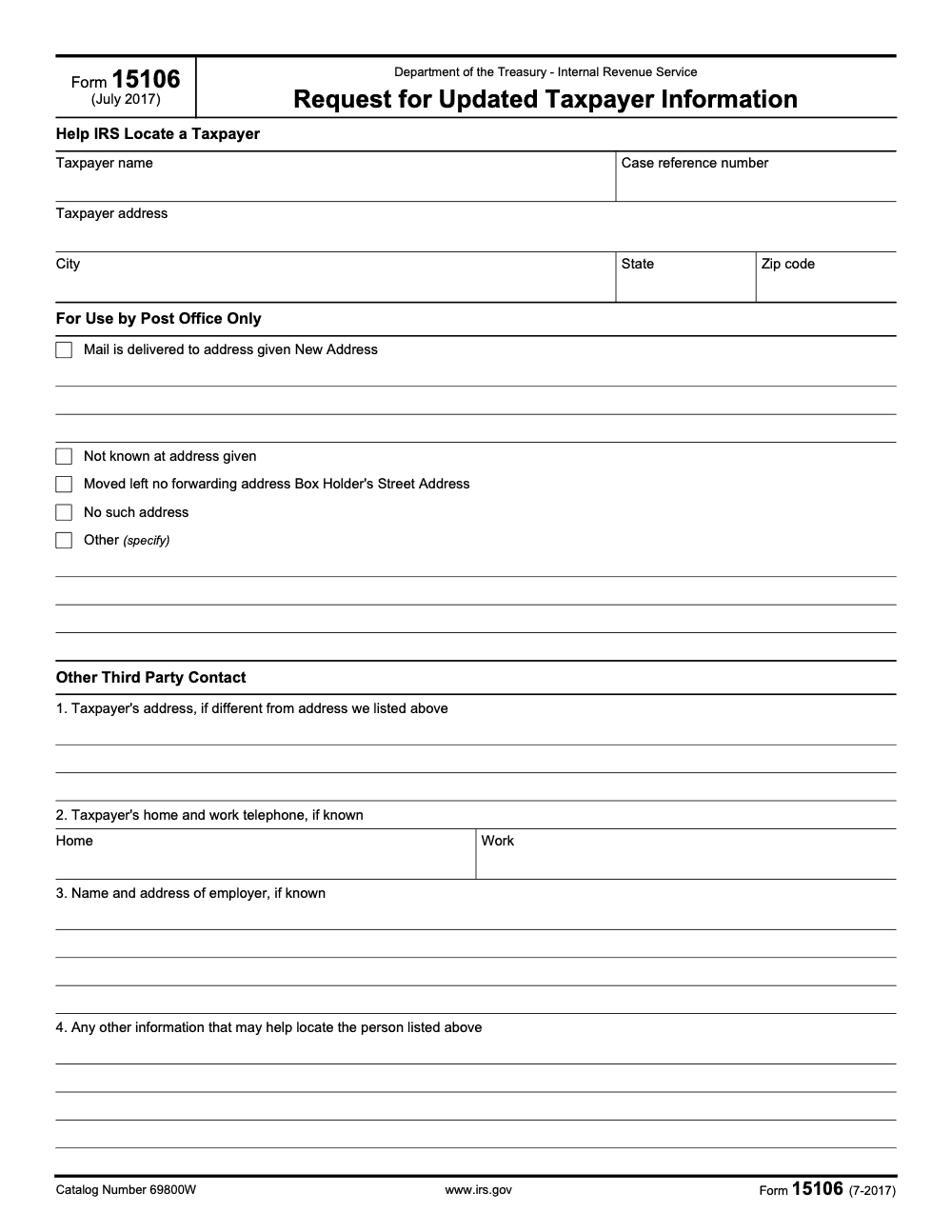
Form 15106, “Request for Updated Taxpayer Information,” is the single-page form the IRS sends to a third party – the U.S. Postal Service or another person who may know a taxpayer’s whereabouts – to help locate a taxpayer it can no longer reach. It is not a form the taxpayer files; a taxpayer who wants to change their own address on file uses Form 8822, or Form 8822-B for a business, instead.
The form is organized into three parts: a header block titled “Help IRS Locate a Taxpayer” that the IRS pre-prints with the taxpayer name, case reference number, and last known address; a “For Use by Post Office Only” section with five mail-delivery status checkboxes; and an “Other Third Party Contact” section with four numbered locator items. The recipient completes only the section that applies to them and returns the form to the issuing office.
How the Form Flows
The IRS issues Form 15106 as part of its effort to locate a taxpayer whose current address or contact information it does not have. It pre-prints the taxpayer name, last known address, and a case reference number that ties the form to one specific locate request, then sends it to a third party who may have useful information. The recipient marks the section that applies to them, supplies only the locator details they already know, and returns the form to the issuing office. There is no tax computation, no signature under penalty of perjury, and no filing deadline.
Why the IRS Contacts a Third Party
Form 15106 is one of the standard instruments the IRS uses in connection with third-party contacts while trying to locate a taxpayer. The IRS’s authority to make third-party contacts in collection cases is governed by Internal Revenue Code Section 7602(c) and the related taxpayer-notification rules. If no one returns the form, the IRS is not blocked; it simply keeps working from the last known address it already has on file, so a non-response carries no penalty for the taxpayer.
How to Complete Form 15106
| Section | What to Include | Practitioner Notes |
|---|---|---|
| Help IRS Locate a Taxpayer (header block) | Taxpayer name, case reference number, and the last known taxpayer address (with city, state, and zip code), all pre-printed by the IRS | Do not change these fields; they identify the specific locate request and must match when the form is returned |
| For Use by Post Office Only | One of five mail-delivery status options describing deliverability at the listed address | Completed only by U.S. Postal Service personnel; other recipients leave this section blank |
| Other Third Party Contact | Four numbered items: an alternate taxpayer address if different, home and work telephone if known, the employer’s name and address if known, and any other detail that may help locate the person | Completed by a non-postal third party; answer only what you already know and leave the rest blank |
The Two Response Sections
Form 15106 has two response areas, and each is restricted to a different kind of recipient. The For Use by Post Office Only section asks the carrier or post office to mark one of five status checkboxes that describe whether mail is still deliverable at the address the IRS has on file. The Other Third Party Contact section is for anyone else the IRS contacts, such as an employer or neighbor, to share known locator details. Quick rule you can copy into your SOP: identify the recipient role first, route the form to the right section, and never let a non-postal contact mark the Post Office checkboxes.
Deadlines, Penalties, and Filing Requirements
This is the section most people expect to be full of dates and dollar amounts, and it is the section that surprises them. Form 15106 carries no statutory deadline, no dollar threshold, and no penalty. It is a locator data request, not a tax filing, so there is nothing to compute and nothing that lapses on a calendar date.
| Question | Answer | Notes |
|---|---|---|
| Is there a filing deadline? | No fixed deadline | The form has no statutory due date; the IRS asks that it be returned promptly to the issuing office |
| Is there a penalty for not responding? | No penalty | Non-return creates no penalty for the taxpayer or the third party; the IRS continues working from the last known address |
| Are dollar thresholds involved? | None | The form captures no amounts, no tax computation, and no liability |
| Does it need a signature under penalty of perjury? | No | Form 15106 has no signature block, jurat, or penalty-of-perjury statement; it is a data request, not a return |
Who Receives Form 15106 and How to Respond
Knowing which recipient you are is the whole task. Form 15106 is sent to a third party, never to the taxpayer, and the form splits its response into two clearly labeled sections so the right person fills in the right part.
U.S. Postal Service Recipients
If the form reaches a post office, the carrier or postal staff complete the For Use by Post Office Only section. They select one of the five status options that describe deliverability at the listed address: mail is delivered to the address given (with space for a new address), the taxpayer is not known at the address given, the taxpayer moved and left no forwarding address (with space for a box holder’s street address if it is a P.O. box), no such address exists, or another status that the post office specifies in free text. From my side of the desk, the most common error here is a non-postal recipient marking these boxes, which the carrier alone can verify.
Other Third-Party Recipients
An employer, neighbor, or other contact answers only the four numbered Other Third Party Contact items: an alternate taxpayer address if it differs from the one the IRS listed, home and work telephone numbers if known, the employer’s name and address if known, and any other information that may help locate the person. Each item is qualified by “if known” or “if different,” so a recipient shares what they already have and leaves the rest blank. Whichever section applies, leave the pre-printed taxpayer name, address, and case reference number untouched and return the form to the office that issued it.
Common Mistakes That Slow Things Down
The errors I see with Form 15106 trace back to one misread: treating a third-party locator request as something the taxpayer files. These are the patterns that slow a response or send it to the wrong office.
Practical Checklists You Can Reuse
These checklists are copy-paste ready for your firm’s SOPs, with one path for each kind of Form 15106 recipient. Pick the block that matches who received the request.
Post Office response (USPS personnel only)
- Confirm the For Use by Post Office Only section applies to your delivery route.
- Select exactly one of the five status options that matches deliverability at the listed address.
- If mail is still delivered but to a different address on file, enter that new address under the first option.
- If the listed address is a P.O. box left with no forwarding address, enter the box holder’s street address if known.
- If you mark Other, specify the delivery status in the free-text space.
- Leave the IRS-supplied taxpayer name, address, and case reference number unchanged.
- Return the form to the IRS office that issued it.
Third-party response (employer, neighbor, or other contact)
- Skip the Post Office section, which is reserved for U.S. Postal Service personnel.
- Item 1: add a taxpayer address only if it differs from the one the IRS pre-printed.
- Item 2: enter home and work telephone numbers, if known.
- Item 3: enter the employer’s name and address, if known.
- Item 4: add any other detail that may help the IRS locate the person.
- Leave any item blank when you do not already know the answer.
- Keep the pre-printed name, address, and case reference number intact, then return the form.
Practitioner intake when a client receives Form 15106
- Confirm the form is the July 2017 revision, Catalog Number 69800W.
- Identify whether the client is the Post Office, a third party, or someone who confused it with an address change.
- If the client wants to change their own address, redirect them to Form 8822 or 8822-B.
- Note that response is discretionary and creates no taxpayer penalty for non-return.
- Document the known locator details, if any, the client chooses to provide.
- Log the IRS case reference number before the form is returned.
Keep 15106 Season From Stalling
Form 15106 has no filing season, yet it still lands on desks at the wrong moment. The IRS sends it to a third party, often an employer named under Item 3, to help locate a taxpayer it can no longer reach, and these third-party contacts run under the authority in Internal Revenue Code Section 7602(c) (per Form 15106, July 2017 revision). When the request sits in a mailroom or an AP inbox for weeks, the IRS simply keeps working from the address it already has, and your team loses the chance to close the contact cleanly.
The fix is not more effort, it is a defined response path so a one-page locator request never stalls. Treat Form 15106 like any other inbound IRS notice: identify the recipient role, answer only what is known, and send it back to the issuing office.
- Route the form by recipient role first, since the For Use by Post Office Only section is for USPS staff and the four Other Third Party Contact items are for everyone else.
- Answer Item 1 only when you hold an address that differs from the pre-printed one, and Items 2 and 3 only for telephone or employer details you already know.
- Leave unknown items blank, because response is discretionary and non-return creates no penalty for the taxpayer.
- Protect the pre-printed taxpayer name, address, and case reference number so the form matches its locate request on the way back.
- Confirm everyone is working from the July 2017 revision, Catalog Number 69800W, before any response goes out.
This is the same documentation discipline we bring to every inbound notice. Our tax execution teams build the SOP, log the case reference number, and keep third-party contacts moving so nothing stalls in an inbox.
FAQs
Form 15106, Request for Updated Taxpayer Information, is a single-page form the IRS sends to a third party to help locate a taxpayer it can no longer reach. The recipient marks the relevant section and returns whatever locator details they already know. It is not a tax return, and it is not filed by the taxpayer.
No. Form 15106 is a third-party locator request the IRS sends out, not a self-service address change. A taxpayer who wants to update their own address on file files Form 8822, or Form 8822-B for a business, instead of Form 15106.
Only U.S. Postal Service personnel responsible for delivery to the listed address complete that section, choosing one of the five mail-delivery status options. A non-postal third party, such as an employer or neighbor, answers only the four numbered Other Third Party Contact items and leaves the Post Office checkboxes blank.
The third-party items are qualified by “if known” and “if different,” so a recipient is asked only for information they already have and may leave any item blank. Non-return creates no penalty for the taxpayer; the IRS simply continues working from the last known address it already has on file.
Other forms this guide names
- Form 8822-B: IRS Change of Address and Responsible Party Guide
About this guide
Accountably helps US CPA, EA, and accounting firms hire trained accountants and tax preparers in India.
About us Reviewed byJugal Thacker, CPAFounder and CEO at Accountably
A Washington-licensed CPA with 7+ years inside US firms – PwC, a real-estate tax practice, then a full-service firm, rising from reviewer to manager to advisory. This article was reviewed against current IRS guidance for the 2025 tax year and updated for filers preparing late returns, amendments, and 2026 estimates.
View profile →How we research, review, and update this guide
Every Accountably guide is researched against primary IRS sources, reviewed by a U.S. CPA, and refreshed as guidance evolves. Read our Editorial Guidelines to see how we source, fact-check, and update our content.