Summarize this article with AI
In Brief
Form 15358 (Rev. 12-2021) is the IRS Coronavirus Safety Protocols template for VITA and TCE sites, a single-page fillable document (Catalog Number 74124X, as published on IRS.gov) that site coordinators complete to display the site's on-site safety protocols. It is not a tax return and is not filed with the IRS, so there is no filing deadline; sites post or retain the completed sheet for volunteer and visitor awareness. For practice-side compliance support, see Accountably's tax outsourcing services or browse the full IRS Forms library.
On a VITA opening morning, the protocol sheet is the thing that nobody quite owns. It gets squeezed between volunteer onboarding, intake setup, and the rush to open the doors, and that is exactly where Form 15358 lives. It is the IRS Coronavirus Safety Protocols template for VITA and TCE sites, a single-page fillable document the site coordinator completes and posts.
It is not a tax return, and nothing about it goes to the IRS. There is no filing window, no submission channel, and no penalty; the completed sheet is posted on-site for volunteer and visitor awareness. The current revision is Rev. 12-2021, Catalog Number 74124X, and it has not changed since. A clean habit is to draft the protocol text as a short site SOP, paste it into the single Enter Text field at print time, then date and initial each posted copy.
Key Takeaways
- Form 15358 is a single-page fillable template (Catalog Number 74124X, Rev. 12-2021) that VITA and TCE site coordinators use to document and post the coronavirus safety protocols in effect at their tax-preparation site.
- Who completes it: The site coordinator or the sponsoring organization’s designated administrator. Individual taxpayers and businesses have no role in this form.
- It is not filed with the IRS: No filing window, no submission channel, no acknowledgment, and no penalty – the completed sheet is posted on-site for volunteer and visitor awareness.
- Current revision: Form 15358 (Rev. 12-2021). As published on IRS.gov, the form has not been revised since December 2021; this version remains in use through 2025. There is no tax-year-specific update.
- Main pitfall: Treating Form 15358 as a tax return or information disclosure form. It is neither. Program oversight is handled by the IRS SPEC office, not by enforcement.
- SOP tip: Draft the protocol text separately as a short site SOP, then paste it into the form’s single “Enter Text” field at print time. Date and initial each posted copy.
What Form 15358 Is and When to Use It
Form 15358, “Coronavirus Safety Protocols for VITA/TCE Site,” is a single-page fillable template the IRS publishes for VITA and TCE site coordinators to document the coronavirus safety protocols in effect at their tax-preparation site. The form carries Catalog Number 74124X and was last revised in December 2021. It is not a return, schedule, or information report – the IRS does not collect, process, or score it.
The form is part of the IRS Stakeholder Partnerships, Education, and Communication (SPEC) office toolkit for VITA and TCE program sites. It computes no tax, reports no income, and is not filed with the IRS – it is operational signage the site posts for volunteers and visiting taxpayers.
Sites use Form 15358 to give volunteers and visiting taxpayers a clear, posted statement of the safety rules the site is operating under. The IRS does not prescribe specific protocols on the form itself; the site coordinator drafts the content using IRS SPEC office guidance and local public-health rules.
Who Completes the Form
Form 15358 is completed by the VITA or TCE site coordinator, or by the sponsoring organization’s designated administrator. It is not used by individual taxpayers, businesses, or any party outside the VITA/TCE volunteer-program structure.
When the Form Gets Used
There is no IRS filing window, deadline, or submission channel. Sites complete and post Form 15358 whenever their on-site safety protocols are introduced, updated, or refreshed – typically at the start of each filing season, after a sponsor change, or after public-health guidance shifts. Nothing about the form gets sent to the IRS.
How to Complete Form 15358
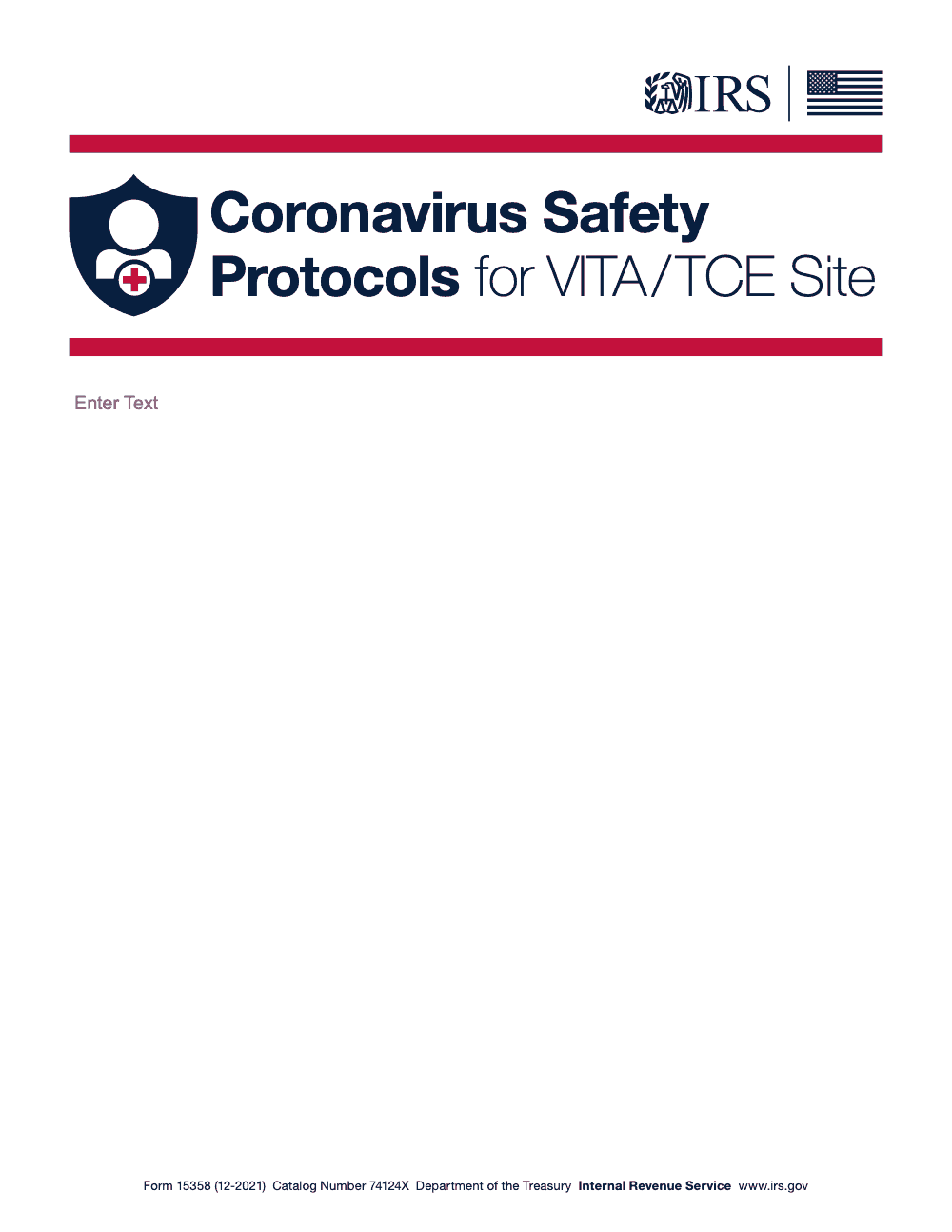
The form is a single page. It carries the IRS title block, branding, and one free-form “Enter Text” field. There are no line items, schedules, attachments, or other fields to populate. The site coordinator types the site’s coronavirus safety protocols into the text field, then prints and posts the completed sheet.
| Section / Field | What to Provide | Practitioner Tip |
|---|---|---|
| Title block | Pre-printed by the IRS: “Coronavirus Safety Protocols for VITA/TCE Site” | No edits required – do not modify the IRS title or branding |
| “Enter Text” field | The site’s on-site coronavirus safety protocols, drafted by the site coordinator | Write the protocol text separately as a short SOP, then paste it into this single field at print time |
| Form footer | Pre-printed: “Form 15358 (12-2021) Catalog Number 74124X Department of the Treasury Internal Revenue Service www.irs.gov” | Confirm the 12-2021 revision date appears in the footer before printing |
Drafting the Protocol Text
The IRS does not prescribe a specific list of protocols on the form. The site coordinator drafts the content using current IRS SPEC office guidance and local public-health rules. Common topics include masking expectations, physical distancing, sanitization, capacity limits, and how the site will respond if a visitor reports symptoms – but the exact language is decided by the site and its sponsoring organization, not the IRS.
Deadlines and Filing Requirements
There is no filing requirement for Form 15358. The form is not submitted to the IRS, so there is no filing deadline, no submission channel, no extension procedure, and no tax penalty regime tied to it. It is operational signage that VITA and TCE sites post on-site for volunteer and visitor awareness.
| Item | Detail |
|---|---|
| Filing Frequency | Not filed – the form is posted on-site, not submitted to the IRS |
| IRS Deadline | None – there is no IRS deadline because the form is not filed |
| Submission Channel | None – the form is operational signage, not a return |
| Consequence of Non-Use | No IRS tax penalty – program-administration matter handled by the IRS SPEC office, not enforcement |
| Extension | Not applicable – no filing window exists to extend |
| Retention | Keep a dated copy of the posted protocols in the site binder for sponsor and IRS SPEC office review |
Program Oversight, Not Tax Enforcement
Form 15358 sits inside the IRS Stakeholder Partnerships, Education, and Communication (SPEC) office, which administers the VITA and TCE programs. SPEC handles site coordination, volunteer certification, and program compliance. No IRC §6651 or §6662 penalty regime applies to Form 15358, and non-completion is a sponsor and SPEC matter, not a tax-enforcement matter.
What the Form Does Not Cover
Because Form 15358 is a coronavirus safety protocols template and not a tax form, it does not capture or report any income, deductions, tax, or compliance items. Anyone arriving at this form expecting a return, a schedule, or a filing process will find a single free-form text field and IRS branding – nothing more.
Not a Prescribed List of Required Measures
Form 15358 does not mandate specific safety measures. The IRS does not enumerate masking, distancing, or capacity rules on the form itself. The site coordinator drafts the protocol language and types it into the single “Enter Text” field, following IRS SPEC office guidance and local public-health rules.
Not a VITA Application or Volunteer Form
Site registration, volunteer certification, and sponsor agreements use separate IRS forms – for example, Form 13206 (Volunteer Assistance Summary Report), Form 13615 (Volunteer Standards of Conduct), and Form 14204 (Tax Counseling for the Elderly Program Application). Form 15358 does not register sites, certify volunteers, or replace any of those forms.
Not a Tax Return or Information Return
Form 15358 has no income, deduction, tax, or signature lines. The IRS provides no filing instructions because there is no filing process. The completed sheet stays on-site; the IRS does not collect, process, or score it.
How the Form Fits Into the VITA/TCE Program
Form 15358 is part of the operational toolkit the IRS Stakeholder Partnerships, Education, and Communication (SPEC) office publishes for VITA and TCE sites. It is not part of the return-processing pipeline and not part of any IRS examination program. It is on-site signage, kept and updated at the site.
The Role of the IRS SPEC Office
SPEC administers the VITA (Volunteer Income Tax Assistance) and TCE (Tax Counseling for the Elderly) programs and publishes the templates, training materials, and standards that sites operate under. Form 15358 is one of those templates – specifically, a single-page coronavirus safety protocols sheet the site can complete and post on-site.
The Role of the Site Coordinator
The site coordinator owns Form 15358. They draft the protocol language, paste it into the single text field, print and post the form, and refresh it when sponsor policy or public-health guidance changes. The sponsoring organization typically reviews the language before posting.
Record Retention for Form 15358
Keep a dated copy of the posted protocols in the site binder under “Operational signage,” along with the prior versions that have been replaced. The sponsoring organization and the IRS SPEC office may request the on-site documentation as part of routine program-administration review.
What Happens When Protocols Change
Because Form 15358 is on-site signage rather than a filed return, there is no formal “termination” step. The change event for Form 15358 is simply when the site’s safety protocols are updated or retired.
Updating the Posted Protocols
When sponsor policy, IRS SPEC guidance, or local public-health rules change, the site coordinator redrafts the protocol text and re-prints the form. Date and initial the new copy, and archive the prior version in the site binder so the change history is preserved.
Retiring the Form
If a site decides to stop displaying the coronavirus safety protocols, the form can simply be removed from the entrance and intake area and archived. There is no IRS notification step, no withdrawal procedure, and no penalty – the form was operational signage, not a tax filing.
Documentation in the Site Binder
Whether the protocols are updated or retired, keep dated copies in the site binder. The sponsoring organization and the IRS SPEC office may request the on-site documentation as part of routine program-administration review.
Common Mistakes That Slow Things Down
From my side of the desk, the recurring problems with Form 15358 are not arithmetic errors or missed line items, they are misconceptions about what the form is for in the first place. Sites that misread it once tend to repeat the same mistake across volunteer rotations and sponsor handoffs.
Practical Checklists You Can Reuse
Each of the checklists below is written to drop straight into a VITA or TCE site SOP without rework. Print, mark, and route them to the site coordinator on file.
Site posting setup
- Download the current Form 15358 (Rev. 12-2021) from the IRS.gov form library.
- Confirm the Catalog Number 74124X appears in the form footer.
- Draft the on-site safety protocols using current IRS SPEC office guidance.
- Cross-check the draft against local and state public-health requirements.
- Paste the finalized text into the form's single fillable field.
- Route the draft to the sponsoring organization's designated reviewer for sign-off.
- Print at least two copies, one for the entrance and one for the intake station.
- Store the signed master copy in the site binder under "Operational signage."
Annual protocol refresh
- Pull the prior season's Form 15358 from the site binder.
- Review each line of the protocol text against current public-health guidance.
- Check the IRS.gov form library for any newer revision of Form 15358.
- Update the protocol text where guidance has shifted.
- Re-route the updated draft to the sponsoring organization for sign-off.
- Reprint and replace the posted copies at the site entrance and intake station.
- Archive the prior copy with the date it was retired.
Volunteer onboarding handoff
- Walk new volunteers through the posted Form 15358 protocols on day one.
- Confirm the volunteer can locate the binder copy of the signed form.
- Identify who at the site is authorized to update the protocol text.
- Note the difference between Form 15358 and the volunteer certification forms (Form 13615 and related).
- Record the briefing in the site's volunteer training log.
Keep 15358 Season From Stalling
VITA and TCE site coordinators usually rebuild their site documentation in late winter, right when volunteer rotations are settling and the intake schedule is filling. The Coronavirus Safety Protocols template, Form 15358 (Rev. 12-2021), is often the last sheet posted before the doors open, and it is the one most likely to slip when a sponsor changes hands or a volunteer coordinator rotates out. As published on IRS.gov, the form has not been revised since December 2021, so any site running multiple seasons can carry forward most of the language with light edits.
The fix is to treat the protocol sheet as a piece of operational documentation rather than a tax form. Build it into the same site-readiness routine that handles the binder, the intake stack, and the volunteer training log.
- Cache the IRS.gov source PDF of Form 15358 in the site binder alongside Form 13206 and Form 13615 so the version reference is one click away.
- Maintain the protocol text as a separate document, then paste it into the form's single fillable field at print time.
- Date and initial the posted copy, and log the same date in the site readiness checklist.
- Schedule a mid-season check to confirm the protocols still match current public-health guidance.
- Assign one named owner per season, usually the site coordinator, to prevent silent drift between rotations.
For VITA and TCE site sponsors that lean on a CPA firm for compliance support, the same offshore review discipline used in Accountably's tax outsourcing services can keep the site documentation cycle on schedule. The protocols are simple to write but easy to forget, and a structured handoff prevents the sheet from becoming the last open item on the site coordinator's list.
FAQs
Form 15358 is completed by VITA (Volunteer Income Tax Assistance) and TCE (Tax Counseling for the Elderly) site coordinators or the sponsoring organization’s designated administrator. It is not used by individual taxpayers or businesses – only by VITA and TCE program sites.
The form has a pre-printed title block and a single free-form “Enter Text” field. The site coordinator types in the site’s coronavirus safety protocols – for example, masking, distancing, sanitization, and capacity rules. The IRS does not prescribe specific protocols on the form itself; site coordinators draft the language using IRS SPEC office guidance and local public-health rules.
There is no IRS due date. Form 15358 is not filed with the IRS – it is operational signage that the site posts or retains on-site for volunteer and visitor awareness. The site refreshes the posted protocols whenever its operating conditions or local public-health guidance change.
No IRS tax penalty applies. Because the form is not a return and is not filed with the IRS, no IRC §6651 or §6662 penalty regime attaches. Program compliance is handled by the IRS Stakeholder Partnerships, Education, and Communication (SPEC) office, not by enforcement.
No. The current and only active revision is dated 12-2021 (Catalog Number 74124X). The IRS has not issued a 2022, 2023, 2024, or 2025 revision. Reference the form by its current revision date: “Form 15358 (Rev. 12-2021).”
Other forms this guide names
- Form 13615: IRS VITA/TCE Volunteer Standards & Requirements
- Form 13206: VITA/TCE Summary Report Guide 2025
- Form 14204: TCE Checklist and Contact Sheet Guide
About this guide
Accountably helps US CPA, EA, and accounting firms hire trained accountants and tax preparers in India.
About us Reviewed byJugal Thacker, CPAFounder and CEO at Accountably
A Washington-licensed CPA with 7+ years inside US firms – PwC, a real-estate tax practice, then a full-service firm, rising from reviewer to manager to advisory. This article was reviewed against current IRS SPEC office guidance and the 12-2021 revision of Form 15358 for VITA and TCE site coordinators.
View profile →How we research, review, and update this guide
Every Accountably guide is researched against primary IRS sources, reviewed by a U.S. CPA, and refreshed as guidance evolves. Read our Editorial Guidelines to see how we source, fact-check, and update our content.