Summarize this article with AI
In Brief
Form 15601 (Rev. 10-2023, Catalog Number 94385E) is an IRS outreach flyer, not a tax form you file. The IRS Stakeholder Partnerships, Education and Communication (SPEC) office publishes it to promote and schedule Rural Partner Action Day and Taxpayer Assistance Events. Nothing on the flyer is submitted to the IRS; its blank fields are for local Stakeholder Tax Consultant contacts and the event date.
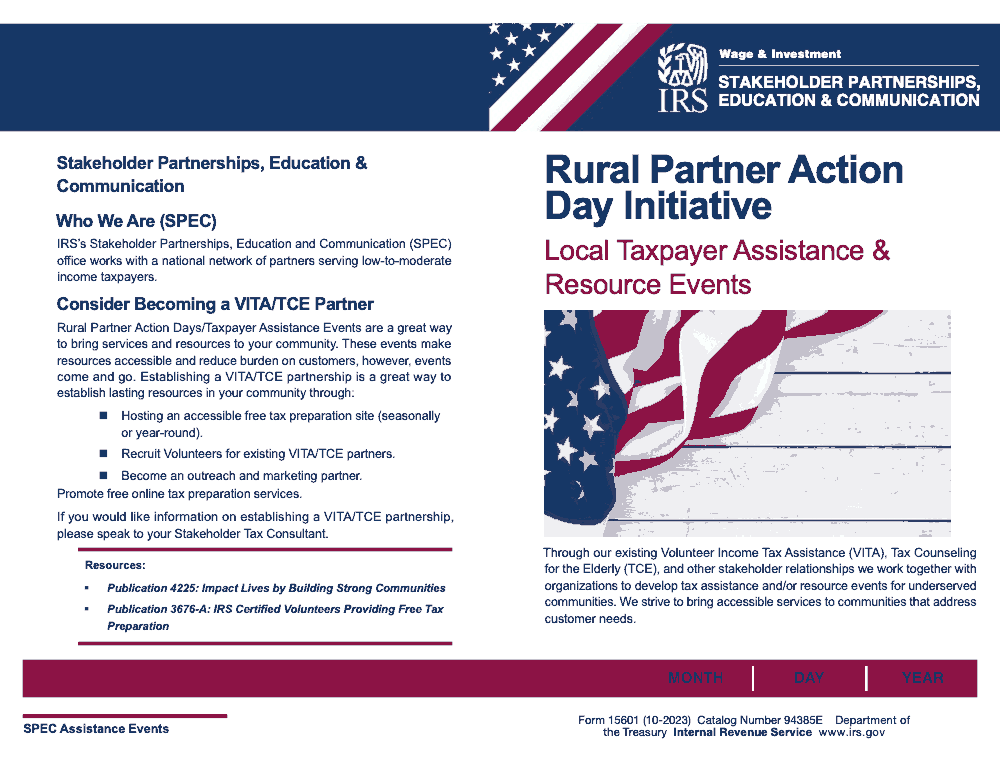
A community partner once handed my team Form 15601 and asked which envelope it goes in. Nothing on it gets mailed to the IRS. It is the Rural Partner Action Day Initiative flyer (Rev. 10-2023, Catalog Number 94385E), an outreach piece the Stakeholder Partnerships, Education and Communication office prints to promote and schedule a local taxpayer assistance event.
The only blank fields are the Stakeholder Tax Consultant contact rows and a MONTH, DAY, YEAR event date, which the local SPEC partner fills in. The flyer's job is to help an organization bring free tax help, online installment-agreement setup, and IRS account assistance to the people it already serves.
Key Takeaways
- Form 15601 is an IRS outreach flyer, not a tax form. Titled the Rural Partner Action Day Initiative flyer, it promotes and schedules Local Taxpayer Assistance and Resource Events. The current revision is 10-2023, Catalog Number 94385E.
- Who publishes it: The IRS Stakeholder Partnerships, Education and Communication (SPEC) office, which sits inside the Wage and Investment operating division and works with a national network of partners serving low-to-moderate income taxpayers.
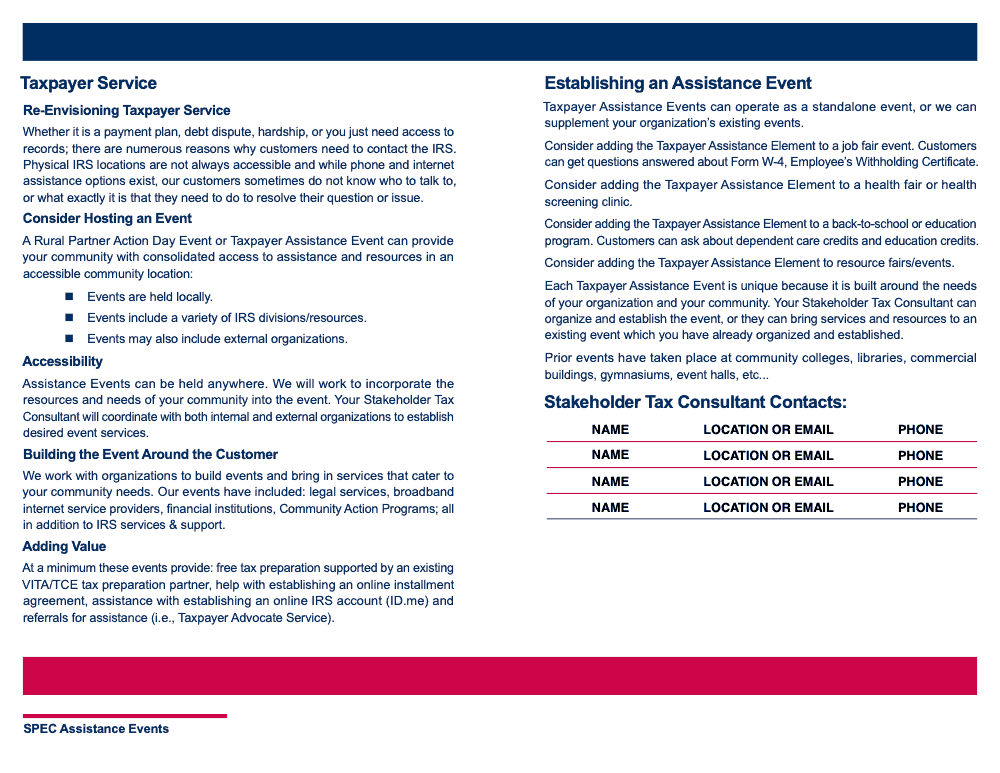
- Nothing on it is filed with the IRS. The flyer’s only blank fields are four Stakeholder Tax Consultant contact rows (Name, Location or Email, Phone Number) and a MONTH / DAY / YEAR event date, which local SPEC partners complete when scheduling an event.
- What the events offer: At a minimum, every event provides free tax preparation through an existing VITA/TCE partner, help with an online installment agreement, help setting up an online IRS account (ID.me), and referrals such as the Taxpayer Advocate Service.
- Events are short-term touchpoints. Events come and go, so SPEC encourages organizations to build a lasting VITA/TCE partnership for year-round community resources.
- Next step for a partner: An organization interested in hosting an event or establishing a VITA/TCE partnership speaks with its Stakeholder Tax Consultant, whose contact details SPEC fills in on the flyer.
What Form 15601 Is and Who Publishes It
Form 15601 is the IRS flyer for the Rural Partner Action Day Initiative, which covers Local Taxpayer Assistance and Resource Events, also called SPEC Assistance Events. The version in circulation is Form 15601 (Rev. 10-2023), Catalog Number 94385E. It is a downloadable marketing piece, not a tax return, an election, or an information return.
The form comes from the Department of the Treasury, Internal Revenue Service. The specific office behind it is Stakeholder Partnerships, Education and Communication, known as SPEC, which sits inside the Wage and Investment operating division. SPEC works with a national network of partners that serve low-to-moderate income taxpayers.
This is the part that trips people up. An IRS form number suggests something you complete and submit. Form 15601 is the opposite: SPEC and partner organizations download it, fill in a few local details, and hand it out to advertise a community event. Nothing on it goes back to the IRS.
If you are looking for a form to fill out and file, Form 15601 is not it. It is an outreach flyer. The only blanks on it are for local event details, which the hosting SPEC partner completes.
Why the “Rural” Name Does Not Limit Where Events Happen
The initiative is branded around rural outreach, but the events are not limited to rural locations. SPEC Assistance Events can be hosted anywhere that meets the needs of the partner organization and the low-to-moderate income taxpayers it serves. Prior events have been held at community colleges, libraries, commercial buildings, gymnasiums, and event halls.
Is the 10-2023 Revision Still Current?
Yes. The 10-2023 revision is the latest version of the flyer, and it remains the current outreach piece for tax year 2025 events. When you reference the form, cite the revision date so readers can confirm they are looking at the right version.
Who Uses Form 15601 and When
Form 15601 is used by SPEC staff and by community partner organizations, not by individual taxpayers or paid preparers filing returns. The flyer is a planning and promotion tool that goes out before an event to let a community know help is coming.
| Who | How They Use Form 15601 | What to Note |
|---|---|---|
| SPEC staff | Publish the flyer and fill in the Stakeholder Tax Consultant contact details so a community has a named point of contact | SPEC sits inside the Wage and Investment division and works with a national network of partners |
| Partner organizations | Distribute the flyer to advertise a Rural Partner Action Day or Taxpayer Assistance Event to the people they serve | Partners include nonprofits, schools, libraries, and Community Action Programs |
| Event hosts | Complete the MONTH / DAY / YEAR date fields and event details when scheduling a local event | The date fields at the bottom of page 1 are blank on the master flyer |
| Prospective VITA/TCE partners | Use the contact path on the flyer to ask their Stakeholder Tax Consultant about a lasting partnership | This is how a one-time event turns into year-round community resources |
How a Community Gets an Event Scheduled
An organization that wants to host an event speaks with its Stakeholder Tax Consultant. The consultant can organize and establish the event from scratch, or bring IRS services and resources to an event the organization has already planned. Each event is built around the needs of the host organization and its community, so no two look exactly alike.
What Is Printed on the Flyer
Because Form 15601 is a flyer, it has no line items, schedules, or taxpayer entries. What it does have is a small set of blank fields that a local SPEC partner fills in, plus content that explains the program. Knowing the layout helps you confirm you are looking at the right document.
The Blank Fields
The flyer carries two sets of fillable fields. The first is a block of four Stakeholder Tax Consultant contact rows, each with Name, Location or Email, and Phone Number. These are blank on the master flyer and meant to be filled in locally so a community has a named point of contact. The second is a date stamp at the bottom of page 1, printed as MONTH / DAY / YEAR, which local partners complete when scheduling an event.
The Program Content
The body of the flyer explains the Rural Partner Action Day Initiative and the Local Taxpayer Assistance and Resource Events it supports. It describes what a SPEC Assistance Event provides, where prior events have been held, and how an organization can move from a single event to a lasting VITA/TCE partnership.
Cross-References to Other IRS Material
The flyer points organizations toward two IRS publications for more context: Publication 4225, “Impact Lives by Building Strong Communities,” and Publication 3676-A, “IRS Certified Volunteers Providing Free Tax Preparation.” Both speak to the VITA/TCE volunteer and partner model that these events draw on.
If your copy of Form 15601 already has names and a date filled in, those were added by the local SPEC partner running the event, not by the IRS. The master flyer ships blank.
What Happens at a Rural Partner Action Day Event
The flyer sets a clear baseline for what these events deliver. Events are held locally, include a variety of IRS divisions and resources, and may also bring in outside organizations. The goal is to make IRS services accessible to people who might otherwise struggle to reach them.
The Minimum Service Bundle
At a minimum, every SPEC Assistance Event provides four things: free tax preparation supported by an existing VITA/TCE partner, help establishing an online installment agreement, help setting up an online IRS account through ID.me, and referrals for assistance, such as to the Taxpayer Advocate Service. So free tax prep is one piece of a larger bundle, not the whole event.
Outside Organizations That May Take Part
Beyond IRS divisions, events may include external organizations such as legal services, broadband internet providers, financial institutions, and Community Action Programs. Bringing these partners under one roof is part of what makes a single event valuable to a community.
Why People Need This Access
Taxpayers contact the IRS for many reasons: a payment plan, a debt dispute, a hardship, or simply access to records. Physical IRS locations are not always nearby, and while phone and internet options exist, people sometimes do not know who to talk to or what to do to resolve their issue. These events are designed to close that gap by putting the right help in the same room.
Adding a Taxpayer Assistance Element to Your Event
One of the most useful ideas on the flyer is that you do not always need a standalone event. A Taxpayer Assistance Event can operate on its own, or SPEC can supplement an event your organization is already running. That means a job fair, health fair, back-to-school program, or resource fair can host an IRS help element with little extra lift.
Job Fairs
When you add a Taxpayer Assistance element to a job fair, attendees can get questions answered about Form W-4, the Employee’s Withholding Certificate. New and returning workers often have withholding questions, so a job fair is a natural fit.
Back-to-School and Education Programs
At a back-to-school or education program, attendees can ask about dependent care credits and education credits. Families are already focused on school costs at that time of year, which makes the help timely.
Map the IRS topic to the event theme. The flyer is built around the idea that each event is unique because it reflects the needs of your organization and your community.
Becoming a Lasting VITA/TCE Partner
Events make resources accessible and reduce burden on the people who attend, but events come and go. The flyer is candid about this. Establishing a VITA/TCE partnership is how an organization turns a one-day event into year-round community support.
Three Partnership Paths
The flyer lays out three ways to build a lasting partnership. An organization can host an accessible free tax preparation site, seasonally or year-round. It can recruit volunteers for existing VITA/TCE partners. Or it can become an outreach and marketing partner that promotes free online tax preparation services. Any of the three deepens the community’s access to free tax help.
Who to Talk To
If you want information on establishing a VITA/TCE partnership, the flyer directs you to speak with your Stakeholder Tax Consultant. That contact information is filled in on the form by SPEC, so the flyer doubles as your starting point.
Events Supplement, They Do Not Replace
It helps to frame these events correctly. A Rural Partner Action Day event is a short-term, locally hosted touchpoint that supplements, and often partners with, the year-round VITA/TCE free tax preparation network. It is not a substitute for an ongoing free tax prep site.
Why SPEC Runs These Events
Understanding the mission behind Form 15601 helps a partner organization decide whether to take part. SPEC works with a national network of partners that serve low-to-moderate income taxpayers, and the Rural Partner Action Day Initiative is one way it reaches communities that need help most.
Closing the Access Gap
Many taxpayers need to reach the IRS but cannot easily do so. They may need a payment plan, a way to dispute a debt, relief from a hardship, or access to their records. When a physical IRS office is far away and phone or internet help feels confusing, an in-person event run by a trusted local partner can be the difference between resolving an issue and giving up on it.
Bringing Resources Together
Because events include a variety of IRS divisions and resources, plus outside organizations, a single visit can solve several problems at once. A family might get a return prepared, set up an installment agreement, and create an online IRS account in the same afternoon.
Built Around the Community
Each Taxpayer Assistance Event is unique because it is built around the needs of the host organization and its community. Your Stakeholder Tax Consultant can organize the event from scratch or bring services and resources to an event you have already established, which keeps the model flexible.
Form 15601 vs. a Tax Return
The fastest way to keep Form 15601 straight is to compare it to a real tax form. A tax return has line items, deadlines, and a place to send it. An outreach flyer has none of that. The table below makes the difference plain.
| Feature | Form 15601 (Outreach Flyer) | A Typical IRS Tax Form |
|---|---|---|
| Who completes it | SPEC staff and local partner organizations | Taxpayers or paid preparers |
| Filed with the IRS? | No, nothing on it is submitted | Yes, mailed or e-filed to the IRS |
| Fillable fields | Stakeholder Tax Consultant contacts and an event date | Income, deductions, credits, and tax line items |
| Purpose | Promote and schedule a community assistance event | Report tax information or claim a refund |
| Revision shown | Rev. 10-2023, Catalog Number 94385E | Annual or periodic revision tied to a tax year |
So if you arrived here looking for a return to complete, the flyer is not the right document. For help with the work behind real filings, our team handles that production through our tax preparation services.
Common Mistakes That Slow Things Down
The mistakes around Form 15601 are mostly misunderstandings about what it is. Clearing them up early saves a community partner real time.
Practical Checklists You Can Reuse
Two short checklists you can copy into your own planning notes: one for hosting an event, one for moving toward a lasting partnership.
Hosting a Taxpayer Assistance Event
0/6- Confirm you are working from Form 15601 (Rev. 10-2023, Catalog Number 94385E).
- Contact your Stakeholder Tax Consultant to discuss a standalone or supplemented event.
- Decide whether to add a Taxpayer Assistance element to an existing event such as a job fair or back-to-school program.
- Choose an accessible location for your community, such as a library, community college, or event hall.
- Confirm the minimum services: free tax prep via a VITA/TCE partner, installment agreement help, ID.me setup, and referrals.
- Complete the MONTH / DAY / YEAR date fields and distribute the flyer to promote the event.
Moving Toward a Lasting VITA/TCE Partnership
0/4- Decide which path fits: host a free tax prep site, recruit volunteers, or become an outreach and marketing partner.
- Review Publication 4225 and Publication 3676-A for the VITA/TCE partner and volunteer model.
- Speak with your Stakeholder Tax Consultant about establishing the partnership.
- Plan for year-round access rather than a single event, since events come and go.
For Partner Organizations
Most organizations that look up Form 15601 are not preparers; they are community groups deciding whether to host an event. If that is you, the flyer is the on-ramp. It names your Stakeholder Tax Consultant and explains how a single event can grow into a year-round VITA/TCE partnership that keeps free tax help in your community.
The execution side, the actual tax preparation and review behind those returns, is the part Accountably knows well. We are an offshore and outsourced accounting and tax staffing partner for CPA, EA, and accounting firms, built by a CPA, and our trained teams handle tax prep, bookkeeping, payroll, and audit support with documented SOPs. If your organization or your clients need that production capacity handled cleanly, that is where we help. We keep this mention brief on purpose, your community work comes first.
FAQs
No. Form 15601 (Rev. 10-2023, Catalog Number 94385E) is a downloadable IRS outreach flyer used by the Stakeholder Partnerships, Education and Communication (SPEC) office to promote and schedule Rural Partner Action Day Initiative and Taxpayer Assistance Events. It is not a tax return, election, or information return, so nothing on it is filed with the IRS. The blank fields on the flyer are for local Stakeholder Tax Consultant contact details and the event date.
Form 15601 is published by the Department of the Treasury, Internal Revenue Service. The IRS office behind it is Stakeholder Partnerships, Education and Communication (SPEC), which sits inside the Wage and Investment operating division. SPEC works with a national network of partners that serve low-to-moderate income taxpayers.
At a minimum, every SPEC Assistance Event provides free tax preparation supported by an existing VITA/TCE partner, help establishing an online installment agreement, help setting up an online IRS account (ID.me), and referrals for assistance such as the Taxpayer Advocate Service. Events may also bring in external organizations like legal services, broadband internet providers, financial institutions, and Community Action Programs.
No. While the initiative is branded around rural outreach, SPEC Assistance Events can be hosted in any community location that meets the needs of the partner organization and low-to-moderate income taxpayers. Prior events have been held at community colleges, libraries, commercial buildings, gymnasiums, and event halls.
Events come and go, so SPEC encourages organizations to build a lasting VITA/TCE partnership. An organization can host an accessible free tax preparation site seasonally or year-round, recruit volunteers for existing VITA/TCE partners, or become an outreach and marketing partner that promotes free online tax preparation. To get started, an organization speaks with its Stakeholder Tax Consultant, whose contact details SPEC fills in on the flyer.
About this guide
Accountably helps US CPA, EA, and accounting firms hire trained accountants and tax preparers in India.
About us Reviewed byJugal Thacker, CPAFounder and CEO at Accountably
A Washington-licensed CPA with 7+ years inside US firms – PwC, a real-estate tax practice, then a full-service firm, rising from reviewer to manager to advisory. This article was reviewed against current IRS guidance for the 2025 tax year and updated for filers preparing late returns, amendments, and 2026 estimates.
View profile →How we research, review, and update this guide
Every Accountably guide is researched against primary IRS sources, reviewed by a U.S. CPA, and refreshed as guidance evolves. Read our Editorial Guidelines to see how we source, fact-check, and update our content.