Summarize this article with AI
In Brief
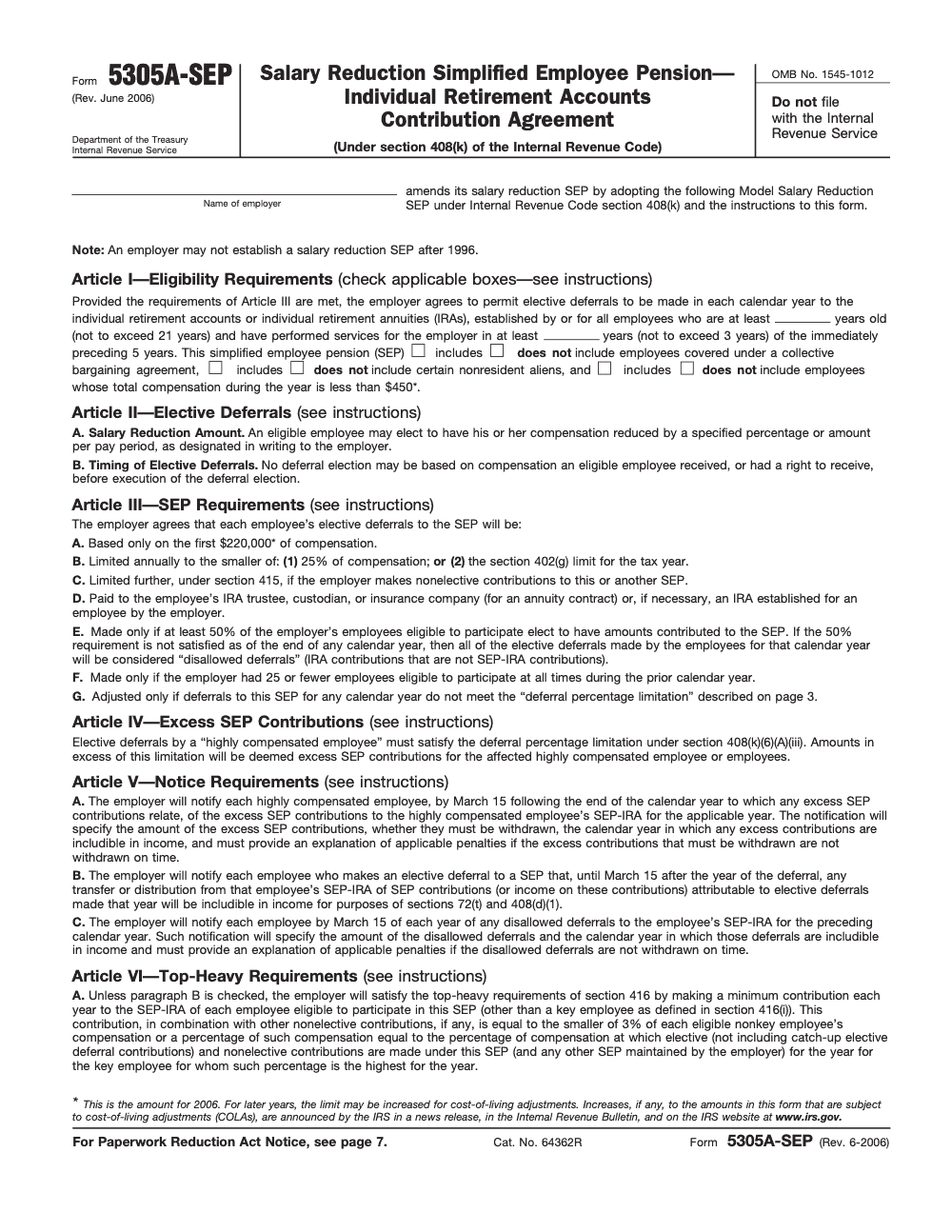
Form 5305-A-SEP is the IRS model Salary Reduction SEP (SARSEP) agreement authorized under IRC §408(k)(6); the employer keeps the executed form in plan records and does not file it with the IRS (per the IRS Instructions for Form 5305-A-SEP). No new SARSEP has been allowed since December 31, 1996, so only an employer that had the plan in place by that date, has no more than 25 eligible employees, and keeps at least 50% of eligible employees electing salary reduction each year may continue using it. If you maintain a grandfathered plan, our tax preparation and review services can handle the annual testing.
An owner runs a salary reduction arrangement adopted decades ago as though it were a plain SEP, making contributions each year without checking who is participating. What they miss is that the 50% employee participation requirement still applies every single year, and a SARSEP that fails that test can lose its status. Grandfathered plans need active monitoring, not just annual deposits.
Form 5305-A-SEP is the IRS model Salary Reduction SEP agreement authorized under IRC §408(k)(6); the employer keeps the executed form in plan records and does not file it with the IRS. No new SARSEP has been allowed since December 31, 1996, so only an employer that had the plan in place by that date, has no more than 25 eligible employees, and keeps at least 50% of eligible employees electing salary reduction each year may continue using it. For existing SARSEPs, the 2025 salary reduction deferral limit is $23,500, or $31,000 with the age-50 catch-up.
Key Takeaways
- Form 5305-A-SEP is the IRS model agreement for a Salary Reduction Simplified Employee Pension (SARSEP) – a plan type that allowed employees to reduce their salaries and have those amounts contributed to SEP-IRAs on a pre-tax basis.
- No new SARSEPs have been permitted since January 1, 1997 – Small Business Job Protection Act of 1996 closed SARSEPs to new adoption. Only plans established before 1997 can continue operating as SARSEPs; new employees hired by grandfathered employers can still participate.
- For existing SARSEPs, the employee salary reduction deferral limit for 2025 is $23,500 ($31,000 with age-50 catch-up), subject to the 25% of compensation limit.
- SARSEPs have a 50% employee participation requirement: at least 50% of eligible employees must elect to participate in the salary reduction arrangement each year. Failing this test disqualifies the salary reduction feature.
- Employer contributions to the SEP portion (non-salary reduction) can also be made to SARSEP accounts under the same SEP rules – up to the lesser of 25% of compensation or $70,000 (2025).
- Quick rule for your SOP: for any SARSEP client, verify at year-end that the 50% participation test is met before reporting salary reductions as excludable from income.
What Form 5305-A-SEP Is and When to Use It
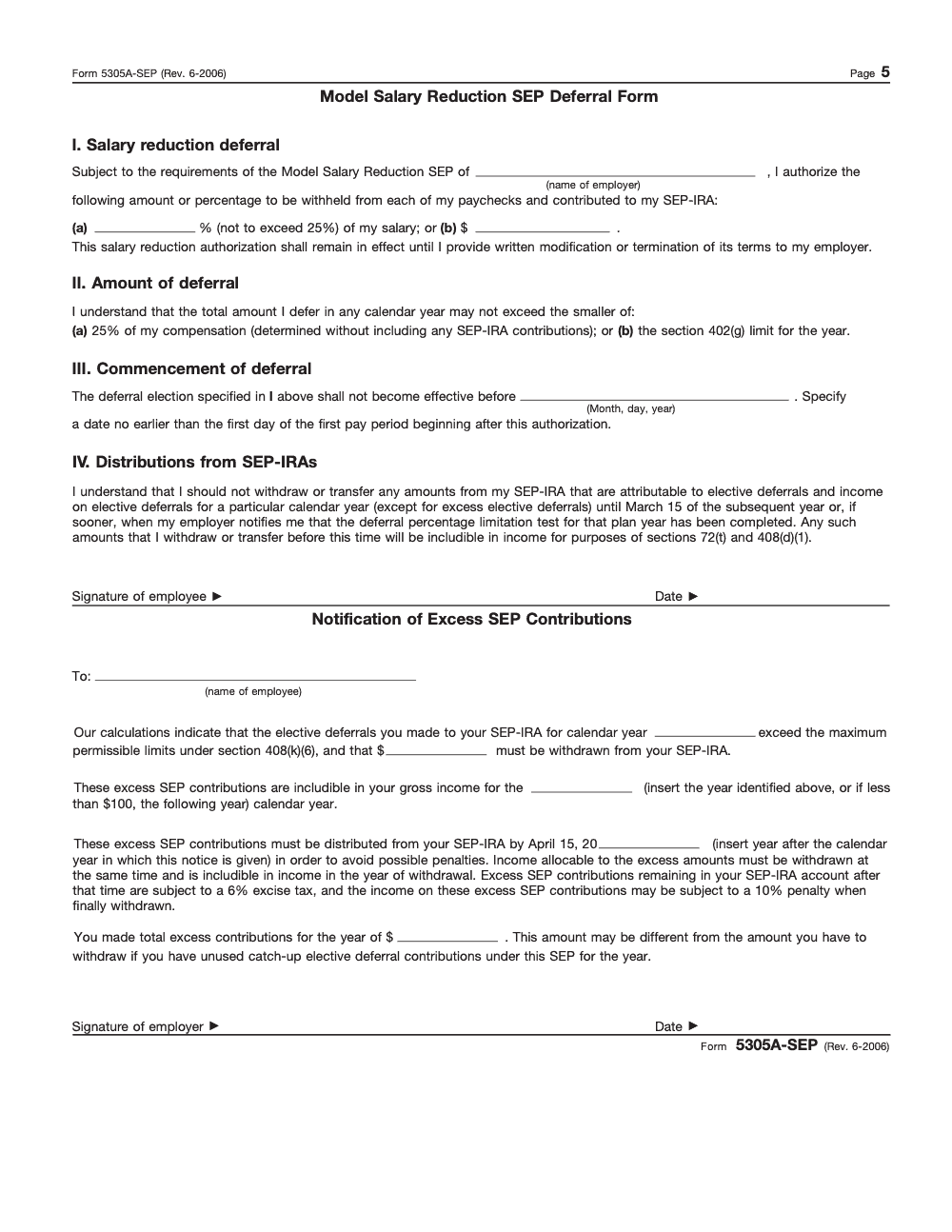
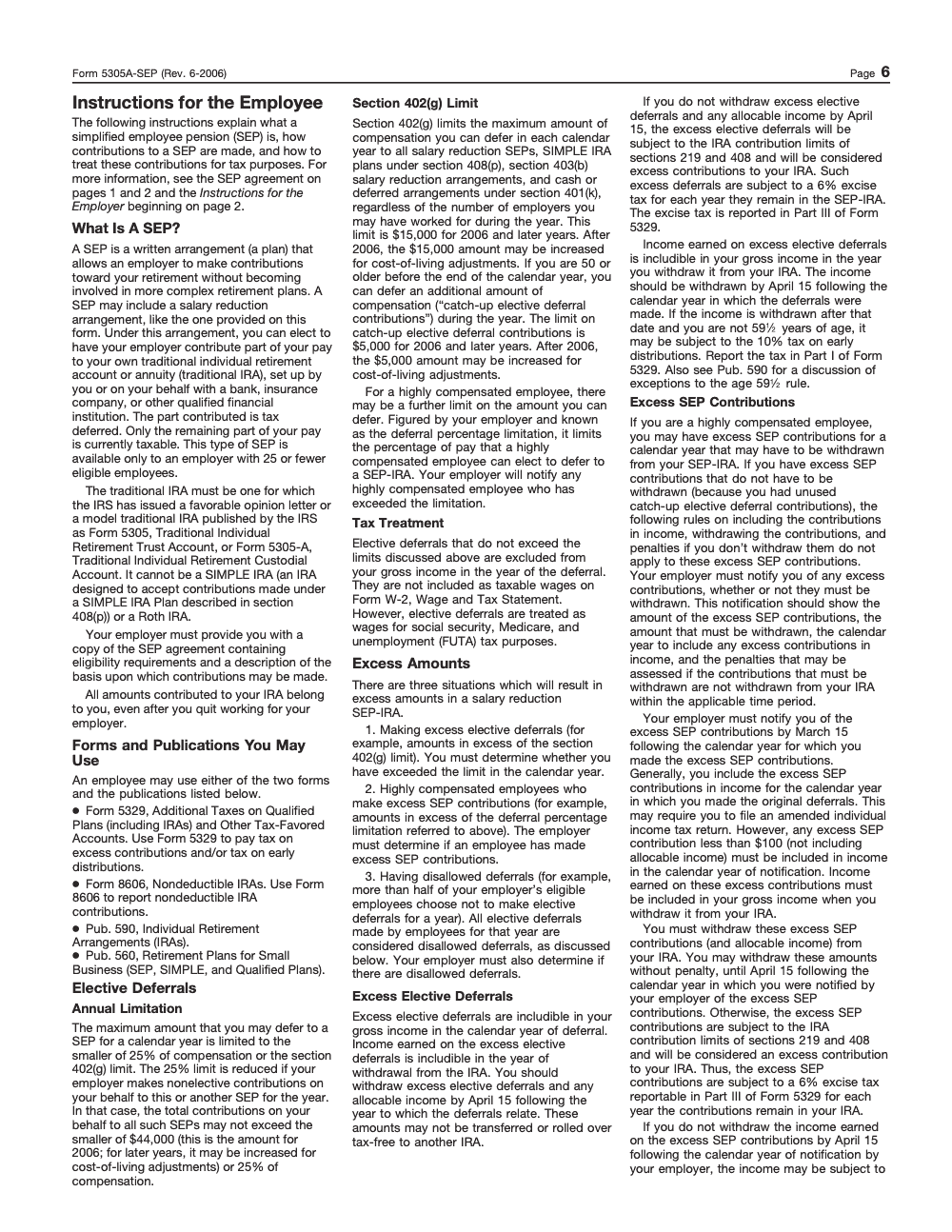
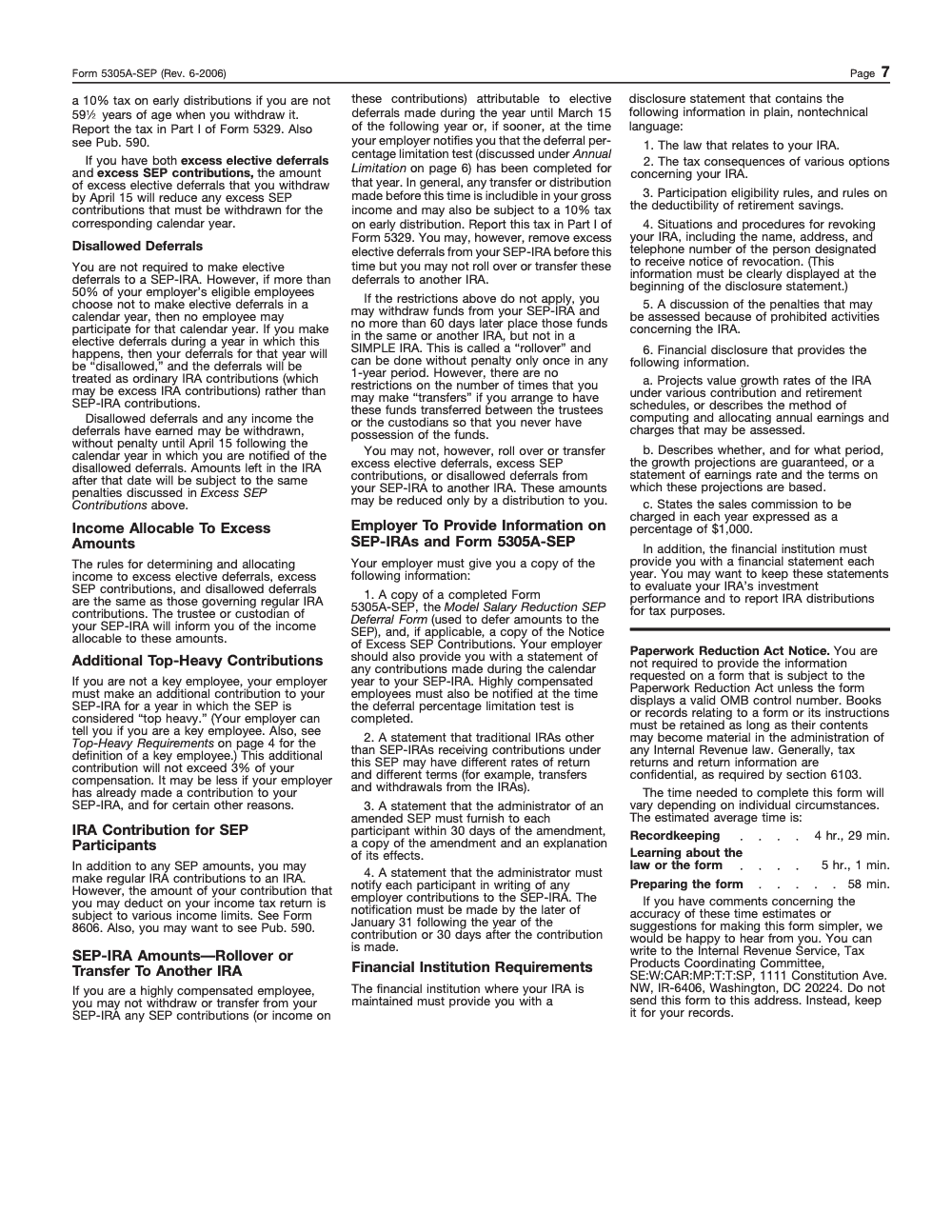
Form 5305-A-SEP, Salary Reduction Simplified Employee Pension – Individual Retirement Accounts Contribution Agreement, is the IRS model plan agreement that established the legal framework for a SARSEP. It governs the relationship between the employer, employees, and the SEP-IRA accounts that hold the contributions. Like other 5305-series forms, it is not filed with the IRS but is retained by the employer as the plan document.
The critical context: SARSEPs were a simplified alternative to 401(k) plans for small employers, allowing employees to defer a portion of their salary pre-tax into SEP-IRA accounts without the complexity and administrative cost of a full 401(k). The Small Business Job Protection Act of 1996 eliminated the ability to establish new SARSEPs starting January 1, 1997, replacing them with SIMPLE IRAs and expanded SIMPLE 401(k) options. However, SARSEPs established before that date were grandfathered – they can continue to operate, and new employees hired after 1996 by an existing SARSEP employer are eligible to participate.
Who Can Still Use a SARSEP
An employer can continue using a SARSEP if – and only if – the plan was established before January 1, 1997, using Form 5305-A-SEP or equivalent approved plan language. Employers who meet that historical threshold can continue making both employee salary reduction contributions and employer SEP contributions under the grandfathered plan. New employers, and employers who allowed a prior SARSEP to lapse or be terminated, cannot establish a new SARSEP – they must use a SIMPLE IRA or SIMPLE 401(k) instead.
SARSEP vs. SEP-IRA vs. SIMPLE IRA
The SARSEP combined features of both a SEP (employer contributes to IRA accounts) and a 401(k)-like salary reduction arrangement. The modern SIMPLE IRA is the closest equivalent for new small employer plans – it allows employee elective deferrals and requires employer matching or nonelective contributions. Standard SEP-IRAs do not allow employee salary reduction; only employer contributions are permitted. If a client operates a SARSEP, they have the most feature-rich of these three options – which is exactly why eligible employers are motivated to continue the grandfathered plan.
How to Complete Form 5305-A-SEP
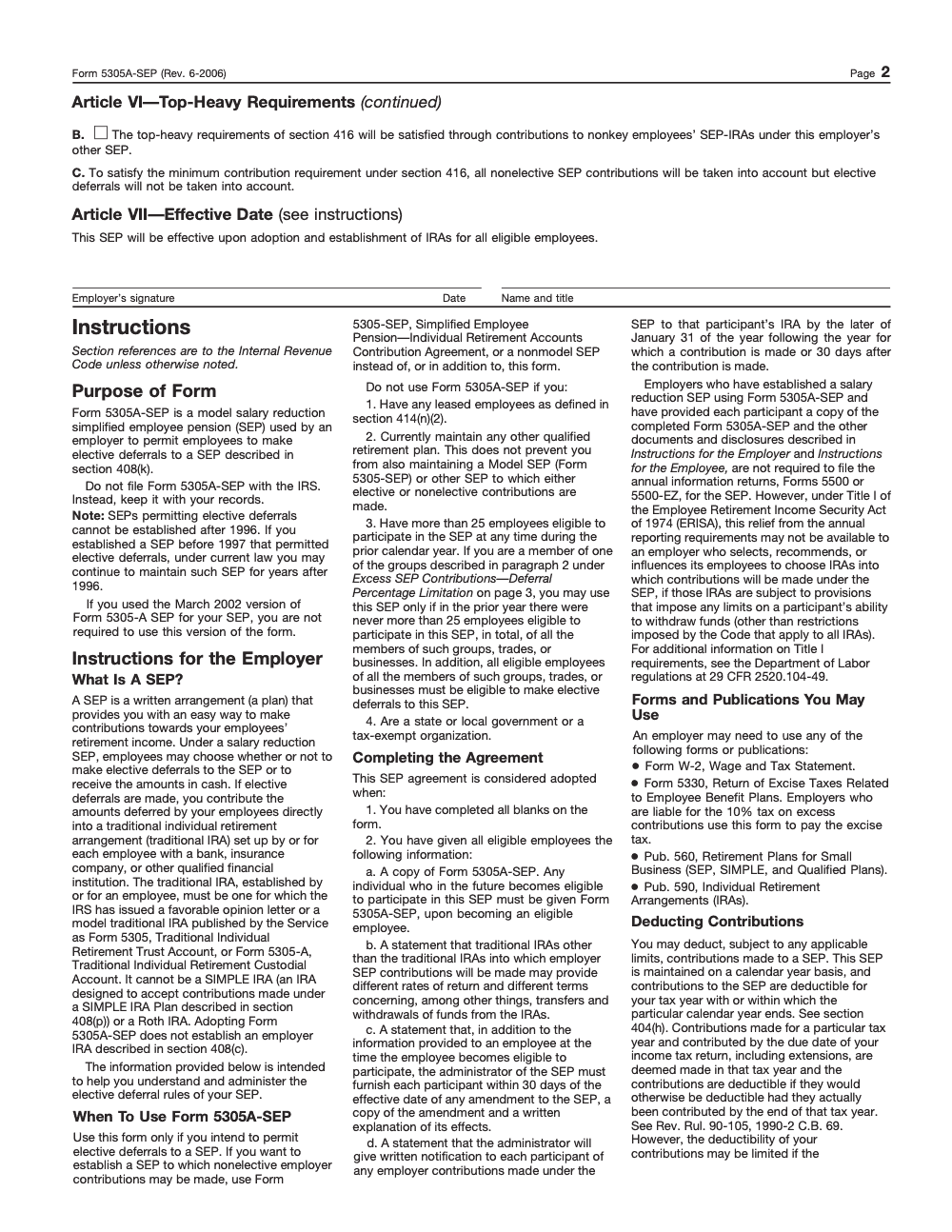
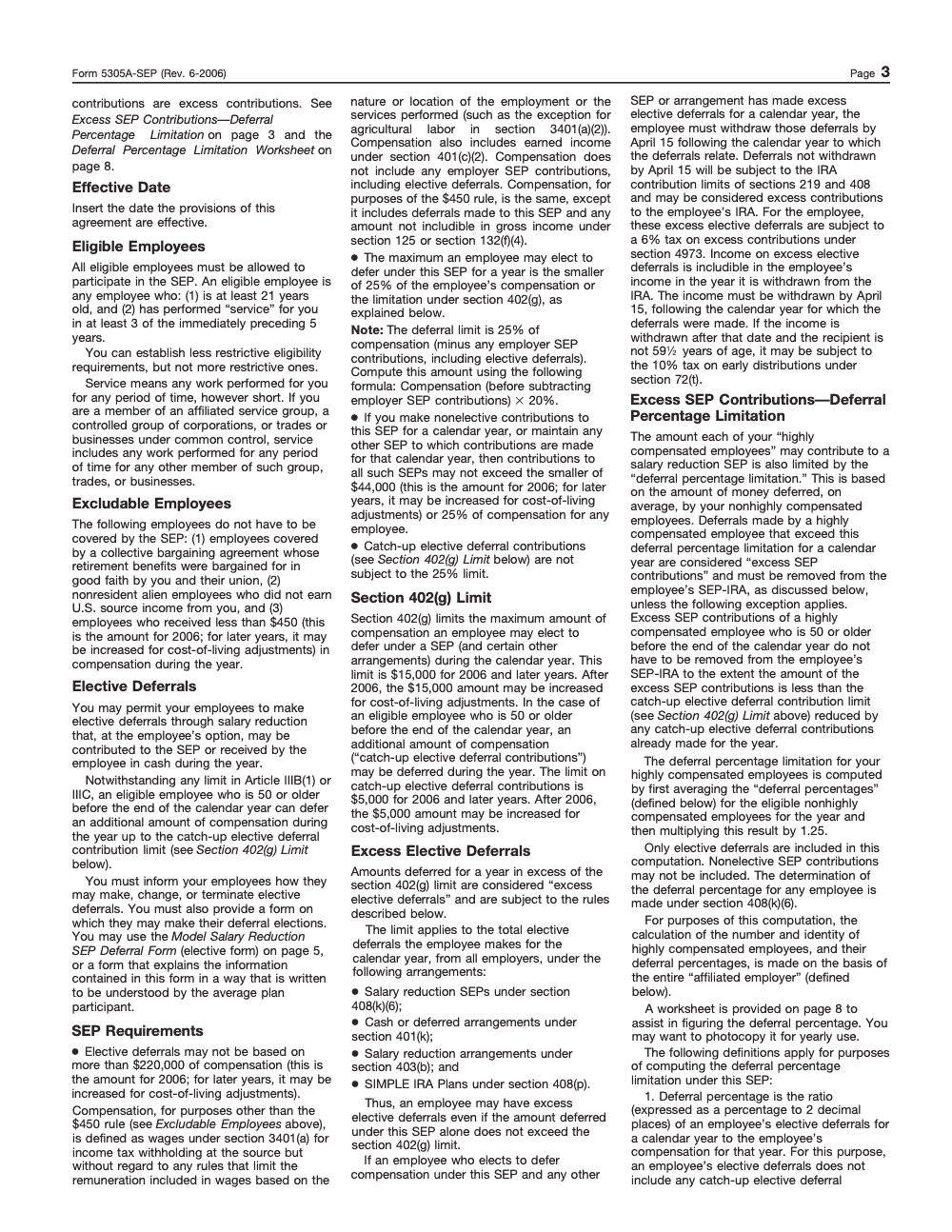
The model form establishes the terms of the SARSEP, including which employees are eligible, the salary reduction election procedures, contribution limits, and the 50% participation test mechanics. Most of the plan terms are prescribed by the IRS; the employer fills in identifying information and executes the agreement.
| Article / Section | Content | Key Points |
|---|---|---|
| Employer identification | Employer name, EIN, plan year, effective date | Must show pre-1997 establishment date for grandfathered status |
| Eligibility requirements | Employee participation criteria: age, service, minimum compensation | SEP eligibility: age 21, at least 3 of the past 5 years, earned at least $750 (2025 threshold) from employer |
| Salary reduction election | Employee election procedure and timing | Election must be made before the compensation is paid; cannot be retroactive |
| Deferral limitation | Annual elective deferral cap | Lesser of annual 402(g) limit ($23,500 for 2025) or 25% of compensation |
| 50% participation test | Minimum participation requirement | At least 50% of eligible employees must make an election each year; failure disqualifies salary reduction feature for the year |
| Employer SEP contributions | Optional employer contributions in addition to salary reductions | Same SEP rules apply: nondiscrimination, same percentage of compensation for all eligible employees |
| IRA accounts | Both salary reductions and employer contributions deposited to individual SEP-IRA accounts | Each participating employee must have a traditional SEP-IRA (Roth IRAs cannot receive SARSEP contributions under the model form); funds are immediately vested and portable |
The 50% Participation Test in Practice
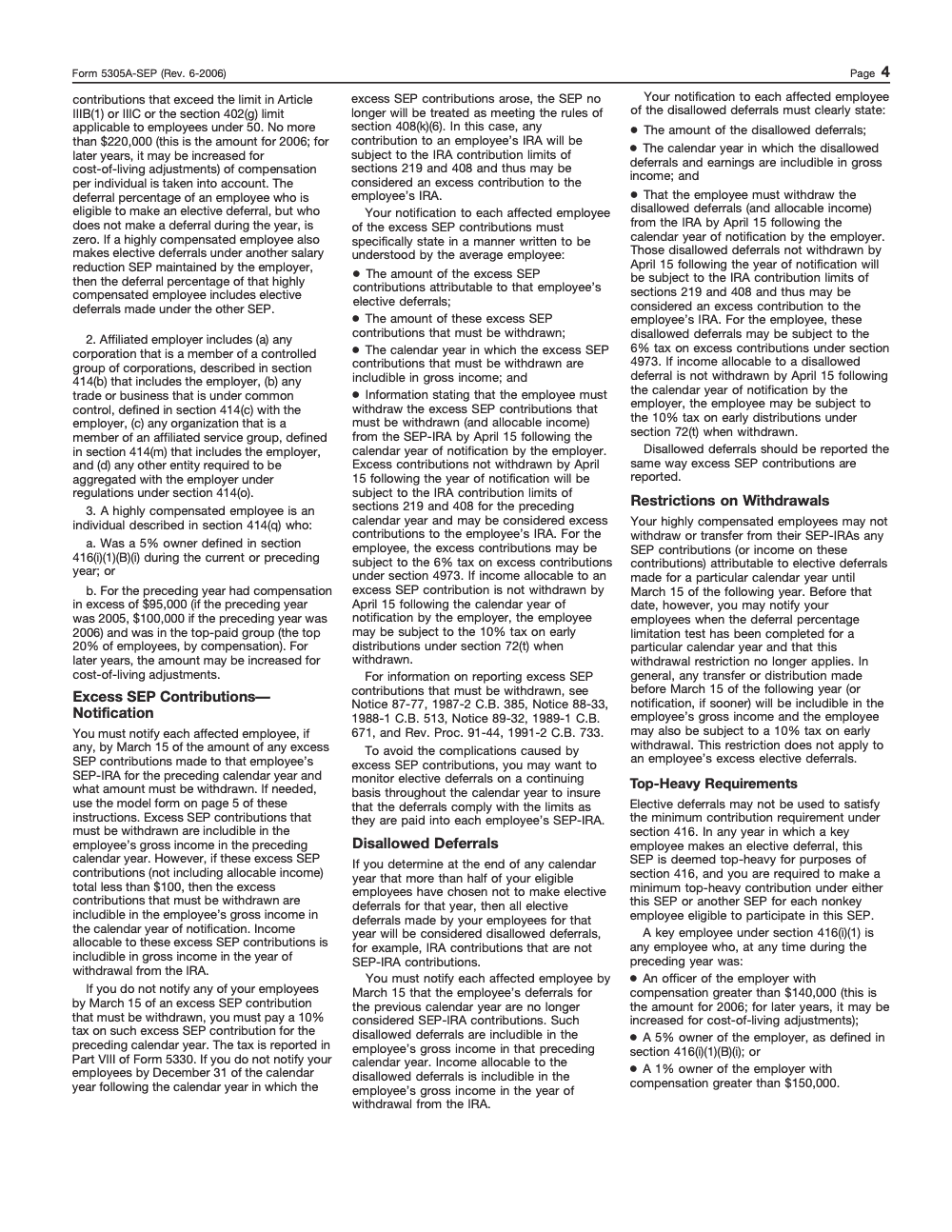
The 50% participation test requires that at least half of all eligible employees elect to participate in the salary reduction arrangement each year. This can be tricky in small businesses where the total eligible workforce fluctuates. If only 4 of 10 eligible employees make a salary reduction election, the test fails for that year – the employer must treat the elected deferrals as regular compensation (includable in income) rather than pre-tax reductions. The employer contributions to SEP-IRAs can still be made, but the salary reduction feature is effectively suspended for that year.
Deadlines, Penalties, and Filing Requirements
| Requirement | Deadline | Notes |
|---|---|---|
| SARSEP salary reduction election | Before compensation is paid | Must be a prospective election; retroactive salary reduction elections are not permitted |
| SARSEP contributions to SEP-IRAs | Due date of employer’s tax return (including extensions) | Same deadline applies to employer SEP contributions. Employee salary-reduction deferrals are plan assets governed by DOL timing rules – they must be deposited as soon as they can be segregated from the employer’s general assets (generally within 7 business days for plans under 100 participants), not by the tax-return due date. |
| Employee elective deferral limit (2025) | $23,500 ($31,000 age 50+) | Subject also to 25% of compensation limit; whichever is lower |
| Total SEP contribution limit (2025) | $70,000 | Combined employer + employee salary reductions cannot exceed this amount |
| 50% participation test | Must be met annually | Failure in any year means salary reductions for that year are not excludable |
| Form 5498 (annual contribution reporting) | Trustee files by May 31 | Reports contributions, rollovers, and FMV for each SEP-IRA account holder |
No Form 5500 Required
One administrative advantage of a SARSEP is that it generally does not require filing Form 5500 (Annual Return/Report of Employee Benefit Plan). SEP plans, including SARSEPs, are exempt from most ERISA plan reporting requirements that apply to 401(k) plans. This means significantly lower administrative burden – no annual return to the Department of Labor, no plan audit requirements for most employers. The employer’s primary compliance obligations are maintaining the plan document, verifying the 50% test annually, and ensuring contributions are deposited timely.
SARSEP Compliance and Grandfathering Rules
A grandfathered SARSEP can continue indefinitely as long as the employer maintains the plan and continues to meet the participation and contribution requirements. There is no deadline by which existing SARSEPs must be converted to another plan type. However, the practical issue is that plan sponsors and participants sometimes lose awareness of the specific SARSEP rules – particularly the 50% test – over time, especially as the original advisors who set up the plan move on.
For CPAs advising SARSEP employers, I recommend an annual SARSEP compliance checklist as part of the tax return engagement. The checklist should confirm that the plan was established before 1997, that the 50% participation test was met, that elective deferrals did not exceed the applicable limit, and that employer contributions (if any) were made on a nondiscriminatory basis. Small errors create big cleanup if a SARSEP is later determined to have been disqualified – all contributions for disqualified years would be includable in employees’ income.
Converting a SARSEP to a SIMPLE IRA
An employer with a grandfathered SARSEP may decide to simplify by terminating the SARSEP and establishing a SIMPLE IRA instead. This is a legitimate planning option, particularly for employers who want more consistent treatment and SIMPLE IRA matching contribution flexibility. The transition requires proper notice to employees, a plan termination process, and confirmation that the former SARSEP accounts are properly maintained as regular SEP-IRAs going forward. SARSEP termination is a one-way door – once terminated, the SARSEP cannot be re-established.
SARSEP vs. SIMPLE IRA – Employer Comparison
For the small number of employers still operating grandfathered SARSEPs, understanding the comparison to SIMPLE IRAs is valuable for planning conversations. The SARSEP often wins on contribution limits (the elective deferral limit for SARSEPs follows the 402(g) limit, which equals the 401(k) limit; because it is the same 402(g) limit, any 401(k) or 403(b) deferrals the employee makes in the same year reduce what is left to defer into the SARSEP), while SIMPLE IRA limits are lower. The SIMPLE IRA wins on administrative simplicity and does not have a 50% participation test.
| Feature | SARSEP (Grandfathered) | SIMPLE IRA (New Adoption) |
|---|---|---|
| New adoption permitted? | No – pre-1997 only | Yes |
| Employee elective deferral (2025) | $23,500 ($31,000 age 50+) | $16,500 ($20,000 age 50+, $17,600 ages 60–63 under SECURE 2.0) |
| Employer size limit | 25 or fewer eligible employees at adoption (counts only employees who meet the age, service, and compensation tests, not total headcount) | 100 or fewer employees |
| 50% participation test | Yes – must be met annually | No |
| Employer contribution requirement | None required (optional SEP contributions) | Required: 2% nonelective or 3% matching |
| Form 5500 required? | Generally no | Generally no |
Common Mistakes That Slow Things Down
Grandfathered SARSEPs fail quietly, because the plan keeps running on autopilot long after the rules stopped being front of mind. These are the errors I see most often when a 5305-A-SEP lands on my desk for cleanup.
Practical Checklists You Can Reuse
Copy these into your firm SOP. They are built to be checked line by line at year-end so a grandfathered SARSEP never fails a test by neglect.
Annual SARSEP Eligibility Confirmation
- Confirm the SARSEP was established on or before December 31, 1996.
- Build the eligible-employee list using the age 21, 3-of-5-years service, and $750 (2025) compensation tests.
- Verify the eligible-employee count did not exceed 25 during the preceding plan year.
- Confirm the employer maintains no other qualified plan while using the model Form 5305-A-SEP.
- Document that the executed form is retained in plan records and not filed with the IRS.
50% Participation and Deferral Testing
- Tally how many eligible employees elected salary reduction this plan year.
- Confirm that at least 50% of eligible employees made an election.
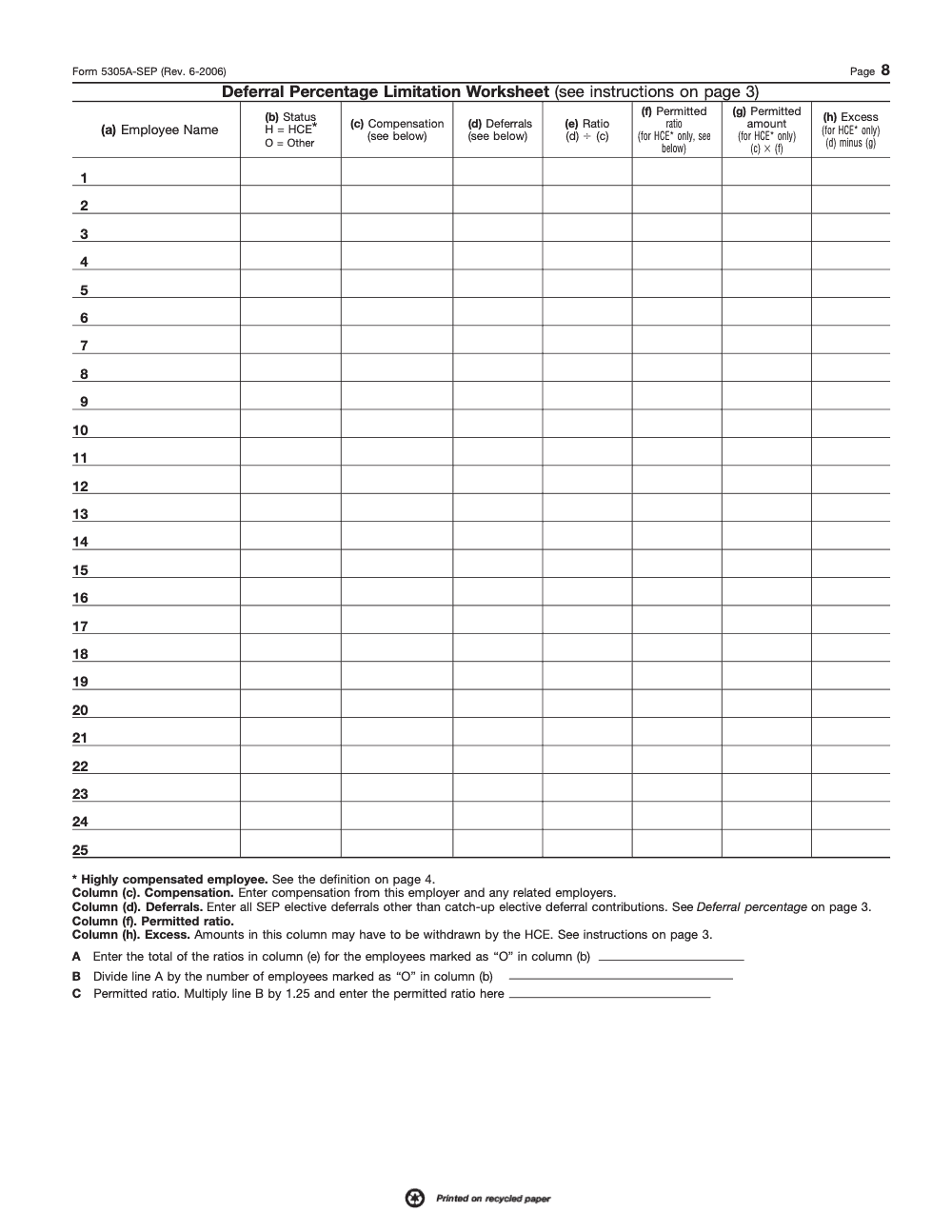
- Cap each highly compensated employee's deferral percentage at 1.25 times the average of all other eligible employees.
- Identify and arrange timely refunds for any excess HCE deferrals.
- Document the test results before reporting salary reductions as excludable.
Deposit and Year-End Reporting
- Confirm each participant's deferrals were deposited into a traditional IRA.
- Check that deferrals were deposited as soon as segregable, within the 7-business-day safe harbor for plans under 100 participants.
- Verify all contributions are recorded as 100% vested with no vesting schedule applied.
- Reconcile elective deferrals to W-2 Box 12 code F for each participant.
- File the year's testing worksheets with the retained plan document.
Keep Form 5305-A-SEP Season From Stalling
Most retirement-plan work has a clean filing deadline to force the issue. A grandfathered SARSEP does not, and that is exactly why it slips. The model Form 5305-A-SEP is never filed with the IRS (per the IRS Instructions for Form 5305-A-SEP), so the annual 50% participation test and the 25-eligible-employee ceiling get checked only when someone remembers to look.
The plans that stay compliant treat SARSEP review as a fixed step in the year-end close, not an ad hoc favor. A short, repeatable workflow keeps a decades-old plan from quietly losing its salary-reduction feature over a test no one ran.
- Confirm the plan was in place by December 31, 1996 and that the eligible-employee count from the preceding plan year is still no more than 25.
- Run the 50% participation test before reporting any salary reductions as excludable from income.
- Apply the SARSEP deferral limit correctly: cap each highly compensated employee at 1.25 times the average of all other eligible employees, not the two-tier 401(k) ADP test.
- Verify each participant's deferrals landed in a traditional IRA and were deposited within the 7-business-day safe harbor for plans under 100 participants.
- Reconcile elective deferrals to W-2 Box 12 code F and retain the executed model form in plan records.
This is the kind of recurring, checklist-driven execution we build into a documented workflow. If your year-end review queue is the bottleneck, our tax preparation and review services can carry the SARSEP testing and deposit reconciliation so nothing waits on one person's memory.
FAQs
No. The Small Business Job Protection Act of 1996 closed SARSEPs to new adoption effective January 1, 1997. No new SARSEPs can be established. If you want a plan that allows employee salary deferrals, the equivalent modern option is a SIMPLE IRA (for employers with 100 or fewer employees) or a SIMPLE 401(k). Existing SARSEPs established before 1997 can continue to operate.
The 50% participation test requires that at least half of all eligible employees make a salary reduction election each year. If fewer than 50% elect to participate, the salary reduction feature fails for that year – the amounts employees elected to defer must be treated as regular compensation, includable in income. Employer SEP contributions can still be made, but the salary reduction feature is effectively suspended. The test must be re-evaluated each year.
For 2025, the maximum elective deferral to a SARSEP is $23,500 ($31,000 for participants age 50 or older), subject to the additional limit of 25% of the employee’s compensation. The 25% limit is often the binding constraint for lower-income employees. These limits follow the same structure as 401(k) elective deferral limits – not the lower SIMPLE IRA limits.
Generally no. SEP plans, including SARSEPs, are exempt from most ERISA Form 5500 filing requirements that apply to 401(k) plans. This is one of the administrative advantages of maintaining a SARSEP versus transitioning to a SIMPLE 401(k). The employer’s primary compliance obligations are maintaining the plan document, verifying the 50% test annually, and ensuring timely contributions.
Once terminated, a SARSEP cannot be re-established. The SEP-IRA accounts continue to exist as regular IRA accounts for each participant – the funds remain accessible subject to normal IRA distribution rules. If the employer wants to continue offering retirement benefits, they would need to establish a new plan type (SIMPLE IRA, SEP-IRA without salary reduction, or a qualified plan). Termination requires proper notice to employees and should be documented.
Other forms this guide names
- Form W‑2: Deadlines, E‑File Rules, Boxes, and W‑2c Corrections
About this guide
Accountably helps US CPA, EA, and accounting firms hire trained accountants and tax preparers in India.
About us Reviewed byJugal Thacker, CPAFounder and CEO at Accountably
A Washington-licensed CPA with 7+ years inside US firms – PwC, a real-estate tax practice, then a full-service firm, rising from reviewer to manager to advisory. This article was reviewed against current IRS guidance for the 2025 tax year and updated for filers preparing late returns, amendments, and 2026 estimates.
View profile →How we research, review, and update this guide
Every Accountably guide is researched against primary IRS sources, reviewed by a U.S. CPA, and refreshed as guidance evolves. Read our Editorial Guidelines to see how we source, fact-check, and update our content.