Summarize this article with AI
In Brief
Form 5498-SA is the information return an HSA, Archer MSA, or Medicare Advantage MSA trustee files to report contributions, rollovers (Box 4), and the December 31 fair market value (Box 5); the participant keeps it for their records and never attaches it to a return (per the IRS Instructions for Form 5498-SA and Pub. 969). For 2025 the HSA contribution limit is $4,300 self-only and $8,550 family, trustees furnish the participant statement by May 31, and Copy A is filed with the IRS by June 1, 2026.
Form 5498-SA arrives after tax season, by May 31, because trustees capture contributions made through April 15 for the prior year. The surprise sits in the last-month rule: treating a December 1 HDHP enrollment as full-year coverage allows a full-year HSA contribution, but requires keeping HDHP coverage through December 31 of the following year, or the excess becomes taxable plus a 10% penalty.
The HSA, Archer MSA, or Medicare Advantage MSA trustee files the form to report contributions, rollovers in Box 4, and the year-end fair market value in Box 5, and the account holder checks it against Form 8889 and never attaches it to a return. For 2025 the HSA limit is $4,300 self-only and $8,550 family, with a $1,000 catch-up at age 55 or older.
Key Takeaways
- Form 5498-SA is filed by HSA, Archer MSA, and Medicare Advantage MSA trustees and custodians to report annual contributions, rollover amounts, and year-end fair market value – the account holder uses it to verify Form 8889 data.
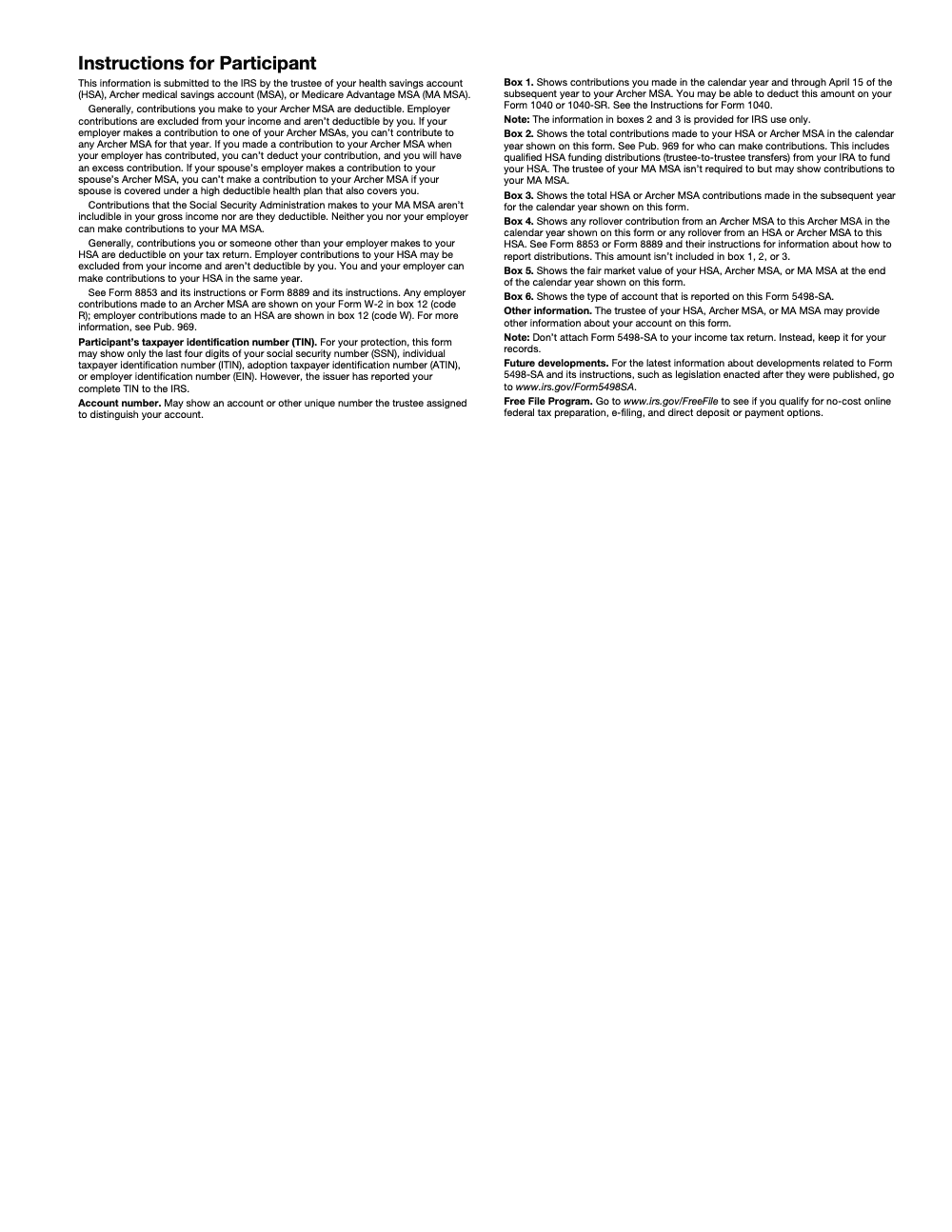
- The trustee or custodian files Form 5498-SA; the account holder receives Copy B but does not attach it to their tax return – HSA information is reported on Form 8889 instead.
- For HSAs, the 2025 contribution limit is $4,300 for self-only coverage and $8,550 for family coverage, with a $1,000 catch-up for account holders age 55 or older.
- The filing deadline for Form 5498-SA is May 31, later than most information returns, to allow trustees to capture contributions made through April 15 for the prior tax year.
- The most common pitfall is the last-month rule: electing to treat December 1 HDHP enrollment as full-year coverage allows a full-year contribution – but requires maintaining HDHP coverage through December 31 of the following year, or the excess contribution becomes taxable plus a 10% penalty.
- Quick rule for your SOP: when a client’s 5498-SA contribution exceeds the annual limit for the months they actually had HDHP coverage, immediately check whether they used the last-month rule and whether they maintained coverage through the testing period.
What Form 5498-SA Is and When to Use It
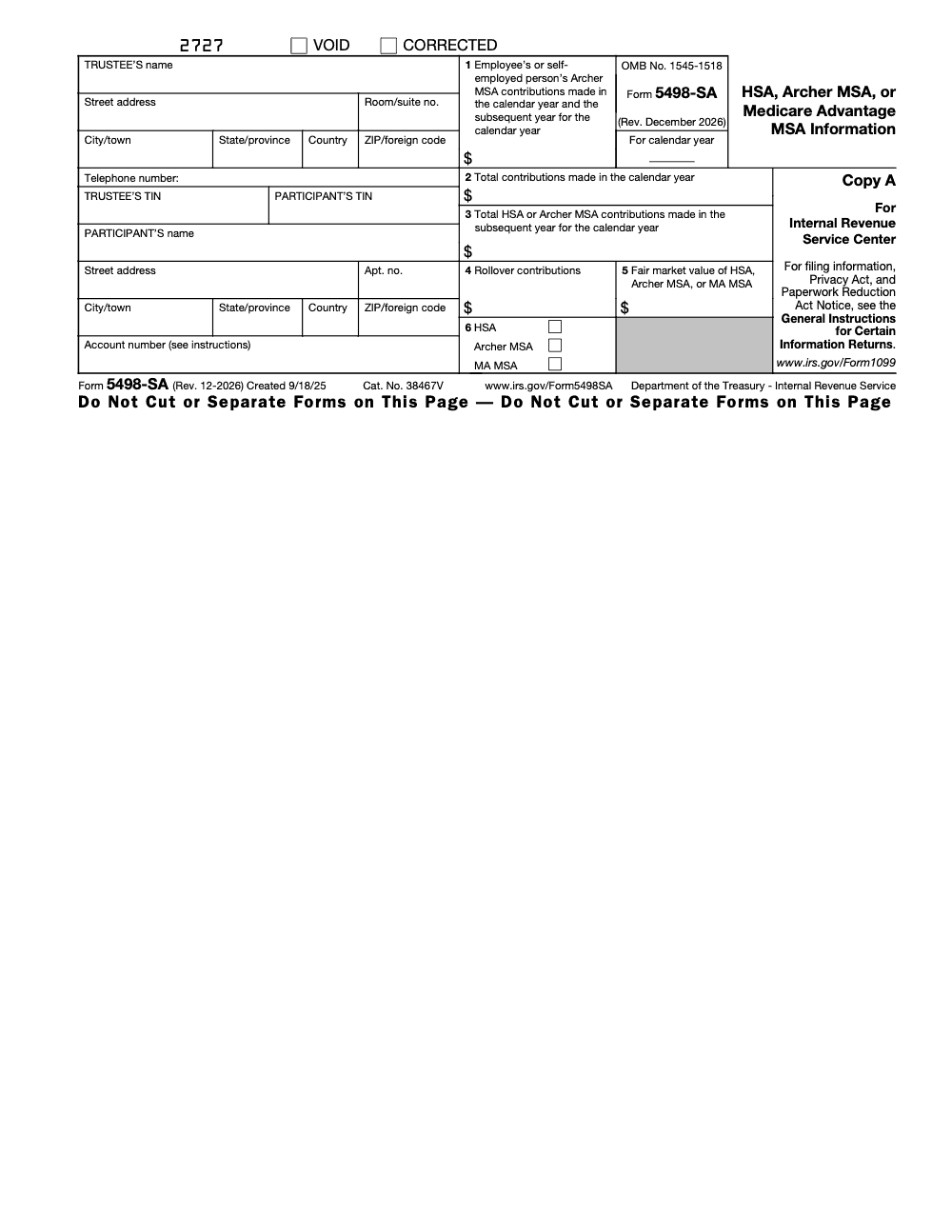
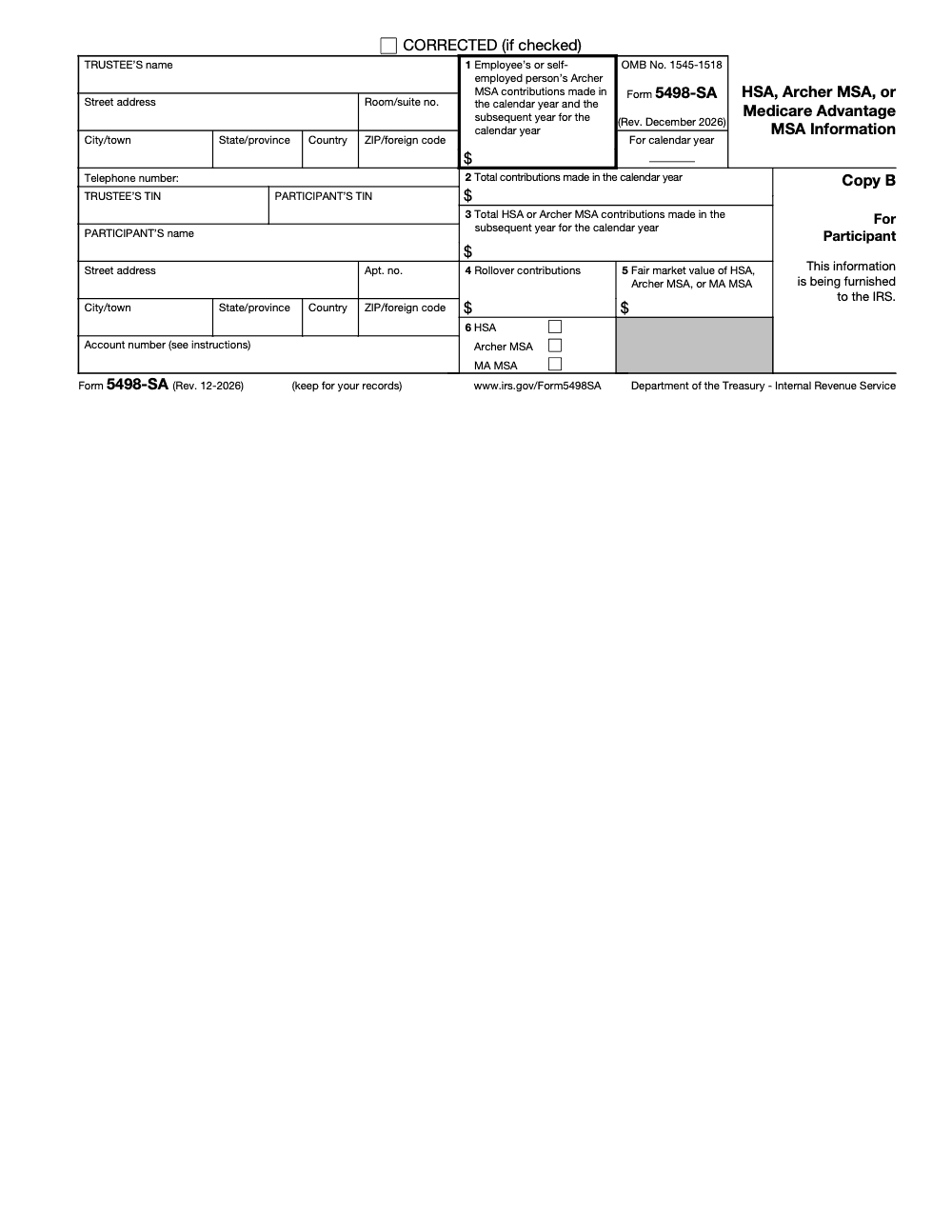
Form 5498-SA, HSA, Archer MSA, or Medicare Advantage MSA Information, is the annual information return filed by trustees and custodians of health savings accounts (HSAs), Archer Medical Savings Accounts (Archer MSAs), and Medicare Advantage MSAs. The form reports the account type, contributions made during the year, rollover contributions, and the year-end fair market value. The IRS uses this data to cross-reference against Form 8889 (HSA reporting on the individual return) and to identify potential excess contributions or deduction errors.
From the preparer’s perspective, the 5498-SA is a verification tool. The primary HSA reporting happens on Form 8889, which the taxpayer or preparer completes based on actual contribution, distribution, and HDHP coverage data. The 5498-SA confirms what the trustee recorded. If the numbers don’t reconcile, there is either a reporting error by the trustee or a deduction discrepancy on the return that needs to be resolved.
Three Account Types on One Form
The form covers three distinct account types, each with its own rules and limits. A box in the upper right identifies which type is being reported. HSAs are by far the most common – they require enrollment in a qualifying High-Deductible Health Plan (HDHP). Archer MSAs, a predecessor to HSAs, are available only to self-employed individuals and employees of small employers (50 or fewer employees on average) who have HDHP coverage. The Archer MSA HDHP definition under IRC §220 uses different minimum deductible and out-of-pocket thresholds than the HSA HDHP definition under IRC §223, so the two sets of limits are not interchangeable. Medicare Advantage MSAs are a specialized account type associated with certain Medicare Advantage plans and have unique reporting requirements. Only the Social Security Administration funds an MA MSA, so neither the account holder nor an employer may contribute to one. The deduction rules, limits, and distribution rules differ across all three types.
Who Can Contribute to an HSA
To be eligible to contribute to an HSA in a given month, the account holder must be enrolled in a qualifying HDHP on the first day of that month, must not be covered by any other non-HDHP health coverage (with limited exceptions), must not be enrolled in Medicare, and must not be claimed as a dependent on someone else’s return. Eligibility is determined month by month, so the contribution limit is prorated based on the number of months of qualifying coverage during the year – unless the last-month rule applies.
How to Complete Form 5498-SA
Trustees complete the form based on account activity during the calendar year. The critical point is that contributions made January 1 through April 15 for the prior tax year are included in Box 3 of the 5498-SA for the prior year – not the year in which they were physically deposited. Trustees must track the year designation of contributions to report them in the correct box.
| Box | What It Contains | Preparer Notes |
|---|---|---|
| Box 1 – Employee or self-employed person’s HSA contributions (Archer MSA) | Contributions made by the account holder directly or by the employer on behalf of the Archer MSA participant; for an Archer MSA, if the employer contributes in a given year the account holder cannot also contribute that year (unlike an HSA, where both may contribute in the same year) | Not used for standard HSAs; applicable to Archer MSA reporting only |
| Box 2 – Total contributions made in the year (HSA) | All contributions to the HSA during the year, including employer contributions, prior-year contributions designated for this year, and any qualified HSA funding distribution transferred directly from your IRA | Compare to Form 8889 Line 2 (employee contributions) plus Line 9 (employer contributions); should reconcile |
| Box 3 – Total HSA or Archer MSA contributions made in year for prior year | Contributions made in January–April designated as prior-year contributions | Useful for confirming that the prior-year deduction was fully captured; reduces current-year Box 2 by this amount |
| Box 4 – Rollover contributions | Amounts rolled over from another HSA or Archer MSA; this amount is not included in Box 1, 2, or 3 | Rollovers do not count against the annual contribution limit; verify rollover was completed timely (within 60 days) |
| Box 5 – Fair market value of HSA, Archer MSA, or MA MSA | Account balance as of December 31 | Informational; used to monitor account growth and identify accounts with potential excess contributions |
| Box 6 – Account type | HSA, Archer MSA, or Medicare Advantage MSA | Verify account type is correct; rules differ significantly across the three types |
Reconciling 5498-SA to Form 8889
The 5498-SA Box 2 total should reconcile to the sum of Form 8889 Line 2 (account holder contributions) and Line 9 (employer contributions). Employer contributions reported on Line 9 come from W-2 Box 12 Code W. If the 5498-SA shows total contributions that exceed what appears on Form 8889, investigate whether a January–April prior-year contribution was correctly allocated across tax years. Discrepancies that are not resolved before the return is filed may generate IRS notices.
Deadlines, Penalties, and Filing Requirements
| Requirement | Date | Notes |
|---|---|---|
| Furnish Copy B to account holder | May 31 | Extended beyond most information returns to capture April 15 prior-year contributions |
| File Copy A with IRS (paper) | May 31 | Paper filers use Form 1096 as transmittal cover sheet |
| File Copy A with IRS (electronic) | May 31 | Same deadline; FIRE system accepts electronic filing |
| E-file threshold (mandatory) | 10+ information returns aggregate | Filers with 10+ returns across all information return types must e-file; the old 250-return paper threshold no longer applies (T.D. 9972 reduced it to 10 for returns required to be filed on or after January 1, 2024) |
HSA Contribution Limits for 2025
| Coverage Type | 2025 Limit | Catch-Up (Age 55+) |
|---|---|---|
| Self-only HDHP | $4,300 | Additional $1,000 |
| Family HDHP | $8,550 | Additional $1,000 |
Penalties for Excess Contributions
Excess HSA contributions are subject to a 6% excise tax under IRC §4973 for each year the excess remains in the account, reported on Form 5329. The excess can be corrected by withdrawing the excess contribution plus the net income attributable to it before the tax filing deadline (including extensions). If the taxpayer took a deduction for the excess contribution, an amended return may be needed to reverse the deduction. Trustee-level penalties for failure to file 5498-SA timely follow the standard information return penalty structure.
The Last-Month Rule – A High-Stakes HSA Election
The last-month rule under IRC §223(b)(8) allows an individual who is HSA-eligible on December 1 of a given year to treat themselves as eligible for the entire year and contribute the full annual limit. This sounds beneficial – and it is, if the testing period condition is met. The testing period requires that the individual remain HSA-eligible (enrolled in a qualifying HDHP and not enrolled in Medicare) throughout the following year through December 31. If coverage lapses during the testing period, the excess contribution amount becomes includable in income plus a 10% additional tax.
The practical scenario: a client changes jobs in October, gains HDHP coverage November 1, and wants to contribute the full family HSA limit for the year. Using the last-month rule allows the full $8,550 contribution (2025) instead of the prorated $1,425 for two months of coverage. If the client maintains HDHP coverage through December 31 of the following year, there is no problem. If they switch to a non-HDHP plan during that period – even involuntarily due to a job change – the excess becomes taxable. I make sure every client using the last-month rule signs off on the testing period risk in writing, and I flag their file for follow-up in the following year.
Spouse HSA Contributions
When both spouses have HSA-eligible coverage, the family contribution limit ($8,550 for 2025) must be divided between their two HSAs in any combination they choose. Neither spouse can contribute more than the family limit in total. If one spouse has self-only HDHP coverage and the other has family HDHP coverage, the couple can contribute up to the family limit – but the spouse with self-only coverage cannot exceed the self-only limit in their own account (the other spouse can make up the difference in their account). Catch-up contributions ($1,000 per eligible spouse age 55+) can only go into the eligible spouse’s own HSA.
HSA Rollovers and Transfers
An HSA can be rolled over from one trustee to another. A trustee-to-trustee transfer (direct transfer between custodians) has no annual limit and is not a taxable event – it does not appear in Box 4 of the 5498-SA. An indirect rollover (distribution to the account holder followed by a re-contribution to a new HSA) must be completed within 60 days and is limited to one per 12-month rolling period. Box 4 of the 5498-SA captures indirect rollover amounts.
A one-time qualified HSA funding distribution can be made from an IRA to an HSA. This reduces the IRA balance without income tax, but the amount is limited to the applicable annual HSA contribution limit and counts against the year’s contribution limit. The individual must remain HSA-eligible for the 12 months following the distribution (testing period) or the amount becomes taxable plus the 10% additional tax. This is a niche but valuable planning strategy for clients who hold large traditional IRA balances and have near-term medical expense expectations.
Common Mistakes That Slow Things Down
Most 5498-SA problems I see do not come from the trustee’s boxes being wrong; they come from preparers and account holders reading those boxes the wrong way after the return is already filed. Here are the ones that create the most rework.
Practical Checklists You Can Reuse
These are copy-paste ready for a firm SOP or a trustee’s year-end procedure. Drop them into your workpaper template and check items off as you go.
Trustee filing packet
- Confirm the account type and check exactly one Box 6 (HSA, Archer MSA, or MA MSA); each account needs its own form.
- Enter total current-year contributions in Box 2, including any qualified HSA funding distribution transferred from the participant’s IRA.
- Record subsequent-year (January 1 through April 15) prior-year contributions in Box 3 for an HSA or Archer MSA; use Box 1 for Archer MSA contributions only.
- Report rollovers in Box 4 and keep them out of Boxes 1, 2, and 3.
- Enter the December 31 fair market value in Box 5.
- Mask all but the last four digits of the participant TIN on the participant copy, and report the complete TIN on Copy A to the IRS.
- Furnish the participant statement by May 31 and file Copy A with the IRS by June 1, 2026.
- If you file 10 or more information returns in the aggregate, submit electronically through the FIRE system or IRIS.
Preparer reconciliation
- Pull the client’s HSA statements, W-2 Box 12 code W, and personal contribution records before touching Form 8889.
- Confirm total contributions from all sources stay within the 2025 limit: $4,300 self-only or $8,550 family, plus the $1,000 catch-up at age 55 or older.
- Flag any last-month rule contribution and document the testing-period commitment in writing.
- Verify Box 4 rollovers are reported on Form 8889 line 14 and not double-counted in contributions.
- Treat Box 2 and Box 3 as IRS-use-only; do not transcribe them onto Form 8889 or Form 8853.
- For an Archer MSA, route the figures to Form 8853 and confirm the employer did not also contribute that year.
- When the 5498-SA arrives by May 31, reconcile it against the filed return and note any discrepancy for a possible amendment.
Keep 5498-SA Season From Stalling
Form 5498-SA breaks the usual information-return rhythm. Where most 1099-series forms close in January, the 5498-SA cycle stays open: prior-year contributions can land through April 15, participant statements are due by May 31, and Copy A files with the IRS by June 1, 2026. That long tail is where trustee teams lose track, and a missed or incorrect return carries a $340 penalty per form under IRC §6721, with a matching $340 per participant statement under IRC §6722 (per the General Instructions for Certain Information Returns).
The reliable way through is to treat the 5498-SA as a two-stage close rather than a single year-end task: lock the fair market value early, then hold the contribution boxes open until the April 15 designation window shuts. A structured workflow keeps both stages on schedule without a May scramble.
- Reconcile the Box 5 fair market value against the December 31 custodial balance and furnish it on the January 31 FMV statement, separate from the later full form.
- Hold the Box 2 and Box 3 contribution fields open until April 15, then confirm which deposits the participant designated to the prior year.
- Confirm exactly one Box 6 account type per form, since an HSA and an Archer MSA cannot share a single 5498-SA.
- Keep Box 4 rollovers out of Boxes 1, 2, and 3 so the totals reconcile cleanly.
- Run an aggregate information-return count before filing; at 10 or more, the form must go out electronically.
That two-stage discipline is exactly what a delivery partner is built to hold. Accountably’s tax execution teams run the reconciliations, the box-level checks, and the deadline tracking on a documented SOP, so the May statement run and the June filing go out clean instead of consuming senior review time.
FAQs
Not typically. Form 5498-SA is not issued until May 31, after the April 15 filing deadline. Most preparers complete Form 8889 using HSA account statements, W-2 Box 12 Code W data, and the client’s own records of contributions and distributions. The 5498-SA is a post-filing verification document for most taxpayers. If there is a discrepancy between what was filed and what the 5498-SA shows, an amended return may be warranted.
For 2025, the HSA contribution limit is $4,300 for self-only HDHP coverage and $8,550 for family HDHP coverage. Account holders who are age 55 or older at any point during the year can contribute an additional $1,000 catch-up contribution. These limits apply to the combined contributions from all sources – employee, employer, and any third-party contributions to the account.
The last-month rule allows an individual who is HSA-eligible on December 1 to contribute the full annual limit for that year, even if they were not eligible for the entire year. The trade-off is a testing period requirement: the individual must remain HSA-eligible through December 31 of the following year. If the testing period is not met, the excess contribution amount becomes taxable income plus a 10% additional tax in the year the testing period fails.
Yes. Contributions made between January 1 and April 15 of the current year that are designated for the prior tax year count as prior-year contributions and are deductible on the prior-year return. The HSA trustee reports these in Box 3 of the 5498-SA for the prior year. You must clearly indicate to the trustee that the contribution is for the prior year – contributions without designation default to the current year.
Excess contributions are subject to a 6% excise tax under IRC §4973 for each year they remain in the account, reported on Form 5329. The excess can be corrected by withdrawing the excess plus the net income attributable to it before the tax return due date (including extensions). If the excess was deducted on the return, an amended return is needed to reverse the deduction. Withdrawn excess that was included in income should not be taxed again on the corrective distribution.
Yes. Employer contributions shown in W-2 Box 12 Code W count toward the annual HSA limit and are already excluded from your gross income – you cannot also deduct them on Form 8889. The total of all contributions (employee + employer + any third-party) must stay within the annual limit. If employer contributions alone equal or exceed the limit, you cannot make additional tax-deductible contributions to the HSA.
Other forms this guide names
Summarize this article with AI
About this guide
Accountably helps US CPA, EA, and accounting firms hire trained accountants and tax preparers in India.
About us Reviewed byJugal Thacker, CPAFounder and CEO at Accountably
A US-licensed CPA with 7+ years inside US firms – PwC, a real-estate tax practice, then a full-service firm, rising from reviewer to manager to advisory. This article was reviewed against current IRS guidance for the 2025 tax year and updated for filers preparing late returns, amendments, and 2026 estimates.
View profile →How we research, review, and update this guide
Every Accountably guide is researched against primary IRS sources, reviewed by a U.S. CPA, and refreshed as guidance evolves. Read our Editorial Guidelines to see how we source, fact-check, and update our content.