Key dates
Summarize this article with AI
In Brief
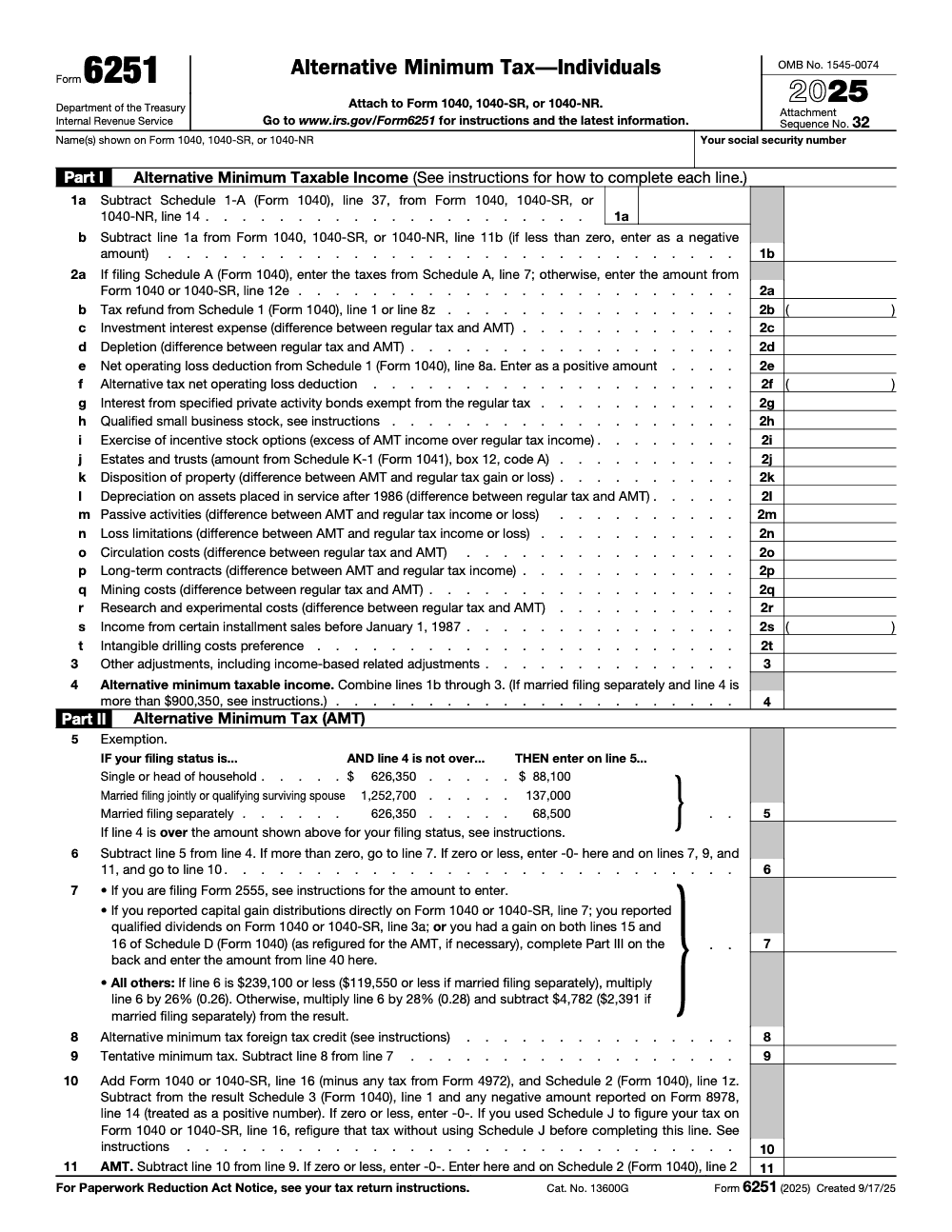
Form 6251 is the Alternative Minimum Tax calculation for individuals – a parallel tax you attach to Form 1040, 1040-SR, or 1040-NR, with any AMT from line 11 reported on Schedule 2, line 2. For 2025 the AMT exemption is $88,100 (single or head of household) and $137,000 (married filing jointly), phasing out above $626,350 and $1,252,700; AMTI above the exemption is taxed at 26% up to $239,100, then 28% (per IRS Revenue Procedure 2024-40 and the Instructions for Form 6251). The 2025 return is due April 15, 2026, with an extension to October 15, 2026 on Form 4868.
Plenty of returns never touch the Alternative Minimum Tax, and then a year with large state taxes, an exercised incentive stock option, or private activity bond interest flips the result, and the regular tax was never the real number. Form 6251 recomputes income as AMTI, applies the exemption, and compares the parallel tax to what you already owe.
For 2025 the exemption is $88,100 for single or head of household and $137,000 for married filing jointly, phasing out above $626,350 and $1,252,700. AMTI above the exemption is taxed at 26% up to a base of $239,100 and 28% beyond it, and any AMT carries from line 11 of this form onto Schedule 2, line 2. If the tentative minimum tax comes out higher, you attach the form and pay the difference.
Key Takeaways
- Form 6251 recomputes income as AMTI, applies the AMT exemption, then the 26 percent and 28 percent AMT rates, and compares the result to your regular tax. If AMT is higher, you pay the excess.
- 2025 AMT exemptions, indexed for inflation, are 88,100 single or head of household, 137,000 married filing jointly, and 68,500 married filing separately. Phaseouts begin at 626,350 for single and 1,252,700 for MFJ, with full phaseout at 978,750 and 1,800,700 respectively.
- The 28 percent AMT rate starts above an AMT base of 239,100 for most filers, 119,550 if married filing separately. Long term capital gains and qualified dividends keep preferential rates via Part III of Form 6251.
- Common AMT triggers include large SALT deductions, private activity bond interest, ISO bargain elements, depreciation differences, and AMT limits on net operating losses, known as ATNOL or ATNOLD on line 2f.
- Always run an annual AMT check. Your software usually does it, but you are responsible for attaching Form 6251 when the tentative minimum tax is higher or when certain credits require the AMT computation.
What Form 6251 Is, and Why It Matters
You file Form 1040 like usual, then Form 6251 asks you to compute income under AMT rules. Start with taxable income, add back adjustments and preference items to arrive at alternative minimum taxable income, AMTI. Reduce AMTI by the AMT exemption, compute tax at 26 and 28 percent, and compare that tentative minimum tax to your regular tax. The higher one wins.
Why you should care, even if last year was fine. AMT exposure shifts with income, deductions, and special transactions. A single ISO exercise, a large state estimate, or a change in depreciation can swing you into AMT for just one year. The fix is simple, run the 6251 math every time.
If your tentative minimum tax exceeds your regular tax, you owe AMT and must attach Form 6251 to your return. Keep the worksheets you used to figure AMTI and any special schedules.
The AMT, In Plain Terms
- What: A parallel tax calculation meant to limit how far certain deductions and preferences can reduce your bill.
- How: Rebuild your income as AMTI, subtract the AMT exemption, apply 26 percent and 28 percent rates, then compare to regular tax. Capital gains and qualified dividends still get preferential rates through Part III.
- Wow: For 2025, the numbers moved. Exemption amounts and the 28 percent breakpoint are higher than 2024, so some borderline filers may avoid AMT this year, while others with ISO exercises or private‑activity bond interest still tip into AMT.
Quick 2025 Numbers You Will Use
| Item | 2025 value |
| AMT exemption, Single or HOH | 88,100 |
| AMT exemption, MFJ | 137,000 |
| AMT exemption, MFS | 68,500 |
| 28 percent rate starts at | 239,100 AMT base for most filers, 119,550 MFS |
| Phaseout starts, Single | 626,350 |
| Phaseout starts, MFJ | 1,252,700 |
| Full phaseout, Single | 978,750 |
| Full phaseout, MFJ | 1,800,700 |
These values come from IRS Rev. Proc. 2024‑40, which sets inflation adjustments for tax year 2025.
A Fast AMT Walkthrough
- Step 1, Start with your Form 1040 taxable income, carry it to Form 6251.
- Step 2, Add AMT adjustments and preference items, for example SALT add backs, private‑activity bond interest, ISO bargain elements, and depreciation differences. This produces AMTI.
- Step 3, Subtract the AMT exemption for your filing status, reduced if you are in the phaseout range.
- Step 4, Apply 26 percent up to the breakpoint and 28 percent above it. If you have long term capital gains or qualified dividends, complete Part III to use preferential rates.
- Step 5, Compare the tentative minimum tax to regular tax. The extra is your AMT. Attach Form 6251 if AMT applies or if a credit requires the calculation.
Small disclosure, for accuracy, our team validated the 2025 exemption amounts, phaseout thresholds, and the 28 percent breakpoint against IRS Rev. Proc. 2024‑40 and the IRS About Form 6251 page on April 29, 2025. We also cross‑checked ATNOLD guidance in the 2024 Instructions for Form 6251, which still describe the 90 percent ATNOL limit.
How The Alternative Minimum Tax Works, Step By Step
The Parallel Calculation
You are running a side by side version of your tax. Start with regular taxable income, then add AMT adjustments and preference items to compute AMTI on Form 6251. From there, reduce by the AMT exemption, apply the 26 percent and 28 percent rates, and, if needed, run Part III for capital gains and qualified dividends. Compare the tentative minimum tax to your regular tax to see if AMT applies.
What counts as an AMT adjustment or preference, in practice: the state and local tax deduction, interest from certain private‑activity municipal bonds, ISO bargain elements in the year of exercise, and depreciation timing differences, among others. Your software will flag these, but you still want to recognize them as early warnings.
Exemptions, Rates, and Phaseouts for 2025
Think in three layers.
- Layer 1, Exemption. For 2025, the AMT exemption is 88,100 single or head of household, 137,000 married filing jointly, and 68,500 married filing separately.
- Layer 2, Rates. The AMT uses two rates, 26 percent up to the breakpoint and 28 percent above it. For 2025 the 28 percent rate kicks in above 239,100 of AMT base for most filers, 119,550 if married filing separately.
- Layer 3, Phaseout. The exemption shrinks by 25 cents for every dollar of AMTI above 626,350 for single and 1,252,700 for MFJ, until it is fully phased out at 978,750 and 1,800,700.
Visual Snapshot
| Concept | 2025 reference |
| AMT exemption | Single 88,100, MFJ 137,000, MFS 68,500 |
| AMT rates | 26% then 28% |
| 28% breakpoint | 239,100 most filers, 119,550 MFS |
| Phaseout start | 626,350 single, 1,252,700 MFJ |
| Full phaseout | 978,750 single, 1,800,700 MFJ |
Source, IRS Rev. Proc. 2024‑40.
Capital Gains And Qualified Dividends
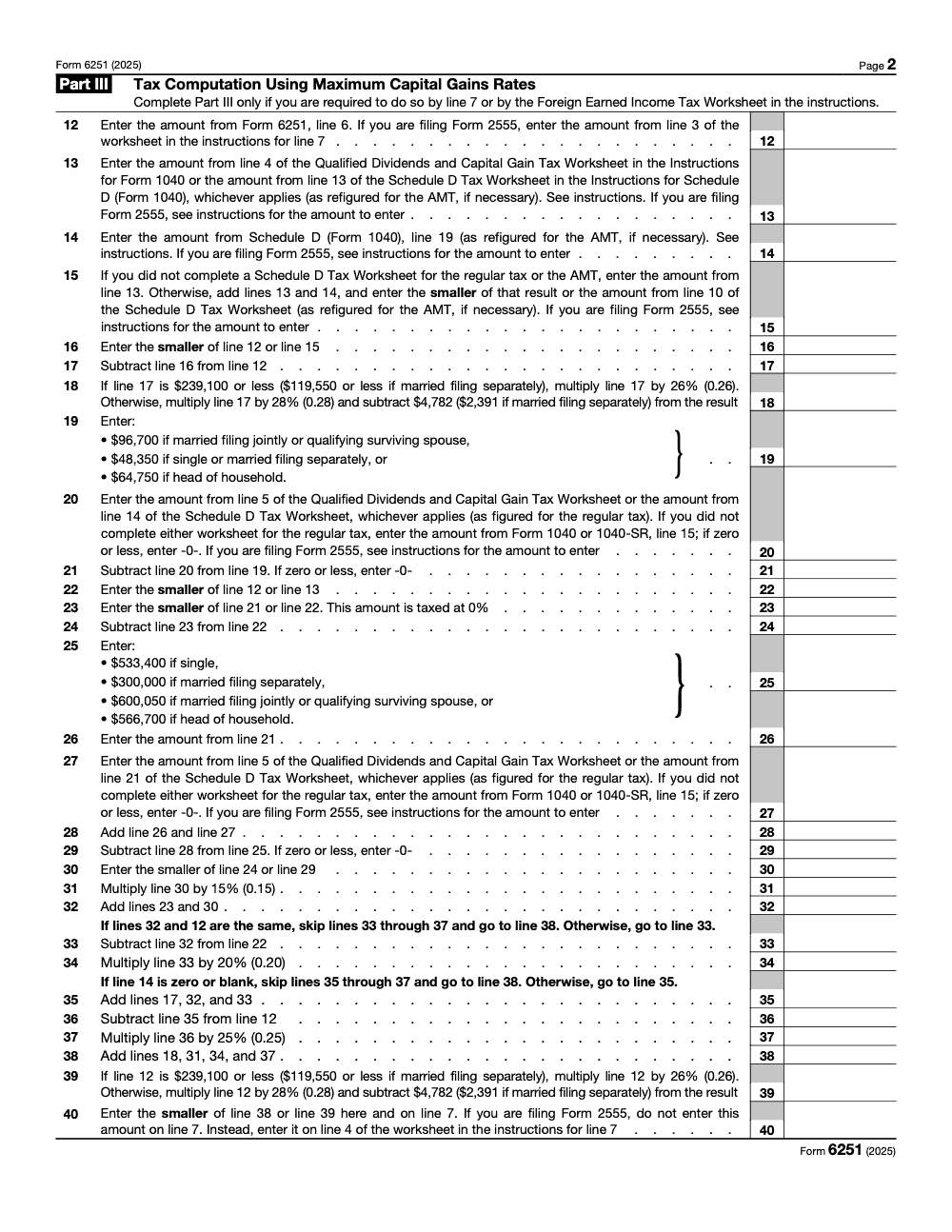
Good news, you do not tax those at 26 or 28 percent when the preferential rates apply. If you have qualified dividends or long term capital gains, complete Part III of Form 6251 (it is mandatory whenever any qualified dividends or net long term capital gain exists, not just when the amounts are significant). The form runs a special worksheet so those items keep the lower capital gain rates, then blends the result back into your AMT tax.
A quick tip, gains can push other AMTI over the 28 percent breakpoint or deeper into exemption phaseout, so timing matters. If your numbers are close, model a sale in December versus January to see the year to year impact before you pull the trigger.
Who Should Check AMT Every Year
- You, if you claim large state and local taxes, have big itemized deductions, or you exercised ISOs.
- You, if you hold private‑activity municipal bonds or run accelerated depreciation.
- You, if you have net operating losses or complex credits that need the AMT comparison.
The IRS expects filers to evaluate AMT annually, and most software will run the check and attach the form when needed. You are still responsible for the attachment and for keeping your workpapers.
Simple rule, run the AMT pass every year, even if last year was clean.
A 2‑Minute Screening Habit
- Look for SALT, ISO exercises, private‑activity interest, large casualty or gambling losses, and depreciation differences.
- Glance at last year’s 6251 or your software’s AMT summary to spot trends.
- If you exercised ISOs, enter the bargain element promptly, even if you did not sell, so the AMT engine can do its job.
If you manage a firm, teach your team to tag potential AMT triggers when they see the source documents, not at review time. That small habit cuts review edits and keeps filing on schedule.
Common AMT Triggers And Preference Items
The Greatest Hits
- State and local tax deduction, disallowed for AMT, which often flips a high‑tax state return into AMT territory.
- Private‑activity municipal bond interest, tax exempt for regular tax, included for AMT.
- ISO bargain element, included in AMTI in the year you exercise.
- Depreciation differences, where AMT requires slower methods or longer lives.
- Net operating losses, limited for AMT by the ATNOL rules.
If you see any of these, plan for an AMT check. Your regular tax can look low while AMT rises quietly in the background.
ISO Example, Why Timing Matters
You exercise 5,000 ISOs at an $18 spread, hold the shares through year end, and do not sell. Your regular tax sees nothing now. AMT adds about 90,000 to AMTI for the bargain element. That may push you through the 28 percent breakpoint or into exemption phaseout, creating a surprise bill. If you later sell in a disqualifying disposition, the AMT credit via Form 8801 can help in a later year, but the cash cost this year is still real. Model this before you exercise.
Depreciation And Real Property
AMT can require straight‑line or longer recovery lives for certain assets, which increases AMTI relative to regular tax in the early years of an asset’s life. If you placed a lot of property in service this year, especially leasehold improvements or 15‑year property, run a quick AMT depreciation worksheet and save it with your file. The Form 6251 instructions walk through the differences and point you to the right worksheets.
NOLs, ATNOL, And ATNOLD
For AMT, the Alternative Tax Net Operating Loss Deduction, ATNOLD, is generally limited to 90 percent of AMTI computed without the ATNOLD. On Form 6251, you enter ATNOLD on line 2f as a negative number. There are exceptions for certain disaster and special zone losses described in the instructions. Keep your carryover schedules current and note which losses are subject to the 90 percent cap and which are not.
Software‑Assisted Checks That Actually Help
Modern consumer and professional suites will auto‑prepare Form 6251 when they detect triggers. A few tips:
- Confirm how your software handles ATNOLD. Some require you to compute and enter the amount on line 2f manually.
- Make sure ISO data entry captures the bargain element.
- Review the AMT capital gains worksheet whenever you have sizable sales or qualified dividends.
If you run a firm and struggle to keep AMT workpapers consistent during peak season, tighten SOPs for naming, version control, and review checklists. It saves partner review time and keeps filing deadlines intact. That operational drumbeat matters more than one extra reviewer when the calendar gets tight.
Calculating AMTI, Line By Line
Start Point
Pull taxable income from Form 1040 to Form 6251, line 1. Then work lines 2 through 3 for AMT adjustments and preference items, using the instructions for items like depreciation and ISOs. Once you total those entries, you arrive at AMTI on line 4, then you subtract the AMT exemption on line 5 and continue to the tax computation.
Checklist while you work:
- Anchor line 1 to your Form 1040 taxable income.
- Add back SALT and other disallowed deductions.
- Include private‑activity interest, ISO bargain elements, and any needed depreciation adjustments.
- Enter ATNOLD on line 2f as a negative.
- Keep every supporting worksheet with your file.
Common AMT Adjustments You Will See
- SALT add back, including state income and property taxes from Schedule A.
- Private‑activity bond interest, usually from your 1099 statements.
- Home equity interest that was not used to buy, build, or improve the home, if it was deducted for regular tax.
- Medical and investment interest tweaks under AMT rules.
- ISO bargain elements, which can be large, and must be computed accurately.
After adjustments and preferences, subtract the AMT exemption for your filing status. Remember the exemption reduction if you are in the phaseout range. For 2025, watch the thresholds, 626,350 single and 1,252,700 MFJ.
Preference Items, Why They Matter
Preference items are the reason AMT exists. They represent items that get favorable treatment under regular tax, then get added back for AMT. Track them as you build AMTI so you can explain your numbers later, especially if you are filing late or under extension. Documenting the AMT version of your basis for assets with depreciation differences is a must for future years.
Compute The Tentative Minimum Tax
- If you have no significant gains or qualified dividends, the quick rule applies, 26 percent up to 239,100, 28 percent above that, with different figures if MFS.
- If you do have gains or qualified dividends, complete Part III of Form 6251 so those items keep preferential rates, then use the result on line 40 in your AMT computation.
Compare To Regular Tax, Then Decide
Your AMT is the excess of tentative minimum tax over your regular tax. If the excess is positive, attach Form 6251 and pay the amount due. If AMT is not due, you may still need the computation if you are claiming certain credits or carrying a prior year minimum tax credit on Form 8801.
Keep a short memo in your file that lists your triggers, the worksheets you used, and the final AMT comparison. It makes next year’s review painless.
Records To Keep For Form 6251
Hold onto W‑2s, 1099s, Schedule A and D back‑up, ISO exercise details, brokerage statements showing private‑activity bond interest, and NOL schedules. Save your depreciation tie‑outs and the AMT versions of any basis or carryover worksheets. Your AMT story should be easy to recreate from your workpapers.
Filing, Deadlines, And Tools
When You Must Attach Form 6251
- When tentative minimum tax exceeds regular tax.
- When a credit requires the AMT computation, even if no AMT is due this year.
- Attach the form to your e‑filed return or mail it with your paper return by the due date. Keep everything you used to compute AMTI and ATNOLD.
Software, Worksheets, And Where To Start
- Use your software’s AMT summary to confirm exemption, rates, breakpoint, and whether Part III was required.
- If you need the official form or instructions, the IRS “About Form 6251” page is the hub for the current revision, links to the form PDF, and instructions.
Start with the current IRS instructions and form PDFs, then mirror those lines in your software so your return and your workpapers tell the same story.
Accuracy Note And Sources
All 2025 AMT exemption amounts, phaseout thresholds, and the 28 percent breakpoint used in this article come from IRS Revenue Procedure 2024‑40. General AMT filing guidance and the role of Part III, capital gains and qualified dividends, and ATNOL limits come from the IRS Instructions for Form 6251 and the IRS “About Form 6251” page. Page dates we relied on, April 29, 2025 for the Form page and the 2024 Instructions, accessed again on November 20, 2025.
For CPA And EA Firms
If you are a firm, AMT is rarely the problem, delivery is. You can cut review time by standardizing workpapers for ISOs, SALT add backs, and private‑activity interest, and by building an AMT checklist into every tax engagement. When firms need disciplined, high‑volume tax execution across multiple tools and busy seasons, they sometimes bring in a structured offshore delivery partner so production, review, and documentation keep pace without burning out the team. Accountably integrates trained offshore teams into your own workflow, uses your templates and software, and runs multi‑layer reviews to protect partner time. Mentioned here for context, use it if it helps your process.
Common Mistakes We See Every Season
AMT errors rarely come from the rate math – they come from rebuilding income wrong before line 6. These are the slips we catch most often when we review Form 6251 workpapers.
Reusable Checklists
These are copy-paste ready for your engagement SOPs. Drop them into your tax workpapers so AMT gets the same discipline as the rest of the return.
AMT Screening Packet
- Confirm filing status and pull the 2025 exemption: $88,100 single or head of household, $137,000 married filing jointly, $68,500 married filing separately.
- Flag any ISO exercises still held at year-end for the line 2i bargain-element add-back.
- Pull Schedule A, line 7 for the line 2a state and local tax add-back.
- Identify specified private-activity bond interest for line 2g.
- List assets placed in service after 1986 with AMT depreciation differences for line 2l.
- Check for NOL carryovers needing an Alternative Tax NOL Deduction on line 2f.
- Note any foreign-source income for a separate AMT foreign tax credit on line 8.
AMTI Build And Compare
- Start lines 1a and 1b from Form 1040 and combine adjustments through line 3 to reach AMTI on line 4.
- Apply the line 5 exemption and reduce it 25 cents per dollar of AMTI above $626,350 (single) or $1,252,700 (married filing jointly).
- Tax line 6 at 26 percent up to $239,100, then 28 percent, using the $4,782 reconciliation subtraction.
- Complete Part III when there are qualified dividends or long-term gains so preferential rates apply.
- Build line 10 regular tax: remove Form 4972 tax and refigure without Schedule J if it was used.
- Enter AMT on line 11 and carry it to Schedule 2, line 2.
Review And Carryforward
- Tie every add-back to its source schedule before sign-off.
- Confirm the married-filing-separately line 4 add-back when AMTI exceeds $900,350.
- Document AMT caused by deferral items for a future Form 8801 Minimum Tax Credit.
- Record ISO basis differences for the year the shares are sold.
- Save the workpaper showing line 9 versus line 10 even when AMT is zero.
Keep 6251 Season From Stalling
Form 6251 does not have its own season – it rides on the Form 1040 crunch and is due April 15, 2026, with an October 15, 2026 extension on Form 4868. The pressure is that AMT lands on the returns that are already the hardest: ISO exercises, multi-state SALT, private-activity bond interest, and depreciation differences. The 2025 inflation bumps to an $88,100 single exemption, a $137,000 joint exemption, and a $239,100 breakpoint for the 28 percent rate (per IRS Revenue Procedure 2024-40) change who gets caught, so the screen has to run on more files, not fewer.
The teams that stay calm in April do not work harder on the rate math; they standardize the inputs that feed line 4 and line 10. When the preference items are captured the same way on every file, the 26/28 percent computation and Part III fall out cleanly and review time drops.
- Standardize the line 2a SALT add-back and the line 2b refund subtraction so high-SALT files reconcile on the first pass.
- Build a line 2i ISO worksheet that ties the bargain element to the eventual Minimum Tax Credit on Form 8801.
- Pre-flag line 2g private-activity bond interest and line 2l post-1986 depreciation differences at data entry, not at review.
- Bake the line 9 versus line 10 comparison into every individual engagement so AMT is documented even when it is zero.
That is the kind of repeatable structure a delivery partner is built to hold. Accountably integrates trained offshore teams into your own software and templates, runs multi-layer review on AMT-heavy returns, and keeps the documentation tight, so capacity scales without senior reviewers absorbing every preference-item question. See how that works on our tax services page.
FAQs
It computes the Alternative Minimum Tax by rebuilding income as AMTI, subtracting the AMT exemption, applying the 26 percent and 28 percent rates, and, when needed, using preferential rates for gains and qualified dividends in Part III. You pay the excess of tentative minimum tax over your regular tax.
No. You evaluate AMT each year. If your tentative minimum tax is not higher than your regular tax and no credit requires the computation, you do not attach Form 6251. Most software runs the check automatically.
For tax year 2025 the AMT exemption is $88,100 for single and head of household filers, $137,000 for married filing jointly and qualifying surviving spouse, and $68,500 for married filing separately. The exemption begins to phase out at $626,350 of AMTI for single filers and $1,252,700 for joint filers.
High SALT payers, ISO exercisers, investors with private‑activity bond interest, and filers with depreciation differences or large NOL carryovers. The 2025 exemption and breakpoint increases help some filers, but not those with large ISO adjustments.
ATNOLD is the Alternative Tax Net Operating Loss Deduction. You compute it under AMT rules and enter it as a negative on Form 6251, line 2f. It generally cannot exceed 90 percent of AMTI computed without the ATNOLD, with limited exceptions listed in the instructions.
You attach Form 6251 to your Form 1040, 1040-SR, or 1040-NR and file it by the individual return deadline, which is April 15, 2026 for the 2025 tax year. The AMT amount flows to Schedule 2 (Form 1040), line 2.
Other forms this guide names
Summarize this article with AI
About this guide
Accountably helps US CPA, EA, and accounting firms hire trained accountants and tax preparers in India.
About us Reviewed byJugal Thacker, CPAFounder and CEO at Accountably
A Washington-licensed CPA with 7+ years inside US firms – PwC, a real-estate tax practice, then a full-service firm, rising from reviewer to manager to advisory. This article was reviewed against current IRS guidance for the 2025 tax year and updated for filers preparing late returns, amendments, and 2026 estimates.
View profile →How we research, review, and update this guide
Every Accountably guide is researched against primary IRS sources, reviewed by a U.S. CPA, and refreshed as guidance evolves. Read our Editorial Guidelines to see how we source, fact-check, and update our content.