Summarize this article with AI
In Brief
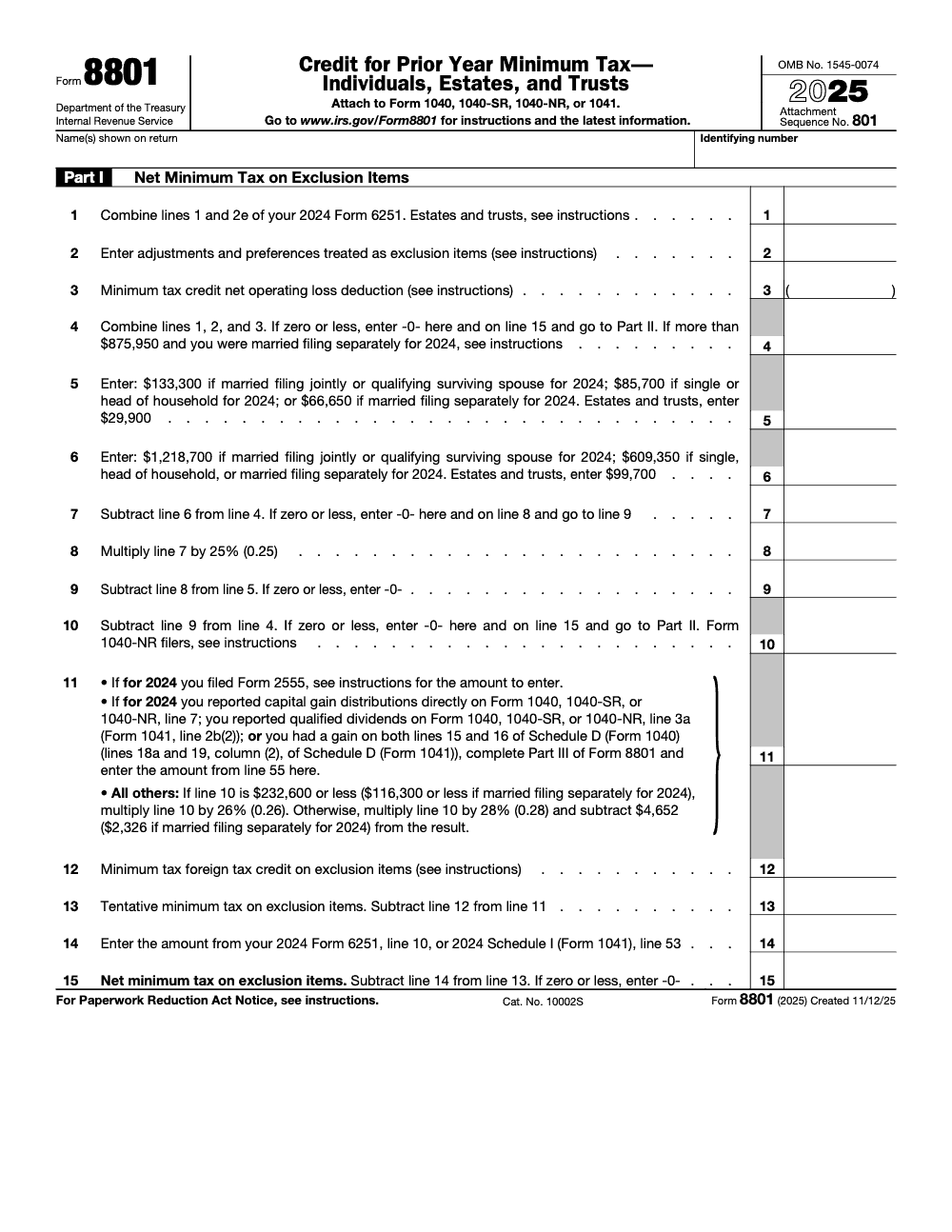
Form 8801 is the IRS form individuals, estates, and trusts use to claim the Credit for Prior Year Minimum Tax on AMT paid from deferral items like ISO exercises or depreciation timing differences (per IRC §53 and the 2025 Form 8801 instructions published on IRS.gov). The allowed credit lands on Schedule 3 (Form 1040), line 6b, or Form 1041 Schedule G, line 2c for estates and trusts; any unused credit goes on line 26 and carries forward indefinitely under IRC §53(b) – corporations file Form 8827 instead. For prior-year AMT reconstruction handled inside a standing workpaper system, see our offshore tax preparation services.
A client paid alternative minimum tax in an earlier year after exercising and holding incentive stock options, and assumed that money was simply gone. Pulling the prior Form 8801 and tracing the deferral items recovered a meaningful credit that lowered the regular tax. That is what this form is for.
Form 8801 lets individuals, estates, and trusts claim the Credit for Prior Year Minimum Tax from deferral items like ISO exercises or accelerated depreciation, and it tracks any carryforward, which under IRC §53(b) runs forward indefinitely with no carryback. The credit lands on Schedule 3, line 6b, and any unused amount carries on line 26. If line 21 is zero or less there is no credit, and it never applies to AMT from exclusion items.
Key Takeaways
- You file Form 8801 to figure your Minimum Tax Credit for prior AMT and any credit carryforward to the next year.
- The credit only comes from AMT tied to deferral items like ISOs exercised and held or accelerated depreciation, not exclusion items like tax-exempt interest on specified private activity bonds or the depletion preference (the standard deduction was an AMT add-back only pre-TCJA – TCJA suspended that add-back for tax years 2018 through 2025).
- You generally file when you have a carryforward on last year’s Form 8801 line 26 or when an older, unallowed qualified electric vehicle credit created an MTC.
- If line 21 of the current Form 8801 is zero or less, you do not get a credit or carry it forward.
- Attach Form 8801 to your Form 1040 and file by the normal due date, usually April 15 for calendar‑year individual returns.
What Is Form 8801 and Who Must File
Form 8801 is where you compute the credit for prior‑year AMT and determine the carryforward you can use against regular tax in the current year or future years. Individuals, estates, and trusts use it to figure the credit, then apply the allowed amount to their return (corporations do not use Form 8801; they claim their prior-year minimum tax credit on Form 8827 instead).
The IRS separates AMT drivers into two buckets, deferral items and exclusion items. Only AMT that came from deferral items creates the Minimum Tax Credit. That distinction matters, because exclusion items produce permanent differences, which never flip in later years, so there is no credit to recover.
You should complete Form 8801 if any of the following is true for you this year:
- Your prior Form 8801 shows a credit carryforward on last year’s line 26.
- You had prior‑year AMT tied to deferral items and now you do not owe AMT.
- You have an older, unallowed qualified electric vehicle credit that feeds into the MTC calculation on line 20.
Attach the completed form to your Form 1040, 1040‑SR, 1040‑NR, or 1041 (Form 1041 applies for estates and trusts). If you are an estate or trust, follow the specific coordination rules with Schedule I, as described in the IRS instructions.
Why Many Firms Miss This Credit, And How You Can Avoid It
In firms that are buried in compliance work, Form 8801 gets skipped for two common reasons. First, prior‑year AMT details are not documented in a consistent workpaper, so the preparer never sees the carryforward. Second, line 21 shows zero because the underlying deferral math is off. In our work with accounting teams, the fix is simple, tighten documentation and standardize review checks around deferral items, especially ISOs and depreciation timing. That habit alone saves rework and protects client trust.
If you run a practice, take thirty minutes and add Form 8801 checks to your year‑end close and your individual return review list. When you do this, you reduce rescoped work in March, you avoid missed credits, and you keep partners out of last‑minute review loops.
Deferral vs Exclusion Items, The Fast Way To Tell Them Apart
AMT compares a parallel tax base with different timing and disallowance rules. Deferral items usually reverse over time, exclusion items do not. Here is a quick comparison to keep near your workpapers.
Quick Comparison Table
| Item type | What it means | Common examples | Does it create MTC? |
| Deferral items | Timing difference that flips in a later year | ISOs exercised and held, accelerated depreciation vs AMT depreciation, certain passive activity timing | Yes, credit eligible when timing reverses |
| Exclusion items | Permanent difference that never reverses | Standard deduction (pre-TCJA only – TCJA suspended the standard-deduction AMT add-back for tax years 2018 through 2025), state and local tax deduction limits, miscellaneous itemized deductions historically disallowed | No, not credit eligible |
Real‑world signals you are dealing with a deferral item
- You booked extra income for AMT in a past year, for example ISO exercise spread, then later you sold the shares and the difference unwinds.
- You took faster regular‑tax depreciation early, AMT used slower methods, and now the schedules converge.
- You have older timing differences tied to credits that the instructions still reference, for example the legacy qualified electric vehicle credit on line 20.
When in doubt, open last year’s Form 8801 and the depreciation subledger, then match the specific adjustments to AMT rules. If the item reverses, it likely supports the credit. If it never reverses, do not force it into the MTC.
When To Use Form 8801 For The Prior‑Year Minimum Tax Credit
Use Form 8801 in any year you have prior‑year AMT from deferral items and your current-year regular tax exceeds your current-year tentative minimum tax (the line 24 limitation). Even if you still have some tentative minimum tax this year, a partial credit is allowed as long as line 24 is positive. The form calculates the allowable credit and determines any carryforward to next year. If last year’s Form 8801 showed a number on line 26, you should include Form 8801 again this year so you can use, or continue, that carryforward.
If line 21 on the current Form 8801 is zero or less, you do not have a credit and you do not carry it forward. Stop there, fix the inputs if you expected a credit, or move on if you did not.
Classic scenarios that point to a usable credit
- Incentive Stock Options, you exercised and held in a prior year, AMT hit then, you sold later, and now the deferral unwinds.
- Depreciation timing, regular tax took accelerated methods, AMT used slower methods, and the difference shrinks in later years.
- Passive activity timing adjustments that were AMT relevant in a prior year and now reverse.
When not to use Form 8801
- Your prior AMT was driven by exclusion items like tax-exempt interest on specified private activity bonds, the depletion preference, or certain pre-TCJA charitable contribution adjustments (the standard deduction was an exclusion item only pre-TCJA – TCJA suspended that add-back for 2018 through 2025). There is no minimum tax credit for those differences.
- Line 24 (your current-year regular tax minus current-year tentative minimum tax) is zero or less, so no credit is allowed this year. You will continue tracking carryforward for a later year.
- You have no carryforward, and there is no prior AMT tied to deferral items.
How To Complete Form 8801, Step By Step
Before you touch the form, pull three things, last year’s Form 8801, your depreciation schedules and ISO worksheets, and this year’s draft Form 1040 with any credits already reflected. The Form 8801 instructions walk through Parts I to III, and the line references below help you avoid the common stumbles.
Part I, Net Minimum Tax On Exclusion Items
Part I isolates exclusion‑item AMT so you do not give yourself credit for it. Follow the IRS instructions, especially if you are preparing an estate or trust and need to coordinate with Schedule I. Your goal is to compute the net minimum tax on exclusion items that gets removed from the credit calculation.
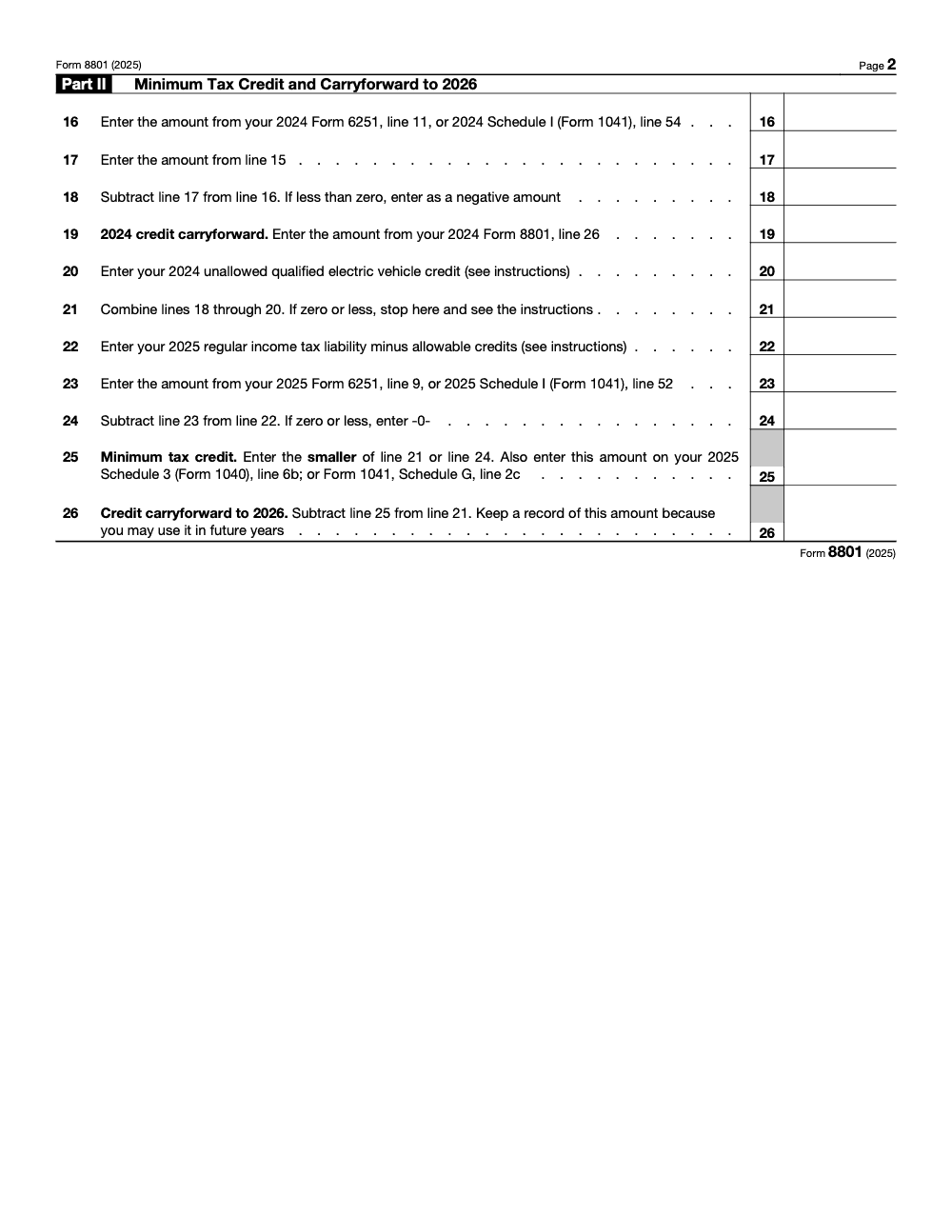
Part II, Minimum Tax Credit And Carryforward
- Check line 20 for any unallowed qualified electric vehicle credit carried under the legacy rule. Not everyone has this, but the instructions still include it.
- Look at line 21. If it is zero or less, you stop. There is no MTC or carryforward. If it is positive, continue.
- On line 22 and related lines, you will reference your Form 1040, including credits on Schedule 3, to compute the current‑year limitation and the allowed MTC. The instructions spell out which lines to add or exclude, so follow them closely.
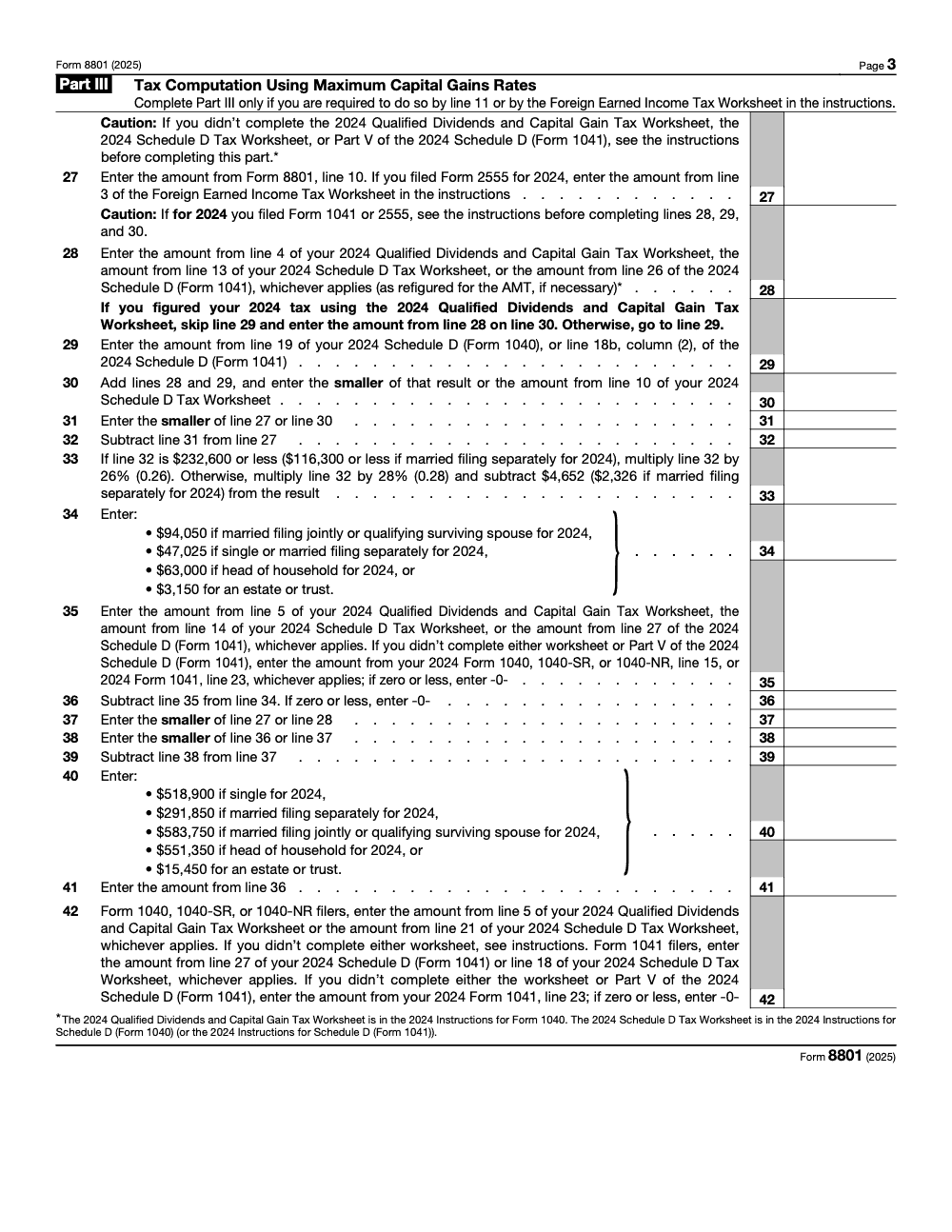
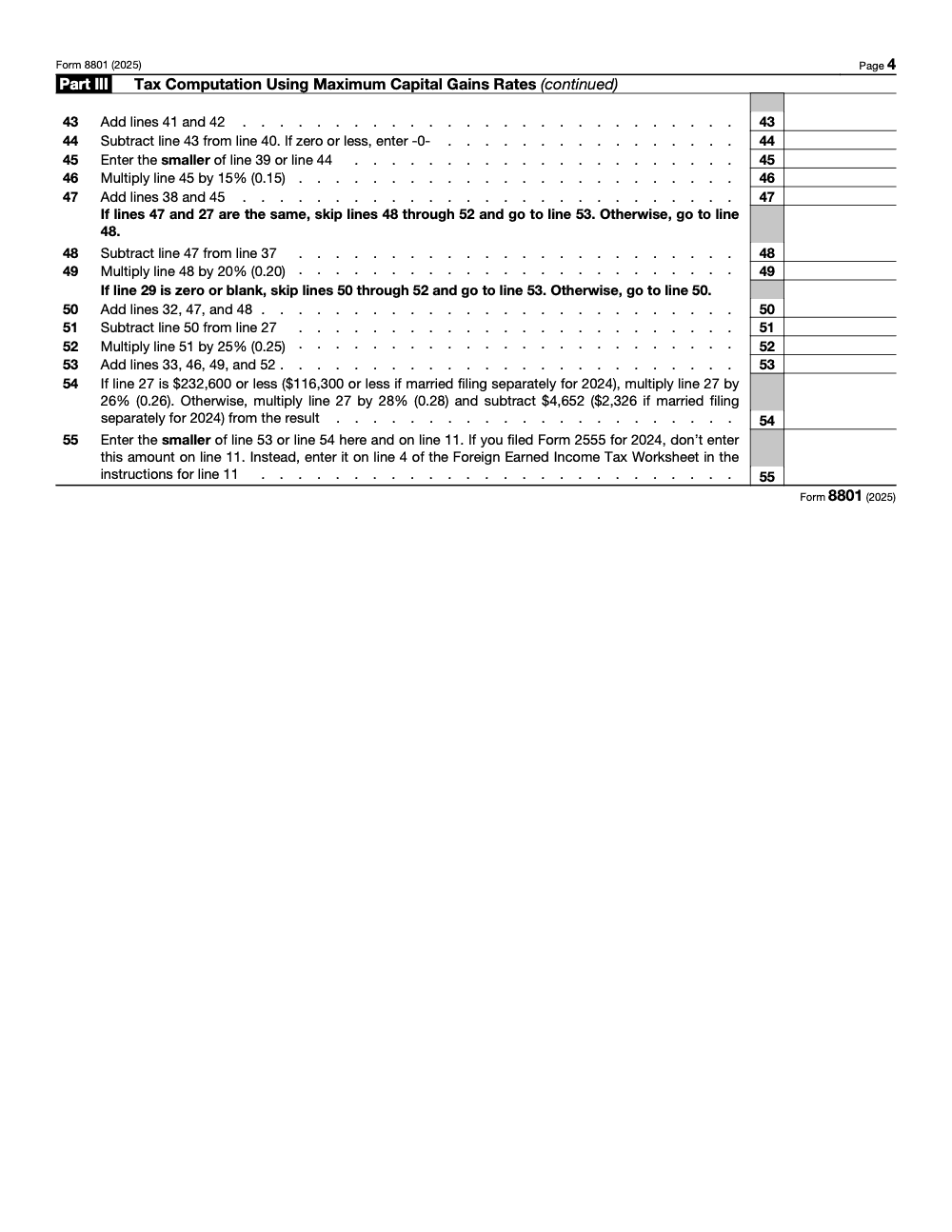
Part III, Tax Computation Using Maximum Capital Gains Rates
Part III preserves the 0%, 15%, 20%, and 25% capital gains rates inside the AMT computation when 2024 included capital gain distributions, qualified dividends, or a gain on both lines 15 and 16 of Schedule D. The line 55 result feeds back into Part I line 11, replacing the flat 26%/28% formula. The credit limitation and any line 26 carryforward sit in Part II – not Part III.
Software Entry Tips That Prevent Rework
- In most tax software, you will find Form 8801 under Credits, often labeled “Credit for Prior Year Minimum Tax.”
- If your software supports it, import last year’s return, so your prior AMT and carryforward populate correctly. If import is not available, manually enter prior AMT and the line 26 carryforward from last year’s Form 8801.
- Tie out deferral items inside your file, for example, attach the ISO detail and the AMT depreciation schedule, so reviewers can verify the reversal.
- If line 21 surprises you with zero, retrace the deferral math and confirm you did not mix in exclusion items.
Filing Deadlines You Should Know
Attach Form 8801 to your Form 1040 and file by the normal due date for individuals, generally April 15 for calendar‑year filers. For the 2025 season covering 2024 returns, the deadline was April 15, 2025, with extensions available to October 15. The IRS opened filing on January 27, 2025. If you live abroad, you typically get an automatic two‑month extension to mid‑June, interest still accrues from April 15. Always check the current IRS calendar if a holiday or disaster relief applies.
Common Mistakes And How To Fix Them
These checklists are copy-paste ready for firm SOPs – fold them into the workpaper template you keep for any return that touches prior-year AMT or has a Minimum Tax Credit carryforward.
Prior-year AMT reconstruction packet
- Pull the client's 2024 Form 6251 and capture lines 1 and 2e (combine these for the Form 8801 line 1 entry per fact:line-1), line 10 (the 2024 regular-tax comparison amount referenced on Form 8801 line 14), and line 11 (the 2024 tentative minimum tax for Form 8801 line 16).
- Pull the 2024 Form 8801 (if filed) and bring line 26 forward as the 2025 line 19 carryforward entry – the IRS does not track this for you.
- Capture 2024 Schedule D (Form 1040) lines 15, 16, and 19 if any capital gain or unrecaptured §1250 gain was reported – any of these triggers Part III.
- Confirm whether 2024 Form 2555 (foreign earned income exclusion) was filed – this triggers the Foreign Earned Income Tax Worksheet path on lines 11 and 55.
- Flag any 2024 ISO exercises held past year-end and any depreciation differences (§56(a)(1)) – these are deferral items that generate the credit on lines 18 through 21.
- If 2024 filing status was MFS and 2024 AMTI exceeded $875,950, route to the line 4 add-back instructions before computing the exemption.
- Note any legacy §30 qualified electric vehicle credit carryover for line 20 (do not confuse with the current §30D Clean Vehicle Credit, which uses Form 8936).
Exclusion vs deferral item scan
- Mark depreciation differences between AMT and regular tax under §56(a)(1) as deferral – credit-generating on Part II.
- Mark ISO exercise spreads from 2024 under §56(b)(3) as deferral – credit-generating, not exclusion.
- Mark passive activity loss adjustments, long-term contract adjustments, and mining exploration/development cost differences as deferral.
- Mark tax-exempt interest from specified private activity bonds, the depletion preference, and certain pre-TCJA charitable contribution adjustments as exclusion – strip out in Part I.
- Do not add back the standard deduction as an exclusion-item adjustment for tax year 2024 or 2025 – that pre-TCJA rule no longer applies.
- Reconcile the deferral/exclusion split against 2024 Form 6251 line 2 entries so the Part II line 18 base is right the first time.
Current-year limitation and carryforward check
- Bring 2025 Form 6251 line 9 (current-year tentative minimum tax) to Form 8801 line 23.
- Compute 2025 regular income tax liability minus allowable credits and enter on line 22.
- Verify line 24 (line 22 minus line 23) is positive – if zero or less, no credit is allowed this year and the full balance rolls to line 26.
- Enter the smaller of line 21 or line 24 on line 25 and report on Schedule 3 (Form 1040), line 6b, or Form 1041 Schedule G, line 2c.
- Compute line 26 (line 21 minus line 25) and tag the workpaper for the 2026 line 19 carryover – the Minimum Tax Credit carries forward indefinitely with no carryback.
- Confirm OBBBA (July 2025) did not change 2025 AMT figures – the $137,000 MFJ and $88,100 single exemption amounts and the 26%/28% rate structure remain authoritative per Rev. Proc. 2024-40.
A Simple Workflow You Can Reuse Every Year
- Intake, capture last year’s Form 8801 line 26 and list deferral drivers, ISOs, depreciation, passive timing.
- Prepare, complete Parts I to III using the IRS instructions side by side.
- Review, confirm line 21 logic, check tie‑outs to Form 1040 lines the instructions specify, and attach supporting schedules.
- Deliver, explain to the client how the credit worked this year, and what remains as carryforward.
If you lead a firm, turn the four bullets above into a standard operating procedure with a one‑page checklist and a sample workpaper. It saves you in March when staffing is tight and review queues get long.
Where Accountably Fits, Only When You Need Us
This article is here to help you file Form 8801 correctly. If you run a CPA or EA firm and your team keeps missing credits because files are inconsistent, Accountably can help you standardize delivery. Our offshore teams work inside your templates and build clean, structured workpapers for AMT items, which makes Form 8801 reviews faster and protects partners from time‑sink loops. Use us for seasonal capacity or a dedicated team when you want predictable turnaround and a tight review process. Keep control of your workflow, keep quality high, and stop losing time to rework.
Examples That Make The Rules Click
ISO exercise and sale
- Year 1, you exercise ISOs and hold, creating AMT income on the spread.
- Year 2, you sell at a price that reduces the AMT difference, so now you may use the Minimum Tax Credit on Form 8801, subject to the current‑year limitation.
- If you still have unused credit, it carries to line 26 for next year.
Accelerated depreciation
- Year 1 and 2, regular tax uses accelerated depreciation, AMT uses a slower method, AMT is higher.
- Later years, the timing catches up, and your Form 8801 allows you to apply the credit against regular tax, again limited by the instructions’ line references to your Form 1040.
Documentation You Should Keep
- Prior‑year Form 8801 and your current Form 8801.
- ISO statements, broker confirmations, and basis computations for sales.
- Fixed asset roll‑forward with AMT depreciation columns.
- A one‑page memo that explains which items are deferral vs exclusion, why line 21 is positive or zero, and how line 26 was derived.
Key Resources And Deadlines
- IRS “About Form 8801” page, plus the current Instructions for Form 8801. Start here for definitions, eligibility, and line‑by‑line rules. Page last reviewed December 3, 2024, with links to the 2024 instructions and current form.
- 2024 Instructions for Form 8801, which explain deferral vs exclusion items, when to file, how line 21 works, how to reference Form 1040 lines, and how to carry line 26 forward to next year.
- 2025 filing season context, the IRS opened filing for 2024 returns on January 27, 2025, and Tax Day fell on April 15, 2025. If you live abroad, the automatic two‑month filing extension pushed the date to June 16, 2025. Always confirm the current year’s dates.
Final Checklist You Can Paste Into Your Workpapers
- Open prior‑year Form 8801, grab line 26 carryforward.
- Identify deferral items that reversed this year, ISOs, depreciation, passive timing.
- Complete Part I to remove exclusion items from the credit base.
- Work through Part II and Part III, reference your Form 1040 lines exactly as the instructions specify.
- If line 21 is zero or less, stop and document why. If positive, apply the credit and record the new line 26 carryforward.
- Attach Form 8801 to your Form 1040 and file by the deadline. If you extend, remember that payment is still due by the April deadline to avoid interest.
Conclusion
You do not need to wrestle with AMT history to get what you are owed. If you paid AMT in a prior year because of timing differences and you are out of AMT this year, Form 8801 is how you reclaim value the right way. Track deferral items with care, keep a tight handle on prior line 26, and follow the IRS instructions line by line. That process protects your clients, your margins, and your sanity.
Reusable Checklists
The delivery problem with Form 8801 is not volume, it's that the credit gets missed entirely or computed against the wrong base because the prior-year carryforward was never tracked. The Minimum Tax Credit carries forward indefinitely under IRC §53(b), but the IRS does not track it for you (per the 2025 Form 8801 instructions on IRS.gov); if line 26 from the 2024 return was not captured in the workpaper system, the 2025 line 19 entry shows up as zero and a real receivable evaporates.
The fix is structural, not heroic. Build a standing intake step that pulls the prior Form 8801 and the prior Form 6251 before any return touches a preparer, and run an exclusion-vs-deferral scan against the 2024 Form 6251 line 2 entries so the Part II line 18 base is right the first time.
- Tag every return where the 2024 Form 6251 line 11 was non-zero with a Minimum Tax Credit scan flag, so the line 19 carryforward path is never skipped at intake.
- Standardize the Part I rebuild on the 2024 AMT exemption amounts ($133,300 MFJ, $85,700 single or head of household, $66,650 MFS, $29,900 estates and trusts) – not the 2025 values, which is the most common preparer error per the IRS instructions.
- For any return with 2024 capital gain distributions, qualified dividends, or both lines 15 and 16 of Schedule D, route through Part III instead of the flat 26%/28% formula to preserve the 0%, 15%, 20%, and 25% rate structure inside the AMT computation.
- For any client with a 2024 Form 2555, follow the Foreign Earned Income Tax Worksheet path on lines 11 and 55 – never let the Part III result feed line 11 directly.
- Cross-check line 25 against line 24 (regular tax over current-year tentative minimum tax) so the credit limitation rule cannot get bypassed in the software.
Structured prior-year reconstruction is exactly the kind of low-volume, high-precision work that benefits from a dedicated, trained team rather than a seasonal scramble. Our offshore tax preparation services include the Part I rebuild, the deferral-versus-exclusion scan, and the Part III routing decision as standard workpaper steps so the credit lands on Schedule 3 line 6b without rework.
Keep 8801 Season From Stalling
Form 8801 has an awkward operational profile for a busy firm. It is low volume – only a slice of the 1040 book has prior-year AMT exposure – but it is unforgiving, because the calculation reaches back into the 2024 return and uses 2024 AMT exemption amounts and 2024 phaseout thresholds on a return filed for tax year 2025 (per IRC §53 and the 2025 Form 8801 instructions published on IRS.gov). Under March-April capacity pressure, preparers default to current-year figures and Part I quietly breaks.
The fix is a delivery cadence change, not more billable hours in April. Move Form 8801 detection ahead of preparer assignment, lock a Part I template to 2024 values, and treat the line 26 carryforward as a multi-year client asset that the firm hands off between return cycles. Once those three pieces sit inside the standing 1040 workflow, the credit clears review on the first pass instead of bouncing back from senior review with rework.
- Run the prior-year Form 8801 lookup at intake, not at preparer pickup. Any client with a positive line 26 on the 2024 Form 8801, a positive line 11 on the 2024 Form 6251, or a legacy §30 unallowed qualified electric vehicle credit gets auto-routed to the MTC track before the return ever opens.
- Lock the Part I template to the 2024 AMT exemption amounts ($133,300 MFJ, $85,700 single or head of household, $66,650 MFS, $29,900 estates and trusts) and the 2024 phaseout thresholds. Strip the ability to enter the 2025 Rev. Proc. 2024-40 figures into Part I cells – those belong on the 2025 Form 6251, never on Form 8801.
- Trigger a Part III routing flag when the prior return reported capital gain distributions on Form 1040 line 7, qualified dividends on line 3a, or gain on both lines 15 and 16 of Schedule D. Part III preserves the 0%/15%/20% capital gains ceilings and the 25% unrecaptured §1250 gain rate inside the parallel AMT base; skipping it inflates the tentative minimum tax that line 24 measures the credit against.
- Add a Form 2555 check at intake. Any 2024 return with Form 2555 forces the Foreign Earned Income Tax Worksheet path on lines 11 and 55: the Part III result feeds the worksheet line 4 rather than directly into Form 8801 line 11.
- Reconcile line 25 against line 24 (current-year regular tax minus tentative minimum tax) before the workpaper closes. If line 24 is zero or less, no credit is allowed this year and the full line 21 amount rolls to line 26 as the next-year line 19 carryforward (Schedule 3 line 6b and Form 1041 Schedule G line 2c are where the line 25 credit lands in years it is allowed, not where line 26 carryforward goes).
Multi-year Minimum Tax Credit continuity is delivery infrastructure, not preparer memory. Our offshore tax preparation services bake the line 19 carryforward pull, the 2024-anchored Part I rebuild, and the deferral-versus-exclusion gate into the standing 1040 workpaper template so the credit clears review every year it should, regardless of who touches the return.
FAQs
It figures the Minimum Tax Credit from prior‑year AMT that came from deferral items and tells you how much credit you can use this year and how much you carry forward. You attach it to your Form 1040. If the key line, line 21, is zero or less, there is no credit this year.
Anyone who previously paid AMT due to deferral items and is not in AMT this year can potentially use the credit, subject to the limitation rules in the instructions (the credit cannot exceed the excess of your regular tax over the current-year tentative minimum tax, so a high-AMT current year can still produce a $0 credit even with a large carryforward). Common triggers are ISO exercises that were held and depreciation timing differences.
For current rules, it is a nonrefundable credit that carries forward until used, limited each year by the excess of your regular tax over the current-year tentative minimum tax. The partial refundability that applied to individuals before 2018 was repealed by TCJA, so the credit is solely nonrefundable now and can only be carried forward – never back. The instructions guide how to compute the allowed amount and the carryforward.
Part II tells you exactly which Form 1040 and Schedule 3 lines to reference when computing the limitation. Follow the specific line instructions in the current year’s guidance to avoid errors.
No. Form 8881 is the Credit for Small Employer Pension Plan Startup Costs. It is unrelated to the Minimum Tax Credit on Form 8801. If you need that retirement plan credit, handle it separately from your AMT credit work.
Form 8821 authorizes someone to receive your confidential tax information from the IRS. It does not grant power of attorney and it does not change your Form 8801 calculation. Use it when you want a tax pro to access IRS records to help reconstruct prior AMT details.
Other forms this guide names
Summarize this article with AI
About this guide
Accountably helps US CPA, EA, and accounting firms hire trained accountants and tax preparers in India.
About us Reviewed byJugal Thacker, CPAFounder and CEO at Accountably
A Washington-licensed CPA with 7+ years inside US firms – PwC, a real-estate tax practice, then a full-service firm, rising from reviewer to manager to advisory. This article was reviewed against current IRS guidance for the 2025 tax year and updated for filers preparing late returns, amendments, and 2026 estimates.
View profile →How we research, review, and update this guide
Every Accountably guide is researched against primary IRS sources, reviewed by a U.S. CPA, and refreshed as guidance evolves. Read our Editorial Guidelines to see how we source, fact-check, and update our content.