Summarize this article with AI
In Brief
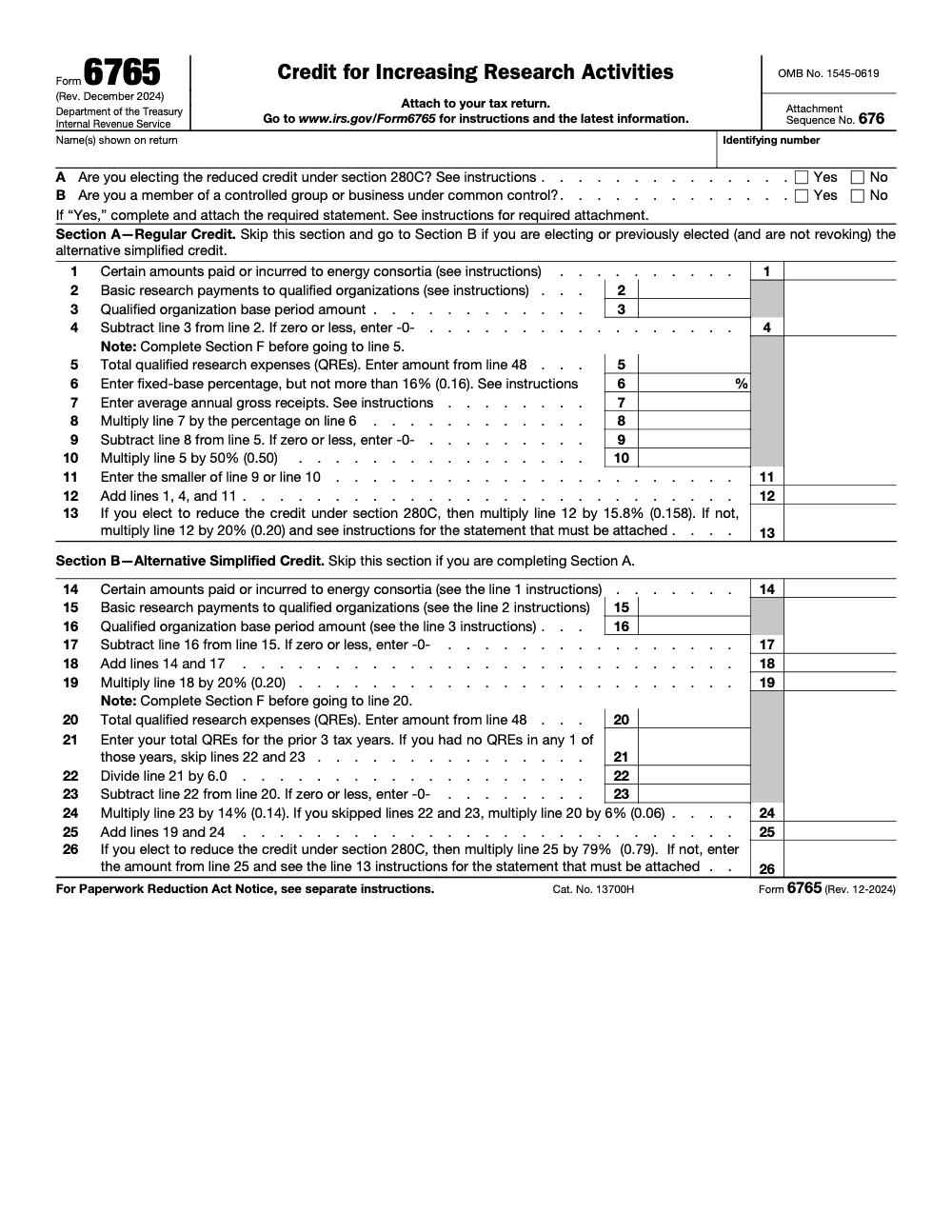
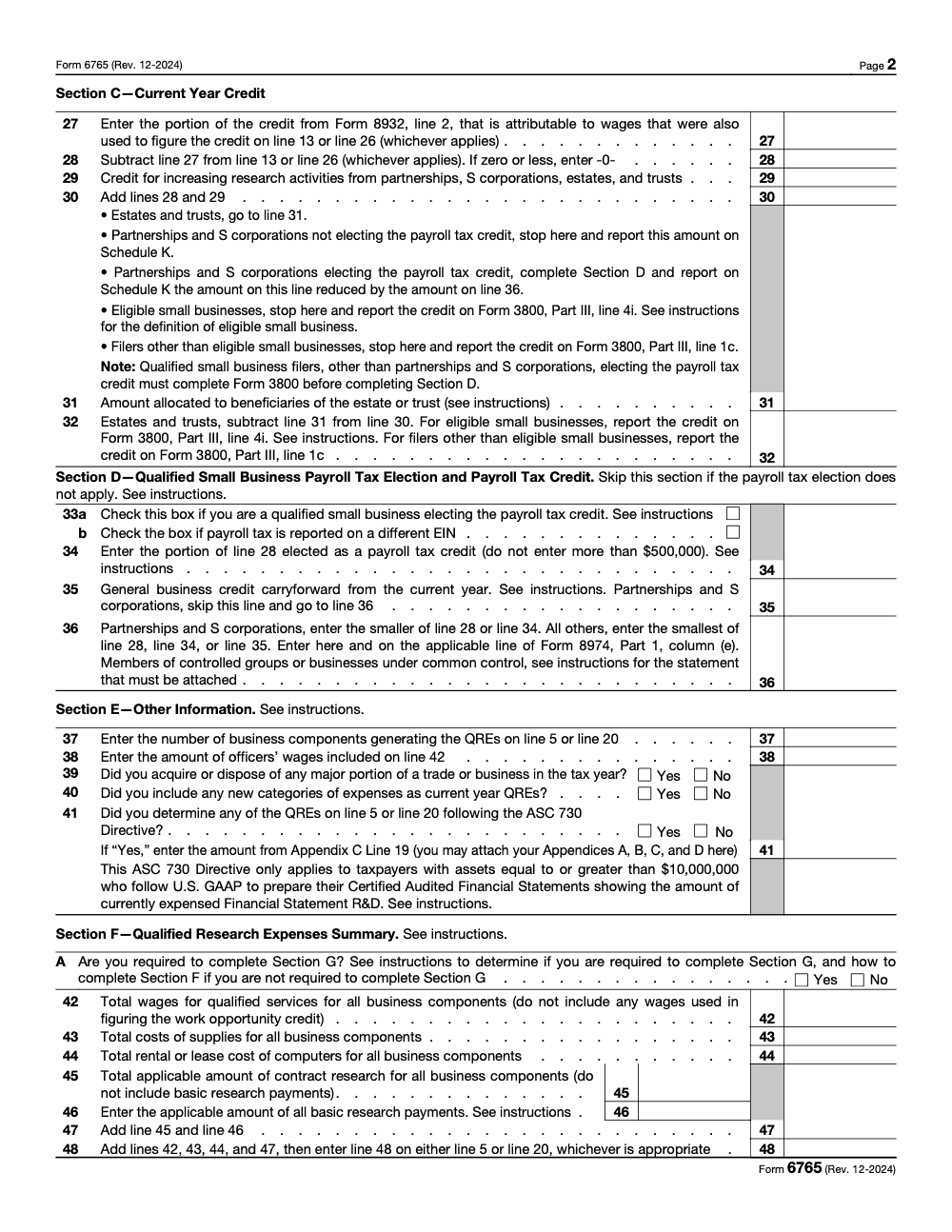
Form 6765 computes the Section 41 Credit for Increasing Research Activities – the R&D credit. Filers choose the Regular Credit (20% of qualified research expenses above the base amount) or the Alternative Simplified Credit (14%, or 6% for first-time researchers), and every filer must now complete the new Section F expense summary on lines 42 through 48. A qualified small business can elect up to $500,000 of the credit against payroll taxes (doubled from $250,000 by the Inflation Reduction Act of 2022). For tax year 2025, calendar-year C corporations attach the form to Form 1120 by April 15, 2026; S corporations and partnerships file by March 16, 2026, per the Form 6765 instructions (Rev. December 2024).
A software company brought us a claim that treated its entire development team as research, with nothing to back it up. No activity logs, no contemporaneous time records, just a year-end push to grab the credit. Rebuilding that file from project tools and payroll codes is where most of the work on Form 6765 actually lives, long before anyone debates the Regular Credit at 20% of qualified research expenses above the base or the Alternative Simplified Credit at 14%.
The newer pressure point is documentation, not arithmetic. Every filer now has to complete the Section F expense summary on lines 42 through 48, and the IRS reads that summary against whatever records you can produce. A qualified small business can still elect up to $500,000 of the credit against payroll taxes, but that election is only as strong as the support sitting behind it.
Key Takeaways
- Form 6765 is used to claim the Credit for Increasing Research Activities (commonly called the R&D credit or Research Credit) under Section 41 of the Internal Revenue Code.
- Who files: Any individual, corporation, partnership, or S corporation with qualifying research expenses. Eligible small businesses and startups have special elections available.
- The credit is computed using either the Regular Credit Method (20% of qualified research expenses above a base amount) or the simpler Alternative Simplified Credit (ASC) method (14% of QREs above 50% of the three-year average, dropping to 6% of current-year QREs if the taxpayer had no QREs in any one of the three prior years).
- Startup benefit: Qualified small businesses – distinct from eligible small businesses, which meet a separate $50 million average gross-receipts test and qualify only for the AMT offset – can apply up to $500,000 per year of R&D credit against payroll taxes – a major benefit for pre-revenue companies with no income tax liability.
- Key pitfall: The IRS has significantly increased scrutiny of R&D credit claims, particularly for software companies. Documentation is the credit’s lifeline – insufficient records is the most common reason claims fail under audit.
- SOP tip: Require clients to maintain contemporaneous time records linking employee hours to specific research activities before the credit study begins, not after.
What Form 6765 Is and When to Use It
Form 6765 is the computation form for the Section 41 Research Credit. Unlike many tax credits that simply reward a business activity, the R&D credit requires qualifying expenses to meet a specific four-part test before they count as qualified research expenses (QREs). The credit is not just for labs and pharmaceutical companies – it extends to software development, manufacturing process improvement, engineering, and any technical activity that meets the statutory criteria.
The credit is nonrefundable for most taxpayers, meaning it can reduce regular income tax liability but not create a refund. However, two important exceptions exist: eligible small businesses can carry the credit back one year and forward 20 years, and qualified small businesses (defined by IRC Section 41(h)) can elect to apply up to $500,000 of the credit against the employer’s share of Social Security and Medicare taxes, making the credit valuable even without income tax liability.
The Four-Part Test for Qualified Research
Every activity that feeds into the R&D credit must pass all four prongs of the Section 41 four-part test. Failing any one of them disqualifies the activity entirely:
- Technological in nature: The activity must rely on principles of physical, biological, computer, or engineering science
- Permitted purpose: The research must be intended to develop a new or improved business component – function, performance, reliability, or quality
- Elimination of uncertainty: The taxpayer must be seeking to eliminate uncertainty about the capability, method, or appropriate design of the component
- Process of experimentation: The taxpayer must evaluate one or more alternatives through a process of experimentation – testing, modeling, simulation, or systematic trial and error
What Counts as Qualified Research Expenses
QREs include wages paid to employees for qualifying research activities, 65% of contract research expenses paid to third parties (the “contractor rule”), and supplies consumed in the research. Overhead, rent, utilities, depreciation, and capitalized property are statutorily excluded and do not count as QREs. Internal-use software may qualify, but is subject to an additional three-part high-threshold-of-innovation test under the regulations. From my side of the desk, the wage component is where most of the credit value lives – and where the documentation demands are highest.
Excluded Activities
Several categories of activity are explicitly excluded from qualified research: research after commercial production begins, adaptation of an existing business component to customer requirements, duplication of an existing component, surveys and studies, social science research, foreign research, funded research (where another party pays and the taxpayer neither bears the financial risk nor retains substantial rights to the results), and management functions. Identifying exclusions early in the credit study prevents overstatement and audit exposure.
How to Complete Form 6765, Section by Section
Form 6765 has seven sections, A through G. Most taxpayers complete Section A (Regular Credit) or Section B (Alternative Simplified Credit), then Section C (Current Year Credit) and, if making the payroll tax election, Section D (Qualified Small Business Payroll Tax Election).
Section A – Regular Credit Method
The Regular Credit requires computing a “base amount” using the taxpayer’s historical gross receipts and QRE percentages going back to 1984. For most businesses, this historical data is difficult to reconstruct accurately, which is why the ASC method is often preferred. The regular credit is 20% of QREs exceeding the base amount, but that base amount can never fall below 50% of current-year QREs, so the effective credit is capped at roughly 10% of total QREs.
Section B – Alternative Simplified Credit (ASC) Method
| Line | Description | Note |
|---|---|---|
| 20 | Enter total QREs for current year | Wages + supplies + 65% of contract research |
| 21 | Enter total QREs for the 3 prior tax years | Skip lines 22 and 23 if you had no QREs in any one of those years |
| 22 | Divide line 21 by 6.0 | Yields 50% of the 3-year average – the ASC base amount |
| 23 | Subtract line 22 from line 20 | Qualifying incremental QREs; if negative, no credit |
| 24 | ASC (line 23 × 14%) | Or multiply line 20 by 6% if you had no QREs in any of the 3 prior years |
Section C – Current Year Credit
Section C is the Current Year Credit section, where the credit from Section A or B is combined with any credit passed through from partnerships, S corporations, estates, and trusts. Partners and shareholders report their allocated portion of the credit on their individual or corporate returns. The entity-level credit computation happens on Form 6765 at the entity level; the allocation to partners or shareholders is reported on Schedule K-1.
Section D – Qualified Small Business Payroll Tax Election
This section is available to taxpayers who meet the definition of a “qualified small business” – a corporation, partnership, or individual with gross receipts under $5 million for the current year and no gross receipts for any tax year preceding the 5-tax-year period ending with the current year (i.e., a startup in its first 5 years). The election allows up to $500,000 of the credit to offset the employer’s portion of Social Security tax (first $250,000) and Medicare tax (additional $250,000) on the quarterly 941. This election is made on a year-by-year basis.
Deadlines, Penalties, and Filing Requirements
Form 6765 is attached to the tax return and has no separate due date. The due date is the underlying return's due date: for calendar-year filers, that is April 15 for C corporations (Form 1120) and individuals (Form 1040), and March 15 for S corporations (Form 1120-S) and partnerships (Form 1065). Extensions of the underlying return also extend the 6765 filing date.
| Filer Type | Return | Original Due Date | Extended Due Date |
|---|---|---|---|
| Individual (sole proprietor, partner, S-corp shareholder) | Form 1040 | April 15 | October 15 |
| S Corporation | Form 1120-S | March 15 | September 15 |
| Partnership | Form 1065 | March 15 | September 15 |
| C Corporation | Form 1120 | April 15 (calendar year) | October 15 |
Amending to Claim the Credit
The R&D credit can be claimed on an amended return within the statute of limitations – generally 3 years from the original due date of the return, or 2 years from when the tax was paid, whichever is later. Many businesses discover they qualify retroactively after learning about the credit. Amended returns claiming the credit are subject to elevated IRS scrutiny and should be supported by a complete credit study with contemporaneous documentation.
IRS Documentation Requirements
The IRS has issued guidance (including CCA 200228042 and various audit technique guides) describing what documentation supports an R&D credit claim. Minimum expectations include: identification of each business component for which research was conducted, identification of the research activities performed, identification of the individuals who performed the research, and contemporaneous records (payroll, time tracking, project logs, technical reports) linking each employee to each qualified activity.
The Payroll Tax Election for Startups – A Game-Changer Often Missed
One of the most underutilized provisions in the tax code is the R&D credit payroll tax election available to qualified small businesses. For early-stage companies that are burning cash and paying significant payroll but have little or no income tax liability, this election turns a nonrefundable income tax credit into an immediate payroll tax offset.
Eligibility Requirements
To qualify for the payroll tax election, the entity must: (1) be a corporation, partnership, or individual with gross receipts under $5 million for the current tax year, and (2) have no gross receipts for any tax year preceding the five-tax-year period ending with the current year (essentially, the business must be in its first five years of having gross receipts). The credit is then applied against the employer’s share of Social Security tax (the first $250,000) and, for tax years beginning after December 31, 2022, the employer’s share of Medicare tax (an additional $250,000), reported on quarterly Form 941.
How the Election Works Mechanically
The taxpayer makes the election on Form 6765, Section D, for the tax year to which the credit applies. The credit is then claimed on Form 8974 (Qualified Small Business Payroll Tax Credit for Increasing Research Activities), which is attached to Form 941 each quarter until the credit is exhausted. The election is irrevocable for the year made. For a startup with no prior-year QREs spending $500,000 on qualified research wages, the 6% ASC startup rate could mean roughly $30,000 in payroll tax credits – immediate cash savings each quarter.
Software Development and the R&D Credit – Where the IRS Draws the Line
Software companies represent a significant share of R&D credit claims, and also a significant share of IRS challenges. The credit applies to software development, but not to all software activities. The distinction between qualifying research and excluded activities is often the central question in software-related credit audits.
What Generally Qualifies in Software Development
Original development of new functionality, development of new algorithms, development of software intended for sale or license to third parties, and internal-use software that meets the elevated three-part test (innovative, subject to significant economic risk, not commercially available) are the primary qualifying categories. The process of experimentation requirement means there must be actual technical uncertainty – not just business uncertainty about market demand or user adoption.
What Does Not Qualify
UI/UX design, customer-facing bug fixes, routine maintenance, post-production support, data migration, project management, and implementation of off-the-shelf software do not qualify. One of the most common mistakes in software R&D credit claims is including the time of developers who are doing maintenance and support alongside their qualifying research activities without properly apportioning their hours. From my side of the desk, I require project-level time tracking with activity codes before committing to a software R&D credit engagement.
Common Mistakes That Slow Things Down
Across R&D credit engagements the same handful of errors surface every season, and most trace back to documentation gaps or outdated assumptions about the rules. Here are the ones my team catches most often.
Practical Checklists You Can Reuse
These checklists are copy-paste ready for your firm SOPs, and each step ties back to the line items and elections on the December 2024 revision of Form 6765.
QRE substantiation packet
- Identify each business component (product, process, software, technique, formula, or invention) at the most disaggregated level.
- Document how each activity meets all four parts of the Section 41 test: technological in nature, permitted purpose, elimination of uncertainty, and a process of experimentation.
- Pull contemporaneous time records linking employees to qualified services (engaging in, supervising, or supporting research).
- Apply the 80% substantially-all rule: if 80% or more of an employee’s wages relate to qualified services, include the full wage; otherwise apportion.
- Limit QREs to the four statutory categories: wages, supplies, computer rental or lease, and contract research (65%, or 75% for a qualified research consortium).
- Exclude overhead, rent, utilities, depreciation, capitalized property, foreign research, and funded research.
- Reconcile R&D wages against any Work Opportunity Credit or Employee Retention Credit claims to avoid double-counting.
Method selection and elections
- Compute the credit both ways: Regular Credit (20% of QREs above the base, with the base never below 50% of current-year QREs) and ASC (14%, or 6% if you had no QREs in any of the 3 prior years).
- Remember the Regular Credit base floor caps the effective credit near 10% of QREs (about 7.9% with the 280C election).
- Decide the Section 280C(c) reduced-credit election (15.8% Regular or 79% of the ASC) on the original return; it is annual and irrevocable.
- If electing the ASC, note it binds for that year and future years unless the IRS consents to revoke.
- Confirm the fixed-base percentage on line 6 is capped at 16%.
- For controlled groups, aggregate QREs and gross receipts under Section 41(f) and attach the required allocation statement.
Startup payroll-tax election
- Confirm qualified small business status: under $5 million in current-year gross receipts and no gross receipts in any year before the 5-year lookback.
- Make the election in Section D (lines 33 through 36) on a timely-filed original return.
- Cap the election at $500,000: first $250,000 against the 6.2% employer Social Security tax, the next $250,000 against the 1.45% Medicare tax.
- Carry the elected amount from line 36 to Form 8974, Part 1, column (e), and claim it on Form 941 starting the first quarter after the income-tax return is filed.
- Track any unused income-tax credit: it carries back 1 year and forward up to 20 years.
Keep 6765 Season From Stalling
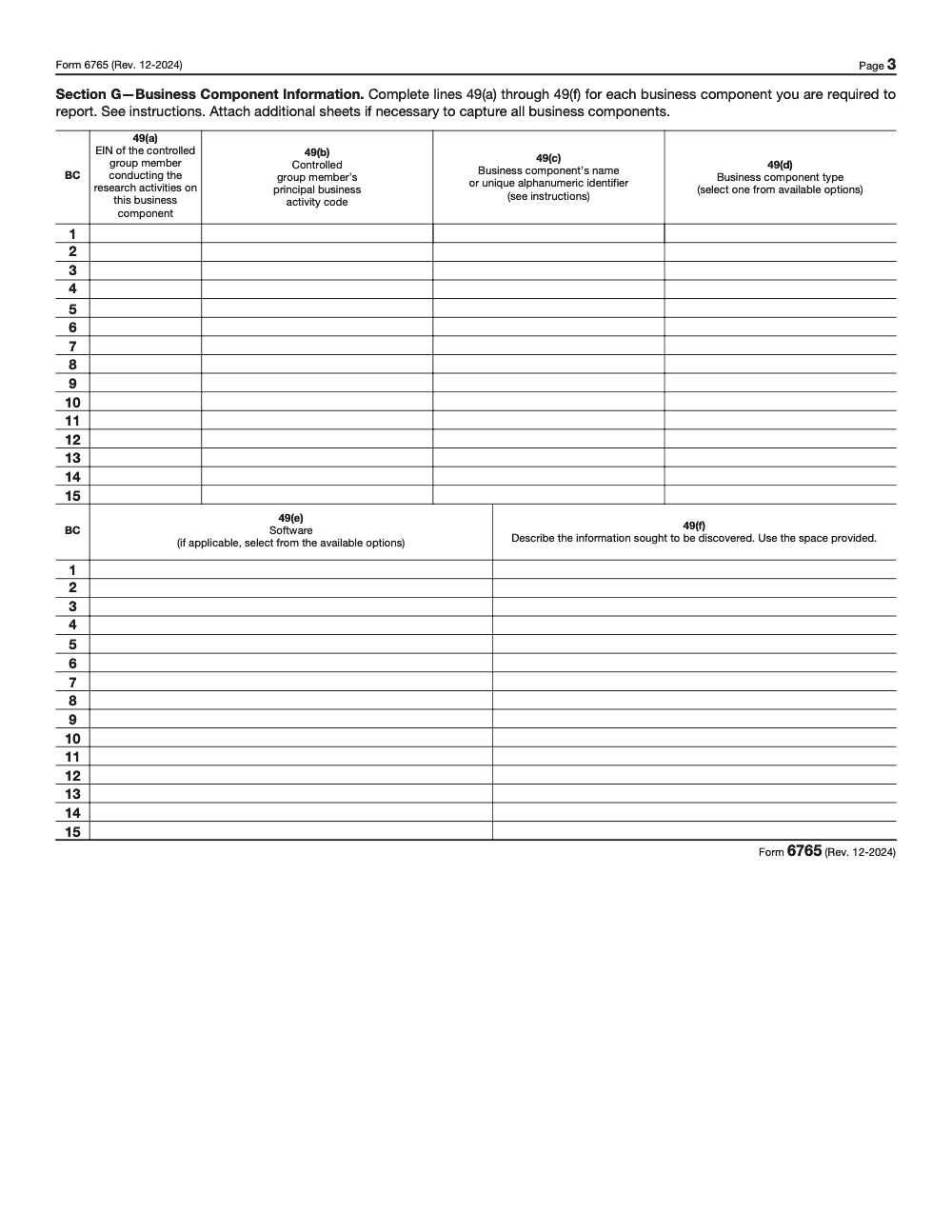
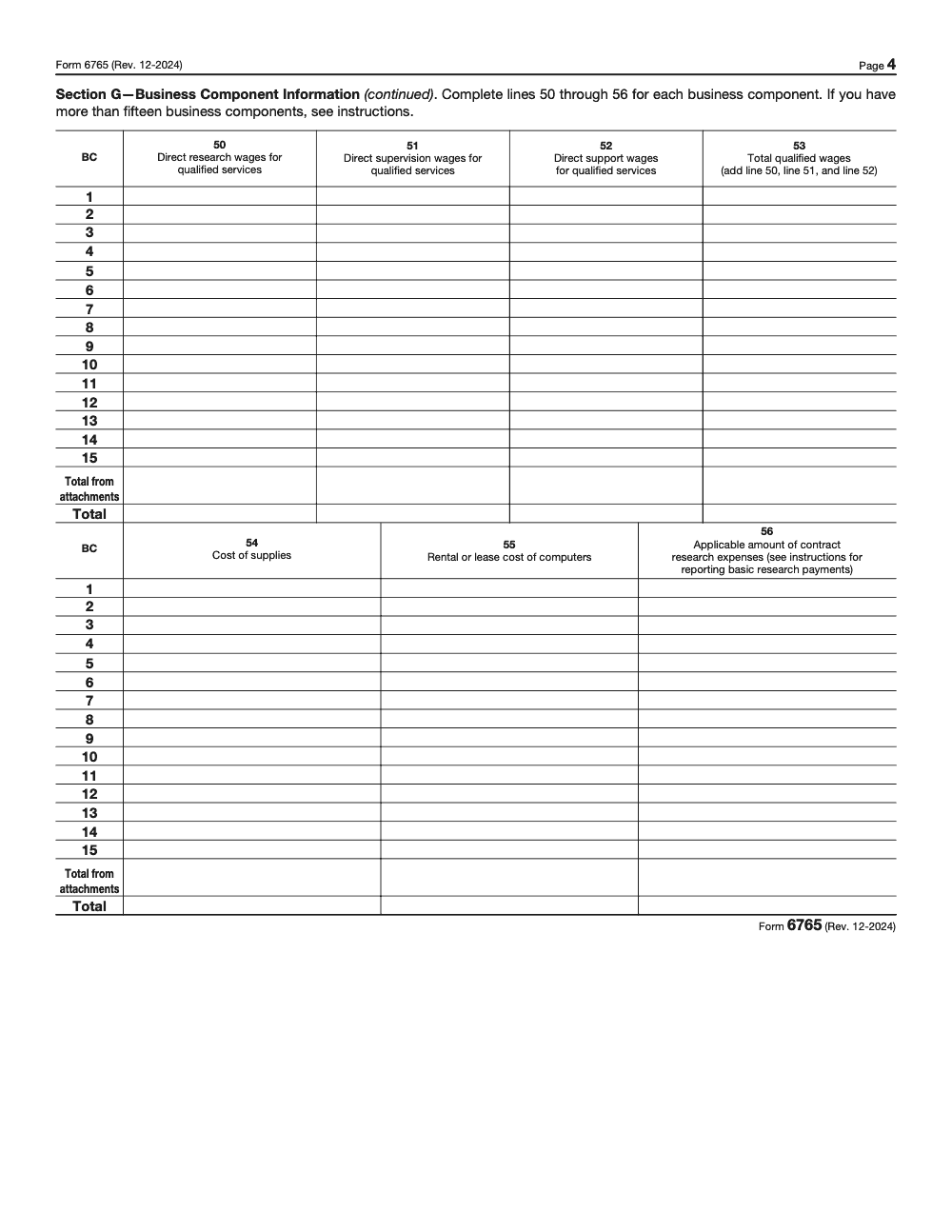
Form 6765 stopped being a quick add-on schedule. The December 2024 revision expanded it to 7 sections, A through G, across 4 pages, and the new Section F now requires every filer to disaggregate wages, supplies, computer rental, and contract research on lines 42 through 46 before any credit is computed (per the Form 6765 instructions, Rev. December 2024). Section G layers up to 15 business-component rows on top of that.
The hard part is not the math, it is the substantiation behind it. When the R&D wage pool, the four-part-test write-ups, and the business-component detail all land in the final weeks before a return is due, review slows and quality slips. A structured production process keeps the credit study moving without burning your senior reviewers.
- Standardize the Section F workpaper so lines 42 through 46 reconcile to payroll, the general ledger, and contract-research invoices at 65% (or 75% for a consortium).
- Build the Section G business-component schedule early, capturing direct, supervision, and support wages (lines 50 through 52) per component.
- Run the four-part test on each component at the most disaggregated level, and flag foreign or funded activity before it reaches the credit calculation.
- Track the Section 280C and ASC elections on a checklist so they are settled on the original return, not revisited in an amendment.
- Reconcile R&D wages against WOTC and ERC claims to prevent double-counted wages on line 42.
This is the kind of structured, review-protected execution Accountably is built for. Our trained, U.S.-led offshore teams run the workpaper preparation, documentation, and multi-layer review behind R&D credit claims, so the credit gets substantiated and filed on time. See how our tax services carry the work without adding headcount.
FAQs
Form 6765 is used to compute the Section 41 Credit for Increasing Research Activities, commonly known as the R&D or Research Credit. It applies to businesses with qualified research expenses in science, technology, engineering, or software development. The credit is generally nonrefundable but can offset payroll taxes for qualifying startups.
Any taxpayer – individual, corporation, S corporation, partnership, or trust – with qualified research expenses that meet the four-part test may claim the credit. The business must have conducted qualifying research aimed at eliminating technical uncertainty through a process of experimentation. The credit is available to businesses of all sizes, though the mechanics differ for eligible small businesses and startups.
The ASC is a simplified method for computing the R&D credit that uses 14% of QREs exceeding 50% of the average QREs for the prior three years. It is available as an election in place of the regular credit method and does not require the historical fixed-base percentage calculation. For most businesses without reliable records going back to 1984, the ASC is the practical choice.
Yes. Qualified small businesses – defined as those with gross receipts under $5 million and in their first five years of having gross receipts – can elect to apply up to $500,000 of the R&D credit against their employer share of Social Security and Medicare taxes. This payroll tax offset provides immediate value to pre-revenue or early-stage companies that would otherwise receive no benefit from a nonrefundable income tax credit.
The IRS audits R&D credit claims by examining whether each claimed activity meets the four-part test and whether the expenses are properly documented. Key audit areas include: time records linking employees to specific activities, project-level documentation of technical uncertainty and experimentation, exclusion of ineligible activities (maintenance, funded research, post-commercial work), and correct application of the contractor rule. Insufficient documentation is the most common reason credits are reduced or disallowed on audit.
Yes, within the standard statute of limitations – generally 3 years from the original filing due date. Many businesses claim the credit retroactively after learning they qualify. Amended returns claiming R&D credits should include a complete credit study with contemporaneous documentation, as the IRS subjects these claims to heightened review.
Other forms this guide names
- Form 941: Employer's Quarterly Tax Return Guide 2025
- Form 8974: Guide to the Payroll R&D Credit for QSBs
- Form 1040: Filing Guide for 2025 Returns (AGI, Deductions, Deadlines)
- Form 1065: Guide, Deadlines, K‑1, K‑2/K‑3, E‑File
- Form 1065: Schedule K-2 and K-3 Guide 2025, one month date rules
- Form 1120: Corporation Tax Return Guide
Summarize this article with AI
About this guide
Accountably helps US CPA, EA, and accounting firms hire trained accountants and tax preparers in India.
About us Reviewed byJugal Thacker, CPAFounder and CEO at Accountably
A Washington-licensed CPA with 7+ years inside US firms – PwC, a real-estate tax practice, then a full-service firm, rising from reviewer to manager to advisory. This article was reviewed against current IRS guidance for the 2025 tax year and updated for filers preparing late returns, amendments, and 2026 estimates.
View profile →How we research, review, and update this guide
Every Accountably guide is researched against primary IRS sources, reviewed by a U.S. CPA, and refreshed as guidance evolves. Read our Editorial Guidelines to see how we source, fact-check, and update our content.