Summarize this article with AI
In Brief
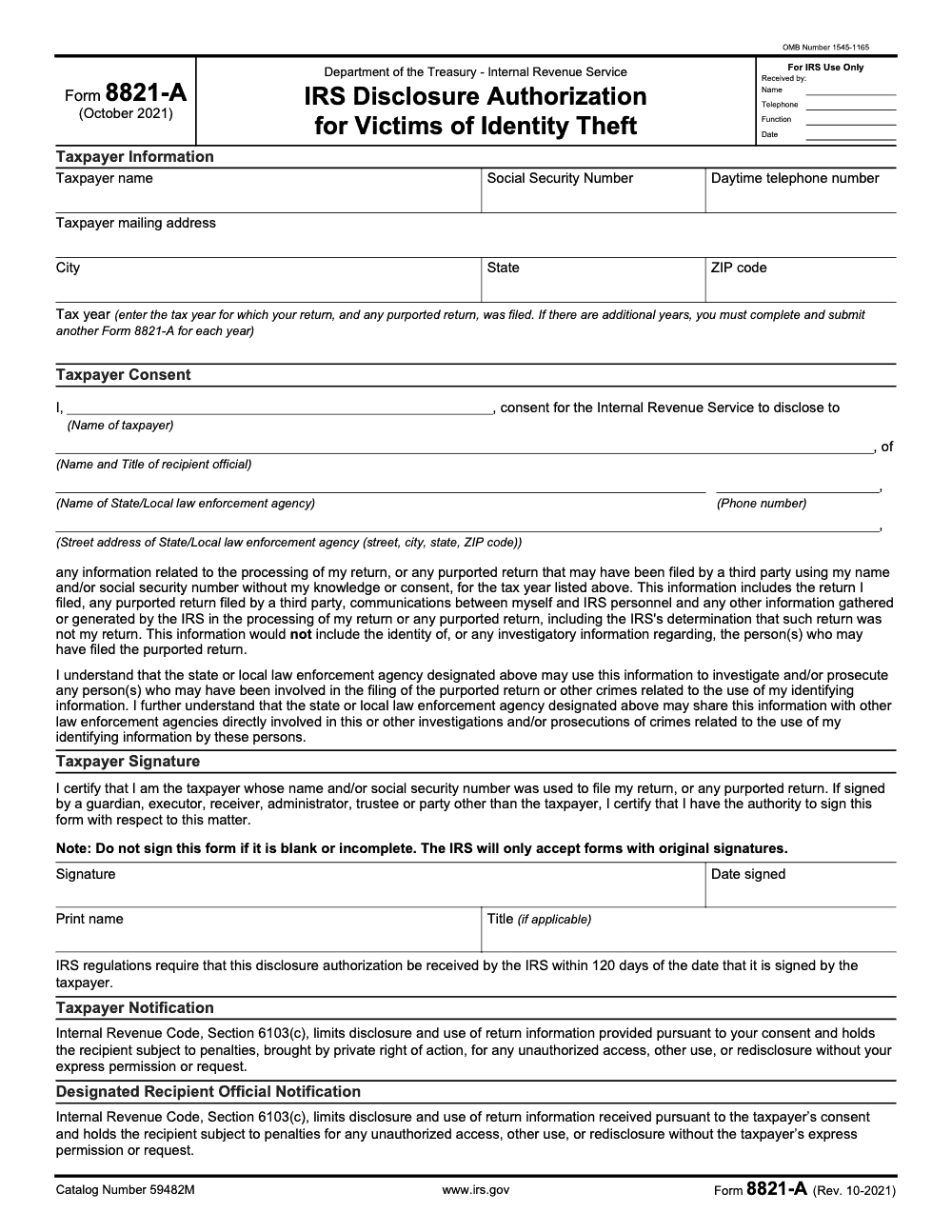
Form 8821-A is the IRS Disclosure Authorization for Victims of Identity Theft. It lets the IRS release a victim’s return and processing data to a named state or local law-enforcement official for one listed tax year (per the Form 8821-A instructions, Rev. October 2021). The IRS must receive the original signed consent within 120 days of the signature date, and a separate form is required for each additional year. For the return work behind these cases, see our tax services.
When a state or local law-enforcement officer is working an identity theft case and needs the victim's IRS return data, Form 8821-A is the consent that opens that file for one named tax year. It is a narrow door, available only to IRS Criminal Investigation or to state and local law enforcement, not to private parties or tax pros.
Timing is the piece teams miss. The IRS must receive the signed consent within 120 days of the signature date, and it counts the date it actually receives the form, not the postmark. Each additional year needs its own form, and the current instructions are Rev. October 2021. The facts here are current as of December 26, 2025.
Key Takeaways
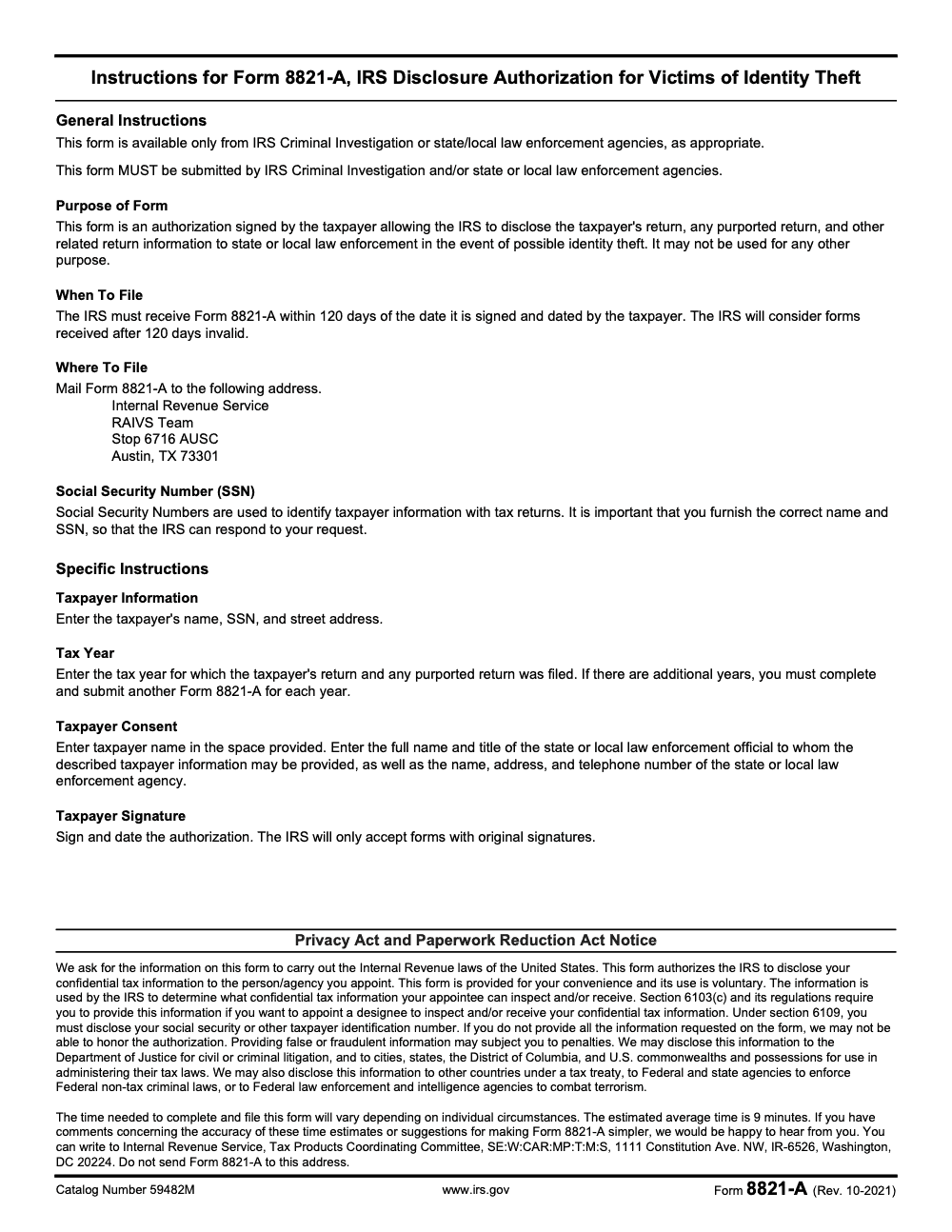
- Form 8821‑A authorizes the IRS to disclose tax‑return processing information and copies of specified federal returns to a named state or local law‑enforcement official. Per the form instructions, completed authorizations are mailed to the IRS RAIVS Team, Stop 6716 AUSC, Austin, TX 73301.
- The IRS must receive the signed consent within 120 days of the signature date, the IRS uses the date it actually receives the form, not the postmark or mailing date, for the determination. Plan your timing carefully.
- Only IRS Criminal Investigation or state and local law enforcement use this path for identity theft investigations, not private parties or tax pros.
- Sign and date the form and list one exact tax year per form, use a separate form for each additional year.
- For access for tax pros or general disclosures, use Form 8821; for representation, use Form 2848; for a copy of a fraudulent return, use Form 4506‑F; for reporting identity theft to the IRS, use Form 14039.
- Details are current as of December 26, 2025, based on IRS sources. Always confirm agency instructions on individual cases.
What Is IRS Form 8821‑A, and When You Use It
Form 8821‑A is a narrow consent that allows the IRS to disclose your client’s return information for the specific identity theft investigation named on the form. It is used by law enforcement with IRS Criminal Investigation support, and requests are processed in the Austin RAIVS unit. Your role is to help your client sign and scope the consent accurately, then coordinate with the requesting officer.
What 8821‑A authorizes
- Disclosure of tax‑return processing information for the listed year.
- Copies of federal returns filed under your client’s SSN for that year, including any potentially fraudulent filing.
Who can request
Only two categories are in scope, IRS Criminal Investigation and state or local law enforcement involved in an identity theft case. They, not private parties, initiate the request, and signed 8821‑A consents are mailed to the IRS RAIVS Team, Stop 6716 AUSC, Austin, TX 73301, per the form instructions.
What 8821‑A does not provide
This consent does not open law‑enforcement case files, suspect identities, or investigative methods. Release focuses on the taxpayer’s return and processing data, within the year(s) listed, consistent with IRS disclosure rules. For copies of fraudulent returns for the victim, the separate path is Form 4506‑F.
Timing that matters
The IRS must receive the signed consent within 120 calendar days of the signature date. The IRS measures the deadline by the date it receives the form, not the postmark or envelope date, so late arrivals are treated as invalid. Treat the window as fixed, do not sign too early if logistics are not ready.
Practical tip, align the client’s signing date with the requesting officer’s intake window, then send immediately and retain proof of delivery.
Where Accountably fits
We standardize the intake, set the timing reminders, populate recipient details exactly as provided by the officer, and package the form and workpapers for your reviewer. Your partner time stays on strategy while our team manages the details, the naming conventions, and the delivery confirmations inside your systems.
Step‑By‑Step, Completing Form 8821‑A Correctly
Use this checklist with your client while your case manager keeps the task moving. Each step below maps to the IRS pre‑screen items the RAIVS unit checks, which helps you avoid rework.
1) Taxpayer information
- Match the legal name and SSN to IRS records, no nicknames.
- Add a reliable daytime phone and a full mailing address.
- If a fiduciary signs, include printed name and capacity.
2) Exact tax year
- Enter one specific year, for example, 2022.
- Use a separate 8821‑A for another year, even if the same officer is requesting both.
3) Recipient official and agency
- Copy the officer’s full name and exact title, for example, Special Agent Jane Q. Doe.
- Enter the full legal agency name and its physical street address, city, state, and ZIP, no generic descriptions.
- Confirm spelling and titles, disclosure is limited to the named person and agency, though that agency may share what it receives with other law-enforcement agencies directly involved in the same or related investigation, and the IRS keeps its standard Section 6103 disclosure routes.
4) Signature, date, and authority
- The IRS pre‑screen checks for a taxpayer signature and the date signed. Sign clearly and print the signer’s name and title if acting in a fiduciary role.
- Plan mailing or delivery so the IRS receives the form within 120 days of the signature date.
5) Where to send and how
- Follow the requesting officer’s instructions. Per the form instructions, signed consents are mailed to the IRS RAIVS Team, Stop 6716 AUSC, Austin, TX 73301, usually via the officer or as directed in writing. Keep a copy and proof of delivery.
If anything is illegible or missing, RAIVS rejects the request and you lose time. Build a final reviewer checklist that mirrors the IRS pre‑screen items.
Form Selection Guide For Your Team
Use this quick reference when your staff asks, which form do we need right now.
| Form | Primary purpose | Who initiates | Validity window | What it authorizes | Typical destination |
| Form 8821‑A | Identity theft disclosure to state or local law enforcement for a listed year | Law enforcement working with IRS CI requests, taxpayer signs | IRS must receive within 120 days of signature | Return‑processing info and copies of the taxpayer’s federal returns for the listed year | IRS RAIVS Team, Stop 6716 AUSC, Austin, TX 73301, per officer instruction |
| Form 8821 | Authorize a person or entity to receive tax information | Taxpayer or business | 120‑day rule applies for some non‑tax purposes, see IRS instructions | Inspect or receive confidential tax information, not representation | CAF or online submission per IRS guidance |
| Form 2848 | Representation before the IRS | Taxpayer or business | Until revoked or expired per scope | Representative can act and receive information | CAF or online submission per IRS guidance |
| Form 4506‑F | Victim requests copy of fraudulent return | Taxpayer or authorized party | Per IRS instructions | Masked copy of fraudulent return filed under the victim’s SSN | Fresno address or fax per IRS page |
| Form 14039 | Report tax‑related identity theft to the IRS | Taxpayer | Not a disclosure tool | Alerts IRS to identity theft for account protection | Per IRS Identity Theft Central guidance (irs.gov/identity-theft-central) |
How Accountably Fits Into Your Delivery System
Most teams do not stall on demand, they stall on delivery. Identity theft requests arrive when your people are at capacity. We designed our U.S.‑led offshore model to take the work, keep your standards, and return clean files to your reviewers. You keep ownership, we bring structure.
Delivery structure built for control
- SOP‑driven execution, consistent workflow across tax, CAS, and month‑end.
- Structured workpapers with standardized naming and version control.
- Multi‑layer review, preparer, senior, then quality before final review.
- Turnaround SLAs that your ops team can see and measure.
- Internal checklists that mirror the IRS pre‑screen to cut rework.
- Live visibility, issue escalation early, and capacity planning by utilization, not guesses.
This structure reduces revision cycles, protects partner time, and keeps client deadlines intact even during peaks.
Security, compliance, and integrity
Your client data sits behind safeguards your partners can sign off on.
- SOC 2 aligned controls and NDA‑backed confidentiality.
- Role‑based access, secure VPN, zero local storage, encrypted exchange.
- Audit logs with activity records and background‑verified staff.
- U.S. GAAP aligned accounting practices, IRS and state tax standards, multi‑state payroll familiarity, and sales tax automation workflows.
Tools and platforms we work in
We work inside your stack so nothing breaks. QuickBooks, Xero, UltraTax, CCH Axcess, ProConnect, Lacerte, Drake, Thomson Reuters, Canopy, Karbon, TaxDome, Suralink, and JetPack.
Your systems, your templates, your client expectations, our disciplined execution.
A Clean 8821‑A Workflow Your Team Can Reuse
Here is a simple flow your managers can apply every time an officer asks for a consent.
Intake and verification
- Confirm it is an identity theft investigation and the officer is state, local, or IRS CI.
- Capture the official’s full name, exact title, agency legal name, and full street address as written on their letter.
Scope and prep
- Identify the single tax year in question.
- Pull basic client data and validate name and SSN format against prior filings.
Draft and internal QC
- Complete taxpayer section and the recipient section, then run your internal 8821‑A checklist against IRS pre‑screen items.
Signature and submission
- Have the client sign and date.
- Confirm the 120‑day clock, plan delivery so IRS receives within the window.
- Send per the officer’s written instruction. The form instructions direct completed authorizations to the IRS RAIVS Team, Stop 6716 AUSC, Austin, TX 73301. Retain delivery proof.
Close and document
- Save the signed form, proof of delivery, and officer instruction.
- Post a note on the client’s file and set a follow‑up for any agency feedback.
Why This Matters For Advisory And Audit Too
Identity theft cleanup is not just tax, it touches advisory and audit work.
- Advisory, you may need a quick analysis of wage and information returns, prior year filing patterns, and client communications timelines for insurers or counsel. We package this analysis without slowing compliance teams.
- Audit, if your firm also audits the client’s entity, identity theft risk shows up in control narratives and fraud risk discussions. We deliver neat PBCs, named and dated the way your audit team expects, so nothing slips during interim or year‑end.
When delivery is disciplined, partners regain time for client strategy and growth.
Practical Examples From The Field
- A 1120S client is flagged after a fraudulent 1040 is filed in a shareholder’s name. The detective requests processing details for 2023. We prepare the 8821‑A, ensure a single year is listed, capture the officer’s full details, and time the signature so receipt falls within the window. The form clears RAIVS on the first pass, and your tax team keeps monthly close moving.
- A 1040 client needs a masked copy of the fraudulent filing for their records. We guide them on the 4506‑F process while keeping the 8821‑A lane focused on the law‑enforcement request.
Detailed Instructions Your Team Can Follow
This section mirrors how reviewers think, short, precise, and complete.
Taxpayer section, how to fill it
- Enter the legal name that appears on filed returns and the correct SSN.
- Add a daytime phone number and a complete mailing address.
- If a guardian or trustee signs, print their name and title so the officer can verify authority.
Tax year, be precise
- Use one year per form, for example, 2021, 2022, or 2023.
- Avoid ranges or vague terms, precision keeps the scope clean and speeds processing.
Recipient official and agency, copy exactly
- Official’s full name and exact title, do not abbreviate unless the letter uses that format.
- Agency’s full legal name, then the physical street address, city, state, and ZIP.
- Small typos can limit disclosure, accuracy controls what the IRS may release and to whom.
Signature rules and timing
- Sign and date the form with an original, wet-ink signature, the IRS does not accept scanned, faxed, or electronic signatures on this form. The IRS must receive the consent within 120 days of the signature date. If it arrives later, it will be rejected and you must redo the consent.
- Use clear handwriting and print the signer’s name and title if signing in a fiduciary capacity so the IRS can confirm authority.
Submission and routing
- Follow the officer’s written instruction. Per the form instructions, completed authorizations are mailed to the IRS RAIVS Team, Stop 6716 AUSC, Austin, TX 73301. Keep a copy of everything you send and keep proof of delivery.
Common rejection triggers to avoid
- Missing signature or undated form.
- Wrong or incomplete agency address or officer title.
- Multiple years listed on one form, use a separate form for each year.
- Illegible entries that block data entry.
Accountably Service Models That Scale With You
Choose the approach that fits your caseload and seasonality. All models include SOPs, standardized workpapers, review protection, and security controls.
Dedicated offshore talent
- Full‑time tax and accounting staff inside your workflow.
- Ideal for firms that want stable, year‑round production capacity.
White‑label delivery teams
- End‑to‑end teams with a manager and reviewers for seasonal spikes or compliance pushes.
- Good for January through April or extended filing periods.
Build–Operate–Transfer offshore unit
- Your own offshore center with exclusive team and management.
- For firms that want long‑term control without starting from scratch.
No resume farming, no short‑term band‑aids, just accountable offshore execution run to your standards.
How This Supports Tax, Advisory, And Audit In One System
Tax execution
- 1040, 1120, 1120S, 1065, 990, multi‑state, SALT, cleanup, and review support, plus workpapers that speed reviewer sign‑off.
- Timely 8821‑A handling protects filing calendars and client trust.
Advisory and CAS
- Monthly financial packages, cash flow, AP and AR, fixed assets, reconciliations, controller support.
- Identity theft cases can trigger lender or insurer requests. We prepare tidy packages that keep advisory projects moving.
Audit and assurance
- PBC readiness for identity‑theft related procedures that affect fraud risk and IT controls.
- Clean documentation trails that your audit partners will appreciate when they test controls or respond to governance inquiries.
Common Mistakes We See Every Season
From my side of the desk, almost every Form 8821-A that stalls fails on the same handful of details, not on anything exotic. Here are the ones we screen for before a consent ever leaves the office.
Reusable Checklists
These are copy-paste ready for your firm SOPs. Drop them into your workflow tool and tick through each one as a consent request moves from intake to close.
8821-A intake verification
- Confirm the request is an identity-theft investigation, not a general inquiry.
- Verify the requester is IRS Criminal Investigation or a state or local law-enforcement officer.
- Capture the official’s full name and exact title from the written request.
- Record the legal agency name and complete physical street address, city, state, and ZIP.
- Identify the single tax year the officer needs.
RAIVS pre-screen QC
- Match the taxpayer’s legal name and SSN to filed-return records, no nicknames.
- Confirm exactly one tax year is listed on the form.
- Check the recipient official and agency block against the officer’s letter, character for character.
- Confirm a daytime phone number and full mailing address are present.
- Verify the form is complete before anyone signs.
- Confirm an original wet-ink signature and a written date are in place.
Signature, send, and close
- Time the client’s signature so the IRS can receive the form within 120 days.
- Send per the officer’s written routing instruction. The form instructions direct it to the IRS RAIVS Team, Stop 6716 AUSC, Austin, TX 73301.
- Keep a copy of the signed form and proof of delivery.
- Save the officer’s request letter to the client file.
- Set a follow-up reminder for agency feedback or a second-year form.
Keep 8821-A Season From Stalling
An 8821-A request rarely arrives on your schedule. It lands the week a detective opens an identity-theft case, often in the middle of a busy compliance stretch, and it carries a hard 120-day receipt window measured from the signature date (per the Form 8821-A instructions). The IRS pegs the form itself at roughly 9 minutes to complete, yet the work around it, verifying the requester, scoping the exact year, and copying agency details without a single typo, is where hours quietly disappear.
The fix is not heroics during the spike, it is a standing process any team member can run the moment a consent request comes in. When intake, scope, and quality control are scripted, one late or sloppy form stops eating senior review time.
- A one-page intake that captures the official’s name, exact title, agency legal name, and full street address straight from the request letter.
- A rule that one tax year goes on one form, with a separate consent queued for each additional year.
- A 120-day countdown started at the signature date, with delivery and proof of receipt baked into the same task.
- A wet-ink signature step that blocks scanned or electronic substitutes before they reach RAIVS.
- A final reviewer pass that mirrors the IRS pre-screen so the consent clears Austin on the first attempt.
That is the disciplined execution our team runs inside your systems and to your SOPs, so identity-theft consents move quickly while reviewers stay on higher-value work. See how we support firms across tax, advisory, and audit delivery.
FAQs
Only IRS Criminal Investigation or a state or local law‑enforcement officer involved in an identity theft investigation. Private parties and tax professionals cannot initiate this authorization.
The IRS must receive the signed consent within 120 days of the signature date. Time your signature so there is enough room for delivery and processing.
Keep it to one year per form. If multiple years are involved, use multiple forms so processing stays fast and clean.
Follow the requesting officer’s written instruction. Per the form instructions, completed authorizations are mailed to the IRS RAIVS Team, Stop 6716 AUSC, Austin, TX 73301.
No. 8821‑A is a special identity theft disclosure to law enforcement. Form 8821 is for information access, and Form 2848 is for representation. Different tools, different jobs.
Other forms this guide names
- Form 2848: Guide to Line 3, Filing, and Rules
- Form 8821: Tax Information Authorization
- Form 4506-F: Request a Masked Copy of a Fraudulent 1040
- Form 1040: Filing Guide for 2025 Returns (AGI, Deductions, Deadlines)
About this guide
Accountably helps US CPA, EA, and accounting firms hire trained accountants and tax preparers in India.
About us Reviewed byJugal Thacker, CPAFounder and CEO at Accountably
A Washington-licensed CPA with 7+ years inside US firms – PwC, a real-estate tax practice, then a full-service firm, rising from reviewer to manager to advisory. This article was reviewed against current IRS guidance for the 2025 tax year and updated for filers preparing late returns, amendments, and 2026 estimates.
View profile →How we research, review, and update this guide
Every Accountably guide is researched against primary IRS sources, reviewed by a U.S. CPA, and refreshed as guidance evolves. Read our Editorial Guidelines to see how we source, fact-check, and update our content.