Key dates
Summarize this article with AI
In Brief
Form 8396 computes the Mortgage Interest Credit for taxpayers holding a qualified state or local Mortgage Credit Certificate (MCC) on their main home. The credit equals interest paid on the certified indebtedness times the MCC certificate rate, capped at $2,000 per year when that rate exceeds 20% (per the 2025 Instructions for Form 8396). The allowed credit flows to Schedule 3, line 6g, and unused amounts carry forward up to 3 years. Tax year 2025 returns were due April 15, 2026, with an extension to October 15, 2026 via Form 4868.
If your Form 1098 shows a year of mortgage interest and you are wondering about the mortgage credit, what matters for Form 8396 is whether you hold a valid Mortgage Credit Certificate, an MCC, from a state or local program, no matter how much interest you paid.
Once you have one, the math is interest paid times your certificate rate, capped at $2,000 a year when that rate runs above 20%. The credit is nonrefundable, so your tax liability can limit it, and any unused amount carries forward up to 3 years. A step that often gets missed is reducing the Schedule A interest deduction by the Form 8396 line 3 amount, even in a carryforward year.
Key Takeaways
- You claim the Mortgage Interest Credit on Form 8396, but only if you have a valid Mortgage Credit Certificate, MCC, from a state or local program.
- The credit is nonrefundable and is limited by your tax liability. It is generally interest times your MCC rate, with a hard $2,000 cap when your certificate rate is over 20%.
- If you have unused credit, you may carry it forward for up to three years, but amounts above the $2,000 cap cannot carry forward.
- Itemizers must reduce their Schedule A mortgage interest deduction by the amount on Form 8396 line 3, even when part of the credit is carried forward.
- Refinance does not kill your credit if your MCC is reissued and meets all five IRS reissuance conditions, though the original MCC continues to cap your annual line 3 amount even when the new loan has a lower interest rate.
What Form 8396 Is, and Why It Exists
Form 8396 lets you convert a slice of your annual mortgage interest into a tax credit when a housing finance agency issues you an MCC. You enter the interest tied to your certified indebtedness, the certificate’s credit rate, and then apply the nonrefundable credit rules. The form also tracks any credit you can carry to next year. In short, it is the official way to claim the Mortgage Interest Credit and to move any leftover amount forward.
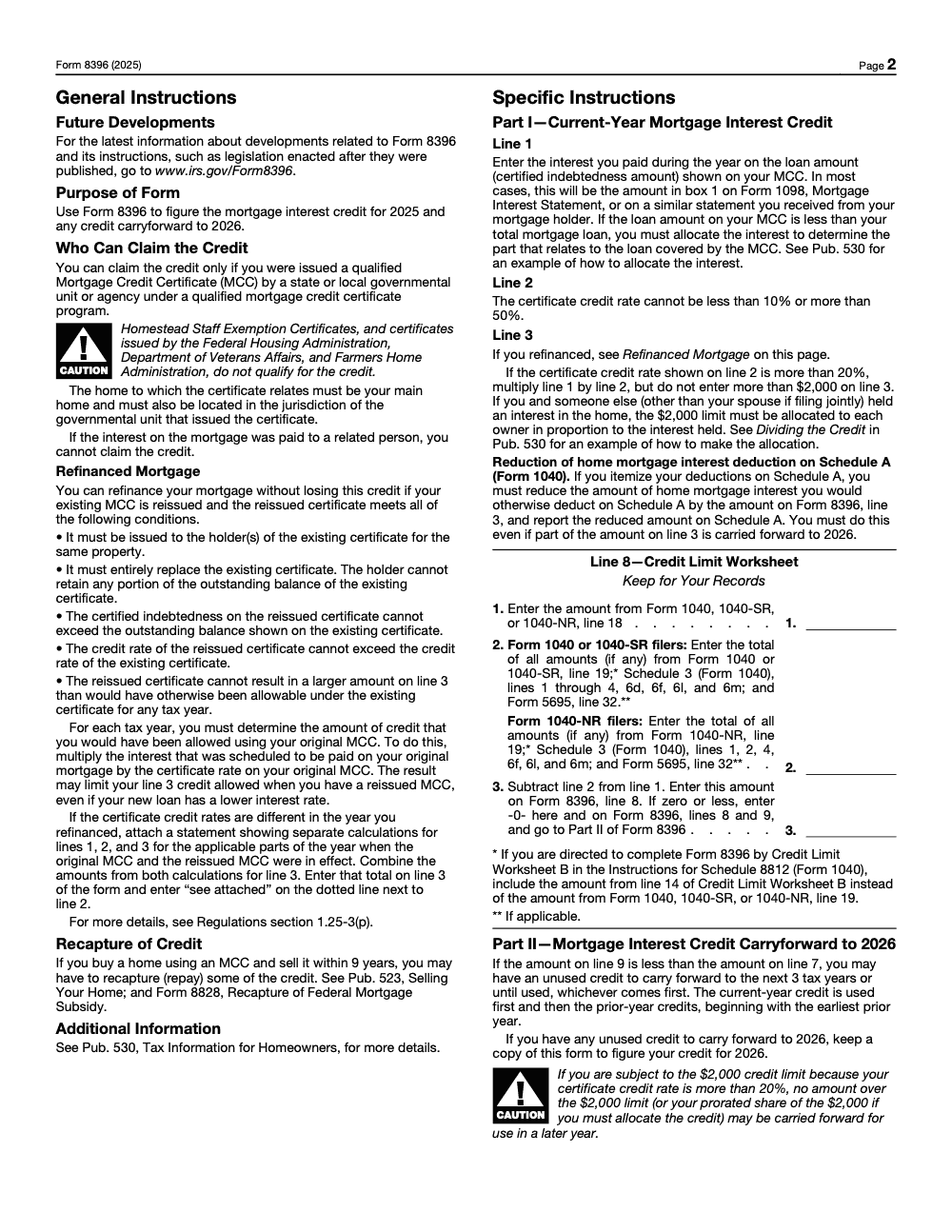
The IRS sets several guardrails. Your MCC’s credit rate must be at least 10% and not more than 50%. If the rate is above 20%, your current year credit is capped at $2,000 per taxpayer. Co‑owners split that $2,000 limit in proportion to ownership.
Because this is a nonrefundable credit, your tax must be high enough to absorb it. The form includes a limit computation, which effectively lines Form 8396 up with other nonrefundable credits shown on Form 1040 and Schedule 3. The IRS also references Credit Limit worksheets used with other credits, which is why your software sometimes jumps between sections as it calculates.
If you hold a qualified MCC for your main home, Form 8396 is the path to claim the Mortgage Interest Credit and to preserve any unused portion for the next three years.
Who This Helps
You benefit most if you have a valid MCC tied to your principal residence and you pay enough mortgage interest for the math to matter. First time buyers and moderate income households often see the biggest impact because many MCC programs target them. Since the credit is nonrefundable, households with some tax liability, but not too much, tend to use it efficiently. The form is also useful for couples who bought with an MCC in prior years and now need to track carryforwards in the right order.
Why Firms Care, Briefly
If you run a CPA or EA practice, Form 8396 can slow reviews when MCC details are missing, names do not match, or the Schedule A reduction is handled incorrectly. A disciplined workflow fixes that, for example standard MCC workpaper templates, certificate detail capture, and a consistent review checklist for the Schedule A adjustment. At Accountably, we focus on structured workpapers and layered review so teams spend less time reworking returns and more time advising clients. Use this article as a checklist to cut preventable back‑and‑forth.
Eligibility, The Nonnegotiables
You must have a qualified Mortgage Credit Certificate from a state or local governmental unit. Without that certificate, there is no Form 8396 credit. The certificate must be tied to your main home, and the property needs to be within the issuing agency’s jurisdiction. Certificates from FHA, VA, or the Farmers Home Administration by themselves do not qualify, and interest paid to a related person does not qualify either.
You Must Hold a Valid MCC
Your MCC tells you the certificate credit rate, commonly between 10% and 50%. You apply that percentage to the interest on the certified indebtedness for the year. If your certificate rate is above 20%, your line 3 amount cannot exceed $2,000 for the year. If there are co‑owners, that $2,000 cap is allocated based on each owner’s share.
Agencies usually set income and purchase price limits. Those rules come from the issuing program and determine whether you received a qualifying MCC in the first place. Keep the original MCC with your tax records, since you will need its issuer, number, issue date, and credit rate to complete the form correctly.
It Must Be Your Principal Residence
The certificate links to your main home, the place you live most of the year. If you stop living there, convert it to a rental, or move, you generally cannot keep claiming the credit. The property must be inside the jurisdiction that issued the MCC.
Program Limits Still Matter
Even though the IRS administers Form 8396, program income limits and purchase price caps are set by the state or local issuer at the time of issuance. Your eligibility to have the MCC at all rests on those rules. Once you have a valid MCC, Form 8396 applies the federal math, including the nonrefundable limit and the $2,000 cap.
How the Credit Works, Plain English
- Pull the interest paid on the certified indebtedness from your Form 1098 or a similar lender statement.
- Multiply that interest by the MCC credit rate on your certificate.
- If your rate is over 20%, limit the result to $2,000 on line 3.
- Bring in any carryforwards from the prior three years.
- Apply the tax liability limit, then report the allowed credit on Schedule 3, line 6g.
- Reduce your Schedule A mortgage interest deduction by the amount on line 3, not by line 9.
Quick Example
- Interest paid for the year, Form 1098 box 1, 9,200
- MCC credit rate, 25%
- Line 3 before cap, 2,300
- Since the rate exceeds 20%, the credit on line 3 is capped at 2,000.
- If your tax liability limit is 1,600, line 9 would be 1,600, and you would carry 400 forward, subject to the three year rule. You still reduce Schedule A interest by 2,000 because the instructions require the reduction by line 3.
A Note On Nonrefundable Limits
Form 8396 includes a Credit Limit Worksheet that cross references lines from Form 1040 and Schedule 3 to make sure your credit cannot exceed your tax. Your software should handle this, but it helps to know why the number sometimes drops below your line 3 calculation.
The MCC rate window is 10% to 50%, and any rate above 20% triggers a firm 2,000 ceiling for the year. That cap is not what you subtract on Schedule A. You subtract the full line 3 amount.
Documents You Need Before You Start
Have these in front of you and triple check the details match.
- Your Mortgage Credit Certificate, MCC, with issuer name, certificate number, issue date, property address, and the credit rate.
- Form 1098, or a lender statement that shows the total mortgage interest you paid for the year on the certified indebtedness.
- Any prior year Form 8396 showing carryforwards still available.
Your MCC, What To Verify
- The certificate credit rate, must be between 10% and 50%.
- That the certificate covers your main home and matches your filing name and address.
- Whether a refinance occurred and, if yes, whether you received a reissued MCC that replaced the old certificate.
Form 1098 Details That Drive Line 1
Line 1 uses the interest paid on the certified indebtedness. In many cases this equals Form 1098 box 1. If your MCC covers only part of your mortgage balance, allocate the interest so line 1 reflects the portion tied to the certified indebtedness. If multiple owners share the loan, enter only your share on line 1. Keep your allocation notes with your records.
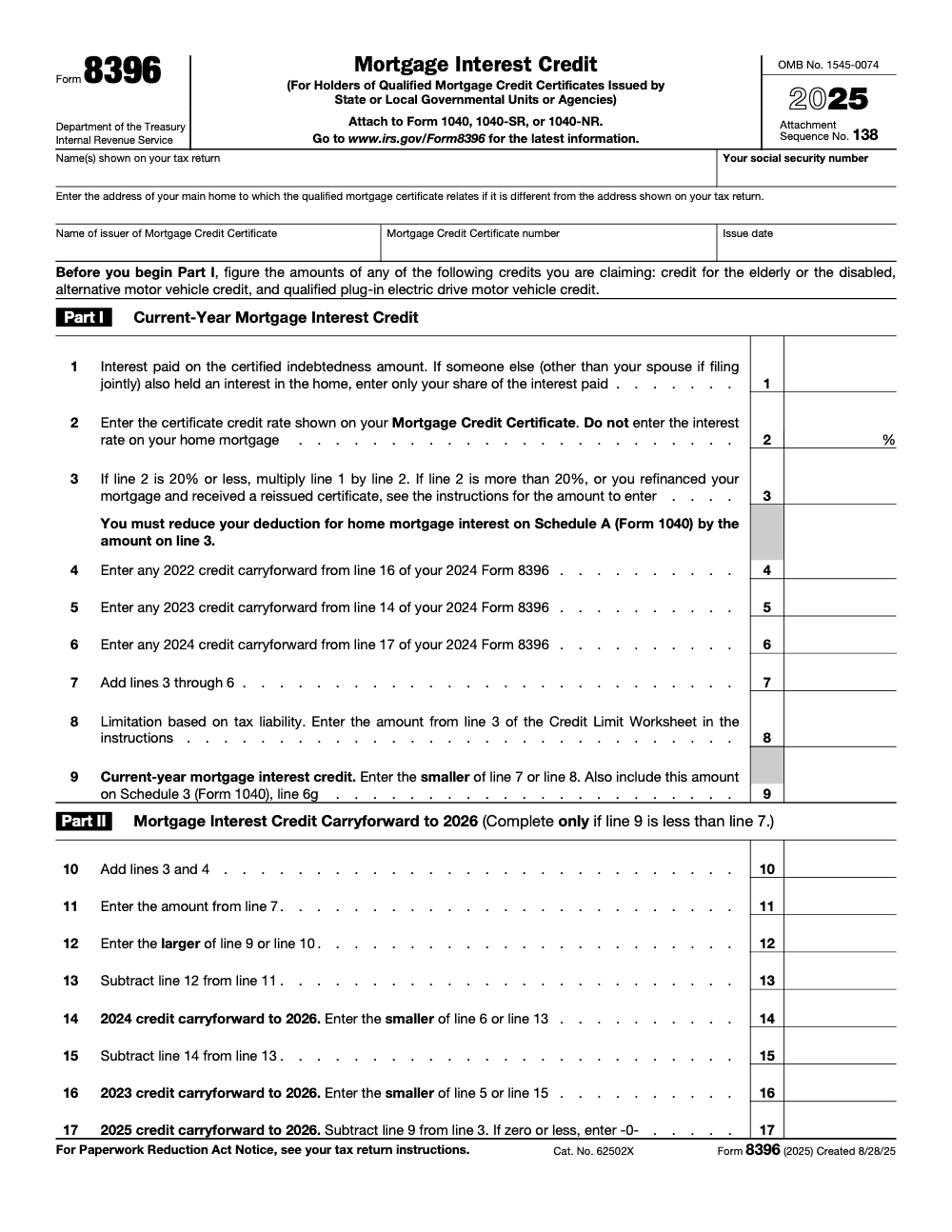
Completing Part I, Current Year Mortgage Interest Credit
- Line 1, enter interest on the certified indebtedness. Allocate if necessary.
- Line 2, enter the certificate credit rate from your MCC, not your loan interest rate.
- Line 3, multiply line 1 by line 2. If the rate is over 20%, do not exceed 2,000. If you refinanced and have a reissued MCC, follow the reissuance rule and attach the required statement when rates differ within the year.
- Lines 4 to 6, bring in any unused credit from the prior three years in the order the form specifies.
- Line 7, add lines 3 through 6.
- Line 8, compute your tax liability limit using the worksheet in the instructions, then bring the result here.
- Line 9, the allowed current year credit, the smaller of line 7 or line 8. Report it on Schedule 3, line 6g.
Mini Worksheet Example
| Step | Input | Result |
| Line 1, interest on certified indebtedness | 9,200 | 9,200 |
| Line 2, MCC credit rate | 25% | 25% |
| Line 3, credit, apply 2,000 cap | 9,200 x 25% | 2,000 |
| Lines 4–6, carryforwards | 0 | 0 |
| Line 7 | 2,000 | 2,000 |
| Line 8, tax limit | 1,600 | 1,600 |
| Line 9, allowed credit | min(2,000, 1,600) | 1,600 |
Even though your allowed credit on line 9 is 1,600, the Schedule A reduction still uses line 3, which is 2,000.
Quick check before you move on, does your Schedule A mortgage interest show the reduction by line 3, not line 9? That single mismatch triggers many paper notices.
Completing Part II, Carryforward of Unused Credit
You complete Part II only when line 9 is less than line 7. In other words, you had more credit available than your tax could absorb this year.
- Line 10 equals the sum of line 3 and line 4 (the 2022 carryforward, the oldest still-eligible amount).
- Line 11 repeats your total credit available, line 7.
- Line 12 is the larger of line 9 or line 10.
- Line 13 is your unused amount, line 11 minus line 12.
- Lines 14 to 16 allocate carryforwards in reverse chronological order: line 14 holds the 2024 carryforward to 2026, and line 16 holds the 2023 carryforward to 2026.
- Line 17 shows the current year unused credit to carry to next year.
Carryforwards last up to three years. Important, if your certificate rate is over 20%, the amount above the $2,000 cap does not carry forward at all. Keep copies of each year’s Form 8396 so you can track what remains and when it expires.
Schedule A Interaction, Avoid The Most Common Error
When you claim the Mortgage Interest Credit, you must reduce your itemized mortgage interest by the amount on Form 8396, line 3. The IRS says to subtract line 3 from the total deductible interest you paid, then report the reduced amount on Schedule A. You make this reduction even when part of the credit is carried forward. This is the rule that trips up many filers because it feels counterintuitive.
Refinancing, Reissued MCCs, and Nine‑Year Recapture
Refinancing does not end your credit if your MCC is properly reissued. The reissued certificate must be issued to the same holder, for the same property, completely replace the old certificate, have certified indebtedness no higher than the old outstanding balance, have a credit rate no higher than the original certificate's rate, and not increase what you could have claimed on line 3 versus the original certificate. All five conditions must be met, no exceptions. If certificate rates differ during the year, attach a statement showing the split‑year calculations. The instructions point to Reg. section 1.25‑3 for reissuance details.
If you sell within nine years of buying with an MCC, you may owe recapture tax, reported on Form 8828. The IRS keeps the 8828 page updated, and the current page confirms its purpose and links to the latest instructions. Check this in the year you sell.
Form 8396 vs Form 1098, Quick Comparison
| What it is | Who issues it | What it reports | Where it goes | Key limit |
| Form 1098, Mortgage Interest Statement | Your lender | Total mortgage interest paid | Sent to you and the IRS | None, information return |
| Form 8396, Mortgage Interest Credit | You file it | Computes your credit from MCC details and interest | Attach to Form 1040 and include allowed credit on Schedule 3 | 2,000 cap when MCC rate is over 20% |
This table matters because the 1098 feeds the 8396, but they serve different audiences.
How To Enter It In Tax Software
- Enter the MCC issuer, certificate number, issue date, property address, and certificate credit rate exactly as printed.
- Enter the interest paid on the certified indebtedness, usually Form 1098 box 1, adjusted if your MCC covers only part of the loan.
- Let the program compute line 3 and apply the 2,000 cap when the rate is over 20%.
- Bring in prior year carryforwards so they flow to line 7 and Part II.
- Confirm the software posts the allowed credit to Schedule 3, line 6g, and reduces Schedule A interest by line 3.
Common Filing Mistakes, And How To Avoid Them
- Missing or mistyped MCC details, like the issuer name or certificate number.
- Entering total payments instead of interest on the certified indebtedness for line 1.
- Forgetting the 2,000 cap when the MCC rate is above 20%.
- Reducing Schedule A by line 9 instead of line 3.
- Mishandling carryforwards, not following the three year limit, or attempting to carry amounts above the 2,000 cap.
- Skipping the refinance reissuance rules after replacing the mortgage.
For Firms, A Quick Operations Tip
If you prepare many returns with MCCs, set a standing request list. Always collect the MCC, the 1098, and last year’s Form 8396, then standardize how you document the Schedule A reduction. This single checklist will save review time. Accountably’s delivery approach emphasizes SOP driven execution and structured workpapers so your team files clean MCC returns without last minute scrambles, which means fewer reviewer loops and happier clients.
Conclusion, Your Next Step
If you have an MCC, you have a path to lower your tax. Gather your certificate and your 1098, complete Part I with the 2,000 cap in mind, work Part II if needed, and make the Schedule A reduction by line 3. If you refinanced, confirm your MCC was reissued. If you plan to sell, check the nine year window for recapture. With those steps, you can file Form 8396 with confidence and keep what is yours.
Compliance Note
This article is general information, not tax advice. For your specific situation, consult a qualified tax professional and the current year IRS instructions for Form 8396 and Schedule A. The IRS last reviewed the main Form 8396 page on December 4, 2024 and updated the Form 8828 page on January 28, 2025, which we referenced above for accuracy on November 19, 2025.
Common Mistakes We See Every Season
These six errors show up year after year on MCC returns we receive from new clients, prior-preparer cleanups, and DIY amendments. Each one is preventable with a 2-minute intake check.
Reusable Checklists
Three copy-paste checklists for the most common MCC return scenarios. Drop these into your tax workflow tool, engagement portal, or preparer SOP as-is.
MCC intake packet
- Original MCC document with issuer name, certificate number, issue date, property address, and certificate credit rate.
- Form 1098 for the current year showing box 1 mortgage interest paid.
- Prior-year Form 8396 with any line 14, 15, 16, or 17 carryforward amounts.
- Loan documents showing total mortgage balance, used to allocate interest if the certified indebtedness is less than the full loan.
- Closing statement or refinance package if the loan was refinanced during the year.
- Confirmation the property remained the taxpayer's main home for the full year and stayed within the issuing agency's jurisdiction.
- For non-spouse co-owners, ownership percentage and confirmation that no interest was paid to a related person.
Schedule A reduction check
- Pull the full line 3 amount from Form 8396, not line 9.
- Subtract line 3 from the total deductible mortgage interest reported on Schedule A.
- If Part II is being filed (line 9 less than line 7), confirm the Schedule A reduction still uses line 3, not the smaller line 9.
- Exclude points and other deductible interest from the reduction; only the certified indebtedness interest is reduced.
- Document the reduction calculation in the Schedule A workpaper so reviewers can trace it back to Form 8396.
Refinance reissuance verification
- Copy of the reissued MCC, dated and signed by the issuing agency.
- Copy of the original MCC for side-by-side comparison.
- Confirm the reissued certificate goes to the same holder and the same property.
- Confirm the reissued certified indebtedness does not exceed the original certificate's outstanding balance at the time of refinance.
- Confirm the reissued certificate rate does not exceed the original certificate rate.
- Run the original-MCC cap test: compute what the credit would have been under the original certificate; the reissued credit cannot exceed that amount.
- If certificate rates differ mid-year, attach the split-year statement showing separate line 1, 2, and 3 calculations for each portion of the year, and write "see attached" on the dotted line next to line 2.
Keep 8396 Season From Stalling
MCC returns land in the same Q1-Q2 individual tax season window as everything else, but they require a separate workpaper for the certificate details, the certified indebtedness allocation, and the Schedule A reduction. The 2025 Instructions for Form 8396 list five distinct conditions for refinance reissuance and a Credit Limit Worksheet that cross-references Form 1040 line 18 against multiple Schedule 3 lines, which means a single missing data point at intake can push the return into a second review cycle.
Most preparer-side errors on Form 8396 are upstream of the math. The wrong rate gets keyed, the 1098 box 1 amount is used without allocating to the certified indebtedness, or a prior-year carryforward gets lost when files change hands between preparers. The fix is intake discipline, not better math.
- Build an MCC intake template that captures issuer name, certificate number, issue date, certificate credit rate, and certified indebtedness as required fields. The 2025 form asks for the issuer name, certificate number, and issue date in the identifying section above Part I; the property address is required only if it differs from the address on the return.
- Tag every MCC return at engagement letter so reviewers know to compare Schedule A mortgage interest against Form 8396 line 3, not line 9.
- Maintain a multi-year carryforward ledger. Line 4 carries the 2022 amount, line 5 carries 2023, and line 6 carries 2024; the 2022 amount expires after this return if unused.
- For refinance years, attach a split-year calculation statement when the original and reissued MCCs have different rates, and walk the five reissuance conditions in Reg. §1.25-3(p) before claiming the credit.
- Flag any MCC-financed home sold within 9 years for Form 8828 recapture review at year-end, well before filing.
We build MCC workpaper templates, Schedule A reduction checks, and carryforward ledgers into the preparer workflow, so high-MCC-volume preparation runs without the rework loops. See how we structure tax production on our taxation services page.
FAQs
A 1098 is a lender statement that shows interest you paid. Form 8396 is your filing to calculate and claim the Mortgage Interest Credit when you have an MCC, then to track any carryforward. The 1098 feeds the 8396, which ultimately posts to Schedule 3.
You are eligible if you hold a qualified MCC for your main home, within the issuer’s jurisdiction, and you follow the certificate rate rules. Program income and price limits apply at issuance. If you refinance, you generally need a reissued MCC to keep claiming the credit.
For many first time or moderate income buyers, yes. It converts part of your mortgage interest into a dollar for dollar tax reduction, subject to the nonrefundable limit and the $2,000 cap when the rate is above 20%. Run the math with your tax software before filing.
Yes. Subtract the amount from Form 8396 line 3 from your otherwise deductible mortgage interest and report the reduced amount on Schedule A. You do this even when you carry part of the credit forward.
There can be a recapture tax. Use Form 8828 in the sale year if you are subject to recapture. Review the IRS page and instructions for the latest details.
Other forms this guide names
Summarize this article with AI
About this guide
Accountably helps US CPA, EA, and accounting firms hire trained accountants and tax preparers in India.
About us Reviewed byJugal Thacker, CPAFounder and CEO at Accountably
A Washington-licensed CPA with 7+ years inside US firms – PwC, a real-estate tax practice, then a full-service firm, rising from reviewer to manager to advisory. This article was reviewed against current IRS guidance for the 2025 tax year and updated for filers preparing late returns, amendments, and 2026 estimates.
View profile →How we research, review, and update this guide
Every Accountably guide is researched against primary IRS sources, reviewed by a U.S. CPA, and refreshed as guidance evolves. Read our Editorial Guidelines to see how we source, fact-check, and update our content.