Summarize this article with AI
In Brief
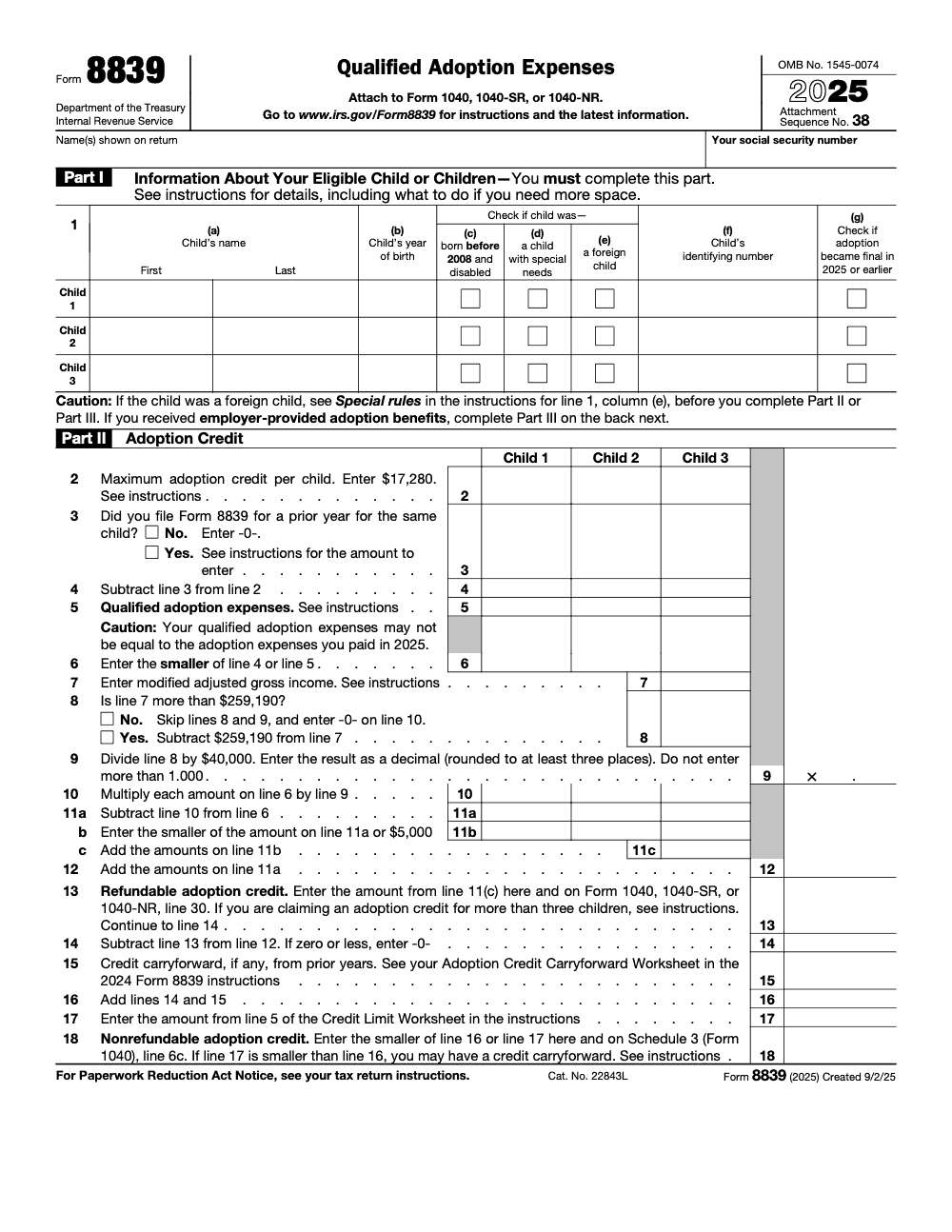
Form 8839 figures the adoption credit and excludes employer-provided adoption benefits for an eligible child, and you attach it to Form 1040 by April 15, 2026. For tax year 2025 the per-child maximum is $17,280, the MAGI phaseout runs $259,190 to $299,190 (per IRS Rev. Proc. 2024-40), and up to $5,000 per child is now refundable on Form 1040 line 30 under the One Big Beautiful Bill Act, with the nonrefundable balance reported on Schedule 3 line 6c.
Two boxes decide more of this return than the arithmetic does: the W-2 box 12, code T employer reimbursement and the order in which you complete the parts. Form 8839 figures the adoption credit and excludes employer-provided adoption benefits for an eligible child, and you complete Part III before Part II because the employer benefits reduce the expenses you can use for the credit.
For tax year 2025 the per-child maximum is $17,280, the MAGI phaseout runs $259,190 to $299,190, and up to $5,000 per child is now refundable under the One Big Beautiful Bill Act, reported on Form 1040 line 30 with the nonrefundable balance flowing to Schedule 3 line 6c. Timing the expenses correctly between the year of payment and the year of finalization is where domestic and foreign adoptions diverge.
Key Takeaways
- Form 8839 lets you claim the adoption credit and exclude employer adoption benefits for eligible children. For 2025, the per‑child limit is 17,280, and the same amount applies to the income exclusion. The MAGI phaseout range runs from 259,190 to 299,190.
- Timing matters. Domestic adoption expenses are usually claimed in the year after payment if paid before finalization, and in the year of finalization if paid that year. For foreign adoptions, both the credit and the exclusion are claimed in the year the adoption becomes final.
- Employer reimbursements shown as W‑2 box 12, code T reduce the expenses you can use for the credit, although you may still claim different expenses toward the exclusion and the credit. Complete Part III before Part II.
- New for 2025 under the One Big Beautiful Bill Act, up to 5,000 per child is refundable. That refundable portion is figured on line 11b and reported on Form 1040 line 30, while the nonrefundable balance flows to Schedule 3 line 6c.
What’s New For 2025
- The 2025 adoption credit is 17,280 per child. The exclusion for employer‑provided adoption assistance matches it, 17,280 per child. The MAGI phaseout starts at 259,190 and fully phases out at 299,190. These apply to both the credit and the exclusion, and the same thresholds apply for every filing status, with no higher married-filing-jointly threshold.
- The One Big Beautiful Bill Act made up to 5,000 per child of the credit refundable for tax year 2025, the first time any part of the adoption credit has been refundable. You figure the refundable piece on line 11b and report it on Form 1040 line 30; only the nonrefundable balance moves to Schedule 3 line 6c, where it keeps a five-year carryforward. For context, the 2024 amounts were 16,810 per child with a 252,150 to 292,150 phaseout, and the credit was fully nonrefundable that year.
Who Qualifies, The Short Version
You can claim the credit or exclude employer assistance if you file as single, head of household, qualifying surviving spouse, or married filing jointly. Limited married filing separately exceptions exist in the instructions. An eligible child is anyone under age 18 for any part of the year, or any age if unable to care for themselves. Qualified expenses include agency, attorney, court costs, and necessary travel, including meals and lodging. Expenses reimbursed by an employer or a government program are not eligible for the credit.
Helpful definitions at a glance
| Term | What it means | Watch out for |
| Qualified adoption assistance program | A written employer plan that provides adoption benefits | The benefit shows on W‑2, box 12, code T |
| Employer‑provided adoption assistance | Amounts you may exclude from income, subject to the cap and MAGI | You cannot claim a credit for the same expense |
| Foreign adoption | Adoption that must be final under foreign law | Credit and exclusion only in the year of finality |
| Qualified adoption expenses | Fees, legal, court, travel, and certain re‑adoption costs | No spouse’s child costs, no illegal payments |
Source notes, see the 2025 Instructions for Form 8839 for definitions and examples.
Timing Rules You Must Get Right
Here is the part that causes the most audits and amended returns, the year you claim each expense.
- Domestic adoptions, expenses paid before finalization are claimed on next year’s return. Expenses paid in the year the adoption becomes final are claimed in that same year. Employer adoption assistance for a domestic adoption is excluded in the year it is paid.
- Foreign adoptions, both the credit and the exclusion are allowed only in the year the adoption becomes final. If your employer paid benefits before finalization, they are included in income when paid, then excluded in the final year by following the worksheet in the instructions.
Pro tip, log every date and amount as you go, then tag each item domestic or foreign in your workpapers. Reviewers move faster when your evidence is date‑stamped and labeled to match Part I columns.
Why Firms Get Stuck On 8839, And How To Avoid It
If you run a firm, the trouble is rarely the tax rule itself. It is missing receipts, unlabeled PDFs, and unclear coordination between Part II and Part III. That is why we standardize file names, cross‑reference code T entries, and keep a one‑page timing map per adoption. Do this, and partner review time drops. If you want help building that discipline into your workflow at scale, this is the kind of operational work Accountably handles for firms during peak season without adding chaos.
Compliance reminder. This guide is educational, not tax advice. Always confirm numbers that apply to your filing year in the official instructions and revenue procedures. For 2025 amounts, use the Form 8839 instructions and IRS Rev. Proc. 2024‑40.
Part I, Information About The Child
Part I looks simple, and it is, if you take two minutes to verify IDs and boxes. List each eligible child with name, date of birth, and the identifying number. You can use an SSN, an ATIN, or an ITIN, depending on status. If you cannot get an SSN in time for filing, apply for an ATIN with Form W‑7A for a U.S. child, or an ITIN with Form W‑7 for a nonresident child. If a number is not available yet, leave it blank, complete the rest, and paper file.
Checklist for clean entries
- Match the exact spelling of the child’s name and the date of birth to the proof in your records.
- Confirm the SSN, ATIN, or ITIN belongs to the child you list, not to a prior foster placement or a sibling.
- Check the “foreign child” and “finalized” boxes accurately.
- If an adoption is unsuccessful or still pending, still complete the row, the timing rules will control when you take the credit.
If a state or tribal authority has determined the child has special needs, you may qualify for the full credit when the adoption is final, even with little or no out‑of‑pocket expenses. Keep the determination in your records.
Part II, Adoption Credit, Step By Step
You will calculate the maximum per child, subtract any amounts already claimed for that child in prior years (the per-child maximum is a cumulative lifetime cap shared across the credit and the exclusion combined, not an annual amount that resets each year), set your qualified expenses for this year, then apply the MAGI phaseout. For 2025, the per‑child maximum is 17,280, and the phaseout range is 259,190 to 299,190. After the phaseout, route up to 5,000 per child of the credit to line 11b as the refundable portion (it flows to Form 1040 line 30); the nonrefundable balance carries to Schedule 3 line 6c.
Determine Qualified Expenses
Include agency fees, attorney fees, court costs, travel including meals and lodging, and re‑adoption costs for a foreign adoption. Do not include amounts reimbursed by an employer or paid by any government program. Track by child, not just a total, and keep receipts and proof of payment. Follow the timing rules for domestic versus foreign adoptions described earlier.
Apply The Income Phaseout, 2025 Return
Start with your MAGI for the credit calculation. The instructions tell you how to compute MAGI starting from Form 1040 line 11, then adding certain items, for example excluded foreign earned income and housing amounts. Use the Form 8839 worksheet if needed.
- If MAGI is 259,190 or less, no reduction applies.
- If MAGI is between 259,190 and 299,190, compute the reduction fraction: (MAGI minus 259,190) divided by 40,000, cap at 1.000, round to three decimals.
- Multiply each child’s allowable amount by the fraction to find the reduction, then subtract it.
Mini example, 2025 return
You paid 19,000 of qualified expenses for a domestic adoption. Your employer paid nothing. You previously claimed 2,000 for this child last year. Your MAGI is 277,190.
- Line 2 limit per child: 17,280
- Less prior credit claimed: 2,000
- Allowable before phaseout: 15,280
- Phaseout fraction: (277,190 − 259,190) ÷ 40,000 = 18,000 ÷ 40,000 = 0.450
- Reduction: 15,280 × 0.450 = 6,876
- Tentative credit: 15,280 − 6,876 = 8,404, round per instructions when you carry to the final lines. Up to 5,000 of this is refundable on line 11b (Form 1040 line 30); the balance is nonrefundable and moves to Schedule 3 line 6c.
Special Needs, The Shortcut Many Miss
If a U.S. state or tribal authority determined the child has special needs, you may claim the full credit at finalization, subject to MAGI and prior year amounts, even if your out‑of‑pocket expenses are low. Keep the state or tribal determination with your records. This rule does not change your phaseout math, it changes the expense side to the full limit.
Amending A Prior Year, Same Math With 2024 Limits
If you are amending a 2024 return, substitute 16,810 for the per‑child limit and use the 252,150 to 292,150 phaseout range, and remember the credit was fully nonrefundable that year. The fraction still uses a 40,000 denominator.
Reviewer tip, total the post‑phaseout amount across children on the same page, then add any carryforward. If a prior‑year carryforward applies, keep the worksheet with your return copy for five years.
Part III, Employer‑Provided Adoption Benefits
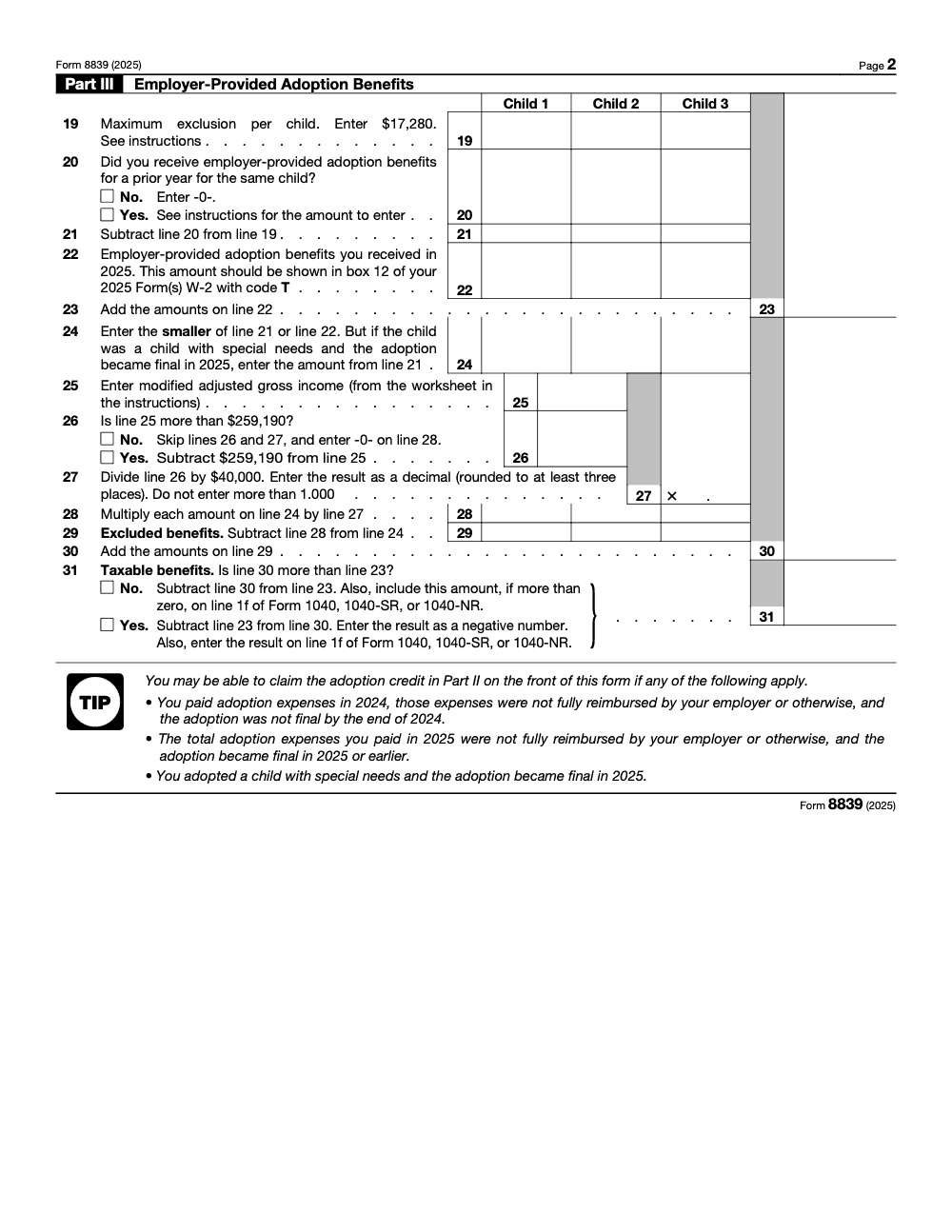
Now match what was paid by your employer to the correct child and compute the exclusion. Find employer payments on Form W‑2, box 12, code T. Aggregate code T amounts across W‑2s if you have more than one, then allocate by child if a single W‑2 covered more than one adoption. The exclusion has the same per‑child limit as the credit and the same 2025 phaseout range, and you must complete Part III before you figure the credit in Part II. Keep in mind the exclusion removes these benefits from federal income tax only; they remain subject to Social Security, Medicare, and FUTA taxes.
Four Steps That Prevent Double Counting
- Enter the code T total from all W‑2s, and allocate per child in the Part III grid.
- For each child, set the exclusion cap at 17,280 for 2025 and compare to the code T amount, then use the smaller amount.
- Apply the MAGI phaseout using the Line 23 worksheet. The calculation uses a MAGI definition tailored to the exclusion, which differs slightly from the credit worksheet.
- Report the excluded benefits per the instructions. Any remaining code T amount after phaseout and caps is taxable on Form 1040.
Important, more‑than‑2% S corporation shareholders cannot exclude employer‑provided adoption benefits. Keep this in mind when reviewing W‑2s for owners.
Coordination Example, Credit And Exclusion Together
You paid 20,000 in qualified expenses for a foreign adoption that became final in 2025. Your employer reimbursed you 8,000 in 2025.
- Exclusion, you may exclude 8,000, capped well below the 17,280 limit.
- Credit, your qualified expenses for credit drop to 12,000 because you cannot use the same expense twice.
- Result, you exclude 8,000 and you can claim up to 12,000 as a credit, subject to MAGI. The IRS instructions include similar examples that mirror this math.
Timing Twist For Foreign Adoptions
If your employer paid before the foreign adoption became final, those benefits are included in income in the year paid. When the adoption becomes final, you use the Exclusion of Prior Year Benefits Worksheet in the instructions to exclude the eligible portion on that later return. Keep the worksheet with your file copy.
Records To Keep And The Pitfalls We See Most
Strong documentation wins. Save every invoice, receipt, court order, agency contract, and travel log. Keep W‑2 code T copies and the employer plan document. Retain any special‑needs determination and proof of finalization. Reconcile current year claims with prior‑year carryforward worksheets so you do not double count.
Common mistakes to avoid
- Mixing expenses across children in the worksheet, track by child.
- Using the wrong threshold for the phaseout, for 2025 the floor is 259,190, not the 252,150 figure that applied in 2024.
- Forgetting to complete Part III before Part II when employer benefits exist.
- Leaving off dates, amounts, or payees on travel records.
- Not aligning domestic versus foreign timing to the year you are filing.
Micro‑anecdote, we once cut a partner’s review time in half by adding a one‑page “8839 map” to each file, child in column A, expenses by date in column B, employer benefits in column C, with ties to each PDF label. Little things speed up delivery.
Quick Calculation Table, 2025 Phaseout
Use this as a cross‑check for your worksheet.
| MAGI | Excess over 259,190 | Fraction (÷ 40,000) | Reduction on a 10,000 tentative credit |
| 259,190 | 0 | 0.000 | 0 |
| 269,190 | 10,000 | 0.250 | 2,500 |
| 279,190 | 20,000 | 0.500 | 5,000 |
| 289,190 | 30,000 | 0.750 | 7,500 |
| 299,190 or more | 40,000+ | 1.000 | 10,000 |
Reference the 2024 instructions for the exact worksheet and rounding rules.
Putting It All Together, A Short Walkthrough
- Complete Part I for each child with names, DOB, ID numbers, and finalization status.
- If you have code T benefits, complete Part III next, allocate per child, apply caps and the MAGI worksheet, and determine the exclusion.
- Complete Part II for the credit, per child, subtract prior credits for that child, then apply the MAGI phaseout using 2024 thresholds or, for 2025 returns, the updated thresholds.
- Add any carryforward and prepare Schedule 3 reporting (for 2025 returns under the OBBBA, up to $5,000 per child of the adoption credit is refundable and goes to Form 1040 line 30, while only the nonrefundable balance flows to Schedule 3, line 6c).
If you are reviewing files for a firm, set one SOP for Form 8839 across your team, for example a standard cover sheet, a naming convention for receipts, and a one‑page timing map. If your staff is spread thin in peak season, structured offshore delivery can keep work on track without overloading partners. That is the niche we serve at Accountably, with disciplined workpapers and review protection that slot into your systems.
Compliance, Sources, And A Final Check
- 2024 limits, timing rules, MAGI details, and W‑2 code T handling, see the 2024 Instructions for Form 8839.
- MAGI definition for the credit and the special worksheet for the exclusion, see the IRS MAGI guidance and the Line 23 worksheet reference.
- 2025 inflation adjustments for the adoption credit and phaseout amounts, see Internal Revenue Bulletin 2024‑45.
Before you file, confirm you are using the correct year’s thresholds, spell names exactly as they appear on IDs, and keep every receipt and determination letter.
If a number changed midyear, update your worksheets, not just the final line. Clean inputs make for clean reviews, fewer notices, and faster refunds.
Conclusion
You now have a clear path to finish Form 8839, with the right limits, the right timing, and the right order of steps. Take ten quiet minutes to match receipts to dates, confirm W‑2 code T amounts, and apply the phaseout using the correct year’s worksheet. If you are a parent, that diligence protects your refund. If you run a firm, it protects your people from bottlenecks. Either way, you will claim every dollar you are entitled to.
This article is general information. It is not tax or legal advice. Always confirm your filing year’s numbers in the official IRS guidance, then keep your records for at least three years after filing.
Common Mistakes We See Every Season
Form 8839 is short, but the same handful of errors surface in our review queue every season, almost always around timing, the order of the two parts, and the 2025 figures. Here are the ones worth catching before the return leaves your desk.
Reusable Checklists
Copy these into your firm SOP or your own filing folder. The page remembers what you tick, so you can work a return across sessions.
Eligibility and Part I packet
- Confirm the child meets the eligible-child definition in the current Form 8839 instructions.
- Verify the SSN, ATIN, or ITIN matches the child you are listing in Part I.
- Check the foreign-child and adoption-final boxes against the proof in the file.
- For a child born before 2008, confirm the disability check in column (c).
- Save the state or tribal special-needs determination where it applies.
- Note domestic or foreign status on the cover sheet so timing is set early.
Credit and exclusion calculation
- Complete Part III before Part II whenever W-2 box 12 code T benefits exist.
- Enter the code T total on line 22 and allocate it per child.
- Subtract any prior-year amount for the same child on line 3 (credit) and line 20 (exclusion).
- Carry only unreimbursed expenses to line 5 so no dollar is counted twice.
- Compute MAGI on line 7 with the foreign-income add-backs, then apply the $259,190 to $299,190 phaseout.
- Split the result: up to $5,000 per child to line 11b, the rest to the nonrefundable lines.
- Pull the line 15 carryforward from the 2024 Form 8839 Adoption Credit Carryforward Worksheet.
Reviewer sign-off
- Confirm the refundable amount lands on Form 1040 line 30 and the nonrefundable balance on Schedule 3 line 6c.
- Verify any taxable employer benefit on line 31 ties to Form 1040 line 1f, positive or negative.
- Re-check that foreign-adoption expenses were claimed in the finalization year, not the payment year.
- Confirm the filing status qualifies, since married taxpayers generally must file jointly.
- Match every receipt, court order, and travel log to the line it supports.
- Keep the return and the carryforward worksheet on file for the 5-year carryforward window.
Keep 8839 Season From Stalling
Form 8839 rarely arrives alone. It rides the April 15, 2026 individual deadline, so it lands in the same spring crush as every other Form 1040, yet it carries its own load: the per-child maximum rose to $17,280 for 2025 under IRS Rev. Proc. 2024-40, and the One Big Beautiful Bill Act made up to $5,000 per child refundable for the first time.
The errors we catch are almost never the tax law. They are sequencing and documentation: Part II worked before Part III, employer code T benefits double-counted against the credit, or a prior-year amount never subtracted from the lifetime cap. Structure removes all three.
- Lock the order: Part III and line 22 code T benefits first, then Part II, on every return where employer assistance exists.
- Keep a one-page timing map per child so domestic and foreign finalization years drive the claim, not the payment date.
- Reconcile lines 3 and 20 against prior-year Forms 8839 so the $17,280 lifetime cap is never overstated.
- Route the line 11b refundable portion to Form 1040 line 30 and the balance to Schedule 3 line 6c as a standard step.
- Run the MAGI add-backs on line 7 before testing the $259,190 to $299,190 phaseout.
When adoption returns stack up against the April deadline, this is the kind of structured, reviewable execution our tax preparation teams handle inside your existing workflow, so the per-child math, the timing, and the refundable split are right before a partner ever opens the file.
FAQs
You use Form 8839 to figure the adoption credit and to exclude employer‑provided adoption assistance from income. The form coordinates expenses, timing, and income limits, and you attach it to your Form 1040. You cannot claim a credit and an exclusion for the same expense.
Agency fees, attorney fees, court costs, necessary travel including meals and lodging, and certain re‑adoption costs for foreign adoptions. Payments reimbursed by an employer or a government program, expenses that violate law, or costs to adopt your spouse’s child are not qualified for the credit or the employer-provided adoption benefits exclusion.
Amounts in box 12 with code T are employer‑provided adoption benefits. You may be able to exclude them from income under the same per‑child cap as the credit and subject to MAGI limits. These amounts reduce the expenses available for the credit. Complete Part III before Part II.
Domestic adoptions, claim before‑finalization expenses in the year after payment and claim final‑year expenses in the year of finalization. Foreign adoptions, claim both the credit and the exclusion only in the year the adoption becomes final. The instructions include examples and a worksheet for prior‑year employer benefits.
If a state or tribal authority determines the child has special needs, you may claim the full credit when the adoption is final, subject to the income limits, even if you paid little or no expenses. Keep the determination in your records.
Other forms this guide names
About this guide
Accountably helps US CPA, EA, and accounting firms hire trained accountants and tax preparers in India.
About us Reviewed byJugal Thacker, CPAFounder and CEO at Accountably
A Washington-licensed CPA with 7+ years inside US firms – PwC, a real-estate tax practice, then a full-service firm, rising from reviewer to manager to advisory. This article was reviewed against current IRS guidance for the 2025 tax year and updated for filers preparing late returns, amendments, and 2026 estimates.
View profile →How we research, review, and update this guide
Every Accountably guide is researched against primary IRS sources, reviewed by a U.S. CPA, and refreshed as guidance evolves. Read our Editorial Guidelines to see how we source, fact-check, and update our content.