Summarize this article with AI
In Brief
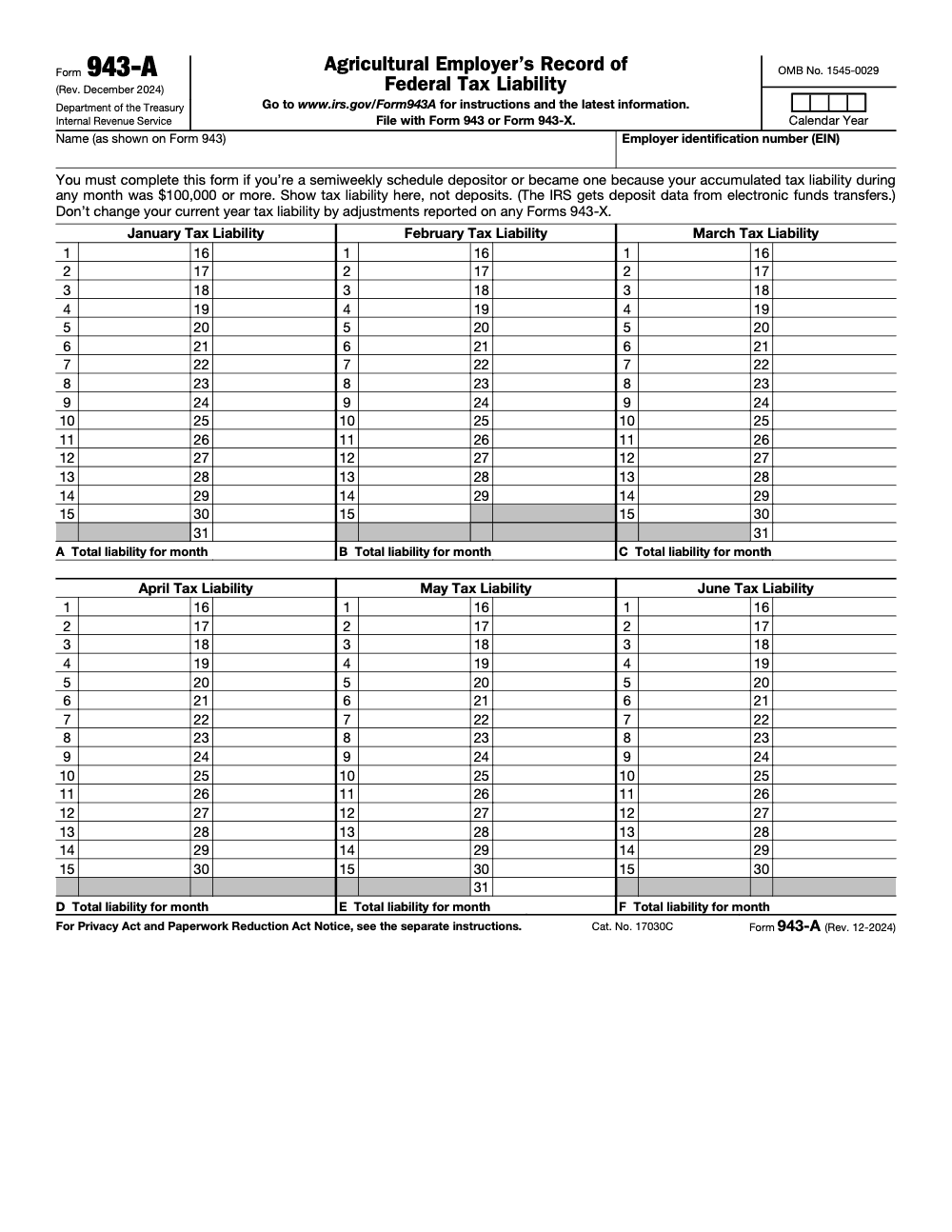
Form 943-A is the Agricultural Employer's Record of Federal Tax Liability, filed with Form 943 by semiweekly schedule depositors and by any monthly depositor whose liability reaches $100,000 on a single day (per the Form 943-A instructions, Rev. December 2024). You record each payday's liability day by day, then tie Line M, the sum of monthly totals A through L, to Form 943, Line 13. Tax year 2025 returns are due February 2, 2026, and the schedule is part of routine agricultural payroll and tax work.
A farm that has filed as a monthly depositor for years hits one heavy harvest week, and a single day's tax liability quietly crosses $100,000. Nobody on the team realizes that one day just converted them to a semiweekly depositor for the rest of that year and all of the next. The stack of late deposits and the averaged failure-to-deposit notice show up months later.
Form 943-A is the Agricultural Employer's Record of Federal Tax Liability, filed with Form 943 by semiweekly schedule depositors and by any monthly depositor whose liability reaches $100,000 on a single day. You record each payday's liability on the actual wage date, not the deposit date, then tie Line M, the sum of the monthly totals A through L, to Form 943, Line 13. Tax year 2025 returns are due February 2, 2026.
Key Takeaways
- Form 943‑A is the IRS daily tax liability schedule for agricultural employers that are semiweekly depositors, and you attach it to Form 943 each year. Line M on 943‑A must equal Line 13 on Form 943.
- Record each day’s liability on the actual wage payment date, not the deposit date, and include FIT withheld plus both employer and employee Social Security and Medicare.
- If your tax for any single day reaches $100,000, you must deposit by the next business day, and you become a semiweekly depositor starting the next day for the rest of that year and the following year.
- File Form 943 and 943‑A by January 31. For example, 2024 wages are due by January 31, 2025, and if you deposited on time in full, you may file by February 10, 2025. For 2025 wages, January 31, 2026 falls on a Saturday, so the due date shifts to Monday, February 2, 2026.
- When fixing errors, use Form 943‑X and follow the amended 943‑A rules. Timely increases usually do not require an amended 943‑A, late corrections do, and decreases may require an amended 943‑A if you were assessed an FTD penalty.
What Form 943‑A Is, and How It Works
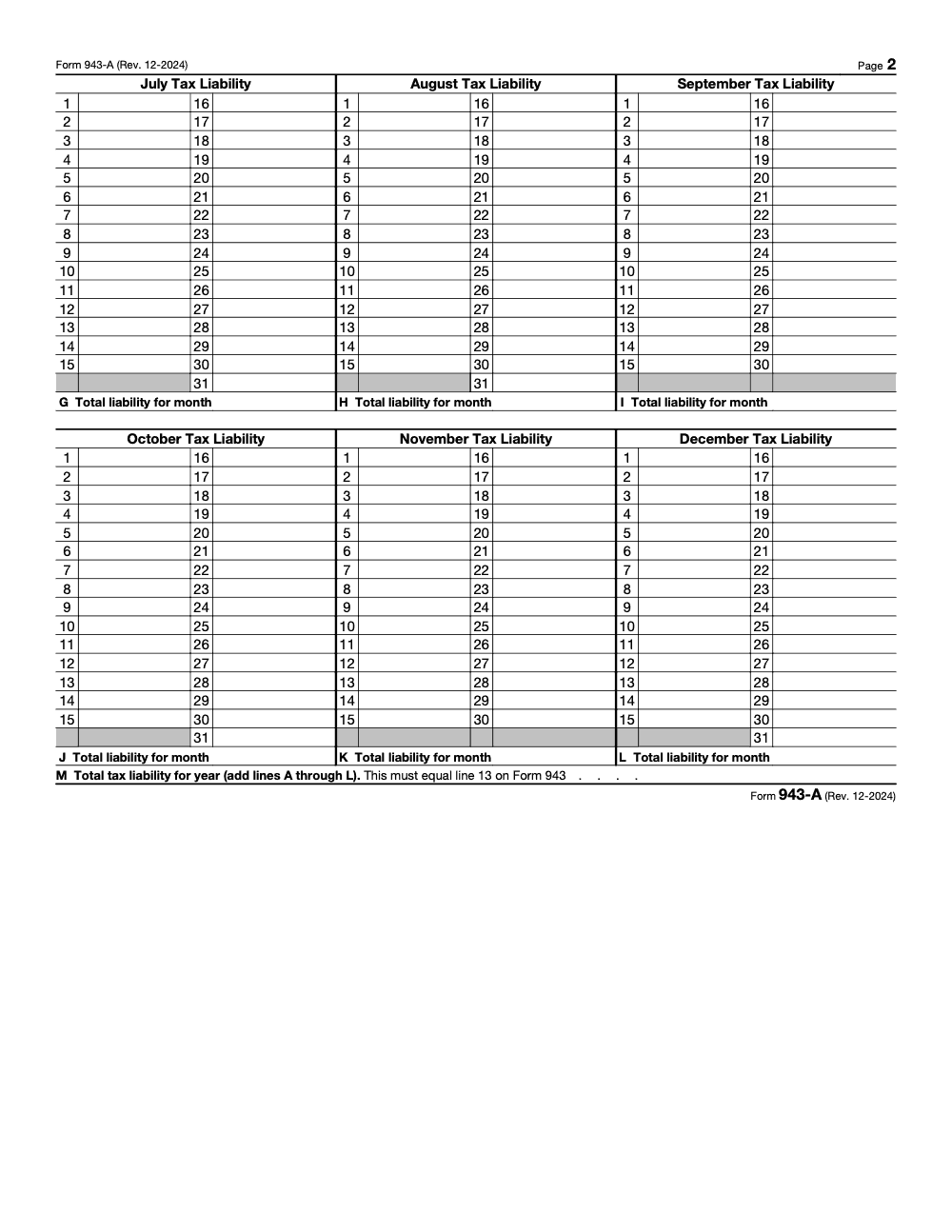
Think of Form 943‑A as your day‑by‑day ledger of federal employment tax liabilities for farmworkers. You enter the liability on the day you actually pay wages. That means the date cash hits paychecks, not the end of the pay period and not the deposit date. The amount for each payday includes federal income tax withheld plus both sides of Social Security and Medicare. At year‑end, you total each month on lines A through L, then confirm that Line M equals Form 943, Line 13.
You file Form 943‑A only if you are on the semiweekly deposit schedule, or you became semiweekly after hitting the $100,000 rule on any day. Monthly depositors that never hit the $100,000 threshold do not file 943‑A.
Pro tip, if your payroll for a period ends on December 31 but you actually pay on January 6, record the liability on January 6 of the new year. Because each calendar year is its own Form 943 return period, liabilities on either side of that December 31 boundary belong on separate years' schedules and must be deposited separately, not combined into one deposit. The IRS examples in the instructions show exactly this situation, and it is a common place where reconciliations go off track.
Why This Matters For Farm Payroll
You are already balancing seasonal crews, piece‑rate or hourly pay, and bonus cycles. The deposit schedule adds another layer. Semiweekly depositors have two recurring windows, Saturday through Tuesday liabilities are due Friday, and Wednesday through Friday liabilities are due the next Wednesday. Stack the 100,000 next‑day rule on top, and timing gets tight. A clear 943‑A is your best defense against FTD penalties and mismatch notices.
Quick Definitions You Can Trust
- Semiweekly depositor, your lookback period tax on Form 943 Line 13 was over $50,000, or you tripped the $100,000 next‑day rule. You must complete and file 943‑A with your annual 943.
- Monthly depositor, your lookback period tax was $50,000 or less, and you never hit $100,000 on any day. You do not file 943‑A.
- Next‑day deposit, if your tax reaches $100,000 in a single day, you deposit by the next business day, and you are semiweekly the next day through the end of that year and the next.
A 60‑Second Story To Make It Stick
You run a Friday bonus for harvest crews. The combined FIT, Social Security, and Medicare for the checks is 112,400. You must deposit by the next business day. You also become semiweekly starting Saturday, and you will remain semiweekly for the rest of the current year and all of next year. Your 943‑A must show the 112,400 on that exact Friday date, and your deposit proof should tie out to that same day in your schedule. This is exactly what the IRS expects.
Where Firms Get Tripped Up
In my reviews, I see four repeat issues. First, posting liabilities to pay period end dates instead of the actual payday. Second, missing the switch to semiweekly after a 100,000 day. Third, forgetting to reconcile Line M to Form 943, Line 13. Fourth, filing an amended 943‑A when it is not required, or skipping it when it is required. The IRS instructions call out each of these points, so a short checklist before filing pays off.
Who Must File Form 943‑A
You must file Form 943‑A if you are a semiweekly depositor for Form 943. This includes two common paths.
- Your lookback period tax on Form 943, Line 13, was over $50,000.
- You hit the $100,000 next‑day deposit threshold on any day, which converts you to semiweekly starting the next day for the rest of the year and the following year.
If you stay monthly all year and never reach 100,000 on any day, you do not file 943‑A. The instructions also note that if your yearly net tax on Form 943, Line 13, is under 2,500, you usually do not complete 943‑A.
The Lookback Test In Plain English
The lookback period for 2025 is tax year 2023. If your Form 943 Line 13 for 2023 was more than $50,000, you are a semiweekly depositor for 2025. This lookback rule is how most farms and ag businesses determine their schedule each year.
Form 943 Filing Basics You Should Know
You must file Form 943 if you paid farmworkers wages subject to FIT withholding or Social Security and Medicare, and that generally means you met either the 150 per worker cash wage test or the 2,500 total wage test for the year. After you file your first 943, you keep filing annually until you file a final return.
When To File Form 943‑A
You file Form 943‑A with your annual Form 943. For 2024 wages, the due date is January 31, 2025, and if all deposits were made on time in full, you may file by February 10, 2025. For 2025 wages, January 31, 2026 falls on a Saturday, so the due date shifts to Monday, February 2, 2026. These calendar details matter for planning your year‑end close and W‑2 timing.
Where To Record Each Liability
Record the tax liability on the day you pay wages. If your pay period ends on one date but paychecks go out on another, use the paycheck date on 943‑A. Your annual total on Line M must match Form 943, Line 13, which is a common reconciliation point the IRS highlights in the instructions.
How Semiweekly Deposits Line Up With Paydays
Semiweekly depositors use two predictable windows.
- Paydays on Saturday, Sunday, Monday, or Tuesday, deposit by Friday.
- Paydays on Wednesday, Thursday, or Friday, deposit by the following Wednesday. Deposits due on holidays or weekends move to the next business day. Keep this cadence in your calendar and tie your 943‑A entries to these paydays.
The 100,000 Rule, With A Quick Example
You run two paydays in the same semiweekly window. You accumulate 95,000 by Tuesday. On Wednesday you add 10,000. The 100,000 rule does not apply, because the Wednesday amount is in a new semiweekly window. You would deposit 95,000 by Friday and 10,000 by the next Wednesday. The IRS examples walk through this exact sequence.
Summary Table, Depositor Status And Filing
| Status | Trigger | What you file | Key note |
| Monthly depositor | Lookback tax ≤ 50,000 and never hit 100,000 | Form 943 only | Do not file 943‑A |
| Converted mid‑year | Any single day reaches 100,000 | Form 943 + Form 943‑A for the full year | You become semiweekly the next day and stay that way through the next year |
| Ongoing semiweekly | Lookback tax > 50,000 | Form 943 + Form 943‑A | Keep daily schedule aligned to paydays |
Sources for thresholds, schedules, and filing alignment are from IRS Topic 760 and the 943‑A instructions.
Quick sanity check, if your payroll is seasonal, you can still be semiweekly. Status depends on the prior lookback year or the 100,000 rule, not on how many months you run payroll.
Completing Form 943‑A, Day‑By‑Day Without Second Guessing
Here is a simple process I use when I review client workpapers.
- Pull your payroll register sorted by pay date for the year.
- For each pay date, compute the tax liability, FIT withheld plus employer and employee Social Security and Medicare.
- Enter that exact amount on the matching calendar day in the correct month on 943‑A.
- Add the month’s column, post it to lines A through L.
- Confirm Line M equals Form 943, Line 13.
- Save deposit receipts and EFTPS confirmations that tie to those paydays.
Sample Daily Entries, One Month
| Date paid | FIT withheld | Employee FICA | Employer FICA | Employee Medicare | Employer Medicare | Total liability to enter on that day |
| Jan 5 | 4,200 | 3,100 | 3,100 | 725 | 725 | 11,850 |
| Jan 12 | 4,050 | 2,980 | 2,980 | 698 | 698 | 11,406 |
| Jan 19 | 3,900 | 2,880 | 2,880 | 674 | 674 | 11,008 |
| Jan 26 | 4,500 | 3,310 | 3,310 | 765 | 765 | 12,650 |
Post each total on the correct line for that calendar day in the January column. The monthly total you compute for January belongs on Line A. Repeat for each month. Your annual Line M then ties to Form 943, Line 13. This is exactly how the IRS expects you to complete the form.
Semiweekly Timing Reference
- Wages paid on Saturday through Tuesday, deposit by Friday.
- Wages paid on Wednesday through Friday, deposit by the following Wednesday.
- If any due date lands on a federal holiday or weekend, the deposit moves to the next business day. For deposit purposes, though, the IRS counts only legal holidays in the District of Columbia, so a statewide holiday does not by itself extend a federal deposit due date.
- If any single day reaches $100,000, deposit by the next business day, and your status becomes semiweekly through the end of this year and all of next year.
Keep The Paper Trail Tight
The most common penalty I see is an FTD penalty caused by either a missing 943‑A or one that does not match deposits. Tie each deposit confirmation to specific paydays, not just amounts. If you later need to correct totals with Form 943‑X, the IRS may require an amended 943‑A in some situations to avoid an averaged penalty. That averaged penalty is figured by spreading your full year of liability evenly across the schedule, so it can run larger than the actual late-deposit penalty, which is why clean records today save time tomorrow.
Avoid These Pitfalls
- Posting to pay period end dates instead of paydays. The instructions are clear, use the date wages were paid.
- Forgetting to switch to semiweekly after a 100,000 day. The status change is automatic and lasts through the following calendar year.
- Leaving Line M off by a few dollars from Form 943 Line 13. Even small gaps can trigger questions, and because the IRS reconciles Line M against Line 13, a mismatch is one of the conditions that can trigger an averaged FTD penalty notice. The instructions require equality.
- Missing deposit windows that straddle holidays, especially around year end. Business day rules give you an extra day when a holiday intervenes.
A Simple Review Checklist Before You File
- Verify EIN and legal name on 943‑A match Form 943 exactly.
- Confirm monthly column totals and that Line M equals Form 943 Line 13.
- Review your EFTPS calendar against semiweekly windows and business day rules.
- Flag any single day near 100,000 and recheck deposits.
- Save registers, workpapers, deposit confirmations, and reviewer signoffs.
If you run multiple entities, keep separate 943‑A schedules and deposits per EIN. Aggregating across entities on one deposit or schedule is a fast way to create mismatch notices.
A Quick Note For Firms And Outsourced Teams
If you are a CPA or payroll team juggling seasonal spikes and review bottlenecks, structure helps. At Accountably, we integrate trained offshore teams into your workflow, inside your systems, with SOP‑driven workpapers and layered reviews. That discipline keeps 943‑A clean, reduces rework, and protects partner review time. Use us where it makes sense, and keep the focus on your client strategy.
Correcting And Adjusting Prior Period Liabilities
When your totals change for a prior year, use Form 943‑X. Whether you also file an amended Form 943‑A depends on timing and whether you were assessed an FTD penalty. Here is the short version with the IRS rules behind it.
If Your Total Tax Increases
- Timely 943‑X, generally do not file an amended 943‑A, unless your FTD penalty was caused by an incorrect, incomplete, or missing 943‑A. If you do file an amended 943‑A in this timely increase situation, do not include the tax increase reported on 943‑X in that amended 943‑A.
- Late 943‑X, if you file after the due date of the Form 943 for the year in which you discovered the error, you must attach an amended 943‑A to avoid an averaged FTD penalty. In that case, Line M on the amended 943‑A must equal the corrected total, Form 943 Line 13 plus 943‑X Line 20, less any prior abatements or interest‑free assessments.
If Your Total Tax Decreases
If you have a tax decrease and you were assessed an FTD penalty, file an amended 943‑A with your 943‑X. The total liability on the amended 943‑A must equal the corrected amount on the 943‑X.
Filing Deadlines And Method
- The general period of limitations gives you three years from the date Form 943 is considered filed, which is treated as April 15 of the following year if you filed earlier than that.
- If you correct underreported tax, file 943‑X by January 31 of the year after you discovered the error to keep it interest‑free and avoid FTD and FTP penalties.
- You can pay by EFTPS, card, or check.
Scenario Table, What To File
| Scenario | What you file | Key details |
| Increase, timely 943‑X | 943‑X only in most cases | Do not amend 943‑A unless the FTD penalty stems from a bad or missing 943‑A, and if you do amend, do not add the increase there. |
| Increase, late 943‑X | 943‑X plus amended 943‑A | Required to avoid averaged FTD penalty. Line M must equal the corrected total. |
| Decrease and FTD penalty assessed | 943‑X plus amended 943‑A | Line M must equal the corrected total on 943‑X. |
| Daily schedule needs edits but annual total unchanged | Corrected 943‑A only | Keep Line M unchanged so it still equals 943 Line 13. |
Records To Keep Handy
Keep your payroll registers by pay date, deposit receipts, EFTPS confirmations, reviewer notes, and any W‑2 or W‑2c support for at least four years, since the IRS can review employment-tax records that far back. If you use an agent under Form 2678, the rules apply based on all liabilities you handle as agent.
A Practical Reconciliation Flow
- Start with Form 943, Line 13, as your anchor.
- Sum Line A through L on 943‑A to confirm Line M equals Line 13.
- Tie each pay date’s liability to a matching deposit inside the correct semiweekly window, or to the next‑day deposit rule if applicable.
- Note any holidays that extend due dates.
- Save a one‑page summary that shows your check for each month, because it speeds reviews and cuts penalty risk.
Short on review time during peak season? This is where a documented checklist and standardized workpapers help. Teams can move faster, reviewers see exactly what changed, and partners spend time on strategy instead of hunting for dates.
Final Checklist And Next Steps
- Confirm semiweekly or monthly status using the lookback year, then watch for the $100,000 trigger.
- Record liabilities on actual paydays on 943‑A, not deposit dates or pay period ends.
- Keep the two semiweekly windows in your calendar, Saturday through Tuesday due Friday, Wednesday through Friday due next Wednesday, with holidays pushing to the next business day.
- Reconcile Line M to Form 943, Line 13 before you file.
- If you discover errors, use 943‑X and attach an amended 943‑A only when the IRS says you must.
If your team is stretched during peak season, and you need clean workpapers, documented SOPs, and consistent daily schedules, our team at Accountably can plug into your systems and reduce review loops. We only mention this because it directly supports accurate 943‑A filings and on‑time deposits, not as a one‑size‑fits‑all pitch.
Compliance Notes And Sources
This article reflects IRS guidance available as of November 27, 2025, including Publication 15 for 2025, Publication 51 for ag deposit timing, the 2024 instructions for 943 and 943‑A, and the April 2025 instructions for 943‑X. Always confirm current year forms and deadlines on IRS.gov before filing.
Common Mistakes We See Every Season
The same handful of 943-A errors come back every season, and most of them surface only when the IRS reconciles your schedule against the deposits it already has on file. Here are the ones we correct most often.
Reusable Checklists
These are copy-paste ready for your firm SOPs. Drop them into your payroll workpapers and check them off each cycle so 943-A stays current instead of getting rebuilt in January.
Depositor-status setup (run every January)
- Pull the second-preceding year's Form 943, Line 13 (use 2023 Line 13 for the 2025 schedule).
- Mark the client semiweekly if that figure exceeds $50,000, monthly if it is $50,000 or less.
- Check whether any single day in the prior year already forced a semiweekly conversion under the $100,000 rule.
- Separate farm liability under Form 943 from any nonfarm liability under Form 941 or 944 before testing thresholds.
- Set the EFTPS deposit calendar to match the assigned schedule for the year.
Day-by-day entry build
- Enter liability on the actual pay date, not the deposit date or the pay-period end.
- Include federal income tax withheld plus both shares of social security (6.2% each) and Medicare (1.45% each).
- Add the 0.9% Additional Medicare Tax once an employee's wages cross $200,000 in the calendar year.
- Confirm each month uses the correct number of day fields, 31, 30, or 28 for February 2025.
- Total each month into Lines A through L and never enter a negative amount.
$100,000 single-day trigger watch
- Flag any single pay date where accumulated liability approaches $100,000.
- Deposit by the next business day once a day reaches $100,000.
- Move a monthly depositor onto the semiweekly schedule the next day, for the rest of this year and all of next year.
- Begin completing Form 943-A from the conversion day forward.
- Document the trigger date and the schedule change in the engagement file.
Keep 943-A Season From Stalling
Form 943-A is an annual record, but the work is daily. Every payday from January through December has to land on the right date, inside the right semiweekly window, with Line M reconciled to Form 943, Line 13 before the February 2, 2026 deadline. For teams running farm payroll across multiple crews and pay frequencies, that is a year-long tracking job reviewed in one compressed window, and a deposit made even one to five days late carries a 2% failure-to-deposit penalty under IRS Publication 15 that climbs to 10% once it passes sixteen days.
The fix is not more hours in January. It is a documented schedule that stays current all year and a review layer that catches the gaps before they turn into averaged FTD notices.
- Maintain the day-by-day liability schedule from each payroll run, so Lines A through L are built at close rather than reconstructed at year end.
- Track the $50,000 lookback test and the $100,000 single-day trigger per EIN, keeping farm liability separate from any Form 941 payroll.
- Calendar both semiweekly windows, Saturday through Tuesday due Friday and Wednesday through Friday due the next Wednesday, with holiday extensions noted.
- Make tying Line M to Form 943, Line 13 a standing reconciliation step instead of a final-week scramble.
This is the kind of structured, documented execution we build at Accountably. Trained offshore teams keep the daily schedule current inside your systems, run multi-layer review on the deposit math, and hand back clean workpapers so 943-A reconciles on the first pass. See how it fits your payroll workflow on our tax services page.
FAQs
It is your day‑by‑day record of federal employment tax liabilities for farmworkers that you must file with Form 943 when you are a semiweekly depositor, and Line M must equal Form 943, Line 13.
If your employment tax liability reaches $100,000 on any day, you must deposit by the next business day. If you were monthly, you become semiweekly the next day for the rest of this year and all of the next year.
Use the lookback period. If your Form 943 Line 13 for that lookback year was over 50,000, you are semiweekly. If it was 50,000 or less, you are monthly, unless you hit 100,000 on any day.
Yes, if a monthly depositor hits $100,000 on any day in a month, you become semiweekly the next day, and you must complete and file 943‑A for the entire year.
Form 943 is the annual return for agricultural employers. You file it if your farmworkers’ wages meet the 150 per worker or 2,500 group test for the year. You file by January 31 following the year, or by February 10 if you deposited on time in full.
File a corrected 943‑A only. If your annual total changes, file Form 943‑X and follow the amended 943‑A rules in the instructions.
If you are an agent with an approved Form 2678, the deposit rules apply to the total employment taxes you handle. The semiweekly windows and the 100,000 rule still apply.
Other forms this guide names
- Form 943: Agricultural Employer Guide, Deadlines, Filing Steps
- Form 943-X: Correct Agricultural Payroll Tax Returns
- Form W‑2: Deadlines, E‑File Rules, Boxes, and W‑2c Corrections
- Form 2678: Appointment of Agent: 2025 Guide to IRC §3504
- Form 941: Employer's Quarterly Tax Return Guide 2025
Summarize this article with AI
About this guide
Accountably helps US CPA, EA, and accounting firms hire trained accountants and tax preparers in India.
About us Reviewed byJugal Thacker, CPAFounder and CEO at Accountably
A Washington-licensed CPA with 7+ years inside US firms – PwC, a real-estate tax practice, then a full-service firm, rising from reviewer to manager to advisory. This article was reviewed against current IRS guidance for the 2025 tax year and updated for filers preparing late returns, amendments, and 2026 estimates.
View profile →How we research, review, and update this guide
Every Accountably guide is researched against primary IRS sources, reviewed by a U.S. CPA, and refreshed as guidance evolves. Read our Editorial Guidelines to see how we source, fact-check, and update our content.