Summarize this article with AI
In Brief
Form 9549 is the IRS Explanation of Other Income worksheet (Rev. 3-2024, Catalog Number 25626C) – a single-page form a taxpayer completes to break the Other Income reported on a federal return into six categories, rows (a) trade or business through (f) prior-year expense recoveries. The amounts entered must total the Other Income figure on the underlying return, and any row marked Yes for FICA withholding needs verification such as a Form 1099 or pay stub, according to the Form 9549 instructions. For help reconciling these schedules, see our tax preparation services.
A return shows one tidy number on the Other Income line, and the IRS wants to see what is actually inside it. That number might bundle a hobby sale, a contest prize, and a reimbursement for an expense deducted in an earlier year, all collapsed together. Form 9549, the Explanation of Other Income worksheet, is what unbundles that lump into rows the IRS can follow.
The taxpayer completes it directly. The worksheet breaks Other Income into six categories, rows (a) trade or business through (f) prior-year expense recoveries, and the amounts you enter must total the Other Income figure on the underlying return. It looks like a simple one-page form, but the slips happen in the columns and checkboxes, not the dollars. Any row marked Yes for FICA withholding needs verification such as a Form 1099 or pay stub before you commit to the answer.
Key Takeaways
- Form 9549 is the IRS Explanation of Other Income worksheet – a single-page form (Rev. 3-2024, Catalog Number 25626C) a taxpayer completes to break the Other Income line of a federal return into six categories, not an internal IRS document.
- The taxpayer completes Form 9549 directly – entering their name, Social Security number, and each component of Other Income on the worksheet so the IRS can see what makes up the Other Income line of the return.
- The worksheet breaks Other Income into six categories – rows (a) trade or business, (b) hobby, (c) prize, (d) odd job or contract labor, (e) other (with a written explanation), and (f) reimbursement of expenses paid and deducted in a previous year.
- The amounts must reconcile to the return – per the form’s Important! note, the Amount column across rows (a) through (f) has to total the Other Income figure shown on the underlying federal return.
- Quick rule you can copy into your SOP: for every row, set the occupation or type of service, mark the Home or Other location, answer the FICA-withheld question, and on joint returns check either Husband or Wife so each row is attributed to one spouse.
- Form 9549 is the supporting schedule that itemizes the Other Income reported on a federal return; the amounts entered must total the Other Income figure shown on the underlying return.
What Form 9549 Is and When to Use It
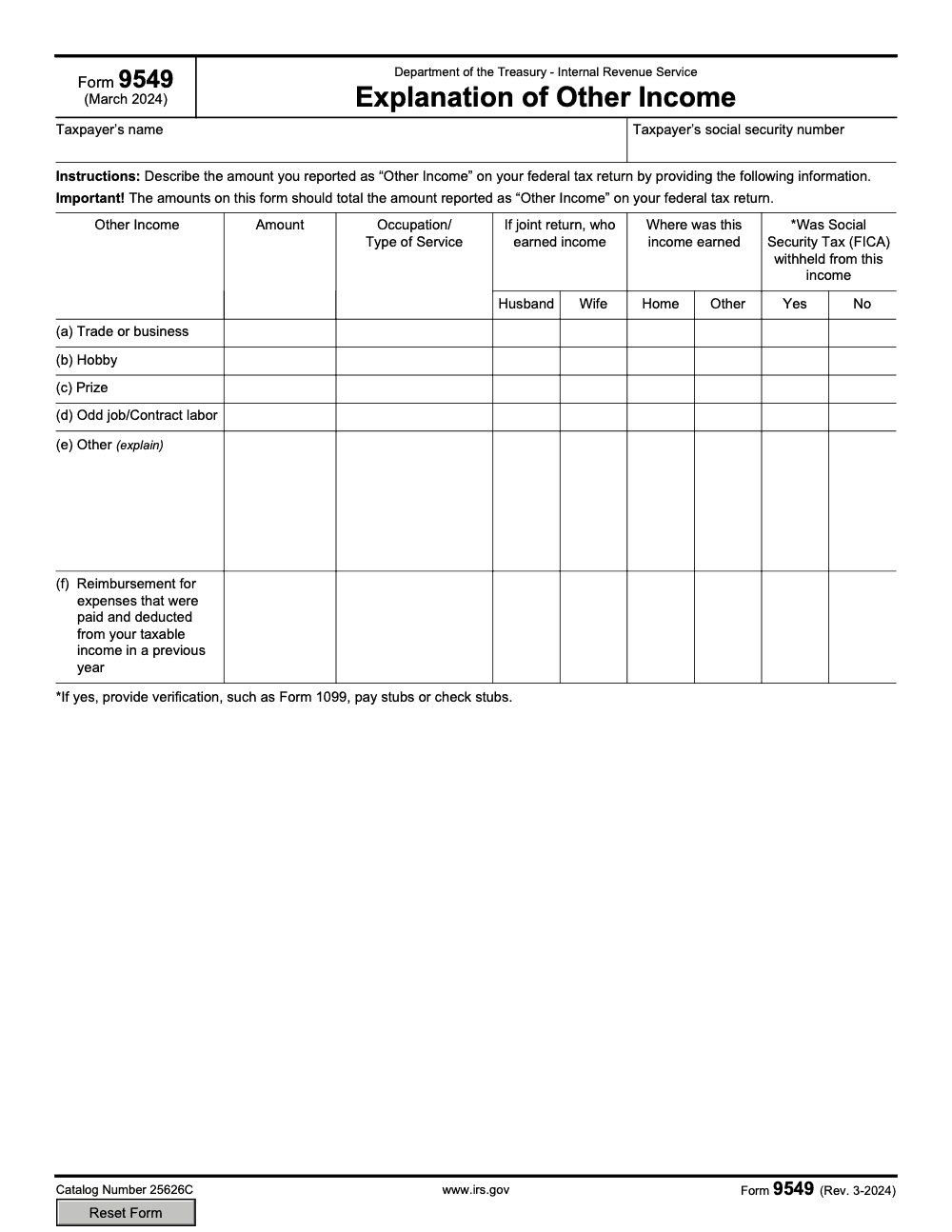
Form 9549 is the IRS Explanation of Other Income worksheet (Rev. 3-2024, Catalog Number 25626C) – a public, taxpayer-completed form used to describe and break down the amount reported as Other Income on a federal tax return. Its own instructions say to describe the Other Income amount you reported by providing the information the form asks for, row by row.
Taxpayers complete Form 9549 to itemize the Other Income line of their return, listing each amount on its own row so the IRS can see what the figure is made of. The form carries an Important! note that the amounts on it should total the amount reported as Other Income on the federal return, so the worksheet has to reconcile to the underlying figure.
This is a single-page form the taxpayer completes and keeps with the return it supports; it is a publicly available IRS form, not a standalone return and not an internal IRS document. It captures the taxpayer’s name and Social Security number at the top, then six income categories with columns for the dollar amount, the occupation or type of service, the earning spouse on a joint return, the location, and whether Social Security Tax (FICA) was withheld.
The Six Other Income Categories
Every dollar on the Other Income line maps to one of six pre-printed rows: (a) trade or business, (b) hobby, (c) prize, (d) odd job or contract labor, (e) other, which requires a written explanation, and (f) reimbursement for expenses that were paid and deducted from taxable income in a previous year. Row (f) is narrow on purpose – it covers a tax-benefit-rule recovery, not an ordinary current-year reimbursement.
Why the Detail Matters
The form asks for more than a number. For each row you set the occupation or type of service, mark where the income was earned (Home or Other), and answer whether FICA was withheld. If you check Yes for FICA, the asterisked footnote tells you to attach verification such as a Form 1099, pay stubs, or check stubs. Filling these in cleanly the first time is what keeps the Other Income line from drawing follow-up questions.
The Six Income Categories – What Each Row Captures
Form 9549 lists six pre-printed Other Income categories, rows (a) through (f). Every component of the Other Income line belongs in exactly one of these rows. Knowing where each item lands is what keeps the worksheet clean and the total tied to the return.
| Row | Category | What Belongs Here |
|---|---|---|
| (a) | Trade or business | Income from a trade or business activity reported as Other Income on the return |
| (b) | Hobby | Income from an activity not carried on for profit |
| (c) | Prize | Prizes and awards reported as Other Income |
| (d) | Odd job/Contract labor | Income from odd jobs or contract labor |
| (e) | Other (explain) | Anything that does not fit the other rows – a written explanation is required on the form |
| (f) | Reimbursement for previously deducted expenses | Reimbursement of expenses that were paid and deducted from taxable income in a previous year (the tax-benefit-rule recovery) |
Totals Must Tie to the Return
The form’s Important! note is explicit: the amounts on Form 9549 should total the amount reported as Other Income on the federal return. Foot the Amount column across rows (a) through (f) and confirm it equals the Other Income figure on the underlying return before the file leaves the desk. A worksheet that does not reconcile is the most common reason the IRS comes back with questions.
The Columns on Form 9549 and What They Ask
Each row of Other Income runs across the worksheet’s columns, and every column has a job. Skipping a column is what leaves an entry unsupported, so it helps to read the worksheet column by column rather than row by row the first time through.
| Column | What You Enter | Practical Note |
|---|---|---|
| Amount | The dollar amount of income for that row | The rows must foot to the Other Income line on the return |
| Occupation/Type of Service | The kind of work or service that generated the income | Describe the activity, not just the payer |
| If joint return, who earned income (Husband / Wife) | A checkbox attributing the row to one spouse on a joint return | Not optional for joint filers – check exactly one box per row |
| Where was this income earned (Home / Other) | A checkbox showing the location the income was earned | Mark Home or Other for every row |
| Was Social Security Tax (FICA) withheld (Yes / No) | A checkbox stating whether FICA was withheld from the row | A Yes triggers the verification requirement below |
FICA Verification When You Check Yes
The FICA-withheld column carries an asterisked footnote: if Yes, provide verification such as a Form 1099, pay stubs, or check stubs. A Yes without backup is an unsupported claim, so pull the proof and clip it to the worksheet before you mark the box. This is the single column most often left unsupported in returns that come across my desk.
How Row (f) and the Tax Benefit Rule Work Together
Row (f) is the row that trips people up. It is scoped only to a reimbursement of expenses that were paid and deducted from taxable income in a previous year. That is the tax-benefit-rule recovery: you deducted something last year, got reimbursed for it this year, and now that recovery is income.
When Row (f) Does Not Apply
An ordinary current-year reimbursement of an expense you never deducted is generally not income, and it does not belong on row (f). Before using the row, confirm the underlying expense was actually deducted in a prior tax year. If it was not, the item stays off the worksheet entirely rather than getting forced into a category that does not fit.
Keep the Worksheet With the Return
Form 9549 is a supporting schedule, not a standalone filing. Complete it, reconcile it to the Other Income line, and keep it with the return it supports in the engagement file. Because the worksheet documents what the Other Income figure is made of, a clean copy in the file is what answers a later question without reopening the whole return.
Building Form 9549 Into the Workpaper Flow
Form 9549 rarely arrives on its own. It rides in with returns where the Other Income line is a single number standing in for several unrelated items. Handled at the right point in the workflow, the worksheet is a quick reconciliation; handled last, it becomes the piece that slips.
Categorize at Intake, Not at Review
Pull the Other Income detail when the source documents are still open and assign each piece to a category row right away. Trade or business, hobby, prize, odd job or contract labor, the catch-all other row, and a prior-year recovery are easy to separate at intake and painful to untangle at the last minute. My team maps each item to its row before the file moves forward.
Verify Before Sign-Off
Make the reconciliation a standing review step: foot the Amount column to the Other Income line, confirm the husband or wife attribution and the Home or Other location on joint returns, and clip FICA verification to any row marked Yes. Running that short list before the worksheet leaves the desk is what keeps the Other Income line from drawing follow-up questions later.
Common Mistakes That Slow Things Down
The same handful of errors land on my desk every time a client tries to complete Form 9549 on their own. Each one is small on the form and expensive in cleanup.
Practical Checklists You Can Reuse
These two checklists are copy-paste ready for a firm SOP. Drop them into your workpaper template and run them before any Form 9549 leaves the desk.
Form 9549 build checklist
- Confirm the taxpayer's name and Social Security number are entered at the top of the form.
- List every component of Other Income on its own row, using categories (a) through (f).
- Describe the occupation or type of service that generated each row's income.
- Enter the dollar amount for each row in the Amount column.
- For row (e) Other, write a specific explanation of what the income is.
- Confirm row (f) is used only for recoveries of expenses deducted in a prior year.
Reconcile and verify checklist
- Foot the Amount column and tie the total to the Other Income line on the return.
- On joint returns, check either Husband or Wife for every row.
- Mark Home or Other to show where each row of income was earned.
- Answer the FICA-withheld question Yes or No for each row.
- Attach verification – a Form 1099, pay stubs, or check stubs – for every Yes.
- Keep the completed worksheet with the return file for the engagement.
Keep 9549 Season From Stalling
Form 9549 rarely arrives on its own. It rides in with returns where the Other Income line is a single number standing in for several unrelated items, and someone has to take that number apart into the six categories the worksheet expects. When a desk is already buried in primary returns, that unbundling work is the piece that slips.
The fix is to treat the worksheet as a structured reconciliation, not a last-minute write-up. Every dollar on the Other Income line needs a home in rows (a) through (f), an earner on joint returns, a location, and a FICA answer that is backed by proof. Build that into the workpaper flow and the form stops being a bottleneck.
- Map each piece of Other Income to a category row at intake, so trade or business, hobby, prize, odd job or contract labor, and prior-year recoveries are separated before review.
- Foot the Amount column and tie it to the Other Income line on the return as a standing review step.
- Resolve the husband or wife attribution and the Home or Other location on joint returns while the source documents are still open.
- Gather FICA verification, a Form 1099, pay stubs, or check stubs, for any row marked Yes before the file moves to final review.
That is the kind of structured, reviewable execution we build into every engagement. Our tax preparation services handle the schedule-level reconciliation behind forms like 9549, so the Other Income line ties out cleanly and your reviewers spend their time on judgment instead of footing columns.
FAQs
Yes. Form 9549 is the Explanation of Other Income worksheet, a public IRS form the taxpayer completes and keeps with the return it supports. The taxpayer enters their name, Social Security number, and each component of the Other Income line, and the amounts must total the Other Income figure reported on the return.
The worksheet lists six pre-printed rows: (a) trade or business, (b) hobby, (c) prize, (d) odd job or contract labor, (e) other, which requires a written explanation, and (f) reimbursement for expenses that were paid and deducted from taxable income in a previous year. Every component of the Other Income line should be placed in one of these rows.
Yes. The form carries an Important! note that the amounts on it should total the amount reported as Other Income on the federal return. Foot the Amount column across rows (a) through (f) and confirm it equals the Other Income figure on the underlying return before sign-off.
Whenever you check Yes in the Social Security Tax (FICA) withheld column for a row. The asterisked footnote on the form says to provide verification such as a Form 1099, pay stubs, or check stubs. A Yes without supporting documentation leaves the entry unsupported, so attach the proof to the worksheet.
About this guide
Accountably helps US CPA, EA, and accounting firms hire trained accountants and tax preparers in India.
About us Reviewed byJugal Thacker, CPAFounder and CEO at Accountably
A Washington-licensed CPA with 7+ years inside US firms – PwC, a real-estate tax practice, then a full-service firm, rising from reviewer to manager to advisory. This article was reviewed against current IRS guidance for the 2025 tax year and updated for filers preparing late returns, amendments, and 2026 estimates.
View profile →How we research, review, and update this guide
Every Accountably guide is researched against primary IRS sources, reviewed by a U.S. CPA, and refreshed as guidance evolves. Read our Editorial Guidelines to see how we source, fact-check, and update our content.