Summarize this article with AI
In Brief
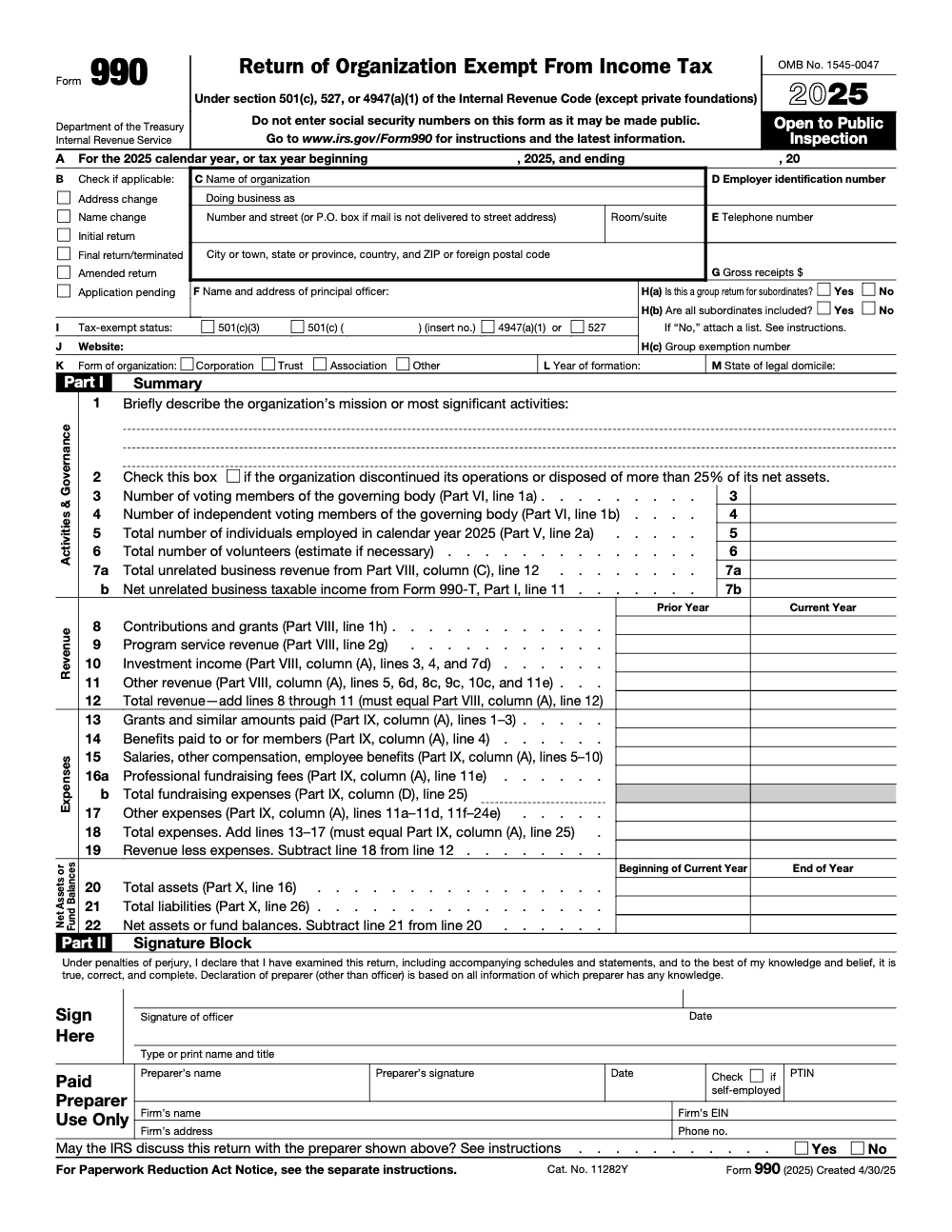
Form 990 is the annual information return for tax-exempt organizations under IRC §501(a), other than private foundations (which file Form 990-PF). Organizations with gross receipts of $200,000 or more, or total assets of $500,000 or more at year end, must file the full Form 990; smaller organizations file Form 990-EZ or the Form 990-N e-Postcard, per IRC §6033 and IRS Publication 557. Calendar-year 2025 returns are due May 15, 2026, with an automatic six-month extension available via Form 8868.
A growth-stage charity calls in April convinced it still qualifies for the short form, then learns that one large board-restricted grant pushed gross receipts past $200,000 for the year. The full Form 990 is now on the table, as it is for any organization with total assets of $500,000 or more at year end, and the return is public record that donors, journalists, and watchdog organizations read.
Failing to file for 3 consecutive years results in automatic revocation of tax-exempt status, which requires a full reinstatement application. Calendar-year 2025 returns are due May 15, 2026, with an automatic six-month extension on Form 8868. A governance questionnaire gathers Schedule O narratives and compensation data early, so they do not arrive last.
Key Takeaways
- Form 990 is the annual information return filed by tax-exempt organizations to report revenue, expenses, program service accomplishments, and governance to the IRS.
- Who files Form 990: Organizations with gross receipts of $200,000+ or total assets of $500,000+. Smaller organizations may use Form 990-EZ; very small organizations use Form 990-N.
- Due date: 15th day of the 5th month after fiscal year-end. For calendar-year organizations, that is May 15. An automatic 6-month extension is available via Form 8868.
- Key pitfall: Form 990 is public record. Compensation disclosures, governance policies, and program descriptions will be read by donors, journalists, and watchdog organizations.
- Revocation risk: Failing to file for 3 consecutive years results in automatic revocation of tax-exempt status, which requires a full reinstatement application.
- SOP tip: Build a governance questionnaire to gather Schedule O narratives and compensation data early in the engagement – collecting these last-minute is the single biggest cause of 990 filing delays.
What Form 990 Is and When to Use It
Form 990 serves a dual purpose. For the IRS, it is the primary information return through which tax-exempt organizations demonstrate that they continue to qualify for exemption – by showing that revenues are used for exempt purposes, compensation is reasonable, and governance meets minimum standards. For the public, Form 990 is a transparency document – available to anyone who requests it and searchable on platforms like ProPublica’s Nonprofit Explorer.
This dual audience changes how you approach the preparation. It is not enough to be technically accurate. The narrative responses in Part III (program service accomplishments) and Schedule O (supplemental information) are read by major donors, grant funders, and journalists. Weak or incomplete narratives reflect poorly on the organization, even if the numbers are correct. From my side of the desk, I treat Form 990 as both a compliance filing and a communications document.
Which Version of Form 990 Applies
| Form | Gross Receipts | Total Assets | Notes |
|---|---|---|---|
| Form 990-N (e-Postcard) | Under $50,000 | Any | Online filing only; minimal data |
| Form 990-EZ | $50,000–$199,999 | Under $500,000 | Shorter version of full 990 |
| Form 990 | $200,000 or more | $500,000 or more (either test) | Full return with all schedules |
| Form 990-PF | Any | Any | Private foundations only |
Who Is Exempt From Filing
Churches and certain church-affiliated organizations are not required to file. State institutions, government entities, and certain subordinate organizations covered by group returns also have filing relief. However, just because an organization is not required to file does not mean filing is never advisable – some organizations file voluntarily to maintain transparency with funders.
Fiscal Year Considerations
Form 990 follows the organization’s fiscal year, not the calendar year. A June 30 fiscal year-end means the return is due November 15. This is a common point of confusion when organizations change fiscal years or when new clients come onboard mid-year. Always confirm the fiscal year before computing the due date.
How to Complete Form 990, Part by Part
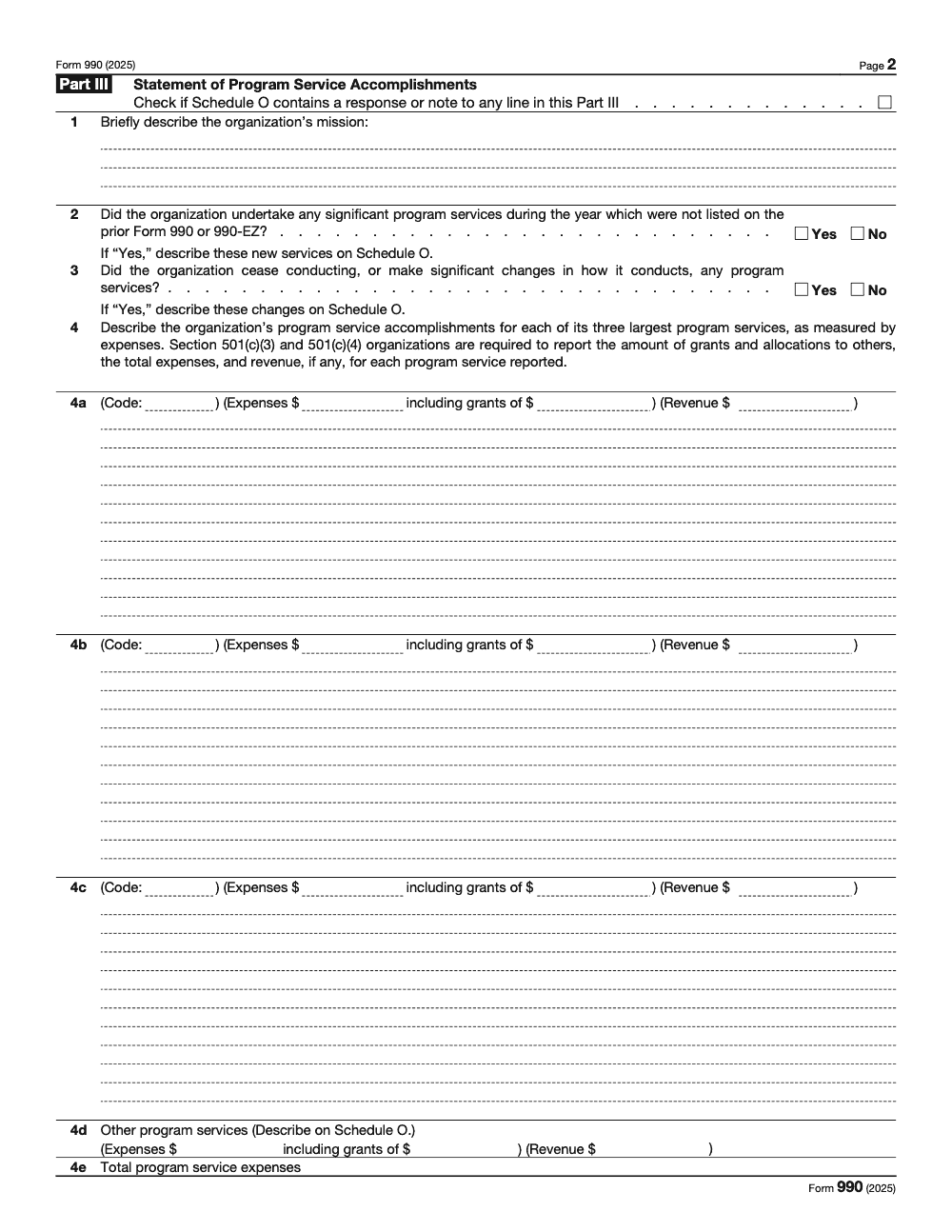
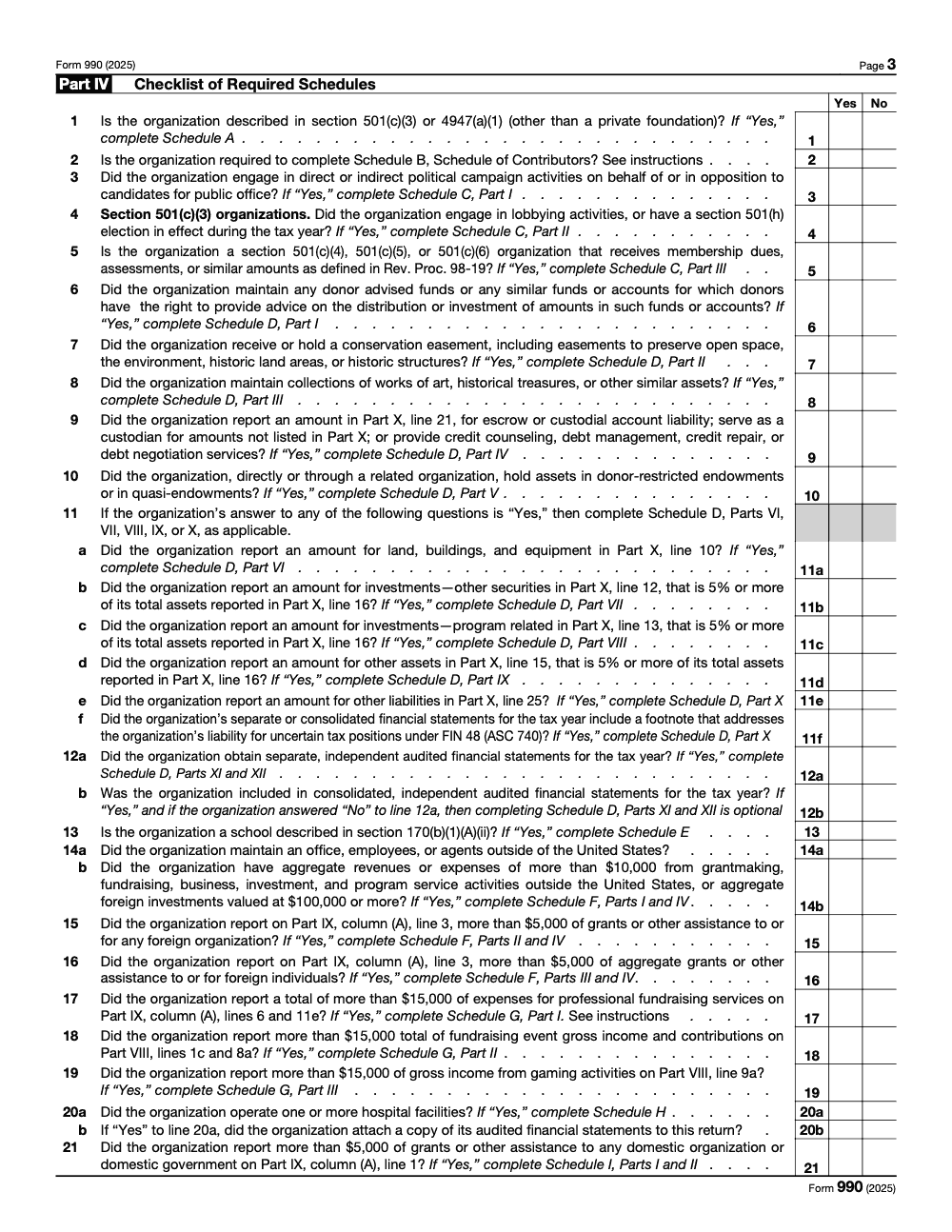
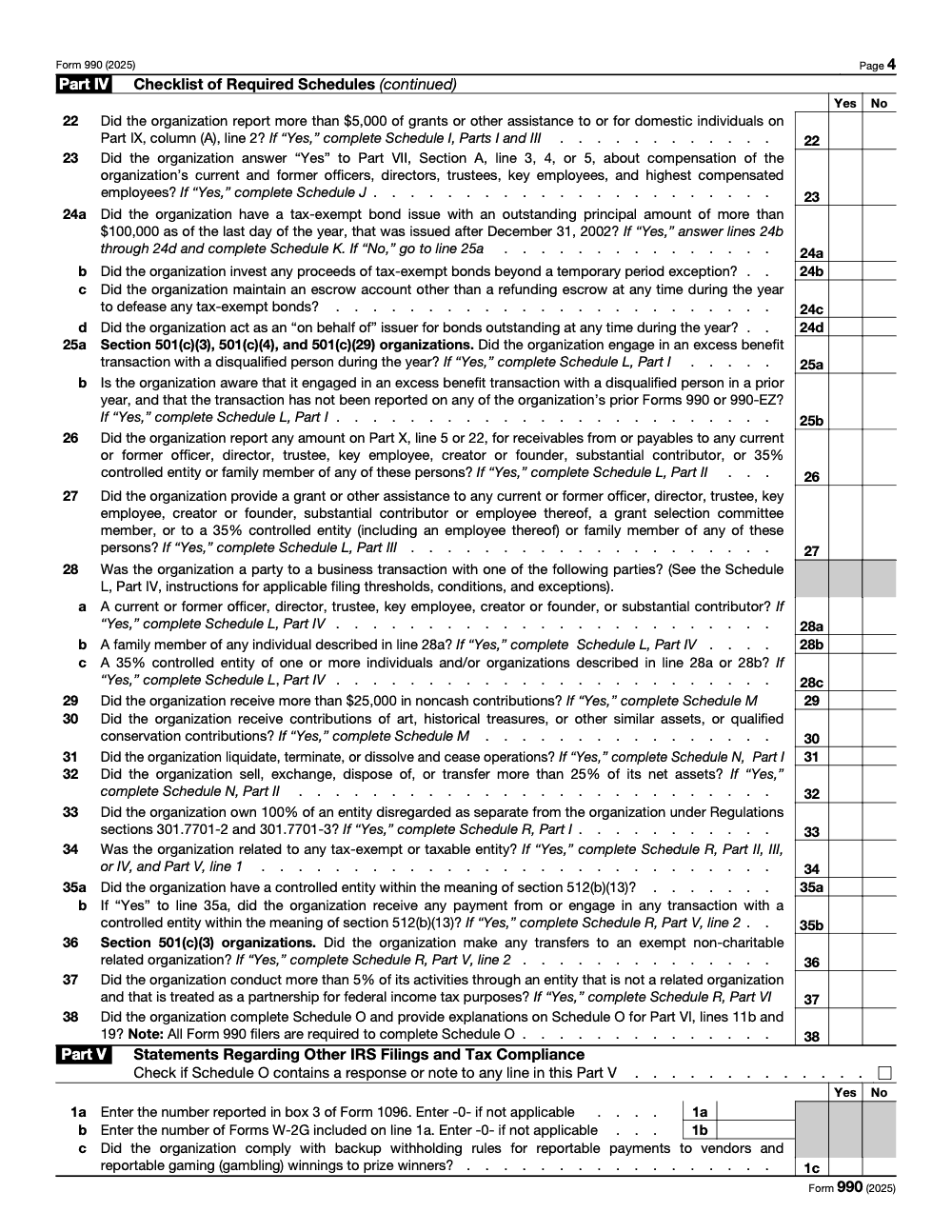
Form 990 has 12 parts plus up to 16 schedules. Not all schedules apply to every organization. Work through the form systematically – the header and Parts I through X before the schedules.
Header – Organization Information
Confirm the legal name, EIN, address, tax year, and type of organization. If the organization amended its articles of incorporation or bylaws, note the change. The “group return” checkbox applies to affiliated organizations filing under a group exemption. Confirm it applies before checking it.
Part I – Summary
Part I is a condensed financial summary: total revenue, expenses, and net assets for the current year and prior year. The numbers here come from Parts VIII and IX. Prepare Part I last, after completing the detailed financial sections. The prior-year figures should match the prior year’s filed return exactly – do not adjust them for restatements without noting the reason in Schedule O.
Part III – Program Service Accomplishments
This is one of the most important and most neglected sections of the form. Describe the three largest program services by expenditure, including outcomes and metrics. Funder and watchdog readers evaluate these descriptions carefully. Vague language like “provided services to the community” is a red flag. Specific language – number of people served, outcomes achieved, dollars spent per program – signals organizational health and mission focus.
Part VI – Governance, Management, and Disclosure
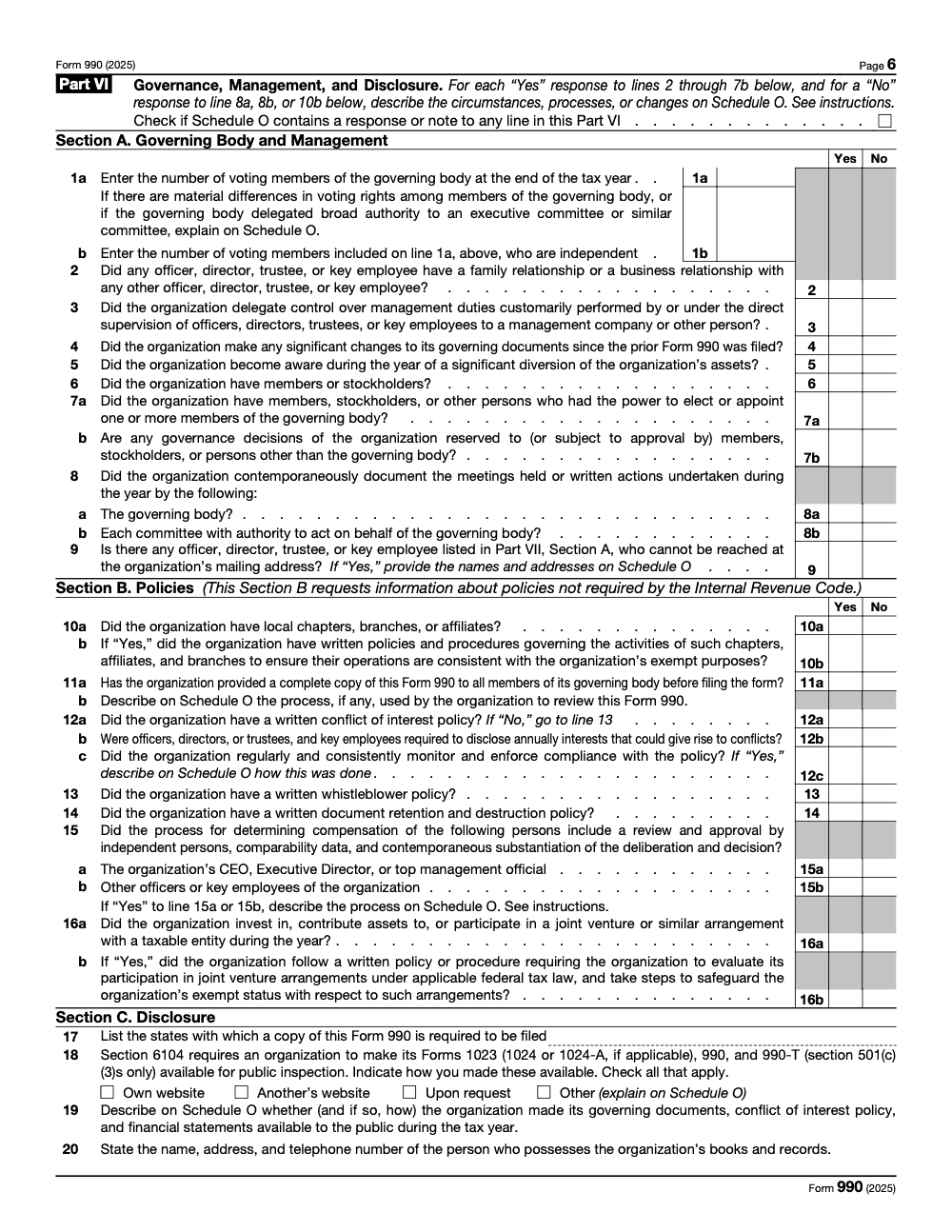
Part VI asks about board composition, conflict of interest policies, whistleblower policies, document retention policies, and whether the return was reviewed by the governing board before filing. Organizations that cannot answer “yes” to basic governance questions should treat the 990 as a governance improvement trigger, not just a filing. Small errors create big cleanup when the IRS or state attorney general scrutinizes a nonprofit’s governance history.
Part VII – Compensation of Officers, Directors, Trustees, Key Employees, and Highest-Compensated Employees
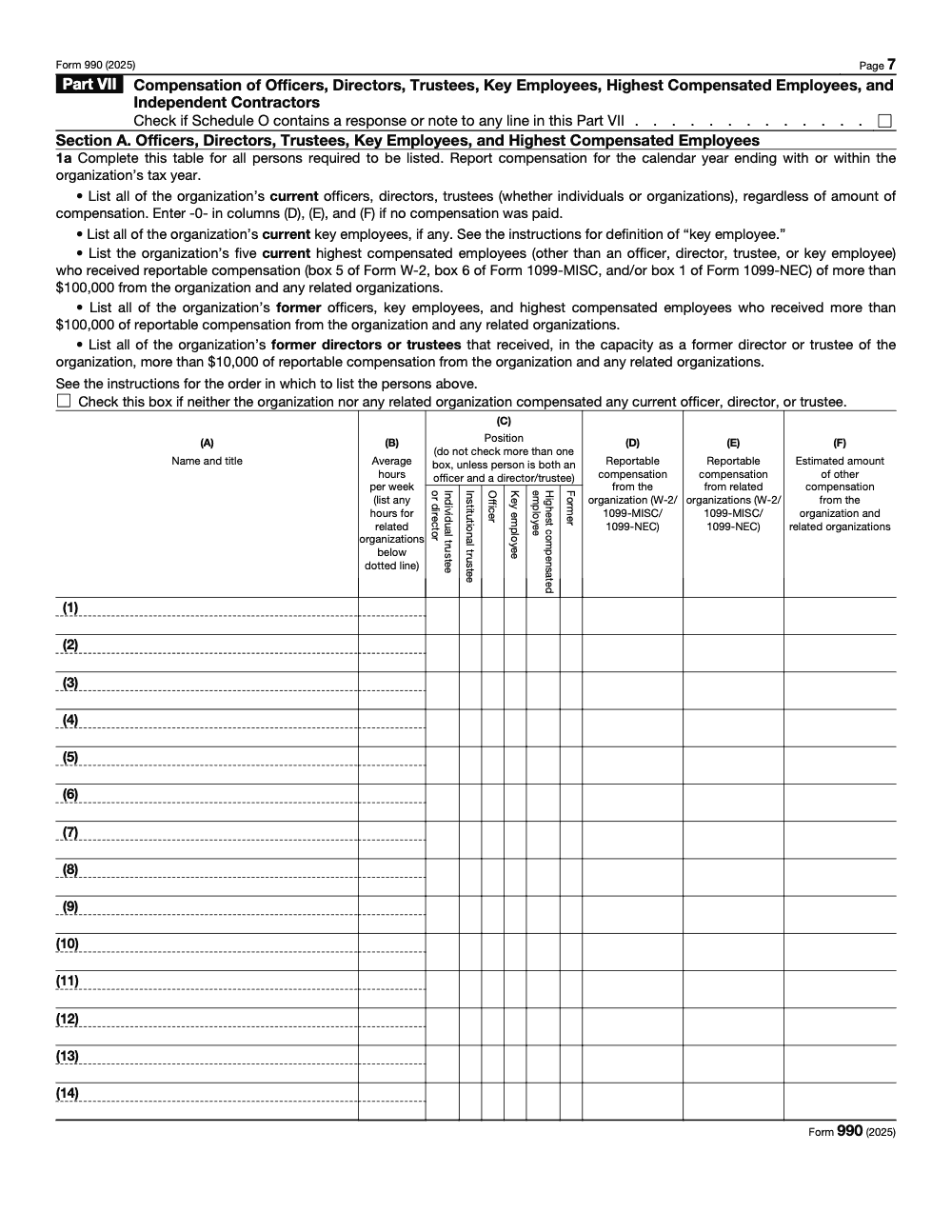
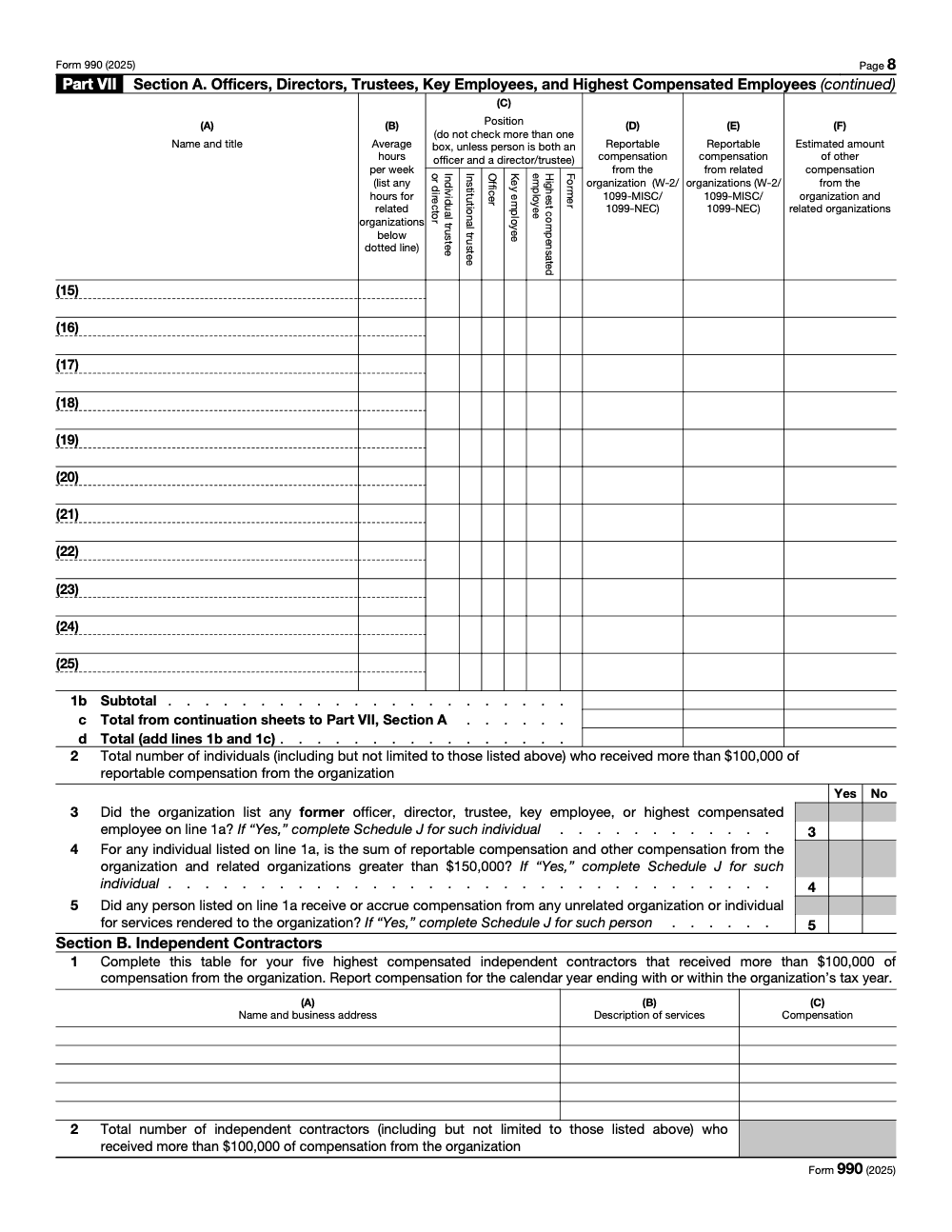
Part VII requires disclosure of all compensation paid to officers, directors, and the five highest-compensated employees earning more than $100,000. “Reportable compensation” includes W-2 wages, 1099 payments from the organization and related organizations, and deferred compensation vested during the year. This is the section that generates the most public and media attention. Accuracy is non-negotiable – compensation not disclosed here that appears on a W-2 creates a mismatch the IRS will catch.
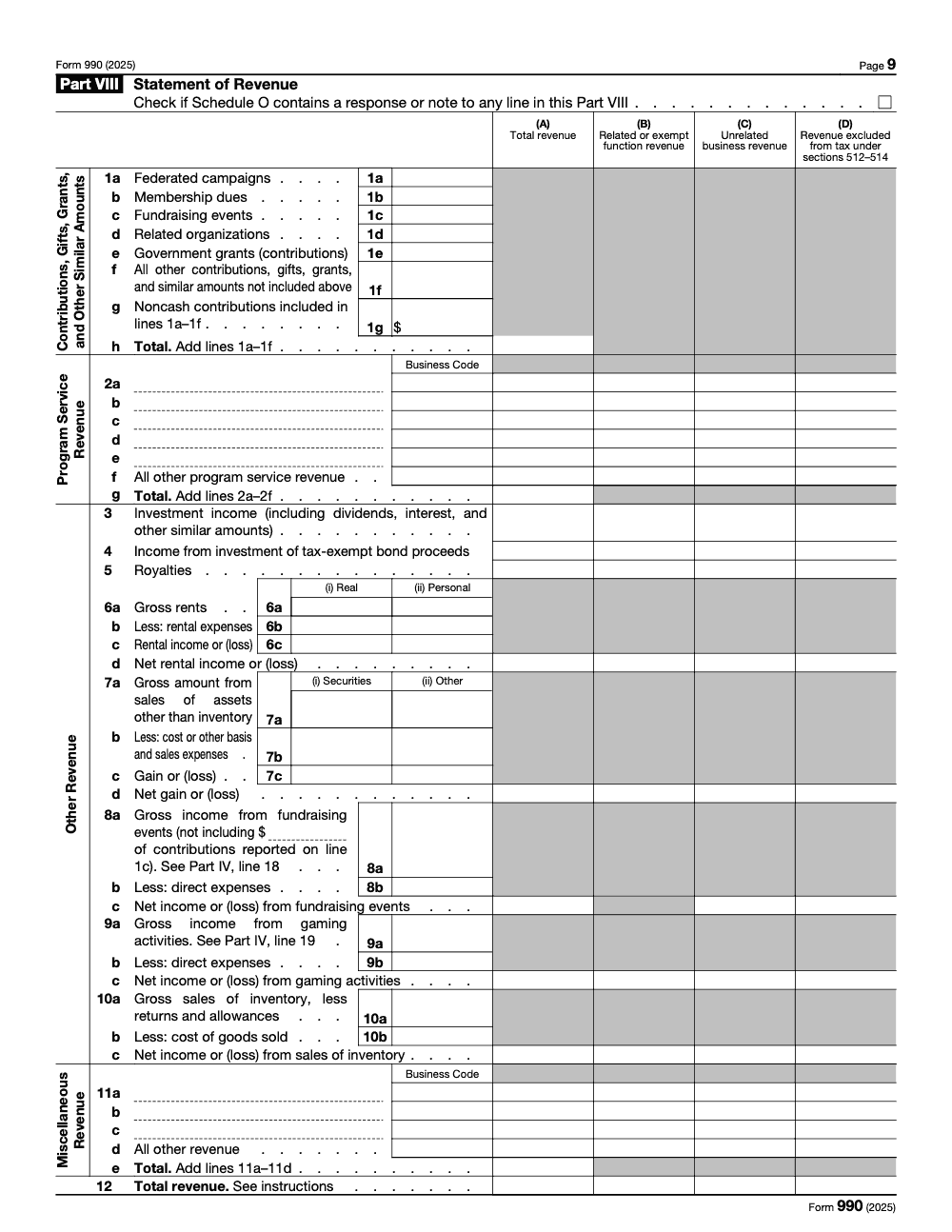
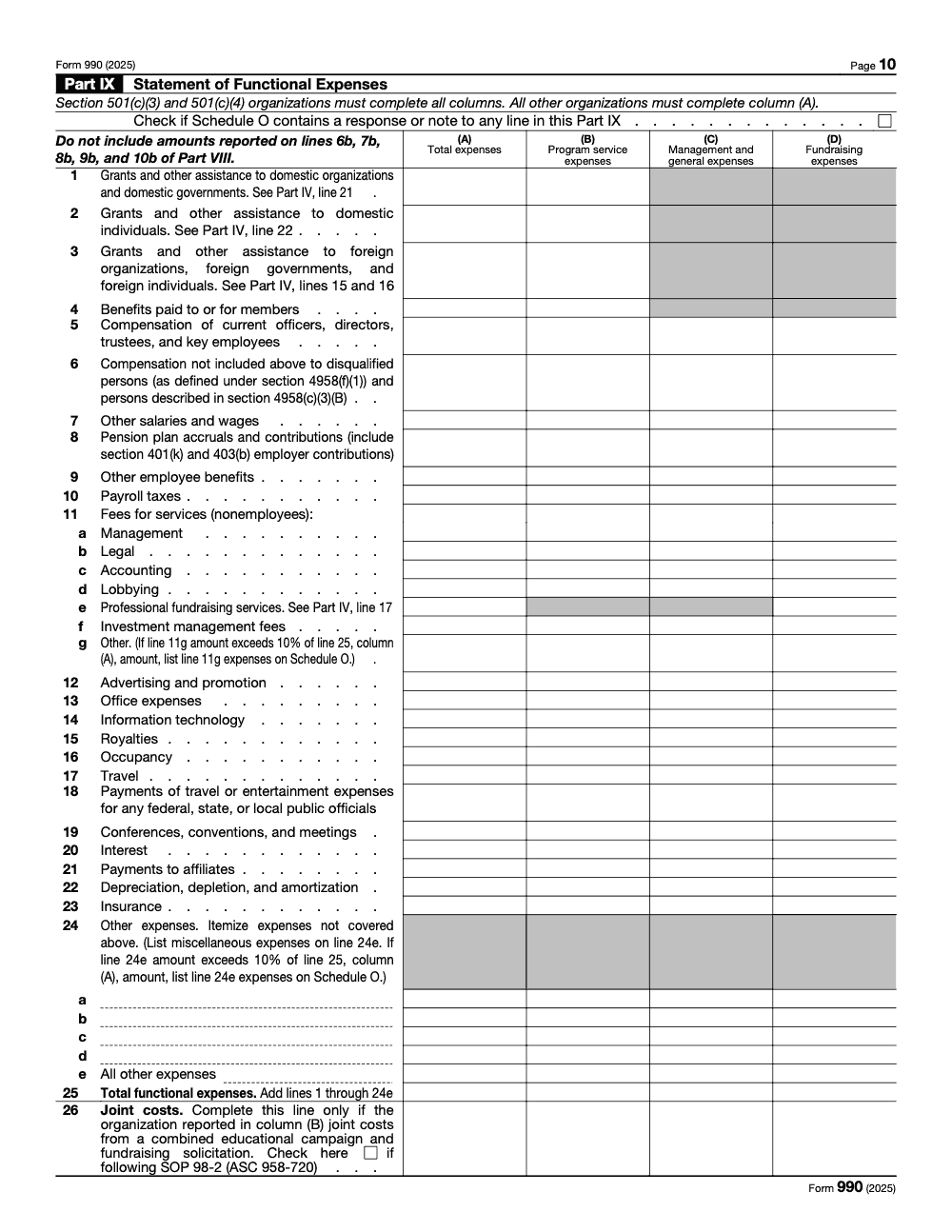
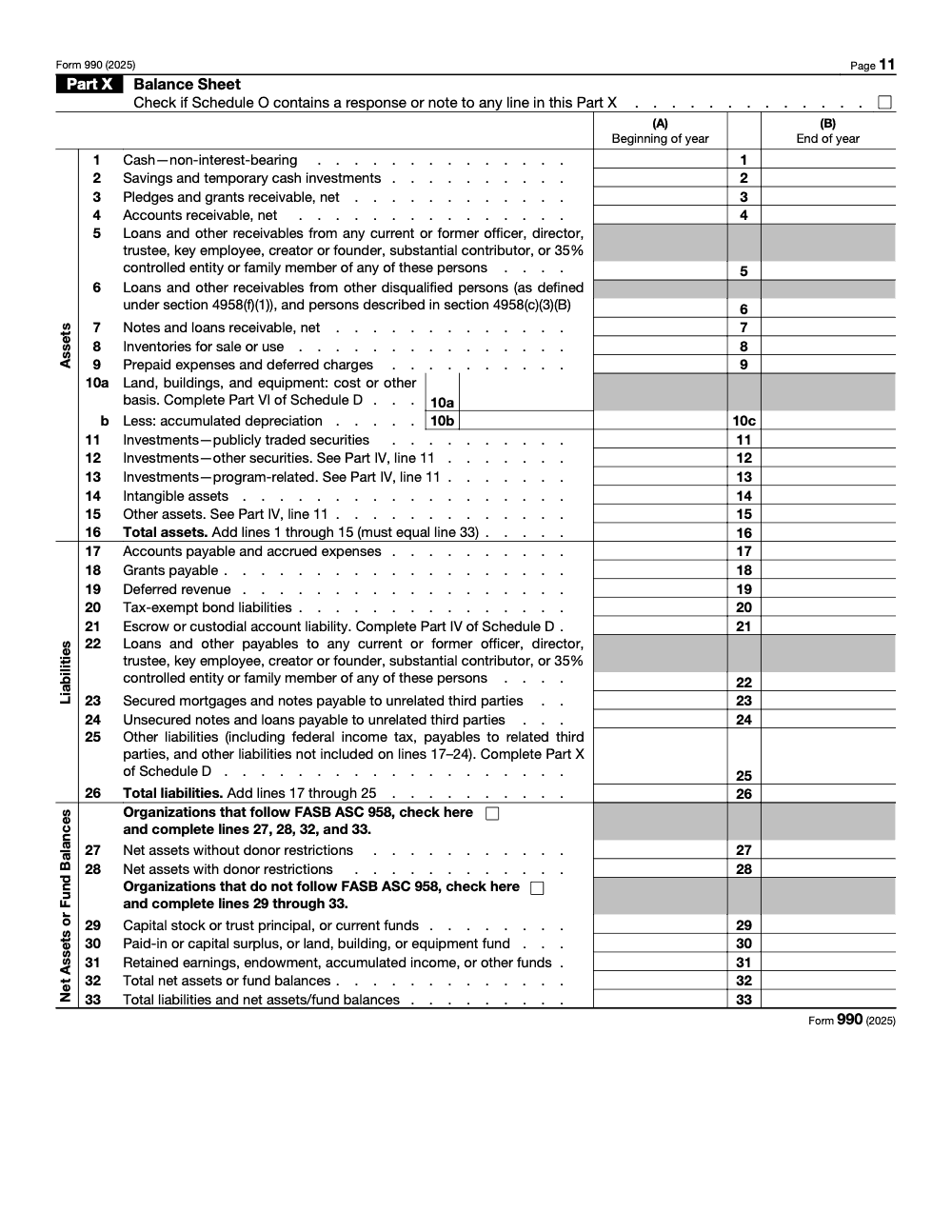
Part VIII, IX, X – Financial Statements
Parts VIII through X are the revenue statement, functional expense statement, and balance sheet. These should reconcile to audited financial statements if the organization has them. The functional expense allocation (program services vs. management and general vs. fundraising) is scrutinized by charity watchdogs like Charity Navigator and GuideStar. Reasonable program expense ratios and low administrative overhead signal financial health.
Deadlines, Penalties, and Filing Requirements
| Fiscal Year End | Original Due Date | Extended Due Date (6 months) |
|---|---|---|
| December 31 | May 15 | November 15 |
| March 31 | August 15 | February 15 |
| June 30 | November 15 | May 15 |
| September 30 | February 15 | August 15 |
Filing the Extension – Form 8868
File Form 8868 before the original due date to receive an automatic 6-month extension. No IRS approval is needed – it is automatic as long as the extension request is filed on time. The extension extends the time to file, not the time to pay any tax due (relevant for organizations subject to unrelated business income tax). Build an 8868 workflow trigger into your April/May calendar for any calendar-year nonprofit clients.
Penalty for Late Filing
| Organization Size | Penalty Per Day | Maximum Penalty |
|---|---|---|
| Gross receipts of $1,000,000 or less | $20/day | $10,000 or 5% of gross receipts (lesser) |
| Gross receipts over $1,000,000 | $100/day | $50,000 |
Automatic Revocation for Non-Filing
The most severe consequence of non-filing is not a penalty – it is automatic revocation of tax-exempt status after three consecutive years without filing. Under section 6033(j) the revocation happens by operation of law – the IRS does not send a warning letter before it takes effect, and only publishes the Auto-Revocation List after status has already been lost. Reinstatement requires a new exemption application and potentially paying income tax on any revenues earned during the revocation period. For large organizations, this can be financially catastrophic and reputationally damaging.
E-Filing Requirements
All organizations filing Form 990, 990-EZ, 990-PF, or 990-N are required to e-file. Paper filing is no longer accepted for these returns. This requirement took effect for tax years beginning after July 1, 2019. Ensure your software supports e-filing before beginning preparation.
Form 990 Schedules – Which Ones Apply and Why
One of the most confusing aspects of Form 990 preparation is determining which schedules are required. The core form asks trigger questions throughout Parts IV and V that determine which schedules must be attached. Missing a required schedule is a common cause of incomplete returns and IRS correspondence.
Most Commonly Required Schedules
| Schedule | Purpose | When Required |
|---|---|---|
| Schedule A | Public charity status and public support test | All 501(c)(3) public charities |
| Schedule B | Schedule of contributors | Organizations receiving contributions above threshold from a single donor |
| Schedule D | Supplemental financial statements | Organizations with endowments, investments, or conservation easements |
| Schedule J | Compensation information for certain officers | Officers or key employees paid over $150,000 |
| Schedule L | Transactions with interested persons | Loans to/from officers, excess benefit transactions |
| Schedule O | Supplemental information | Required for every Form 990 filer; narrative explanations for Yes/No answers |
| Schedule R | Related organizations | Organizations with affiliates, subsidiaries, or joint ventures |
Schedule B Confidentiality
Schedule B – the list of donors giving above threshold amounts – is the one part of Form 990 that is not publicly disclosed for 501(c)(3) organizations (section 527 political organizations are the exception – their Schedule B contributor information IS subject to full public disclosure). The organization must maintain it and provide it to the IRS on request, but for 501(c)(3)s it is redacted from public copies. Mishandling donor confidentiality by accidentally disclosing Schedule B in response to a public records request is a serious error. Build a dual-copy workflow: one complete copy for IRS filing, one redacted copy for public disclosure.
Executive Compensation Reporting on Form 990
Executive compensation is the highest-scrutiny section of Form 990 and the most technically demanding. Part VII and Schedule J together create a complete picture of how the organization compensates its leadership. Errors here draw IRS attention and media coverage.
What Counts as Reportable Compensation
Reportable compensation includes W-2 Box 5 wages plus any amounts received for services from related organizations. It also includes deferred compensation that vested during the year, even if not yet paid. Housing allowances, car allowances, club memberships, and other non-cash benefits are “other compensation” reported in a separate column. Every element of the executive’s total package must be categorized and disclosed – not just the base salary.
The Rebuttable Presumption of Reasonableness
To protect against intermediate sanctions (excise taxes on excessive compensation), organizations should establish the “rebuttable presumption of reasonableness” for compensation decisions. This means: the board (or a committee) approved the compensation in advance, relied on comparable data from similarly situated organizations, and documented the decision contemporaneously. Without this process, the IRS can challenge whether compensation is reasonable and impose excise taxes on both the executive and approving board members.
Unrelated Business Income – When Form 990-T Is Also Required
If a tax-exempt organization earns income from activities unrelated to its exempt purpose, that income may be subject to unrelated business income tax (UBIT), and the organization must file Form 990-T in addition to Form 990. This is an area many preparers miss entirely because the 990 itself does not fully surface it.
Common Sources of Unrelated Business Income
- Advertising revenue from publications where the content is not substantially related to the exempt purpose
- Income from debt-financed property
- Rental income from real property when the organization provides significant services to tenants
- Trade show income from for-profit exhibitors
- Parking facility income (post-TCJA)
- Certain investment income for social clubs (501(c)(7))
UBIT Thresholds and Form 990-T
If the organization has gross unrelated business income of $1,000 or more, it must file Form 990-T and pay corporate tax rates on the net profit from those activities. The Form 990-T due date is the same as Form 990, with the same extension available. Quarterly estimated tax payments may be required if annual tax liability will exceed $500. Integrate Form 990-T into your nonprofit engagement workflow so it is never omitted when the revenue streams are present.
Common Mistakes That Slow Things Down
Across nonprofit engagements the same Form 990 mistakes resurface every cycle. Most cost a couple of hours to unwind on review, but a few carry penalty exposure or revocation risk if they slip past the final reader.
Practical Checklists You Can Reuse
These checklists are written for paste-into-SOP use. Treat them as starting points and tighten the wording to match the engagement letter and the organization's accounting close.
Form determination and intake
- Confirm filing requirement: §501(a) status, exclude churches and integrated auxiliaries, exclude private foundations (those file 990-PF).
- Pull gross receipts and total assets from the year-end trial balance.
- Apply the 990-N test: normally $50,000 or less in gross receipts.
- Apply the 990-EZ test: gross receipts under $200,000 AND total assets under $500,000.
- Verify public charity vs private foundation classification from the IRS determination letter.
- Flag §509(a)(3) supporting orgs – not eligible for 990-N regardless of size.
- Confirm tax year end and compute the due date (15th day of the 5th month after year end).
- Schedule a Form 8868 extension if review capacity is tight – file before the original due date.
Schedules trigger scan (Part IV and Part V walkthrough)
- Schedule A: required for every 501(c)(3) public charity and §4947(a)(1) trust.
- Schedule B: contributors reported by 501(c)(3) and 527 organizations; names redacted from the public copy except for 527.
- Schedule C: any political campaign activity or lobbying, including §501(h) elections.
- Schedule D: investments or other assets above 5% of total assets, donor-advised funds, conservation easements.
- Schedule F: foreign activities at the $10,000 aggregate revenue/expense or $100,000 investment threshold.
- Schedule G: professional fundraising fees over $15,000, fundraising events over $15,000, gaming over $15,000.
- Schedule H: any hospital facility operated by the organization (attach audited financials).
- Schedule I: domestic grants over $5,000 to any one organization, government, or individual.
- Schedule J: any individual listed in Part VII with combined compensation over $150,000.
- Schedule K: outstanding tax-exempt bond principal over $100,000 on issues after December 31, 2002.
- Schedule L: excess benefit transactions, loans, grants, or business transactions with disqualified persons.
- Schedule M: noncash contributions of $25,000 or more in aggregate.
- Schedule N: liquidation, termination, dissolution, or disposal of 25% or more of net assets.
- Schedule O: required for every Form 990 filer – do not skip.
- Schedule R: 100% owned disregarded entities, related tax-exempt or taxable entities, partnership activity above 5%.
Pre e-file review
- Confirm Part I lines 8 through 11 tie to Part VIII column (A) line 12 (total revenue).
- Confirm Part I line 18 ties to Part IX column (A) line 25 (total expenses).
- Confirm Part I line 20 ties to Part X line 16 (total assets) and line 21 ties to Part X line 26 (total liabilities).
- Verify Part VI line 11a confirms the governing body reviewed Form 990 before filing.
- Verify Part VI lines 12a through 12c on the conflict-of-interest policy and annual disclosure process.
- Verify Part VI lines 15a and 15b on the compensation-setting process (independent review, comparability data, contemporaneous substantiation).
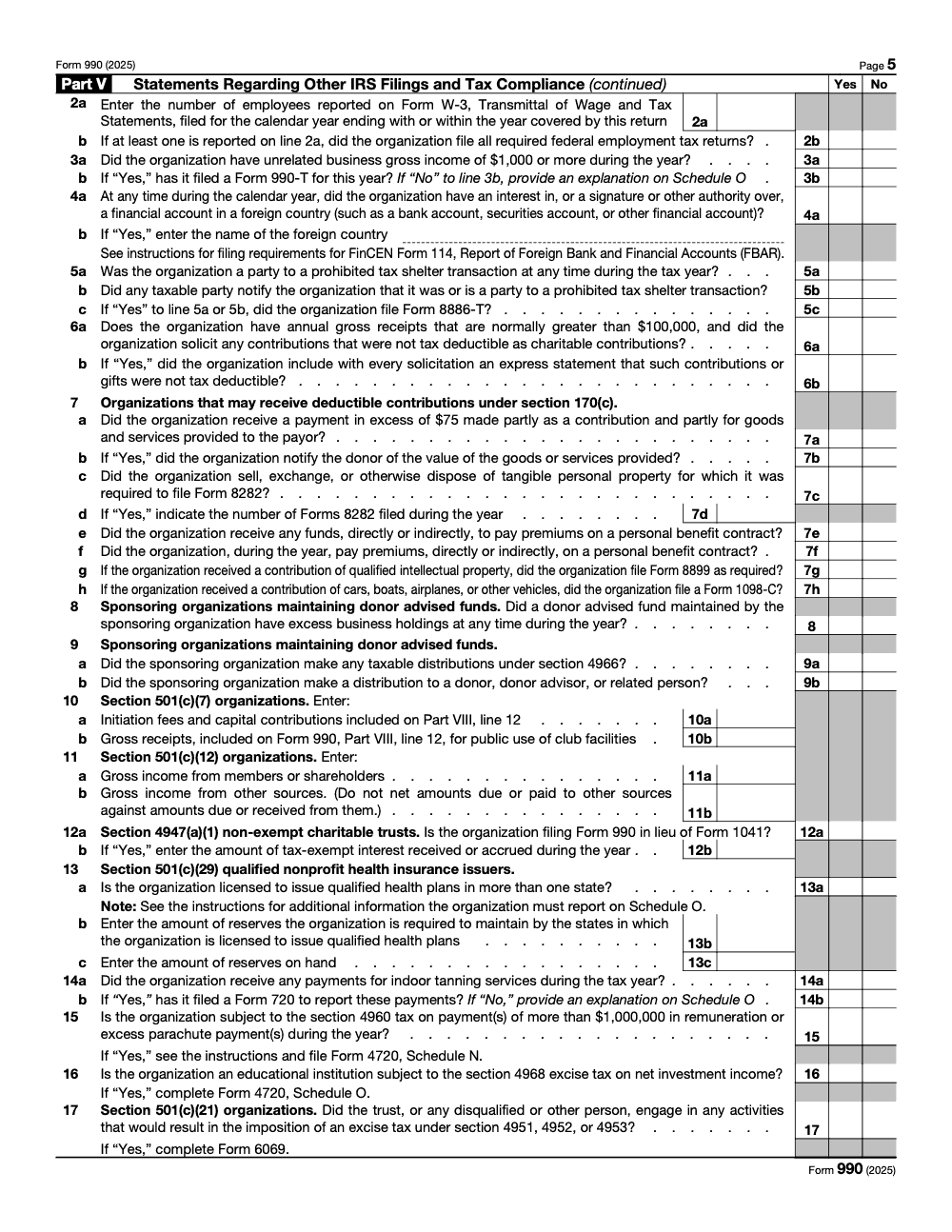
- Scan Part VIII column (C) for any gross unrelated business income at or above $1,000 and queue Form 990-T if triggered.
- Scrub the return for any SSNs in Part VII, Schedule J, narrative, or attachments before transmission.
- Confirm Schedule O addresses Part VI lines 11b and 19 at minimum.
- Log the e-file acceptance, save a filed copy to the engagement workpapers, and place a copy in the public-disclosure folder for the 3-year retention window.
Keep 990 Season From Stalling
Nonprofit calendars do not look like commercial calendars. A May 15 due date for calendar-year filers, paired with a return that can fan out to 15 or more schedules depending on the activity mix, concentrates the workload into a narrow window where reviewers are also juggling audit support and grant cycles. The penalty side is unforgiving: per IRC §6652(c), organizations with gross receipts at or below $1,000,000 face a $20 per day late-filing penalty capped at $10,000 (or 5% of gross receipts), and the larger-org penalty climbs to $100 per day up to $50,000. Three consecutive years of non-filing triggers automatic revocation of exempt status by operation of law under IRC §6033(j) – no IRS warning letter required.
The fix is rarely "work later hours." The teams that ship 990 season cleanly treat it as a delivery problem and standardize the parts of the return that get re-litigated every cycle.
- Lock the form-determination test (full 990 vs 990-EZ vs 990-N) at intake using both the $200,000 gross receipts AND $500,000 assets thresholds – the assets half is the most-skipped half.
- Run the Part IV and Part V trigger questions as a structured schedule scan early so Schedule D, F, G, K, L, and R show up in the work plan before drafting, not at review.
- Build Part VII compensation against W-2 box 5 and Form 1099-NEC box 1 for the calendar year ending within the tax year, with separate checks at the $150,000 Schedule J threshold and the $1,000,000 §4960 excise-tax line.
- Set a Form 990-T trigger scan on Part VIII column (C) at the $1,000 gross UBI threshold, with separate UBTI silos per unrelated activity for post-2017 tax years.
- Treat Schedule O as a required deliverable from day one, with template narratives for Part VI lines 11b and 19 that get tailored, not skipped.
That structure is what we install when nonprofit clients hand us their 990 production. Our tax services team works inside your file naming, your review tiering, and your engagement workflow so May 15 becomes a delivery date, not a fire drill.
FAQs
Form 990 is the annual information return filed by tax-exempt organizations with the IRS. It reports revenue, expenses, program service activities, governance, and executive compensation. The form is publicly available and serves as the primary transparency document for nonprofits and tax-exempt organizations.
Most tax-exempt organizations must file annually. Organizations with gross receipts of $200,000+ or total assets of $500,000+ file the full Form 990. Smaller organizations file Form 990-EZ. Organizations with gross receipts under $50,000 may file the Form 990-N e-Postcard. Churches and certain church affiliates are exempt from filing.
Form 990 is due the 15th day of the 5th month after the organization’s fiscal year ends. For calendar-year organizations that is May 15. An automatic 6-month extension is available by filing Form 8868 before the original due date. The extension is automatically granted – no IRS approval required.
Yes. Form 990 and most of its schedules are public documents. Organizations must provide copies to anyone who requests them and make them available at their principal office. They are also searchable through ProPublica Nonprofit Explorer and the IRS Tax Exempt Organization Search. Only Schedule B (list of donors) is kept confidential and must be redacted from public copies for 501(c)(3) organizations – section 527 political organizations are an exception, and their Schedule B contributor information is publicly disclosable.
Late filing triggers a penalty of $20 or $100 per day (depending on organization size), capped at $10,000 or $50,000 respectively. More severely, failing to file for three consecutive years results in automatic revocation of tax-exempt status. Reinstatement requires a new exemption application and may involve paying income tax on revenues earned during the revocation period.
Required schedules depend on the organization’s activities. Schedule A is required for all 501(c)(3) public charities. Schedule O (supplemental information) is required for every Form 990 filer. Other common schedules include Schedule B (contributors), Schedule D (supplemental financial statements), Schedule J (executive compensation detail), and Schedule R (related organizations). Work through the trigger questions in Parts IV and V of the core form to determine which schedules apply.
Form 990 family
- Form 990 Schedule A: Public Charity Status Guide, Tests & Deadlines
- Form 990 Schedule B: Donor Reporting, 2% Rule, Noncash Gifts
- Form 990 Schedule C: Lobbying & Proxy Tax Guide
- Form 990 Schedule D Guide: Donor‑Advised Funds, Endowments
- Form 990 Schedule E: Private School Filing Guide
- Form 990 Schedule F: Foreign Activity Reporting
- Form 990 Schedule G: Filing Triggers, Events & Gaming
- Form 990 Schedule H: Hospital Guide to 501(r), CHNA, and FAP
- Form 990 Schedule I: U.S. Grant Reporting Compliance Guide
- Form 990 Schedule J: Triggers, $150,000 Threshold, and Reporting Guide
Other forms this guide names
- Form 990‑T: UBTI Filing Guide, Schedule A, Deadlines, E‑file
- Form 990‑EZ: Eligibility, Deadlines, E‑File, Schedules
- Form 8868: Extension for Exempt Organization Returns
- Form W‑2: Deadlines, E‑File Rules, Boxes, and W‑2c Corrections
- Form 990‑PF: Filing Guide, Payout, E‑File
Summarize this article with AI
About this guide
Accountably helps US CPA, EA, and accounting firms hire trained accountants and tax preparers in India.
About us Reviewed byJugal Thacker, CPAFounder and CEO at Accountably
A Washington-licensed CPA with 7+ years inside US firms – PwC, a real-estate tax practice, then a full-service firm, rising from reviewer to manager to advisory. This article was reviewed against current IRS guidance for the 2025 tax year and updated for filers preparing late returns, amendments, and 2026 estimates.
View profile →How we research, review, and update this guide
Every Accountably guide is researched against primary IRS sources, reviewed by a U.S. CPA, and refreshed as guidance evolves. Read our Editorial Guidelines to see how we source, fact-check, and update our content.