Summarize this article with AI
In Brief
Form 990-BL is the historical Information and Initial Excise Tax Return for Black Lung Benefit Trusts under IRC §501(c)(21). The form was last revised in December 2013 and has been historical beginning with tax year 2021, per IRS guidance on Form 990-BL. For tax year 2025, a 501(c)(21) trust files Form 990 (or Form 990-N if gross receipts are normally $50,000 or less), and the §4951, §4952, and §4953 excise taxes are reported on Form 6069, not on the former Schedule A.
It is easy to assume a black lung benefit trust still files Form 990-BL, since that was the return for years. It is not. The form was last revised in December 2013 and has been historical beginning with tax year 2021, so a 501(c)(21) trust now files Form 990 instead, or the 990-N e-Postcard when gross receipts are normally $50,000 or less.
The excise tax piece moved too. The §4951, §4952, and §4953 taxes that the old Schedule A once carried are now reported on Form 6069. Filing the legacy form, or attaching the wrong schedule, creates exactly the kind of error that a coal-industry trust cannot afford to leave on the record.
Key Takeaways
- Form 990-BL is a historical form for tax year 2021 and later – black lung benefit trusts established under the Federal Coal Mine Health and Safety Act or state law equivalents historically filed Form 990-BL, but per IRS Publication 557, §501(c)(21) trusts can no longer file Form 990-BL and now file Form 990 (or Form 990-N if gross receipts are normally $50,000 or less) to meet their annual filing obligation.
- Form 990-BL historically served a dual purpose: it was both an annual information return (like the 990 series for other exempt organizations) and the vehicle for reporting and paying the initial excise tax on prohibited transactions involving the trust. For tax year 2021 and later, however, the §4951, §4952, and §4953 excise taxes are reported on Form 6069, not on Form 990-BL, per IRS Publication 557.
- Black lung benefit trusts are tax-exempt under IRC §501(c)(21) – they are a specific category of exempt organization distinct from general 501(c)(3) charities, and their compliance requirements differ accordingly.
- The initial excise tax on prohibited transactions can be significant – it applies when the trust engages in transactions with disqualified persons (typically employers who established the trust) that violate the IRC §4951 rules.
- Quick rule you can copy into your SOP: for any black lung benefit trust client, conduct an annual prohibited transaction review before the return is prepared – catching a prohibited transaction early allows for self-correction before the excise tax compounds.
- Form 990-BL is not widely encountered outside of coal industry practices, but its compliance requirements are specific and consequential – misclassifying the trust on the wrong return form creates filing errors that the IRS will eventually identify.
What Form 990-BL Is and When to Use It
Form 990-BL – Information and Initial Excise Tax Return for Black Lung Benefit Trusts and Certain Related Persons – was historically the annual return filed by black lung benefit trusts exempt from taxation under IRC §501(c)(21); the form was last revised December 2013 and, per IRS Publication 557, became historical beginning with tax year 2021, after which §501(c)(21) trusts file Form 990 (or Form 990-N for small trusts) instead. These trusts are established by coal mine operators to provide tax-deductible contributions that fund benefits for miners who suffer from black lung disease (pneumoconiosis), as required under federal and state law.
The form serves two distinct functions. First, it is an information return, reporting the trust’s income, expenses, assets, liabilities, and other financial data – similar to what Form 990 does for general exempt organizations. Second, for trusts that historically engaged in prohibited transactions under IRC §4951, Form 990-BL was the vehicle for reporting and paying the initial excise tax on those transactions; for tax year 2021 and later, however, these §4951 excise taxes are reported on Form 6069 rather than on Form 990-BL, per IRS Publication 557. This dual function historically made Form 990-BL more complex than a standard information return.
Black lung benefit trusts occupy a narrow but legally important niche in the IRC §501(c) exemption categories. Unlike the broad categories of charitable, educational, and religious organizations under §501(c)(3), or trade associations under §501(c)(6), the §501(c)(21) category exists specifically to provide a tax-advantaged vehicle for coal mine operators to pre-fund their statutory black lung benefit obligations. The trust’s exempt status is conditional on compliance with both the IRC’s investment and distribution requirements and its prohibited transaction rules.
Who Must File Form 990-BL
Historically, all black lung benefit trusts exempt under IRC §501(c)(21) filed Form 990-BL annually. However, per IRS Publication 557, Form 990-BL is historical beginning with tax year 2021: §501(c)(21) trusts now file Form 990 to meet the annual filing obligation, and a trust whose gross receipts are normally $50,000 or less is excepted from filing Form 990 and instead files Form 990-N (the e-Postcard) annually. Additionally, “related persons” who engage in prohibited transactions with the trust may be required to file Form 6069 to report their involvement and pay the applicable §4951, §4952, or §4953 excise tax, per IRS Publication 557.
Relationship to Other Black Lung Benefit Regulations
Black lung benefit trusts are also governed by the Department of Labor (DOL) under the Federal Coal Mine Health and Safety Act and the Black Lung Benefits Act. The DOL has its own reporting and compliance requirements that run parallel to the IRS Form 990-BL filing obligation. Practitioners advising these trusts must maintain awareness of both regulatory frameworks – IRS exempt organization rules and DOL benefit trust standards – and coordinate compliance accordingly.
How to Complete Form 990-BL
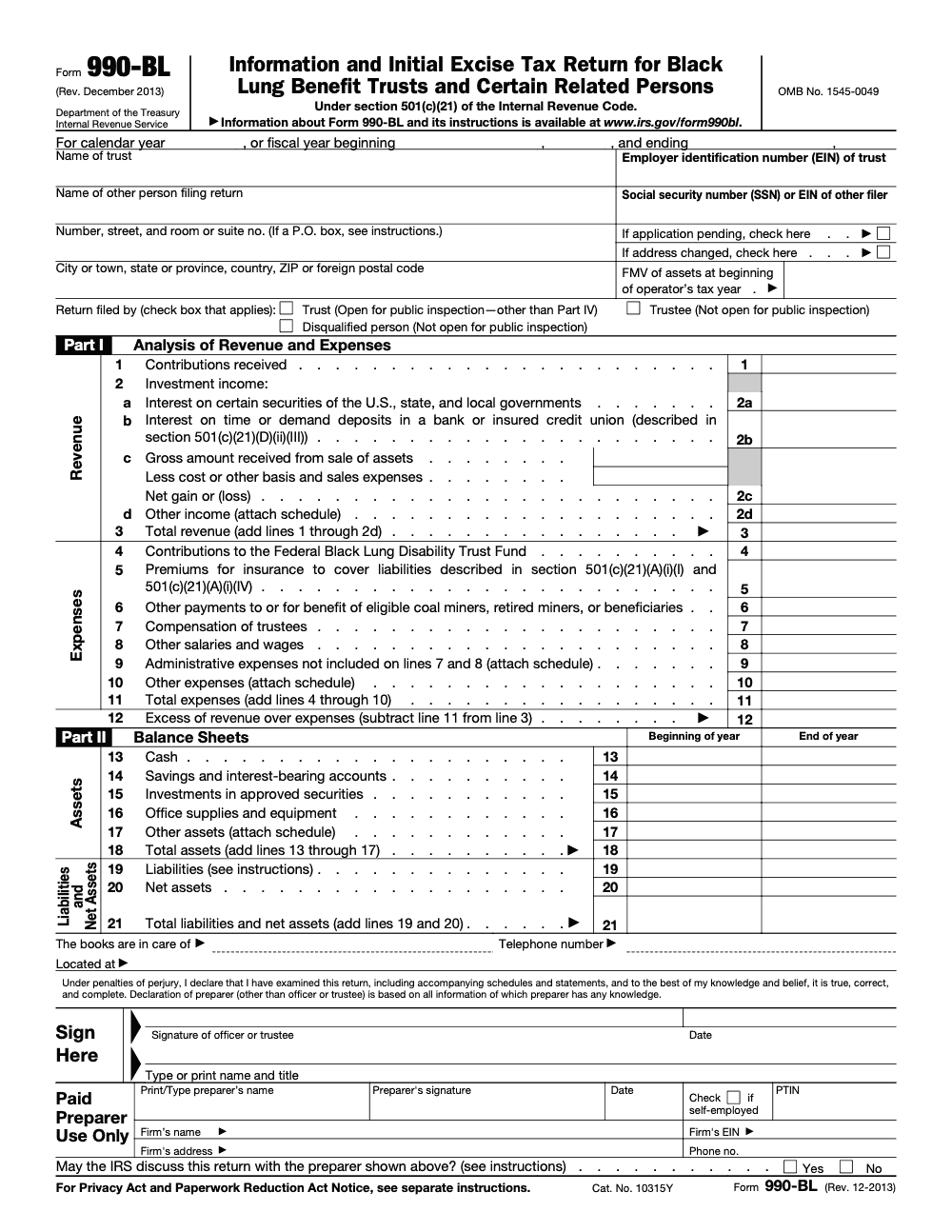
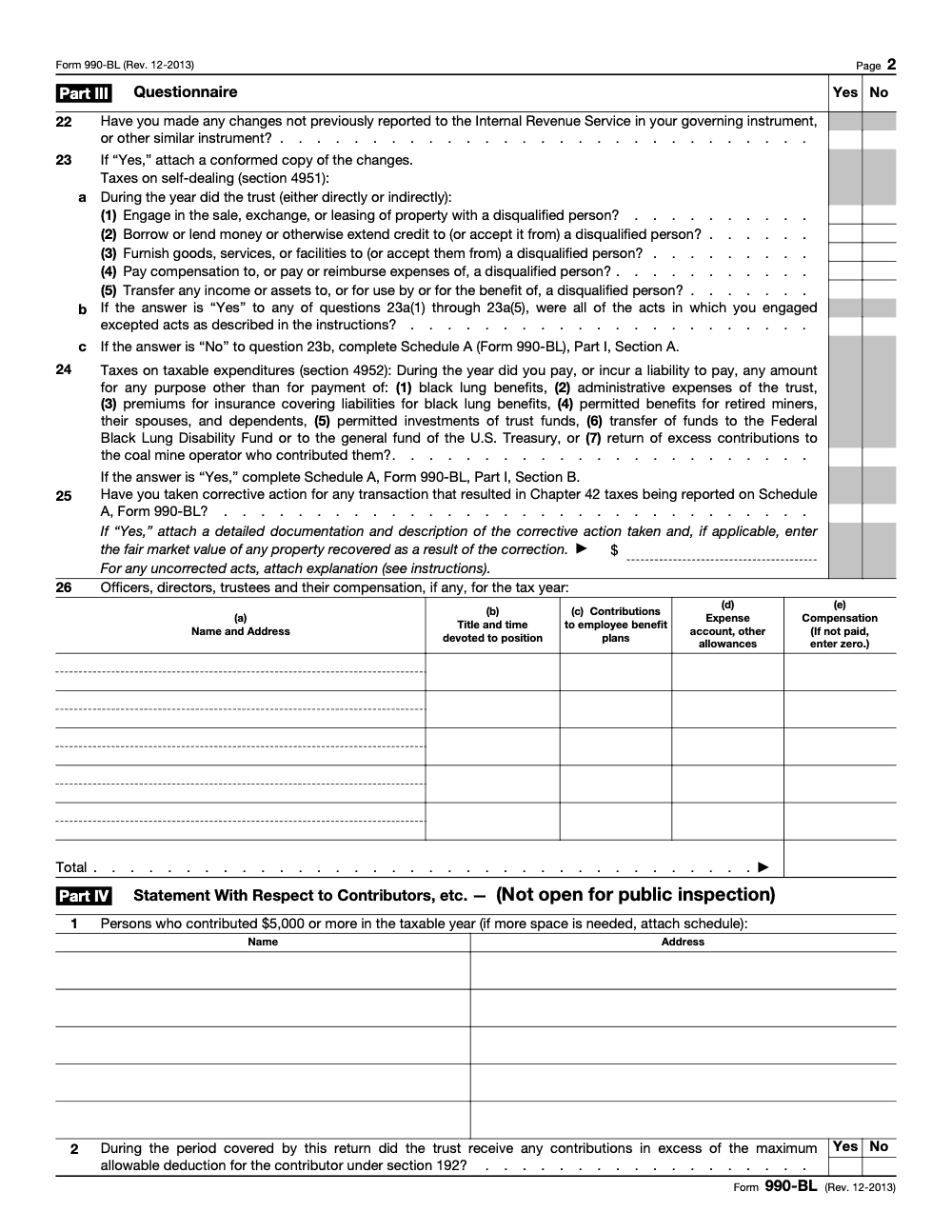
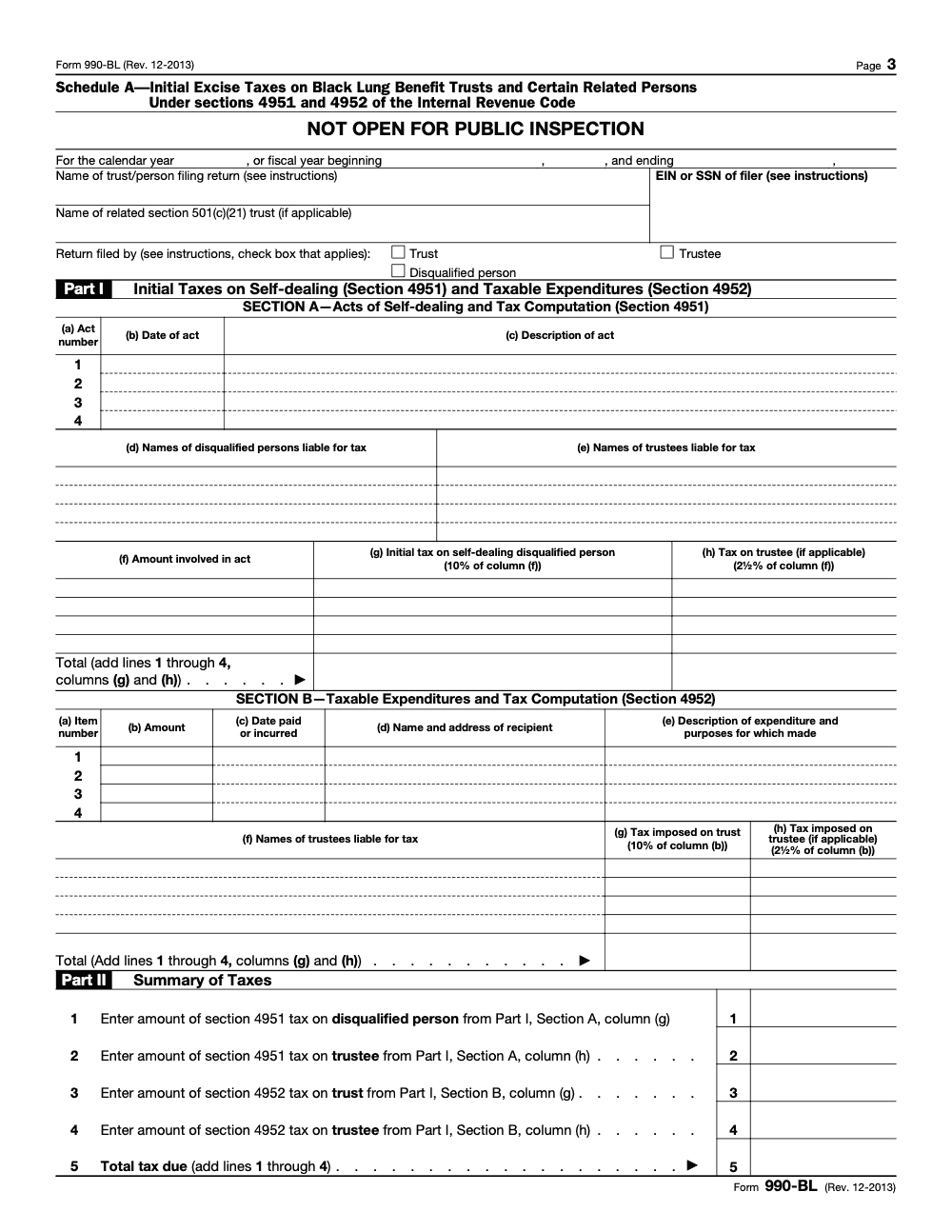
Form 990-BL consists of multiple sections covering the trust’s financial information, the prohibited transactions analysis, and the excise tax calculation. It is more complex than a standard 990-N or 990-EZ, and requires careful attention to the IRC §4951 prohibited transaction rules.
| Section | What It Covers | Practitioner Tip |
|---|---|---|
| Part I – Income and Expenses | Contributions received, interest income, gains/losses, other income, and trust expenses (Lines 1–12) | Line 3 (total revenue, Lines 1–2d) less Line 11 (total expenses, Lines 4–10) yields Line 12 (excess of revenue over expenses) |
| Part II – Balance Sheet | Cash, savings and interest-bearing accounts, investments in approved securities, office equipment, other assets, liabilities, and net assets (Lines 13–21) | Line 18 (total assets, Lines 13–17) must equal Line 21 (total liabilities and net assets, Lines 19–20); reconcile to the trust’s audited financials if available |
| Part III – Questionnaire | Governing instrument changes (Line 22), §4951 self-dealing inquiries (Line 23), §4952 taxable-expenditure inquiries (Line 24), corrective action for Chapter 42 taxes (Line 25), and officer/trustee compensation (Line 26) | Any “Yes” answer to Line 23 or Line 24 routes to Schedule A; uncorrected acts under Line 25 require an explanation attachment |
| Part IV – Statement With Respect to Contributors | Each person who contributed $5,000 or more in the taxable year, with name and address (attach schedule if more space is needed) | Part IV is NOT open for public inspection; keep it separate from the public-inspection packet for the trust’s own filing |
| Schedule A (Form 990-BL) – Initial Excise Taxes | Legacy calculation of the initial excise taxes on self-dealing (§4951) and taxable expenditures (§4952); Schedule A is NOT open for public inspection | The §4951 initial tax is 10% of the amount involved on the disqualified person (plus 2½% on a knowingly participating trustee); the §4952 initial tax is 10% on the trust (plus 2½% on the trustee). For tax year 2021 and later, however, these §4951 and §4952 excise taxes are reported on Form 6069, not on Schedule A of Form 990-BL, per IRS Publication 557. |
| Signature | Trustee signature under penalties of perjury | The trustee – not just the preparer – must sign; confirm the signatory is the current authorized trustee |
Actuarial Funding Requirements
Black lung benefit trusts are subject to actuarial funding requirements under IRC §192. Employer contributions to the trust are deductible only to the extent permitted by the actuarial funding calculations. The trust should have a certified actuary prepare the funding valuation annually, and the results should inform both the employer’s contribution deduction and the Form 990-BL financial disclosures. Without an actuarial analysis, the trust’s financial reporting is incomplete.
Deadlines, Penalties, and Filing Requirements
Historically, Form 990-BL was due on the 15th day of the 5th month after the trust’s fiscal year ends (May 15 for calendar-year trusts). For tax year 2025, however, per IRS Publication 557 a §501(c)(21) trust does not file Form 990-BL at all; it files Form 990 (or Form 990-N if eligible) on the same due date instead. Extensions are available, but the initial excise tax (if applicable) is due with the return regardless of extension status.
| Event | Deadline | Notes |
|---|---|---|
| Form 990-BL annual return | 15th day of 5th month after fiscal year end | May 15 for calendar-year trusts; extension available via Form 8868 |
| Extension of time to file | Form 8868 by the original due date | 6-month automatic extension available; does not extend time to pay initial excise tax |
| Initial excise tax payment (if applicable) | Due with the Form 990-BL return | IRC §4951 initial excise tax on prohibited transactions; 10% of the amount involved. For tax year 2021 and later, reported on Form 6069 (not Schedule A of Form 990-BL), and only when there is an excise tax liability, per IRS Publication 557. |
| Failure-to-file penalty | Begins after due date (including extension) | $20 per day up to the lesser of $10,000 or 5% of gross receipts; higher penalties for large organizations |
The IRC §4951 Excise Tax – Initial and Additional Taxes
The initial excise tax under IRC §4951 is 10% of the prohibited transaction amount. If the transaction is not corrected within the “taxable period” (generally, the period ending with the assessment of the initial tax), an additional tax of 100% of the transaction amount applies. The combined potential cost of an uncorrected prohibited transaction – initial tax plus additional tax – can be devastating. Early identification and self-correction is far less expensive.
Black Lung Benefit Trust Excise Tax Rules – Understanding IRC §4951
IRC §4951 is the parallel to IRC §4975 (which applies to prohibited transactions in pension, profit-sharing, and IRA plans) for black lung benefit trusts. Understanding what constitutes a prohibited transaction is the most critical compliance area for Form 990-BL filers.
What Constitutes a Prohibited Transaction
Under IRC §4951, prohibited transactions between a black lung benefit trust and a “disqualified person” include: sale, exchange, or lease of property; loans or other extensions of credit; furnishing of goods, services, or facilities; transfer of income or assets of the trust to or for the benefit of a disqualified person; and certain self-dealing activities. Disqualified persons include the employer who established the trust, officers and directors of that employer, and members of their families. The rules are broadly similar in concept to the private foundation self-dealing rules under IRC §4941, but the tax rates and statutory framework differ: §4951 imposes a 10% initial tax on the disqualified person and a 2½% tax on a knowingly participating trustee (each computed on the amount involved), and the private-foundation §4941 rates and definitions should not be imported into a §4951 analysis.
Common Prohibited Transactions in Practice
In my experience with benefit trust clients, the most common prohibited transaction risks arise from: administrative service arrangements where the employer provides services to the trust without arm’s-length compensation; loans from the trust to the employer’s related entities; and use of trust assets or facilities by disqualified persons. All of these should be reviewed annually before the Form 990-BL is prepared – a question that gets answered “No” on the prohibited transaction section without a documented review is a compliance gap waiting to become a problem.
Trust Investment and Distribution Standards
Black lung benefit trusts are subject to investment and distribution requirements that are distinct from the rules governing other exempt organizations or pension trusts. Understanding these requirements is essential for trustees and their advisors.
Investment Standards
Trust assets must be invested in a manner consistent with the trust’s benefit obligations – specifically, the trust must maintain sufficient assets to fund its actuarially calculated benefit liabilities. Investment in the stock of the employer or in employer-related entities raises prohibited transaction concerns and should be reviewed with counsel before any such investment is made. The trust’s investment policy should be documented and reviewed annually by the trustee and the trust’s advisor.
Benefit Distribution Requirements
Under IRC §4952, trust assets may only be used for seven permitted purposes: (1) black lung benefits, (2) administrative expenses of the trust, (3) premiums for insurance covering black lung liabilities, (4) permitted benefits for retired miners and their spouses and dependents, (5) permitted investments of trust funds, (6) transfers to the Federal Black Lung Disability Fund or to the general fund of the U.S. Treasury, and (7) return of excess contributions to the contributing coal mine operator. Distributions for any other purpose – including returning excess assets to the employer outside of a proper plan termination – raise prohibited transaction issues. When a trust accumulates assets significantly in excess of its actuarial liability, the trustee should consult counsel about permissible options for managing the surplus, which may include adjusting contribution levels rather than making distributions to disqualified persons.
Common Mistakes That Slow Things Down
The same handful of 990-BL errors show up across coal-operator engagements, and most of them now turn on the form's historical status. Catching them early is the difference between a clean 501(c)(21) file and a multi-year correction.
Practical Checklists You Can Reuse
These three checklists fold into a firm's 501(c)(21) trust SOP and cover the annual cycle from filing decision to excise tax review. Copy them into the engagement file; the boxes save state for each return.
Annual filing decision packet (501(c)(21) trust)
- Confirm the trust's tax year and gross receipts for the year.
- If gross receipts are normally $50,000 or less, queue Form 990-N (e-Postcard); otherwise queue Form 990.
- Pull the recognition letter and verify IRC §501(c)(21) status; if exemption was never applied for, sequence Form 1024 with a copy of the trust instrument.
- Document any changes to the governing instrument since the last filing and attach a conformed copy if required.
- Confirm the trust is irrevocable per §501(c)(21) and that no reversion right exists other than return of excess contributions.
- Capture fair market value of trust assets at the beginning of the operator's tax year for the return header.
- Calendar the federal filing deadline and any state-level reporting that runs in parallel.
§4951, §4952, and §4953 excise tax scan
- List every transaction during the year between the trust and a disqualified person across the five §4951 categories: sale or exchange, lease, borrowing or lending, furnishing goods or services, and compensation or transfer of income or assets.
- Flag any expenditure that falls outside the seven §4952 permitted purposes for review.
- Compare operator contributions against the §192 deductible limit; calculate any excess for the §4953 5% tax.
- Where a self-dealing act or taxable expenditure occurred, compute the 10% trust or disqualified-person tax and the 2.5% trustee tax separately.
- If any Chapter 42 tax exists for the year, draft Form 6069 (and Form 4720 where applicable); skip the filing if total liability is zero.
- Document corrective action for any uncorrected acts and attach a description plus fair market value of recovered property to the return.
Permitted investment and retired-miner benefit review
- Confirm trust assets are held only in public-debt U.S. securities, non-defaulted state or local government obligations, or time and demand deposits in a U.S. bank or insured credit union.
- Verify the trustee's determination that invested amounts are not currently needed for the trust's purposes is documented in the minutes.
- Calculate the present value of the trust's black lung liability and confirm assets earmarked for retired-miner accident, health, and insurance benefits stay within 110% of that value.
- Reconcile distributions for the year against the seven §4952 permitted purposes and the §501(c)(21)(A) miner-beneficiary class.
- Cross-check insurance premium payments to the §501(c)(21)(A)(i)(I) and (IV) liability categories on the trust's Form 990 schedule.
- Tie balance-sheet movement to the prior-year filing and explain any unusual swings in the workpaper memo.
Keep 990-BL Season From Stalling
Black lung benefit trust work is small in volume but disproportionately fragile. The December 2013 revision is the most recent one ever released for Form 990-BL, and the form has been historical since tax year 2021 per IRS guidance on Form 990-BL, which means every annual cycle still triggers a fresh round of “which form does this trust actually file” and “where does §4951 land now” questions.
The fix is the same shape as on any low-volume, high-risk return: build the decision tree once, document it, and let the same trustee, operator, and reviewer touch it every year. The work that breaks 501(c)(21) compliance is almost never the math, it is the routing.
- Lock the annual form decision in a one-page SOP: Form 990 for normal gross receipts above $50,000, Form 990-N for trusts at or below that threshold, Form 6069 for any §4951, §4952, or §4953 liability.
- Keep a live workpaper for the five §4951 self-dealing categories tracked on Part III Line 23a and the seven §4952 permitted purposes tracked on Line 24, refreshed at every quarterly trustee meeting.
- Track the 110% retired-miner asset cap against the present value of the trust's black lung liability so distributions never slip past the §501(c)(21) limit.
- Calendar Form 6069 only in years with a Chapter 42 liability; flag the §192 deduction limit on every operator contribution so any excess feeds the 5% §4953 calculation.
- Separate the public file (the trust's own Form 990 with Schedule B contributor data withheld from public disclosure) from the non-public file (trustee and disqualified-person returns, plus any legacy Form 990-BL Part IV contributor list or Schedule A workpaper) so public-inspection requests never sweep up the wrong document.
Accountably's tax outsourcing team runs this routing pattern across low-volume tax-exempt engagements, so the §501(c)(21) workflow drops into an existing review queue instead of standing up a new one every year.
FAQs
A black lung benefit trust is a trust established by a coal mine operator to fund benefits for miners with black lung disease (pneumoconiosis), as required under federal or state law. These trusts are exempt from income tax under IRC §501(c)(21). For tax year 2025, per IRS Publication 557, Form 990-BL is historical beginning with tax year 2021; §501(c)(21) trusts now file Form 990 (or Form 990-N if gross receipts are normally $50,000 or less) to meet their annual filing obligation, and the §4951 excise tax on prohibited transactions is reported on Form 6069 when there is a liability.
Under IRC §4951, the initial excise tax is 10% of the amount involved in a prohibited transaction between the trust and a disqualified person (typically the employer or related parties). If the prohibited transaction is not corrected within the applicable taxable period, an additional excise tax of 100% of the transaction amount applies. The combined potential liability makes early identification and correction essential.
No. For tax year 2025, a §501(c)(21) trust files Form 990 (not Form 990-BL, which is historical for tax year 2021 and later) to satisfy its IRS filing obligation, per IRS Publication 557; that IRS filing does not replace applicable Department of Labor reporting requirements under the Federal Coal Mine Health and Safety Act or the Black Lung Benefits Act. Trustees must ensure that both IRS and DOL compliance obligations are met annually. The specific DOL reporting requirements depend on the trust’s structure and the applicable federal or state law.
For tax year 2025, yes: per IRS Publication 557, Form 990-BL is historical beginning with tax year 2021, and §501(c)(21) black lung benefit trusts now file Form 990 to meet their annual information-return obligation. A trust whose gross receipts are normally $50,000 or less files Form 990-N (the e-Postcard) instead. Separately, the §4951 and §4952 excise taxes that were once reported on Schedule A of Form 990-BL are now reported on Form 6069 (along with the §4953 excess-contribution tax, which has always been reported on Form 6069), but only when there is an excise tax liability.
Other forms this guide names
About this guide
Accountably helps US CPA, EA, and accounting firms hire trained accountants and tax preparers in India.
About us Reviewed byJugal Thacker, CPAFounder and CEO at Accountably
A Washington-licensed CPA with 7+ years inside US firms – PwC, a real-estate tax practice, then a full-service firm, rising from reviewer to manager to advisory. This article was reviewed against current IRS guidance for the 2025 tax year and updated for filers preparing late returns, amendments, and 2026 estimates.
View profile →How we research, review, and update this guide
Every Accountably guide is researched against primary IRS sources, reviewed by a U.S. CPA, and refreshed as guidance evolves. Read our Editorial Guidelines to see how we source, fact-check, and update our content.