Summarize this article with AI
In Brief
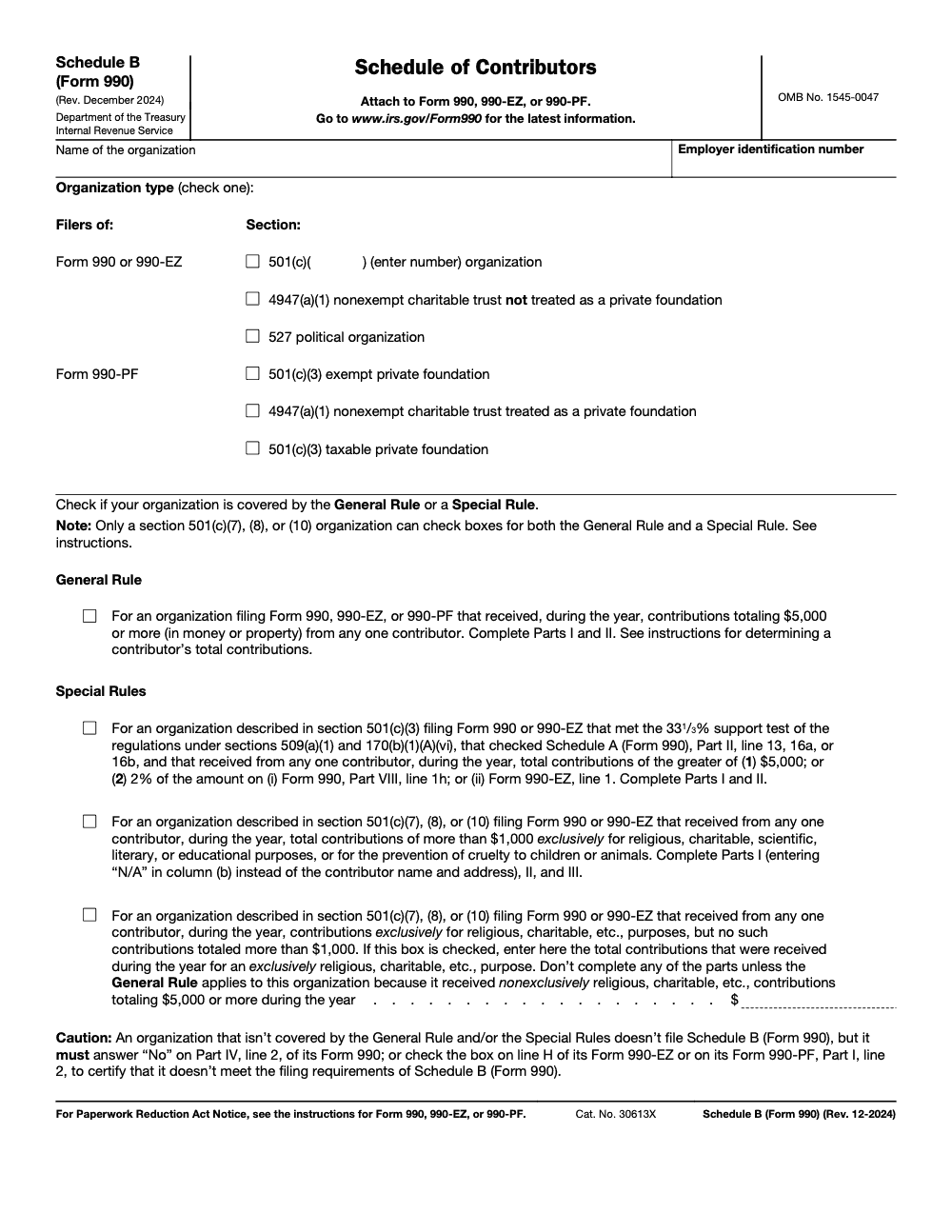
Schedule B (Form 990), the Schedule of Contributors, is attached to Form 990, 990-EZ, or 990-PF to report donors: under the General Rule you list any contributor who gave $5,000 or more in money and property combined (Parts I and II), while a 501(c)(3) that met the 33-1/3% public support test reports at the greater of $5,000 or 2% of total contributions (per the Schedule B instructions). Noncash gifts go in Part II at fair market value on the date received, and for calendar-year filers the attached schedule is due May 15.
Who lands on the Schedule B contributors list depends on the reporting rule the organization uses. Under the General Rule you report every donor who gave $5,000 or more in money and property combined, while a 501(c)(3) that met the 33-1/3% public support test reports at the greater of $5,000 or 2% of total contributions, measured against Form 990 Part VIII line 1h or Form 990-EZ line 1.
For 501(c)(7), (8), and (10) organizations the Special Rule covers gifts over $1,000 given exclusively for religious, charitable, scientific, literary, or educational purposes, reported in Parts I and III. Noncash gifts go in Part II at fair market value on the date received, and for calendar-year filers the schedule is due with the return on May 15, with a six-month extension available on Form 8868.
Key Takeaways
- Schedule B (Form 990), the Schedule of Contributors, attaches to Form 990, 990-EZ, or 990-PF to report donors. It is revision 12-2024, Catalog Number 30613X, OMB Number 1545-0047.
- Under the General Rule, you list any contributor who gave $5,000 or more in money and property combined, completing Parts I and II.
- A 501(c)(3) that met the 33-1/3% public support test reports at the greater of $5,000 or 2% of total contributions, measured against Form 990 Part VIII line 1h or Form 990-EZ line 1.
- For 501(c)(7), (8), or (10) organizations, the Special Rule covers gifts over $1,000 given exclusively for religious, charitable, scientific, literary, or educational purposes, reported in Parts I and III.
- Noncash gifts go in Part II at fair market value on the date received. The schedule has three Parts and four pages.
- For calendar-year filers the attached return is due May 15, with a six-month extension available on Form 8868.
Who must file Schedule B, and which rule applies
If you file Form 990, 990‑EZ, or 990‑PF, Schedule B is how you report your contributors. Whether you attach it, and which contributors you list, depends on a General Rule and a set of Special Rules.
- General Rule: an organization that received, during the year, contributions totaling $5,000 or more in money or property from any one contributor completes Parts I and II.
- 2% Special Rule: a 501(c)(3) filing Form 990 or 990‑EZ that met the 33-1/3% support test of the regulations under sections 509(a)(1) and 170(b)(1)(A)(vi) reports each contributor who gave the greater of $5,000 or 2% of total contributions.
- Religious or charitable Special Rule: a 501(c)(7), (8), or (10) reports any contributor who gave more than $1,000 exclusively for religious, charitable, scientific, literary, or educational purposes, completing Parts I, II, and III.
- Not required: if no rule applies, you still certify that on the parent return rather than silently omitting the schedule.
Plain cue, start with the $5,000 General Rule. If you are a 501(c)(3) public charity, swap in the greater of $5,000 or 2% test. If you are a 501(c)(7), (8), or (10), test the more-than-$1,000 religious-or-charitable rule.
The General Rule, the $5,000 threshold
The General Rule is the default. It looks at the aggregate of money and property a single contributor gave during the year, not cash alone, and the trigger is $5,000 or more.
How the aggregation works
- Sum every gift from one contributor: cash, checks, wires, and the fair market value of any property.
- Apply the $5,000 test to that combined figure.
- If the contributor crosses $5,000, complete Part I for the contributor and Part II for any noncash portion.
What Part I captures
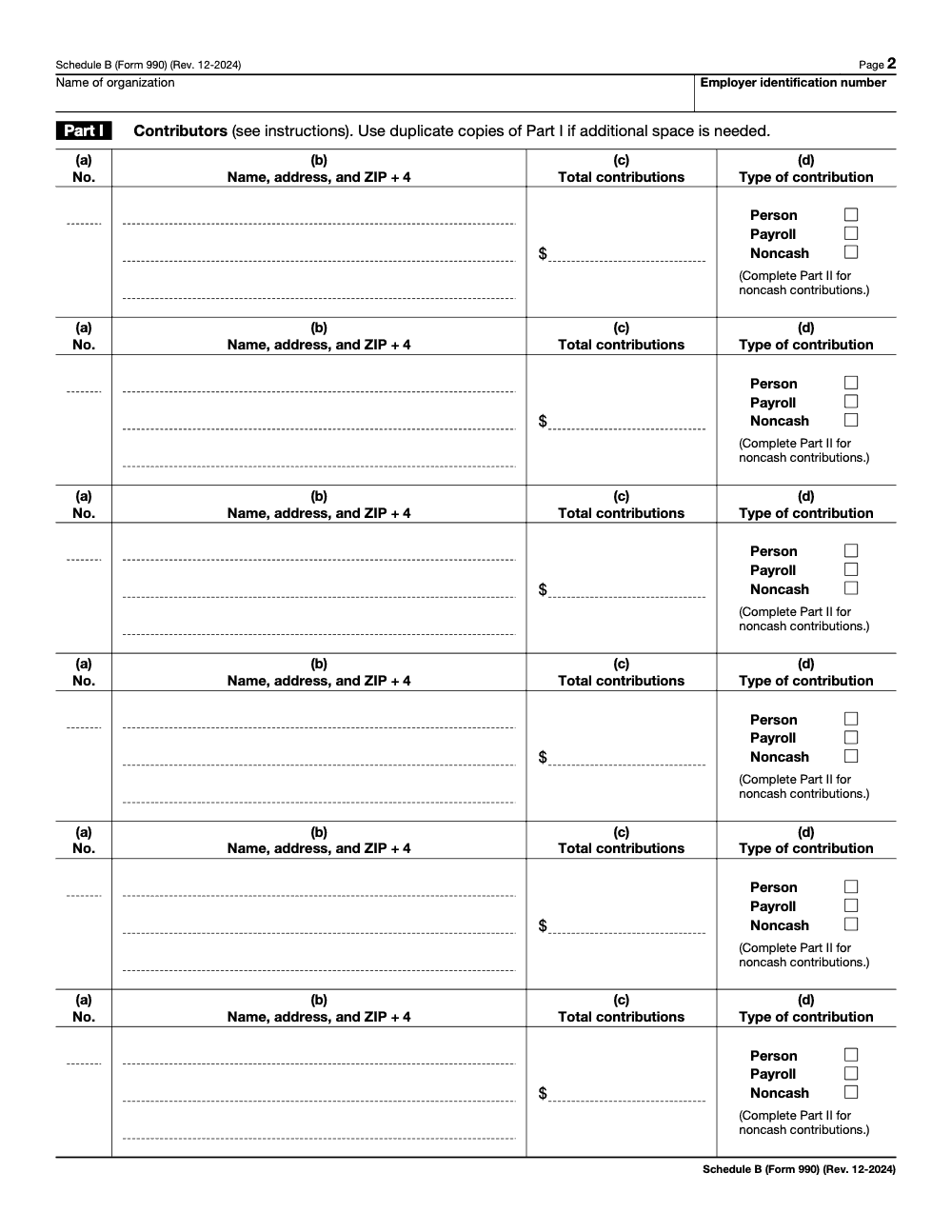
Part I lists contributors using four columns: (a) the contributor number, (b) name, address, and ZIP + 4, (c) total contributions, and (d) type of contribution, checked as Person, Payroll, or Noncash. Part I uses five rows per page, and you use duplicate copies if you need more space.
- Column (a): a sequential number for each contributor.
- Column (b): name, address, and ZIP + 4.
- Column (c): total contributions from that contributor for the year.
- Column (d): Person, Payroll, or Noncash. Mark Noncash and complete Part II for any noncash gift.
Practical examples
- A donor wires $3,000 and gifts appreciated stock worth $2,500. The combined $5,500 crosses the General Rule, so the donor goes in Part I, and the stock goes in Part II.
- A donor gives $4,000 in cash and nothing else. Below $5,000, so under the General Rule the donor is not listed.
- A donor sets up $500 monthly payroll deductions totaling $6,000 for the year. List the donor in Part I and mark column (d) as Payroll.
Data to gather before you start Schedule B
- A donor ledger that aggregates each contributor's cash and noncash gifts for the year.
- Fair market value support for every noncash gift, valued at the date received.
- Your Form 990 Part VIII line 1h total, or Form 990-EZ line 1, for the 2% calculation.
- Your public support test result if you are a 501(c)(3), to confirm whether the 2% Special Rule applies.
- Contributor names, addresses, and ZIP + 4 for Part I column (b).
- For 501(c)(7)/(8)/(10), a breakdown of gifts given exclusively for religious or charitable purposes, split between over $1,000 and $1,000 or less.
Pro tip, create a year‑labeled folder with three subfolders, “Part I,” “Part II,” and “Part III.” Place the donor ledger, valuation memos, and the public-support workpaper behind the exact part they support. Reviewers fly through returns when support mirrors the form.
The 2% Special Rule for 501(c)(3) public charities
If you are a 501(c)(3) that filed Form 990 or 990‑EZ and met the 33-1/3% support test under sections 509(a)(1) and 170(b)(1)(A)(vi), you do not list every $5,000 donor. Instead you report each contributor whose total gifts reach the greater of $5,000 or 2% of the amount on Form 990 Part VIII line 1h, or Form 990‑EZ line 1.
How to run the 2% math
- Pull total contributions from Form 990 Part VIII line 1h (or Form 990-EZ line 1).
- Multiply by 2%. Compare that figure to $5,000 and use the greater of the two as your threshold.
- List only contributors at or above that threshold in Part I.
Example, if total contributions are $400,000, 2% is $8,000, which is greater than $5,000, so your reporting threshold is $8,000. A 501(c)(3) that checked Schedule A (Form 990), Part II, line 13, 16a, or 16b also uses this Special Rule.
The Special Rule for 501(c)(7), (8), and (10) organizations
Social clubs and fraternal organizations under section 501(c)(7), (8), or (10) follow a different path for gifts given for charitable purposes. The trigger is more than $1,000 from any one contributor given exclusively for religious, charitable, scientific, literary, or educational purposes, or for the prevention of cruelty to children or animals.
What to complete
- Complete Part I, entering “N/A” in column (b) for the contributor name and address.
- Complete Part II for any noncash portion.
- Complete Part III to describe the exclusively religious or charitable gifts.
The $1,000-or-less aggregate
For gifts that did not exceed $1,000, you do not list each one. Instead, enter the total of exclusively religious or charitable contributions of $1,000 or less for the year once on the Part III summary line. If no such contribution totaled more than $1,000, you can check the box and report only that aggregate.
Choosing one organization-type box
The top of Schedule B asks you to check exactly one organization-type box that matches your filer. Get this right, because it drives which rules and which public-inspection treatment apply.
- Form 990 or 990-EZ filers choose from: 501(c)( ) organization (enter the number), 4947(a)(1) nonexempt charitable trust not treated as a private foundation, or 527 political organization.
- Form 990-PF filers choose from: 501(c)(3) exempt private foundation, 4947(a)(1) nonexempt charitable trust treated as a private foundation, or 501(c)(3) taxable private foundation.
Check only one box. A second checked box is a common defect that sends the return back for correction.
Part I, the contributors list
Part I is the heart of Schedule B. Each line records one contributor across four columns, and you fill it in for every contributor your rule captures.
Filling in the four columns
- Column (a) No.: a sequential number for each contributor.
- Column (b) Name, address, and ZIP + 4: the contributor's full details, except enter “N/A” here for 501(c)(7)/(8)/(10) religious or charitable gifts.
- Column (c) Total contributions: the contributor's combined money and property for the year.
- Column (d) Type of contribution: check Person, Payroll, or Noncash. Complete Part II for any Noncash entry.
Part I gives five rows per page. Use duplicate copies of Part I if you need additional space, and keep the contributor numbering continuous across pages so Part II and Part III can reference the same numbers.
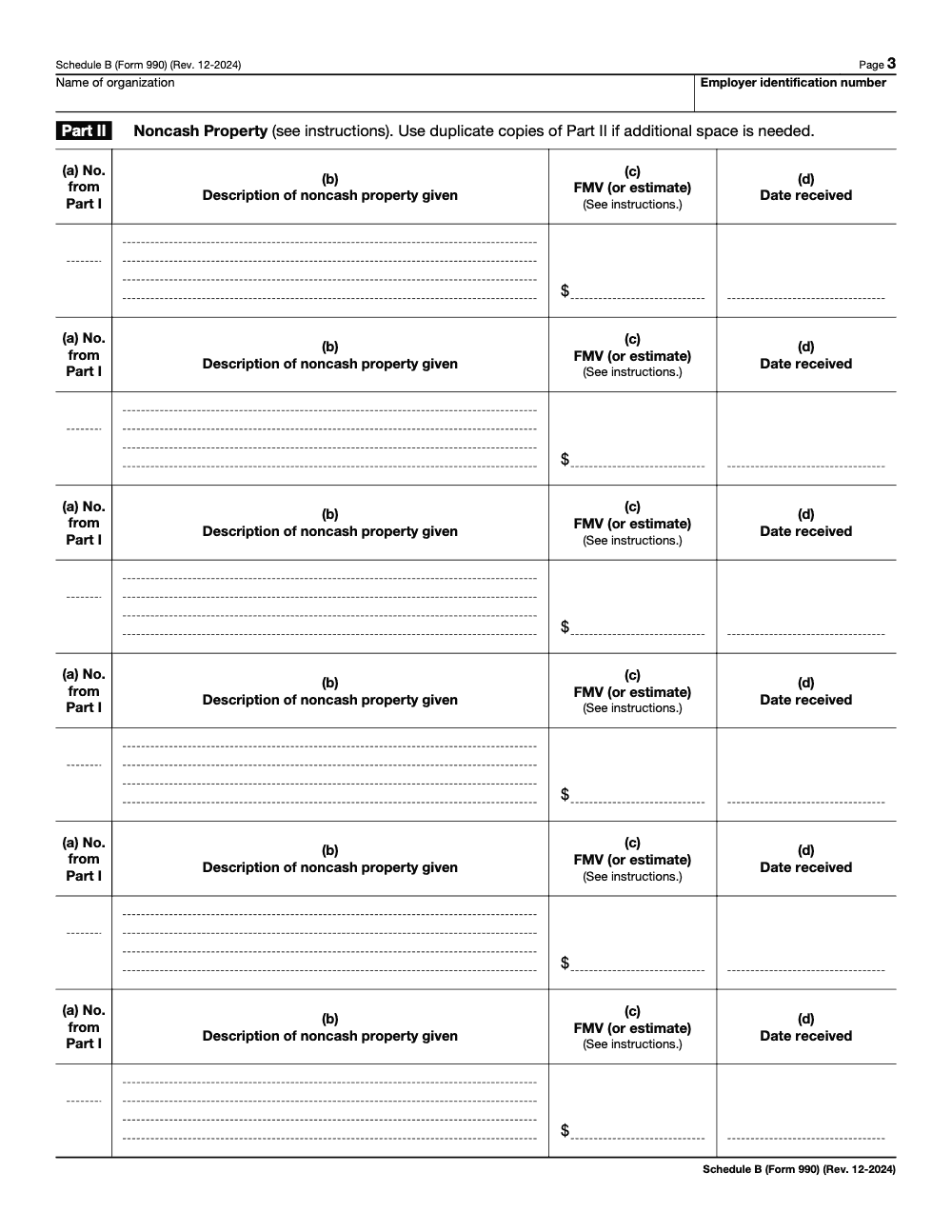
Part II, noncash property at fair market value
Part II describes the noncash gifts you flagged in Part I column (d). The cardinal rule is valuation: report fair market value, or a reasonable estimate, as of the date the organization received the property, not the donor's cost basis or a later sale price.
The Part II columns
- Column (a) No. from Part I: the contributor number you assigned in Part I.
- Column (b) Description of noncash property given.
- Column (c) FMV (or estimate): the fair market value at the date received.
- Column (d) Date received.
Valuation discipline
FMV at the date received is what belongs in column (c). If a donor gives publicly traded stock, that is the market value on the receipt date. For property that is harder to value, keep a short estimate memo in your workpapers so a reviewer can see how you arrived at the number.
Donor substantiation that travels with the gift
- A donor claiming a deduction over $500 but not over $5,000 for a noncash gift must complete Form 8283, Section A, and have a contemporaneous written acknowledgment.
- A donor claiming over $5,000 must obtain a qualified appraisal and complete Form 8283, Section B.
- If the organization disposes of property within three years that required a Form 8283 signature, it generally files Form 8282 within 125 days, unless the appraised value was $500 or less.
Keep the donor record either way
Even when a contributor falls below your reporting threshold, keep names, addresses, and gift details in your own records. The schedule reports a subset of donors; your books should hold the full picture for audit support and the public-support test.
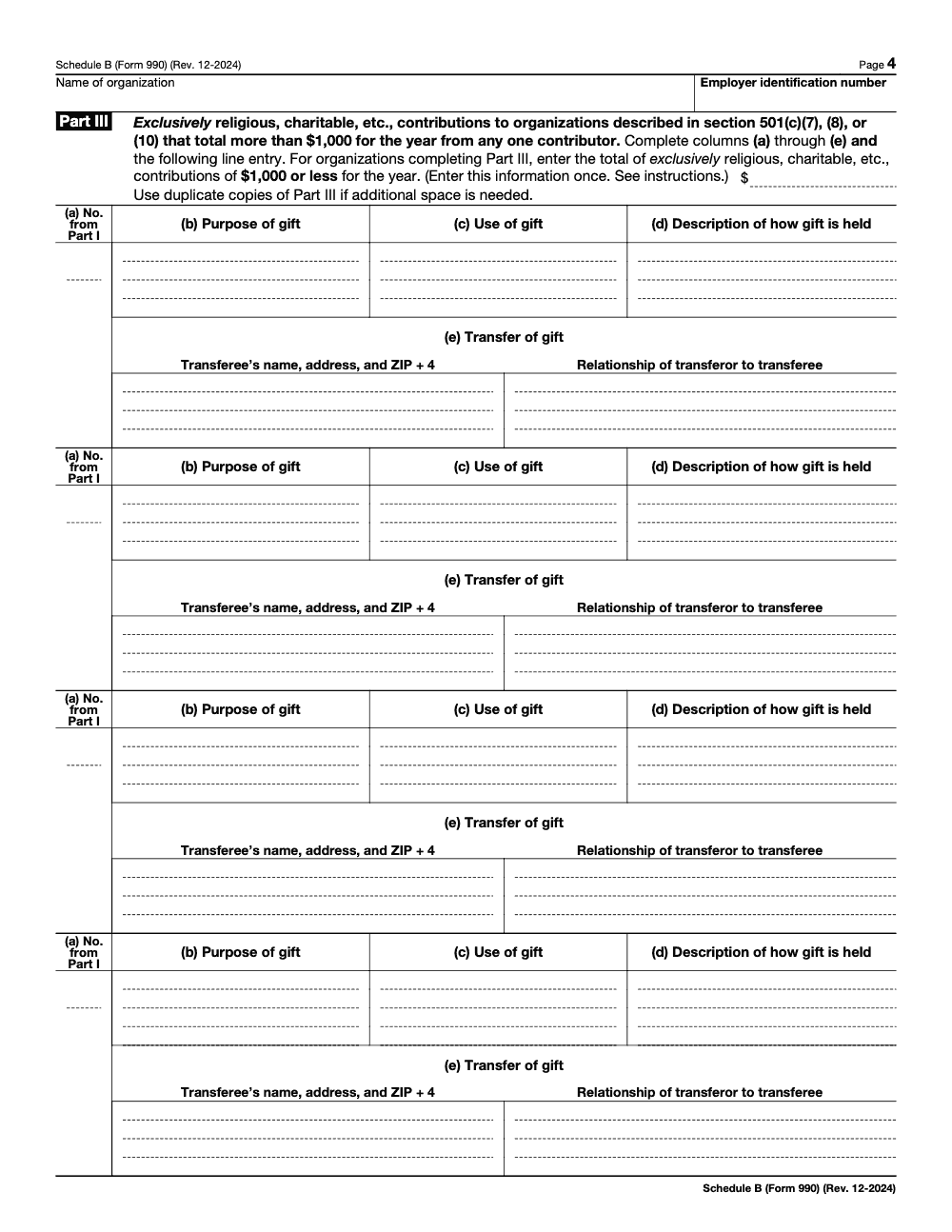
Part III, exclusively religious or charitable gifts
Part III applies only to 501(c)(7), (8), or (10) organizations and only for gifts given exclusively for religious, charitable, scientific, literary, or educational purposes, or for the prevention of cruelty to children or animals.
The over-$1,000 detail
- Column (a) No. from Part I: the contributor number.
- Column (b) Purpose of gift.
- Column (c) Use of gift.
- Column (d) Description of how the gift is held.
- Column (e) Transfer of gift: the transferee's name, address, and ZIP + 4, and the relationship of transferor to transferee, when the gift was transferred.
The $1,000-or-less aggregate line
For gifts of $1,000 or less, you do not detail each one. Enter the total of exclusively religious or charitable contributions of $1,000 or less for the year once on the Part III summary line. Enter that information a single time.
Why the N/A treatment matters
For these organizations, Part I column (b) takes “N/A,” not the donor's name and address. The donor identity lives in your workpapers, while Part III carries the purpose and use. Mixing those up is a common disclosure error.
Public inspection, what stays private
Schedule B is unusual: it is filed with the IRS, but for most filers the contributor names and addresses are not part of the publicly inspected return.
Who is redacted, who is public
- For most 501(c) organizations filing Form 990 or 990-EZ, contributor names and addresses on Schedule B are redacted from the public copy.
- Private foundations on Form 990-PF and section 527 political organizations have contributor detail that is public.
- Failing to allow required public inspection carries a $20-per-day penalty, up to $10,000 for any one return, and a $5,000 penalty for willful failure.
Route private-foundation and 527 returns through a separate public-disclosure review so the redaction call is never made by default.
Certifying when Schedule B is not required
If no rule captures any contributor, you cannot simply leave the schedule off. You affirmatively certify that Schedule B is not required on the parent return.
- On Form 990, answer “No” on Part IV, line 2.
- On Form 990-EZ, check the box on line H.
- On Form 990-PF, check the box on Part I, line 2.
That certification tells the IRS the omission is intentional, not a missing attachment. Build it into your filing checklist so every return either attaches Schedule B or states it is not required.
Common mistakes and how to avoid them
Most Schedule B errors I see are not arithmetic, they are routing errors: the wrong threshold, the wrong column, or the wrong assumption about what becomes public. Here are the ones that send a return back for rework.
A step‑by‑step Schedule B workflow you can reuse
- Identify the parent return: Form 990, 990‑EZ, or 990‑PF, and check exactly one organization-type box.
- Aggregate each contributor's money and property for the year from a clean donor ledger.
- Apply the right threshold: the $5,000 General Rule, the greater of $5,000 or 2% for qualifying 501(c)(3) public charities, or the more-than-$1,000 religious-or-charitable rule for 501(c)(7)/(8)/(10).
- Complete Part I columns (a) through (d), marking Person, Payroll, or Noncash.
- For every Noncash entry, complete Part II with the description, FMV at the date received, and the date.
- For 501(c)(7)/(8)/(10), enter “N/A” in Part I column (b), complete Part III, and enter the $1,000-or-less aggregate once.
- Settle the public-versus-private redaction call by filer type, then route to a second reviewer for a cold read.
E‑filing and software hygiene
Use reputable software that supports Schedule B prompts, validates the threshold tests, and flags incomplete contributor rows. Before you transmit, do a final PDF pass from the top of the parent return through Schedule B's three Parts. Confirm only one organization-type box is checked, Part II is completed for every Noncash contributor, and the public copy redacts contributor detail for non-PF, non-527 filers. Most exempt returns are accepted quickly, yet turnaround can slow during peak season, so build in buffer time.
Delivery discipline, the hidden edge
You do not scale compliance by working later. You scale it by building a repeatable delivery system. Standard operating procedures, structured workpapers, layered reviews, turnaround SLAs, and predictable escalation paths reduce rework and protect reviewer time. If you need extra hands, bring in trained support that works inside your systems, uses your templates, and understands U.S. standards, so you gain capacity without losing control.
Our team has seen firms cut Schedule B review time by hours once they standardize the donor ledger, introduce preparer checklists, and add a quality layer that catches missed Part II valuations and redaction errors before partner review. That is the kind of simple, durable win that sticks year after year.
Final checklist and a calm close
- Confirm which rule applies for your filer type, and check exactly one organization-type box.
- Aggregate money and property per contributor, then apply the threshold and complete Part I.
- Value every noncash gift at FMV on the date received in Part II, and complete Part III for 501(c)(7)/(8)/(10) religious or charitable gifts.
- Make the public-versus-private redaction call, certify on the parent return if Schedule B is not required, then e‑file early to avoid peak season slowdowns.
If your internal team is stretched, add capacity the right way. Trained, accountable support that works inside your systems, follows your SOPs, and respects your review notes will keep quality high and filings on time. That way, Schedule B becomes a smooth, repeatable part of your compliance calendar, not a source of last‑minute stress.
This guide is for general information. It is not legal or tax advice. Always apply the most current IRS instructions to your facts and consult a qualified advisor when you have edge cases or uncertainty.
Reusable Checklists
These checklists are copy-paste ready for your firm SOPs. Drop them into your nonprofit engagement file and work them top to bottom each season.
Schedule B filing decision
- Identify the parent return: Form 990, 990-EZ, or 990-PF.
- Check exactly one organization-type box at the top of Schedule B.
- Apply the right threshold: the $5,000 General Rule, or the greater of $5,000 or 2% of total contributions for a 501(c)(3) that met the 33-1/3% public support test.
- For a 501(c)(7), (8), or (10), test the more-than-$1,000 exclusively-religious-or-charitable Special Rule.
- If no rule applies, certify it on Form 990 Part IV line 2, Form 990-EZ line H, or Form 990-PF Part I line 2.
- Confirm the parent return is e-filed with the schedule attached.
Contributor and noncash workpaper
- Aggregate money and property per contributor before applying any threshold.
- Complete Part I columns (a) through (d), marking Person, Payroll, or Noncash.
- For every Noncash entry, complete Part II with a description, FMV (or estimate) at the date received, and the date.
- Pull the total contributions figure from Form 990 Part VIII line 1h or Form 990-EZ line 1 for the 2% calculation.
- For 501(c)(7)/(8)/(10) gifts over $1,000, enter “N/A” in Part I column (b) and complete Part III.
- Enter the aggregate of exclusively religious or charitable gifts of $1,000 or less one time on the Part III summary line.
Pre-release review
- Verify only one organization-type box is checked.
- Confirm Part II is completed for every contributor marked Noncash.
- Redact contributor names and addresses on the public copy for non-PF, non-527 filers.
- Leave private-foundation and section 527 contributor detail public where required.
- Diary the May 15 deadline for calendar-year filers, or file Form 8868 for the six-month extension.
- Keep donor names and addresses in your records even where reporting is not required.
Keep Schedule B (Form 990) Season From Stalling
Schedule B does not get its own calendar slot; it rides on the Form 990, 990-EZ, or 990-PF, which all land for calendar-year organizations on May 15. That single deadline stacks donor reconciliation, noncash valuation, and public-disclosure decisions into the same window, and the stakes are real: an incomplete return carries the same $20-per-day failure-to-file penalty as filing nothing, capped at the smaller of $10,000 or 5% of gross receipts, and three consecutive years of missed filings revoke exempt status by operation of law (per IRS Publication 557).
The fix is not longer nights in early May. It is a contributor workflow that runs the same way every year, so the threshold tests, the Part II valuations, and the redaction call are settled well before the parent return is assembled.
- Lock the threshold test first: aggregate money and property per donor, then apply the $5,000 General Rule or the greater of $5,000 or 2% of total contributions for qualifying 501(c)(3) public charities.
- Capture fair market value at the date received for every Noncash entry, so Part II is never reconstructed from memory at filing time.
- Standardize the “N/A” treatment in Part I column (b) for 501(c)(7)/(8)/(10) gifts over $1,000, and the single aggregate line in Part III for gifts of $1,000 or less.
- Settle the public-versus-private call by filer type early, since contributor names are redacted for most 501(c) filers but public for private foundations and 527 organizations.
- Calendar the May 15 parent-return date and the Form 8868 six-month extension so nothing slips during a peak-season crush.
This is the kind of repeatable, review-friendly system we build with clients. Accountably integrates trained, U.S.-led offshore teams into your tax and accounting workflow with documented SOPs and layered review, so contributor schedules are prepared, valued, and disclosure-checked on a predictable cadence rather than in a last-minute scramble.
FAQs
Schedule B (Form 990), the Schedule of Contributors, is the attachment that reports an exempt organization's donors. It attaches to Form 990, 990-EZ, or 990-PF and lists contributors who meet a reporting threshold, along with noncash gifts and, for certain organizations, exclusively religious or charitable contributions.
Under the General Rule, you report any contributor who gave $5,000 or more in money and property combined. A 501(c)(3) that met the 33-1/3% public support test reports at the greater of $5,000 or 2% of total contributions. A 501(c)(7), (8), or (10) reports contributors who gave more than $1,000 exclusively for religious or charitable purposes.
Mark the contribution as Noncash in Part I column (d), then complete Part II with a description of the property, its fair market value (or a reasonable estimate) as of the date received, and the date received. Use FMV at the date received, not the donor's cost basis or a later sale price.
For most 501(c) organizations filing Form 990 or 990-EZ, contributor names and addresses on Schedule B are redacted from the publicly inspected return. The exceptions are private foundations on Form 990-PF and section 527 political organizations, whose contributor detail is public.
You certify it on the parent return rather than omitting the schedule silently. Answer “No” on Form 990 Part IV, line 2, check the box on Form 990-EZ line H, or check the box on Form 990-PF Part I, line 2. For calendar-year filers the return is due May 15, with a six-month extension available on Form 8868.
Other forms this guide names
- Form 990: Nonprofit Tax Return Filing Guide 2025
- Form 990‑EZ: Eligibility, Deadlines, E‑File, Schedules
- Form 990‑PF: Filing Guide, Payout, E‑File
- Form 8283: Noncash Charitable Contributions Guide 2025
- Form 8868: Extension for Exempt Organization Returns
- Form 8282: Nonprofit Filing Guide, 125‑Day Deadline and 3‑Year Rule
Summarize this article with AI
About this guide
Accountably helps US CPA, EA, and accounting firms hire trained accountants and tax preparers in India.
About us Reviewed byJugal Thacker, CPAFounder and CEO at Accountably
A Washington-licensed CPA with 7+ years inside US firms – PwC, a real-estate tax practice, then a full-service firm, rising from reviewer to manager to advisory. This article was reviewed against current IRS guidance for the 2025 tax year and updated for filers preparing late returns, amendments, and 2026 estimates.
View profile →How we research, review, and update this guide
Every Accountably guide is researched against primary IRS sources, reviewed by a U.S. CPA, and refreshed as guidance evolves. Read our Editorial Guidelines to see how we source, fact-check, and update our content.