Summarize this article with AI
In Brief
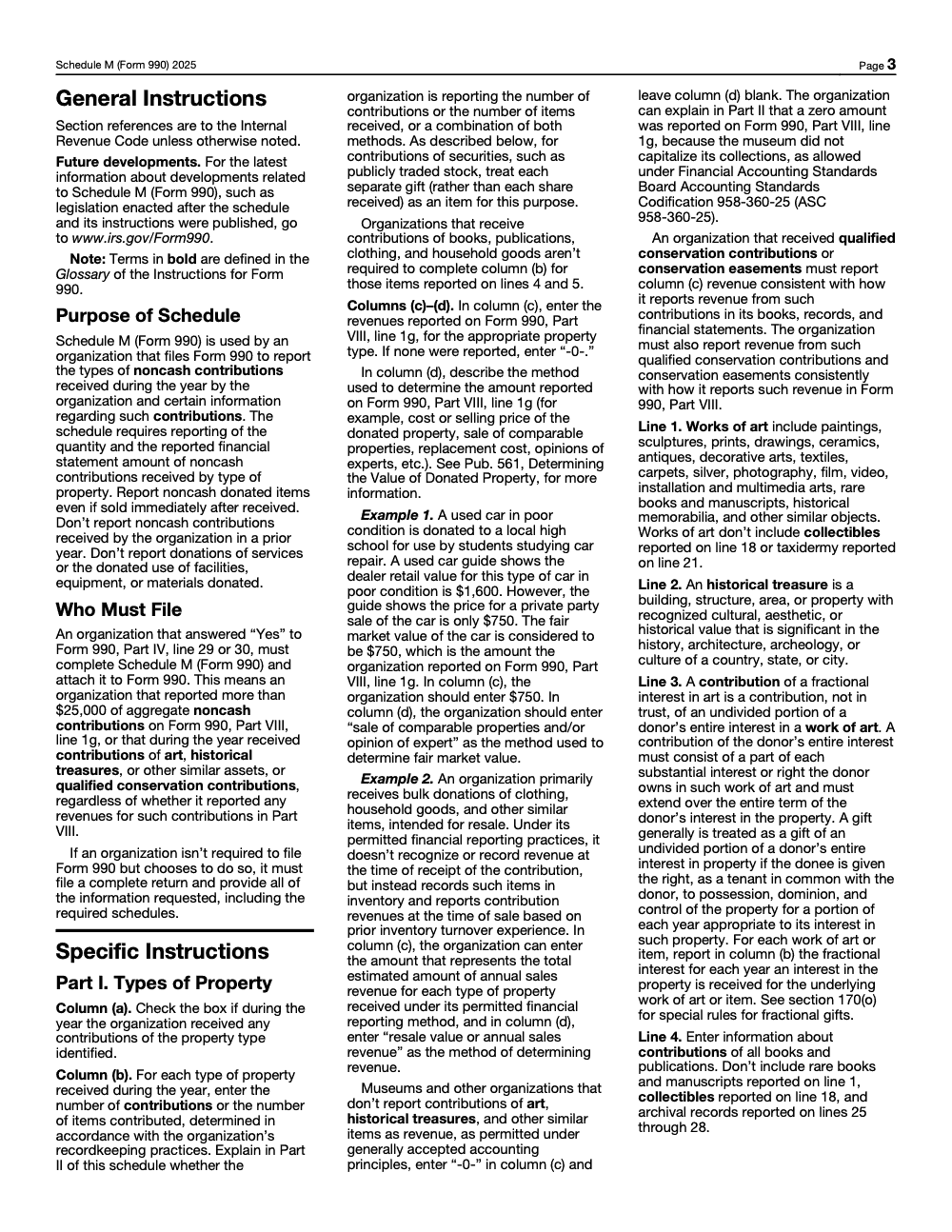
Schedule M (Form 990) is the attachment where a tax-exempt organization reports its noncash contributions by property type across lines 1-28, with amounts that reconcile to Form 990, Part VIII, line 1g. You attach it when you answer Yes to Form 990, Part IV, line 29 (more than $25,000 in aggregate noncash contributions) or line 30 (any gift of art, historical treasures, or a qualified conservation contribution, regardless of dollar amount), per the 2025 Instructions for Schedule M (Form 990). Firms running 990 preparation at volume standardize this step.
A nonprofit takes in donated furniture, a used van, and a block of stock over the year, books them at year-end, and then has to decide whether any of it lands on Schedule M. The deciding lines are Form 990, Part IV, line 29, more than $25,000 of aggregate noncash contributions, and line 30, any gift of art, historical treasures, or a qualified conservation contribution regardless of dollar amount. One Yes on either, and the schedule is in play.
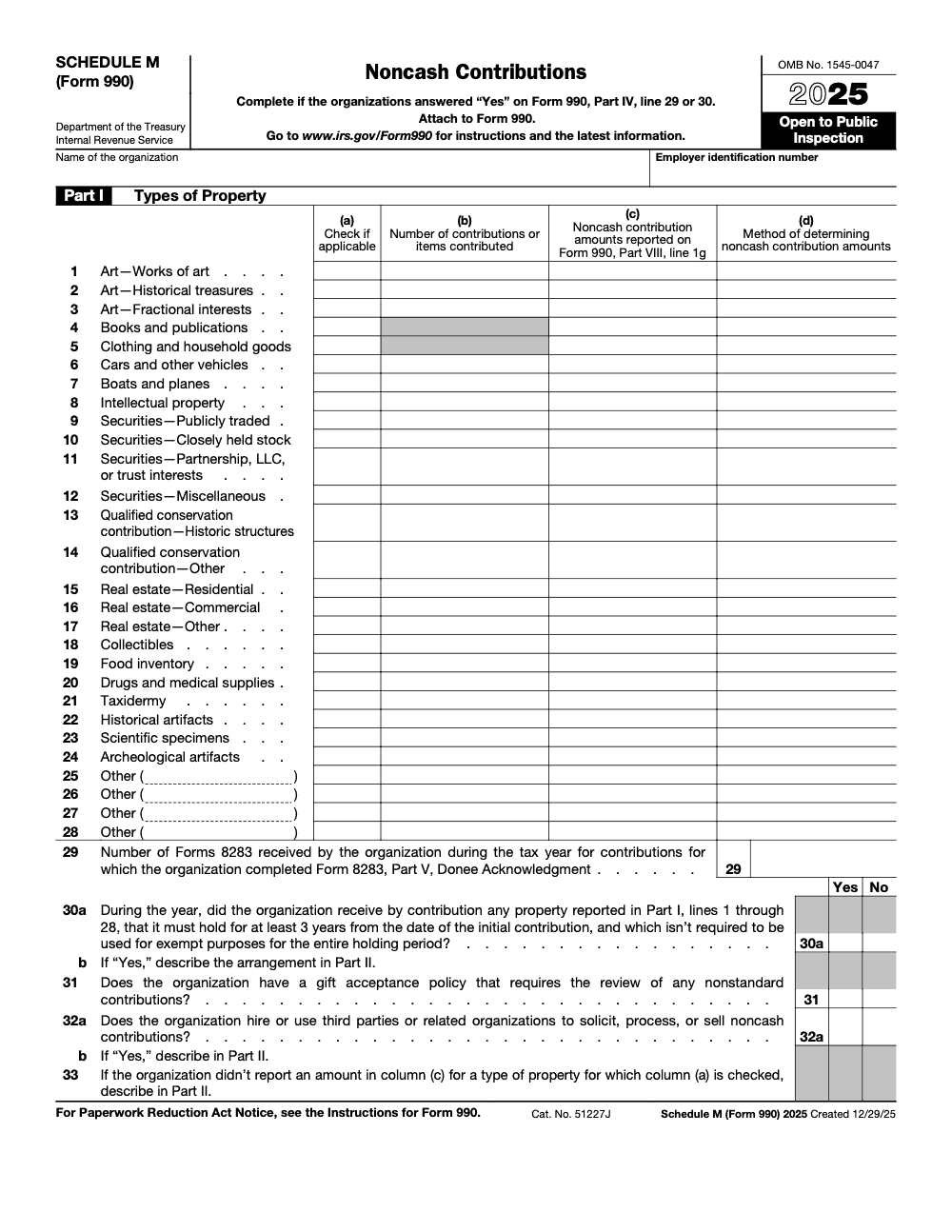
Part I sorts gifts across 24 named property types on lines 1-24, plus four user-defined lines 25 through 28, with the amounts reconciling to Form 990, Part VIII, line 1g. Watch the cross-form ties: vehicle, boat, and airplane gifts on lines 6-7 need Form 1098-C, certain intellectual property on line 8 needs Form 8899, and for calendar-year filers the return with Schedule M is due May 15, 2026, extendable to November 16, 2026.
Key Takeaways
- Schedule M (Form 990) reports the types of noncash contributions a tax-exempt organization received during the year. It attaches to Form 990, not Form 990-EZ or Form 990-PF.
- You must file Schedule M if you answered “Yes” on Form 990, Part IV, line 29 (more than $25,000 of aggregate noncash contributions on Part VIII, line 1g) or line 30 (art, historical treasures, similar assets, or qualified conservation contributions, regardless of dollar amount).
- Part I lists 24 named property types (lines 1-24) plus four user-defined “Other” lines (25-28), with columns for the count, the amount tied to Part VIII, line 1g, and the valuation method. Part II is the supplemental narrative.
- Vehicle, boat, and airplane gifts (lines 6-7) require Form 1098-C; certain intellectual property gifts (line 8) require Form 8899. Line 29 counts the Forms 8283 you completed as donee in Part V.
- Report noncash gifts even if sold immediately after receipt, and don’t report donated services or the donated use of facilities, equipment, or materials.
- For calendar-year filers, Form 990 with Schedule M is due May 15, 2026. Form 8868 grants an automatic 6-month extension to November 16, 2026 (the 15th falls on a Sunday, so the deadline rolls to the next business day). Schedule M is open to public inspection.
What Schedule M does, in plain terms
Schedule M surfaces your organization’s noncash contributions so readers can see what you received, how you valued it, and how you handled it. Think of it as a property‑by‑property roll‑up, paired with a short narrative explaining your policies and any unusual facts. You will list up to 24 property types in Part I, plus up to four “Other” lines. You will show counts, the total amounts you reported on Part VIII, line 1g, and how you determined those amounts. Then, in Part II, you will add context that makes those numbers understandable and review‑ready.
What counts as “noncash contributions”? Property, tangible or intangible, such as securities, real estate, artwork, vehicles, inventory, intellectual property, or items donated for auction. Do not include volunteer services, or the donated use of facilities or equipment. Value items at the time received, even if you immediately liquidate them.
Where this fits on the core 990
- You capture noncash gifts in the contributions section of Part VIII. The noncash portion is summarized on line 1g. If line 1g exceeds 25,000, answer “Yes” on Part IV, line 29. If you received works of art, historical treasures, similar assets, or a qualified conservation contribution, answer “Yes” on Part IV, line 30, regardless of dollar amount. Either “Yes” requires attaching Schedule M.
What Schedule M is not
- It is not a place to report donated services or donated use of space or equipment.
- It is not a donor acknowledgment form. However, you will often reference donor documentation to substantiate values and counts.
- It is not a substitute for Forms 8283, 8282, or 1098‑C. Those forms have their own rules that may apply alongside Schedule M.
The What‑How‑Wow, a quick map
- What: A required attachment that details noncash contributions by property type, amounts, and valuation methods, plus a short narrative clarifying policies and special situations.
- How: Reconcile totals to Part VIII, line 1g, disclose how you counted items, describe any required holding periods or donor restrictions, and explain third‑party roles. Keep your supporting files tight.
- Wow: Use clear valuation methods anchored in IRS valuation guidance, for example Publication 561. Anticipate reviewer questions in Part II to cut review time and avoid IRS correspondence.
When Schedule M is required, thresholds and triggers
Start by checking the two triggers on the core Form 990.
- Trigger 1, the aggregate threshold: If the total value of your noncash contributions reported on Part VIII, line 1g exceeds $25,000, you must answer “Yes” on Part IV, line 29 and attach Schedule M. Remember, you measure value at the time you received the property, even when you sold it right away.
- Trigger 2, specified asset types: If you received any works of art, historical treasures or artifacts, scientific specimens, archaeological artifacts, or a qualified conservation contribution, answer “Yes” on Part IV, line 30 and attach Schedule M, even if total noncash gifts are under $25,000.
Clarifying what to include
- Include, donated securities, closely held shares, partnership or LLC interests, artwork, vehicles, boats, airplanes, real estate, inventory such as food or medical supplies, intellectual property, collectibles, and conservation easements.
- Exclude, donated services, the donated use of facilities, donated use of equipment or materials, and noncash gifts received in prior years.
Example, your organization receives a block of stock in April that is sold the same day. You still report the fair value at receipt on Part VIII and include it in the line 1g total that drives the Schedule M threshold.
Reconciling to Part VIII line 1g without drama
- Sum the amounts you recorded for each checked property type in Part I, column c, then reconcile to your Form 990, Part VIII, line 1g. If a property type is checked but the amount is zero, explain why in Part II, for example museum collections not capitalized under GAAP.
- For museums and similar organizations that choose not to capitalize collections under ASC 958, it is acceptable to show zero in column c and explain that policy in Part II. A zero in column c does not remove the filing obligation. If you check column a for that property type, you must still complete Schedule M for it.
Completing Part I, the types of property and columns that matter
Part I is where you check each applicable property category, provide counts in column b, report total noncash contribution amounts in column c, and name your valuation method in column d.
- Column a, check every property type you actually received during the year, including “Other” lines 25–28 for anything not listed.
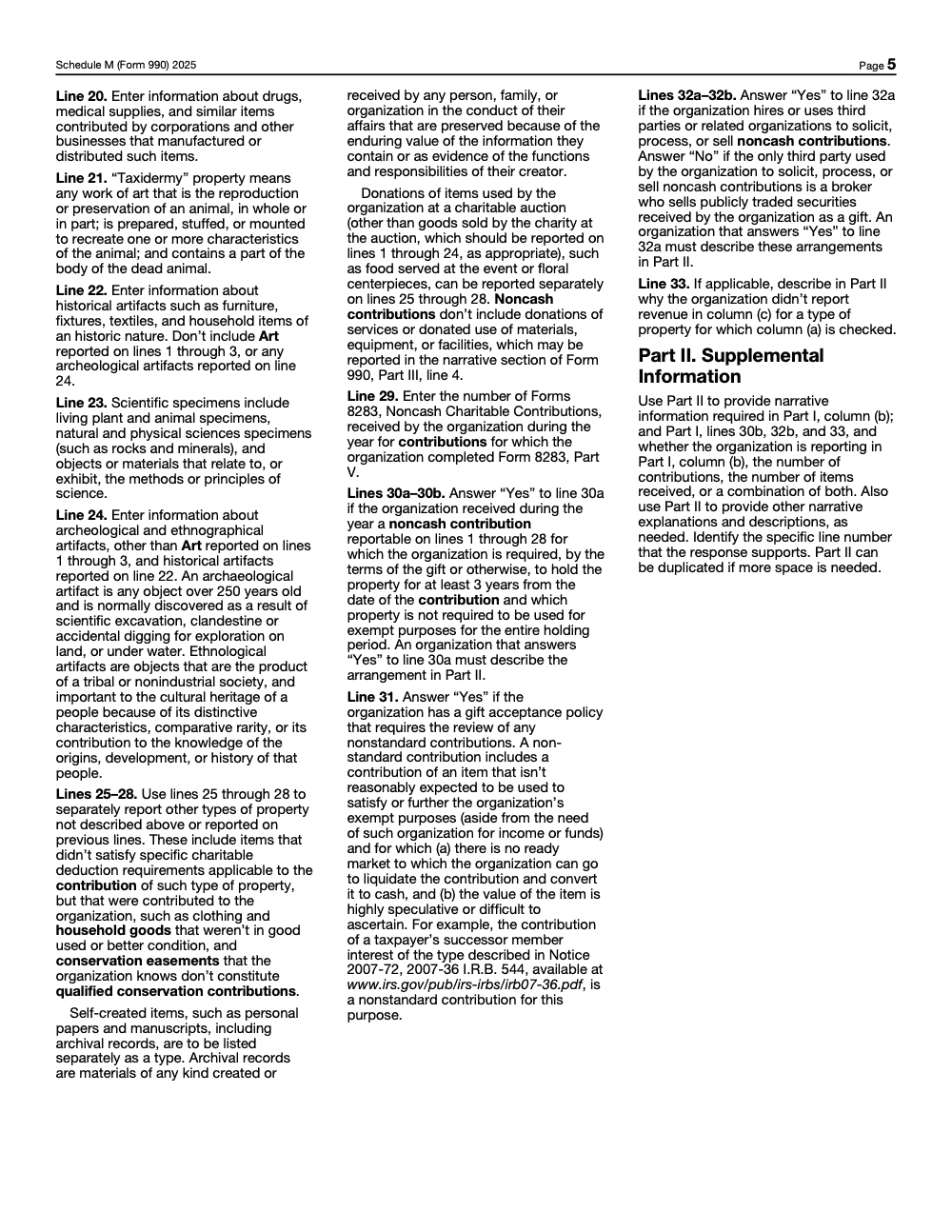
- Column b, report either the number of contributions or the number of items, consistent with how you track them. You must disclose in Part II whether column b reflects contributions, items, or a combination. For securities gifts, count each gift, not each share. You can skip column b for books, publications, clothing, and household goods.
- Column c, enter the amounts you reported on Part VIII, line 1g, for each checked type. If none, enter zero.
- Column d, state how you determined those amounts, for example quoted market prices, resale value, cost or selling price, sale of comparable property, replacement cost, or opinions of experts. Use Publication 561 as your anchor for valuation approaches.
A quick valuation guide you can adapt
| Property type | Typical valuation touchpoints you may cite in column d |
| Publicly traded securities | Average of high and low, or bid‑ask on date received, consistent with GAAP and your policy |
| Closely held stock, partnership, LLC interests | Qualified appraisal or valuation report, sale of comparable interests, expert opinion |
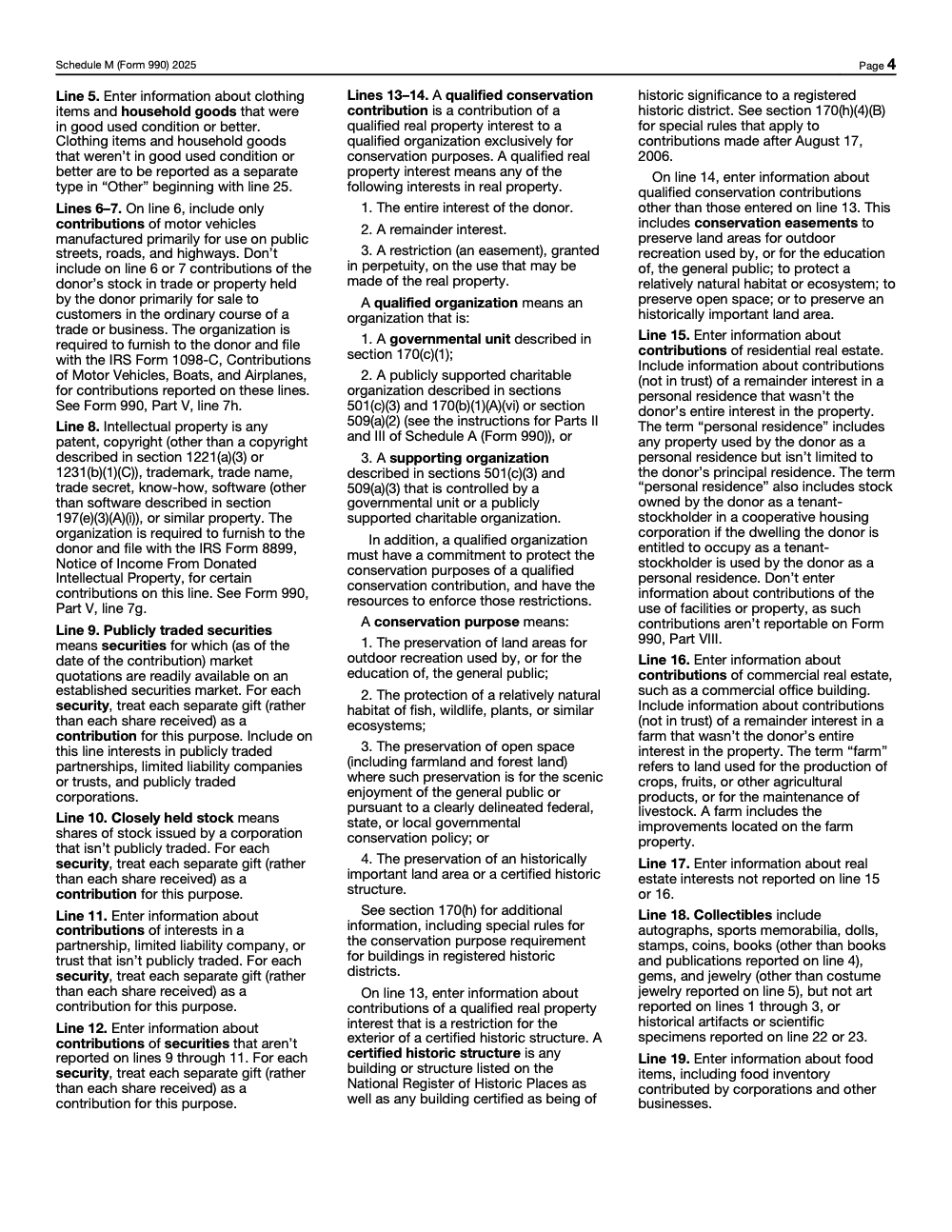
| Vehicles, boats, planes | Guides plus sale of comparable property, or gross proceeds model consistent with your accounting, using the private-party sale price from the guide rather than the dealer retail value when the two diverge, paired with donor 1098‑C for their deduction record, not your valuation |
| Real estate | Qualified appraisal, comparable sales, replacement cost less depreciation where appropriate |
| Artwork and historical treasures | Qualified appraisal by a qualified appraiser, consistent with museum policy and GAAP |
| Inventory like food or medical supplies | Cost, replacement cost, or permitted resale value method consistent with your financial statements |
Tie each method to the real documentation you keep, for example appraisal reports or market quotes. Keep methods consistent year to year unless policy changes are documented.
Tip, if you check a property type but show zero in column c, use Part II to explain the GAAP policy, resale timing, or other reason. It prevents unnecessary reviewer questions.
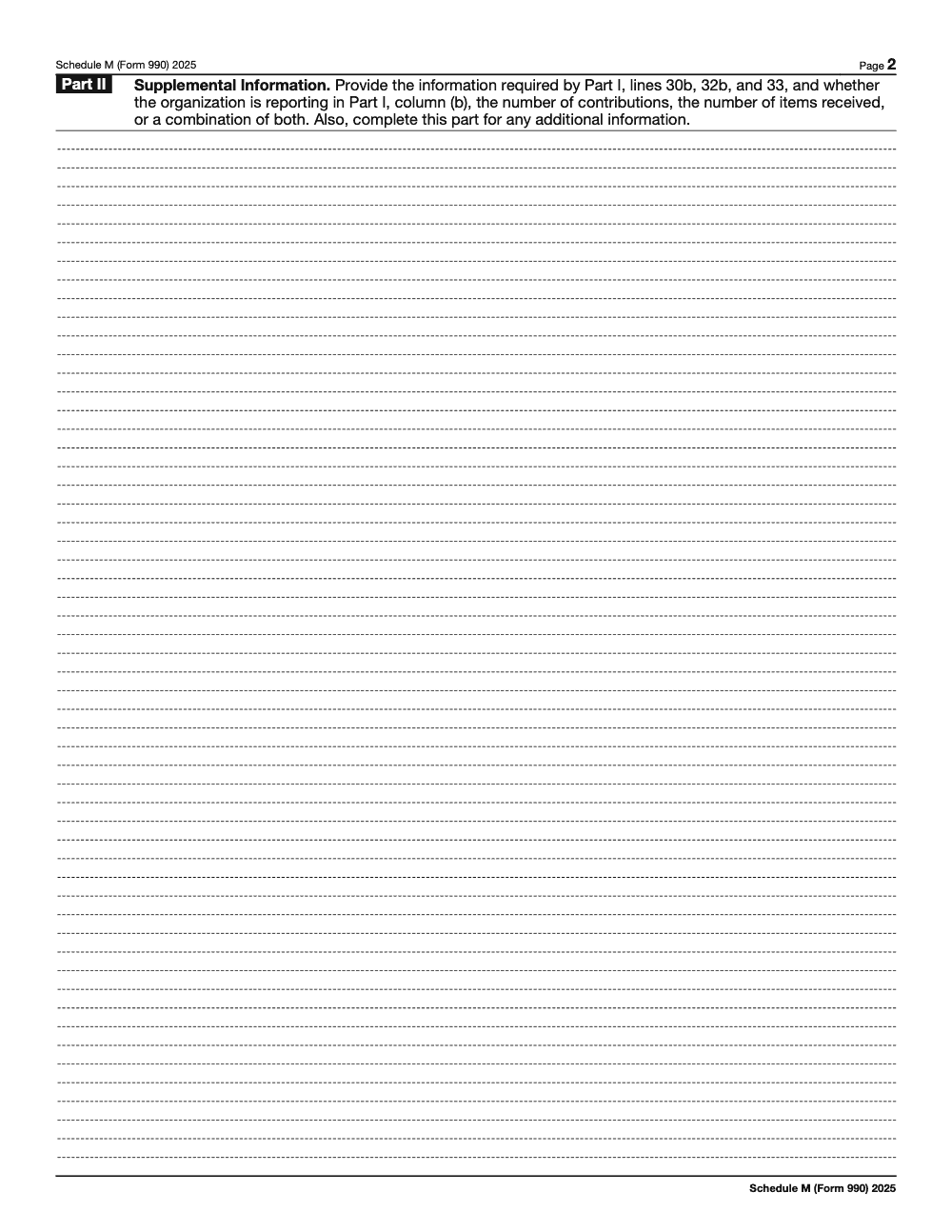
Part II narratives that protect your review time
Part II turns your columns into a complete story. Keep it concise, specific, and tied to Part I line numbers.
- State whether column b shows number of contributions, number of items, or a mix, and why that approach best fits your records.
- Identify any required holding periods, for example property that must be held for at least three years, and say whether the item must be used for exempt purposes during that period. Reference the relevant Part I lines.
- Describe any donor‑imposed restrictions, such as use limitations, naming, or resale limits.
- Disclose third‑party roles, for example an affiliate or vendor that solicits, processes, or sells noncash contributions, and how proceeds and reporting are handled.
- Clarify valuation methods by property type, especially if you use different methods for different categories, for example quoted prices for stock and qualified appraisals for art. Cite Publication 561 as your policy basis.
Copy‑ready sample language you can tailor
Part I, lines 9–12 securities, column b reflects number of contributions, not number of shares, consistent with brokerage intake reports. Column d amounts are based on quoted market prices on the date received. Part I, line 1 works of art and line 2 historical treasures, items received for our collection are not capitalized under ASC 958. Column c shows zero, consistent with our GAAP policy. Part I, line 6 vehicles, we receive and process donated vehicles through a contracted auction vendor. The vendor handles towing, sale, and proceeds remittance. We recognize contribution revenue based on expected proceeds. Donor acknowledgments are furnished on Form 1098‑C by the required deadlines.
The documents you should have on hand
- Form 8283, if a donor requests your acknowledgment for donations over 5,000 or for certain partial interests. Keep a copy after you sign Part V of Section B. You are acknowledging receipt, not the value.
- Qualified appraisals where applicable, for example art, real estate, or closely held interests, consistent with Publication 561 and the Form 8283 instructions.
- Form 8282, if you dispose of donated property within three years of receipt and it is not excluded property. Track the date received so you do not miss this requirement.
- For donated vehicles, timely Form 1098‑C acknowledgments to donors, and if required, the filed copy to the IRS.
Year‑round recordkeeping checklist
- A running ledger of noncash contributions with donor, date received, description, quantity or item count, and recorded value at receipt.
- Source support, for example brokerage confirmations, appraisals, price quotes, photos, intake receipts, vendor contracts.
- Completed donor Forms 8283 provided back to donors when required, with your signed acknowledgment retained.
- Disposition tracking for three years to catch 8282 filings promptly.
- For vehicles, keep 1098‑C copies and timing proof for the 30‑day acknowledgment rule.
Build your Part II disclosure outline from this same checklist. When your files mirror your narrative, reviews move fast and questions drop.
Common edge cases, solved
- Immediate sales, you still report the fair value at receipt on Part VIII, then separately report the sale in the gains section of Part VIII. Keep both the intake value and the sale details in your workpapers.
- Museums and collections, if you do not capitalize collections under GAAP, show zero in Part I column c for those items and explain in Part II that policy under ASC 958.
- Bulk thrift or resale operations, if your permitted financial reporting recognizes revenue upon sale rather than receipt, you can report estimated annual sales revenue by property type in column c and label your method as “resale value or annual sales revenue.” Document the method in Part II.
Vehicles and acknowledgments, what your 990 team should know
If your organization receives a vehicle with a donor‑claimed value over 500, you must furnish a contemporaneous written acknowledgment to the donor that includes the information shown on Form 1098‑C, and in many cases you must file Form 1098‑C with the IRS. There are strict 30‑day timing rules tied to the date of sale or the date of contribution, depending on how the vehicle is used. Keep copies with your Schedule M workpapers, even though 1098‑C is not attached to the 990.
How Forms 8283 and 8282 interact with Schedule M
- Donors may request you to sign Form 8283 for gifts over 5,000. Signing acknowledges receipt, not value. Keep copies.
- If you dispose of contributed property within 3 years, you may need to file Form 8282 to report the disposition to the IRS and the donor. Many IRS notices stem from missed 8282 filings, so date tracking matters.
Policy statements that strengthen Part II
Consider referencing these policies in your Part II narrative, then mirror them in your internal SOPs.
- Gift acceptance policy for nonstandard assets, including when you require a qualified appraisal and when you will decline a gift that creates disproportionate risk.
- Valuation policy, for example quoted prices for marketable securities, qualified appraisals for art and real estate, resale value method for thrift inventory, and how you handle bulk donations. Reference Publication 561.
- Third‑party involvement, who solicits or processes certain gifts, how proceeds are remitted, and what controls you maintain.
- Three‑year hold and disposition monitoring, how you track potential 8282 obligations.
Mini template, Part II disclosure
Column b reflects number of contributions for securities and real property, and number of items for vehicles and equipment, consistent with our intake records. We require qualified appraisals for art, real estate, and closely held interests. For marketable securities, values are based on quoted prices at receipt. For thrift inventory, we use a permitted resale value method consistent with our financial statements. Donated vehicles are processed by a contracted vendor, proceeds are remitted net of fees, and donors receive contemporaneous acknowledgments on Form 1098‑C within the required timeframes. We track all property for three years to determine any Form 8282 filing requirements.
Compliance note, IRS schedules continue to evolve. The IRS confirms that Schedule M’s instructions are included in the schedule PDF and that the schedules page was updated on January 30, 2025. Check the latest PDF each season.
Quick compliance checklist before you file
- Reconcile Part I, column c totals to Part VIII, line 1g and confirm the line 29 and line 30 answers.
- Validate column b counting logic and disclose it in Part II.
- Confirm valuation methods align with Publication 561 and your accounting policies.
- Ensure required donor acknowledgments and forms are in place, for example 8283, 8282, and 1098‑C.
Where Accountably fits, briefly
If your accounting team is juggling multiple entities, seasonal surges, or third‑party processors for vehicle and auction donations, disciplined delivery matters. Accountably integrates trained offshore teams into firm workflows with SOPs, naming standards for workpapers, and review checkpoints, which helps keep your Schedule M, 8283, 8282, and 1098‑C support consistent and on time. Mentioning it once here is enough, since the goal is your compliance and reviewer‑ready files, not a sales pitch.
Conclusion
You do not need heroics to get Schedule M right. You need clean intake records, consistent valuations, and a short, specific Part II narrative that answers the obvious questions. Track your totals against Part VIII, line 1g through the year, keep donor forms and appraisals handy, and disclose counting and policies in plain language. That is how you protect your reviewers’ time and file a confident, audit‑ready Form 990. This article is general education, not tax advice. For complex gifts or conservation easements, consult your exempt‑org tax advisor and always check the latest IRS pages before you file.
Common Mistakes We See Every Season
Schedule M looks like a simple checklist, but the same handful of errors surface in review every season. Here is where I see filers slip.
Reusable Checklists
These are copy-paste ready for your firm SOPs. Drop them into your 990 workpaper template and check items off as the noncash detail comes together.
Schedule M trigger check
- Confirm whether Form 990, Part IV, line 29 is Yes (more than $25,000 in aggregate noncash contributions on Part VIII, line 1g).
- Confirm whether Part IV, line 30 is Yes (art, historical treasures, similar assets, or a qualified conservation contribution).
- Remember that line 30 triggers Schedule M regardless of dollar amount.
- Exclude donated services and the donated use of facilities, equipment, or materials.
- Exclude noncash contributions received in a prior year.
- Include gifts sold immediately after receipt.
Part I completion packet
- Check column (a) for every property type received during the year.
- Enter the count of contributions or items in column (b), and skip column (b) for lines 4 and 5.
- For securities (lines 9 through 12), count each gift as one contribution, not each share.
- Tie column (c) amounts to Form 990, Part VIII, line 1g, entering -0- where no revenue was reported.
- Describe the valuation method in column (d): cost, selling price, comparable sales, replacement cost, or expert opinion.
- Confirm Form 1098-C is filed for lines 6 and 7, and Form 8899 for line 8, where required.
- Report the number of Forms 8283 with a completed Part V on line 29.
Part II narrative and policy review
- Answer line 30a Yes only when both a 3-year-or-longer hold and a non-exempt-use condition apply, then describe it under line 30b.
- Answer line 31 on whether a gift acceptance policy governs nonstandard contributions.
- Answer line 32a No only if your sole third party is a broker selling publicly traded securities; otherwise answer Yes and describe under line 32b.
- Use line 33 to explain any property type checked in column (a) with no amount in column (c).
- Document your column (b) counting method (contributions, items, or a combination).
- Cross-check every Part II entry against the specific Part I line it supports.
Keep Schedule M Season From Stalling
Schedule M rarely breaks a 990, but it quietly eats review hours. The form runs 28 property lines across Part I plus a Part II narrative section (per the 2025 Instructions for Schedule M, Form 990), and every noncash gift has to be sorted, counted, valued, and tied to Form 990, Part VIII, line 1g before a reviewer can sign off.
The pressure is not the arithmetic, it is the sorting and the documentation. When donated vehicles, securities, art, and bulk clothing all land in the same year, a preparer without a standard workflow rebuilds the valuation logic from scratch and chases missing Forms 1098-C and 8283 at the worst possible moment. Structure removes that scramble.
- Map each noncash gift to its Part I line first (art on lines 1-3, securities on lines 9-12, vehicles on lines 6-7) so the column (a) checks are settled before valuation starts.
- Lock a column (b) counting rule into the SOP, counting each securities gift as one contribution rather than each share.
- Queue Form 1098-C for vehicles, boats, and planes and Form 8899 for intellectual property the moment those gifts post.
- Default column (d) to the private-party sale price for used vehicles, with Part II ready to explain any -0- in column (c).
- Pre-draft the Part II narratives for lines 30b, 32b, and 33 so review is reading, not writing.
That is the discipline we build into our tax preparation services: documented SOPs, structured workpapers, and a multi-layer review that catches a miscounted securities gift or a missing 1098-C before the return reaches a partner. The 990 still gets filed on time, with noncash detail that stands up to public inspection.
FAQs
It is the attachment where you report noncash contributions by property type, show counts, state amounts that reconcile to Part VIII, line 1g, and disclose how you valued those gifts and handled special situations in Part II.
No. You attach it only if you exceed $25,000 in aggregate noncash contributions for the year, or if you received specified assets, for example works of art or a qualified conservation contribution, regardless of the dollar amount.
The IRS combines Schedule M’s instructions within the schedule PDF, and the core 990 instructions explain the line 29 and line 30 triggers and how line 1g works. Start with the current year Form 990 instructions page, then open the Schedule M PDF from the IRS schedules page.
You may hear about the 33⅓% public support test for certain public charities. That test relates to your Schedule A public support calculations, not Schedule M. Keep them separate. Use Schedule M for noncash contribution reporting, and use Schedule A to document your public support status.
Other forms this guide names
- Form 990: Nonprofit Tax Return Filing Guide 2025
- Form 1098-C: Vehicle, Boat & Airplane Donation Guide
- Form 8283: Noncash Charitable Contributions Guide 2025
- Form 8282: Nonprofit Filing Guide, 125‑Day Deadline and 3‑Year Rule
- Form 8899: Report Net Income from Donated IP
Summarize this article with AI
About this guide
Accountably helps US CPA, EA, and accounting firms hire trained accountants and tax preparers in India.
About us Reviewed byJugal Thacker, CPAFounder and CEO at Accountably
A Washington-licensed CPA with 7+ years inside US firms – PwC, a real-estate tax practice, then a full-service firm, rising from reviewer to manager to advisory. This article was reviewed against current IRS guidance for the 2025 tax year and updated for filers preparing late returns, amendments, and 2026 estimates.
View profile →How we research, review, and update this guide
Every Accountably guide is researched against primary IRS sources, reviewed by a U.S. CPA, and refreshed as guidance evolves. Read our Editorial Guidelines to see how we source, fact-check, and update our content.