Summarize this article with AI
In Brief
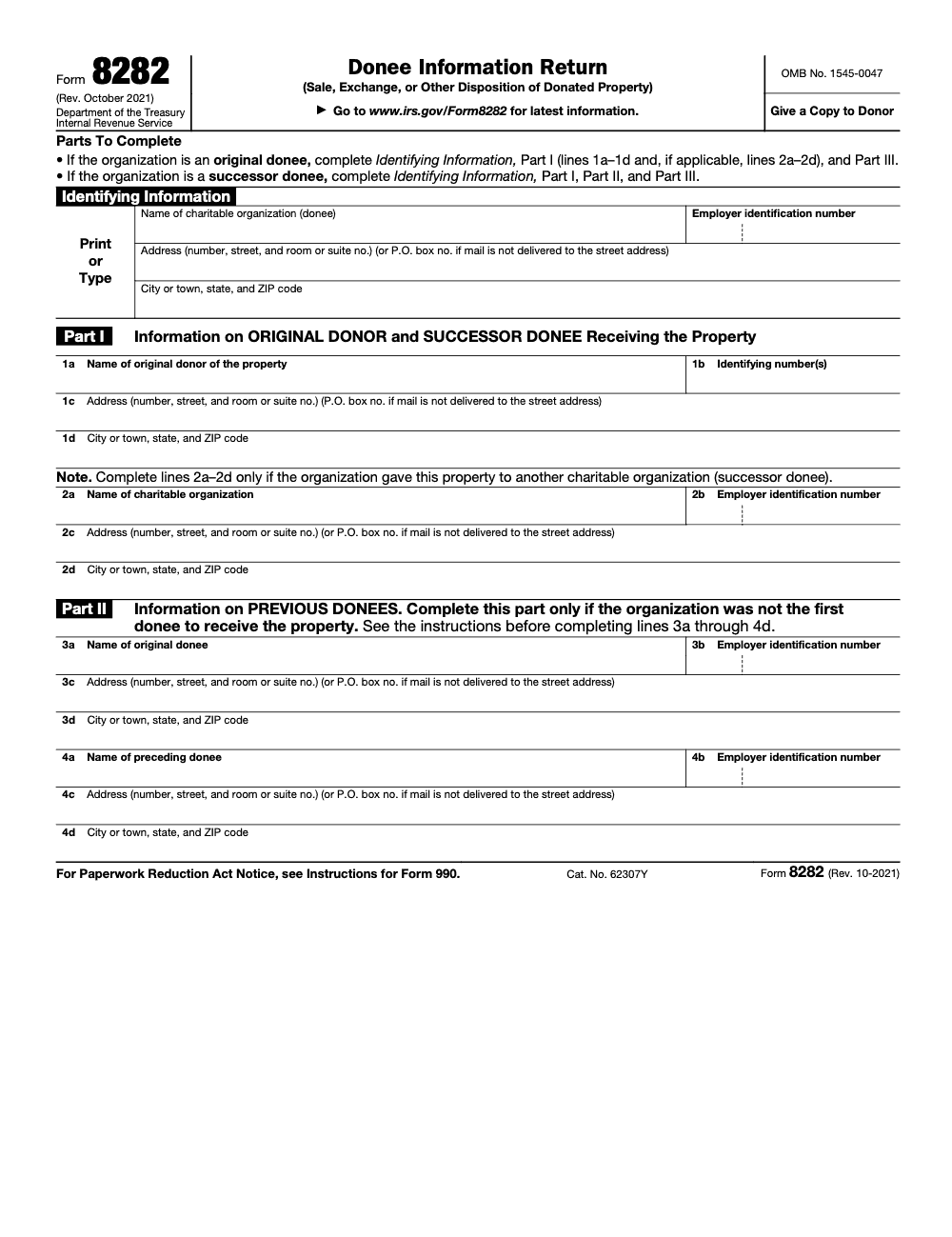
Form 8282 is the Donee Information Return nonprofit organizations file when they sell, exchange, or otherwise dispose of donated noncash property within 3 years of the original donee's receipt (per the IRS Form 8282 instructions, Rev. October 2021). Filing is due within 125 days after the disposition date, the form is mailed to the IRS service center at Ogden, UT 84201-0027, and a copy must also go to the original donor and any successor donee. See other IRS form guides for adjacent reporting.
A development director sells a donated vehicle a year and a half after the gift, the acceptance log never reaches finance, and the filing clock runs out before anyone connects the dots. We see that exact pattern every spring during 990 prep, often with vehicles, nonpublicly traded stock, and donated art. Form 8282 is the Donee Information Return that closes the loop when a nonprofit disposes of donated noncash property within 3 years of the original donee's receipt.
The deadline is 125 days from the disposition date, and a copy has to go to the original donor as well as the IRS service center at Ogden, UT 84201-0027. The obligation falls on original and successor donees alike, and the 3-year clock does not restart on transfer. A narrow exception covers items valued at $500 or less when the donor signed a Form 8283 statement to that effect, but most dispositions are squarely in scope.
Key Takeaways
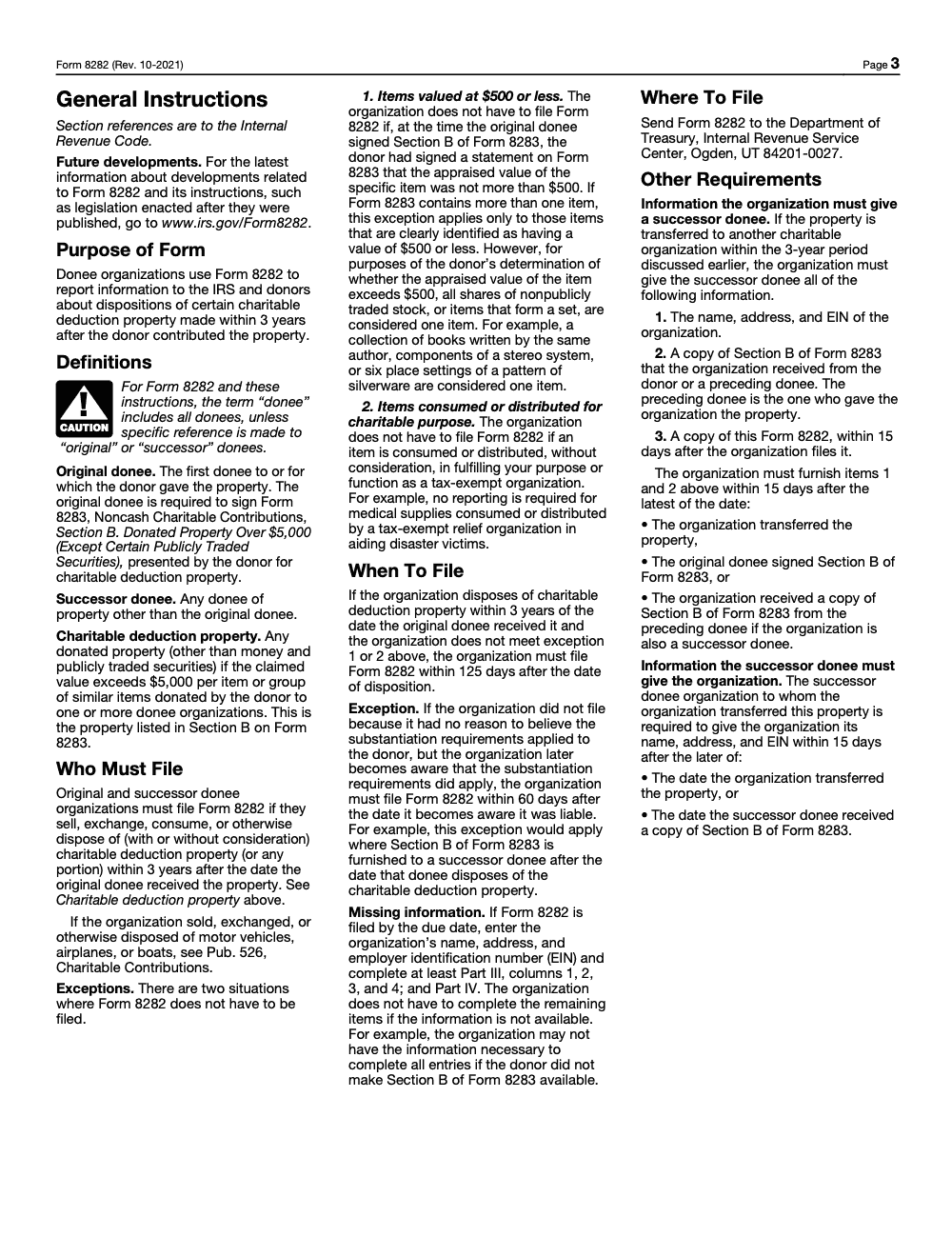
- You file Form 8282 when you dispose of donated noncash property within 3 years of the original donee’s receipt (the obligation applies equally to original AND successor donees, and the 3‑year clock does not restart when a successor receives the property). This covers “charitable deduction property,” generally noncash items valued over $5,000 reported on the donor’s Form 8283 Section B.
- The deadline is 125 days from the date of disposition, and you must send a copy to the original donor. There is also a special 60‑day rule if you learn later that the donor’s substantiation applied.
- You do not file for cash, publicly traded securities, items valued at $500 or less on the donor’s return (and only when the donor signed a Form 8283 statement to that effect at the time the original donee signed Section B), or items consumed or distributed without consideration for charitable use.
- If you transfer the property to another charity, you pass required details to the successor within 15 days (measured from the latest of the property transfer date, the original donee’s Form 8283 Section B signature date, or the date you received Section B from the preceding donee) and the three‑year lookback still ties back to the original donee’s receipt date.
- There is no new e‑file option, and the current mailing address remains Ogden, UT 84201‑0027 as of December 4, 2025.
What Form 8282 Is, In Plain English
Form 8282 is the donee organization’s information return for reporting the sale, exchange, or any other disposition of donated noncash property that a donor treated as a charitable deduction property gift. If the donor had to complete Form 8283 Section B because the claimed value of an item or similar items exceeded $5,000, and your organization later disposes of that property within three years, you report that disposition on 8282. You also send a copy to the original donor so the IRS can match both sides of the story.
Two built‑in exceptions often simplify life. You do not file if either the donor claimed $500 or less for the item on Form 8283, or you consumed or distributed the item without consideration as part of your exempt activities, for example medical supplies used in a clinic or food distributed to clients.
The IRS confirms there are no new developments that change the thresholds, timelines, or mechanics. The form revision on IRS.gov, last reviewed December 4, 2025, still points you to the same authoritative PDF and instructions.
When Filing Is Required
You must file if you dispose of charitable deduction property within three years of the date the original donee received it. That “original donee” phrase matters. If you are a successor donee, your three‑year clock still looks back to the original donee’s receipt date, which is why Line 6 in Part III asks for that original date. The deadline to file is 125 days after your disposition date, and you must provide a copy to the original donor.
The Two Clocks You Need To Watch
- Clock 1, the three‑year window. Measure from the original donee’s receipt date to your disposition date. Dispositions within that window trigger Form 8282 unless an exception applies.
- Clock 2, the 125‑day deadline. File and mail the donor copy within 125 days after the actual sale, exchange, or transfer. If you later discover you were subject to the substantiation rules but did not know it at the time, you get a special 60‑day window from the day you become aware.
What Does Not Require Form 8282
You skip filing in three common situations. First, the donor’s claimed value was $500 or less for the specific item identified on Form 8283. Second, the property was consumed or distributed without consideration for your exempt purpose, for example distributing donated hygiene kits to clients. Third, the asset class was outside the rule, such as publicly traded securities and cash. All of this is spelled out in the instructions and the IRS nonprofit guidance.
Quick Example
You receive a set of lab equipment valued by the donor at $12,000 on Form 8283 Section B. After 18 months you sell it for $6,500 because your program moved to a different model. You must file Form 8282 within 125 days and send a copy to the donor. If instead you used the equipment for patient services and it was fully consumed without consideration in furthering your exempt purpose, no Form 8282 is required.
Tip, track the donor’s original Form 8283 details the day the gift arrives. Your later 8282 filing depends on those dates and descriptions.
Who Must File, And How Roles Work
“Donee” on Form 8282 means any qualified organization holding the property. If you were the first recipient, you are the original donee. Any later exempt organization that received the same property from a prior donee is a successor donee. Original donees complete Identifying Information, Part I, and Part III. Successor donees also complete Part II to identify the original and, if applicable, the immediately preceding donee. The three‑year lookback always anchors to the original donee’s receipt date.
Role Map At A Glance
| Term | Who it describes | What you do on Form 8282 |
| Donee | The organization holding the property | Enter your legal name, EIN, and address in Identifying Information |
| Original donee | First exempt recipient | Complete Part I and Part III when you dispose of the item |
| Successor donee | Later exempt recipient | Complete Part I, Part II, and Part III, listing the original and possibly the preceding donee |
The form also builds in a handoff rule. If you pass the item to another charity during the three‑year window, you must provide the successor with your organization’s name and EIN, a copy of the donor’s Form 8283 Section B you received, and a copy of your filed 8282, each within 15 days of the relevant trigger.
Exceptions, With Practical Guidance
Under‑$500 Items
If the donor claimed $500 or less for the specific item on Form 8283, you do not file 8282 for that item, but only when the donor signed that valuation statement on Form 8283 at the time the original donee signed Section B, not based on a later donee valuation. When the donor listed multiple items, apply the exception only to those clearly shown at or under $500. Treat sets and nonpublicly traded stock as one item. Keep a copy of the donor’s 8283 to substantiate your decision not to file.
Consumed or Distributed For Exempt Purposes
There is no filing when you consume or distribute the property, without consideration, in carrying out your exempt activities. Think of medical supplies used in a clinic or food given to clients. Document dates, recipients, and program use in case the IRS asks why you did not file.
Publicly Traded Securities, Cash, And Digital Assets
Cash and publicly traded securities are outside “charitable deduction property” for Form 8282. Digital assets, including cryptocurrency, are treated as property but they are not “publicly traded securities” for these rules, so large crypto gifts often require the donor’s appraisal and your 8282 filing if you dispose of the assets within three years. The IRS updated its digital asset Q&A in December 2025 and reminds charities that they may be asked to sign Form 8283 and should understand the 8282 reporting that can follow a later sale.
If you accept digital asset donations and later liquidate them within three years, treat that sale like any other noncash disposition and apply the 125‑day 8282 filing rule.
What To Gather Before You Start
- Donor’s Form 8283 Section B, including the original donee signature date.
- The date the original donee received the item and, if you are a successor, the immediately preceding donee’s information.
- A clear description of the item, including serial numbers like VINs, tail numbers, or hull IDs if relevant.
- How you used the property while you held it, whether that use related to your exempt purpose, and whether you disposed of your entire interest.
Real‑World Scenario
You are a nonprofit clinic that received a donated X‑ray unit valued at $8,000 on the donor’s 8283. You used it for 10 months, then replaced it and sold the old unit. Because the donor claimed more than $5,000 and the sale happened within three years of the original donee’s receipt date, you must file 8282 within 125 days and send the donor a copy. In Part III you will describe how you used the unit, note whether the use related to your exempt purpose, and list dates and proceeds.
How To Complete Form 8282, Step By Step
Identifying Information
Enter your organization’s exact legal name, EIN, and full street address exactly as it appears in your IRS records. If you moved recently, file Form 8822‑B to update your address before filing 8282 to avoid mismatch notices.
Part I, Original Donor And Any Successor Donee
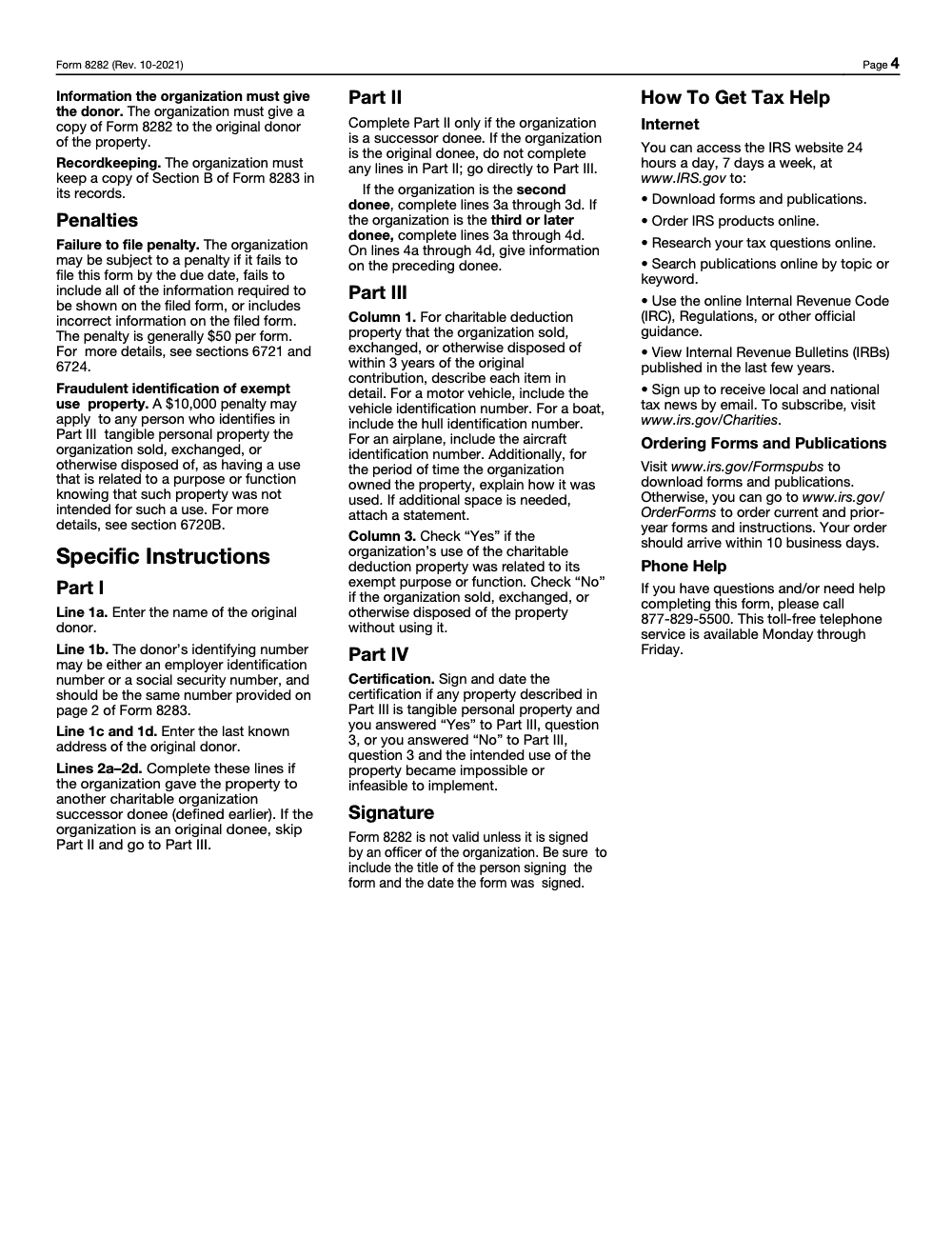
Line 1 captures the donor’s full legal name, identifying number, and address, which should match the donor’s Form 8283. Lines 2a through 2d are only for a successor donee if you transferred the property to another qualified organization. Keep the conventions identical to the donor’s paperwork for cleaner IRS matching.
Part II, Previous Donees
Complete Part II only if you are not the original donee. List the original donee on Lines 3a through 3d. If you are the third or later donee, identify the immediately preceding donee on Lines 4a through 4d. You do not list anyone else between them.
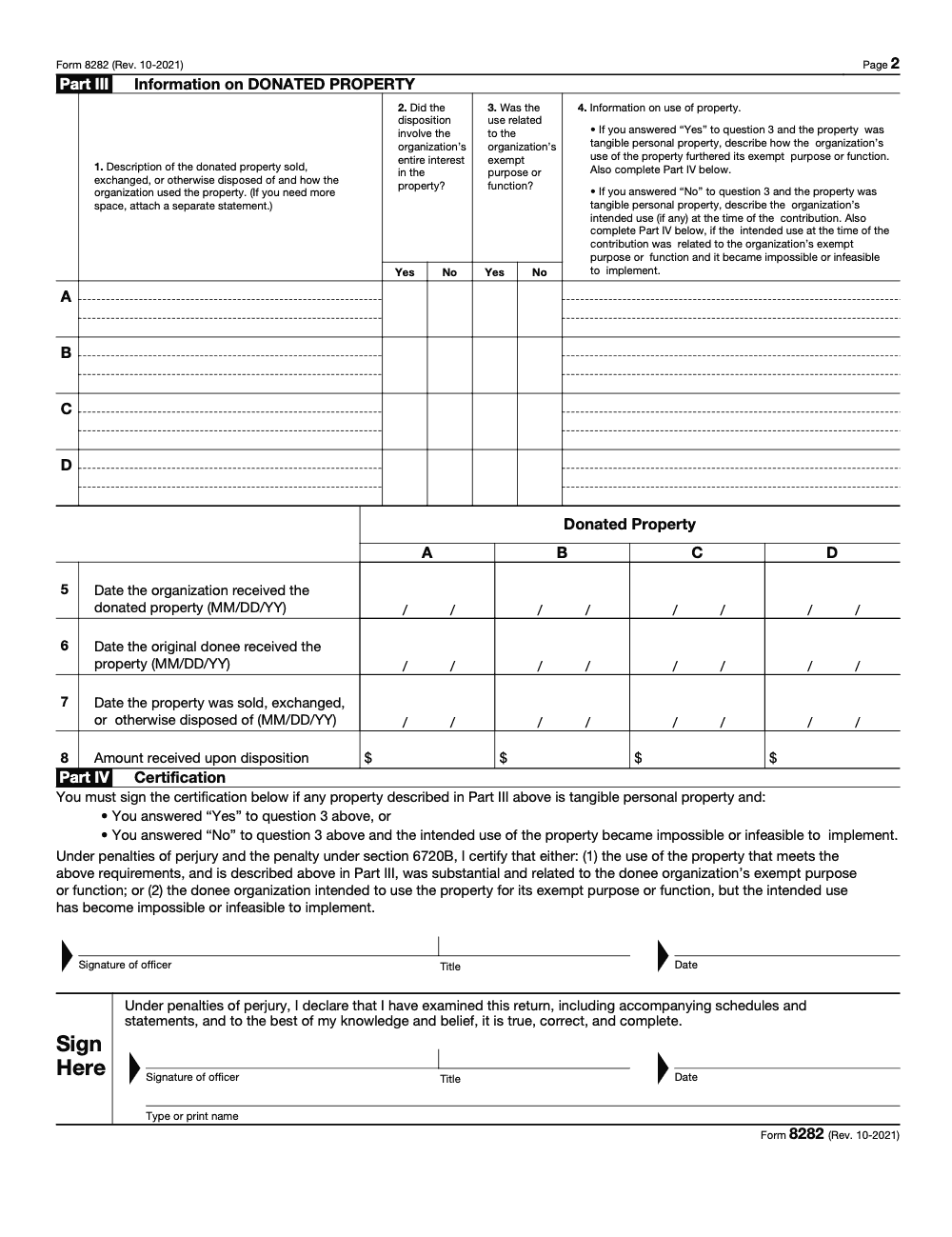
Part III, Donated Property Details
Describe each item precisely. Include serial identifiers when relevant, for example VIN for vehicles or aircraft tail numbers. Indicate whether your disposition involved your entire interest, whether your use related to your exempt purpose, then explain that use briefly. Use a separate block for each item and attach additional pages if you have more than four items. Lines 5 through 8 capture the received date, the original donee’s receipt date, the disposition date, and the amount received.
Part IV, Certification
You sign Part IV if the property is tangible personal property and either your use was related to your exempt purpose or you intended a related use that became impossible or infeasible. This certification is made under penalties of perjury and under IRC §6720B, which imposes a $10,000 penalty for knowingly identifying property as related use when it is not intended for such use (the penalty can apply to any person who signs Part IV, including individual officers, not just the organization). Align your narrative with Part III and make sure your internal records back it up.
Keep certification tight. Say what the item was, how it furthered your exempt function, and why any planned related use could not continue. Then make sure your files tell the same story.
Filing Logistics, Timing, And Addresses
Mail the form to the Department of the Treasury, Internal Revenue Service Center, Ogden, UT 84201‑0027. As of December 4, 2025, there is no new electronic submission option on IRS.gov for Form 8282, so treat it as a paper filing and track delivery. Send a full copy to the original donor within the same 125‑day window. If you pass the property to another charity, provide the required handoff documents to the successor within 15 days.
The 125‑Day Checklist
- Confirm the disposition date that starts the 125‑day clock.
- Verify whether the $500 or consumed or distributed exceptions apply.
- Gather the donor’s Form 8283 and confirm the original donee receipt date for Line 6.
- Complete Parts I through IV as applicable, attach pages as needed, and get a responsible officer’s signature.
- Mail to Ogden and send the donor copy.
Common Errors That Waste Time
- Using abbreviations or a different legal name than shown on prior filings.
- Missing the original donee date in Line 6, which drives the three‑year test.
- Vague property descriptions without identifiers.
- Signing Part IV when it does not apply, or skipping it when it does.
- Waiting until day 120 to route internal approvals.
Quick Reference Tables
Triggers, Deadlines, And Who You Notify
| Trigger | Deadline | Who you notify | Notes |
| Disposition within 3 years of original donee receipt | 125 days | IRS and original donor | File Form 8282 and mail donor copy |
| You later learn donor substantiation applied | 60 days from awareness | IRS and original donor | Special timing rule in instructions |
| Transfer to a successor charity | 15 days | Successor donee | Provide your info, Form 8283 Section B, and a copy of your 8282 after filing |
| Under‑$500 item or consumed or distributed use | None | No filing | Document why you did not file |
Citations, see the Form 8282 instructions PDF for the 125‑day rule, 60‑day awareness rule, and 15‑day successor handoff, and the exceptions.
Compliance Notes And Simple SOP You Can Adopt Today
- Keep a single repository for every donor Form 8283 Section B you receive.
- Record two dates for each item, the original donee’s receipt date and your disposition date.
- Use a short intake checklist, description, serial identifiers, intended use, and program owner.
- Run a monthly report to catch pending 125‑day deadlines.
- Store proof of donor copy mailing.
One small habit pays off, saving the donor’s 8283 in your intake folder the day the gift arrives. That single page makes every later 8282 easy.
Where Accountably Fits, When It Helps
If you are an accounting firm serving nonprofits, or a nonprofit finance leader who needs reliable capacity to keep 8283 and 8282 workflows tight, our team has seen how missed dates turn into avoidable notices. Accountably integrates trained offshore staff into your existing systems, templates, and review process so routine compliance, including 8282 tracking and donor copy workflows, runs on time without adding stress to your core team. Use it when you need disciplined execution at scale, not resume piles.
Final Word
You do not need to fear Form 8282. You need two dates, a 125‑day timer, and a clean handoff to donors and successors. When in doubt, check the current form PDF and the IRS charitable contribution guidance, then file on time. Add a one‑page SOP and you will be audit‑ready every time. This article is general guidance as of December 27, 2025, not legal or tax advice, so speak with your advisor for edge cases.
Common Mistakes We See Every Season
We see the same Form 8282 patterns at nonprofit clients every year. The form is short, but the rules around timing, signatures, successor donees, and exempt-use certification create real exposure if any link in the chain breaks.
Reusable Checklists
These are copy-paste ready for nonprofit gift acceptance SOPs and for firm advisors who review 990 packages. Each step references the actual Form 8282 line item or rule it serves.
Pre-disposition packet (before you sell or transfer donated property)
- Pull the original Form 8283 Section B and confirm the donor's identifying number on page 2 (matches Form 8282 line 1b).
- Record line 6 (date the original donee received the property) and compare to today. If within 3 years, Form 8282 will apply on disposition.
- Confirm the property is in scope: noncash, nonpublicly traded, not cash (publicly traded securities and money are excluded per IRS Form 8282 instructions).
- Check the $500 exception: did the donor sign a Form 8283 statement attesting to a value of $500 or less at the time of original signing?
- For vehicles, boats, or airplanes, capture the VIN, hull, or aircraft ID for Part III column 1 and confirm whether Pub. 526 routes the disposition to Form 1098-C or Form 8282.
- Decide and document the answer to Part III question 3 (related use) before any officer signature.
125-day filing routine
- Log the disposition date (Form 8282 Part III line 7) the day it happens.
- Set a calendar trigger 100 days out and a hard deadline at 125 days.
- Complete Part I lines 1a-1d (original donor) and lines 2a-2d if a successor donee received the property.
- Complete Part II only if you are a successor donee: lines 3a-3d if second donee, lines 3a-4d if third or later donee.
- Complete Part III lines 5, 6, 7, 8 and the property rows (A through D), attaching a separate statement if there are more than 4 items.
- If any property is tangible personal property and the answer to question 3 is Yes (or No but the intended use became infeasible), sign Part IV.
- Have an organizational officer sign with title and date.
- Mail to Department of Treasury, Internal Revenue Service Center, Ogden, UT 84201-0027.
- If you must file with missing information by the due date, include name, address, EIN, Part III columns 1, 2, 3, 4, and Part IV certification at minimum.
Donor and successor 15-day handoff
- Send the original donor a copy of the filed Form 8282 (required, not optional).
- If the property was transferred to another charitable organization, send the successor donee the transferring organization's name, address, and EIN within 15 days of the latest of: transfer date, original donee Section B signing date, or date Section B was received from a preceding donee.
- Send the successor donee a copy of Form 8283 Section B inside the same 15-day window.
- Send the successor donee a copy of the filed Form 8282 within 15 days of filing.
- Confirm the successor donee returns its name, address, and EIN within 15 days of the later of property transfer or its receipt of Section B.
- Keep a copy of Form 8283 Section B and the filed Form 8282 in the donor file.
Keep 8282 Season From Stalling
Form 8282 stalls inside nonprofits and the firms that serve them for a predictable reason: dispositions are sporadic, the gift acceptance log lives in the development office while the filing duty lives in finance, and the 125-day deadline is unforgiving. Per the IRS Form 8282 instructions, the baseline failure-to-file penalty is $50 per form under IRC §6721 with higher tiers for intentional disregard, and the $10,000 §6720B exposure on a careless Part IV certification can attach to the officer who signs, not just the organization.
The fix is moving Form 8282 from an exception to a documented routine inside the gift acceptance workflow. The same dates, signatures, and copies repeat on every filing, so the work pays back every time the form comes up.
- Capture line 6 (original donee receipt date) at intake so any later disposition can be checked against the 3-year window without rebuilding the file.
- Set a 125-day calendar trigger the moment a disposition lands in Part III line 7, with a 100-day pre-deadline review.
- Run the Part III question 3 and Part IV §6720B check before any officer signs, with the documented use sitting in the donor file.
- Build a 15-day successor packet: organization name, address, EIN, Form 8283 Section B copy, and the filed Form 8282 copy.
- Mail the donor copy the same day the IRS copy goes to Ogden, UT 84201-0027 so it is never the step that drops.
Accountably handles the production side of this routine for clients with nonprofit work in scope, with documented SOPs and turnaround SLAs that keep the 125-day clock visible. See our tax outsourcing and offshoring service for how the workflow plugs into existing review cycles.
FAQs
It lets the IRS match a donor’s deduction to your later sale or other disposition, and it keeps the donor informed. You file when you dispose of charitable deduction property within three years of the original donee’s receipt.
Form 8283 is the donor’s form for claiming a noncash charitable deduction. Form 8282 is the donee’s form for reporting a later disposition within three years. The two forms work together to ensure proper substantiation and reporting.
No. As of December 4, 2025, IRS.gov shows no recent developments that change thresholds, deadlines, or filing mechanics for Form 8282.
Digital assets are property, not publicly traded securities for these rules. Donors typically need an appraisal over $5,000 and may ask you to sign Form 8283. If you sell the crypto within three years, file Form 8282 within 125 days and send the donor a copy.
If you knowingly make a false related‑use certification on Part IV, IRC §6720B imposes a $10,000 penalty that can fall on any person who identifies the property in Part III, including individual officers who sign, not just the organization itself. Standard information return penalties can also apply to failures, so build a simple calendar and routing process to avoid timing errors.
The form is currently treated as a paper filing mailed to the Ogden, UT address listed in the instructions. IRS.gov does not list a new electronic submission option for 8282.
Other forms this guide names
Summarize this article with AI
About this guide
Accountably helps US CPA, EA, and accounting firms hire trained accountants and tax preparers in India.
About us Reviewed byJugal Thacker, CPAFounder and CEO at Accountably
A Washington-licensed CPA with 7+ years inside US firms – PwC, a real-estate tax practice, then a full-service firm, rising from reviewer to manager to advisory. This article was reviewed against current IRS guidance for the 2025 tax year and updated for filers preparing late returns, amendments, and 2026 estimates.
View profile →How we research, review, and update this guide
Every Accountably guide is researched against primary IRS sources, reviewed by a U.S. CPA, and refreshed as guidance evolves. Read our Editorial Guidelines to see how we source, fact-check, and update our content.