Key dates
Summarize this article with AI
In Brief
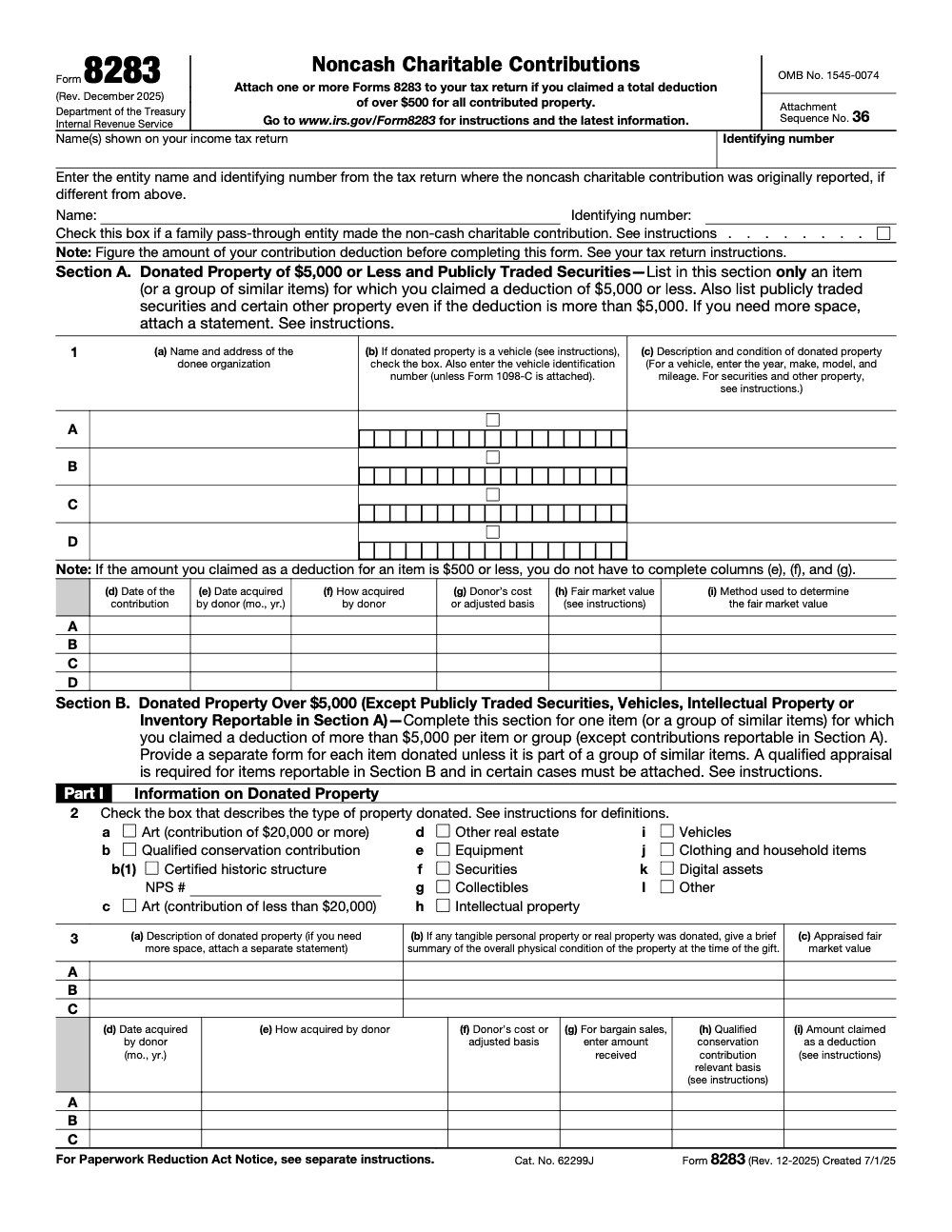
Form 8283 reports noncash charitable contributions when your year's aggregate noncash deductions exceed $500 (per IRS Form 8283 instructions, Rev. December 2025). Use Section A for items at or below $5,000 plus publicly traded securities; Section B applies to other property over $5,000 with a qualified appraisal. The form attaches to Form 1040 Schedule A, line 12; tax year 2025 returns are due April 15, 2026, and Form 4868 extends the filing deadline to October 15, 2026.
A donor gives away used equipment and a piece of artwork in the same year and assumes a receipt is enough. Once the year's noncash deductions clear $500, Form 8283 is required, and the bigger gift changes how the form gets completed. Section A handles items at or below $5,000 plus publicly traded securities; anything over $5,000 moves to Section B and pulls in a qualified appraisal with appraiser and donee signatures.
The form attaches to Schedule A, line 12, and the section you choose drives what records hold up under review. Vehicle donations generally follow the charity's Form 1098-C, and a vehicle sold without significant use caps the deduction at the gross sale proceeds. For tax year 2025 returns the filing deadline is April 15, 2026, with Form 4868 extending it to October 15, 2026.
Key Takeaways
- Use Form 8283 when your total noncash charitable deductions exceed $500 for the year. Individuals, partnerships, S corporations, and most corporations file, with special C‑corp thresholds noted below.
- Use Section A for items of $5,000 or less, for publicly traded securities, for qualified vehicles when your deduction is limited to gross proceeds, and for certain other exceptions.
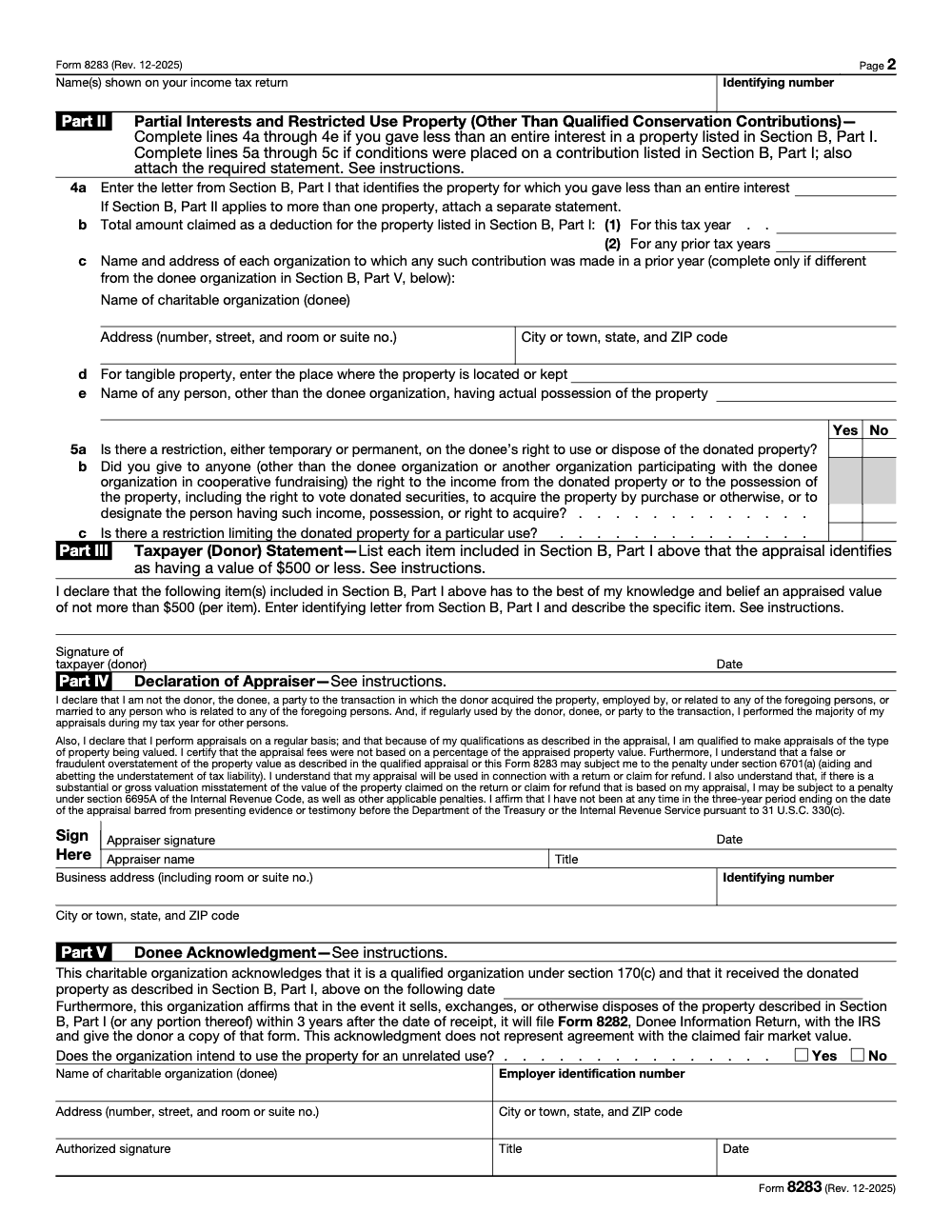
- Use Section B for any single item or group of similar items over $5,000, and get a qualified appraisal plus appraiser and donee signatures. Attach the appraisal if the total claimed value for an item exceeds $500,000.
- Vehicle donations generally follow the charity’s Form 1098‑C and, if sold without significant use or improvement, your deduction is capped at the charity’s gross sale proceeds.
- Keep contemporaneous acknowledgments, basis, and valuation support. The IRS closely reviews noncash deductions and requires precise completion of the correct section.
What Form 8283 is, and when you must file it
Form 8283 reports your noncash charitable contributions and the details that support your deduction, including what you gave, when you acquired it, your cost or basis, your valuation method, and the charity’s information. If your total noncash contributions exceed $500, the form must be attached to your return. Failure to fully complete the right section, or to obtain required signatures or a qualified appraisal when needed, can lead to disallowance.
Who files
- Individuals, partnerships, S corporations, and corporations generally file Form 8283 when their total noncash charitable contributions for the year exceed $500 in aggregate, not per item or per donee (per IRS Form 8283 instructions, Rev. December 2025).
- C corporations that are not personal service or closely held generally only file when a single item, or similar group, exceeds $5,000. Personal service corporations and closely held C corps must file at over $500.
What counts as a “similar group”
Similar items of property are items of the same general type, such as clothing, books, or paintings. To determine whether you cross the $5,000 threshold for Section B, you must aggregate similar items, even if donated to more than one charity. If the aggregate exceeds $5,000, you complete a separate Section B for each donee.
Quick chooser, Section A vs Section B
| Item or situation | Section you complete | Special requirements |
| Publicly traded stock or mutual fund shares | Section A | No qualified appraisal required; value typically uses the average of the high and low on the contribution date. |
| Qualified vehicle where deduction is limited to charity’s sale proceeds | Section A | Attach Form 1098‑C or the acknowledgment showing gross proceeds. |
| Any single item or similar group over $5,000, most property types | Section B | Qualified appraisal, appraiser signs Part IV, donee signs Part V. |
| Nonpublicly traded securities over $5,000 | Section B | Qualified appraisal required. |
| Total deduction for an item over $500,000 | Section B | Attach the qualified appraisal to your return. |
Why accuracy matters in 2025
Two regulation sections drive most of the compliance burden. Section 1.170A‑16 sets the substantiation and reporting rules for thresholds at $250, $500, $5,000, and $500,000, including when to use Section A versus Section B. Section 1.170A‑17 defines what a “qualified appraisal” is, who counts as a “qualified appraiser,” what must be in the report, and the 60‑day timing window. If you miss one of these elements, your deduction can be denied even when the gift was real and generous.
A quick practice tip, track appraiser and donee signatures early, not at filing time, and pin each to the specific property ID you will reference on Section B. This saves last minute chasing and prevents mismatched descriptions.
Section A vs Section B, how to pick the right path
When your total noncash gifts exceed $500, you must attach Form 8283. The section depends on the property and value.
- Section A is for property of $5,000 or less, publicly traded securities regardless of value, qualified vehicles when the deduction is limited to the charity’s sale proceeds, and a few other exceptions.
- Section B is for any single item, or similar group, with a deduction over $5,000 (except publicly traded securities, qualified vehicles, intellectual property, and inventory, which stay in Section A regardless of value). You will need a qualified appraisal, the appraiser’s declaration in Part IV, and the charity’s acknowledgment in Part V.
If your team donates multiple lots of similar items to different charities, aggregate them to test the $5,000 threshold, then prepare a separate Section B for each donee that received part of that group.
Appraisal exceptions you can rely on
You do not need a qualified appraisal for the following, even when the total exceeds $5,000, provided you complete the appropriate section correctly.
- Publicly traded securities, as defined in the regulations.
- Certain intellectual property.
- Qualified vehicles with the proper acknowledgment when the deduction is capped by sale proceeds.
- Inventory or property held primarily for sale to customers.
What makes an appraisal “qualified”
Your appraisal must have a valuation effective date no earlier than 60 days before the date of the contribution and no later than the date of the contribution itself, and the donor must receive the signed appraisal before the return due date including extensions for the year you first claim the deduction. It must follow generally accepted appraisal standards, list the valuation method and specific basis for value, and include the appraiser’s qualifications. Keep the appraisal with your records, and attach it to the return if your deduction for a property exceeds $500,000 after aggregating similar items across all donees – or if another attach-trigger applies (art of $20,000 or more, clothing or household items over $500 not in good used condition, or exterior historic-district easements).
Valuation basics that hold up under review
The baseline is fair market value, the price a willing buyer and willing seller would agree to on the date of the gift, both with reasonable knowledge of the facts. The IRS expects objective evidence that fits the asset type.
- Publicly traded securities, use the average of the high and low on the contribution date, or the weighted average around the date if no trades occurred that day.
- Vehicles, use the charity’s 1098‑C for gross proceeds if sold, or acceptable pricing guides adjusted to condition when another exception applies (use the private-party sale price in the guide, not the dealer retail value).
- For large or unique items, a qualified appraisal explains the method, the comps, and the reasoning, and it ties to your Section B detail.
Basis still matters
Your adjusted basis can limit the deduction, for example, short‑term or ordinary income property usually limits your deduction to basis, not FMV. Publication 526 explains the ordering and limits that may apply alongside Form 8283.
Special rule, vehicles and Form 1098‑C
If the charity sells the vehicle without significant intervening use or material improvement, your deduction is generally limited to the charity’s gross sale proceeds. The charity must give you a contemporaneous written acknowledgment, typically on Form 1098‑C, within 30 days of the sale or receipt, and you attach it to your return. There are exceptions when the charity significantly uses or improves the vehicle, or transfers it to a needy individual at a price significantly below FMV to further its charitable purpose. In those exceptions, FMV may be allowed.
Quick example, you donate a car and the charity later sells it for $7,000. With no significant use or improvement documented, your deduction is generally $7,000, not a higher guide value.
Records the IRS expects you to keep
- Contemporaneous written acknowledgments for gifts of $250 or more.
- Basis and acquisition details, including when and how acquired.
- Qualified appraisals when required, with appraiser and donee signatures captured for Section B.
- For stock, keep brokerage confirmations showing transfer date, and the pricing used to compute FMV.
A small investment in file hygiene saves time in review. If you run a firm, standardize filenames, versions, and checklists so reviewers see the same structure every time.
AGI limits and five‑year carryforwards
Form 8283 reports the gift, but your deduction still must pass the percentage‑of‑AGI limits and ordering rules in Publication 526. In general, cash gifts to public charities are limited to 60% of AGI, and noncash gifts often fall into 50%, 30%, or 20% categories depending on the property and the donee. If your allowed deduction is less than the value you reported, the remainder may carry forward up to five years, and the substantiation rules still apply in the carryforward years.
Fast framework to apply limits
- Classify the property, cash, ordinary income property, or long‑term capital gain property.
- Identify the donee type, for example, public charity or private foundation.
- Apply the correct AGI percentage limit and ordering rules.
- Track any unused amount as a carryforward, then reapply the same rules next year, oldest carryforward first.
Step‑by‑step, completing Form 8283
- Confirm you must file. If your total noncash gifts exceed $500, you must attach Form 8283.
- Choose the section.
- Section A for items of $5,000 or less, publicly traded securities, qualified vehicles with sale‑proceeds limits, and specified exceptions.
- Section B for items, or similar groups, over $5,000.
- Gather data. Description, date acquired, how acquired, basis, donation date, valuation method, and FMV. For stock, capture the average of the day’s high and low.
- If Section B applies, secure a qualified appraisal, have the appraiser sign Part IV, and have the donee sign Part V.
- Check thresholds. If your deduction for a property exceeds $500,000 after aggregating similar items across all donees, attach the appraisal to your return.
- Attach Form 8283 to your return and retain all support, including acknowledgments and appraisals, for your records.
Mini‑checklist you can paste into your workpapers
- Similar items aggregated and tested against the $5,000 threshold.
- For vehicles, 1098‑C attached or equivalent acknowledgment included.
- Appraisal valuation effective date no earlier than 60 days before the gift and no later than the contribution date, signed by a qualified appraiser, with valuation method and comps.
- Section B, Part IV and Part V signatures present and readable.
- If deduction for a property exceeds $500,000 after aggregating similar items across all donees, appraisal attached to return.
Practical examples
- Example, publicly traded stock. You donate 1,000 shares on March 15. The day’s high is $52 and the low is $50, so the FMV per share is $51, and you report the gift in Section A. Keep the broker transfer slip and the price computation.
- Example, vintage guitar worth $7,500. You aggregate similar guitars donated this year and exceed $5,000, so you complete Section B, get a qualified appraisal signed within the timing window, obtain the charity’s Part V signature, and attach the form.
- Example, vehicle sold by the charity. The charity sells within weeks for $4,200, sends you Form 1098‑C, and your deduction is generally limited to $4,200.
Reviewer note you can add to your file: “Section chosen, signatures verified, valuation evidence attached, AGI limit modeled, carryforward tracked if applicable.”
Common mistakes that lead to denials
After years of reviewing noncash filings, the same handful of mistakes show up across firms and DIY filers alike. Each one is small on its own, and each one can disqualify a deduction outright if missed.
Editor’s checklist for firms
- Build a standard Section A and Section B packet, including labeled evidence for description, basis, and FMV method.
- Use a signature tracker for Part IV and Part V with reminders tied to the return due date.
- Create a mini‑matrix for AGI limit modeling and carryforward tracking in your tax software file.
If you manage a busy accounting practice, structure and visibility keep reviewers out of endless loops. At Accountably, we integrate disciplined workpaper naming, appraiser‑signature tracking, and deadline accountability into your workflow so Section B files reach review ready, with fewer revision cycles. Use this when you truly need a delivery partner that respects your standards and systems, not a quick staffing patch.
Resources
- Instructions for Form 8283, last reviewed February 4, 2025, for thresholds, Section A vs B, and signature requirements.
- Regulations 1.170A‑16 and 1.170A‑17, for substantiation tiers, appraisal timing, and qualified appraiser standards.
- Publication 561, Determining the Value of Donated Property, for FMV principles and specific asset valuation, including securities and vehicles.
- Publication 526, Charitable Contributions, for AGI limits and carryover rules.
- Form 1098‑C instructions and Notice 2005‑44 for vehicle‑specific acknowledgment and gross‑proceeds rules.
Reusable Checklists
These checklists are written for copy-paste into firm SOPs, tax-software file checklists, or a personal pre-filing review. Each item maps to an actual Form 8283 line, threshold, or instruction reference.
Pre-filing Form 8283 packet
- Confirm aggregate noncash contributions for the year exceed $500 before deciding the form is required.
- Sort contributions by per-item (or similar-group) value: at or below $5,000 (Section A) versus over $5,000 (Section B).
- For each Section A row, populate columns (a) donee, (c) description and condition, (d) date of contribution, (h) FMV, and (i) FMV method (per the Form 8283 instructions).
- For items $500 or less in Section A, confirm columns (e) date acquired, (f) how acquired, and (g) donor's basis can be left blank.
- For each Section B item, confirm a qualified appraisal was received before the return due date including extensions.
- Verify the appraisal valuation effective date sits no earlier than 60 days before the contribution date and no later than the contribution date itself.
- Collect Part IV (Declaration of Appraiser) and Part V (Donee Acknowledgment) signatures for every Section B item.
- Stack contemporaneous written acknowledgments (CWAs) for every contribution at or above $250.
- Confirm Schedule A, line 12 (noncash contributions) ties to the Form 8283 total.
Vehicle and qualified-vehicle scan
- For any donated vehicle with claimed value over $500, confirm Form 1098-C is attached (or transmitted via Form 8453 for e-filers).
- For vehicle FMV between $250 and $500, confirm a written acknowledgment from the qualified organization.
- Verify the deduction equals the lesser of gross sale proceeds (Form 1098-C box 4a) or vehicle FMV, unless Exception 1 (significant intervening use or material improvement) or Exception 2 (sold or given below FMV to a needy individual) applies.
- If Form 1098-C is not in hand by the return due date, queue Form 4868 for the 6-month extension or plan to amend on Form 1040-X after the 1098-C arrives.
- For FMV claims, use private-party guide pricing for the documented make, model, year, condition, and options, not dealer retail.
- Enter the vehicle box and VIN in Section A column (b) unless Form 1098-C is attached.
Attach-the-appraisal trigger scan
- Art contribution of $20,000 or more (box 2a): attach the signed qualified appraisal to the return.
- Any contribution where the deduction exceeds $500,000 after aggregating similar items across all donees: attach the qualified appraisal.
- Clothing or household items above $500 not in good used condition: attach the qualified appraisal on Section B.
- Exterior historic-district easement claim above $10,000: attach the appraisal and pay the $500 IRC §170(f)(13) filing fee via Form 8283-V.
- For all other Section B items, retain the qualified appraisal in the donor's records and do not attach to the return.
- Confirm the appraiser declaration (Part IV) attests to no bar under 31 U.S.C. 330(c) within the 3-year look-back ending on the appraisal date.
Keep 8283 Season From Stalling
Form 8283 lands quietly during the busy season, but the Section B file is the one that stalls reviews. By the time a reviewer opens a $5,000-plus contribution, the qualified appraisal often sits half-signed, Part V is missing the donee acknowledgment, or the valuation effective date has drifted outside the 60-day pre-contribution window (per the Form 8283 instructions, Rev. December 2025). IRC §6695A exposure on the appraiser raises the cost of any casual valuation, and IRS Publication 526 confirms that for tax year 2025 charitable contributions remain deductible only to itemizers under the post-OBBBA standard deductions of $15,750 (single) and $31,500 (MFJ).
The fix is not more review meetings; it is upstream packet discipline. Section B work compresses cleanly when intake captures the donee, the property type, and an FMV method on day one, not the week before filing.
- Apply a Section A vs Section B decision card at intake, so the property-type rule (publicly traded securities, qualified vehicles, intellectual property, and inventory stay in Section A regardless of value) is settled before the $5,000 ceiling matters.
- Require the substantiation stack at the correct tier: CWA for every contribution above $250, Form 8283 Section A in the $500 to $5,000 band, and a qualified appraisal plus Section B above $5,000 (they stack, they do not substitute).
- Lock the appraisal valuation effective date inside the 60-day pre-contribution window before the appraiser starts the report, and confirm the donor received the signed appraisal before the return due date including extensions.
- Track Part IV appraiser signatures and Part V donee acknowledgments on the same review sheet as the Section B workpaper, not in a separate email thread.
- For donated vehicles, hold the deduction until Form 1098-C is in hand within the 30-day receipt window, or queue Form 4868 for the 6-month extension rather than file without attachment.
Accountably builds the workpaper templates, signature trackers, and review checkpoints that move Section B files through review on the first pass, with the FMV method and substantiation tier already documented. See our taxation services for how this plugs into your existing engagement workflow.
FAQs
You must attach Form 8283 if your total noncash charitable contributions exceed $500 for the year. Individuals, partnerships, S corporations, and corporations file, with special thresholds for certain C corporations.
No. Publicly traded securities are an appraisal exception. Report them in Section A and generally use the average of the day’s high and low to compute FMV.
For most noncash gifts where a single item or similar group exceeds $5,000, you must obtain a qualified appraisal, have the appraiser sign Part IV, and the donee sign Part V. The appraisal must have a valuation effective date no earlier than 60 days before the contribution and no later than the date of the contribution, and you must receive the signed appraisal before the return due date including extensions.
If the charity sells the vehicle without significant use or improvement, your deduction is generally limited to the gross sale proceeds shown on Form 1098‑C, which you attach to your return. Exceptions allow FMV in limited cases.
Your deduction is capped by percentage‑of‑AGI limits that depend on property type and the donee. Unused amounts can carry forward for up to five years and are subject to the same limits in each carryforward year.
Other forms this guide names
- Form 1098-C: Vehicle, Boat & Airplane Donation Guide
- Form 4868: IRS Tax Extension 2025 Guide to Filing
- Form 1040‑X: How to Amend Your Tax Return in 2025
- Form 8453: What to Mail, Address, and 3-Day Deadline
Summarize this article with AI
About this guide
Accountably helps US CPA, EA, and accounting firms hire trained accountants and tax preparers in India.
About us Reviewed byJugal Thacker, CPAFounder and CEO at Accountably
A Washington-licensed CPA with 7+ years inside US firms – PwC, a real-estate tax practice, then a full-service firm, rising from reviewer to manager to advisory. This article was reviewed against current IRS guidance for the 2025 tax year and updated for filers preparing late returns, amendments, and 2026 estimates.
View profile →How we research, review, and update this guide
Every Accountably guide is researched against primary IRS sources, reviewed by a U.S. CPA, and refreshed as guidance evolves. Read our Editorial Guidelines to see how we source, fact-check, and update our content.