Summarize this article with AI
In Brief
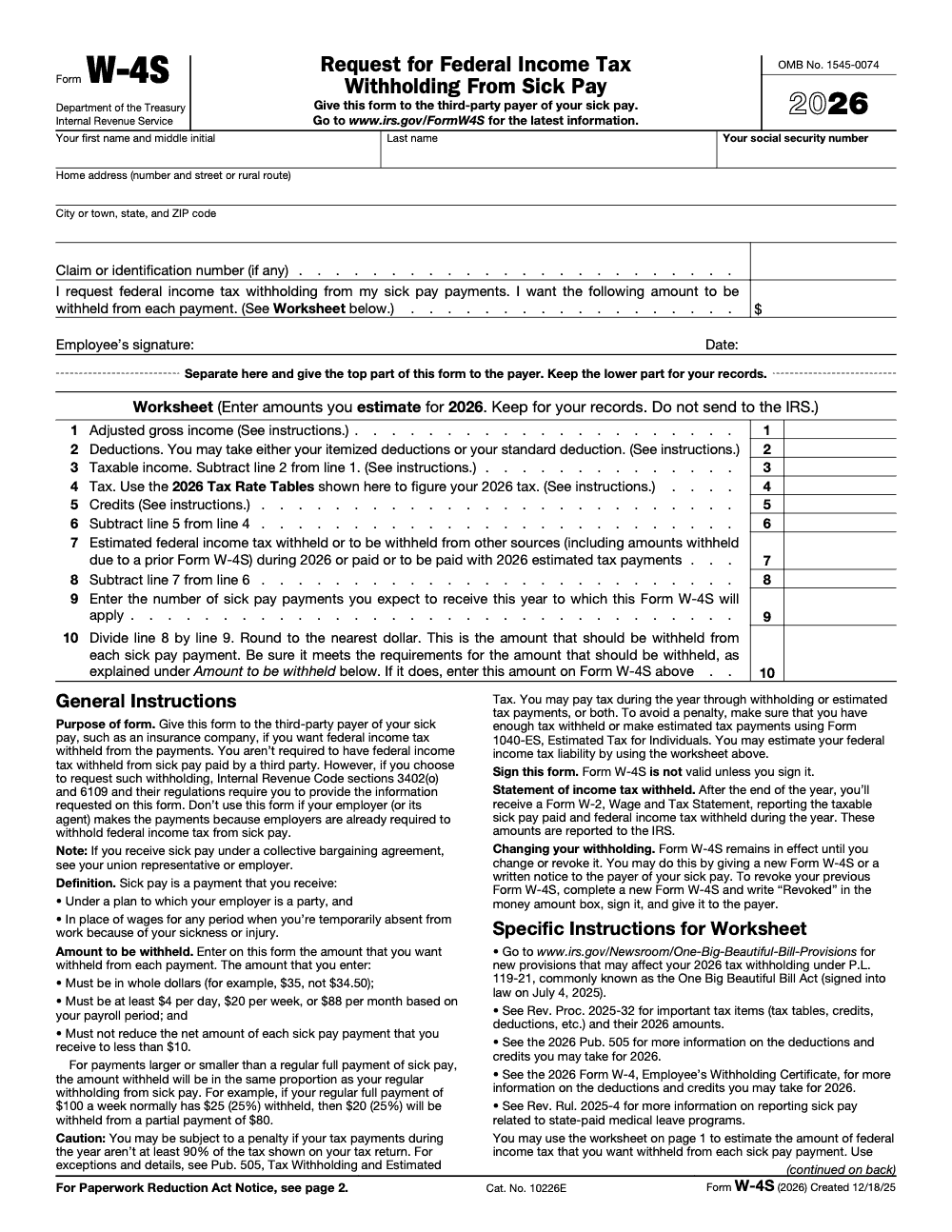
Form W-4S requests federal income tax withholding from third-party sick pay paid by an insurer or plan administrator – the recipient gives it to that payer, not the IRS, and the election is voluntary under Internal Revenue Code section 3402(o). The requested amount must be in whole dollars and at least $4 per day, $20 per week, or $88 per month, and it cannot drop any net payment below $10 (per the Form W-4S instructions). At year-end the payer reports the taxable sick pay and the tax withheld on Form W-2, not a 1099.
An insurer paying disability benefits never withheld federal income tax, because no one on the team knew which form turned it on, and no one asked. The fix is one page. Form W-4S requests federal income tax withholding from third-party sick pay paid by an insurer or plan administrator, the recipient hands it to that payer rather than the IRS, and the election is voluntary under Internal Revenue Code section 3402(o).
The amount you request has rules. It must be in whole dollars and at least $4 per day, $20 per week, or $88 per month, and it cannot drop any net payment below $10. Timing matters too: once the payer has a valid W-4S, withholding should start on payments made 8 or more days later. And keep the lanes straight, because the 22 percent supplemental flat rate applies to agents and employers, not to a third-party payer using W-4S.
Key Takeaways
- Form W‑4S lets you ask the third‑party payer of taxable sick pay to withhold federal income tax. You give it to the insurer or plan administrator that pays you, not to the IRS.
- W‑4S applies when your sick pay is issued by a third party that is not acting as your employer’s agent. If your employer or its agent pays the sick pay, withholding follows your regular Form W‑4 or the 22 percent supplemental rules, and W‑4S is not used.
- Timing matters. After the payer receives a valid W‑4S, they should start withholding on payments made 8 or more days later. Minimums apply, for example at least 4 per day or 20 per week, and they should not withhold if doing so would reduce a net payment below 10.
- The common supplemental flat rate is 22 percent for supplemental wages and 37 percent above 1 million, rules that apply to agents and employers, not to a third‑party payer using W‑4S.
- FICA is separate from W‑4S. Social Security and Medicare usually apply during the first six months after the last month you worked, then stop after that six‑month window.
What Form W‑4S Is, in plain English
Form W‑4S, Request for Federal Income Tax Withholding from Sick Pay, is a short IRS form you can give to the company that sends your sick‑pay checks, usually an insurer or third‑party administrator. When you submit W‑4S, you tell that payer to withhold a specific whole‑dollar amount of federal income tax from each payment. If you do nothing, third‑party sick pay generally is not subject to mandatory federal income tax withholding, which is why many people end up with year‑end surprises.
Quick rule of thumb, if an insurer or plan, not your payroll, is cutting the sick‑pay check, W‑4S is how you turn on federal income tax withholding. If payroll or an employer’s agent is paying it, W‑4S is not used.
When W‑4S applies, and when it does not
It applies when a third party is not your employer’s agent
- If a third party that is not your employer’s agent pays you, there is no mandatory federal income tax withholding. You can elect withholding by submitting Form W‑4S to that payer. Once they have it, they should begin withholding on payments made 8 or more days later.
It does not apply when your employer or its agent pays you
- If your employer or its approved agent pays the sick pay, federal income tax withholding is mandatory, figured using your Form W‑4. An agent that does not pay your regular wages may choose to use the flat 22 percent supplemental rate. In these employer or agent cases, you do not use Form W‑4S.
How federal withholding from sick pay works
Here is the flow most recipients see.
- Identify your payer. Look at the check or the statement. If it is from payroll or an employer’s agent, your regular Form W‑4 applies or the agent may use the 22 percent rule. If it is from an insurer or TPA, you can turn on withholding by filing W‑4S with them.
- Choose a dollar amount. On W‑4S, you request a specific whole‑dollar amount per payment. The IRS sets minimums by pay frequency, for example 4 per day, 20 per week, or 88 per month. If your request would push any net payment below 10, they should skip withholding for that payment.
- Watch the timing. The payer should begin withholding on payments made at least 8 days after they receive your form. Many payers implement it sooner when administratively possible.
- Keep FICA in mind. Social Security and Medicare withholding on sick pay follow their own rules. In most cases, FICA applies during the first six months after the last month you worked, then stops after that six‑month window. This is separate from whether federal income tax is withheld.
The “What, How, Wow” at a glance
- What, W‑4S is the on‑switch for federal income tax withholding on sick pay paid by a third party that is not your employer’s agent.
- How, You pick a whole‑dollar amount per payment, submit W‑4S to the payer, and they start withholding on the next eligible payment cycle.
- Wow, Two rules catch many people off guard, the 8‑day start window and the minimum withholding amounts by pay period. If you know those, you can plan the cash flow and avoid penalties at year‑end.
A quick story from the field
In 2023 through 2025, our team helped several firms set up simple sick‑pay workflows so clients stopped getting surprise balances. The win was not exotic. We added a single checklist item at claim approval, give W‑4S to any third‑party payer and pick a dollar amount that fits the tax plan. That one step cut springtime bill shock and kept cash flow steady. The IRS guidance has not changed dramatically since then, and the current IRS W‑4S page was last reviewed on January 17, 2025.
How to fill out Form W‑4S in 10 minutes
You do not need a calculator marathon. You do need clean details and a realistic dollar amount.
- Gather basics
- Your name, address, and SSN, and the payer’s name and address as shown on your benefit paperwork.
- Decide your per‑payment withholding
- Pick a whole‑dollar amount you want withheld from each sick‑pay check. Remember the IRS minimums by frequency, for example 4 per day, 20 per week, 88 per month. If your choice would drop any net payment below 10, the payer should skip withholding on that payment.
- Sign and date
- Unsigned forms are not valid. Keep a copy for your records.
- Deliver it to the payer
- Send it to the insurer or administrator that issues your sick pay, not the IRS, not your employer’s HR if they are not the payer.
Tip, time the delivery to land before the next payment cycle. Payers should start withholding on payments made 8 or more days after they receive your form.
Choosing a dollar amount that actually fits your tax plan
- Use the worksheet in the W‑4S instructions or the IRS Tax Withholding Estimator to size your request. Aim so your total withholding for the year, wages plus sick pay, covers your expected tax. If you prefer simplicity, choose a round number that balances cash in hand with peace of mind.
- Expect changes, if your benefit amount changes or other income shifts, submit a new W‑4S. Your election stays in place until you replace or cancel it.
Example
You expect eight remaining weekly payments of 900 each, and your tax plan calls for an extra 160 of federal withholding to avoid underpayment. On W‑4S, request 20 per week. That adds 160 across the remaining eight checks and keeps you above the 20 weekly minimum. If one week’s net would fall under 10, the payer should skip withholding for that check.
W‑4S vs W‑4 vs W‑4P
| Form | Use case | Who gets it | How withholding is set |
| W‑4S | Federal income tax withholding from taxable sick pay paid by a third party that is not the employer’s agent | The insurer or third‑party payer | You request a specific whole‑dollar amount per payment, subject to IRS minimums and timing rules |
| W‑4 | Regular wage withholding | Your employer | Based on filing status and entries on Form W‑4, plus optional Step 4(c) extra amount |
| W‑4P | Periodic pension or annuity withholding | The payer of the retirement income | Based on the form’s elections and pension rules |
This distinction matters. If payroll or an employer’s agent is paying sick pay, federal income tax withholding is mandatory under your W‑4 or at the flat 22 percent supplemental rate chosen by the agent. You do not give W‑4S to your employer in that scenario.
Withholding rates and special cases you should know
Supplemental wage flat rates
If an employer or its agent pays supplemental wages, such as sick pay treated as supplemental wages, they may use the flat 22 percent method for amounts up to 1 million in the year, and 37 percent for amounts above that threshold. These are employer or agent rules. They are not how a third‑party payer uses W‑4S.
FICA on sick pay, the six‑month rule
- Social Security and Medicare taxes generally apply to sick pay during the first six calendar months after the last calendar month you worked, then they stop after that six‑month window. This FICA rule applies whether the payer is your employer, an agent, or a third party.
- Contributions matter. If you paid after‑tax premiums into the plan, part of the benefit may be excluded from FICA and income tax. Pub. 15‑A explains how to compute the taxable share when both employer and employee contributed.
Reporting touchpoints
- Sick‑pay withholding shows up on your Form W‑2 when the employer reports it, and third‑party payers follow specific reporting and Form 8922 rules if liability is transferred. You do not need to manage those mechanics, but it helps to know where the numbers land at year‑end.
Practical note, if your W‑4S is on file, the payer should withhold the dollar amount you requested from each regular full payment, and for a larger or smaller payment they withhold that same proportion at the rate rather than the fixed dollar amount, so the amount withheld scales with the size of the check.
Common mistakes to avoid
After years of cleaning these up, the same handful of W-4S errors come back every benefit season. None are complicated, and each one is avoidable with a single check before the form leaves your hands.
Changing or canceling your request
You can change your withholding any time by giving a new signed W‑4S to the payer. You can also cancel withholding for future payments. Your update applies prospectively, usually starting with the next payment after the payer processes your request. Keep copies and confirm the effective pay period.
Employer and payer responsibilities, in brief
If you are an employer or employer’s agent
- Withholding is mandatory on sick pay you or your agent pay, using the employee’s Form W‑4 or, for an agent without regular wages, the optional flat 22 percent method.
- Deposit and report under the usual wage rules, including Forms W‑2, W‑3, 941 or 944, and 940.
If you are a third‑party payer that is not an agent
- Withholding is elective. If the employee files W‑4S, withhold the requested whole‑dollar amount subject to the minimums and timing rules.
- Follow the 8‑day start guideline (an administrative timing practice to confirm against the current Form W‑4S instructions, which is the source for the rules below), apply the minimum per‑period amounts, and observe the 10 net‑payment threshold, both of which the Form W‑4S instructions set.
- Follow reporting rules, including Form 8922 when required and the W‑2 workflow if liability is transferred.
Where to get the current Form W‑4S
Download the current Form W‑4S and instructions from the IRS site. The W‑4S page was last reviewed January 17, 2025, and links directly to the current PDF.
Quick compliance checklist
- Confirm who pays your sick pay, employer, agent, or third party that is not an agent.
- If third party, complete and send W‑4S to elect withholding.
- Choose a whole‑dollar amount that meets IRS minimums and your tax plan.
- Track the 8‑day start window and verify the first payment affected.
- Revisit your amount after any change in benefits, wages, or other income.
Bottom line
When sick pay replaces your paycheck, W‑4S gives you back a measure of control. You pick a dollar amount, you time the request, and you keep year‑end math manageable. If your employer or an agent is paying the benefit, your Form W‑4 or the 22 percent method handles it. If a third‑party payer is cutting the checks, W‑4S is your tool. This article reflects IRS guidance available as of November 7, 2025. For personal tax advice, talk with a qualified tax pro and review the current IRS publications and forms before you file.
Reusable Checklists
These are copy-paste ready for a firm SOP or your personal file. Each step maps to the Form W-4S instructions, so you can run them without re-reading the form every time.
W-4S election setup
- Confirm the sick pay comes from a third-party payer that is not the employer or its agent.
- Get the payer’s exact legal name and address from the benefit statement.
- Gather the recipient name, address, and SSN for the form.
- Pick a whole-dollar amount per payment that meets the $4 per day, $20 per week, or $88 per month minimum.
- Confirm the amount leaves at least $10 net on every payment.
- Sign and date the form; an unsigned W-4S is not valid.
- Deliver it to the payer ahead of the next payment cycle and keep a copy.
- Remember the election stays in effect until you replace or revoke it.
Withholding amount worksheet
- Estimate 2026 adjusted gross income on Line 1.
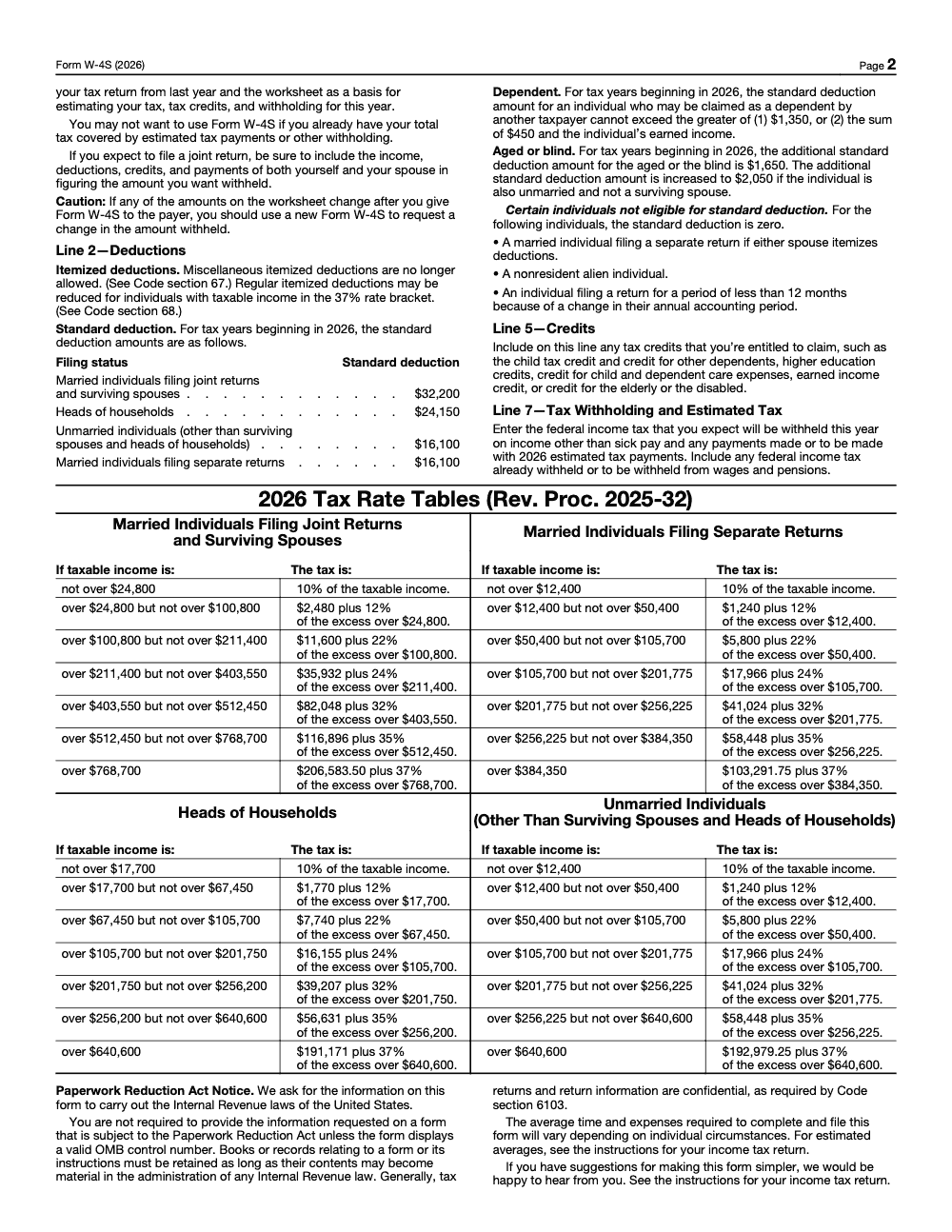
- Enter your itemized or standard deduction on Line 2; for 2026 the standard deduction is $16,100 single or married filing separately, $32,200 married filing jointly, and $24,150 head of household, per Rev. Proc. 2025-32.
- Figure taxable income on Line 3 and tax from the 2026 rate tables on Line 4.
- Subtract credits on Line 5, then other withholding plus estimated payments on Line 7.
- Carry the shortfall to Line 8, divide by the number of expected payments on Line 9, and round Line 10 to the nearest dollar.
- Re-check the Line 10 amount against the whole-dollar, minimum, and $10 net rules.
- On a joint return, include both spouses’ income, deductions, credits, and payments.
Change or revoke a W-4S
- File a new signed W-4S whenever benefits, wages, or other income change.
- To revoke, complete a new W-4S, write “Revoked” in the money-amount box, and sign it.
- Give the new or revoked form to the payer, not the IRS.
- Confirm the effective pay period with the payer.
- Keep dated copies of every version for your records.
- Reconcile the year-end Form W-2 against the amounts you elected.
Keep W4S Season From Stalling
Form W-4S work does not arrive on a clean quarterly calendar. It shows up whenever someone moves onto third-party sick pay, and each election carries exact rules: a whole-dollar amount of at least $4 per day, $20 per week, or $88 per month, plus a $10 net-payment floor, per the Form W-4S instructions. Miss one and the payer rejects the election, or the recipient under-withholds against the 90 percent current-year safe harbor described in IRS Publication 505.
The problem is rarely the form itself. It is keeping these one-off elections from slipping through while a team is already deep in payroll and tax cycles. A little structure turns a scattered task into a repeatable step.
- Add a W-4S check to every disability or leave-benefit intake, so no third-party payer is missed.
- Standardize the worksheet so Line 8 through Line 10 are computed the same way every time and rounded to whole dollars.
- Validate each Line 10 amount against the $4, $20, or $88 minimum and the $10 net floor before the form goes out.
- Track when withholding begins and reconcile the year-end Form W-2 against the elected amount.
- Re-run the election whenever benefits or other income change, since a W-4S stays in effect until replaced or revoked.
This is the kind of detailed, deadline-bound execution we systematize. Accountably is an offshore accounting and tax staffing company built for CPA, EA, and accounting firms, and our tax preparation and review services fold elections like W-4S into documented SOPs with multi-layer review, so the small forms get handled with the same discipline as the returns.
FAQs
It lets you ask a third‑party payer of taxable sick pay to withhold federal income tax from each payment. You give the form to the payer, not the IRS or your employer.
No. W‑4S only affects federal income tax. FICA follows separate rules, generally applies during the first six months after the last month you worked, then stops after that window.
No. You request a whole‑dollar amount per payment, and the IRS sets minimums by pay period. Percentage methods like the 22 percent flat rate apply to employers or agents when they pay supplemental wages, not to third‑party W‑4S withholding.
The payer should begin withholding on payments made 8 or more days after receiving your form, and may withhold sooner if feasible.
Then there is usually no federal income tax withheld, and you may need to make estimated tax payments to avoid a balance due and potential penalties. Publication 505 explains how to plan withholding and estimates.
Other forms this guide names
About this guide
Accountably helps US CPA, EA, and accounting firms hire trained accountants and tax preparers in India.
About us Reviewed byJugal Thacker, CPAFounder and CEO at Accountably
A Washington-licensed CPA with 7+ years inside US firms – PwC, a real-estate tax practice, then a full-service firm, rising from reviewer to manager to advisory. This article was reviewed against current IRS guidance for the 2025 tax year and updated for filers preparing late returns, amendments, and 2026 estimates.
View profile →How we research, review, and update this guide
Every Accountably guide is researched against primary IRS sources, reviewed by a U.S. CPA, and refreshed as guidance evolves. Read our Editorial Guidelines to see how we source, fact-check, and update our content.