Summarize this article with AI
In Brief
Schedule Q (Form 1042) reports a Qualified Derivatives Dealer's tax liability on section 871(m) dividend equivalents and related items (per the 2025 Schedule Q instructions published on IRS.gov, revision date June 5, 2025). One Schedule Q is required for each QDD branch, even when liability is zero, and it rides with Form 1042 as an attachment, never as a stand-alone return. For calendar years 2019 through 2026, transition relief suspends Line 1, Line 3, and certain Line 5 detail (per the Schedule Q instructions and Notice 2024-44).
Schedule Q is filed by a Qualified Derivatives Dealer reporting tax liability on section 871(m) dividend equivalents, so most Form 1042 filers never see it. The detail that catches teams is the branch rule: you file a separate Schedule Q for each QDD branch, even when that branch's liability comes out to zero, and a fiscal year spanning two calendar years means two schedules for the same branch.
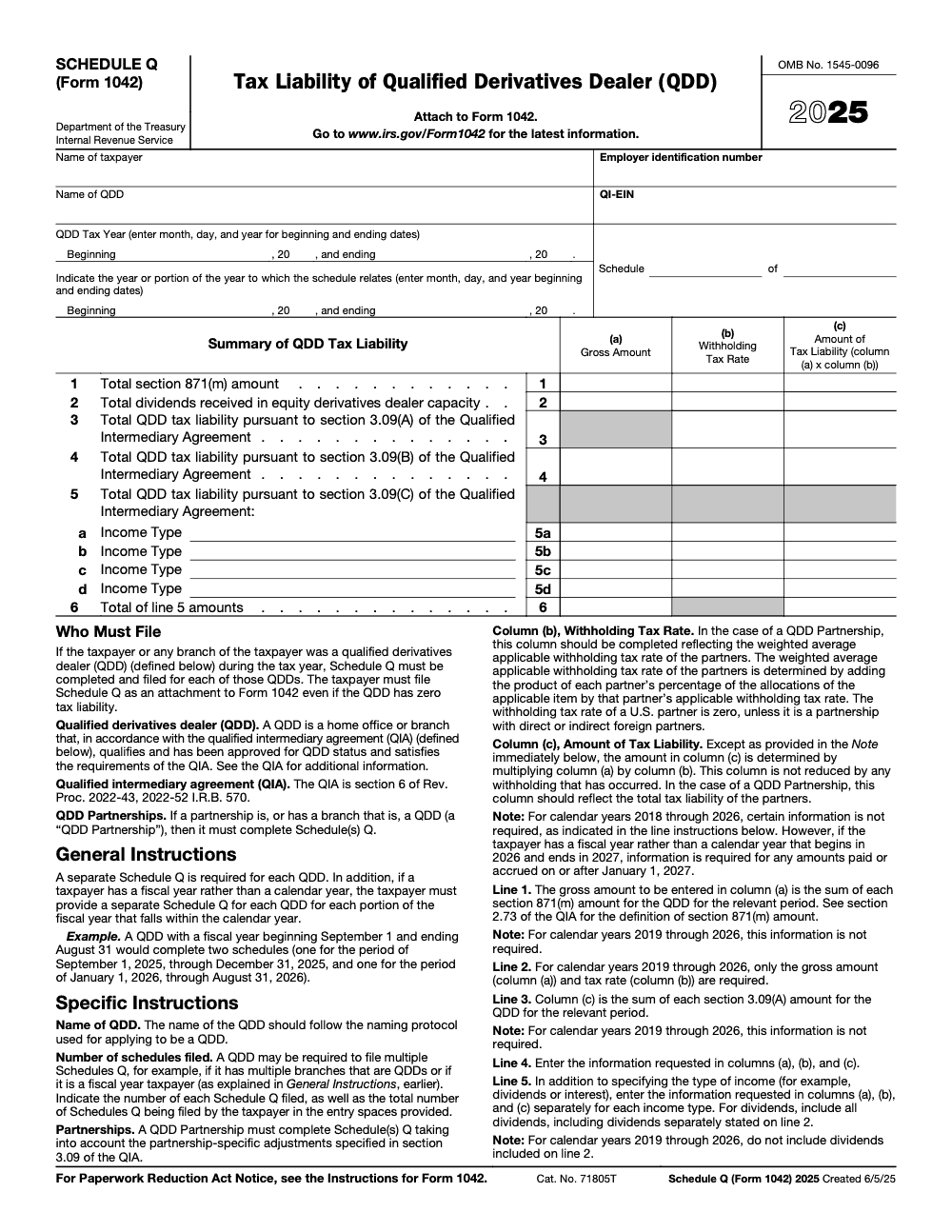
It attaches to Form 1042 and never stands alone. For 2025 the IRS has extended transition relief for certain 871(m) rules through 2026, so some line-item detail is not required for calendar years 2019 through 2026, and the current schedule already reflects that. The form below is what you attach; everything on it has to tie back to your Form 1042 liability lines and your related Forms 1042-S.
Key Takeaways
- Schedule Q isolates a QDD’s tax liability related to section 871(m) dividend equivalents and related items. You attach it to Form 1042, it is not a standalone return.
- You must file a separate Schedule Q for each QDD branch. If you have a fiscal year that spans two calendar years, you file two Schedules Q for that branch, one for each calendar‑year portion.
- For 2025, the IRS has extended transition relief for certain 871(m) rules through 2026, and the current Schedule Q reflects that relief. Some line‑item details are not required for calendar years 2019 through 2026.
- Your totals on Schedule Q must reconcile to Form 1042 liability lines and to all related Forms 1042‑S. Keep complete workpapers, audit trails, and tie‑outs for every schedule you file.
Why teams trip on Schedule Q
You are juggling derivative data, delta tests, treaty claims, and QI Agreement nuances, all while month end and peak deadlines collide. In my experience, problems cluster in three places.
- Capacity spikes create review bottlenecks, so branch‑level QDD schedules get prepared late or inconsistently.
- Workpapers lack standard naming and version control, so reconciliations to Form 1042 and 1042‑S drift across versions.
- Documentation gets stale, especially W‑8IMY packages and withholding statements, which makes recipient classification and rate setting shaky.
The fix is not heroic effort. It is disciplined delivery. Clear SOPs, structured workpapers, and a defined multi‑layer review flow keep you out of trouble. If you use an offshore partner, make sure they work inside your systems, follow your templates, and are accountable for turnaround, quality control, and security. Capacity without structure turns into chaos during 1042 season.
What Schedule Q is, in plain English
Schedule Q is a single‑page, editable PDF that reports a QDD’s tax liability on dividend equivalents and related items tied to section 871(m). It sits behind your Form 1042 as a branch‑specific attachment. The form itself highlights what changed, including relief under Notice 2024‑44. You complete columns for gross amounts, applicable rates, and computed liability (column (c) is gross tax liability and is not reduced by any withholding that has already occurred), then you tie those figures to Form 1042 and your 1042‑S population.
- Must file even if the QDD has zero liability, because the IRS wants visibility into each QDD branch.
- If your QI has a non‑calendar fiscal year, and that year spans a calendar year boundary, you file two Schedules Q for that branch, one for each calendar‑year portion. The Schedule Q PDF gives a concrete example.
Where Schedule Q fits with other forms
Think of Schedule Q as the branch‑level detail that supports your annual Form 1042 and your payee‑level Forms 1042‑S. If you file any 1042‑S on paper, you add Form 1042‑T as the transmittal, which is not used for e‑filed forms. Publication 515 and the 1042‑S instructions explain how dividend equivalents are reported as U.S. source dividends for withholding and coding, typically Income Codes 34 or 40.
| Form | What it covers | Why it matters |
| Form 1042 | Annual aggregate withholding liability and deposits | The top‑level return that must reconcile with all supporting schedules and 1042‑S forms. |
| Schedule Q (Form 1042) | QDD branch‑level liability on dividend equivalents and related items | Required for each QDD branch, even with zero liability, and updated for 2025 relief. |
| Form 1042‑S | Payee‑level amounts, status, and withholding | Must reflect dividend equivalents as U.S. source dividends and tie back to Form 1042 totals. |
| Form 1042‑T | Transmittal for paper 1042‑S only | Include only when you paper file Forms 1042‑S. |
A quick word on delivery, if you are stretched thin, bring in help that fits your operations. At Accountably, our role with firms is to strengthen the delivery system around 1042, 1042‑S, and Schedule Q, using SOPs, standardized workpapers, and layered review so partner time is protected. Mentioning us here only because structure is often the difference between a clean tie‑out and a week of rework.
The 2025 rules that actually change your Schedule Q
Two items shape your 2025 filing season. First, the IRS extended the section 871(m) transition relief via Notice 2024‑44, carrying several phase‑ins through 2026. Second, the current Schedule Q (revised June 5, 2025) explicitly reflects that relief, and it tells you which details are not required for 2019 through 2026.
- Transition relief extended. The IRS intends to amend the regulations so a QDD is not subject to tax on dividends and dividend equivalents it receives in its equity derivatives dealer capacity for 2025 and 2026, and related phase‑ins continue. Law firms summarized that the phase‑in for delta‑one and non‑delta‑one, certain combined transaction rules, and QDD relief all extend through 2026. Always confirm the primary IRS sources before you file.
- What the current Schedule Q asks for. The 2025 Schedule Q (revised June 5, 2025) confirms that for calendar years 2019 through 2026, certain line‑item details are not required, for example the section 871(m) amount on line 1 and the section 3.09(A) amount on line 3. If your fiscal year begins in 2026 and ends in 2027, you must provide information for amounts paid or accrued on or after January 1, 2027.
QDD definition and relationship to the QI Agreement
A QDD is a QI home office or branch that qualifies and is approved for QDD status under the QI Agreement. Each qualified branch is treated as a separate QDD for documentation, withholding, and reporting, and it must represent itself as a QDD on Form W‑8IMY and on a withholding statement. The 2025 1042‑S instructions restate these points and point to Rev. Proc. 2022‑43 for agreement terms.
Practical tip, manage QDD branches as separate filers for workpaper purposes. Give each branch its own Schedule Q workpaper, its own review checklist, and its own reconciliation to the Form 1042 and 1042‑S universe.
Filing timing, multiple branches, and fiscal years
- One Schedule Q per QDD branch, attached to Form 1042, even with zero liability. The 1042 instructions and the Schedule Q PDF both make this clear.
- Non‑calendar fiscal years, the Schedule Q PDF gives a concrete example. A QDD with a year beginning September 1 and ending August 31 files two schedules for the calendar‑year portions. Build your reporting calendar around that split to avoid last‑minute surprises.
What counts as a section 871(m) dividend equivalent
A dividend equivalent is any payment or deemed payment that is contingent on, or determined by reference to, a U.S. source dividend, including substitute dividends under securities lending or repo, specified notional principal contracts, and specified equity‑linked instruments. These are treated as U.S. source dividends for withholding and reporting. Publication 515 and the regulations at 1.871‑15 lay out the definitions, sourcing, and calculation mechanics.
- Income codes. Dividend equivalents are generally reported using Income Code 34 or 40 on Form 1042‑S, subject to exceptions in chapter 4 contexts.
- Sourcing. The regulations treat dividend equivalents as U.S. source dividends for chapters 3 and 4, which is why your withholding and reporting obligations look like ordinary dividend withholding, unless an exception applies.
The delta idea, the test you actually apply
You test contracts against thresholds to determine whether they are section 871(m) transactions. For simple contracts, the amount of a dividend equivalent is the per‑share dividend times the number of shares times the contract’s delta at the relevant time. For complex contracts, rules vary, and the anti‑abuse rule can still pull a transaction into scope. Keep a clean record of the delta you used, the timing, and your instrument classification.
A quick, realistic example
- Facts, your non‑U.S. counterparty is long a delta‑one total return swap on 100,000 shares of U.S. stock. The issuer declares a dividend of 0.50 per share.
- Amount, per the regulations, a simple contract dividend equivalent equals 0.50 times 100,000 times delta of 1.00, so 50,000 is the gross dividend equivalent.
- Treatment, you apply the correct rate based on documentation, chapter 3 status, and treaty claims, then you report on Form 1042‑S and reflect the QDD liability on Schedule Q as applicable. Publication 515 and the 1042‑S instructions guide rate setting and codes.
Keep every step auditable, instrument terms, delta source, documentation used for rate setting, and the exact tie‑out from trade data to Schedule Q, to 1042‑S, to the Form 1042 liability line.
Your end‑to‑end Schedule Q workflow that actually reconciles
Here is a practical sequence my team uses with QI and QDD filers. Adjust names to your systems, keep the order.
- Data pull and validation
- Extract dividend equivalent candidates from trading systems and securities lending platforms. Tag by instrument type, branch, and payee.
- Validate counterparty status and documentation, including Form W‑8IMY and any withholding statements that identify QDD branches. Use the information‑sharing mechanics in Reg. 1.871‑15(p) where appropriate.
- Scope and rate setting
- Determine whether each instrument is in scope under the 871(m) rules, including delta and combined transaction considerations, and apply the anti‑abuse lens.
- Set the correct rate, typically 30 percent unless a treaty reduction applies to the beneficial owner or the QDD’s computed liability dictates otherwise. Publication 515 and 1042‑S instructions remain your quick references for codes and treaty considerations.
- Compute and book
- Compute dividend equivalents and any other amounts that feed the Schedule Q lines for your QDD branches.
- Post entries and capture workpapers that match instrument‑level details to branch‑level schedules.
- Prepare forms, then reconcile
- Complete Schedule Q for each QDD branch. Remember, for 2019 through 2026 certain line details are not required, and a fiscal year that spans 2026 into 2027 triggers additional detail for amounts on or after January 1, 2027.
- Reconcile Schedule Q totals to Form 1042 liability lines and to your full 1042‑S population. Use a one‑to‑many tie‑out that explains any timing differences and credits.
- Review and file
- Run a multi‑layer review, preparer to senior to quality to final sign‑off, so partners spend time on exceptions rather than page‑by‑page checks.
- File Form 1042 with all required Schedule Q attachments. If any 1042‑S are filed on paper, include Form 1042‑T. The 1042 instructions spell out the attachment and 1042‑T use.
Controls checklist you can copy
- QDD branch list, with EINs and naming conventions that match your W‑8IMY and IRS approval letters.
- Instrument catalog with delta source, measurement date, and whether combined transaction rules were evaluated.
- Documentation tracker for W‑8s, treaties, and withholding statements, with expiration dates and exception notes.
- Workpaper standard, consistent file names, version control, and a tie‑out index from trades to Schedule Q, to 1042‑S, to Form 1042.
- SLA clock for turnaround and a review log that shows who checked what, and when.
Data elements you need on every Schedule Q
The Schedule Q PDF lists the core items, including name of taxpayer, name of QDD, QI‑EIN, the specific QDD tax year, and a summary of the QDD tax liability across designated lines. For partnerships that are QDDs, the form instructs you to reflect the weighted average applicable withholding tax rate of the partners, and to show the total partner‑level liability in column (c). The withholding tax rate of a U.S. partner is zero in that weighted average, unless the U.S. partner is itself a partnership with direct or indirect foreign partners, in which case it carries a non‑zero rate.
- Line notes that matter in 2025
- Line 1, line 3, and line 5 details are not required for calendar years 2019 through 2026.
- Line 2 requires the gross amount and tax rate for 2019 through 2026.
- For fiscal years that begin in 2026 and end in 2027, include required information for amounts on or after January 1, 2027.
Recipient classifications and treaty positions
Get recipient status right, then your rate is defensible. The 1042‑S instructions explain the QDD and QI roles, and Publication 515 explains how dividend equivalents are treated and coded. Your documentation must back the status and any treaty claim you apply.
- Classify the recipient, QDD, QI, QSL, flow‑through, or beneficial owner. Notice 2024‑44 allows continued application of QSL transition rules from Notice 2010‑46 for payments made in 2025 and 2026, which affects how you treat substitute dividends in lending chains.
- Record the treaty country, article, rate, and the exact form relied upon, then keep that with your Schedule Q and 1042‑S workpapers.
Common pitfalls and how to sidestep them
- Treating Schedule Q as an afterthought When teams build Form 1042 first and bolt on Schedule Q later, branch details do not match the 1042‑S population, and you spend days chasing breaks. Close the branch schedules first, then roll up to Form 1042.
- Missing the “zero liability, still file” rule Even if your QDD branch computes zero liability for the year, you must attach Schedule Q for that branch. This is explicit in both the 1042 instructions and the Schedule Q PDF.
- Fiscal year, calendar year mismatch If your fiscal year spans two calendar years, you owe two Schedules Q for the affected branch. Put the example from the IRS PDF into your filing calendar so the team is not surprised in February.
- Documentation drift Outdated W‑8IMY packages and missing branch identification on withholding statements cause misapplied rates and misrouted liability. Refresh documentation early and keep a tracker with expiry dates.
- Ignoring extended relief details The 2025 season lives under transition relief that runs through 2026. The current Schedule Q tells you which line details are not required for 2019 through 2026. Use that to simplify, while keeping full internal records.
Quick reference, what to file and how it ties together
- Form 1042 is your annual return for withholding agents.
- Schedule Q is attached for each QDD branch, whether liability exists or not.
- Forms 1042‑S report payee‑level amounts and withholding, using the right income codes for dividend equivalents.
- If any 1042‑S are paper, include Form 1042‑T. All totals reconcile to Form 1042.
FAQs
Schedule Q reports a QDD’s tax liability under section 871(m), and you attach it to Form 1042. The 2025 Schedule Q (created June 5, 2025) summarizes QDD tax liability across Lines 1 through 6, and the line instructions tell you which details are not required for calendar years 2019 through 2026.
Yes. If the taxpayer or any branch was a qualified derivatives dealer during the year, you must complete and attach a Schedule Q for each QDD, even with zero liability. The instructions are explicit that Schedule Q is filed as an attachment to Form 1042 even when the QDD has zero tax liability.
A separate Schedule Q is required for each QDD. You cannot consolidate multiple QDD branches onto a single schedule. Record how many you filed in the “Schedule ___ of ___” field, and follow the QDD naming protocol used when QDD status was approved.
A fiscal-year QDD must split the fiscal year at the calendar-year boundary and file one Schedule Q per QDD per fragment. The instructions illustrate this with a September 1 to August 31 fiscal year, which produces two Schedules Q: one for September 1, 2025 through December 31, 2025, and one for January 1, 2026 through August 31, 2026.
No. Column (c) is gross tax liability, generally Column (a) multiplied by Column (b), and it is not reduced by any withholding that has already occurred. Withholding paid is reflected elsewhere on Form 1042, not on Schedule Q.
If you need help with delivery
If you want a second set of hands that works inside your systems and templates, our team at Accountably can support QDD and 1042 workflows with SOPs, standardized workpapers, and a multi‑layer review so your partners stay focused on strategy. If that kind of help would save your next filing week, reach out for a short working session. We can map your current process, identify where reconciliations stall, and propose a delivery plan that preserves control, quality, and security.
Common Mistakes We See Every Season
The Schedule Q errors we see year after year are not arithmetic, they are scoping mistakes made before anyone touched a number. Six patterns repeat.
Reusable Checklists
These checklists are copy-paste ready for your firm SOPs. Use them as the preparer and reviewer signoff pages on every QDD engagement so the Schedule Q work stays auditable.
QDD pre-file packet
- Confirm QDD status is current under the QI Agreement (Section 6 of Rev. Proc. 2022-43).
- List every QDD branch by approved name and QI-EIN, matched to the naming protocol used at application.
- Confirm tax-year type for each QDD (calendar vs. fiscal); flag any fiscal year that crosses Dec 31.
- Collect W-8IMY packages and withholding statements for each branch, with effective dates noted.
- Pull Form 1042 prior-year working file to verify branch list matches.
- Confirm the 2025 Schedule Q PDF in use is the June 5, 2025 revision.
- Flag any QDD Partnership for the separate weighted-average rate workpaper.
Schedule Q tie-out and reconciliation
- Header completed: taxpayer name, EIN, QDD name, QI-EIN, QDD tax year, period covered, "Schedule ___ of ___".
- Line 1 (section 871(m) amount): for 2025, confirm Line 1 is left blank under the 2019-2026 transition.
- Line 2: gross dividends received in equity derivatives dealer capacity entered in Column (a) and Column (b) only.
- Line 3: confirm Line 3 detail is suspended for 2025 under the transition window.
- Line 4 (Section 3.09(B)): all three columns completed, with Column (c) = Column (a) x Column (b), no withholding netted.
- Line 5 (Section 3.09(C)): one row per income type, dividends already on Line 2 excluded for the transition window.
- Line 6: equals the sum of all Line 5 amounts in Column (c).
- Schedule Q totals reconcile to the corresponding lines on Form 1042 and to the 1042-S population.
Fiscal-year QDD split review
- Two Schedules Q drafted per branch: Jan 1 to fiscal year-end, fiscal year-start to Dec 31.
- "Year or portion of year" header field on each schedule shows the correct begin and end dates.
- "Schedule ___ of ___" field reflects the multi-schedule count across branches.
- For any fiscal year beginning in 2026 and ending in 2027, Line 1 / Line 3 / Line 5 detail is captured for amounts paid or accrued on or after Jan 1, 2027.
- Workpaper notes which portion of the period falls inside the 2019-2026 transition relief and which does not.
- Reviewer signoff confirms the multi-period totals tie back to Form 1042 aggregate liability lines.
Keep Schedule Q (Form 1042) Season From Stalling
Schedule Q sits in the middle of the busiest stretch of the year for QI compliance teams. Form 1042 is annual, but the workpaper effort behind every QDD branch compounds with each new branch, treaty refresh, and Notice 2024-44 transition adjustment. The Schedule Q instructions suspend several detail rows for calendar years 2019 through 2026, which sounds like relief on paper but in practice creates more version-control risk, not less, because preparers and reviewers have to remember which rows the PDF expects this year and which it does not.
The fix is process, not heroics. Most Schedule Q breakdowns trace back to branch segmentation, weighted-average rate logic, or transition-row tracking that was not locked in before the preparer touched the file.
- Build a branch-level workpaper register keyed to QI-EIN, with separate folders for each fiscal-year fragment where the December 31 boundary splits the period.
- Lock the Column (b) rate logic for any QDD Partnership before line entries begin, using a weighted-average across partners with U.S. partner zero-rate carve-outs per Section 3.09 of the QIA.
- Tie Schedule Q Column (c) to Form 1042 liability lines and to the 1042-S population before preparer signoff, not after the reviewer.
- Maintain a per-year transition checklist for which Line 1, Line 3, and Line 5 detail is suspended through 2026, so the preparer ticks the right rows for the right calendar year.
- Document every Notice 2024-44 election and QIA reference on the same workpaper page as the number it supports, so reviewers do not chase citations across folders.
When the bench is thin during 1042 season, our U.S. tax outsourcing teams plug into your QDD workflow, follow your templates, and run the multi-layer review so partners stay on advisory work and the QI Agreement obligations stay clean.
Other forms this guide names
- Form 1042: Annual Withholding Tax Return for Foreign Persons 2025
- Form W-8IMY: Foreign Intermediary Withholding Certificate
- Form 1042-T: Paper Transmittal for 1042-S, Due March 15
Summarize this article with AI
About this guide
Accountably helps US CPA, EA, and accounting firms hire trained accountants and tax preparers in India.
About us Reviewed byJugal Thacker, CPAFounder and CEO at Accountably
A US-licensed CPA with 7+ years inside US firms – PwC, a real-estate tax practice, then a full-service firm, rising from reviewer to manager to advisory. This article was reviewed against current IRS guidance for the 2025 tax year and updated for filers preparing late returns, amendments, and 2026 estimates.
View profile →How we research, review, and update this guide
Every Accountably guide is researched against primary IRS sources, reviewed by a U.S. CPA, and refreshed as guidance evolves. Read our Editorial Guidelines to see how we source, fact-check, and update our content.