Summarize this article with AI
In Brief
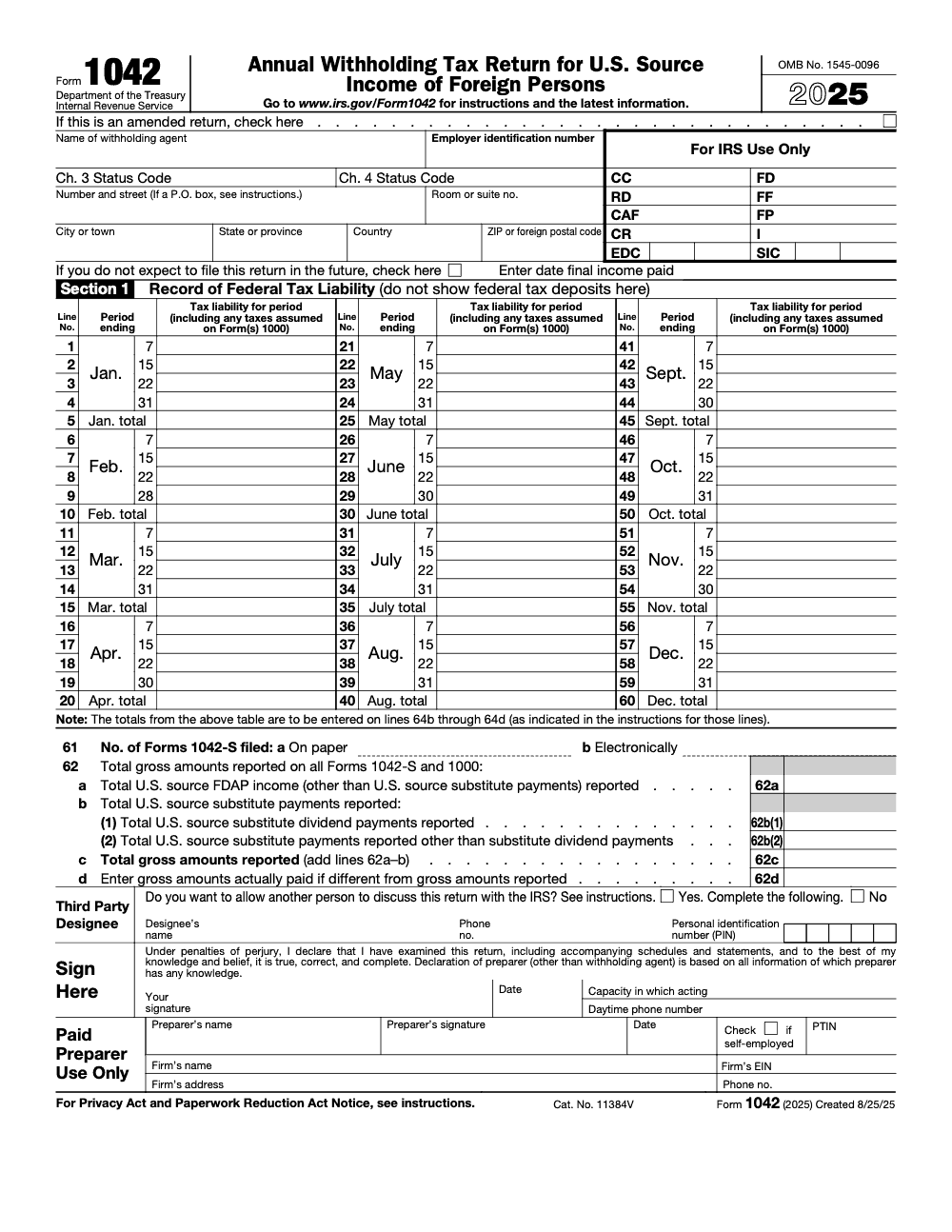
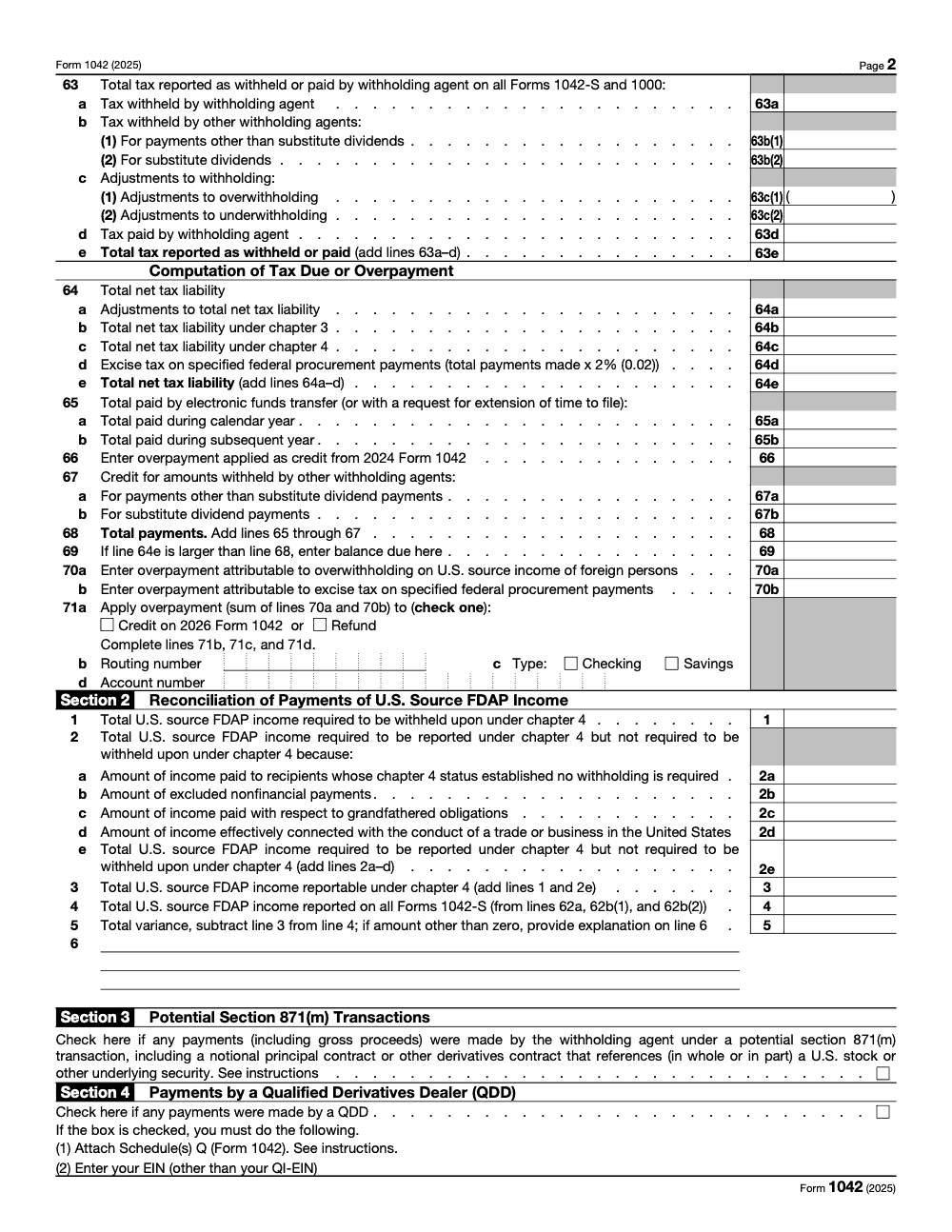
Form 1042 is the U.S. withholding agent's annual aggregate return for U.S.-source FDAP income paid to foreign persons (per IRS Form 1042 instructions, OMB 1545-0096). The default Chapter 3 withholding rate is 30%, Section 1 monthly totals (lines 5, 10, 15, 20, 25, 30, 35, 40, 45, 50, 55, 60) flow into lines 64b through 64d on page 2, and refunds tied to over-withholding reported on Form 1042-S can take up to 6 months to process. See our companion Form 1042-S guide for the per-payee information return.
A university with a handful of foreign scholarship recipients looks like a simple filing until the treaty income codes, the qualified-scholarship exclusions, and the link to nonresident individual returns all surface at once. Form 1042 is the withholding agent's annual aggregate return for U.S.-source FDAP income paid to foreign persons, and the default Chapter 3 rate that runs underneath all of it is 30%.
The mechanics are mostly plumbing once you respect them: the monthly Section 1 totals on lines 5 through 60 flow into lines 64b through 64d on page 2, the return is due March 15 with an extension to September 15 on Form 7004, and a refund tied to over-withholding can take up to 6 months to process. The form below is what you file; its per-payee companion, Form 1042-S, is covered separately.
Key Takeaways
- Form 1042 is the Annual Withholding Tax Return for U.S. Source Income of Foreign Persons, filed by withholding agents to report and pay tax withheld under Chapter 3 (and Chapter 4 / FATCA for applicable filers).
- Who files: Any U.S. withholding agent that paid U.S.-source FDAP income to a foreign person during the year – including corporations, universities, partnerships, financial institutions, and individuals acting as withholding agents.
- Due date: March 15 of the year following the calendar year in which the income was paid. An extension to September 15 is available via Form 7004.
- Withholding deposits must be made monthly (or more frequently) via EFTPS using deposit coupon form designating Chapter 3 withholding.
- Key companion form: Form 1042-S is the per-payee information return that must be issued to each foreign payee and filed with the IRS. Form 1042 is the aggregate return.
- SOP tip: Build Form 1042-S preparation into your year-end close workflow so that all foreign payee income is captured by the Form 1042-S deadline (March 15), which is the same as the Form 1042 due date.
What Form 1042 Is and When to Use It
Form 1042 is the annual tax return through which U.S. withholding agents report and reconcile tax withheld from U.S.-source income paid to foreign persons under the Chapter 3 withholding regime. Chapter 3 (Sections 1441–1443) requires withholding agents to withhold 30% from fixed or determinable annual or periodical (FDAP) income paid to foreign persons, unless a reduced rate applies based on a W-8 form certification or tax treaty.
FDAP income includes dividends, interest, rents, royalties, salaries paid to foreign nationals for services performed in the U.S., scholarship and fellowship income, and other periodic income. It does not include income that is effectively connected with the conduct of a U.S. trade or business (ECI), which is subject to different withholding rules under Section 1446 (for partnerships) or Section 1441 if the payee provides Form W-8ECI.
Who Is a Withholding Agent
The definition of withholding agent is broad. Any U.S. person (or foreign person in certain circumstances) that has control, receipt, custody, disposal, or payment of an amount subject to Chapter 3 withholding is a withholding agent. This includes: domestic corporations paying dividends to foreign shareholders, U.S. universities paying scholarships or fellowships to foreign students, U.S. employers paying wages to foreign employees for U.S. services, partnerships with foreign partners, and U.S. financial institutions holding accounts of foreign individuals.
Form 1042 vs. Form 1042-S
Form 1042 is the aggregate annual withholding return – one return per withholding agent, summarizing all withholding for the year. Form 1042-S is the per-payee information return that must be issued to each foreign recipient of FDAP income and filed with the IRS. The total withholding on all Form 1042-S filings must reconcile to the Form 1042. Failure to issue Form 1042-S by the deadline triggers a separate penalty from the Form 1042 late-filing penalty.
How to Complete Form 1042, Section by Section
Form 1042 is organized in parts that flow from identification information through income-type reporting, deposit reconciliation, and balance due computation.
Lines 1–3 – Identification and Filing Status
Enter the withholding agent’s legal name, EIN, address, and type of withholding agent. Line 61 asks the total number of Forms 1042-S filed for the year (61a paper, 61b electronically) – this should reconcile to the 1042-S filing count. A mismatch here is the first thing the IRS looks at in a 1042 review.
Form 1042-S Income Codes – Withholding Rate Reference
Lines 1–60 of Form 1042 are the Section 1 Record of Federal Tax Liability (three columns of 20 period-ending rows for Jan–Apr, May–Aug, Sept–Dec). The income-code matrix below lives on Form 1042-S (the per-payee return that feeds Form 1042), not on Form 1042 itself. Common Chapter 3 income codes used on Form 1042-S include:
| Income Code | Income Type | Default Rate |
|---|---|---|
| 01 | Interest paid by U.S. obligors – general | 30% (may be reduced by treaty or portfolio interest exemption) |
| 06 | Dividends paid by U.S. corporations | 30% (reduced to 15% or less under most treaties) |
| 12 | Royalties – industrial | 30% (often reduced to 0% or 5% under treaties) |
| 15 | Scholarship or fellowship grants | 14% for F, J, M, Q visa holders who are degree candidates (or lower treaty rate); 30% for non-degree candidates and others |
| 16 | Compensation for independent personal services | 30% |
| 17 | Compensation for dependent personal services | Graduated rates (treated as wages) |
| 20 | Gross proceeds from sale of securities | Varies by treaty and FATCA |
On each Form 1042-S issued, enter the income code, total amount of income paid, the amount withheld, any treaty exemptions claimed, and the net tax due. The income code determines the withholding rate applied. The Form 1042 aggregates these per-recipient totals on lines 62a, 62b(1), and 62b(2). Quick rule you can copy into your SOP: before completing Form 1042, create a master ledger of all foreign payees, income codes, treaty claims, and withholding amounts – it is the foundation of both the 1042 and the 1042-S filings.
Deposit Reconciliation and Balance Due
The form reconciles the tax withheld against deposits made during the year via EFTPS. Deposits are required monthly – by the 15th of the month following the month in which the withheld amount exceeds $200, or within 3 business days if the cumulative liability exceeds $2,000 at any point. The balance due or overpayment on the return reflects the difference between what was withheld and what was deposited.
Deadlines, Penalties, and Filing Requirements
| Filing Event | Due Date | Extension Available |
|---|---|---|
| Form 1042 annual return | March 15 | 6-month extension (Form 7004) to September 15 |
| Form 1042-S to payees | March 15 | 30-day extension via Form 8809 |
| Form 1042-S filed with IRS | March 15 (paper); March 31 (electronic) | 30-day extension via Form 8809 |
| Monthly deposits (if liability > $200) | 15th of following month | None |
| Same-day rule (if liability > $2,000) | Within 3 business days | None |
Failure-to-File and Failure-to-Deposit Penalties
Failure to file Form 1042 triggers a 5% per month penalty, up to 25% of the unpaid tax. Failure to deposit withheld tax triggers the same graduated deposit penalties as payroll tax – 2% (1–5 days late), 5% (6–15 days late), 10% (16+ days), 15% (after IRS demand). Failure to file Form 1042-S or issuing incorrect 1042-S forms carries penalties of $60–$310 per form depending on how late the correction is made, with higher caps for intentional disregard.
E-Filing Requirements
Withholding agents filing 250 or more Form 1042-S information returns must e-file. The IRS FIRE system handles 1042-S electronic filing. Form 1042 itself is typically filed on paper, though electronic options may exist through tax software.
Form 1042-S – The Per-Payee Information Return
Form 1042-S is the information return that makes the Chapter 3 withholding system work. Every foreign person who received FDAP income from the withholding agent during the year receives a Form 1042-S showing the income, withholding, and any treaty exemption applied. It serves the same function as a W-2 or 1099 – giving the recipient information needed to file their own return and giving the IRS a matching document.
Key Fields on Form 1042-S
Box 1 is the income code (must match the codes reported on Form 1042). Box 2 is gross income. Box 3 is the Chapter 3 withholding indicator. Box 4 is the exemption code (if the income is exempt from withholding). Box 7 is federal tax withheld. Box 12 is the recipient TIN – either a U.S. ITIN or an EIN. Box 13 is the recipient information. Box 17 is the country code for the payee’s country of residence. Each 1042-S must be issued to the payee and filed with the IRS. Retain a copy for 4 years.
Correcting Errors on Form 1042-S
If you issue an incorrect 1042-S, file a corrected version with the IRS and provide the corrected form to the payee as soon as the error is discovered. Common corrections: wrong income code, wrong withholding amount, wrong treaty exemption code. Corrected 1042-S forms must be clearly marked “AMENDED.” Filing corrections promptly reduces the penalty exposure from incorrect information returns.
Chapter 4 (FATCA) Withholding and Form 1042
Chapter 4 – the FATCA withholding regime enacted by the Foreign Account Tax Compliance Act – added a parallel withholding obligation alongside Chapter 3 for certain withholdable payments made to non-participating foreign financial institutions (NP-FFIs) and recalcitrant account holders. Form 1042 includes Chapter 4 withholding sections in addition to the Chapter 3 sections, and both must be completed when applicable.
Withholdable Payments Under FATCA
Chapter 4 withholding at 30% applies to U.S.-source FDAP income paid to non-compliant FFIs and to certain non-financial foreign entities (NFFEs) that fail to provide required ownership information. Most FATCA compliance issues arise at the financial institution level, but U.S. operating companies that make substantial payments to foreign entities should verify the FATCA status of their payees as well.
FATCA Status Documentation
The FATCA status of each payee is documented through the W-8 series forms. Form W-8BEN-E includes a section where foreign entities certify their FATCA status (e.g., participating FFI, registered deemed-compliant FFI, NFFE, etc.). Withholding agents rely on this certification to determine whether Chapter 4 withholding applies. If the FATCA status is unclear or the entity is non-compliant, 30% withholding is required under Chapter 4, which may stack on top of Chapter 3 withholding in some circumstances.
Common Mistakes That Slow Things Down
Five patterns trip up first-year and seasoned 1042 filers alike. Each one shows up in IRS correspondence months after the return is signed and filed.
Practical Checklists You Can Reuse
These are copy-paste ready for a firm SOP. Drop them into your 1042 binder, your withholding-agent prep wiki, or your internal control checklist.
Pre-file reconciliation packet
- Confirm the Chapter 3 status code and Chapter 4 status code at the top of page 1 are both populated (both fields are required).
- Tie lines 62a (FDAP income), 62b(1) (substitute dividends), and 62b(2) (other substitute payments) to the sum of every Form 1042-S issued.
- Reconcile lines 63a (tax withheld by you), 63b(1) and 63b(2) (tax withheld by other agents), 63c(1) and 63c(2) (overwithholding and underwithholding adjustments), 63d (tax paid by withholding agent), and 63e (total).
- Complete Section 2 (chapter 4 reconciliation). If line 5 variance is non-zero, write the explanation on line 6 before signing.
- Check Section 3 (871(m)) if any payments referenced a U.S. underlying.
- Check Section 4 (QDD), attach Schedule Q, and enter the non-QI EIN if any payments were made by a Qualified Derivatives Dealer.
- Verify the amended-return box (page 1) or the final-return box plus date (above Section 1) is correctly marked or correctly left blank.
Section 1 monthly liability tie-out
- Confirm each period-ending row (7th, 15th, 22nd, and month-end) reflects the actual tax liability for that period, including any taxes assumed on Form 1000.
- Do NOT enter federal tax deposits in Section 1. Deposits belong on line 65a (calendar-year EFT) or 65b (subsequent year).
- Roll the monthly totals on lines 5, 10, 15, 20, 25, 30, 35, 40, 45, 50, 55, and 60 into lines 64b (chapter 3 liability) and 64c (chapter 4 liability) per the instructions.
- If you paid specified federal procurement payments to a foreign vendor, report the 2% Section 5000C excise on line 64d and re-sum line 64e.
- Reconcile line 64e (total net tax liability) against line 68 (total payments). A larger 64e means balance due on line 69; a larger 68 produces an overpayment on line 70a or 70b.
Treaty status refresh before calendar year-end
- Sweep the W-8BEN and W-8BEN-E file for Hungary residents and apply the statutory 30% withholding for payments on or after January 1, 2024.
- Sweep for Russia residents and apply 30% statutory withholding for payments on or after August 16, 2024 while the treaty remains suspended.
- Confirm Chile residents are eligible for U.S.-Chile treaty rates on payments on or after February 1, 2024.
- Confirm Belarus partial suspension (effective December 17, 2024) is reflected in your withholding tables.
- Verify Form 8233 is on file for personal-services income claiming a treaty exemption (Form W-8BEN does not cover personal services).
- For entertainer or athlete tours, confirm any Central Withholding Agreement request was received by the IRS at least 45 days before the agreement was to take effect.
Keep 1042 Season From Stalling
The 1042 cycle does not collapse on a single deadline. It stretches from the December close (when withholding agents reconcile Forms 1042-S totals to general-ledger withholding) through the March filing window, into the extension tail, and the up-to-six-month refund queue that can stall recipient tax cleanup well into the following fall (per IRS Publication 519 refund-timing guidance). Firms running dozens of withholding agents at once feel every one of those stages stacking on the same desk.
The fix is not adding hours. It is locking the workflow so the monthly liability roll-up, the per-recipient 1042-S population, and the treaty-status sweep run as separate, sequenced production lines instead of one tangled review pass.
- Stand up a Section 1 production line: every preparer transcribes the period-ending tax liability rows (7th, 15th, 22nd, month-end) into one standardized workpaper, with monthly totals tied to lines 5, 10, 15, 20, 25, 30, 35, 40, 45, 50, 55, and 60 before any reviewer opens the file.
- Tie out the per-recipient 1042-S file BEFORE Form 1042 totals are typed. Lines 62a, 62b(1), and 62b(2) must equal the recipient-level totals, and Section 2 line 4 chapter-4 reportable income must reconcile to recipient detail.
- Build a checkbox-state checklist: amended-return box, final-return box plus date, Section 3 (871(m)) box, Section 4 (QDD) box plus Schedule Q plus non-QI EIN. Missing checkboxes drive the bulk of IRS correspondence on 1042 returns.
- Run the treaty-status refresh as a recurring quarterly task. Hungary termination (January 1, 2024), Russia suspension (August 16, 2024), Chile effective date (February 1, 2024), and Belarus partial suspension (December 17, 2024) all changed within a 24-month window.
- Document refund expectations with recipients upfront. Refunds claimed against Form 1042-S, Form 8288-A, and Form 8805 may take up to 6 months, well beyond the 21-day window foreign filers usually expect.
This is what runs inside our taxation delivery teams. Preparer transcribes Section 1, senior reviewer ties out 1042-S totals, quality reviewer runs the treaty and checkbox sweep, all on shared SOPs so 1042 season ships clean and the refund queue does not stall downstream recipient work.
FAQs
Form 1042 is the Annual Withholding Tax Return for U.S. Source Income of Foreign Persons. It is filed by U.S. withholding agents to report and reconcile tax withheld on U.S.-source FDAP income paid to foreign persons under the Chapter 3 withholding rules. It is accompanied by Form 1042-S, which is the per-payee information return.
Any U.S. withholding agent that paid U.S.-source FDAP income to a foreign person during the calendar year must file Form 1042. This includes corporations, partnerships, universities, financial institutions, trusts, and individuals. The obligation exists even if no tax was withheld because of treaty exemptions – if FDAP income was paid to a foreign person, Form 1042 and Form 1042-S must be filed.
Form 1042 is due March 15 of the year following the calendar year in which payments were made. A 6-month extension to September 15 is available by filing Form 7004 by the March 15 original due date. Form 1042-S information returns must also be issued to payees and filed with the IRS by March 15 (paper) or March 31 (electronic).
Form 1042 is the withholding agent’s aggregate annual return, summarizing all withholding for the year. Form 1042-S is the per-payee information return issued to each foreign recipient and filed with the IRS, similar to a W-2 or 1099. The totals on all 1042-S forms must reconcile to the amounts reported on Form 1042.
U.S.-source fixed or determinable annual or periodical (FDAP) income is subject to Chapter 3 withholding at 30% unless reduced by treaty. Common examples include dividends from U.S. corporations, interest from U.S. obligors, royalties, rents, and scholarship income. Wages and compensation for services performed in the U.S. by foreign nationals are also subject to withholding under Chapter 3 rules for nonresident aliens.
Yes. Foreign individuals who had more U.S. tax withheld than their actual liability can claim a refund by filing Form 1040-NR (Nonresident Alien Income Tax Return). Foreign entities may file their own appropriate return. The Form 1042-S received from the withholding agent is the documentation supporting the refund claim. Refunds claimed against Form 1042-S, Form 8288-A, or Form 8805 may take up to 6 months to process (per IRS Publication 519), longer than the standard refund window. Withholding agents who over-withhold can also file an amended Form 1042 claiming a refund of the excess withheld amount.
Form 1042 family
- Form 1042 Schedule Q: QDD Reporting Guide for 2025
Other forms this guide names
- Form 7004: Business Tax Extension Guide, Deadlines & E‑File
- Form W-8BEN: Foreign Status Certificate Guide 2025
- Form W‑2: Deadlines, E‑File Rules, Boxes, and W‑2c Corrections
- Form W-8BEN-E: Treaty Benefits and Withholding Basics
- Form 8288-A: FIRPTA and 1446(f) Withholding Credit
- Form 8805: Section 1446 Foreign Partner Statement
Summarize this article with AI
About this guide
Accountably helps US CPA, EA, and accounting firms hire trained accountants and tax preparers in India.
About us Reviewed byJugal Thacker, CPAFounder and CEO at Accountably
A Washington-licensed CPA with 7+ years inside US firms – PwC, a real-estate tax practice, then a full-service firm, rising from reviewer to manager to advisory. This article was reviewed against current IRS guidance for the 2025 tax year and updated for filers preparing late returns, amendments, and 2026 estimates.
View profile →How we research, review, and update this guide
Every Accountably guide is researched against primary IRS sources, reviewed by a U.S. CPA, and refreshed as guidance evolves. Read our Editorial Guidelines to see how we source, fact-check, and update our content.