Summarize this article with AI
In Brief
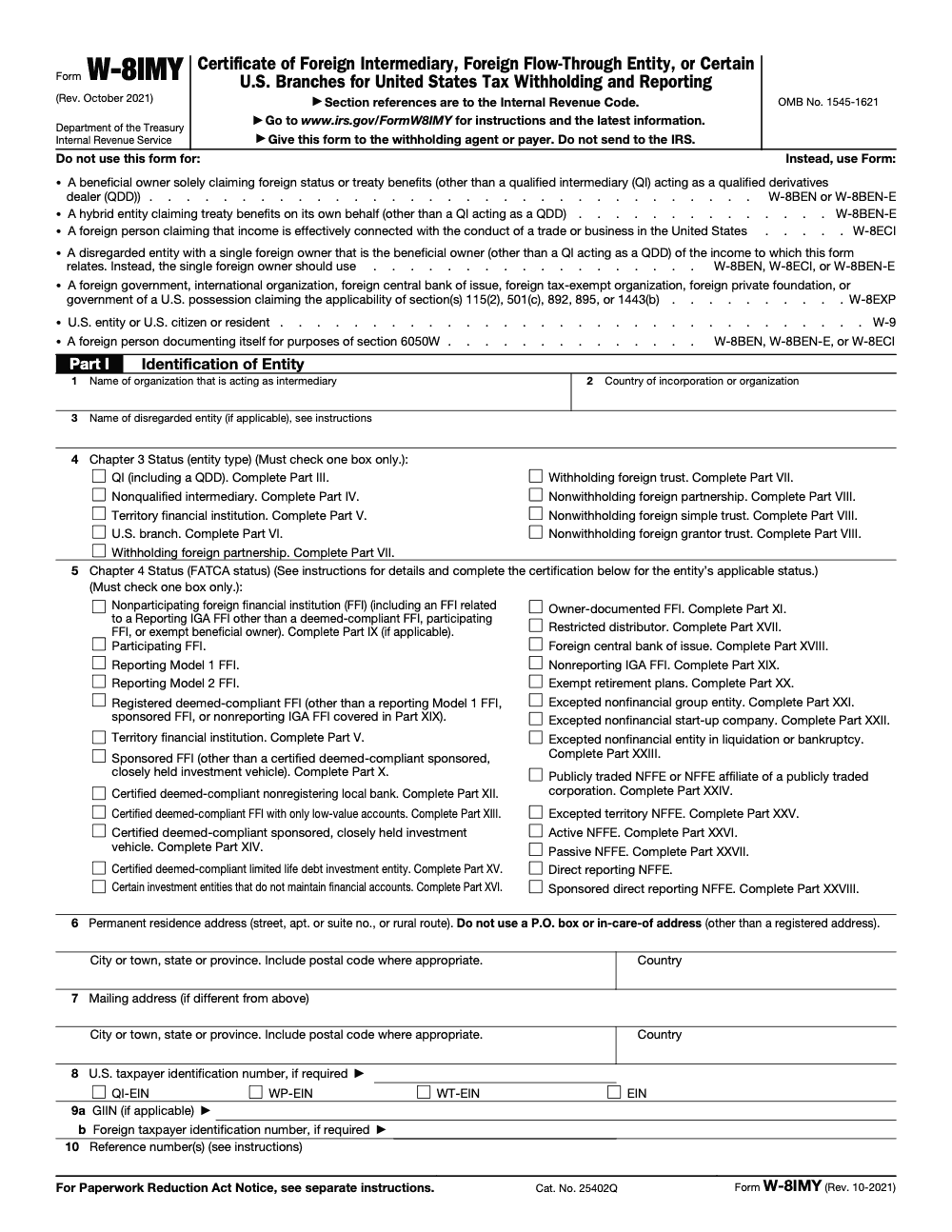
Form W-8IMY is the Certificate of Foreign Intermediary, Foreign Flow-Through Entity, or Certain U.S. Branches for U.S. tax withholding and reporting under chapters 3 and 4 (OMB 1545-1621, revision October 2021, per the Instructions for Form W-8IMY). The form runs 29 Parts, is given to the withholding agent, and is never mailed to the IRS – any certification change triggers a new submission within 30 days. See related certificates in the IRS forms library or how Accountably handles withholding documentation at scale.
Treating W-8IMY as a set-and-forget document is the mistake that comes back to bite. Foreign intermediaries, flow-through entities, and certain U.S. branches use it to tell an upstream withholding agent how to handle payments they receive on behalf of others, but the form almost never stands alone. A withholding statement allocating the payment among the underlying beneficial owners has to ride with it.
The certificate goes to the withholding agent and is never mailed to the IRS. It stays valid for three calendar years from signature, yet the withholding statement needs refreshing whenever account holders or partners change, and a new W-8IMY is due within 30 days of any change in the certifications themselves. Stale statements are the usual reason fund and partnership payments get withheld wrong.
Key Takeaways
- What it does: Form W-8IMY is the certificate that foreign intermediaries, flow-through entities, and certain U.S. branches provide to upstream withholding agents to document the withholding treatment for payments they receive on behalf of others.
- Who files it: Foreign financial intermediaries (qualified and nonqualified), foreign partnerships, foreign simple and grantor trusts, and certain U.S. branches of foreign banks or insurers receiving U.S.-source income for others.
- Critical requirement: In most cases a withholding statement allocating the payment among underlying beneficial owners must accompany the W-8IMY – the form alone is not enough for the upstream agent to apply correct rates.
- Validity: Three calendar years from the date signed, but the withholding statement often needs updating whenever account holder composition changes – and a new W-8IMY itself must be submitted within 30 days whenever any certification on the form becomes incorrect, regardless of the three-year renewal cycle.
- Main pitfall: Treating W-8IMY as a “set and forget” document – stale withholding statements are the leading cause of incorrect withholding on fund and partnership payments.
- SOP tip: Build a quarterly review trigger for all active W-8IMY withholding statements so changes in account holders or partners are reflected before the next payment cycle.
What Form W-8IMY Is and When to Use It
Form W-8IMY – the Certificate of Foreign Intermediary, Foreign Flow-Through Entity, or Certain U.S. Branches for United States Tax Withholding and Reporting – is the most complex of the W-8 series. Where W-8BEN and W-8ECI address the tax status of the ultimate beneficial owner, W-8IMY addresses the entity standing between the payer and the ultimate owners: the intermediary layer.
In the U.S. withholding system, someone must be responsible for withholding the correct amount on each payment of U.S.-source income to foreign persons. The W-8IMY documents the terms under which that responsibility is allocated between the upstream withholding agent (the payer) and the intermediary. The key question the form answers: Is the intermediary assuming withholding responsibility, or is it passing that responsibility back upstream?
The Three Main Filer Types
The IRS designed W-8IMY to cover three fundamentally different situations that share the common feature of an entity standing between the payment source and the beneficial owners:
- Foreign financial intermediaries: Banks, brokers, custodians, and other financial institutions outside the U.S. that hold accounts for clients and receive U.S.-source income on their behalf. These may be qualified intermediaries (QIs) that have signed an agreement with the IRS or nonqualified intermediaries (NQIs) that have not.
- Foreign flow-through entities: Foreign partnerships and foreign simple or grantor trusts whose income “flows through” to partners or beneficiaries for U.S. tax purposes. The entity is not the beneficial owner – the partners or beneficiaries are.
- Certain U.S. branches of foreign banks or insurance companies: U.S. branches that agree to be treated as U.S. persons for withholding purposes, or that transmit documentation on behalf of their foreign head office.
The Withholding Statement Requirement
Unlike W-8BEN or W-8ECI, a bare W-8IMY is almost never sufficient by itself. The upstream withholding agent needs to know how to allocate the payment among the underlying beneficial owners and what withholding rate applies to each. That allocation comes through a withholding statement – an attachment to the W-8IMY that maps percentages of the payment to each beneficial owner’s W-8 or W-9 documentation on file with the intermediary.
From my side of the desk, the withholding statement is where most of the practical work happens. Getting the form itself completed correctly is important – but an outdated or incomplete withholding statement is what triggers incorrect withholding and the painful cleanup that follows.
When W-8IMY Does Not Apply
W-8IMY is not appropriate when a foreign entity is the sole beneficial owner of income – that situation calls for W-8BEN-E (or W-8EXP for foreign governments, international organizations, and tax-exempt entities). The narrow exception is a QI acting as a Qualified Derivatives Dealer, which does use W-8IMY even though it is a beneficial owner for QDD payments. It also does not apply when a foreign partner’s share of partnership income is effectively connected income – that situation uses W-8ECI. Partnerships that elect to be treated as a withholding foreign partnership (WP) or withholding foreign trust (WT) use a different chapter of the W-8IMY instructions and assume full withholding responsibility, eliminating the need to transmit underlying owner documentation upstream.
How to Complete Form W-8IMY, Part by Part
The current Form W-8IMY is a multi-part document – the form itself has over 25 parts covering different entity types and certifications. Most filers only complete the parts relevant to their specific category. Here is a roadmap.
| Part | Title | Who Completes It | Key Fields |
|---|---|---|---|
| Part I | Identification of Entity | All filers | Name, country of incorporation, entity type, permanent residence address, U.S. TIN (if applicable), GIIN (for FFIs), foreign TIN |
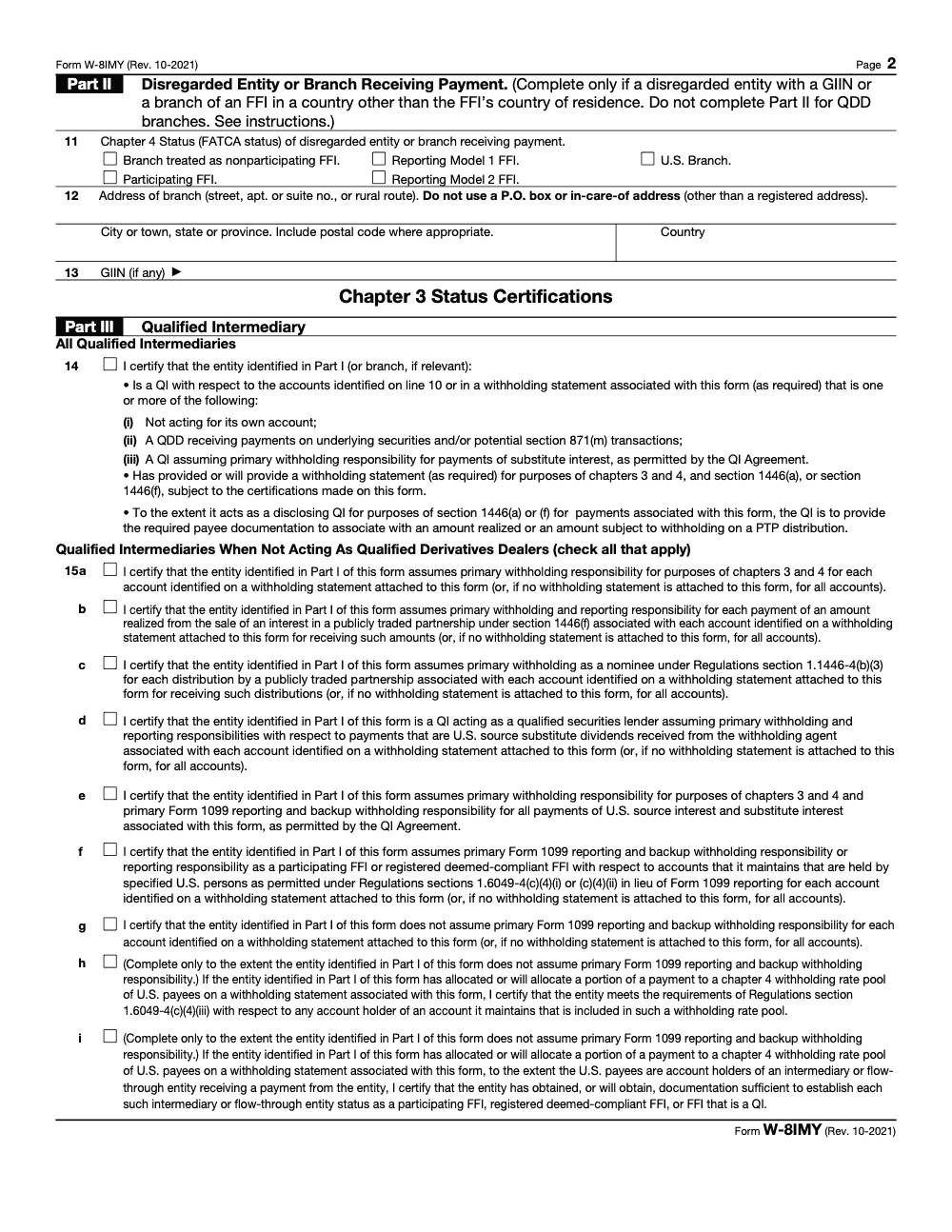
| Part II | Disregarded Entity or Branch Receiving Payment | Disregarded entities with a GIIN, or a branch of an FFI in a country other than the FFI’s country of residence (not QDD branches) | Chapter 4 (FATCA) status of disregarded entity or branch (Line 11), branch address (Line 12), branch GIIN (Line 13) |
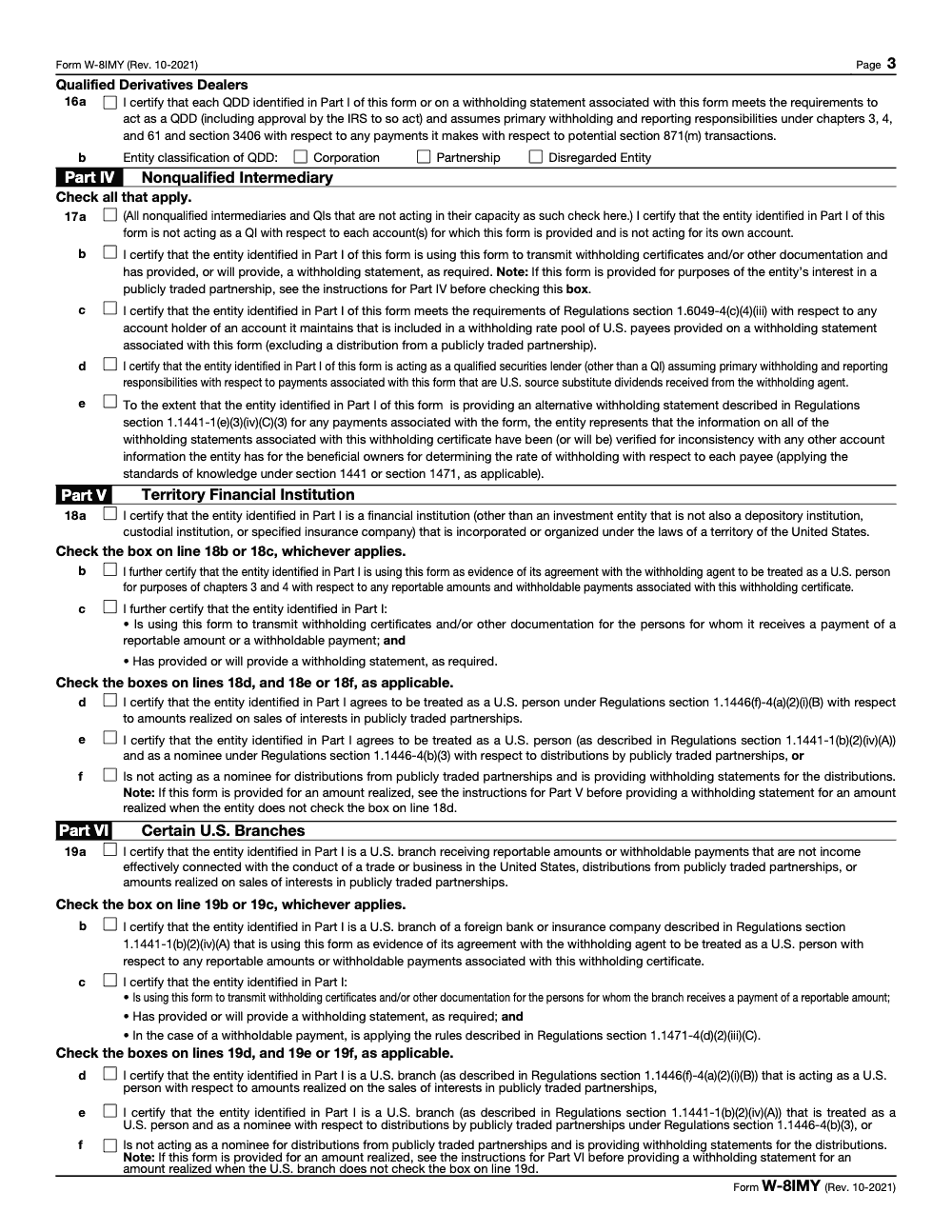
| Part III | Qualified Intermediary (including QDD) | QIs and QIs acting as Qualified Derivatives Dealers | General QI certification (Line 14), QI certifications when not acting as QDD (Lines 15a-15i), QDD certifications and entity classification (Lines 16a-16b) |
| Part IV | Nonqualified Intermediary | NQIs and QIs not acting in their QI capacity | Certifications on Lines 17a-17e that the entity is not acting as a QI for the relevant accounts and is not acting for its own account; withholding statement must be attached |
| Part V | Territory Financial Institution | Financial institutions incorporated or organized under the laws of a U.S. territory | Lines 18a-18f: territory financial institution certifications (other than non-qualifying investment entities) |
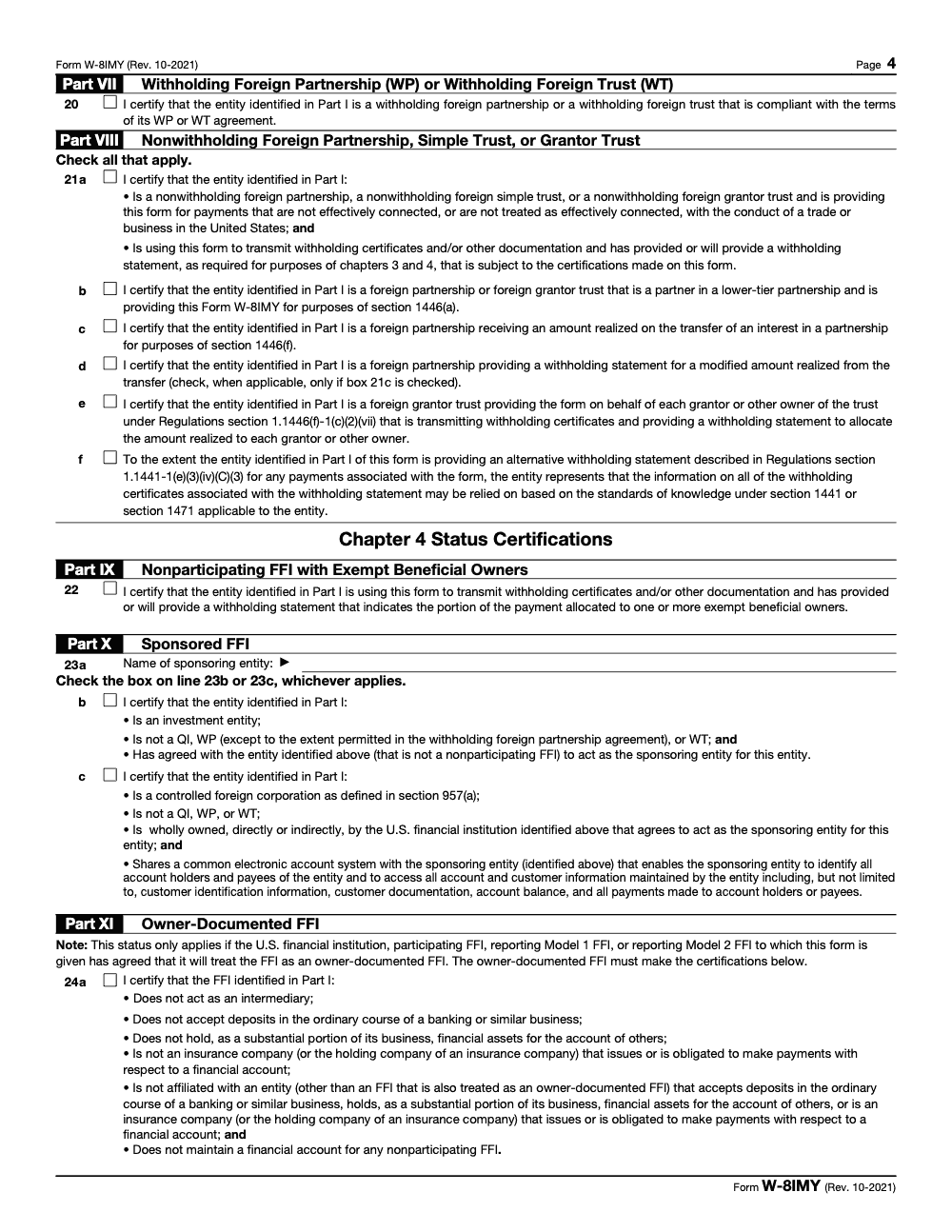
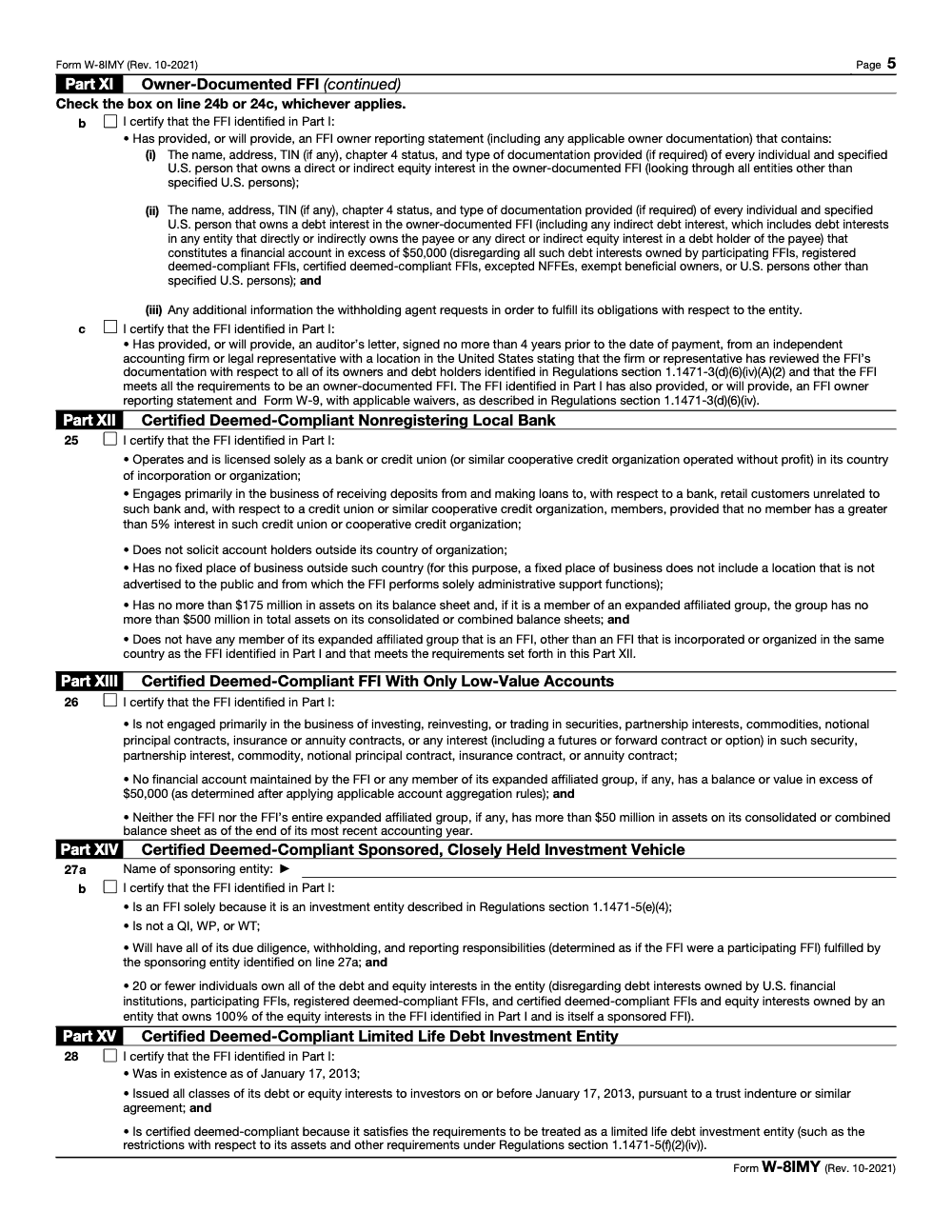
| Parts VI–XII | Various U.S. Branch and Chapter 4 Certifications | U.S. branches of foreign banks/insurers; FFIs with specific FATCA statuses | FATCA status certifications, GIIN, agreement to be treated as U.S. person for withholding, etc. |
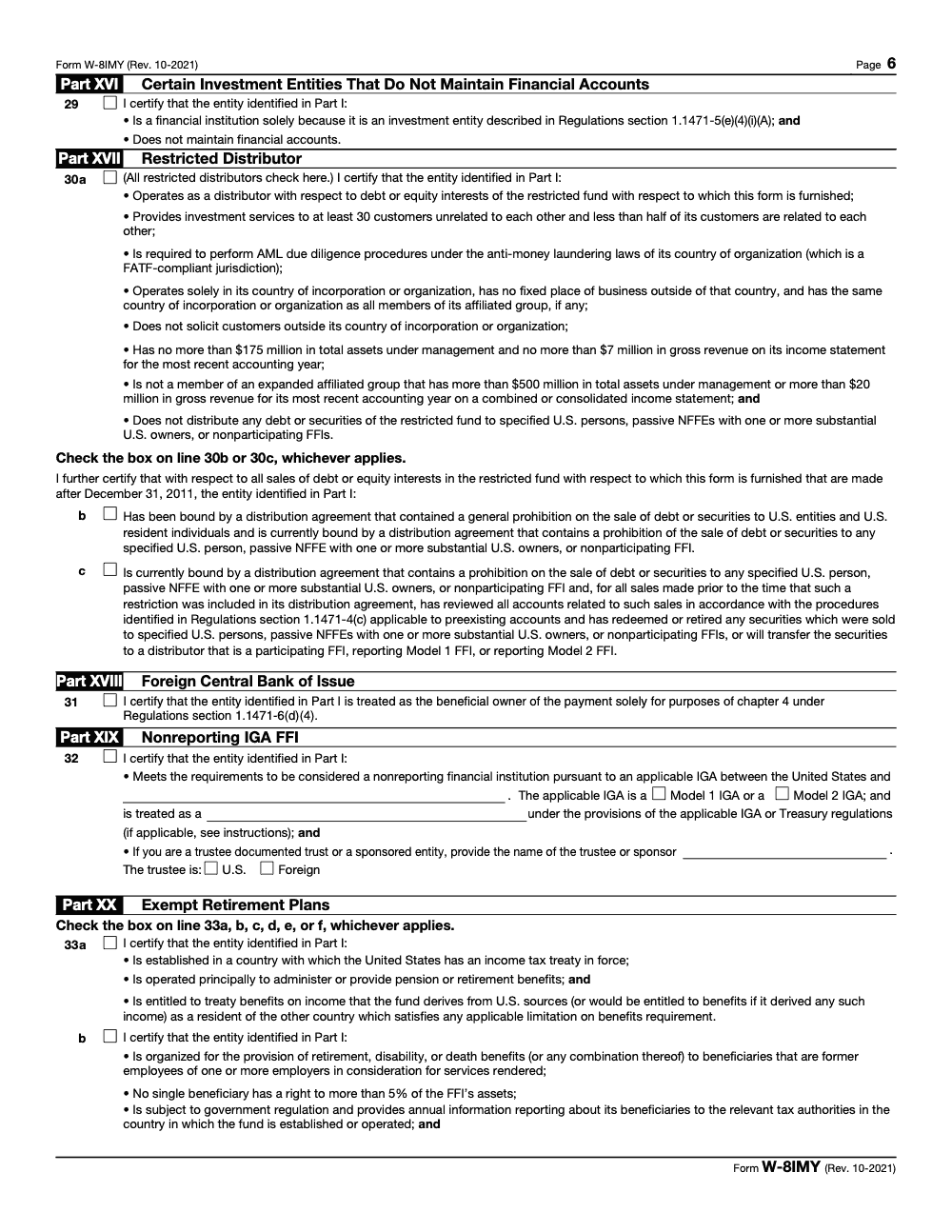
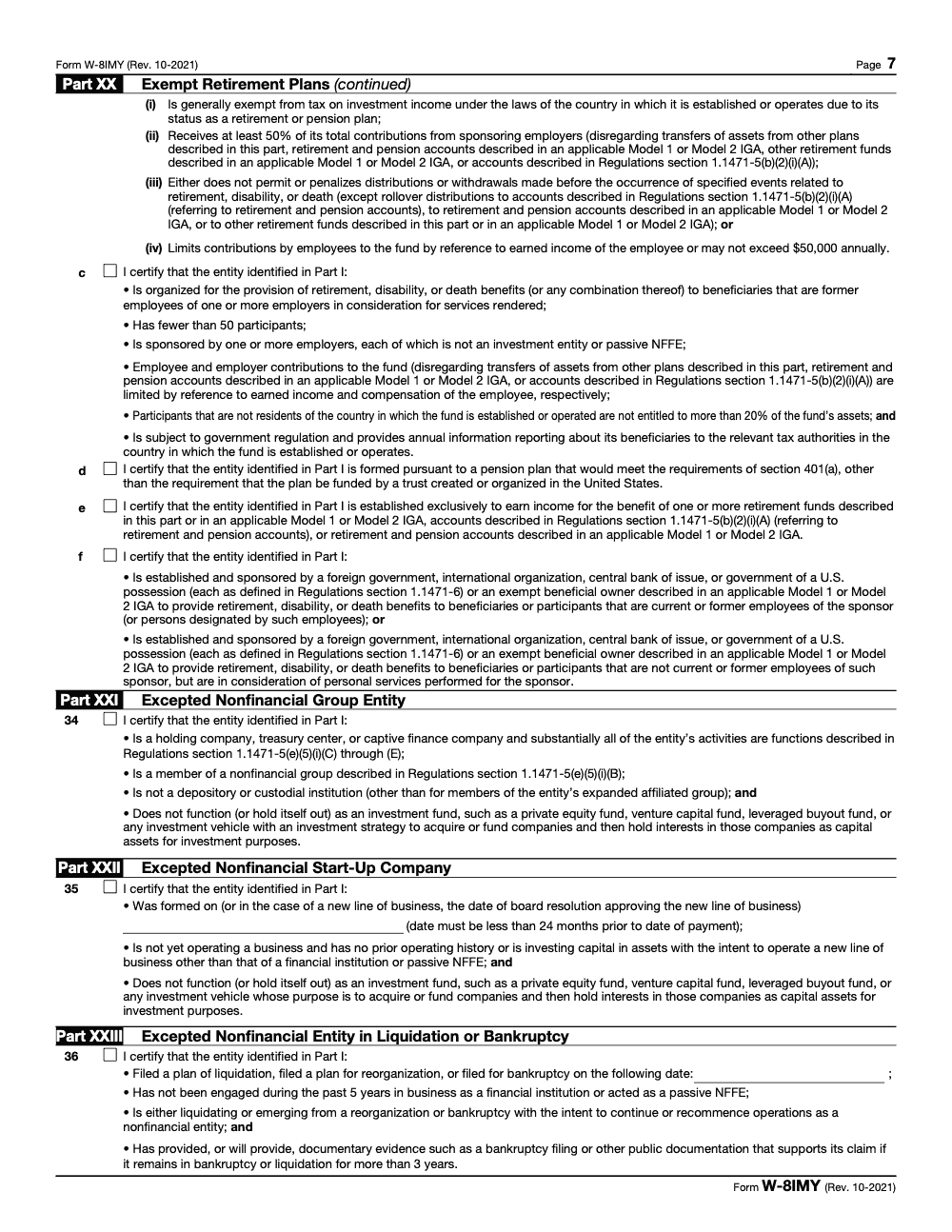
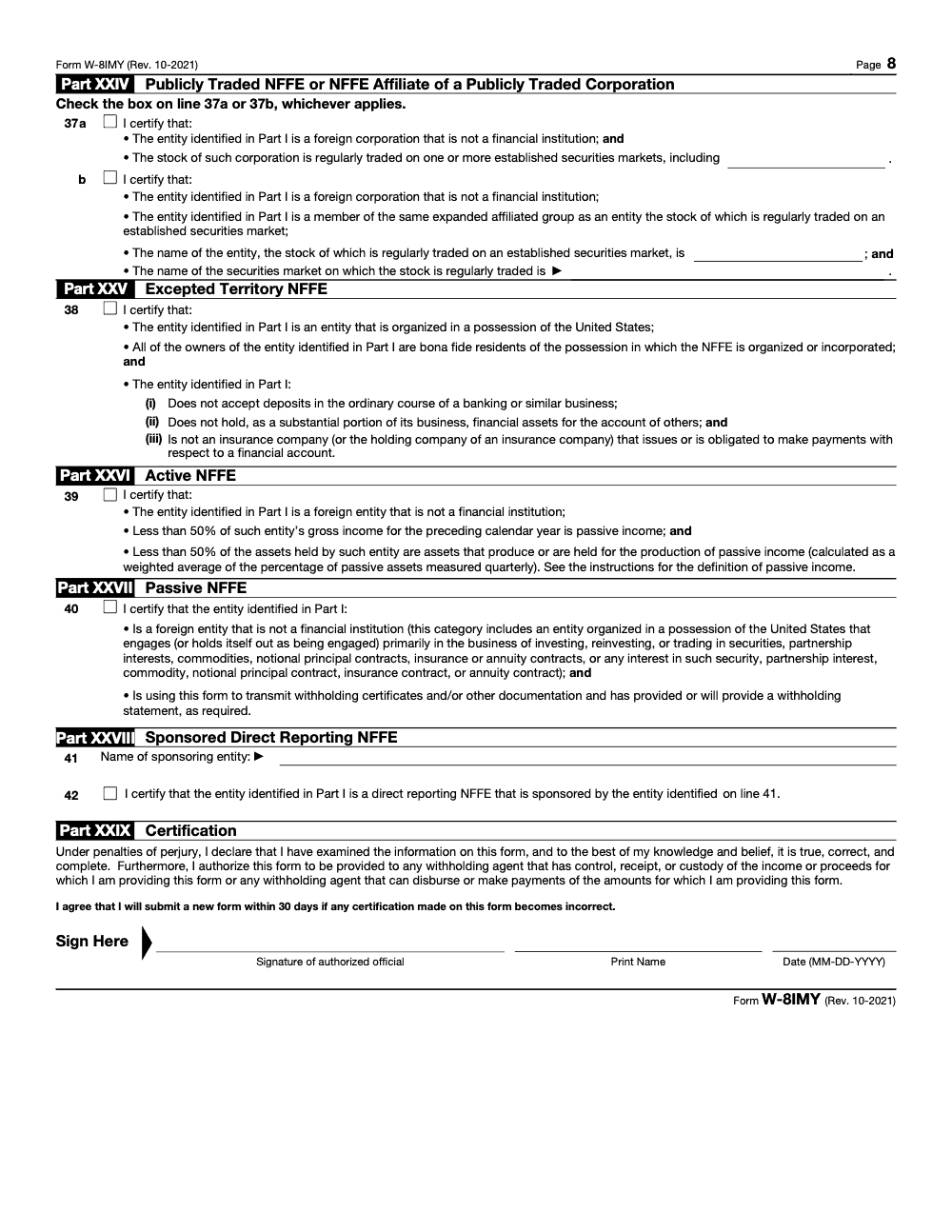
| Parts XIII–XXVII+ | FATCA Status Certifications | Foreign entities with specific FATCA classifications (participating FFI, deemed-compliant FFI, exempt beneficial owner, etc.) | Specific certifications required by FATCA for each FFI category; consult current instructions carefully |
The Withholding Statement Format
The withholding statement is not a pre-printed IRS form – it is a document created by the intermediary that allocates the payment to underlying account holders and specifies the withholding treatment for each. It must include the beneficial owner’s name, the percentage of the payment allocable to them, the applicable withholding rate, and a reference to the supporting W-8 or W-9 documentation on file.
Quick rule you can copy into your SOP: a withholding statement is incomplete if it does not add up to 100% of the payment. Any unallocated portion is treated as paid to an unknown foreign person and withheld at 30%.
GIIN Requirement for FFIs
Foreign financial institutions that are participating FFIs, registered deemed-compliant FFIs, or certain other FATCA-registered entities must include their Global Intermediary Identification Number (GIIN) on Part I of the W-8IMY. Without a valid GIIN, the upstream withholding agent cannot confirm the FFI’s FATCA status and may be required to apply Chapter 4 withholding at 30% on withholdable payments regardless of what Part II or III certifies for Chapter 3.
Deadlines, Penalties, and Filing Requirements
Like other W-8 forms, W-8IMY is not filed with the IRS on a calendar deadline – it is provided to the withholding agent before payments begin. But the consequences of gaps are severe in the withholding chain context because they affect not just one payee but all underlying beneficial owners.
| Event | Timing Rule | Consequence of Non-Compliance |
|---|---|---|
| Provide W-8IMY to withholding agent | Before the first payment or credit | 30% withholding on entire payment; withholding statement rates cannot be applied |
| Form validity expiration | 3 calendar years from signature date | Revert to 30% withholding; no treaty or reduced rates until renewed |
| Change in circumstances | Notify withholding agent within 30 days | Continued use of invalid form creates back-withholding exposure for both parties |
| Withholding statement update | Must be updated when account holder pool changes materially | Incorrect allocation to beneficial owners creates 1042-S errors and potential penalties |
| QI Agreement renewal | Per IRS QI renewal cycle (typically every 3 years, check current revenue procedure) | Lapsed QI Agreement means the entity becomes an NQI; all QI certifications on W-8IMY are no longer valid |
| 1042-S reporting by withholding agent | Due March 15 following the tax year | Penalties up to $310 per form (2026 amounts) for failure to file or incorrect reporting |
Withholding Agent Liability for Intermediary Documentation
The U.S. withholding agent at the top of the payment chain bears primary liability for correct withholding. If an intermediary provides a W-8IMY with a withholding statement that proves to be incorrect, and the withholding agent relied on it in good faith, the agent may be relieved of liability under the “reliable association” standard in the Treasury Regulations. But good faith requires that the agent actually reviewed the form and found it facially valid – not merely filed it away without review.
Qualified Intermediary vs. Nonqualified Intermediary: Practical Differences
The QI/NQI distinction is the central design choice for any foreign financial institution that regularly receives U.S.-source payments for clients. The economics and compliance burden differ substantially.
Qualified Intermediary Advantages
A QI that has signed an IRS QI Agreement can receive payments from upstream withholding agents without disclosing the identities of its clients. The QI certifies on W-8IMY that it is a QI, and the upstream agent withholds at the rates the QI specifies in its withholding statement – but the QI does not have to pass up individual W-8BEN forms for each account holder. This confidentiality is the primary reason foreign banks pursue QI status.
QIs may also assume primary withholding responsibility for some or all of their account holders, removing the upstream agent from the loop entirely for those payments. This simplifies the withholding chain and reduces the risk of documentation failures causing over-withholding.
Nonqualified Intermediary Obligations
An NQI must transmit the beneficial owner documentation (W-8BEN forms, W-9s) for all its account holders upstream to the withholding agent. This is operationally burdensome and exposes account holder identities. For many foreign banks, the administrative cost and client privacy concerns make NQI status impractical for high volumes of U.S.-source payments. But for smaller institutions or those with limited U.S. business, it may be simpler to operate as an NQI than to maintain a QI Agreement.
Withholding Foreign Partnership Election
A foreign partnership can elect to become a Withholding Foreign Partnership (WP) by entering into a WP Agreement with the IRS and remaining compliant with its terms (the Part VII certification covers ongoing compliance with the WP or WT agreement, not merely the existence of a signed one). A WP assumes responsibility for withholding on its partners’ shares of U.S.-source income, so it does not need to pass partner-level documentation upstream. The WP certifies its status in Part VII of Form W-8IMY. This election works well for established funds or partnerships with stable investor bases and the compliance infrastructure to maintain partner-level withholding records.
FATCA Implications for W-8IMY Filers
Every W-8IMY filer that is a foreign financial institution must also address its FATCA status under Chapter 4. The FATCA certification on the W-8IMY is separate from and in addition to the Chapter 3 withholding certifications in the earlier parts of the form.
Why FATCA Status Matters on This Form
FATCA imposes 30% withholding on “withholdable payments” made to foreign financial institutions that are not compliant with FATCA reporting requirements. A withholding agent that receives a W-8IMY without a proper FATCA certification must apply Chapter 4 withholding at 30% to all withholdable payments, even if Chapter 3 withholding would otherwise be zero or reduced by treaty.
The FATCA FFI-category parts of the W-8IMY (Parts IX through XXIX) cover a wide range of FFI categories: participating FFIs, registered deemed-compliant FFIs, certified deemed-compliant FFIs, exempt beneficial owners, nonparticipating FFIs, and territory financial institutions. Each category has specific certification language – checking the wrong box creates FATCA withholding problems that can be very difficult to unwind.
GIIN Verification
Withholding agents are required to verify the GIIN provided on Part I of the W-8IMY against the IRS FATCA FFI List, which is updated monthly. If the GIIN cannot be verified, the agent cannot treat the entity as a participating FFI or registered deemed-compliant FFI and must apply Chapter 4 withholding. My standard workflow includes a GIIN verification step every quarter for all active foreign intermediary payees.
Common Mistakes That Slow Things Down
Same patterns surface across W-8IMY engagements – the form looks like a checklist, but a single mis-checked box on Line 4 or Line 5 invalidates the entire certification for the withholding cycle.
Practical Checklists You Can Reuse
These are copy-paste ready for firm SOPs. Mirror them inside the engagement file when a W-8IMY first arrives, then re-run the recertification list each quarter.
Pre-submission packet
- Confirm the filer is an intermediary, foreign flow-through entity, U.S. branch, or QDD – beneficial owners route to W-8BEN, W-8BEN-E, W-8ECI, or W-8EXP.
- Capture entity legal name (Line 1), country of organization (Line 2), and disregarded entity name where applicable (Line 3).
- Pull a physical permanent residence address for Line 6 and the branch address for Line 12 – no P.O. boxes or mail-drops.
- Match the U.S. TIN type on Line 8 (QI-EIN, WP-EIN, WT-EIN, or EIN) to the entity's IRS records.
- Verify the GIIN on Line 9a is active and not a lapsed or duplicate registration.
- Record the foreign TIN on Line 9b where the Chapter 3 or Chapter 4 status requires it.
Chapter 3 and Chapter 4 status review
- Check exactly one box on Line 4 (Chapter 3 Status) – nine entity-type options.
- Check exactly one box on Line 5 (Chapter 4 FATCA Status) – 26 FATCA status options.
- If QI, decide between Line 14 (general QI) and Line 16a (QDD) before Part III is signed – QDD status requires IRS approval and a QI Agreement.
- For active NFFE on Line 39, confirm both the 50% passive income test and the 50% passive asset test pass.
- For owner-documented FFI claims (Lines 24a-24c), confirm the receiving U.S. FI, participating FFI, or reporting Model 1 or Model 2 FFI has agreed to that treatment in advance.
- Route exempt retirement plan claims to the correct option on Lines 33a-33f based on the plan's structure and treaty status.
Recertification trigger scan
- List every signed W-8IMY in the withholding file with its signing date, Chapter 3 status, and Chapter 4 status.
- Cross-check each filer for entity-name changes, address changes, ownership changes, and FATCA-status changes since the last review.
- Flag any change that affects a certification on the form – the filer must submit a new W-8IMY within 30 days.
- Confirm withholding statements provided alongside QI, NQI, and flow-through forms are still current.
- Document the review date and reviewer in the engagement file so the audit trail survives staff changes.
Keep W8IMY Season From Stalling
W-8IMY pipelines stall on documentation, not math. The October 2021 revision spans 29 Parts and 26 Chapter 4 FATCA statuses (per the Instructions for Form W-8IMY), and a single mis-checked box on Line 4 or Line 5 invalidates the certification for the entire withholding cycle. Cross-border counterparties also change ownership, addresses, and GIINs more often than domestic entities, and each change starts a fresh 30-day clock on the filer to submit a new form.
The fix is not more reviewers on the back end. It is a documented intake and refresh routine that captures exactly what changed at the filer, who validates the affected Part of the form, and which withholding agents need the new document before the next payment date.
- Build a one-pass intake template that records entity name, Chapter 3 status (Line 4), Chapter 4 status (Line 5), TIN type (Line 8), GIIN (Line 9a), and Foreign TIN (Line 9b) before the form is signed.
- For QI filers, decide between Line 14 (general QI) and Line 16a (QDD) at intake – QDD status requires IRS approval and a QI Agreement, not self-election.
- Validate active NFFE claims on Line 39 against both the 50% passive income test and the 50% passive asset test – a single-test pass disqualifies the status.
- Calendar a 30-day recertification trigger from the date of any certification change, not from the original signing date.
- Store the executed form alongside the withholding statement for QI, NQI, and flow-through filers so audit pulls do not stall the next payment.
Accountably's cross-border tax desk runs W-8IMY intake, FATCA status validation, and 30-day refresh cycles inside the same workflow as the rest of your tax execution, so withholding documentation stops being the bottleneck.
FAQs
Form W-8IMY is used by foreign intermediaries, foreign flow-through entities, and certain U.S. branches to document their withholding status when receiving U.S.-source income on behalf of others. It tells the upstream withholding agent how to treat the payment for Chapter 3 (standard FDAP withholding) and Chapter 4 (FATCA) purposes, and it is almost always accompanied by a withholding statement that allocates the payment among the underlying beneficial owners.
Foreign financial intermediaries (both qualified and nonqualified), foreign partnerships, foreign simple trusts, foreign grantor trusts, and certain U.S. branches of foreign banks or insurance companies that receive U.S.-source income on behalf of their clients, partners, or beneficiaries must provide W-8IMY to the upstream withholding agent. Entities that are the sole beneficial owner of the income should use W-8BEN-E instead (other than a QI acting as a Qualified Derivatives Dealer, which uses W-8IMY).
A Qualified Intermediary is a foreign financial institution with an IRS QI Agreement that allows it to receive U.S.-source payments without disclosing its clients’ identities to upstream withholding agents. The QI uses Part III of Form W-8IMY to certify its QI status and its GIIN, and then provides a withholding statement that specifies the rates applicable to its client pool without naming individual clients.
Yes, in most cases. An NQI, a nonwithholding foreign partnership, a nonwithholding foreign simple trust, and a nonwithholding foreign grantor trust must all attach withholding statements that allocate the payment to underlying beneficial owners. Without a withholding statement, the upstream agent must withhold at 30% on the entire payment. QIs and WPs/WTs that assume primary withholding responsibility have different rules and may not need to pass up individual owner documentation.
The form is generally valid for three calendar years from the date signed, becoming invalid immediately upon any change in circumstances that makes information on it incorrect. However, the accompanying withholding statement may need to be updated more frequently – ideally every time there is a material change in the account holder or partner pool – to ensure correct withholding on each payment.
Without a valid W-8IMY, the upstream withholding agent must treat the entire payment as made to an unknown foreign person and withhold at 30%. The individual partners cannot receive their proper treaty or reduced withholding rates until documentation is in place. Recovery requires amended 1042-S forms, partner-level refund claims on 1040-NR or treaty-based returns, and significant administrative effort – far more costly than getting the form right before the first payment.
Other forms this guide names
- Form W-8BEN: Foreign Status Certificate Guide 2025
- Form W-8BEN-E: Treaty Benefits and Withholding Basics
- Form W-8ECI: Effectively Connected Income Certificate
- Form W-8EXP: QFPF and Qualified Holder Rules Explained
- Form W-9: Guide & Instructions
Summarize this article with AI
About this guide
Accountably helps US CPA, EA, and accounting firms hire trained accountants and tax preparers in India.
About us Reviewed byJugal Thacker, CPAFounder and CEO at Accountably
A US-licensed CPA with 7+ years inside US firms – PwC, a real-estate tax practice, then a full-service firm, rising from reviewer to manager to advisory. This article was reviewed against current IRS guidance for the 2025 tax year and updated for filers preparing late returns, amendments, and 2026 estimates.
View profile →How we research, review, and update this guide
Every Accountably guide is researched against primary IRS sources, reviewed by a U.S. CPA, and refreshed as guidance evolves. Read our Editorial Guidelines to see how we source, fact-check, and update our content.