Summarize this article with AI
In Brief
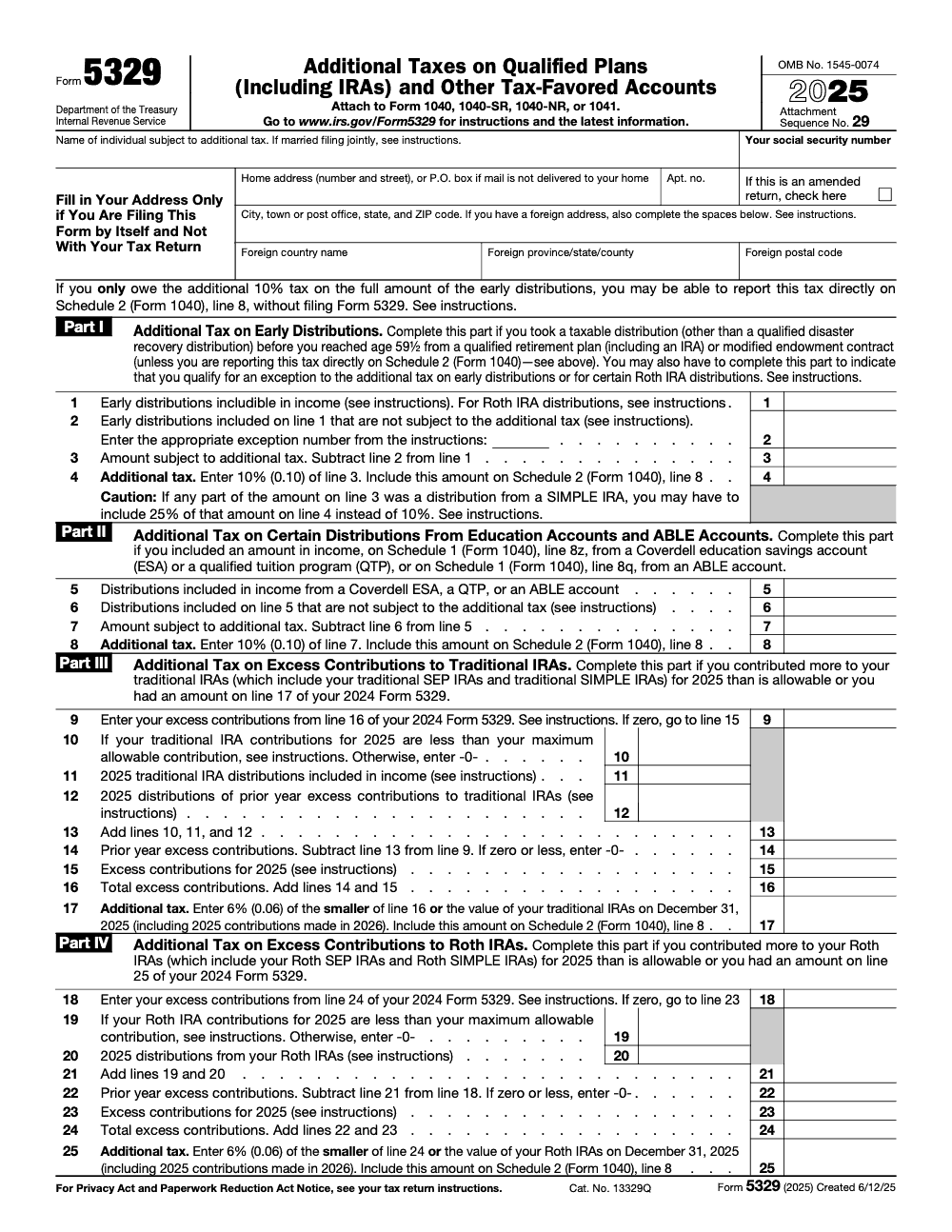
Form 5329 is the IRS return for additional taxes on tax-favored accounts – the 10 percent early-distribution tax under IRC §72(t), the 6 percent excess-contribution excise under §4973, and the missed-RMD excise under §4974 (per the 2025 Form 5329 instructions). The total flows to Schedule 2 (Form 1040), line 8; under SECURE 2.0 the missed-RMD rate is 25 percent (10 percent if corrected within the statutory correction window), and the 2025 IRA contribution limit is $7,000 ($8,000 if age 50 or older) per IRS Publication 17. For practitioner support on retirement-distribution reviews, see Accountably's taxation services.
A retiree took his first required minimum distribution two years late, received a notice, and panicked that a penalty would swallow a big slice of the distribution. Under SECURE 2.0 the missed-RMD excise had already dropped to 25 percent, and once a reasonable-cause statement went in on Part IX inside the correction window, the rate fell to 10 percent and the IRS granted a full waiver. The fear was real; the number behind it was already out of date.
Form 5329 is the return for additional taxes on tax-favored accounts: the 10 percent early-distribution tax under §72(t), the 6 percent excess-contribution excise under §4973, and the missed-RMD excise under §4974, all flowing to Schedule 2 line 8. Half the job is knowing which of the nine Parts applies and which exception number to enter on Part I, and the rest is keeping current limits in front of you, since the 2025 IRA contribution limit is $7,000, or $8,000 at age 50 and older.
Key Takeaways
- Form 5329 is where you compute extra taxes or claim relief for early distributions, excess contributions, and missed RMDs across IRAs, employer plans, HSAs, ESAs, MSAs, 529, and ABLE accounts. You attach it to Form 1040 or file it alone if no return is otherwise due, one form per spouse.
- The missed RMD excise is generally 25 percent of the shortfall, and it can drop to 10 percent when you correct within the “correction window.” You may ask for a waiver by writing “RC,” attaching a reasonable‑cause statement, and following the line instructions.
- SECURE 2.0 added penalty exceptions you can claim through Form 5329, including a once‑per‑year emergency personal expense distribution up to 1,000, a domestic abuse distribution, permanent qualified disaster recovery distributions up to 22,000, and a terminal illness exception that relies on a physician certification.
- For HSAs, remember the split, the 20 percent tax on nonqualified HSA distributions is figured on Form 8889, while the 6 percent excise on HSA excess contributions is on Form 5329 Part VII.
- Planning tip, confirm current year retirement plan and HSA limits before funding to prevent excess‑contribution issues that flow onto Form 5329.
What Is IRS Form 5329
When retirement or tax‑favored accounts break the rules, you do not fix it only on the 1040. You reach for Form 5329. This is the IRS form for computing additional taxes or claiming exceptions tied to early distributions, excess contributions, and missed RMDs for IRAs, qualified plans, HSAs, Archer MSAs, Coverdell ESAs, 529 plans, and ABLE accounts.
You typically attach Form 5329 to Form 1040 or 1040‑SR by the due date. If the taxpayer does not otherwise have to file a return, you can file Form 5329 by itself, by paper, with payment enclosed. Each spouse files a separate Form 5329.
Who Needs To File Form 5329
File Form 5329 any year you owe an excise tax or you need to document relief. You must file if you had an early distribution and owe the 10 percent tax, or you qualify for an exception that the 1099‑R did not code correctly. You must also file if you left excess contributions in an IRA, HSA, ESA, MSA, or ABLE at year‑end, or if you missed an RMD and need to compute the excise or request a waiver.
A practical note, if every early distribution was correctly coded with box 7 code 1, no exception applies, and no other Form 5329 tax is owed for the year, you can often post that penalty directly to Schedule 2 without filing Form 5329. If an exception applies or only part is penalized, use Form 5329 to do it right.
Accounts Covered By Form 5329
| Account Type | Typical Form 5329 use |
| IRAs and employer plans | Early distribution penalty and exceptions, excess contributions, missed RMD excise and waiver |
| HSAs and Archer MSAs | HSA excess contribution excise on Form 5329, HSA 20 percent nonqualified distribution tax stays on Form 8889 |
| Coverdell ESA and 529 | Nonqualified distribution additional tax and excess contribution excise in the education parts |
| ABLE | Excess contributions and specific nonqualified spending penalties |
The Delivery Problem Behind 5329 Errors
Most firms do not struggle for lack of clients, they struggle in delivery. 5329 mistakes usually trace back to review bottlenecks, rushed workpapers, or unclear ownership, not a lack of knowledge. A simple control sheet for early distribution exceptions, excess contribution tracking, and RMD waivers, saved with the return, prevents rework and keeps partner time focused on strategy instead of salvage.
Accountably, briefly since you are on our site, integrates trained offshore teams into your systems with SOP‑driven execution, standard naming, and layered review. The result is fewer exception‑code misses, cleaner RMD waiver packages, and faster reviews, without surrendering control. Use us where it helps, or borrow the structure and run it in‑house. The goal is control, not headcount.
Early Distributions And The 10 Percent Additional Tax
When someone takes money from an IRA or plan before age 59½, the taxable portion is usually subject to a 10 percent additional tax, unless a statutory exception applies. If the payer already coded code 1, there is no exception, and you do not owe any other Form 5329 tax for the year, you can often put the penalty directly on Schedule 2. If you need to correct payer coding or claim an exception, use Form 5329 Part I.
When The 10 Percent Applies, Three Checks
Ask three questions in order.
- Is any part of the distribution taxable after basis and rollovers
- Was the taxpayer under 59½ on the distribution date
- Does a statutory exception apply and for which dollar amount
Only the taxable portion is penalized. Use Form 5329 to compute the tax on the portion that does not qualify for an exception.
Common Exceptions You Actually See
- Death of the owner or total and permanent disability.
- Substantially equal periodic payments, SEPPs.
- IRS levy.
- IRA‑only exceptions, for example qualified higher‑education expenses or a first‑time homebuyer distribution up to 10,000 lifetime.
- Health exceptions, for example unreimbursed medical expenses over 7.5 percent of AGI, or health‑insurance premiums while unemployed.
- Qualified reservist distributions.
Enter the exception amount on line 2 with the correct exception code from the instructions, and keep the proof in the file.
Reporting On Form 5329, Cleanly
- Pull the taxable amount from Form 1040, lines 4b or 5b.
- Enter any exception amount on line 2 with the correct code.
- Compute 10 percent on the amount still subject to penalty.
- Carry the total additional taxes from Form 5329 to Schedule 2, line 8.
Review cue Do not treat the payer’s box 7 code as final. If facts support an exception, claim it on Form 5329 with the right code and leave a one‑page support sheet in the binder.
SECURE 2.0 Exceptions You Must Know
SECURE 2.0 created several high‑impact exceptions. You can claim them on your return even when the plan did not adopt the feature, by using Form 5329 and keeping your documentation.
Emergency Personal Expense Distribution, Up To 1,000
You can treat one distribution per calendar year as an emergency personal expense distribution up to 1,000, penalty‑free, if you meet the definition and limits. You may repay within three years. If the plan did not label it, you can still treat an otherwise permissible distribution as an EPED on your return and claim the exception on Form 5329. Keep records and mind the three‑year limitation on repeats unless repaid or offset by new contributions.
| Item | What to check |
| Frequency | One per calendar year, no repeats for three years unless repaid or offset |
| Amount | Up to 1,000, subject to the account’s limit mechanics in current guidance |
| Reporting | Use Form 5329 if the plan did not code the exception, retain records |
| Tax | Still taxable income unless repaid within three years |
Domestic Abuse Distribution
A domestic abuse victim can self‑certify to the plan for distribution purposes and take eligible distributions up to the lesser of 10,000, indexed, or 50 percent of the vested account, penalty‑free. Income tax still applies unless another rule excludes it, and recontribution is allowed within three years. If the plan did not code it, treat a permissible distribution as a domestic abuse distribution on the return and claim the exception on Form 5329. Keep the certification.
Qualified Disaster Recovery Distributions, Up To 22,000
For federally declared disasters, qualified individuals can take up to 22,000 penalty‑free, may spread income over three years, and can recontribute within three years. Coordinate reporting with Form 8915‑F when required.
Terminal Illness Exception
A distribution to a terminally ill individual, certified by a physician, is not subject to the 10 percent additional tax. There is no statutory dollar cap. If the plan does not offer a labeled distribution, you can treat a permissible in‑service distribution as a terminal illness distribution on the return and claim the exception on Form 5329. Retain the physician certification that meets the content and timing rules, including the 84‑month expectancy standard.
Documentation reminder For EPED, domestic abuse, disaster, and terminal illness exceptions, the law allows you to claim the exception on the return even if the plan does not adopt the feature. That is powerful, so your workpapers must carry the weight, with dates, amounts, and proof.
Excess Contributions And The 6 Percent Excise
Excess contributions create a recurring 6 percent excise for each year the excess remains. You compute it in the part of Form 5329 that matches the account type and keep filing it annually until the excess goes to zero. Timely corrective withdrawals can often avoid the excise.
Where To Report, Lines That Matter
Use the account‑specific sections and lines on Form 5329.
- IRAs, see the traditional and Roth excess sections that culminate near lines 17 and 25.
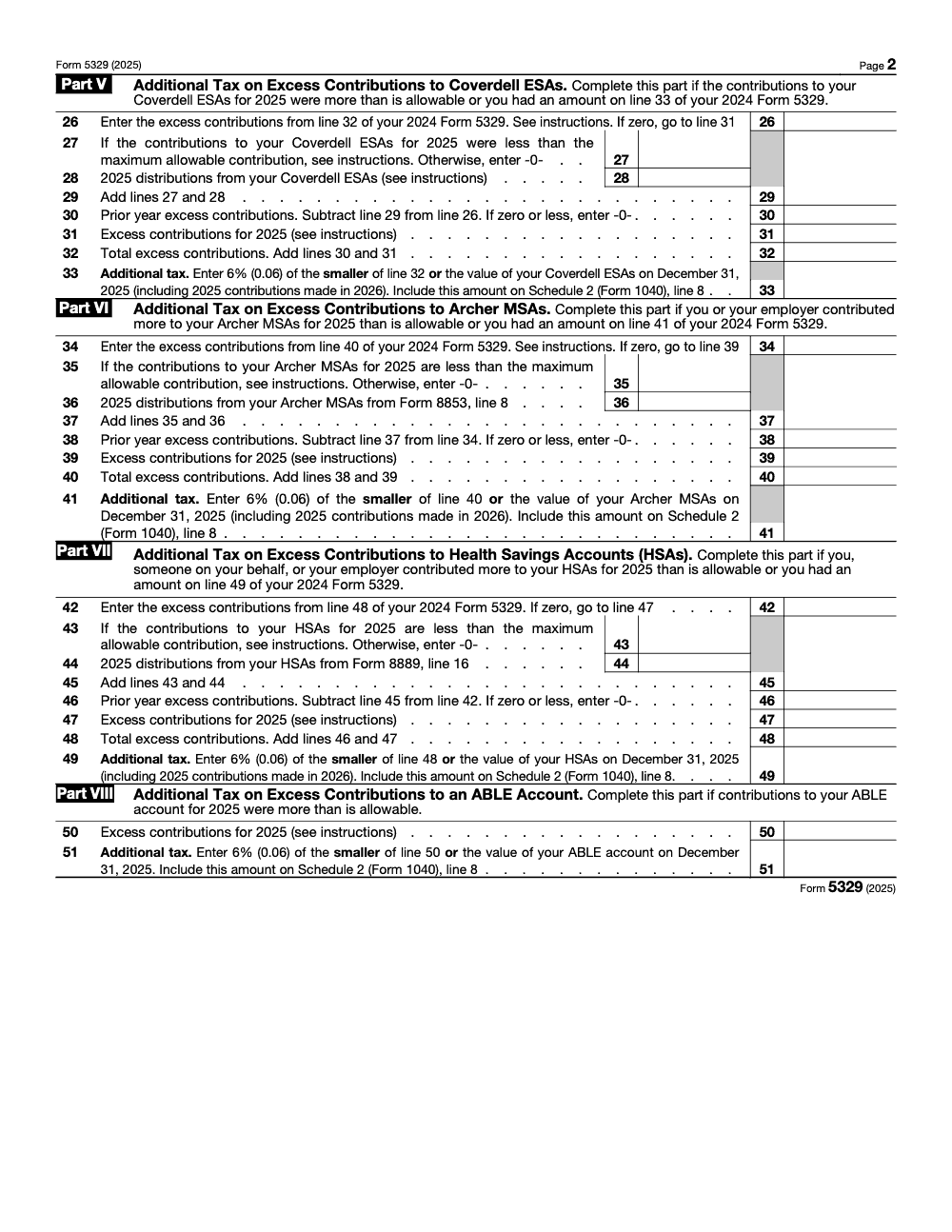
- Coverdell ESAs, see lines 26 through 33.
- ABLE accounts, see Part VIII at lines 50 and 51 (line 41 is the Part VI Archer MSA additional-tax line, not ABLE).
- HSAs, use Part VII with line 49 as the anchor for the excise computation.
Enter the original excess, any corrective distributions including earnings, the carry, and then compute 6 percent on the smaller of what remains at year end or the year-end value of the relevant accounts (the excise is capped at 6 percent of account value, not the excess). Post the total to Schedule 2, line 8.
Correction Deadlines, Not All The Same
- IRAs and HSAs, remove the excess plus net income attributable by the filing deadline, including extensions, to avoid the 6 percent excise. Earnings are taxable. Certain IRA corrective withdrawals after late 2022 are not subject to the 10 percent penalty.
- Coverdell ESAs, remove the excess plus earnings by June 1 of the following year to avoid the 6 percent excise, no extension on the June 1 rule.
HSA Special Note, Where The 20 Percent Lives
Clients often assume all “extra taxes” live on Form 5329. Not for HSAs. The 20 percent additional tax on nonqualified HSA distributions is figured on Form 8889, Part II, then carried to Schedule 2. Only the 6 percent excise for HSA excess sits on Form 5329. This split trips up rushed reviews, so cross‑reference your 8889 and 5329 calculations.
Contribution Limit Guardrails That Prevent 5329 Problems
Use current year limits to stop excesses before they happen.
- Confirm deferral limits for 401(k), 403(b), 457(b), plus catch‑ups.
- Confirm IRA limits and catch‑up rules.
- Confirm HSA limits for self‑only, family, and the age‑55 catch‑up.
Keep a one‑page “limit sheet” in the binder and reconcile Form 5498, payroll deferrals, and spousal IRA rules before posting contributions.
Required Minimum Distributions And Missed RMD Penalties
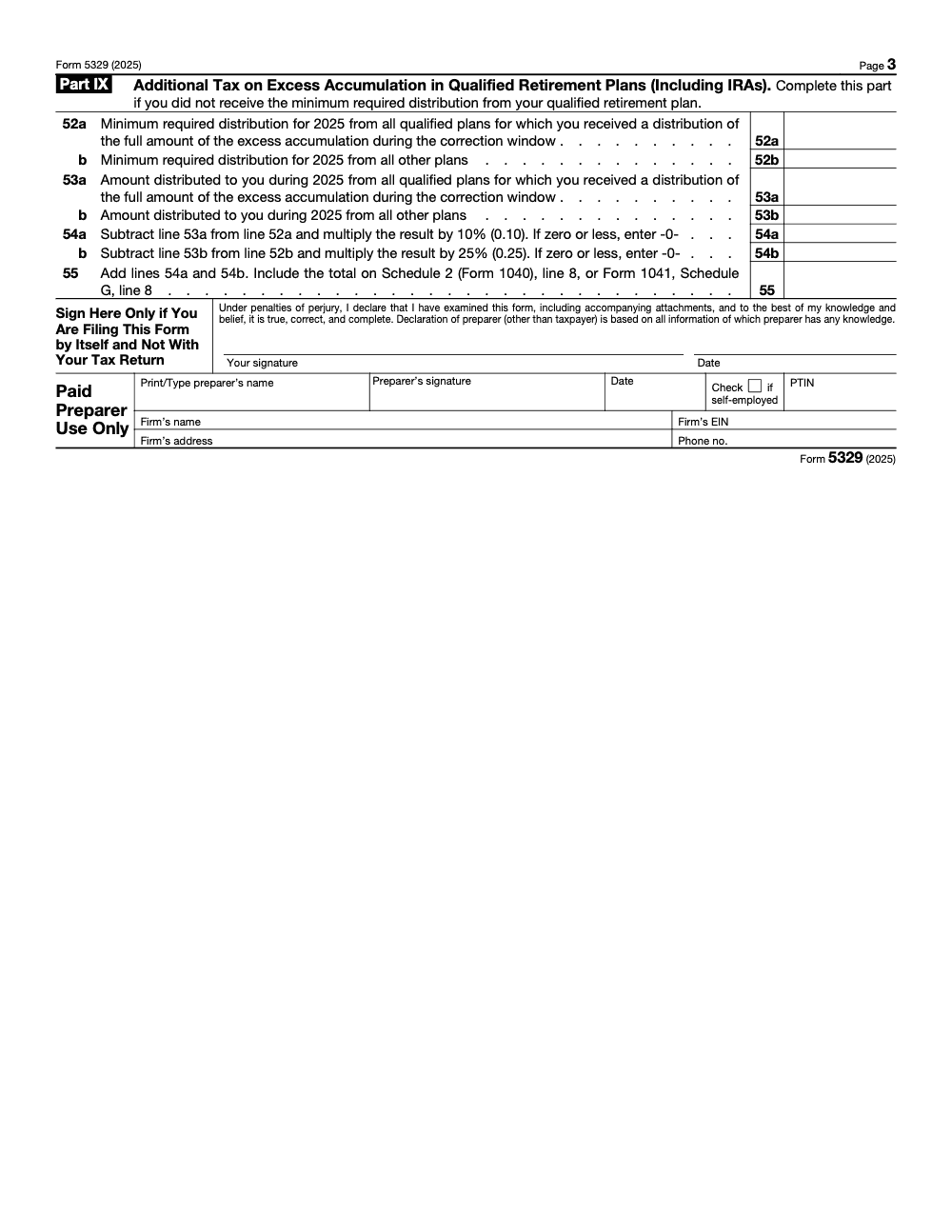
Once a taxpayer is subject to RMDs, generally age 73 for those who turned 72 after December 31, 2022 (and rising to age 75 starting in 2033 under SECURE 2.0), they must take the RMD by December 31 each year, except that the first RMD can be delayed until April 1 of the next year. If they fall short, use Form 5329 Part IX to compute the excise or request waiver.
- The excise is 25 percent of the shortfall, which can be 10 percent if corrected within the “correction window.” Show dates in your attachment to support reduced rates.
- Use lines 52a through 55 to report the required amount, actual distributions, shortfall, and tax. Write “RC” and the amount you want waived on the dotted line near line 54, attach a concise statement, and pay any tax still due. The IRS reviews waiver requests case by case.
Reviewer cue Tie the RMD calculation to the prior year‑end balance and the life expectancy factor used. If IRAs were aggregated, show that math in one spot.
Reporting HSA And Education Account Distributions
- HSAs, compute taxable amounts and the 20 percent additional tax on Form 8889. Only the HSA excess excise sits on Form 5329.
- Coverdell and 529, tax the earnings portion of nonqualified distributions and, if applicable, compute the additional tax in the education parts of Form 5329. Track the Coverdell June 1 excess‑removal rule.
Add a short memo that explains why a distribution is qualified, and link receipts or bursar statements to the payer forms.
How To Request A Waiver For A Missed RMD
You can ask the IRS to waive all or part of the missed RMD excise if the shortfall happened for reasonable cause and you fixed it. Here is the sequence that keeps reviewers calm and clients protected.
- Complete Part IX through the shortfall lines, including the required and actual amounts.
- On the dotted line next to line 54, write RC, then the shortfall you want waived in parentheses.
- Attach a signed statement that explains the facts, dates, amount missed, and the corrective distributions, with exhibits such as custodian letters or medical documentation.
- Enter any remaining tax on line 55 and include it with the return. Keep proof of correction and mail‑date evidence.
Cite the correction window and the 25 percent baseline excise, potentially reduced to 10 percent when you correct in time. Keep the statement concise, factual, and dated.
SECURE 2.0 Exceptions, Deeper Notes For Files
EPED, The 1,000 Emergency Distribution
- One per calendar year, subject to the three‑year repeat limitation unless repaid or offset by new contributions at least equal to the unrepaid amount.
- If the plan did not adopt EPED, you can still treat a permissible distribution as EPED on the tax return and claim the exception on Form 5329. Keep your support.
Domestic Abuse Distribution
- Self‑certify for plan purposes, take the distribution within one year of the abuse date.
- Cap is the lesser of 10,000, indexed, or 50 percent of the vested balance for many plans.
- Still taxable unless another rule applies, recontribution allowed within three years. Claim on Form 5329 if not plan‑coded.
Qualified Disaster Recovery Distributions
- Up to 22,000 per FEMA‑declared disaster, available even if the plan did not adopt the feature.
- Spread income over three years or include in the year of receipt. Recontribution allowed within three years. Coordinate with Form 8915‑F when applicable.
Terminal Illness Exception
- Requires a physician certification that meets the content and timing rules, including the 84‑month standard.
- Plans are not required to offer a specific distribution right. If they do not, you may treat a permissible distribution as a terminal illness distribution on the return and claim the exception on Form 5329. Keep the certification with your records.
One‑pager to include in workpapers Clip the rule cite and the one‑paragraph facts for each exception. Add dates, dollar amounts, and proof. If the plan did not code the exception, tuck a copy of the Form 5329 page behind the support so your reviewer is not guessing.
A Simple Control Checklist You Can Drop Into Reviews
- Confirm the taxpayer’s age at distribution and at year end, then test the 10 percent rule.
- Reconcile 1099‑R, 5498, 8889, and any 1099‑Q or 1099‑SA to return amounts.
- If an exception applies, write the 5329 exception code in the margin and keep proof.
- For RMDs, tie to the prior year‑end balance and the life‑expectancy factor.
- For excess contributions, map contribution, the limit for that year, the corrective distribution date, and the earnings.
- For HSAs, remember the split, 20 percent on 8889, HSA excess on 5329. Add a cross‑reference tick mark.
Where Accountably Fits, Briefly
You do not need another resume stack. You need predictable files. Accountably integrates trained offshore teams inside your workflow with SOP‑driven execution, standardized naming, and layered review. That is how early distribution exceptions get coded the same way every time, excess contributions get tracked across years, and RMD waiver packages leave the door complete. Use us only where it is helpful. The point is control.
Common Errors And How To Avoid Them
- Treating the payer’s box 7 code as final, if facts support an exception, claim it on Form 5329 and attach proof.
- Missing the Coverdell June 1 correction deadline and turning a fix into recurring 6 percent excise, track it like a payroll due date.
- Mixing HSA rules, calculating the 20 percent on Form 5329 instead of Form 8889, or forgetting to file the HSA excess excise on Form 5329.
- Forgetting the RMD correction window or omitting the “RC” statement. Show dates and proof of correction.
Resources Worth Bookmarking
- Instructions for Form 5329, line‑by‑line rules and exception codes.
- Publication 590‑B, RMD rules, age 73 start, correction window mechanics, and waiver framework.
- IRS guidance for emergency personal expense, domestic abuse, disaster, and terminal illness exceptions.
- Instructions for Form 8889 and Form 8915‑F for HSA and disaster reporting.
- Current year retirement plan and HSA contribution limits.
Final Word And A Simple CTA
You can tame Form 5329. The real win is a short, repeatable control sheet so exceptions, excesses, and RMD waivers get handled the same way every time. That is how you protect clients, speed reviews, and keep busy season sane.
If you want a ready‑to‑use template pack for 5329 reviews, exception coding, and RMD waiver statements, reach out and ask. If you want a disciplined team that runs the playbook inside your stack, Accountably can help, without changing what already works for you.
Common Mistakes We See Every Season
Five mistakes show up almost every season on Form 5329 reviews, and most of them stem from guidance that pre-dates the SECURE 2.0 Act of 2022. The pattern is consistent enough that we now scan for it on every preparer file before it reaches senior review.
Reusable Checklists
These checklists are copy-paste ready for firm SOPs and workpaper templates. Each item maps to a specific line, schedule, or supporting document referenced in the 2025 Form 5329 instructions.
Pre-file 5329 packet
- Confirm every 1099-R, 1099-SA, 1099-Q, and 5498 is in hand for the tax year.
- Reconcile each 1099-R box 7 distribution code to the §72(t) exception map before drafting Part I.
- Pull the prior-year Form 5329 and identify carryforward lines (16, 24, 32, 40, 48) for Parts III through VII.
- Verify SIMPLE IRA participation start date for any code S distribution before computing Part I line 4 at 25 percent versus 10 percent.
- Source Part VI line 36 from Form 8853 line 8 and Part VII line 44 from Form 8889 line 16, not the 1099-SA gross.
- Calculate the year-end FMV cap (smaller of excess contribution or account value) for each affected Part III through VIII.
- Confirm whether the standalone-filing rule applies (no Form 1040 due, but an additional tax owed under Form 5329).
- For MFJ returns, produce one Form 5329 per spouse with that spouse's own SSN.
Missed-RMD Part IX waiver request
- Compute the required RMD using the prior-year December 31 account balance and the applicable IRS life-expectancy factor.
- Document the actual amount distributed in the missed year and the make-up distribution date.
- Enter required, distributed, and shortfall amounts on Part IX lines 52a / 52b / 53a / 53b.
- Write "RC" next to line 54 with the shortfall amount being waived.
- Attach a signed reasonable-cause statement: facts, error timeline, remedial steps taken, and proof of the make-up distribution.
- Confirm the correction-window date so the 25 percent rate drops to 10 percent on line 54a.
- Carry any residual additional tax from Part IX line 55 to Schedule 2 (Form 1040), line 8.
Excess-contribution remediation
- Identify the excess against 2025 limits: IRA $7,000 / $8,000, Archer MSA HDHP self-only $2,850 to $4,300 (deductible) and $5,700 (out-of-pocket max), family $5,700 to $8,550 (deductible) and $10,500 (out-of-pocket max), per Rev. Proc. 2024-40.
- Compute the earnings attributable to the excess using the actuarial calculation referenced in IRS Publication 590-A.
- Withdraw the excess plus earnings by the return due date (including extensions) to avoid the 6 percent excise.
- Include the attributable earnings in gross income for the year of contribution; under SECURE 2.0 the 10 percent early-distribution tax no longer applies to corrective earnings withdrawn on or before the due date.
- If not corrected timely, complete the relevant prior-year and current-year lines in Parts III through VIII.
- Confirm the 6 percent excise is capped at year-end account FMV (smaller of excess or actual balance), not the raw excess.
- For Roth IRA modified-AGI excess, verify against the 2025 phase-out ceilings (single / HoH $165,000, MFJ $246,000, MFS living with spouse $10,000).
Keep 5329 Season From Stalling
Form 5329 errors rarely surface on time. Most appear at signoff, or worse, three months later when the IRS issues a CP141 or CP14 notice. The 2025 form spans nine Parts: early distributions, six different excess-contribution Parts, and a Part IX missed-RMD calculation that changed materially under the SECURE 2.0 Act of 2022 (effective December 29, 2022, per Pub. L. 117-328). When a client memo or template still quotes 50 percent for a missed RMD, age 72 for the required beginning date, or 10 percent for a first-two-year SIMPLE IRA distribution, the file has not absorbed SECURE 2.0 yet.
The fix is not more review hours. It is moving the 5329 decision points earlier in the workflow, before the form is drafted, so the preparer cannot encode an outdated rate or skip a carryforward.
- Build a §72(t) exception-code library that maps every 1099-R box 7 code to the Part I line 2 exception number from the 2025 Form 5329 instructions, so preparers never leave the exception number blank.
- Automate prior-year carryforward across Parts III through VII (line 16 to 9, line 24 to 18, line 32 to 26, line 40 to 34, line 48 to 42) inside the prep template, so the cumulative 6 percent excise is never reset to zero.
- Standardize Part IX intake: required RMD amount, actual distributed amount, make-up distribution date, correction-window evidence, and the reasonable-cause statement attachment, all gathered before the form is drafted.
- Cross-reference Part VI line 36 to Form 8853 line 8 and Part VII line 44 to Form 8889 line 16, never the 1099-SA gross.
- For MFJ returns with two triggering events, build a per-spouse 5329 generation step so two forms are produced from one return, one per spouse SSN.
This is the structured-review work that Accountably's taxation team runs on every 5329 review before it reaches signoff: a documented preparer-to-senior handoff with SECURE 2.0 rate verification, carryforward reconciliation, and exception-code validation baked into the workpaper template.
FAQs
It is the form for computing extra taxes and claiming relief tied to retirement and tax‑favored accounts, including the 10 percent early distribution tax, 6 percent excess‑contribution excise, and the missed‑RMD excise. Attach it to Form 1040 or file it alone if no return is otherwise due. Each spouse files a separate form.
Not always. If every early distribution was correctly coded with box 7 code 1 and you owe 10 percent on the full taxable amounts, you can usually post the penalty to Schedule 2. If an exception applies or only part is penalized, use Form 5329 to compute and claim the exception.
Use Part IX, report the required and actual amounts, write RC near line 54 with the shortfall to waive, attach a signed reasonable‑cause statement with dates and proof of correction, and compute any remaining tax on line 55. The excise is generally 25 percent, which can be 10 percent if corrected during the window.
On Form 8889, not on Form 5329. Only HSA excess contributions trigger a 6 percent excise on Form 5329.
Keep current year deferral limits for 401(k), 403(b), and 457(b), the IRA limit and catch‑up, and the HSA self‑only and family limits, plus the 1,000 HSA catch‑up at age 55. Build these into your contribution checklists.
Other forms this guide names
- Form 8889: HSA Instructions, Limits & Filing Guide
- Form 1040: Filing Guide for 2025 Returns (AGI, Deductions, Deadlines)
- Form 1099‑R: Box 7 Codes, Rollovers, 2025 Filing Guide
- Form 1099-SA: HSA Distributions, Codes, Penalties & Filing
- Form 5498: IRA Guide for Contributions, Rollovers, FMV, RMDs
- Form 8853: Archer MSA, Medicare Advantage MSA & Long‑Term Care Reporting Guide
Summarize this article with AI
About this guide
Accountably helps US CPA, EA, and accounting firms hire trained accountants and tax preparers in India.
About us Reviewed byJugal Thacker, CPAFounder and CEO at Accountably
A Washington-licensed CPA with 7+ years inside US firms – PwC, a real-estate tax practice, then a full-service firm, rising from reviewer to manager to advisory. This article was reviewed against current IRS guidance for the 2025 tax year and updated for filers preparing late returns, amendments, and 2026 estimates.
View profile →How we research, review, and update this guide
Every Accountably guide is researched against primary IRS sources, reviewed by a U.S. CPA, and refreshed as guidance evolves. Read our Editorial Guidelines to see how we source, fact-check, and update our content.