Summarize this article with AI
In Brief
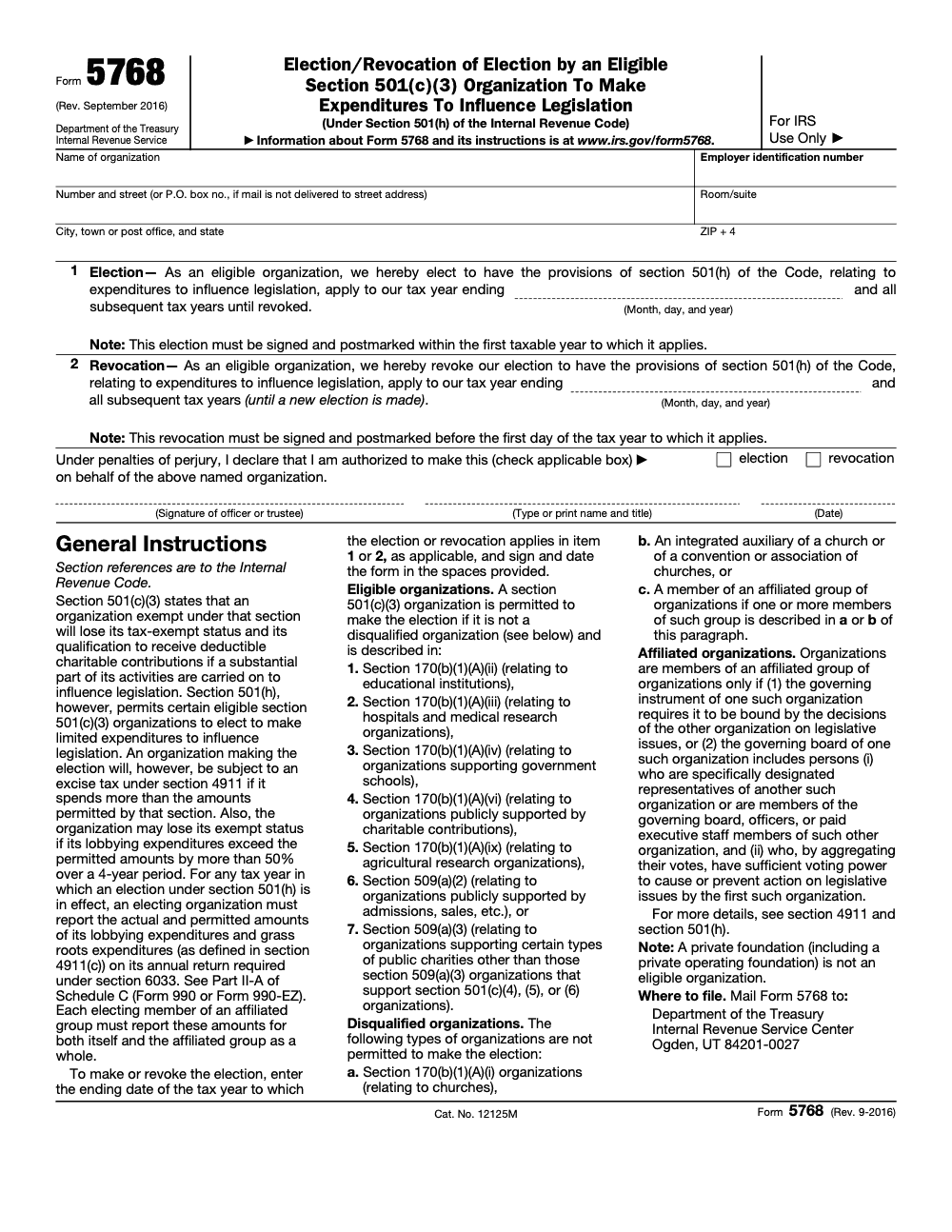
Form 5768 is the one-page election an eligible 501(c)(3) public charity uses to switch from the vague substantial part lobbying test to the dollar-based 501(h) expenditure test. The lobbying nontaxable amount tops out at $1,000,000 (20% of the first $500,000 of exempt purpose expenditures, then 15%, 10%, and 5% on the higher tiers per IRC 4911), grassroots is 25% of that cap, and a single year over the limit triggers a 25% excise tax reported on Form 4720. The signed form must be postmarked within the first taxable year of the election and mailed to the IRS Service Center in Ogden, UT (per IRS Form 5768 instructions and IRS Publication 557, Rev. January 2025).
The question a nonprofit board asks most is the wrong one: can we lobby at all? Every 501(c)(3) public charity can lobby within limits, and Form 5768 is the one-page election that swaps a vague substantial part test for hard dollar ceilings under 501(h). The September 2016 revision date throws people off, but it is still the form for a 2025 election.
Under the 501(h) test, the lobbying nontaxable amount runs on a sliding scale, 20% of the first $500,000 of exempt purpose expenditures and smaller percentages above that, capped at $1,000,000, with the grassroots limit set at 25% of that cap under IRC 4911. File any time during your tax year and the election is effective from the start of that year; for calendar-year filers, filing by December 31 makes it effective as of January 1. Go a single year over the limit and a 25% excise tax follows on Form 4720.
Key Takeaways
- Form 5768 lets eligible 501(c)(3) public charities elect the 501(h) expenditure test instead of the subjective “substantial part” standard. The election uses numeric limits and continues each year until revoked.
- File any time during your tax year. The election is effective from the start of that same year. For calendar‑year filers, filing by December 31 makes it effective as of January 1.
- Under 501(h), your annual lobbying limit is a sliding scale based on exempt purpose expenditures, capped at $1,000,000, and your grassroots cap is 25% of that limit.
- You report lobbying on Form 990, Schedule C, Part II‑A, if the 501(h) election was in effect for the year.
- Ineligible to elect, churches and integrated auxiliaries, organizations affiliated with a church under the 501(h) rules, private foundations, and organizations described in 509(a)(4).
What Is Form 5768 and the 501(h) Election?
Form 5768 is a short IRS filing that activates the 501(h) expenditure test for eligible 501(c)(3) public charities. Once you elect 501(h), your lobbying compliance becomes numeric, not subjective. You calculate allowable lobbying spend from your exempt purpose expenditures, then plan your advocacy inside those limits. The election remains in place until you revoke it.
Here is why teams like 501(h):
- Predictable budgets, the statute gives a sliding scale and a hard cap, so you can model spending with confidence.
- Cleaner reporting, Schedule C, Part II‑A focuses on totals for direct and grassroots lobbying.
- Lower risk of status loss, even if you overspend in a single year, the usual consequence is a 25% excise tax on the excess, not automatic revocation. Status can be at risk only if, over a four‑year period, your averages exceed 150% of the ceiling amounts.
A plain‑English snapshot of the rules
- Your “lobbying nontaxable amount” is computed from your exempt purpose expenditures using a sliding scale, with a $1,000,000 maximum.
- Your “grassroots nontaxable amount” is 25% of that lobbying nontaxable amount.
- If you exceed either limit in a year, you owe a 25% excise tax on the excess.
- If your averages over four years exceed 150% of the relevant ceiling, exemption can be denied for the next year.
Why Elect 501(h) With Form 5768
You replace guesswork with math. That allows you to:
- Budget advocacy, tie activity to a clear annual number and split it between direct and grassroots efforts.
- Plan reviews, use simple internal checklists, so staff code time and invoices correctly.
- Report efficiently, complete Schedule C, Part II‑A rather than narrative lobbying detail.
“Under the expenditure test, there are limits on both total lobbying and grassroots lobbying, and an excise tax applies to excess amounts.” This is the IRS framework in a single sentence.
Who Is Eligible, And Who Is Not
Eligible public charities include many organizations described in 170(b)(1)(A)(ii)–(iv), (vi), plus 509(a)(2) and 509(a)(3) supporting organizations (except 509(a)(3) supporting organizations that support 501(c)(4), (5), or (6) entities, which the statute excludes from eligibility). The regulations spell this out and allow new organizations to submit Form 5768 with Form 1023, effective once recognition as an eligible 501(c)(3) is granted.
Ineligible to elect:
- Churches, conventions or associations of churches, and integrated auxiliaries.
- Any 501(c)(3) affiliated with a church under the 501(h) affiliation rules.
- Private foundations and organizations described in section 509(a)(4).
If you later become ineligible, the election is automatically revoked beginning with the first full ineligible tax year.
When The Election Takes Effect, Timing That Actually Matters
The timing rule is generous and simple. File Form 5768 any time during a taxable year, and your 501(h) election is effective from the start of that same year. A calendar‑year filer that posts the form on December 31 has an election effective as of January 1 of that year. The regulation gives this exact example.
Practical calendar examples
- Calendar‑year filer, you mail Form 5768 on December 15, 2026, your election applies to the year that began January 1, 2026.
- Fiscal‑year filer with a July 1 to June 30 year, you mail the form on March 20, 2026, your election applies to the year that began July 1, 2025.
If you revoke later, the change takes effect with the first taxable year after the year you file the revocation. You may re‑elect, but the new election can be effective no earlier than the taxable year after the first year for which the revocation was effective.
How To File Form 5768, Step By Step
- Confirm eligibility, make sure you are an eligible 501(c)(3) public charity and not a church, integrated auxiliary, private foundation, 509(a)(4), or an affiliate captured by the church rules.
- Complete Form 5768, enter your legal name, EIN, address, and the first tax year the election will apply. Sign and date.
- File during your tax year, the election is effective from the start of that year if you are eligible. Keep proof of mailing.
- Retain the acknowledgment and keep the form with your permanent records. You do not re‑file annually unless you revoke.
Tip, addresses and submission options can change. Always use the current IRS page for Form 5768 and the version of the form in effect for your filing date.
501(h) Expenditure Limits, The Numbers You Plan Around
Under section 4911, your annual lobbying limit is a function of your exempt purpose expenditures, with a hard maximum of $1,000,000 that does not scale with budget size, so even a charity with $50 million of exempt purpose spending is still capped at $1,000,000 of nontaxable lobbying (and $250,000 of nontaxable grassroots). The grassroots limit is 25% of that amount. The IRS table below reflects current thresholds reviewed in October 2025.
Sliding‑Scale Limits Table
| Exempt purpose expenditures | Lobbying nontaxable amount |
| ≤ $500,000 | 20% of exempt purpose expenditures |
| > $500,000 and ≤ $1,000,000 | $100,000 plus 15% of the excess over $500,000 |
| > $1,000,000 and ≤ $1,500,000 | $175,000 plus 10% of the excess over $1,000,000 |
| > $1,500,000 and ≤ $17,000,000 | $225,000 plus 5% of the excess over $1,500,000 |
| > $17,000,000 | $1,000,000 cap |
The grassroots nontaxable amount is always 25% of your lobbying nontaxable amount, by statute.
Sample calculation you can copy
If your exempt purpose expenditures are $800,000:
- Lobbying nontaxable amount, 20% of the first $500,000 is $100,000, plus 15% of the next $300,000 is $45,000, total limit $145,000.
- Grassroots nontaxable amount, 25% of $145,000 is $36,250.
- You may spend up to $145,000 on lobbying in total, of which no more than $36,250 may be grassroots.
If you exceed a limit in a year, you owe a 25% excise tax on the amount over the limit. If your four‑year averages exceed 150% of the ceiling, exemption can be denied for the next year. Plan and monitor quarterly so you never get close to either line.
What Counts As Lobbying Under 501(h)
Two ingredients define lobbying under the 501(h) regulations, a reference to specific legislation and a stated view. Add a “call to action” to the general public, and you have grassroots lobbying. Address those points to lawmakers or their staff, and you have direct lobbying (communications with executive-branch officials generally are not lobbying unless those officials participate in formulating legislation).
Direct vs grassroots, clear examples
- Direct lobbying, you or your staff meet with a senator’s office about Bill 123 and state your position. That is direct lobbying.
- Grassroots lobbying, you publish an alert to your supporters about Bill 123 and urge them to contact their legislators. Including contact info or a petition is a call to action, so it is grassroots lobbying.
- Public ballot measures, messages to the public about a pending referendum count as direct lobbying for 501(h) purposes, a special rule in the regulation.
What is an “expenditure” in this context
The IRS defines expenditure broadly as a payment or anything of value, including an agreement to pay. Unpaid volunteer time is not an expenditure, which is why many nonprofits hold “lobby days” staffed by volunteers. Track staff time and paid vendors carefully, but do not count uncompensated volunteer hours.
What’s not lobbying under 501(h), key exclusions
Several activities are excluded from lobbying under the statute and regulations:
- Nonpartisan analysis, study, or research made widely available without a call to action.
- Technical assistance provided in response to a written request from a governmental body.
- Self‑defense communications about your existence, powers, tax status, or deductibility of contributions.
Those exclusions are detailed in the 501(h) rules and in the regulations that define what is, and is not, a lobbying communication.
How To Track Direct vs Grassroots Spend
- Code each activity to a specific bill or proposal, use project codes in your ledger so you can roll up totals.
- Separate direct lobbying, meetings, letters to lawmakers, testimony, and staff prep tied to specific legislation.
- Separate grassroots lobbying, public alerts with a call to action, list‑building for the alert, creative and ad spend.
- Exclude non‑lobbying items, neutral research and technical responses, as described above, but keep documentation showing why they are excluded.
Recordkeeping tip, align your Chart of Accounts with 501(h) categories and mirror Schedule C, Part II‑A. Your return becomes a copy‑paste exercise at year end.
Reporting After The Election, Form 990 Schedule C
If your 501(h) election was valid and in effect for the tax year, complete Schedule C, Part II‑A (a small electing charity that would otherwise file the Form 990-N e-Postcard cannot use it for this purpose, since Schedule C only attaches to Form 990 or 990-EZ). It asks for your direct lobbying, grassroots lobbying, the exempt purpose expenditures used to compute your limits, and a four‑year look‑back for the 150% test. The instructions were updated for 2025 and confirm the Part II‑A requirement for electing charities.
Keep contemporaneous records to support each line. If you owe the 25% excise tax on excess lobbying, file and pay it using Form 4720. The Schedule C instructions detail how the numbers tie out.
Filing Scenarios, Eligibility Details, And Timing Traps
New organizations
A newly formed charity can submit Form 5768 with its Form 1023. The election will only take effect once the IRS recognizes the organization as an eligible 501(c)(3), and then it is effective as of the beginning of the taxable year in which Form 5768 was filed.
Churches, integrated auxiliaries, and related affiliations
Churches, integrated auxiliaries, and 501(c)(3)s affiliated with a church under the 501(h) affiliation rules cannot make the 501(h) election. Private foundations and 509(a)(4) organizations also cannot elect. If your status changes and you become ineligible, your election is automatically revoked beginning with the first full ineligible year.
State lobbying laws still apply
The 501(h) election is a federal tax framework. It does not replace state registration or reporting for lobbying. Plan to meet both sets of obligations, and watch grant agreements or federal funds that prohibit using those funds for lobbying.
Affiliates, Chapters, And Aggregation
If you are part of an affiliated group under the 501(h) rules, the group is treated as a single organization for determining lobbying and grassroots limits and for any excise tax. There are also special rules for limited affiliated groups. Know how your network is structured, because aggregation changes both limits and tax exposure.
What “affiliated” means here
Two organizations are affiliated if one can control action on legislative issues by the other, for example through interlocking boards or governing document provisions. The regulations include examples and define how the group year is determined.
Common Filing And Compliance Mistakes To Avoid
| Mistake | Why it hurts |
| Filing after year‑end and hoping it is retroactive | The election only reaches back to the beginning of the year in which you file, not to prior years. |
| Assuming all nonprofits can elect | Churches, integrated auxiliaries, church‑affiliated 501(c)(3)s, private foundations, and 509(a)(4) orgs cannot. |
| Misclassifying activities | Nonpartisan analysis, technical assistance on written request, and self‑defense communications are excluded, but you must document why. |
| Forgetting the grassroots sub‑limit | Grassroots is capped at 25% of your lobbying nontaxable amount. |
| Ignoring the four‑year 150% rule | Repeated overspending can threaten exemption for the following year. |
Quick win, set quarterly checkpoints. If your trajectory suggests you will approach 80% of either limit by Q3, slow spend or shift activity to non‑lobbying education to stay compliant.
A Simple Workflow You Can Adopt This Week
- File Form 5768, confirm eligibility, and keep proof of mailing.
- Set annual caps, compute your lobbying and grassroots nontaxable amounts from your budgeted exempt purpose expenditures.
- Code activity, configure your accounting system to separate direct lobbying, grassroots lobbying, and excluded activities.
- Review monthly, compare year‑to‑date totals to your caps, and adjust plans early.
- Report cleanly, complete Schedule C, Part II‑A, and prepare Form 4720 if you owe excise tax.
Note, many nonprofits assign a single “advocacy controller” who signs off on any planned mass communication that mentions a bill or urges the public to act. That one gate keeps your totals accurate and avoids last‑minute fire drills.
Gentle, Real‑World Guidance
- Keep your advocacy public‑facing and clear, make your position on specific bills easy to understand, and reserve calls to action for when they matter.
- Use volunteers for in‑person outreach when appropriate, their time does not count as expenditures, although you must still follow your state’s lobbying rules.
- Build a short internal preflight for any email, ad, or webinar that touches a bill, ask, does this reference specific legislation, state a view, or urge a public action, then code it correctly.
When Accountably Can Help
This article lives on Accountably.com, so a quick note. If you want help standardizing your 501(h) tracking, organizing workpapers for Schedule C, or building simple reviewer checklists that keep your team under limits, our operations team can set that up inside your existing systems. We keep the focus on documentation discipline, clear coding, and predictable turnaround, so your staff can advocate with confidence.
Conclusion
Electing 501(h) with Form 5768 turns anxiety into a plan. You file during your tax year, the election applies from the start of that year, and you work within hard numbers, a total lobbying cap and a grassroots sub‑limit. With clean coding, light monthly checks, and strong documentation, your team can educate, persuade, and stay compliant, year after year.
Common Mistakes We See Every Season
The same handful of errors come up on nearly every 501(h) audit cycle. Each one is fixable with a calendar entry and a short SOP note.
Reusable Checklists
Copy these into the firm SOP for any nonprofit client running a 501(h) election. The boxes save state in your browser, so the reviewer can work them as they go.
Pre-file checklist for the 501(h) election
- Confirm the organization is a public charity under 170(b)(1)(A)(ii), (iii), (iv), (vi), (ix), 509(a)(2), or qualifying 509(a)(3); rule out churches, integrated auxiliaries, and private foundations.
- Pull the current Form 5768 (Rev. September 2016) from IRS.gov to avoid a corrupted file.
- Enter the correct first-year ending date on Item 1, and confirm the EIN and address fields match the IRS record.
- Have an officer or trustee sign under penalties of perjury; general staff or volunteer signatures are not valid.
- Mail to Department of the Treasury, Internal Revenue Service Center, Ogden, UT 84201-0027 by certified mail, return receipt requested.
- Scan the postmarked envelope and signed form into the permanent client file; the IRS does not issue a separate confirmation letter.
Annual 501(h) lobbying limits calculation
- Compute exempt purpose expenditures for the tax year (operating, administrative, depreciation, amortization, and lobbying outlays; exclude capital expenditures and separate fundraising unit costs).
- Apply the tiered formula under IRC 4911: 20% of the first $500,000, plus 15% of the next $500,000, plus 10% of the next $500,000, plus 5% of exempt purpose expenditures over $1,500,000.
- Cap the lobbying nontaxable amount at $1,000,000 regardless of organization size.
- Calculate the grassroots nontaxable amount at 25% of the lobbying nontaxable amount.
- Compare actual direct and grassroots spend against both ceilings; flag any year over the limit for the 25% excise tax on Form 4720.
- Update the 4-year rolling average to watch the 150% loss-of-exemption threshold.
Schedule C, Part II-A handoff to the 990 preparer
- Confirm the Form 5768 election is still in effect for the reporting year (no revocation postmarked before year start).
- Provide direct lobbying total and grassroots lobbying total separately from the GL, using the IRC 4911(c) definitions.
- Provide total exempt purpose expenditures, with capital expenditures excluded.
- Provide prior three years of lobbying and grassroots actuals for the 4-year average columns.
- Note any affiliated group membership so the preparer can report both organization-level and group-level numbers.
- Reconcile to the financial statements before sign-off to avoid a Schedule C versus Form 990 mismatch.
Keep 5768 Season From Stalling
Form 5768 is a one-time, one-page election, but the work that follows is annual and the calendar is unforgiving. The election must be postmarked inside the elected tax year, the limits calculation runs every year on Schedule C, Part II-A of Form 990 or 990-EZ, and the 4-year average has to be tracked to stay clear of the 150% loss-of-exemption threshold under IRC 4911. According to IRS Publication 557 (Rev. January 2025), an electing public charity that drifts above the lobbying nontaxable amount in a single year owes a 25% excise tax on the excess, reported on Form 4720.
For a firm running multiple nonprofit clients, the failure mode is rarely the election itself, it is the documentation discipline around it. Lobbying entries get coded inconsistently, capital expenditures slip into the exempt purpose expenditure base, and grassroots versus direct lobbying gets blurred at year end. The fix is a workflow that ties every dollar to the right bucket from the GL up.
- Build a chart-of-accounts overlay that separates direct lobbying, grassroots lobbying, self-defense communications, and program advocacy, so Schedule C Part II-A totals come out of the GL and not out of an end-of-year reclassification.
- Set a November calendar lock for any client considering the election that year, and use certified mail with return receipt for the Ogden, UT filing so the postmark is in evidence.
- Run a quarterly check against the lobbying nontaxable cap (the lesser of $1,000,000 or the IRC 4911 tier formula) and the 25% grassroots sub-limit; flag any client approaching 80% of either ceiling before Q4.
- Track exempt purpose expenditures using the 4911(c) definition (exclude capital expenditures and separate fundraising unit costs) so the cap is not inflated.
- Maintain a 4-year rolling average tab on every electing client to catch the 150% threshold long before it triggers status loss under IRC 4911.
Accountably builds these controls into the engagement file from day one, with documented SOPs for Form 5768 filings, 501(h) limits monitoring, and Schedule C handoff to the 990 preparer. See our tax services for how that delivery is structured for nonprofit clients.
FAQs
No. Private foundations are not eligible to elect 501(h). The regulations also exclude organizations described in 509(a)(4).
No. Churches, integrated auxiliaries, and 501(c)(3)s affiliated with a church under the 501(h) affiliation rules cannot elect 501(h).
No. The election changes how your lobbying is measured and reported, not your eligibility to receive tax‑deductible gifts. You must still track lobbying costs and report them on Schedule C, Part II‑A when the election is in effect.
It does not replace or preempt state rules. You still need to register and report under state law when required, and some grant funds cannot be used for lobbying at all.
You owe a 25% excise tax on the excess. Keep an eye on your four‑year averages too, because spending more than 150% of the ceilings over that period can jeopardize exemption for the next year.
On Form 990, complete Schedule C, Part II‑A for the year the election was in effect. Use your books to support direct and grassroots totals.
Other forms this guide names
- Form 990: Nonprofit Tax Return Filing Guide 2025
- Form 990‑EZ: Eligibility, Deadlines, E‑File, Schedules
- Form 4720: IRS Excise Tax Guide for Foundations and Managers
About this guide
Accountably helps US CPA, EA, and accounting firms hire trained accountants and tax preparers in India.
About us Reviewed byJugal Thacker, CPAFounder and CEO at Accountably
A Washington-licensed CPA with 7+ years inside US firms – PwC, a real-estate tax practice, then a full-service firm, rising from reviewer to manager to advisory. This article was reviewed against current IRS guidance for the 2025 tax year and updated for filers preparing late returns, amendments, and 2026 estimates.
View profile →How we research, review, and update this guide
Every Accountably guide is researched against primary IRS sources, reviewed by a U.S. CPA, and refreshed as guidance evolves. Read our Editorial Guidelines to see how we source, fact-check, and update our content.