Summarize this article with AI
In Brief
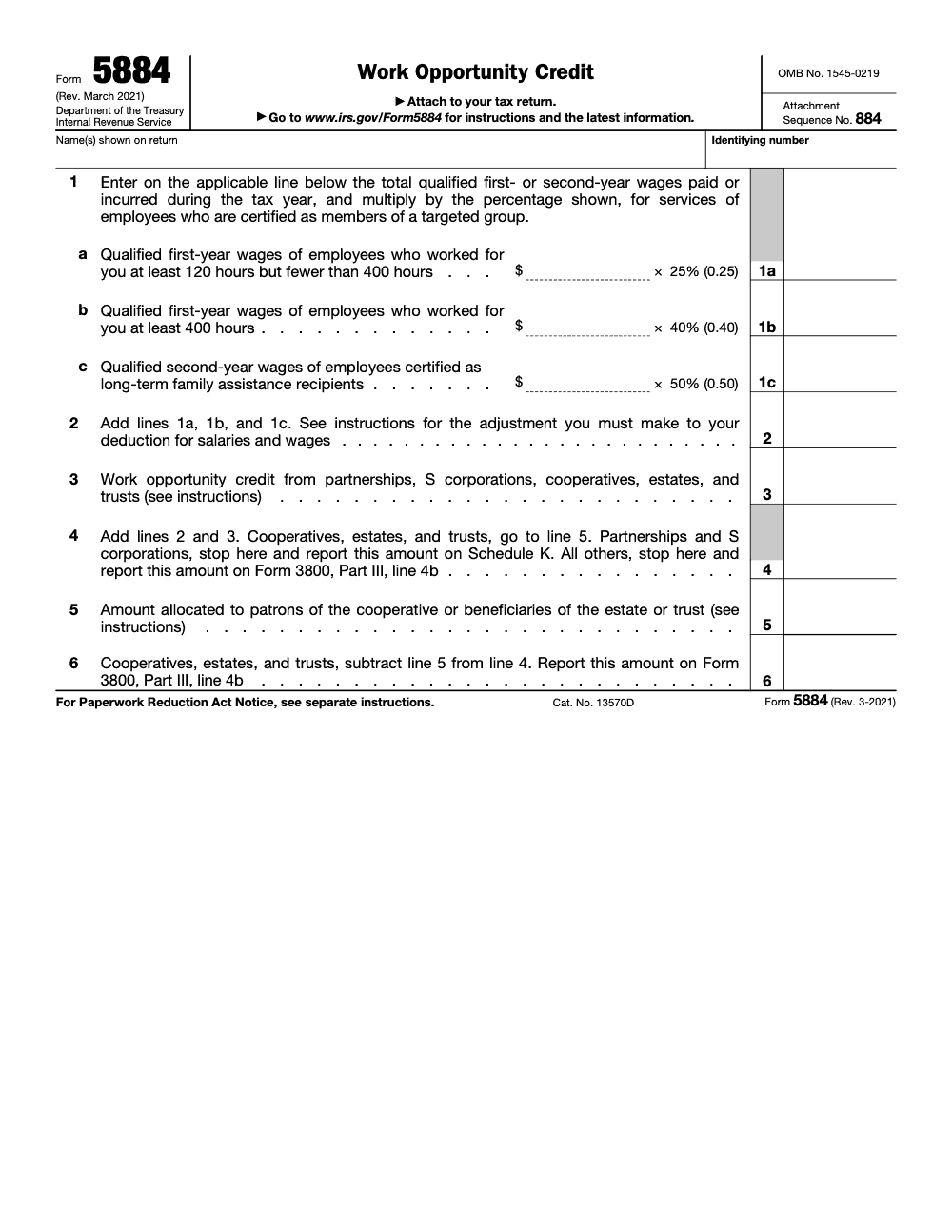
Form 5884 is the Work Opportunity Credit form – employers claim 25 percent of qualified first-year wages when a certified targeted-group hire works 120 to 399 hours and 40 percent when the hire works 400 or more (per the Form 5884 instructions, March 2021 revision). The line 4 credit carries to Form 3800, Part III, line 4b, and the related Form 8850 must reach the State Workforce Agency within 28 calendar days of the employee's start date.
Whether a hire earns the Work Opportunity Credit on Form 5884 is settled in the first weeks of the job, long before the return. Form 8850 has to reach the State Workforce Agency within 28 calendar days of the employee's start date; if it sat on a desk past that window, the credit was gone from that point, however long the employee went on to work. Certification has to be in hand before any number lands on this form.
Once the certification is clean, the math is plain: 25 percent of qualified first-year wages when a hire works 120 to 399 hours, 40 percent at 400 or more, against the wage cap that fits the group. Most caps sit at $6,000, summer youth at $3,000, long-term family assistance at $10,000, and certain veterans up to $24,000. The line 4 result carries to Form 3800, and partnerships and S corporations pass it to owners on Schedule K-1 using code J.
Key Takeaways
- You compute the WOTC on Form 5884 using qualified wages for employees who are certified members of targeted groups. The credit is generally 25 percent for 120–399 hours, 40 percent for 400 or more hours, and 50 percent for second year long term family assistance wages.
- You must submit Form 8850 to your State Workforce Agency within 28 days after the employee’s start date, certification is required before you can claim the credit.
- Wage caps apply by group, most are capped at $6,000 for first year wages, veterans can be higher, up to $24,000, summer youth is $3,000, and long term family assistance is $10,000 per year for up to two years.
- For 2025, WOTC is authorized for workers who begin work on or before December 31, 2025, watch for any late year extensions.
- Partnerships and S corporations pass WOTC to owners on Schedule K‑1 using code J, most other filers claim it through Form 3800 and must reduce wage deductions by the credit to avoid double benefits.
What Form 5884 Is, And Why It Matters
Form 5884 is the IRS form you use to figure the Work Opportunity Tax Credit. If you hire people who are certified as members of targeted groups, WOTC gives you a dollar for dollar reduction of federal income tax based on a slice of their first year wages, plus a second year for long term family assistance hires. Think of it as a hiring incentive that rewards you for bringing people back into the workforce. You complete Form 5884 to compute the credit, then carry it to Form 3800 or your entity return as required.
As of today, December 29, 2025, WOTC is available for employees who begin work on or before December 31, 2025. If Congress extends it again, the IRS will update its page, so build a habit of checking status each season.
Who can use it, just about every employer type, including corporations, partnerships, S corporations, estates, and trusts. Tax‑exempt organizations can claim a related credit for qualified veterans using Form 5884‑C against employer Social Security tax, not income tax.
How The Credit Is Figured, The Quick Version
- Hours rule, 25 percent of qualified first year wages if the employee works 120 to 399 hours, 40 percent if they reach 400 hours, and for long term family assistance, 50 percent of qualified second year wages.
- Base wage caps, most targeted groups are capped at $6,000 in first year wages, summer youth is $3,000, veterans have higher caps in certain cases, up to $24,000, and long term family assistance is $10,000 per year for up to two years.
- Wage deduction reduction, you must reduce the salary or wage deduction by the credit on line 2 of Form 5884, this prevents double dipping.
You cannot claim WOTC without state certification. Complete Form 8850 by the offer date, submit it within 28 days of the start date, and keep the agency’s certification on file. Missing this step usually kills the credit.
A Straightforward Workflow That Fits Real Life
Here is a simple pattern you can put in place this week.
- Pre‑screen at offer, collect a Form 8850 signed by both the applicant and the employer on or before the day the job offer is made (signing after the hire date voids the application even if you still file within the 28-day window), and time stamp intake.
- Submit to the State Workforce Agency within 28 days, include required ETA forms, 9061 or 9062, and 9175 for long term unemployment recipients.
- Track certifications and link each SWA number to the employee in payroll.
- When certifications arrive, bucket wages by hours and caps, then calculate on Form 5884 and flow to Form 3800 or K‑1s.
- Reduce wage deductions by the credit and store the workpapers, certification letters, and calculations with your return files.
Where this often breaks is not the math, it is the handoffs. If your team is constantly in peak season scramble, a missed 28‑day window or a lost certification letter is more common than you think. A disciplined workflow fixes that, your margin and your stress both improve.
Targeted Groups And Wage Caps, What Counts And How Much
WOTC applies when a new hire is certified as a member of a targeted group. Here is the quick map of groups and their typical wage caps for first year wages.
| Targeted group | First year wage cap | Notes |
| Most non‑veteran groups, for example SNAP, SSI, ex‑felons, designated community residents, vocational rehab referrals | $6,000 | 25 percent credit if 120–399 hours, 40 percent if 400 or more hours. |
| Veterans, category varies | $6,000 to $24,000 | Higher caps depend on unemployment duration and service‑connected disability, max credit can reach $9,600. |
| Summer youth employees living in empowerment zones | $3,000 | Wages must be earned between May 1 and September 15. |
| Long term family assistance recipients, TANF | $10,000 per year for up to two years | 40 percent in year one, 50 percent in year two, total up to $9,000 credit. |
A few plain English points your reviewers will appreciate
- You only count wages paid after the employee starts and after pre‑screening is complete, and only for the periods allowed for each group.
- For most groups, the cap is $6,000. For long term family assistance, it is $10,000 per year for two years. For summer youth, it is $3,000. For certain veteran subgroups, the cap can be $12,000, $14,000, or $24,000 depending on the facts.
- The percentage you use depends on hours, 25 percent if the person reaches at least 120 hours, 40 percent if they reach 400 hours, with the special 50 percent rule for long term family assistance in year two. Below 120 hours the credit is zero, not pro-rated.
What “Qualified Wages” Means In Practice
“Qualified wages” generally follow FUTA wage concepts, without applying the $7,000 base. That means regular pay for work performed. Do not include vacation pay or other nonworked hours, and do not double count wages that you already used for another overlapping credit. The instructions also require you to reduce your wage deduction by the credit you claim, see line 2.
Common inclusions and exclusions that save time in review
- Include taxable wages paid for services performed during the qualifying period.
- Exclude wages used for the 2020 qualified disaster employee retention credit on Form 5884‑A, the empowerment zone employment credit, the Indian employment credit, or the employer differential wage payment credit, you cannot use the same wage dollars to drive two credits.
- Track each employee’s hours bucket, 120–399 or 400 or more, and apply caps before the percentage math so your numbers tie out cleanly.
Certification Is Not Optional, It Is The Heart Of WOTC
You must obtain State Workforce Agency certification that your new hire is a targeted group member, and note that even with certification, wages paid to rehired former employees, to close relatives of the employer (children, parents, siblings, in-laws, dependents), or to anyone owning more than 50 percent of the business are statutorily excluded from WOTC. The process starts at the job offer with Form 8850, then submission within 28 days of the start date, along with ETA forms, usually 9061 or 9062, and 9175 when long term unemployment is the qualifying group. Only employees with an SWA certification number belong on Form 5884.
The 28‑Day Filing Window
- Complete Form 8850 by the offer date, submit to the State Workforce Agency within 28 days after the start date.
- Late submission usually forfeits the credit for that hire, prior transition relief was limited to specific periods and groups.
- Keep copies of Form 8850, ETA forms, the agency acknowledgments, and the final certification letter in a central file.
A Simple Certification Checklist
Pre‑screen, submit, track, reconcile, file. That rhythm protects the credit when your team is busy.
- Pre‑screen with Form 8850 at offer, time stamp receipt.
- Submit 8850 plus ETA 9061 or 9062, and 9175 when needed, within 28 days of start.
- Track pending certifications and follow up until the SWA number posts.
- Reconcile certified employees to payroll, flag them for Form 5884.
- File the credit and reduce wage deductions, store all support with your return.
Step By Step, Completing Form 5884 Without Guesswork
Once you have certifications in hand, the form itself is straightforward when you keep wages in tidy buckets.
- Confirm certification, tie each SWA number to the employee in payroll and your workpapers. Only certified employees count.
- Bucket wages by hours and group, first year 120–399 hours, first year 400 or more, and second year for long term family assistance hires. Apply the right wage cap for each person before you multiply.
- Do the math on lines 1a, 1b, and 1c. That is 25 percent, 40 percent, and 50 percent respectively. Sum to line 2.
- Add any passthrough WOTC from K‑1s on line 3, then compute your total on line 4.
- Reduce wage deductions, or amounts you capitalized, by the line 2 credit. This is not optional, it is in the instructions.
A Quick Example
You hire Taylor, certified SNAP recipient, who works 1,000 hours and earns $8,000 in the first year. You can use up to $6,000 of wages for WOTC, multiply by 40 percent based on hours, your credit is $2,400. Your wage deduction must drop by $2,400 on the return.
Now consider Jordan, certified long term family assistance. Year one, you can use up to $10,000, multiply by 40 percent for a $4,000 credit. Year two, up to $10,000 times 50 percent for a $5,000 credit. Total possible credit across two years, $9,000.
Coordination With Other Credits And Rules
- If you used some of the same wages for the 2020 qualified disaster employee retention credit on Form 5884‑A, remove those wages from WOTC.
- The WOTC is part of the general business credit, so the usual limitations and carry rules apply when you file Form 3800.
- For tax‑exempt employers hiring qualified veterans, use Form 5884‑C to claim the credit against the employer share of Social Security tax after you receive certification.
Common Mistakes That Cost Credits
- Waiting to collect Form 8850 until after the start date, the pre‑screening step should be at offer.
- Submitting 8850 on day 29 or later, the window is 28 days from the start date.
- Forgetting to reduce wage deductions by the credit, this one shows up often in reviews.
- Double counting wages that were already used for another credit.
Documentation That Survives Busy Season
When returns go on extension, memories fade. Build a package that tells the story clearly.
- Employee roster showing who is certified, with SWA numbers and hire dates.
- Copies of Form 8850, ETA 9061 or 9062, any 9175, the SWA certification letters, and mail or portal confirmations.
- A schedule of qualified wages by employee, the hours bucket, the wage cap applied, and the math that lands on lines 1a through 1c.
- A return memo that shows the wage deduction reduction tied to line 2.
Treat WOTC like any other recurring compliance process. When you tighten the intake, submission, tracking, and review cycle, your hit rate rises, rework falls, and partners stop chasing missing letters.
Reporting The Credit On Returns And K‑1s
Once Form 5884 is complete, here is where it goes.
- C corporations, claim the WOTC on the Form 1120 as part of the general business credit after carrying it through Form 3800, and reduce wage deductions by the amount on line 2.
- Sole proprietors and other direct filers, carry the amount to Form 3800 and apply the general business credit limits and carry rules.
- Partnerships and S corporations, complete Form 5884, then pass the credit to owners on Schedule K‑1 using code J, and keep copies of the certifications with your workpapers.
- Estates and trusts, allocate the credit on Schedule K‑1 using code F.
A Handy Mapping Table
| Step | What to enter | Where it flows |
| 1 | Qualified wages by bucket | Form 5884, lines 1a to 1c |
| 2 | Add lines 1a to 1c | Line 2, then reduce wage deductions by line 2 |
| 3 | Passthrough WOTC received | Line 3 |
| 4 | Total current year WOTC | Line 4, then to Form 3800 or entity return |
| 5 | Entity allocations | Schedule K‑1, partnerships and S corps, code J, estates and trusts, code F |
A Ready‑To‑Use 28‑Day Certification Playbook
Here is a simple, repeatable checklist you can drop into your onboarding package.
- At offer, include Form 8850 with standard hiring paperwork, bookmark your state’s WOTC submission portal.
- Within 2 business days of acceptance, collect the signed Form 8850, and if needed, ETA 9061 or 9062, and 9175 for long term unemployment.
- Within 10 calendar days of the start date, submit the packet to the State Workforce Agency and capture the submission confirmation.
- Weekly, review pending submissions, resolve agency questions, and update your roster with SWA numbers as approvals arrive.
- Month end, bucket wages for any employees who crossed 120 hours, then 400 hours, and flag caps by group.
- Quarter end, prepare Form 5884 workpapers, reduce wage deductions by the pending credit, and line up your 3800 or K‑1 entries.
Where Delivery Discipline Meets Tax Credit Results
You do not need more heroic effort, you need cleaner handoffs. The biggest WOTC failures are not technical, they are operational, missing 8850, late submission, or scattered documentation. If your core team is buried during peak season, consider standard operating procedures that make pre‑screening part of offer acceptance, single‑owner tracking of the 28‑day clock, and a tidy Form 5884 workbook that any reviewer can follow in five minutes.
How Accountably Can Help, If You Need It
If you want a controlled way to scale this work without quality loss, Accountably integrates trained offshore professionals into your tax workflow, inside your systems, with SOP driven execution, structured workpapers, and a layered review model. That structure reduces rework, protects deadlines, and gives partners back time for advisory work, not rescue missions. Use us when you need production stability, do not use us as a shortcut around process. That is how credits get lost.
Compliance Notes, Because Details Matter
- WOTC is part of the general business credit, so apply Form 3800 limits and carry rules.
- For partnerships and S corporations, pass WOTC on K‑1s using code J and keep an attachment that lists the Form 5884 amount.
- Keep records of Form 8850, ETA forms, SWA letters, and your wage math for as long as they may be needed for administration of the credit.
- Check the IRS WOTC page near year end for any extension beyond December 31, 2025.
Conclusion
You do not have to be perfect to realize WOTC, you just need a steady system. Pre‑screen every offer, submit within 28 days, track certifications to an owner, bucket wages by hours, apply caps before the math, and reduce wage deductions by the credit. Form 5884 then becomes a short, calm step in your compliance plan, not a last minute fire drill. If you want a partner to help you build the workflow and keep it humming, we are here, and we will work inside your tools so nothing feels bolted on.
Common Mistakes We See Every Season
WOTC is a paperwork credit before it is a tax credit, and the same five mistakes turn up every year. Most of them happen in the first 28 days after the hire, well before the return ever lands on a preparer's desk.
Reusable Checklists
The three checklists below are copy-paste ready for a firm SOP, a controller's binder, or an in-house payroll team's quarterly review. Each one tracks the moments where WOTC credits are won or lost.
Pre-hire WOTC screening
- Confirm the role is for a new hire, not a rehire of a former employee.
- Confirm the candidate is not a child, sibling, parent, in-law, or more-than-50 percent owner of the employer.
- Hand Form 8850 to the candidate on or before the day the job offer is extended.
- Collect both signatures (employer and candidate) on Form 8850 dated by the offer date.
- Identify the likely targeted-group category from background facts so the wage cap is known before day one.
- Pair Form 8850 with ETA Form 9061, or with ETA Form 9062 if a conditional certification was already issued.
- Start the 28-calendar-day countdown to the State Workforce Agency submission from the documented start date.
Form 8850 certification packet for the SWA
- Cover sheet listing employer EIN, employee name, SSN, start date, and the 28-day deadline.
- Signed Form 8850 with both signatures dated on or before the job-offer date.
- ETA Form 9061 with the targeted-group category clearly identified.
- Supporting documentation for the targeted-group claim (DD-214 for veterans, SNAP eligibility verification, vocational rehab referral letter, etc.).
- Submission proof from the SWA channel used (mail tracking, fax confirmation, or state portal receipt).
- File the approved certification in the employee record once returned by the SWA.
- Confirm Form 8850 is NOT mailed with the federal income tax return; the IRS never receives the certification request itself.
Year-end Form 5884 credit calculation
- Pull each certified hire's qualified first-year wages and total hours worked.
- Apply the 120-hour minimum filter (zero credit below 120 hours).
- Apply the 25 percent rate to hires at 120 to 399 hours and the 40 percent rate to hires at 400 hours or more.
- Apply the targeted-group wage cap ($6,000 / $12,000 / $14,000 / $24,000 for veteran subcategories; $3,000 for summer youth; $10,000 for LTFA year one).
- For LTFA recipients in year two, calculate the 50 percent credit on the separate $10,000 second-year wage cap.
- Sum lines 1a + 1b + 1c into line 2, then reduce the salaries-and-wages deduction by the line 2 amount under IRC §280C(a).
- Add any K-1 pass-through WOTC received from partnerships, S corporations, cooperatives, estates, or trusts to line 3.
- Carry line 4 to Form 3800, Part III, line 4b for taxable filers; allocate to patrons or beneficiaries on line 5 for cooperatives, estates, and trusts.
Keep 5884 Season From Stalling
WOTC delivery is paced by the hire date, not the tax-return calendar. Every new hire opens a 28-calendar-day clock to get Form 8850 in front of the State Workforce Agency, and missing the window by a single day means zero credit on that employee (per the Form 8850 instructions). With the credit scheduled to sunset for new hires after December 31, 2025 under IRC §51(c)(4), the operational pressure now sits on whoever runs the certification pipeline, not on the tax preparer at year end.
The fix is to push the credit work upstream into the hiring workflow and the payroll system, so by the time the return is prepared the math is already locked. A clean Form 5884 is the byproduct of a clean WOTC tracker, not a year-end exercise in catching up.
- Log every new hire into a WOTC tracker on day one, with start date, suspected targeted-group category, and the 28-calendar-day countdown to the SWA submission.
- Lock Form 8850 signatures to the offer date or earlier; any 8850 dated on or after the start date gets pulled from the credit pool.
- Map each certified hire to the correct wage cap up front ($6,000 / $12,000 / $14,000 / $24,000 for veteran subcategories, $3,000 for summer youth, $10,000 first year plus $10,000 second year for long-term family assistance recipients), so the calculation does not get re-litigated at year end.
- Tie the §280C(a) wage-deduction reduction to the same workpaper that produces line 2, so the deduction adjustment never gets lost between preparer and reviewer.
- Reconcile line 4 to Form 3800, Part III, line 4b on every taxable filer; for partnerships and S corporations, stop at line 4 and push the credit to partners and shareholders on Schedule K-1.
Accountably teams run this pipeline as a standing workflow rather than a once-a-year event, with documented SOPs covering Form 8850 routing, wage-cap mapping, and the §280C(a) reduction, so credits do not leak between the hiring system and the return. If the in-house team is short on bandwidth heading into the 2025 sunset window, our tax delivery service can take the calculation and the workpapers without disrupting how the rest of the engagement is run.
FAQs
Yes, for individuals who begin work on or before December 31, 2025. Watch for late year extensions and check the IRS page before year end planning.
The credit is usually lost for that hire. Prior relief applied only to specific groups and periods, so plan for day 1 intake and day 28 submission at the latest.
Yes. Reduce your wage or capitalized labor amounts by the credit shown on line 2 of Form 5884.
They vary by subgroup and can be $12,000, $14,000, or $24,000 in the first year, which can push the credit up to $9,600.
A tax‑exempt employer can claim a related credit for hiring qualified veterans, using Form 5884‑C against employer Social Security tax, after receiving certification.
No. Summer youth wages have a $3,000 cap and must be earned between May 1 and September 15, with the employee living in an empowerment zone.
Other forms this guide names
- Form 3800: How to Claim the General Business Credit in 2025
- Form 5884-C: WOTC for Tax-Exempt Employers Hiring Veterans
- Form 5884‑A: Disaster Employee Retention Credit Guide 2018–2020
Summarize this article with AI
About this guide
Accountably helps US CPA, EA, and accounting firms hire trained accountants and tax preparers in India.
About us Reviewed byJugal Thacker, CPAFounder and CEO at Accountably
A Washington-licensed CPA with 7+ years inside US firms – PwC, a real-estate tax practice, then a full-service firm, rising from reviewer to manager to advisory. This article was reviewed against current IRS guidance for the 2025 tax year and updated for filers preparing late returns, amendments, and 2026 estimates.
View profile →How we research, review, and update this guide
Every Accountably guide is researched against primary IRS sources, reviewed by a U.S. CPA, and refreshed as guidance evolves. Read our Editorial Guidelines to see how we source, fact-check, and update our content.