Summarize this article with AI
In Brief
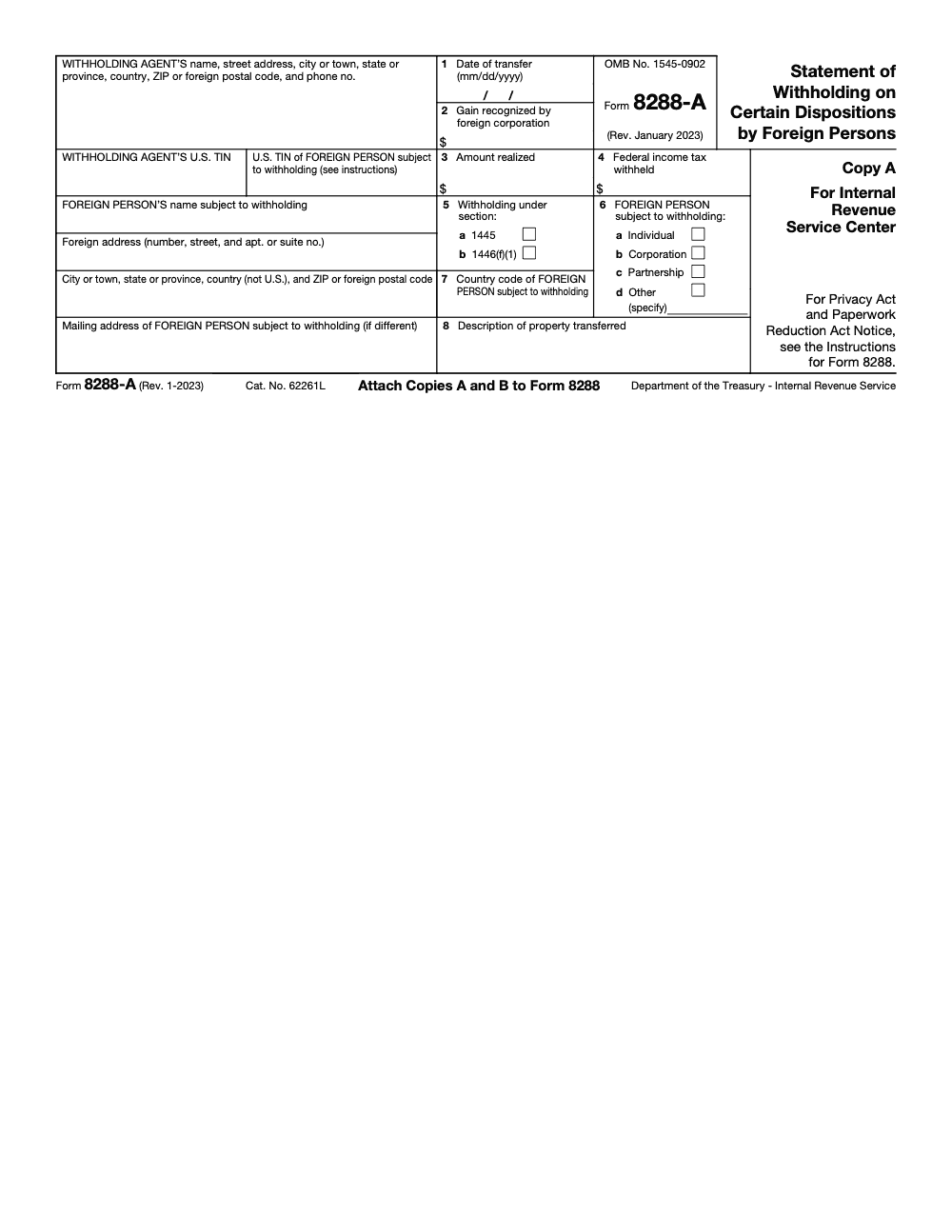
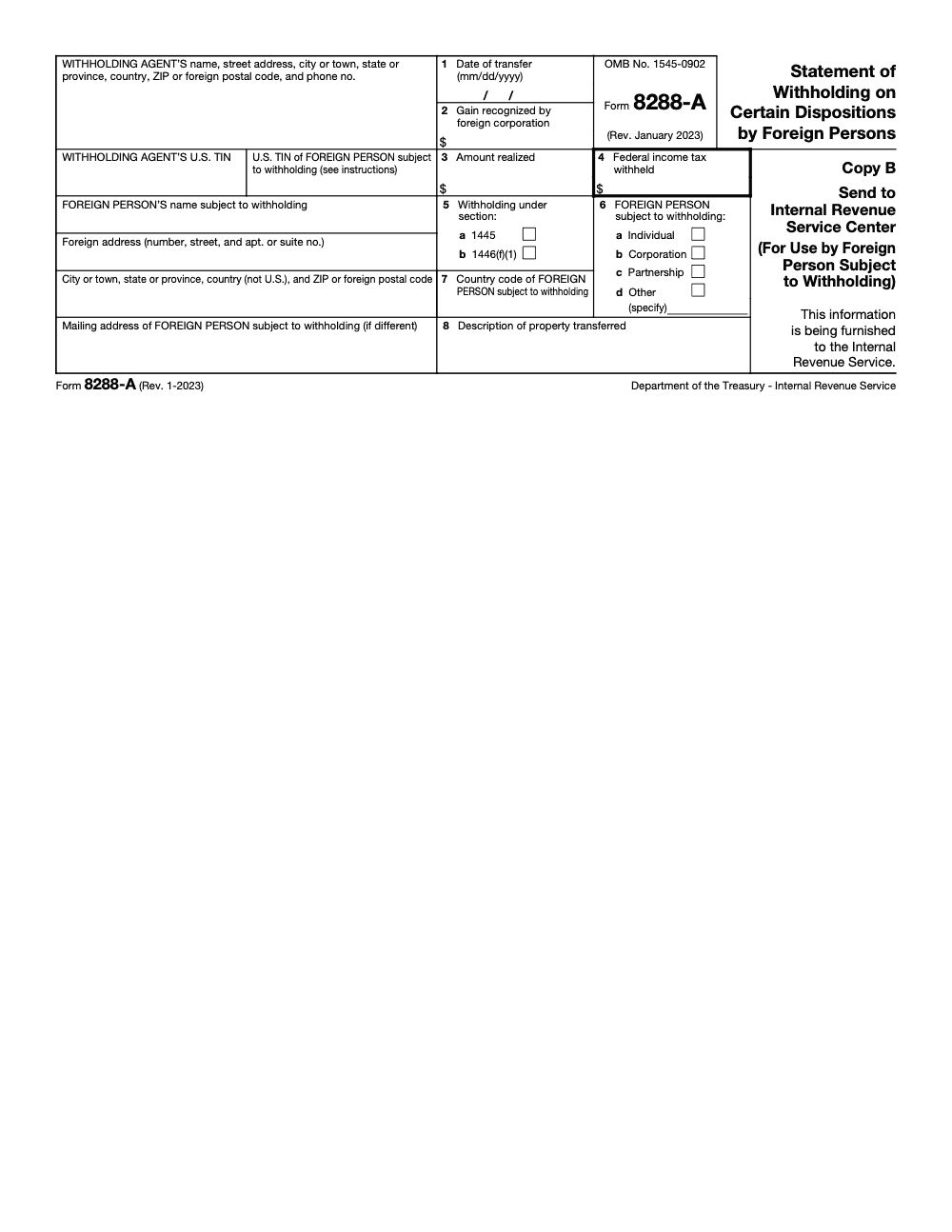
Form 8288-A documents federal income tax withheld on a foreign person's disposition of U.S. real property under FIRPTA (section 1445, 15% rate) or a partnership-interest transfer under section 1446(f)(1) (10% rate). The withholding agent attaches Copies A and B to Form 8288 within 20 days of the transfer; the IRS stamps Copy B and forwards it to the foreign person, who attaches it to their U.S. return (Form 1040-NR line 25f, or 1120-F, 1041, or 1065 as applicable) to claim the Box 4 amount as a credit, per the Instructions for Form 8288-A (Rev. January 2023).
The credit a foreign seller claims from Form 8288-A is the amount in Box 4, federal income tax withheld, not Box 2, and nothing else on the form substitutes for it.
Form 8288-A documents the tax withheld on a foreign person's sale of U.S. real property under FIRPTA or on certain partnership-interest transfers under section 1446(f). The withholding agent attaches Copies A and B to Form 8288 by the 20th day after the transfer, the IRS stamps Copy B and forwards it to the seller, and the seller uses it to claim the credit, on Form 1040-NR line 25f for nonresidents or Form 1040 line 25c for residents. If the transferor's TIN is missing, there is no stamped Copy B and no documentary basis for the credit.
Key Takeaways
- Form 8288-A is the IRS-stamped receipt that proves U.S. tax was withheld on a foreign person’s sale of U.S. real property or certain partnership interests. You use it to claim a credit.
- For most property sales, withholding is generally 15% of the amount realized under FIRPTA. For non‑publicly traded partnership interests under section 1446(f)(1), withholding is generally 10% of the amount realized.
- The buyer or other withholding agent must file Form 8288, attach 8288‑A Copies A and B, and remit payment to the IRS by the 20th day after the transfer. Mail to the Ogden Service Center shown in current instructions.
- On Form 8288-A, the credit you claim is the amount in Box 4, Federal income tax withheld, not Box 2. Keep the stamped Copy B for your return.
- Nonresidents report the 8288‑A credit on Form 1040‑NR, line 25f, and must attach Copy B. Resident filers typically include it on Form 1040, line 25c, and should attach the form.
What Form 8288-A is and why it matters
Form 8288-A is the statement that ties your transaction to the withholding the buyer remitted. It is how the IRS links the cash sent in with your tax account, and it is how you prove that money should be credited to you. Without the stamped Copy B, your refund or credit can be delayed. The IRS confirms that the buyer attaches Copies A and B to Form 8288, remits the funds, and the IRS then stamps and forwards Copy B to the seller at the address on the form.
For FIRPTA dispositions, the standard withholding is generally 15% of the amount realized, that is cash paid, fair market value of property transferred, and any liabilities the buyer assumes. For certain partnership interest transfers subject to section 1446(f)(1), the withholding is generally 10% of the amount realized. These amounts show up as the “Federal income tax withheld” in Box 4 of your Form 8288-A.
If you obtained an IRS withholding certificate that reduced the required withholding, the buyer still files Form 8288 and the IRS issues Form 8288-A reflecting the actual amount remitted. You will later attach the stamped Copy B to your return to claim exactly what was paid.
How Form 8288-A fits with FIRPTA and section 1446(f)
- FIRPTA, section 1445, generally requires the buyer to withhold on a foreign person’s disposition of a U.S. real property interest. The rate is usually 15%. The buyer uses Form 8288 to report and pay, and prepares Form 8288-A for each foreign seller.
- Section 1446(f)(1) generally requires 10% withholding on a foreign person’s disposition of a partnership interest to the extent gain would be effectively connected. The same 8288 and 8288‑A process and timing apply. If the buyer fails to withhold, the partnership may have to withhold under section 1446(f)(4) and file Form 8288 with Form 8288‑C.
In short, 8288 is the return that carries the payment, 8288-A is the seller’s stamped receipt to claim the credit, and 8288-C documents partnership backup withholding if a buyer did not withhold.
The exact box that matters
Many guides still tell you to claim the amount in “Box 2.” That is outdated. On the current Form 8288‑A, the creditable withholding is in Box 4, Federal income tax withheld. Box 2 is used only when a foreign corporation recognizes gain in certain distributions. Always match your return to Box 4 and keep the stamped Copy B with your records.
Quick example
You sell a U.S. rental condo as a nonresident on March 10. The buyer withholds 15% of the amount realized and files Form 8288 with Copies A and B of Form 8288-A by March 30. The IRS stamps Copy B and mails it to you. When you file your 2025 Form 1040‑NR, you report the sale, then claim the exact amount from Box 4 of the 8288‑A on line 25f, and attach Copy B to the front of the return. That is how the IRS gives you credit for what was withheld.
What to do when Form 8288-A arrives
Start with a quick audit of the details. Two minutes now can save months of IRS notices later.
- Names and TINs, yours and the withholding agent’s.
- Transfer date and property or partnership description.
- Amount realized.
- Box 4, Federal income tax withheld, the exact credit you will claim.
If anything is off, contact the withholding agent right away to correct the filing. The IRS stamps and mails Copy B based on what the buyer submitted, so fixing errors early avoids mismatches when you file.
Use this simple table
| Action | Why it matters |
| Verify names and TINs | Prevents IRS matching delays and notices |
| Confirm transfer date and description | Ensures the credit ties to the right year and asset |
| Reconcile Box 4 to the remittance | Avoids refund delays due to amount mismatches |
| Retain stamped Copy B | You must attach it to claim the credit on 1040‑NR, and it supports resident claims too |
The IRS notes that the buyer attaches Copies A and B to Form 8288, then the IRS stamps Copy B and sends it to the seller. If the TIN is missing, the IRS will not send the stamped copy until a valid TIN is provided. Expect delays when the TIN is absent.
Filing timeline, the 20‑day rule, and where to send
Buyers usually have a tight window. They must file Form 8288, attach 8288‑A Copies A and B for each foreign transferor, and remit the tax by the 20th day after the transfer. Mail the package to the Ogden Service Center address shown in the current instructions. If a withholding certificate application was filed by or on the transfer date, you still withhold, but the filing and payment may be deferred until 20 days after the IRS mails the certificate or a denial. Interest applies if the application’s principal purpose was to delay payment.
For 2025 and early 2026, the instructions show mailing to P.O. Box 409101, Ogden, UT 84409. Always confirm the address in the latest IRS instructions before you ship. Use certified mail or a trackable courier and keep proof of mailing.
Withholding rates at a glance
- Most real property dispositions by foreign persons, 15% of amount realized.
- Certain residence purchases can qualify for a reduced rate or exemption based on price and use, subject to strict rules. See the current instructions.
- Partnership interest transfers under section 1446(f)(1), 10% of amount realized, with specific exceptions and certifications possible.
- Certain corporate or trust distributions have other rates, often 21% of recognized gain.
If a withholding certificate is approved, the buyer still files Form 8288 and 8288‑A for the reduced amount. Your 8288‑A will mirror what was actually paid.
The forms work together
- Form 8288 is the transmittal and payment return.
- Form 8288‑A is the stamped receipt you, the seller, use to claim credit.
- Form 8288‑C applies if the partnership must withhold because a buyer failed to do so under section 1446(f)(1).
What appears on Form 8288-A
Here is what you should see and check:
- Withholding agent’s name, address, and TIN.
- Your name, foreign address, and TIN.
- Transfer date and brief description of the property or the partnership interest.
- Amount realized and the all‑important Box 4, Federal income tax withheld.
Pro tip, the IRS requires a foreign home or office address for the seller on 8288‑A (if no foreign address exists, enter the country of residence in that field and provide a separate mailing address). If a separate mailing address is provided, the IRS will use it to send the stamped Copy B. Missing or incorrect addresses can slow things down.
A quick story from the review room
We once helped a nonresident seller who reported the 8288‑A amount on the wrong tax year and forgot to include the withholding agent’s TIN in the software. The credit sat unmatched in the IRS systems for months. Once we corrected the year and added the agent TIN exactly as shown on the 8288‑A, the refund released. Small mismatches are the number one cause of delay here.
If you are a CPA firm, bake these checks into your workpapers. If you operate with offshore teams, insist that reviewers confirm Box 4, the agent TIN, and the disposition year before returns move to e‑file. Structure beats scramble every time.
Who prepares and files, plus the most common scenarios
In most sales, the buyer or transferee is the withholding agent. That means the buyer prepares Form 8288 and a separate Form 8288‑A for each foreign transferor, attaches Copies A and B of every 8288‑A to Form 8288, and pays the tax to the IRS by day 20 after the transfer. The IRS then stamps Copy B and mails it to the seller’s address listed on the form.
For partnership interest sales under section 1446(f)(1), the buyer usually has the same duty to withhold 10% of the amount realized and follow the same filing process and timing. If the buyer fails to withhold, the partnership may need to withhold from future distributions to that buyer under section 1446(f)(4) and file Form 8288 with Form 8288‑C.
Timing rules in plain English
- Day 0, Closing or distribution date.
- By day 20, Buyer files 8288, attaches 8288‑A Copies A and B, and pays the withheld amount.
- After processing, IRS stamps and mails Copy B of 8288‑A to the seller.
- Seller claims the Box 4 credit on the tax return for the disposition year and attaches Copy B for the IRS match.
If a withholding certificate was filed by or on the transfer date and is still pending, you still withhold at closing, but you may delay filing and paying until 20 days after the IRS mails the certificate or denial. If the application’s main purpose was to delay payment, interest and penalties can run starting day 21 after closing.
The 8288, 8288‑A, and 8288‑C chain
- 8288 is the return and payment.
- 8288‑A is the seller’s stamped proof to claim credit, showing Box 4 for the federal income tax withheld.
- 8288‑C is used when a partnership withholds because a buyer did not under 1446(f)(1).
Where and how to file
As of December 27, 2025, the instructions direct you to mail Form 8288 with Copies A and B of Form 8288‑A and payment to the IRS Ogden Service Center, P.O. Box 409101, Ogden, UT 84409. Always check the most current instructions in case the address changes. Use certified mail or a trackable courier and retain proof of mailing.
Avoidable pitfalls for withholding agents
- Missing seller TIN. The IRS will not mail the stamped Copy B until a valid TIN is on file, which slows the seller’s ability to claim the credit. File anyway, then ensure the seller obtains a TIN quickly.
- Copy B expectations. You, the buyer, do not send Copy B directly to the seller. The IRS stamps and mails it. That is by design, and it protects both parties.
- Wrong rate or amount realized. Confirm the correct rate, confirm what counts in “amount realized,” and document your calculation in the closing file.
Quality controls that save weeks
Here is a short control set you can drop into your workflow:
- Tie out the settlement statement to the amount realized and to the check or EFT sent with 8288.
- Confirm the seller’s foreign address plus any separate mailing address on 8288‑A so Copy B reaches the right place.
- Review Box 4 on every 8288‑A against the remittance, then review again at return prep.
- Keep stamped Copy B in the e‑file archive with the return PDF, and, if you paper‑file, attach it to the front of the return per the IRS.
A brief note for firms using offshore teams
Scaling FIRPTA and 1446(f) work without rework takes discipline. At Accountably, we fold SOPs, naming standards, and a two‑step review into the 8288/8288‑A process so reviewers spend less time hunting for Box 4, the agent TIN, and the disposition year, and more time on tax. If you are building your own process, adopt the same structure, not just extra bodies.
Accuracy here is not about heroics at deadline, it is about a checklist that runs every single time.
How to claim the credit on your return
Your return must show the 8288‑A withholding exactly as the IRS expects, or the credit may not match.
Nonresident individuals, Form 1040‑NR
- Enter the 8288‑A withholding on line 25f, “Form(s) 8288‑A.”
- Attach the stamped Copy B of every Form 8288‑A to the front of the return.
- Expect that refunds based on 8288‑A credits can be delayed several months while the IRS verifies the withholding.
Resident individuals, Form 1040
- Include the 8288‑A withholding in line 25c, “Other forms,” and attach the form to your return. While the 1040 instructions are broader, they note that amounts shown on 8288‑A belong in the payments section and should be attached to help processing.
Entities
- Foreign corporations claiming credit use Form 1120‑F and attach Copy B.
- Partnerships that received 8288‑A related to partnership transactions follow the instructions for their specific filing, and for section 1446(f)(4) withholding the partnership uses Form 8288 with 8288‑C.
Required entries that trigger the IRS match
- Use the exact amount from Box 4 on your 8288‑A.
- Include the withholding agent’s TIN in the return or software field that asks for it.
- File for the correct tax year, the year of the disposition.
Common mistakes we still see
- Reporting the credit on the wrong line, for example putting it in “Other payments” on 1040‑NR instead of line 25f.
- Using the wrong box number from 8288‑A, or entering the estimated amount instead of the amount actually withheld.
- Omitting the withholding agent’s TIN or misspelling the name, which blocks matching.
- Filing the credit in the wrong year, often when a denial or certificate changed the dates. The IRS FAQ confirms that Copy B may reflect a certificate date, but you still report the disposition on the actual sale year return.
Correcting a missing or wrong Form 8288-A
If you never received the stamped Copy B, confirm the buyer filed correctly, then contact the IRS Ogden Service Center with the transaction details. If the buyer filed with the wrong information, they should file an amended Form 8288 and corrected 8288‑A. The IRS will then issue a corrected Copy B. Keep proof of payment and closing documents in case you need to substantiate the credit while waiting.
Early refund basics
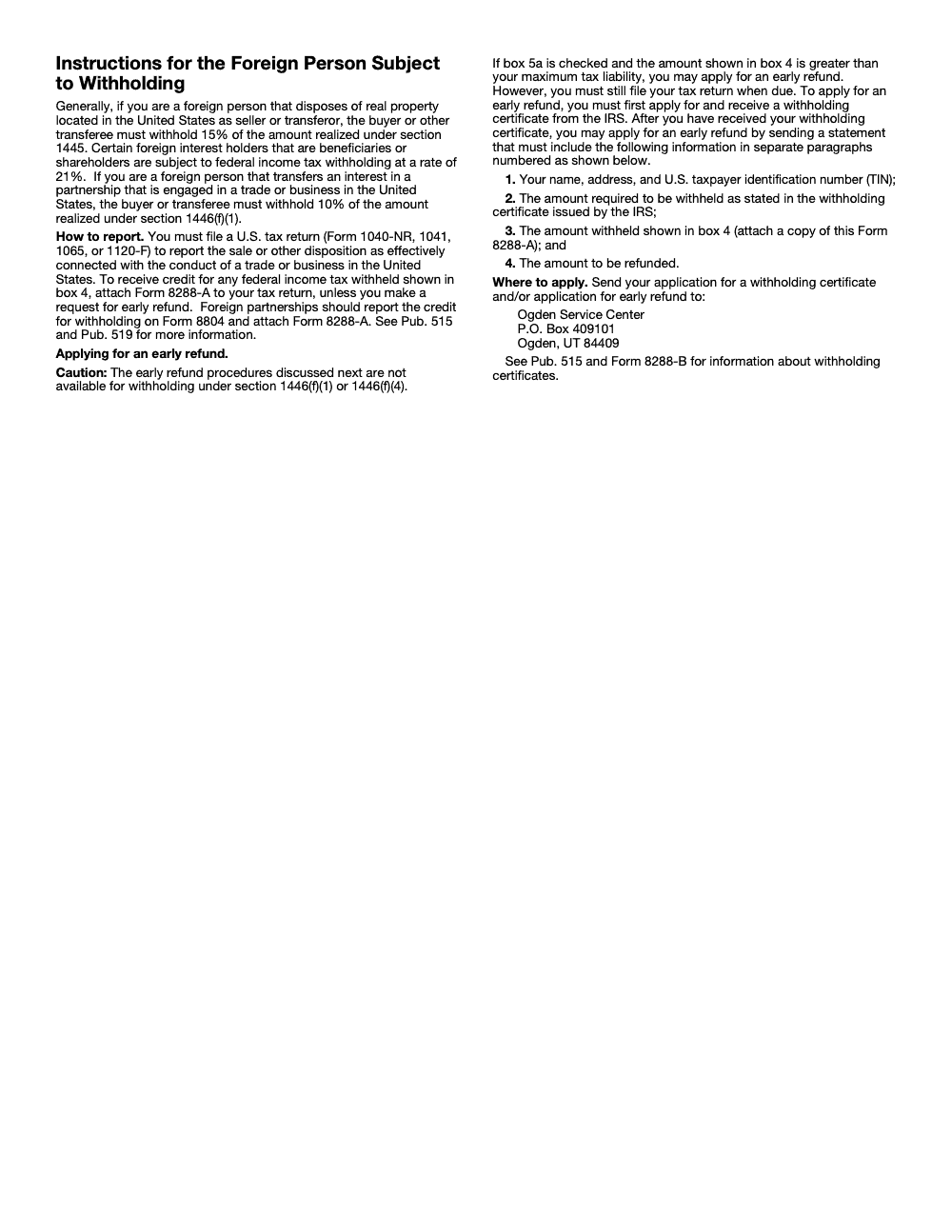
If you are over‑withheld on a FIRPTA sale and you obtained a withholding certificate, the IRS allows a process for early refund on FIRPTA transactions, though not for section 1446(f) withholding. Follow the directions in the 8288‑A instructions for the foreign person, referencing Box 4 and the certificate. Mail the request to the Ogden address in the current instructions. Even if you apply for an early refund, you must still file your U.S. tax return when due. The early refund is layered on top of, not in place of, the return.
Penalties, interest, and personal liability
If you are the withholding agent and miss the 20‑day deadline, or if you fail to withhold, you can be personally liable for the tax, plus penalties and interest. The Form 8288 instructions outline failure‑to‑file and failure‑to‑pay penalties under section 6651, and note potential criminal penalties for willful failure to collect and pay over tax. It is always better to file and pay late than not at all, then seek abatement for reasonable cause.
Software pointers and practical tips
- 1040‑NR, line 25f is where Form 8288‑A withholding belongs. Attach Copy B. Many platforms have a dedicated “US Tax Withheld on Form(s) 8288‑A” field that feeds this line.
- Resident 1040 returns typically include the credit on line 25c, and the instructions advise attaching the form to assist processing. If you e‑file, include a PDF of Copy B when your software supports it, and keep the stamped original with your records.
- For 1446(f) scenarios and 8288‑C, check your software’s partnership withholding screens and follow the mapping notes in current IRS guidance.
A short, printable checklist
- Confirm seller status and apply the correct rate, FIRPTA 15% or 1446(f) 10%.
- Prepare Form 8288 and a separate 8288‑A for each foreign transferor.
- File and pay by day 20 after the transfer, mail to the Ogden address in the current instructions.
- Match Box 4 on 8288‑A to the remittance.
- As the seller, claim Box 4 on your return, line 25f on 1040‑NR, attach Copy B.
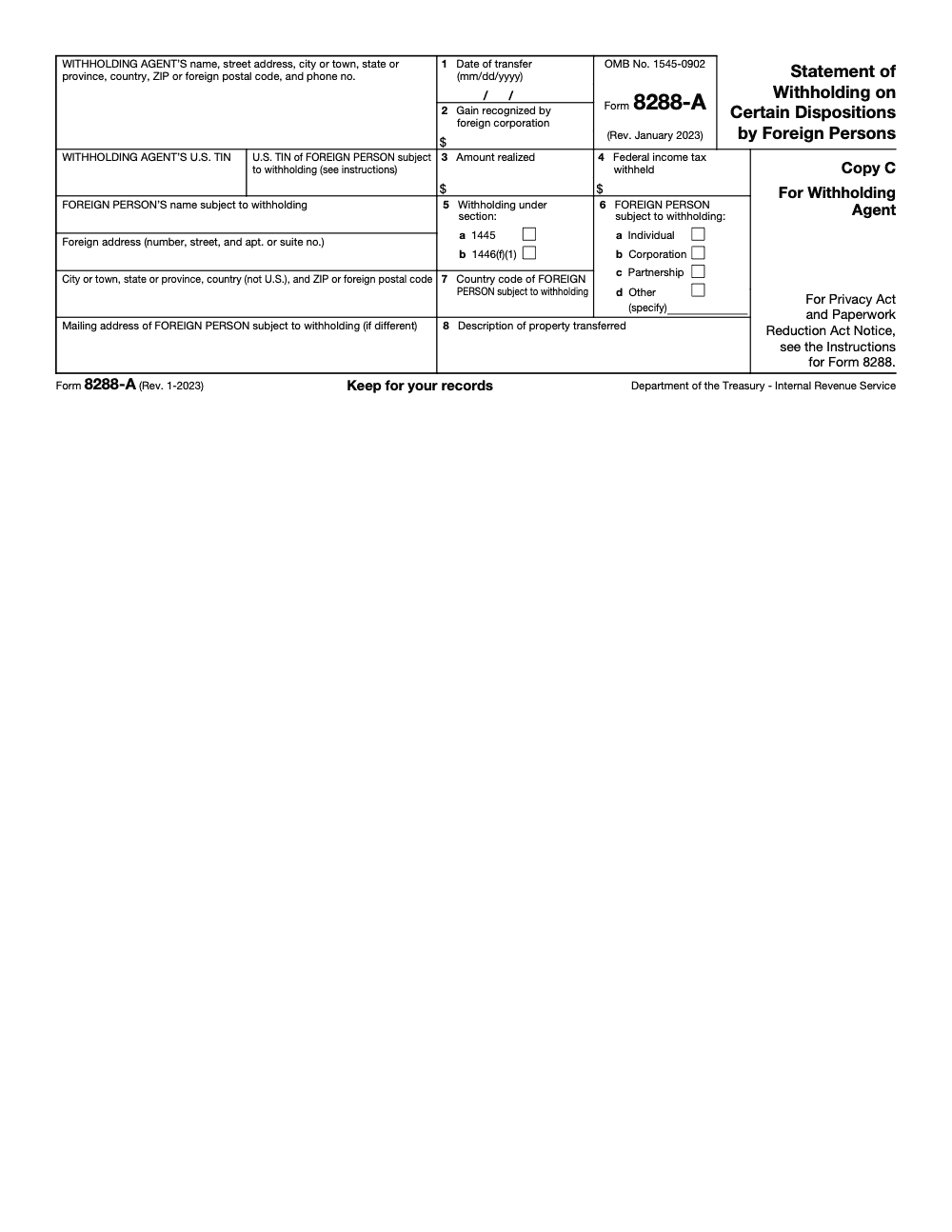
- Keep the stamped Copy B and closing documents with your records.
Final word and a gentle nudge
If you are a firm owner, you already know the real bottleneck is not finding returns to prepare, it is delivering clean work, on time, without bogging partners down in review loops. For FIRPTA and 1446(f) engagements, that means standard naming for files, a two‑minute Box 4 check, and a hard stop on the 20‑day filing window. If you want help building that discipline into your production, Accountably integrates trained offshore teams into your workflow with SOPs that keep 8288 and 8288‑A tight and on schedule, without sacrificing review control or security.
Common Mistakes We See Every Season
Most 8288-A problems we catch in review trace back to the same handful of cause-and-effect missteps at the closing desk. Each one is small on its own, and each one breaks the IRS stamping chain so the foreign seller cannot claim the credit on their return.
Reusable Checklists
Copy these into your closing-desk or tax-team SOP. The checkboxes save state per browser, so a reviewer can pick up where the preparer left off.
Closing-desk pre-file packet (buyer or closing agent)
- Confirm the seller is a foreign person and capture a valid SSN, EIN, or ITIN for every foreign seller; hold the wire if the TIN is missing.
- Determine the withholding rate: 15% under section 1445 for the typical FIRPTA sale, 21% for distributions to certain foreign beneficiaries or shareholders under section 1445(e), or 10% under section 1446(f)(1) for partnership-interest transfers.
- Prepare a separate Form 8288-A per foreign person, not one consolidated form for a co-owned property.
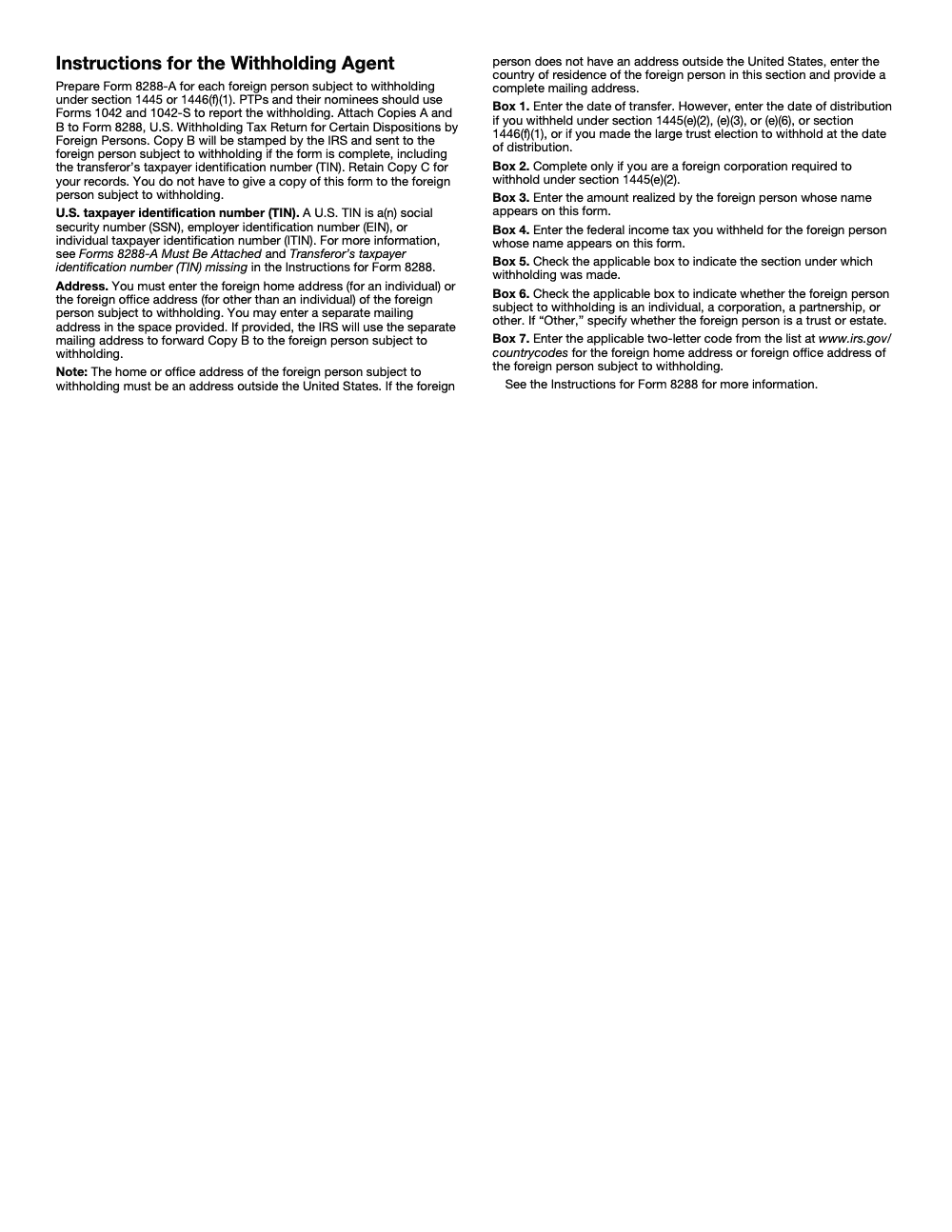
- Set Box 1 to the date of transfer, or to the distribution date if withholding falls under section 1445(e)(2), (e)(3), (e)(6), or 1446(f)(1).
- Check Box 5a (section 1445) or Box 5b (section 1446(f)(1)) to match the transaction type.
- Pick the two-letter country code from www.irs.gov/countrycodes; do not use ISO 3166 or three-letter codes.
- Enter the foreign person's home or office address outside the U.S.; use the separate mailing-address field if a U.S. forwarding address is needed.
- Attach Copies A and B to Form 8288 and file within 20 days of the transfer; retain Copy C in the closing file.
Stamped Copy B inbound review (seller side)
- Confirm Box 1 (date of transfer or distribution) ties to the closing documents.
- Confirm Box 3 (amount realized) ties to the settlement statement.
- Confirm Box 4 (federal income tax withheld) matches the wire to the IRS, since this is the credit number the seller claims.
- Confirm Box 5a or 5b is checked correctly (section 1445 vs section 1446(f)(1)).
- Confirm Box 6 category (Individual, Corporation, Partnership, or Other with trust or estate specified) matches the return being filed.
- Match the foreign person's identification to the U.S. return type: Form 1040-NR, 1041, 1065, or 1120-F. Foreign partnerships report the credit on Form 8804 with Form 8288-A attached.
- Staple the IRS-stamped Copy B to the front of the return and reconcile total Box 4 to the credit line (Form 1040-NR line 25f, or the applicable entity-return credit line).
Early-refund eligibility scan
- Box 5a (section 1445) is checked; Box 5b (section 1446(f)(1)) disqualifies the transaction from the early-refund procedure.
- A withholding certificate from the IRS (typically via Form 8288-B) has been issued before submitting the refund application.
- Box 4 withholding exceeds the foreign person's maximum tax liability shown on the certificate.
- The four required paragraphs are drafted: (1) name, address, and TIN; (2) amount required to be withheld per the certificate; (3) amount actually withheld in Box 4 with a copy of Form 8288-A attached; (4) amount to be refunded.
- Mail the application to Ogden Service Center, P.O. Box 409101, Ogden, UT 84409.
- Keep the U.S. tax return on schedule for its original due date; the early-refund application does not delay the filing obligation.
Keep 8288-A Season From Stalling
Form 8288-A does not run on a quarterly or April calendar, but it has its own pressure point: every covered closing triggers a 20-day filing window during which the buyer's team has to nail down the seller's TIN, the correct withholding section, the right Box 1 date rule, and the two-letter country code. A single foreign-seller transaction can stall an entire deal if no one on the closing side knows they are the withholding agent under section 1445 or section 1446(f)(1), or where Copies A and B have to land.
The fix is documentation discipline upstream, not faster typing on the day of close. By the time the deed records, every variable on Form 8288-A should already be queued from the engagement letter, the title file, and the wire instructions. That keeps the IRS-stamped Copy B moving and stops the seller from chasing the buyer for paperwork six months into the next return cycle.
- Confirm foreign-person status, withholding section (1445 vs 1446(f)(1)), and a valid SSN, EIN, or ITIN before the wire is authorized; missing TIN means no stamped Copy B and no credit downstream, per the Instructions for Form 8288-A.
- Generate one 8288-A per foreign seller and tie each to the underlying Form 8288 with a control number; consolidated forms create IRS-match rejections.
- Lock the section 1445(e) distribution-date rule into the closing template so Box 1 does not default to the transfer date when the rule requires the distribution date, and so Box 2 (gain recognized by foreign corporation) fills when section 1445(e)(2) applies.
- Standardize country-code lookups against www.irs.gov/countrycodes; ISO 3166 codes and three-letter codes are a top cause of stamped-Copy-B delays.
- Run the early-refund pre-check against section 1445 only (Box 5a checked) and route partnership-interest withholding under section 1446(f)(1) or (f)(4) to the regular return-credit path instead.
Accountably's U.S. tax delivery team handles the 20-day filing window inside the same SOP that catches TIN gaps, country-code mismatches, and section 1445(e) distribution-date triggers before the wire releases. The closing desk gets one clean handoff, the foreign seller gets a stamped Copy B that actually arrives, and review hours stay pointed at advisory work instead of paperwork repair.
FAQs
It documents federal income tax withheld on a foreign person’s sale of U.S. real property under FIRPTA or certain partnership interest transfers under section 1446(f). You use the amount in Box 4 as a credit on your U.S. return and generally attach the stamped Copy B to claim it.
Form 8288 is the withholding agent’s return and payment form. Form 8288‑A is the stamped statement the IRS sends to the seller so the seller can claim the credit. The buyer files 8288 with 8288‑A Copies A and B within 20 days of the transfer.
Line 25f. Attach Copy B of each 8288‑A to the front of your return.
Generally under line 25c, “Other forms,” and attach the form to help processing. Check the current year’s instructions.
Yes. Under section 1446(f)(4), the partnership may need to withhold from distributions to that buyer and file Form 8288 with 8288‑C.
First, confirm the buyer filed correctly. If the TIN was missing, the IRS will not send Copy B until a valid TIN is provided. Otherwise, contact the IRS Ogden Service Center with your transaction details to request help, or have the buyer submit a corrected filing.
Other forms this guide names
- Form 8288: FIRPTA, 1446(f), 20-Day Filing Guide
- Form 1040‑NR: Filing 2025, Nonresident Taxes Made Simple
- Form 8288-C: Partnership Backstop Withholding Guide
- Form 1040: Filing Guide for 2025 Returns (AGI, Deductions, Deadlines)
- Form 1120‑F: Guide, Filing, Deadlines, Protective Return
- Form 1120-F: Schedule Q, QDD Filing Guide
Summarize this article with AI
About this guide
Accountably helps US CPA, EA, and accounting firms hire trained accountants and tax preparers in India.
About us Reviewed byJugal Thacker, CPAFounder and CEO at Accountably
A Washington-licensed CPA with 7+ years inside US firms – PwC, a real-estate tax practice, then a full-service firm, rising from reviewer to manager to advisory. This article was reviewed against current IRS guidance for the 2025 tax year and updated for filers preparing late returns, amendments, and 2026 estimates.
View profile →How we research, review, and update this guide
Every Accountably guide is researched against primary IRS sources, reviewed by a U.S. CPA, and refreshed as guidance evolves. Read our Editorial Guidelines to see how we source, fact-check, and update our content.