Summarize this article with AI
In Brief
Form 8302 authorizes electronic deposit of a federal tax refund of $1,000,000 or more (per the IRS Form 8302 instructions, November 2018 revision, which is still the active version for 2025 filings). Attach it to Form 1045 or Form 1139 – not to Form 1040, which uses its own direct-deposit fields, and not to Forms 1120 or 1120S, which use Form 8050 instead.
A client filed Form 1139 on a loss carryback that cleared a seven-figure refund, attached Form 8302 to authorize the direct deposit, and a single transposed digit on Line 2 dropped the whole package into paper-check fallback. We caught it on the next review pass, but the cash landed three weeks later than the controller had baked into the draw forecast.
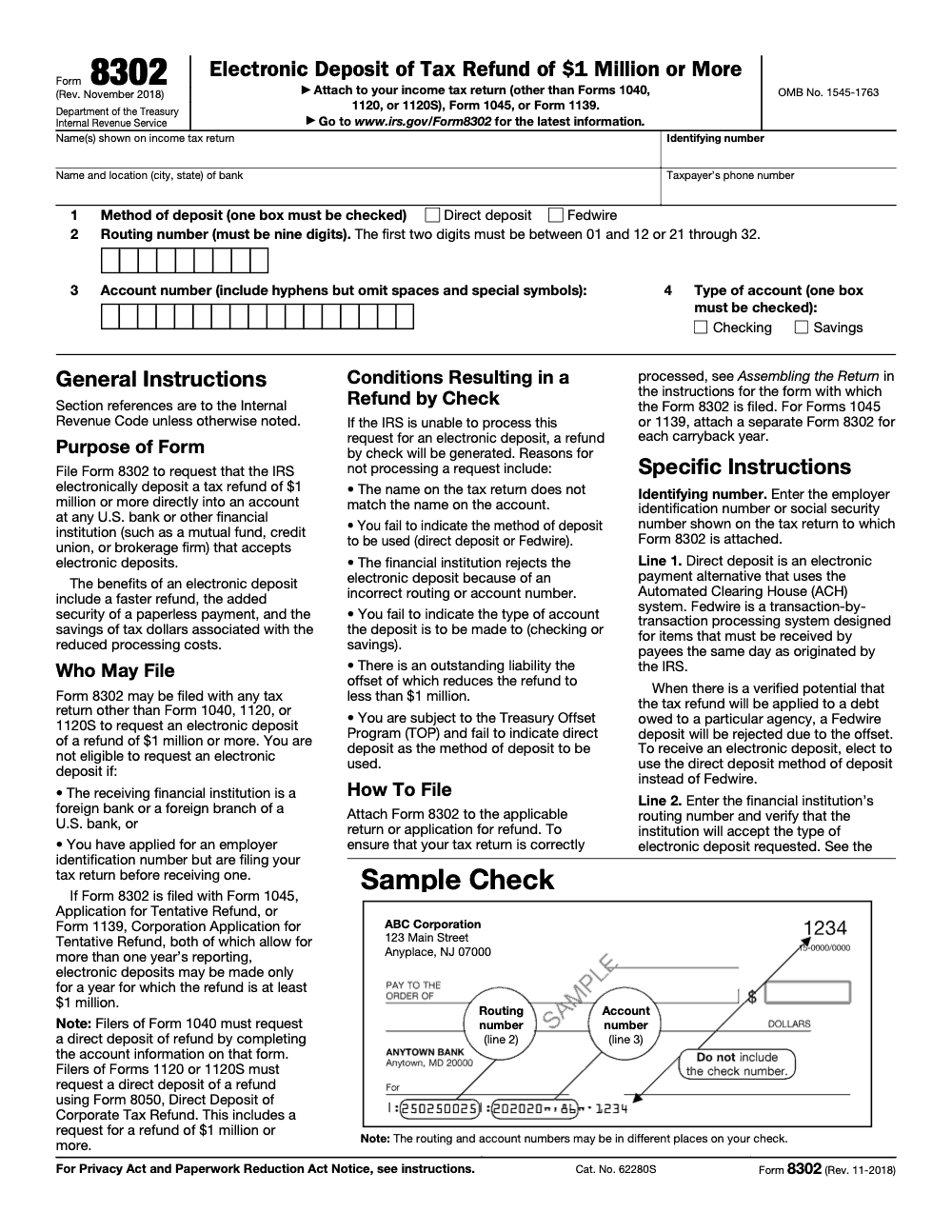
Form 8302 authorizes electronic deposit of a federal refund of $1,000,000 or more, and it attaches to Form 1045 or Form 1139, not to Form 1040, which has its own direct-deposit fields, and not to Forms 1120 or 1120S, which use Form 8050 instead. The active version is still the November 2018 revision, you file a separate Form 8302 for each carryback year that clears the threshold, and the routing and account entries have to be exact, because a mismatch forces a paper check or a rejection.
Key Takeaways
- You use Form 8302 to authorize the IRS to deposit a refund of $1,000,000 or more directly to a U.S. bank or financial institution that accepts electronic deposits.
- As of January 27, 2026, the current IRS revision is still November 2018 – the IRS has not issued a newer revision, so the same Nov 2018 form applies for 2025 tax-year filings. It applies to a wide range of returns, but not to Form 1040, 1120, or 1120‑S.
- For original corporate returns requesting direct deposit, corporations use Form 8050, not 8302. Form 8302 can still accompany Form 1139 or amended claims when the refund for that year is at least $1,000,000.
- If you are filing a tentative refund on Form 1045 or Form 1139, attach a separate Form 8302 for each carryback year that clears the $1,000,000 threshold.
- Enter the exact nine‑digit routing number, account number, and account type. A mismatch can force a paper check or rejection.
- Starting in October 2025, the IRS generally stops issuing paper checks, with exceptions, so electronic deposit planning matters even more.
What Form 8302 Is And Why It Exists
Think of Form 8302 as a precise set of banking instructions for very large refunds. When your refund for a given year is at least $1,000,000, Form 8302 lets the IRS send that money electronically to an account in your name at a U.S. bank, credit union, brokerage, or similar institution that accepts ACH. The agency created it to move large refunds faster, reduce mail risk, and cut processing costs.
You will complete the form with your legal name as it appears on the return, the nine‑digit ABA routing number, your account number, and you will check checking or savings. The routing number must begin with the valid ranges the IRS accepts. Accuracy matters, because the IRS will default to a paper check if the information does not pass basic validations or if your bank rejects the deposit.
The IRS designed Form 8302 for high‑dollar refunds, not everyday direct deposits. If the refund for that year is under $1,000,000, you do not need this form for direct deposit.
Form 8302 supports two electronic paths. Most filers choose Direct Deposit over ACH, which is standard for refunds. The form also lists Fedwire for same‑day items, however the IRS cautions that a Fedwire may be rejected if there is an offset potential, so direct deposit is the safer default in many cases.
A few bright‑line rules keep this simple:
- Do not use Form 8302 with Form 1040. Individuals request direct deposit on the 1040 itself (this stays true even when the personal refund is $1 million or more – the 1040 direct-deposit fields handle any size of refund).
- Do not use Form 8302 with original corporate Forms 1120 or 1120‑S. For those, request direct deposit using Form 8050 (this holds regardless of refund size – Form 8050 is still the right form even when the corporate refund is $1 million or more).
- Do not use foreign banks or foreign branches of U.S. banks. The account must be domestic and ACH‑capable.
Why This Matters More In 2026
The IRS has been phasing away paper checks for most disbursements. Instructions for the 1040 series make it clear that, starting October 2025, paper checks generally stop, except for limited exceptions. That policy makes accurate direct deposit setup a must, especially when seven figures are at stake.
From a practical standpoint, direct deposit shortens the path between “Refund Approved” and cash in your account, reduces the chance of physical theft, and eliminates mail rerouting if your address changes mid‑process. For million‑plus refunds, you should still expect extra verification and potential manual handling, but the electronic rails keep the timeline predictable once released.
If you have ever chased a lost check, you already know, electronic beats paper every time, especially when every day of delay affects cash planning.
Who Should Use Form 8302, And When It Is Required
If you are requesting a direct deposit of a qualifying refund and your filing route allows it, Form 8302 is your green light. In practice, firms most often attach it to Form 1045 or Form 1139 when seeking a tentative refund. This is common after carrybacks or year‑over‑year shifts that swing a large overpayment. The form exists to keep those funds moving quickly and safely into a U.S. account you own.
Quick Fit Check
- You are filing a tentative refund on Form 1045 or Form 1139.
- You want the refund by direct deposit to a U.S. bank or financial institution.
- You can provide an exact nine‑digit routing number, your account number, and the correct account type.
- The account is ACH‑capable and is in the filer’s name, not a third party.
If any of those points is a no, expect a paper check or a delay while the IRS resolves mismatches.
Common Use Cases We See
- A corporation files Form 1139 to claim a tentative refund from a loss carryback and wants funds deposited to treasury’s controlled account.
- An individual or estate files Form 1045 for a quick refund after a carryback and needs clean banking data on file to avoid a check.
- A partnership or S corporation aligns workpapers and documentation so the reviewing partner spends less time verifying bank details during peak season.
If the deposit must hit the account quickly, treat the routing and account entries like critical path items, not afterthoughts.
Accepted Financial Institutions, What Counts And What Does Not
The IRS will only send a Form 8302 deposit to a U.S.‑based account that accepts ACH credits. That includes most commercial banks, credit unions, and many brokerage cash accounts that post ACH. Foreign accounts are out. Intermediary arrangements, like routing to a processor that is not your account, are risky and should be avoided.
Ownership And Matching
- The name on the tax return should match the account owner.
- If you use a controlled disbursement account or a pooled cash structure, make sure the legal owner still lines up with the filer.
- If multiple signers exist, the account must still be open and eligible to receive tax refunds.
Quick Table, Use Or Do Not Use
| Scenario | Use Form 8302 | Do not use Form 8302 |
| Tentative refund on Form 1045 or 1139, U.S. ACH account, correct owner | ✅ | |
| Attempting deposit to a foreign account or intermediary wallet | ❌ | |
| Mismatched owner name or closed account | ❌ | |
| No ACH capability or unclear account type | ❌ |
How To Fill Out Form 8302 Correctly
Filling the form is simple, but precision matters. I tell teams to treat it like entering wire instructions, because a single digit can add weeks.
Step‑By‑Step
- Pull the current Form 8302 and your banking details, then confirm the legal name exactly as it appears on the return.
- Enter the taxpayer identification number, then the nine‑digit ABA routing number. Validate from a voided check or bank portal, not from memory.
- Enter the account number and select checking or savings. If the account is a brokerage cash account, confirm the correct ACH posting number.
- Confirm the account is domestic and ACH‑enabled. If the bank uses separate numbers for wires and ACH, use the ACH routing number.
- Sign and date the form. Unsigned forms stall, and the IRS will default to paper if it cannot validate authority.
- Attach Form 8302 to the eligible filing, most commonly Form 1045 or Form 1139, and submit to the correct IRS location for that return.
- Save a PDF copy and your internal review notes. If questions arise, you will want your evidence in one place.
Micro Checklist Before You File
- Routing number is nine digits and tested with your bank.
- Account number matches bank records, including any leading zeros.
- Account type selected and accurate.
- Name on the form matches the return and the bank account owner.
- The account is open today and remains open through the refund window.
- You attached Form 8302 to the right package and kept a copy.
When You Must Not Attach Form 8302
This is where many teams slip. Do not attach Form 8302 to Forms 1040, 1120, 1120‑A, or 1120‑S. Those filings have their own paths for refunds, and stapling 8302 to them only creates noise and mismatches in processing. If you are not filing a qualifying tentative refund package or other allowed case, leave Form 8302 out.
Why This Rule Matters In Production
- Reviewers burn time reconciling unsupported attachments.
- Misdirected forms can stall a clean direct deposit and push you to a paper check.
- The partner ends up in a second review loop that should never happen during peak weeks.
Large Refunds, Extra Verification, What To Expect
Refunds at or above $1,000,000 often route through additional IRS validation. That can add days or weeks compared to smaller refunds. Your job is to remove avoidable friction. Give the IRS clean, complete data, attach 8302 correctly, and double check bank acceptance. If risk flags arise, the fallback is often a paper check. That is not the end of the world, but it is slower and harder to track.
Practical Ways To De‑Risk Timing
- Use a high‑confidence internal review on all digits and names.
- Confirm the receiving bank’s ACH acceptance and any thresholds that trigger manual posting.
- Keep a point person ready to answer IRS or bank follow up during the release window.
Where And How To Submit Form 8302
You attach Form 8302 to the return or application that supports your refund path, then file the full package the way that filing is normally submitted. In most real projects, that means Form 1045 or Form 1139 with the 8302 stapled right behind the first page. If you are mailing, use the address in the instructions for that form and tax year. If you are using an approved e‑file route for the underlying form, follow the transmitter’s guidance for including 8302 in the submission set.
Attach Form 8302 to the eligible package, not by itself. The authorization needs to travel with the return or the tentative refund request.
Filing Pointers That Keep Things Moving
- Match the IRS address or e‑file schema to the exact tax year.
- Put Form 8302 early in the package so reviewers see it without hunting for it.
- Include any banking certificate or internal approval memo your team requires for audit trails.
- Keep a stamped or e‑file acknowledgment with a copy of the 8302 and the last four of the account number visible in your internal records.
Forms You Must Not Pair With Form 8302
Do not attach Form 8302 to Form 1040, 1120, 1120‑A, or 1120‑S. Those returns have their own direct deposit mechanics or different forms. Attaching 8302 there does not accelerate anything, and it can cause mismatches that slow processing. If you need a tentative refund, the right path is Form 1045 or Form 1139 with a properly completed 8302.
A Quick Do And Do Not Table
| Filing situation | Use Form 8302 | Why |
| Form 1045 tentative refund, refund for that year at or above 1,000,000 | Yes | Clean ACH to a U.S. account you own |
| Form 1139 tentative refund, refund for that year at or above 1,000,000 | Yes | Same, direct deposit authorization rides with the claim |
| Original Form 1040, 1120, or 1120‑S | No | Different rules or forms handle direct deposit |
| Any filing to a foreign bank or third‑party account | No | IRS deposits must go to your U.S. account |
Step‑By‑Step, Filling Form 8302 Without Errors
Treat this like wire instructions, and you will be fine.
- Name and ID. Enter the legal name and taxpayer ID exactly as the return shows.
- Routing. Enter the nine‑digit ABA routing number from a verified source, such as a bank portal or a voided check.
- Account. Enter the account number, including any leading zeros, then select checking or savings.
- Bank eligibility. Confirm the account accepts ACH credits and is a U.S. account.
- Ownership. Make sure the account owner matches the filer on the return or refund claim.
- Signature. Sign and date the form. No signature means no direct deposit.
- Attach. Place the form with Form 1045 or Form 1139, or the other eligible return where required, and file to the correct IRS location.
- Archive. Save a PDF copy, plus your internal reviewer’s checklist and the bank verification note.
Micro‑Anecdote, Why A Single Digit Matters
A controller typed a branch transit code instead of the bank’s ACH routing number. The bank rejected the deposit, the IRS flipped to a paper check, and the cash forecast slipped by three weeks. The fix took five minutes, but the timing cost was real. Double check the routing number, every time.
Common Mistakes And How To Prevent Them
These are the patterns I see again and again on Form 8302 packages, and each one ends the same way: the electronic deposit gets bounced and the refund falls back to a paper check that arrives weeks late. Per the IRS Form 8302 instructions (November 2018 revision), any one of the misses below is enough on its own to disqualify the electronic deposit.
How To Update Or Fix Form 8302 After You File
Mistakes happen. What matters is how quickly you respond, how cleanly you document the fix, and whether the refund has already gone out.
If The Refund Has Not Issued Yet
- Call your preparer and the IRS contact shown for your filing.
- Ask whether you can send a corrected Form 8302 with an amended return or a replacement page, and confirm the correct address or e‑file method.
- Re‑verify the nine digits of the routing number, the full account number, and ownership before you resubmit.
- Record dates, names, and call reference numbers so your team has a clear audit trail.
If The Refund Already Issued
- If the deposit was rejected because of an invalid account, banks typically return the funds and the IRS reissues payment, often by paper check.
- If a deposit went to the wrong account, file Form 3911 to request a refund trace. Contact your bank to flag the issue and ask about return handling.
- Keep your submission copy, bank evidence, and call logs in one folder. That folder becomes your proof stack if follow up is needed.
One Page Fix Table
| Problem | Likely IRS Outcome | What You Do Next |
| Routing or account digit wrong, deposit rejected | Bank returns funds, IRS reissues, often as a check | Confirm correct banking, ask whether you can resubmit 8302 |
| Deposit sent to closed account | Bank returns funds automatically | Monitor transcripts, keep bank closure proof handy |
| Deposit posted to wrong account | IRS refund trace via Form 3911 | File 3911, call IRS and bank, maintain written timeline |
| Name does not match account owner | Deposit may reject or be held | Provide ownership documentation, correct 8302 if allowed |
Refund Timing For $1,000,000 And Up
Very large refunds often go through extra checks. Identity, offset, and fraud screens can add time. That is normal. Your goal is to be boring and accurate so nothing in your package raises a question.
What Typically Slows Things Down
- Routing or account numbers that fail bank validation.
- Ownership that does not align with the return.
- Unclear carryback support that slows the tentative refund review.
- Bank level holds for unusually large first time deposits.
Practical Ways To Keep It Moving
- Use a two person review on the numbers, with one person reading them back from the bank portal.
- Confirm the receiving bank can accept an ACH of this size and whether any internal limit applies.
- Assign a single point of contact who can respond quickly when the IRS or bank calls.
- Keep your workpapers complete so questions get answered in one call, not three.
For seven figure refunds, accuracy beats speed. You will land the funds faster by filing clean the first time than by “expediting” a correction later.
Protecting Your Banking Info And Preventing Misdirected Deposits
Treat your routing and account details like you would a wire instruction. Share them on a need to know basis, store them in your secure vault or practice management system, and avoid retyping from memory.
Security Checklist
- Enter the numbers directly from a verified bank source, not an old spreadsheet or a deposit slip (deposit-slip routing numbers can differ from the ACH/direct-deposit routing number, which causes rejection).
- Use only a U.S. account you control that accepts ACH credits.
- Keep copies of the signed Form 8302 in a secure folder, with access limited to your tax and treasury leads.
- If mailing, include 8302 only in the return package, not loose in the envelope.
- If you suspect misdirection, call the IRS and the bank immediately, then file Form 3911 to start a trace.
Build A Simple Internal Process
- Create a one page SOP for Form 8302, with fields, screenshots, and a sample voided check.
- Add a reviewer sign off line for routing, account number, and ownership match.
- Store your SOP with return templates so staff does not reinvent the process during busy season.
How Accountably Fits, If You Want Fewer Review Loops
This article is about Form 8302, not outsourcing. That said, many firms struggle with delays because review time gets swallowed by preventable errors. If your team routinely fights last minute banking corrections, missing attachments, or inconsistent workpapers, the problem is capacity and review depth, not the form.
- Accountably integrates trained offshore teams into your firm’s workflow, then enforces SOPs, structured workpapers, and multi layer reviews so partners spend less time in correction mode.
- We work inside your systems and templates, including your Form 1045 and 1139 packages, then apply turnaround SLAs and escalation controls so timing stays predictable.
- The result is boring consistency, fewer revision cycles, and cleaner submissions. Exactly what you want when a 1,000,000 plus deposit is on the line.
If You Cannot Use Form 8302, Practical Alternatives
Sometimes Form 8302 is not available for your filing path. That is fine. You can still get paid, you just plan for a different route.
- Expect a paper check mailed to the return address when the form is not allowed or the bank details cannot be validated.
- If speed matters, confirm your mailing address, set up internal mail controls, and track the refund status so you can spot issues quickly.
- For personal refunds that allow it, consider Form 8888 to split a refund across up to three accounts or direct part of it to I Bonds. Make sure each destination accepts ACH and that names match.
- If a check is lost or appears stalled, contact the IRS and use Form 3911 to request a trace and stop payment if needed.
When direct deposit is off the table, accuracy and tracking keep the process predictable.
Quick Tools, Templates, And A One‑Page SOP You Can Copy
Here is a simple outline you can adapt inside your firm. Paste this into your knowledge base, then tailor to your workflow.
One‑Page SOP Outline
- Purpose. Use Form 8302 to authorize direct deposit of qualifying refunds to a U.S. ACH‑capable account.
- Scope. Applies to tentative refunds on Form 1045 or Form 1139, and other allowed cases.
- Inputs. Legal name per return, TIN, bank portal screenshot showing ABA routing and account number, account type.
- Steps. Enter name and TIN, enter routing and account numbers, select account type, sign, attach to eligible filing, archive copy with reviewer initials.
- Quality checks. Two person read‑back of routing and account numbers, ownership match, account open and ACH‑enabled, signature present.
- Exceptions. Do not attach to 1040, 1120, 1120‑A, 1120‑S.
- Records. Save PDF of Form 8302, bank verification, and submission proof in the engagement folder.
Final Checklist Before You File
- The refund for the applicable year qualifies for Form 8302.
- The destination is a U.S. ACH‑capable account and is owned by the filer.
- The nine‑digit routing and the account number were verified from a bank source.
- Account type is correctly selected.
- The form is signed and dated.
- Form 8302 is attached to the right package, often Form 1045 or Form 1139.
- Copies are archived, and a point of contact is assigned for questions.
Conclusion, Fewer Surprises, Faster Cash
When the refund is large, your priorities are speed, certainty, and control. Form 8302 gives you a clean, electronic path, provided the filing is eligible and the numbers are perfect. Treat the form like wire instructions, use a two person check on the digits, and attach it to the correct package. If you cannot use 8302, plan for a paper check and lock down your tracking. Either way, you stay in control and keep your cash plan on schedule.
Reusable Checklists
Copy these into your tax-prep playbook and tag them to the engagement the moment a $1 million-plus refund first shows up on the return. Each list maps to a specific point in the Form 8302 workflow where a missed step turns into a paper check.
Pre-file packet verification
- Confirm the underlying return is Form 1045, Form 1139, or another return type that allows Form 8302 (not Form 1040, 1120, or 1120-S).
- Test the post-offset refund against the $1,000,000 threshold for each year covered by the filing, separately.
- Verify the nine-digit routing number on Line 2 with the receiving bank's ACH desk, never from a deposit slip.
- Confirm the account number on Line 3 includes hyphens, omits spaces and special symbols, and excludes the check number.
- Check that Line 1 has exactly one box marked (Direct deposit or Fedwire) and Line 4 has exactly one box marked (Checking or Savings).
- Confirm the legal name on the underlying return matches the registered owner on the receiving account.
- Confirm the receiving institution is U.S.-located and is not a foreign branch of a U.S. bank.
- Confirm the EIN or SSN on Form 8302 matches the identifying number on the return it is attached to.
Treasury Offset Program and net-refund scan
- Pull the client's Treasury Offset Program status for the filing year before Line 1 is checked.
- If any TOP flag is present, force Line 1 to Direct deposit and record the override note in the workpaper.
- Calculate the post-offset refund net of any debts owed to other agencies, and confirm the net still clears $1,000,000.
- For multi-year Form 1045 or Form 1139 filings, identify any year where the post-offset refund falls below $1,000,000 and remove Form 8302 from that year's submission.
- Document the offset analysis in the workpaper so the reviewer can re-trace the math without rerunning the lookups.
- Flag the engagement for a follow-up trace if the deposit has not landed within the expected window after the IRS releases the refund.
Carryback year-by-year build
- Confirm the application covers more than one carryback year on Form 1045 or Form 1139.
- Prepare a separate Form 8302 for each carryback year that clears the $1,000,000 threshold post-offset.
- Verify the identifying number on each Form 8302 matches the SSN or EIN on the underlying return.
- Confirm the bank account details are identical across all attached Form 8302s when a single account receives all carryback years.
- Stack the carryback-year attachments in the package per the Assembling the Return instructions for the underlying form.
- Save a PDF copy of each year's signed Form 8302 in the engagement folder, alongside the bank-verification screenshot for Line 2.
Keep 8302 Season From Stalling
Form 8302 does not run on a recurring cycle the way quarterly payroll does, but when it lands it lands big. A single mistyped digit on Line 2 turns a $1 million-plus ACH credit into a paper check, and per the IRS Form 8302 instructions (November 2018 revision), the IRS will also default to a paper check when the name on the return does not match the receiving account, when offsets drop the net refund below $1 million, or when a Treasury Offset Program flag collides with a Fedwire election.
The fix is not more review hours, it is tighter pre-file controls so the form leaves the desk perfect on the first attempt. A one-page SOP plus a two-person sign-off on the routing and account fields removes almost every rejection path before the package goes out the door.
- Verify the 9-digit routing number on Line 2 directly with the receiving bank's ACH desk, never from a deposit slip. Deposit-slip routing numbers can differ from the ACH routing number and are a frequent rejection source.
- Confirm Line 1 (Direct deposit or Fedwire) and Line 4 (Checking or Savings) each have exactly one box checked. A blank on either line forces the refund to a paper check, no exceptions.
- For any client flagged under the Treasury Offset Program, force Line 1 to Direct deposit rather than Fedwire. Fedwire is automatically rejected under TOP and falls back to a paper check.
- On multi-year Form 1045 or Form 1139 carrybacks, attach a separate Form 8302 for each carryback year and re-test the $1 million threshold post-offset on each year individually.
- Exclude foreign branches of U.S. banks from the receiving account list. Eligibility requires a U.S.-located institution that accepts ACH credits, and the parent bank's U.S. headquarters does not cure a foreign-branch account.
That pre-file discipline is exactly the kind of control our U.S. tax execution teams bake into the workpaper template the moment a client flags a $1 million-plus refund, so the cash arrives on the timeline the client planned for.
FAQs
Form 8302 authorizes the IRS to send a qualifying refund, typically $1,000,000 or more for that year, by direct deposit to a U.S. ACH‑capable account you own. You attach it to eligible filings like Form 1045 or Form 1139 when you want funds deposited electronically.
No. Individuals request direct deposit on the 1040 itself. If you are pursuing a tentative refund via Form 1045, that is when Form 8302 can come into play for a large deposit.
No. Corporations use the process that applies to the 1120 series. Form 8302 shows up for large tentative refunds on Form 1139, not stapled to an original 1120.
Yes. Use an account you own that accepts ACH deposits. Mismatched ownership can trigger rejection or a fallback to a paper check.
Move fast. If the refund has not issued, ask the IRS contact handling your filing if you can submit a corrected 8302 with an amended page. If payment already issued, file Form 3911 to start a trace and call your bank to coordinate a return.
Large refunds often face extra verification. That review window varies. Your best move is to file a complete package, verify every digit, and keep a single point of contact ready to answer follow up so nothing stalls.
No. Use a U.S.‑based account that accepts ACH credits. Foreign or intermediary accounts lead to rejection and delay (a foreign branch of a U.S. bank is excluded too – the disqualification follows the branch location, not the parent bank's nationality).
Form 982 deals with cancellation of debt and tax attribute reductions. It has nothing to do with direct deposit. The numbers look similar, which is why people confuse them, but the purposes are completely different.
Be careful with viral claims. Refunds depend on your return and current law. Use official IRS resources or your tax advisor before trusting fixed‑amount promises.
Other forms this guide names
- Form 1045: Quick Refund Guide for Carrybacks and Form 172
- Form 1040: Filing Guide for 2025 Returns (AGI, Deductions, Deadlines)
- Form 1120: Corporation Tax Return Guide
- Form 1120-S: Guide for S‑Corp Filing, K‑1, K‑2/K‑3, Deadlines
- Form 3911: Trace a Missing Tax Refund in 2025
- Form 8050: Direct Deposit of Tax Exempt or Government Entity Tax Refund
Summarize this article with AI
About this guide
Accountably helps US CPA, EA, and accounting firms hire trained accountants and tax preparers in India.
About us Reviewed byJugal Thacker, CPAFounder and CEO at Accountably
A Washington-licensed CPA with 7+ years inside US firms – PwC, a real-estate tax practice, then a full-service firm, rising from reviewer to manager to advisory. This article was reviewed against current IRS guidance for the 2025 tax year and updated for filers preparing late returns, amendments, and 2026 estimates.
View profile →How we research, review, and update this guide
Every Accountably guide is researched against primary IRS sources, reviewed by a U.S. CPA, and refreshed as guidance evolves. Read our Editorial Guidelines to see how we source, fact-check, and update our content.