Summarize this article with AI
In Brief
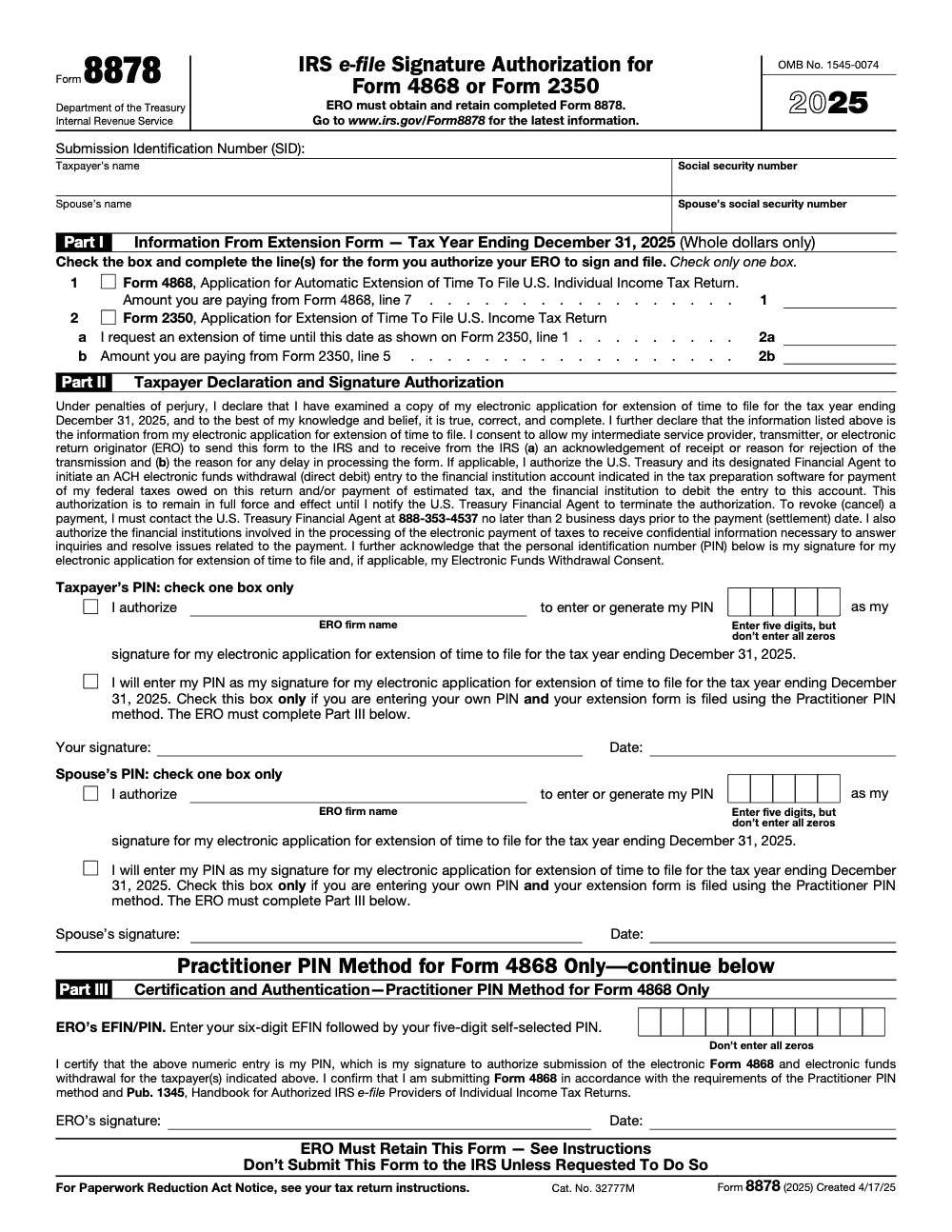
Form 8878 is the IRS e-file signature authorization for an electronically filed Form 4868 or Form 2350 extension. It lets the ERO enter or generate a 5-digit PIN on the taxpayer's behalf. Per the Instructions for Form 8878 (2025), the ERO must receive the signed form before transmitting the extension, retain it for 3 years from the later of the return due date or the IRS received date, and never mail it to the IRS unless specifically requested.
The 8878 mistake I catch most every spring is the ERO who hits transmit on a Form 4868 before the signed authorization is back in the inbox. The extension shows accepted, the payment posts, and weeks later the firm realizes nobody actually collected the signed form sitting in e-signature limbo. That is not a fun conversation with the partner.
Form 8878 is the IRS e-file signature authorization for an electronically filed Form 4868 or Form 2350 extension, and it lets the ERO enter or generate a five-digit PIN on the taxpayer's behalf. The ERO must receive the signed form before transmitting, then retain it for three years from the later of the return due date or the IRS received date. Quick rule for your SOP: no transmit until the signed form is in hand.
Key Takeaways
- Use Form 8878 when you authorize your ERO to create or enter your PIN for a 4868 or 2350 extension.
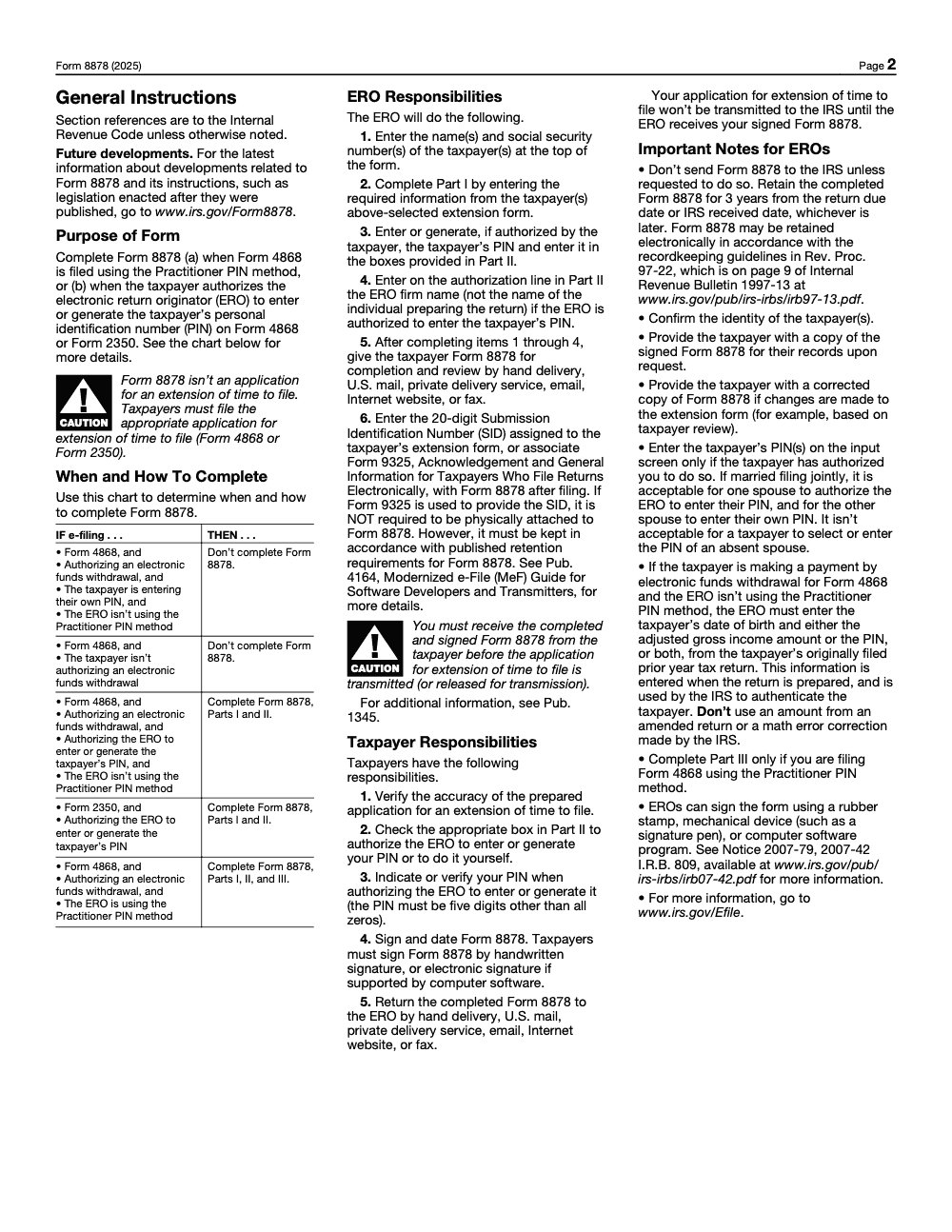
- For Form 4868, 8878 is required when there is an electronic funds withdrawal and you want the ERO to input your PIN, it is not required if there is no payment or you enter your own PIN. For e-filed Form 2350, 8878 is required when you authorize the ERO to enter or generate your PIN.
- Sign Form 8878 before the ERO transmits. Your ERO retains it for three years from the later of the return due date or the IRS receipt date, do not send it to the IRS unless requested.
- Electronic imaging is fine if your storage meets the standards in Rev. Proc. 97‑22, signatures must remain readable and the file must be retrievable.
- The 2025 revision of Form 8878 (Created 4/17/25, for tax year ending December 31, 2025) is the current version. Keep monitoring the IRS Form 8878 page for updates.
What is Form 8878
Form 8878, IRS e‑file Signature Authorization for Form 4868 or Form 2350, documents your consent for the ERO to generate or enter your five‑digit PIN as your electronic signature on an extension. It is the paper trail that proves you reviewed the extension data and approved the exact PIN used.
- You sign 8878, then the ERO can originate the electronic submission for your extension.
- The ERO keeps the signed form on file for three years from the later of the return due date or the IRS receipt date.
- Do not mail 8878 with the extension, produce it only if the IRS asks.
When Form 8878 is required, and when it is not
Required scenarios
- Form 2350, Application for Extension of Time to File for U.S. citizens or resident aliens abroad, requires 8878 when the e‑filed Form 2350 authorizes the ERO to enter or generate the taxpayer's PIN.
- Form 4868 with electronic funds withdrawal, when you want the ERO to input the taxpayer PIN.
- Practitioner PIN method, when you authorize the ERO to create or enter your PIN for the extension.
Not required scenarios
- You paper‑file the extension.
- You e‑file Form 4868 with no electronic funds withdrawal and you, not the ERO, enter your own PIN.
Quick reference
| Purpose | Required | Not required |
| 4868 with EFW and ERO enters the PIN | Yes | |
| 4868, no payment, you self‑select and enter PIN | No | Yes |
| 2350 e‑file when the ERO is authorized to enter or generate the taxpayer PIN | Yes | |
| Paper‑filed 4868 or 2350 | No | Yes |
Source basis, IRS About Form 8878, Self‑Select PIN Q&A, and IRM 3.42.5.
Why this matters for your workflow
Missed signatures and unclear PIN steps are a top cause of extension delays, rework, and anxious client calls. The IRS expects the ERO to confirm identity, obtain a completed 8878 before transmission, and retain it for three years. If you tighten these steps and standardize storage, your team spends less time chasing forms and more time advising clients.
What changed in 2025
The current revision of Form 8878 is the 2025 version (Created 4/17/25, for tax year ending December 31, 2025). Keep an eye on the IRS page in case the agency posts a new revision or updates to related publications such as Pub. 1345.
Practical note, if a change posts during filing season, update your templates, retrain staff, and archive the old 8878 immediately so your team does not circulate the wrong version. This is a small step that prevents large headaches later.
Who does what, taxpayer vs ERO
Taxpayer responsibilities
- Review the extension data, the tax year, and any payment details.
- Approve the exact five‑digit PIN that will be used (it must be five digits and cannot be all zeros).
- Sign and date Form 8878 before the ERO transmits the extension.
ERO responsibilities
- Confirm identity per Publication 1345.
- Provide the taxpayer a copy of the form and the related document for review.
- Receive the signed 8878 before originating the e‑file.
- Retain 8878 for three years from the later of the due date or the IRS receipt date.
- Do not mail 8878 to the IRS except upon request.
PIN methods you will see
Practitioner PIN vs Self‑Select PIN
- Practitioner PIN, you authorize the ERO to enter or generate the five‑digit PIN, 8878 documents that authorization for extensions.
- Self‑Select PIN, you choose and input your own five‑digit PIN. When you self‑select and there is no payment on 4868, 8878 is not needed.
For joint filers on an extension, both spouses may need to approve, and for 4868 with payment the ERO can be authorized to input the PINs via 8878. One spouse cannot select or enter the PIN of an absent spouse, each spouse must select and approve their own PIN. See the IRS Q&A for edge cases and identity rules.
Timing and deadlines you should not miss
- Sign 8878 before your ERO transmits Form 4868 or 2350.
- Your extension must be transmitted by the original due date of the tax return for it to count.
- Do not wait until the final afternoon, route and obtain signatures early so corrections do not jeopardize transmission.
Simple rule, no signed 8878, no e‑filed extension. Hold that line and your team avoids avoidable rejections.
Step‑by‑step, how to complete Form 8878
- Header details, enter legal name, SSN, and tax year, and confirm any balance due you plan to pay with the extension matches the extension data.
- Part I, select the correct extension, Form 4868 or 2350, and verify amounts and payment details.
- Part II, taxpayer signs and dates, ERO details are completed. Complete Part III only when filing Form 4868 using the Practitioner PIN method, Form 2350 never uses Part III.
- File handling, the ERO stores the signed 8878, then originates the e‑file extension.
A quick checklist for busy season
- Match identifiers exactly to IRS records, name, SSN, address if applicable.
- Confirm dollars and payment method, especially electronic funds withdrawal on 4868.
- Capture and date the signature, store the file in the correct client folder.
- Log the return, confirm the IRS acknowledgement, and tie it to the retained 8878.
Practical software notes
Most professional suites can generate 8878, collect signatures, and store a PDF. For example, vendor guidance commonly notes that 8878 is required on 4868 when there is a payment and the ERO enters the PIN, and that the ERO must keep it for three years, not transmit it. Use your software’s signature authorization workflow to record who entered each PIN and when.
How to sign Form 8878 online, cleanly and compliantly
You can deliver and collect Form 8878 in person, by mail, via a secure portal, or by fax. The IRS allows electronic imaging and storage if your system preserves legibility, keeps signatures readable, and enables prompt retrieval. That means a clear PDF, indexed to the client, with restricted access and audit logs.
Steps to get a clean e‑signature trail
- Open the form in your PDF tool, fill name, SSN, tax year, and the extension type, confirm payment details.
- Apply an electronic signature and date that is readable and linked to the signer (electronic signatures are acceptable only if your tax preparation software supports them).
- Return the signed form to the ERO and log receipt before transmission.
- Store the file under your records policy, with backups and access controls.
How long to retain and how to store
Your ERO must retain Form 8878 for three years from the later of the return due date or the IRS receipt date of the extension. You do not mail 8878 to the IRS unless asked. You may store a paper original or an electronic image if your system meets the standards in Rev. Proc. 97‑22, including legibility and reliable retrieval.
Storage options, compared
| Requirement | What good looks like |
| Format | Signed paper or a clear, unaltered PDF image with readable signatures. |
| Indexing | At minimum, client name and SSN or TIN, plus tax year and form type. |
| Access | Role based access, with logs of who viewed or changed metadata. |
| Backups | Encrypted backups with tested restore. |
| Retrieval | You can produce 8878 quickly upon IRS request. |
| Policy | Three year retention from later of due date or IRS receipt date. |
Avoid the top 8878 mistakes
- Collecting the signature after the extension was transmitted.
- Mismatched dollar amounts between the extension and the 8878, especially when there is an electronic funds withdrawal.
- Storing the form in email attachments with no indexing or access controls.
- Forgetting to re‑sign when you correct material errors before transmission.
Quick win, add a column in your extension tracker that flags “8878 on file, yes or no,” and block transmission until the answer is yes.
Monitoring status for 2025
The IRS “About Form 8878” page lists the 2025 revision of Form 8878 (Created 4/17/25, for tax year ending December 31, 2025) as the current version. If the IRS posts a new revision during the season, switch templates the same day and communicate the change to staff.
Corrections, replacements, and re‑signs
If you spot an error before transmission, fix it and obtain a new signature. If a signed 8878 is lost or corrupted, recreate the file and have the taxpayer sign again, then retain for the full three‑year period. Keep a short note in your file that explains what changed and when, so any reviewer understands the paper trail.
A simple SOP you can adopt
- Prep, generate 8878 with populated name, SSN, year, extension type, and payment details.
- Review, verify that identifiers and dollar amounts match the extension.
- Sign, route to the taxpayer for signature and date, with a clear return method.
- Receive, confirm receipt, check legibility, and lock the file.
- Transmit, originate the extension only after the signed 8878 is on file.
- Reconcile, tie the IRS acknowledgement to the stored 8878 and your tracker.
8878 vs 8879, know the difference
Both are e‑file signature authorizations, and both must be retained for three years from the later of the due date or IRS receipt date. Use 8878 for extension requests on 4868 or 2350. Use 8879 for an e‑filed 1040 series return using the Practitioner PIN method or when the ERO is entering the taxpayer’s PIN for the return itself. Neither form is mailed to the IRS in normal cases.
Quick comparison
| Item | Form 8878 | Form 8879 |
| What it authorizes | ERO enters or generates PIN for Form 4868 or 2350 | ERO enters or generates PIN for an e‑filed 1040 series return |
| When used | 4868 with payment and ERO enters PIN, 2350 e-files where the ERO is authorized to enter or generate the PIN, or any extension using Practitioner PIN | Practitioner PIN for the return, or taxpayer authorizes ERO to enter the PIN |
| Retention | Three years from later of due date or IRS receipt date | Same |
| Filed with IRS | No, keep on file unless asked | No, keep on file unless asked |
| Sources, IRS About pages and IRM guidance. |
Real world example, what good looks like
In our team’s seasonal reviews with firms, the smoothest shops use a two step rule, no signed 8878, no transmit, plus a five minute validation where a senior checks identifiers and dollars before the ERO originates the file. That small habit keeps rework near zero and lets partners focus on client strategy instead of chasing authorizations. This is operational discipline, not busywork, and it pays for itself every April.
Where Accountably fits, briefly
If you are growing and want fewer last‑minute scrambles, standard operating procedures help. Accountably works with firms that need consistent, audit ready execution, which includes clean 8878 workflows, version controlled workpapers, and review protection. We integrate trained teams into your systems so forms are prepared, signed, logged, and retained without drama, which cuts review time and reduces deadline risk. Mentioned here because it supports your delivery, not as a sales pitch.
Related resources
- IRS, About Form 8878, overview and status.
- IRS, Self‑Select PIN method Q&A, when 8878 is needed for 4868 with payment and ERO entry of PIN, and retention rules.
- IRS, IRM 3.42.5, ERO duties, retention period, and electronic imaging standards under Rev. Proc. 97‑22.
- IRS, About Form 8879, for comparison.
Final checklist and disclaimer
- Confirm identity per Pub. 1345.
- Match identifiers and dollar amounts.
- Obtain a clear, dated signature before transmission.
- Store the file for three years from the later of the due date or IRS receipt date.
- Reconcile the IRS acknowledgement to your retained 8878.
This article is general information, not tax advice. Always follow the current IRS forms, instructions, and your software provider’s guidance. For time sensitive items, confirm the “About Form 8878” page date before you file.
Common Mistakes We See Every Season
Each April we see the same handful of Form 8878 missteps trip up firms that otherwise run a tight extension workflow. The pattern is almost always rushed transmission, not a misread of the form itself.
Reusable Checklists
These three checklists come straight out of our internal Form 8878 SOP. Each mirrors a point in the extension workflow where things tend to slip, and they are copy-paste ready for your firm's process library.
Pre-Transmission Packet
- Confirm which extension form applies. Only one box in Part I (Form 4868 or Form 2350).
- Confirm the PIN scenario: ERO enters the PIN, taxpayer self-PINs under the Practitioner PIN method, or neither (no Form 8878 needed).
- Pre-fill Part II with the ERO firm name on the authorization line.
- Pre-fill the 20-digit Submission Identification Number, or queue Form 9325 to follow under joint retention.
- For Form 4868 with electronic funds withdrawal outside the Practitioner PIN method, capture prior-year originally filed AGI or PIN plus DOB for IRS authentication.
- Deliver Form 8878 to the taxpayer for signature (hand delivery, U.S. mail, private delivery, email, internet portal, or fax all qualify).
- Verify taxpayer identity before transmission.
- Log the signed Form 8878 in the engagement file before releasing the e-file.
PIN Method Decision Flow
- Form 4868, no EFW, taxpayer self-PINs: Form 8878 is not required.
- Form 4868 with EFW, taxpayer self-PINs without Practitioner PIN method: Form 8878 is not required.
- Form 4868 with EFW, ERO enters or generates the PIN, no Practitioner PIN method: complete Parts I and II only.
- Form 4868 under the Practitioner PIN method: complete Parts I, II, and III. The ERO's 11-digit EFIN/PIN entry in Part III cannot be all zeros.
- Form 2350 with the ERO authorized to enter or generate the PIN: complete Parts I and II only. Part III is not used for Form 2350.
- Taxpayer PIN must be exactly 5 digits and cannot be all zeros.
- On a married-filing-jointly return, spouses may use different PIN methods, but neither spouse may enter the other absent spouse's PIN.
Retention and Revocation
- Store the signed Form 8878 for 3 years from the later of the return due date or the IRS received date.
- Electronic retention is acceptable under Rev. Proc. 97-22 recordkeeping guidelines.
- If a corrected extension form is filed, generate and retain a corrected Form 8878.
- Keep Form 9325 (if used to supply the SID) under the same 3-year retention rule. Physical attachment to Form 8878 is not required.
- Provide the taxpayer with a copy of the signed Form 8878 upon request.
- For an EFW payment revocation, route the taxpayer to the U.S. Treasury Financial Agent at 888-353-4537 at least 2 business days before the scheduled settlement date.
- Flag any IRS request for the retained Form 8878 to the partner who signed the engagement.
Keep 8878 Season From Stalling
Form 8878 is a spring-deadline workflow. Every Form 4868 or Form 2350 your firm e-files using the ERO PIN method or the Practitioner PIN method needs a signed Form 8878 in hand before the IRS will accept the extension. Per the IRS Form 8878 instructions, the application for extension cannot be transmitted until the signed form is received, which turns the signed authorization into the April bottleneck rather than the extension itself.
What stalls firms is not the form, it is the chase. Retroactive signature collection, mismatched templates, and missing prior-year authentication data turn an otherwise routine extension into a same-day fire drill. The fix is to move the friction earlier in the cycle, while there is still time to recover.
- Move the Form 8878 request into the same client packet as the extension intake form, so signature collection runs in parallel with return prep, not after it.
- Pre-fill Part II with the ERO firm name and the correct PIN method box at the template level, so the most common audit-trail error is locked out before staff opens the file.
- For Form 4868 with electronic funds withdrawal outside the Practitioner PIN method, capture prior-year originally filed AGI or PIN plus DOB during intake. 1040-X figures and IRS-corrected amounts will fail authentication.
- Treat the 20-digit Submission Identification Number, or the linked Form 9325, as part of the retention package the day the e-file is accepted, not a quarter later.
- Build a Form 8878 audit into the May closeout: every signed copy logged and retained for the full 3-year window per Rev. Proc. 97-22.
This is the extension workflow our offshore teams run with U.S. firms every spring. If your Form 8878 process is the part of the April cycle that always slips, our tax outsourcing services take the signature chase, the authentication capture, and the retention discipline off your senior reviewers' plates.
FAQs
Form 8878 authorizes your ERO to enter or generate your PIN as your electronic signature on an e‑filed extension, Form 4868 or Form 2350. You must sign before transmission, and the ERO keeps the form for three years, not mailed to the IRS unless requested.
Use it when you will pay by electronic funds withdrawal and you want the ERO to input your PIN, or any time you are using the Practitioner PIN method and authorizing the ERO to enter the PIN. If you self‑select and enter your own PIN and there is no payment, 8878 is not required.
No. Keep it on file for three years from the later of the due date or the IRS receipt date, and produce it only if the IRS requests it.
Use 8878 for extension requests, 4868 or 2350. Use 8879 for the 1040 series return, and Form 8878-A for the business extension Form 7004. Retention rules are the same, and neither is mailed with the e‑file.
The 2025 revision of Form 8878 (Created 4/17/25, for tax year ending December 31, 2025) is the current version. Monitor the IRS Form 8878 page in case a new revision posts.
Other forms this guide names
- Form 4868: IRS Tax Extension 2025 Guide to Filing
- Form 2350: How Expats Extend to Meet FEIE Requirements
- Form 8879: IRS e-file Signature Authorization Explained
- Form 1040: Filing Guide for 2025 Returns (AGI, Deductions, Deadlines)
- Form 9325: E-File Acceptance Proof, Boxes Explained, How to Get It
- Form 1040‑X: How to Amend Your Tax Return in 2025
Summarize this article with AI
About this guide
Accountably helps US CPA, EA, and accounting firms hire trained accountants and tax preparers in India.
About us Reviewed byJugal Thacker, CPAFounder and CEO at Accountably
A Washington-licensed CPA with 7+ years inside US firms – PwC, a real-estate tax practice, then a full-service firm, rising from reviewer to manager to advisory. This article was reviewed against current IRS guidance for the 2025 tax year and updated for filers preparing late returns, amendments, and 2026 estimates.
View profile →How we research, review, and update this guide
Every Accountably guide is researched against primary IRS sources, reviewed by a U.S. CPA, and refreshed as guidance evolves. Read our Editorial Guidelines to see how we source, fact-check, and update our content.